Introduction: The Anti-Prayer Syndrome and Why It Fails Its Own Test
A predictable syndrome has taken hold among a subset of self-identified Quranists: having rejected the fabricated narrations of the traditionalists, they keep cutting, and they do not stop until they have cut away the five Contact Prayers themselves. Some propose three prayers at night. Some propose two. Some propose that the Quran “does not specify” the prayer at all, therefore any five-prayer framework is an innovation to be discarded. This article addresses all three variants simultaneously, because they share one engine: a misread of Arabic grammar, a refusal to let the Quran interpret the Quran, and a failure of the obedience criterion set down in [4:59-65].
The thesis of this article is simple and, I will argue, beyond reasonable refutation: the five daily Contact Prayers are established in the Quran, named explicitly in its verses, confirmed mathematically through the 19-based code, inherited from Abraham, and sealed by the delivery of the messenger through whom God chose to expound the details in our era. To deny any of this is not a “bold reform” — it is an Arabic-grammar error compounding into a theological one. We will demolish the error piece by piece: word by word, morpheme by morpheme, verse by verse.
Part 1: The Arabic Grammar Trap — “Plural Means 3+” Is an Amateur Mistake
The Dual Number in Classical Arabic
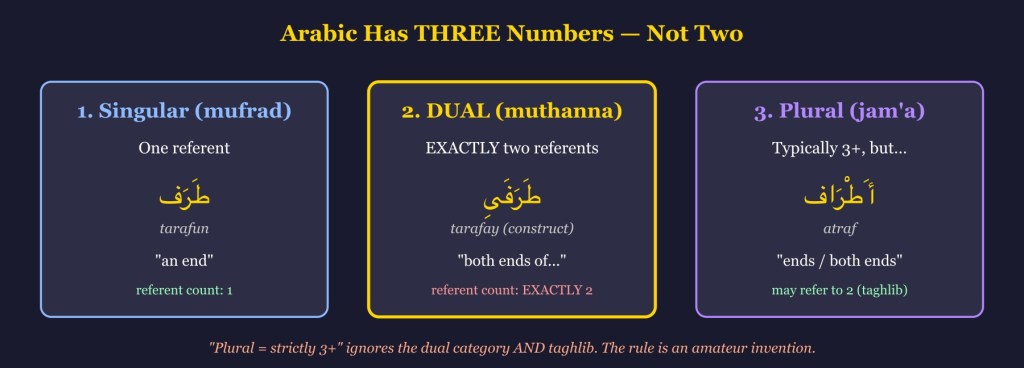
Classical Arabic has three grammatical numbers, not two: singular (mufrad), dual (muthannā), and plural (jamʿ). The dual is a fully productive, regularly marked category. It is morphologically explicit: the suffix ـَانِ (-āni) in the nominative, or ـَيْنِ/ـَيِ (-ayni/-ay) in the genitive/accusative and in construct. This is not a stylistic flourish — it is a grammatical fact, taught on day one of any serious Arabic course.
When Quranist-type debaters assert “plural means three or more, therefore zulafan and aṭrāf mean three or more of these things, therefore the five-prayer framework is false,” they have already lost the argument because they have misidentified the words. Ṭarafay in [11:114] is not plural. It is explicitly, unambiguously dual. Its very suffix says so. And the decisive verse in the prayer-timing cluster is [11:114]. Any interpretation of [20:130] must defer to it under the principle that the Quran explains itself ([25:33]).
Second: The Quran Routinely Uses the Plural Form for the Dual Meaning
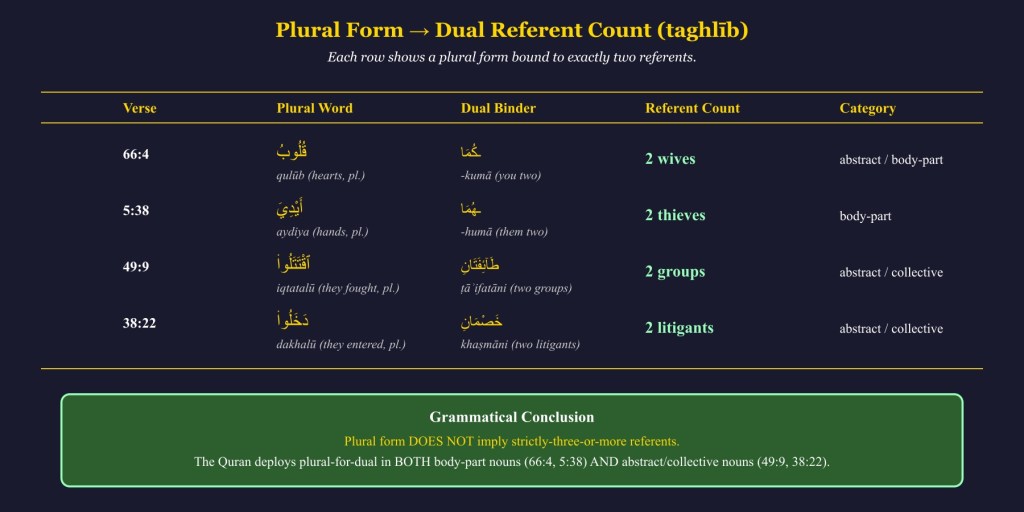
Even if a noun happens to appear in formal plural morphology, Classical Arabic — and the Quran specifically — treats the plural as fully licensed for dual reference. This is a recognised grammatical feature with its own name: taghlīb (تَغْلِيب), literally “overruling” or “predominance.” The plural form overrules the dual form when two referents are being addressed as a collective. Examples follow throughout the Quran, and we will work through four decisive ones. Once these are admitted, the “plural ⇒ 3+” axiom collapses completely, and with it the entire Quranist argument.
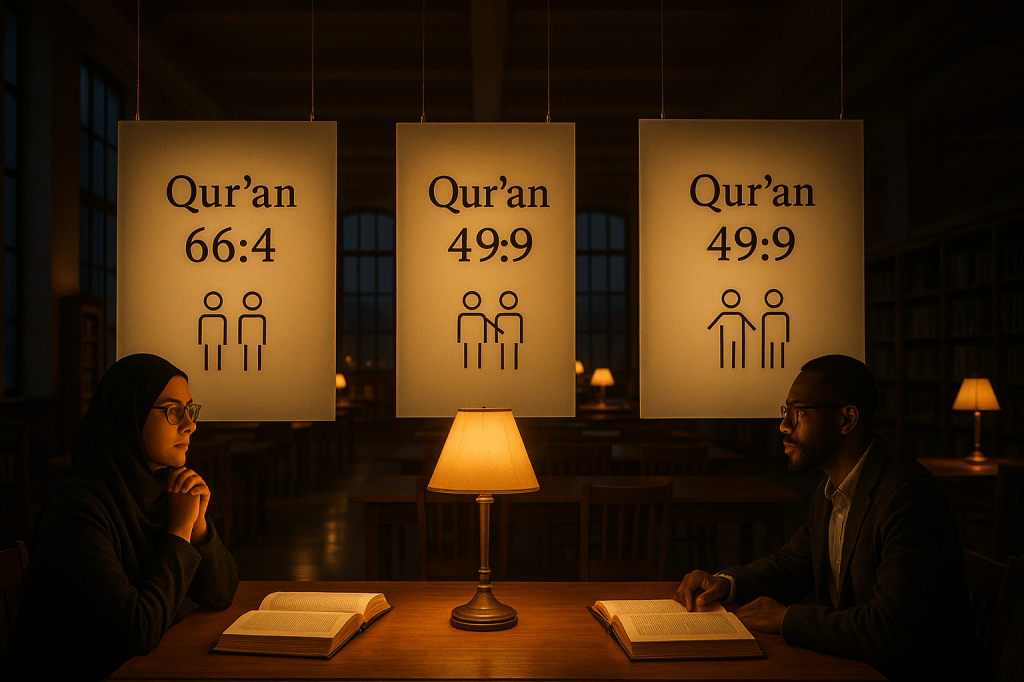
It is worth stating plainly at the outset: anyone who insists on “plural ⇒ strictly 3+” must either (a) deny that [66:4] refers to two specific women — contradicting the narrative in [66:3-5] — or (b) admit that plural-for-dual is a Quranic feature and abandon the argument. There is no third option.
Part 2: [11:114] — The Decisive Dual That Ends the Debate
The Verse Itself
[11:114] “You shall observe the Contact Prayers (Salat) at both ends of the day, and during the night. The righteous works wipe out the evil works. This is a reminder for those who would take heed.”
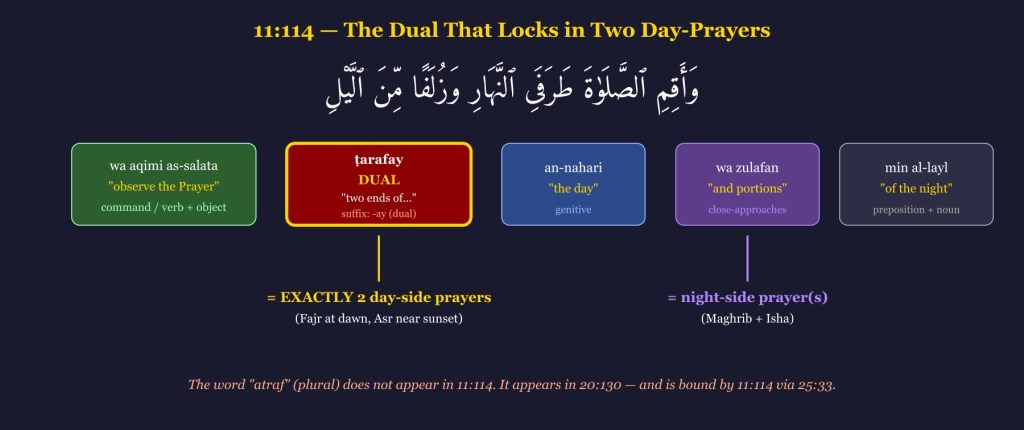
وَأَقِمِ ٱلصَّلَوٰةَ طَرَفَىِ ٱلنَّهَارِ وَزُلَفًا مِّنَ ٱلَّيْلِ إِنَّ ٱلْحَسَنَٰتِ يُذْهِبْنَ ٱلسَّيِّـَٔاتِ ذَٰلِكَ ذِكْرَىٰ لِلذَّٰكِرِينَ
wa aqimi aṣ-ṣalāta ṭarafay an-nahāri wa zulafan mina al-layli…
- Base: طَرَف ṭaraf = “end, edge, extremity” (singular masculine noun)
- Dual ending: ـَيْ (-ay) — the dual suffix ـَانِ (-āni) in construct form shortens to ـَيْ
- In construct (muḍāf) with ٱلنَّهَارِ (“the day”): “the two ends of the day”
- Number: dual — not plural, not singular. Exactly two.
This is the word the entire Quranist argument claims to rest on — and it is not plural. The plural form would be aṭrāf (أَطْرَاف), which does not appear in [11:114] at all. The word that appears is ṭarafay, whose dual suffix is morphologically explicit. An argument that confuses the dual with the plural at the level of the actual word on the page is not a serious grammatical argument; it is the kind of mistake that first-year Arabic students are drilled out of before the first exam.
The Zulafan Clause — What the Verse Actually Says
Having locked in two prayers at the two ends of the day, the verse then commands: wa zulafan mina al-layli — “and [portions/approaches] from the night.” The noun zulaf (singular zulfah) comes from the root ز ل ف meaning “closeness, approach, proximity.” Every non-prayer occurrence of this root in the Quran refers to bringing-near, presenting closely, or positioning-at-proximity — we will cover them in Part 6. The Final Testament translates the clause “during the night,” capturing the functional meaning: prayer(s) at night-portions that are close (to sunset on one end, or to other time-markers).
Crucially — and this is the point the anti-prayer camp does not survive — the five-prayer framework claims two night-side prayers fall in this zulafan window (Maghrib and Isha). If someone insists that zulafan grammatically demands strictly three or more night-portions, they are imposing more prayers than the five-prayer framework commands, not fewer. Their own weapon kills them. We will demonstrate this self-defeat formally in Part 6.
Part 3: Plural-for-Dual in the Quran — Four Decisive Witnesses
Witness 1: [66:4] — The Hearts of the Two Wives
[66:3] “The prophet had trusted some of his wives with a certain statement, then one of them spread it, and God let him know about it. He then informed his wife of part of the issue, and disregarded part. She asked him, ‘Who informed you of this?’ He said, ‘I was informed by the Omniscient, Most Cognizant.’”
[66:4] “If the two of you repent to God, then your hearts have listened. But if you band together against him, then God is his ally, and so is Gabriel and the righteous believers. Also, the angels are his helpers.”
إِن تَتُوبَآ إِلَى ٱللَّهِ فَقَدْ صَغَتْ قُلُوبُكُمَا وَإِن تَظَٰهَرَا عَلَيْهِ فَإِنَّ ٱللَّهَ هُوَ مَوْلَىٰهُ وَجِبْرِيلُ وَصَٰلِحُ ٱلْمُؤْمِنِينَ…
In tatūbā ilā Allāhi faqad ṣaghat qulūbu-kumā, wa in taẓāharā ʿalayhi…
- tatūbā (تَتُوبَآ): dual verb, second-person feminine dual — “if the two of you repent”
- qulūbu-kumā (قُلُوبُكُمَا): plural noun “hearts” + dual possessive pronoun –kumā (“of you two”)
- taẓāharā (تَظَٰهَرَا): dual verb, third-person — “if the two band together”
The entire verse is constructed around a dual addressee — two specific wives of the prophet, named in surrounding tradition as Aisha and Hafsa. The number of hearts in two people is exactly two. Yet the Quran writes qulūbu-kumā — grammatically plural “hearts,” not dual qalbā-kumā. This is the very definition of plural-for-dual (taghlīb).
Note the iron-clad locking mechanism: the possessive pronoun -kumā is unambiguously dual. It means “of you two” — not “of you three” and not “of you many.” Anyone who argues that qulūb here implies three-or-more hearts has to somehow generate a third heart between two women, which is biologically impossible. The only reading the grammar permits is: plural noun form, dual referent count. This is plural-for-dual, full stop.
Witness 2: [5:38] — The Hands of the Two Thieves
[5:38] “The thief, male or female, you shall mark their hands as a punishment for their crime, and to serve as an example from God. God is Almighty, Most Wise.”
وَٱلسَّارِقُ وَٱلسَّارِقَةُ فَٱقْطَعُوٓا۟ أَيْدِيَهُمَا جَزَآءًۢ بِمَا كَسَبَا نَكَٰلًا مِّنَ ٱللَّهِ…
wa as-sāriqu wa as-sāriqatu fa-qṭaʿū aydiyahumā jazāʾan bimā kasabā…
- as-sāriq + as-sāriqa: “the [male] thief and the [female] thief” — exactly two referents
- aydiya-humā (أَيْدِيَهُمَا): plural noun “hands” + dual pronoun –humā (“of them two”)
- kasabā (كَسَبَا): dual verb — “what the two of them earned”
Same structural pattern as [66:4]: plural noun tied to a dual pronoun, framed by a dual verb. Two people, plural form. This is not figurative, not metaphorical, not “loose speech.” It is the standard Quranic construction when two-referent groups are addressed. The grammar of plural-for-dual is demonstrated here in a legal context (the penalty for theft) where precision of reference is required — and still the plural is used for two. Anyone who concedes this example but denies [66:4] is being selective, not grammatical.
Witness 3: [49:9] — Two Groups That “They” (Plural) Fought
[49:9] “If two groups of believers fought with each other, you shall reconcile them. If one group aggresses against the other, you shall fight the aggressing group until they submit to God’s command…”
وَإِن طَآئِفَتَانِ مِنَ ٱلْمُؤْمِنِينَ ٱقْتَتَلُوا۟ فَأَصْلِحُوا۟ بَيْنَهُمَا…
wa in ṭāʾifatāni mina al-muʾminīna iqtatalū fa-aṣliḥū baynahumā…
- ṭāʾifatāni (طَآئِفَتَانِ): explicit dual noun — “two groups” (dual suffix -āni)
- iqtatalū (ٱقْتَتَلُوا): third-person masculine PLURAL verb — “they fought [3+]”
- bayna-humā: “between them two” — dual pronoun pulls the referent back to two
This verse is lethal to the “plural means strictly 3+” position. The subject is introduced as explicitly dual — ṭāʾifatāni, “two groups.” Then the verb attached to this dual subject is the plural form iqtatalū (“they [pl.] fought”). Two groups = one referent each? No — each group is a collective of many believers. But the count of groups is two, the subject is grammatically dual, and the verb is grammatically plural. The Quran tolerates — indeed requires — plural verb agreement with a dual noun-subject when the referents are collectives. This is the classical rule: idhā kāna al-fāʿilu mutathnan fa-idhā kāna lahumā jumhūr yumkinu jamʿu al-fiʿl — dual subjects with collective referents pair with plural verbs.
Conclusion: plural form does not entail count-of-3-or-more. It entails “more than one referent unit,” which a dual ṭāʾifatān already provides.
Witness 4: [38:22] — Two Litigants Who “Entered” (Plural) and Wrong “One Another”
[38:22] “When they entered his room, he was startled. They said, ‘Have no fear. We are feuding with one another, and we are seeking your fair judgment. Do not wrong us, and guide us in the right path.’”
إِذْ دَخَلُوا۟ عَلَىٰ دَاوُۥدَ فَفَزِعَ مِنْهُمْ قَالُوا۟ لَا تَخَفْ خَصْمَانِ بَغَىٰ بَعْضُنَا عَلَىٰ بَعْضٍ…
idh dakhalū ʿalā Dāwūd… qālū lā takhaf, khaṣmāni baghā baʿḍunā ʿalā baʿḍ…
- dakhalū (دَخَلُوا): plural verb — “they entered” (3+ grammatical form)
- khaṣmāni (خَصْمَانِ): explicit dual noun — “two litigants”
- baʿḍunā ʿalā baʿḍ: “some of us against some [others]” — baʿḍunā is grammatically collective
Same pattern as [49:9]. The subject is explicitly dual (khaṣmāni = two litigants), yet the attached verb is plural (dakhalū), and the reciprocal pronoun is the collective baʿḍunā ʿalā baʿḍ. This verse alone, cross-read with [49:9], settles the grammatical question permanently. Plural morphology, dual referent count. The Quran uses this construction repeatedly, deliberately, and the rule it follows has been documented by every serious Arabic grammarian for over a millennium.
Part 4: Dismantling the Counter-Defenses
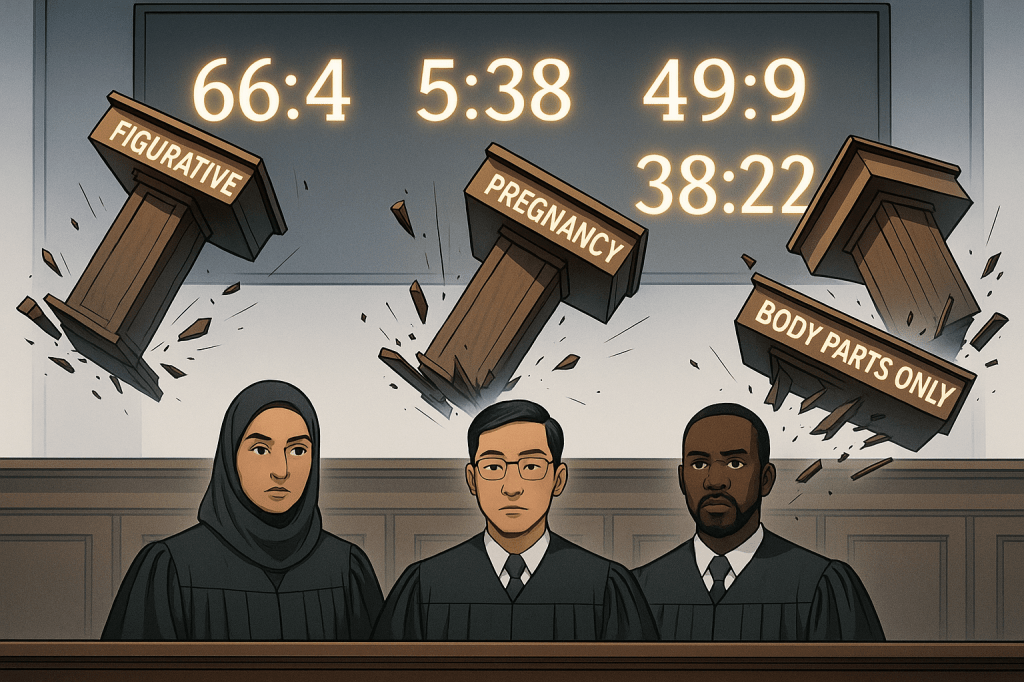
Counter-Defense 1: “It’s Figurative”
The first escape route tried by the anti-prayer camp when shown [66:4] is to claim the plural is “figurative” — as if figurativeness somehow cancels grammatical agreement rules. This is a category error. Figurative usage concerns the semantics of a word — the meanings it carries. It does not rewrite the morphology of a word — the grammatical markers attached to it. Even if we granted that “hearts” was being used figuratively in [66:4] (to mean, say, “inner dispositions”), the grammatical fact remains: qulūb is plural in form; -kumā is dual in reference. Figurative-plural-for-dual still confirms that the plural form can lawfully point to a dual referent count — which is precisely what the debater was trying to deny.
Put it this way: to say “the plural here is figurative, therefore plural-doesn’t-really-mean-plural” is to concede the thesis. You have just admitted that plural morphology does not mechanically encode “3+.” That concession is fatal to the zulafan and aṭrāf arguments, which depend entirely on the reverse assumption.
Counter-Defense 2: “One of Them Might Have Been Pregnant”
An even more desperate move: “Perhaps one of the two wives was pregnant, giving a third heart (the fetus), so the plural is literal after all.” Three grammatical facts annihilate this.
(1) The verb tatūbā is dual, not plural. “If the two of you repent” — a fetus cannot repent. The addressees count is two, fixed by the verb morphology. (2) The pronoun -kumā is dual, not triple. Arabic has no “triple” as a grammatical number, but if pregnancy were the hidden third party, the pronoun should at minimum shift to plural -kunna. It does not. (3) Mary’s pregnancy narrative in [19:22] retains singular grammar throughout.
[19:22] “When she bore him, she isolated herself to a faraway place.”
The verbs ḥamalat-hu (“she bore him”) and intabadhat (“she isolated herself”) are both singular feminine. Mary is pregnant — visibly, explicitly — and the Quran does not flip her to dual or plural. The “pregnancy adds a person” theory is not a Quranic rule; it is an invention generated by someone trying to rescue a failing grammatical argument. Reject it.
Counter-Defense 3: “Body Parts Can Be Collective, So This Rule Doesn’t Apply Elsewhere”
This is the attempt to quarantine [66:4] and [5:38] as “body-part exceptions” and thereby save the “plural = 3+” rule for everything else (including zulafan and aṭrāf). But — crucially — [49:9] and [38:22] are not body-part cases. They involve groups of believers and litigants, abstract collective nouns with zero anatomical content. Yet they exhibit the identical plural-for-dual pattern.
The attempted quarantine fails on the evidence. There is no linguistic basis to restrict taghlīb to “body parts only.” The principle operates on any noun whose referents are collective or numerically finite. Aṭrāf al-nahār (“ends of the day”) falls squarely in this category; the day has measurable ends, and if [11:114] has already told us via its unambiguous dual ṭarafay that there are two such ends, then [20:130]’s plural aṭrāf must be read as plural-for-dual in exactly the manner of the four witnesses above.
Part 5: The Zulafan Self-Defeat
The Root ز ل ف — “Closeness, Approach, Presentation”
The root of zulafan is ز ل ف. Its core semantic is proximity, approach, or bringing-close. Every occurrence in the Quran confirms this. Let us survey them:
- [26:90]: “Paradise will be presented (uzlifat) to the righteous.” — Paradise is brought near.
- [50:31]: “Paradise will be offered (uzlifat) to the righteous, readily.” — Proximity emphasised.
- [81:13]: “Paradise is presented (uzlifat).” — Again the sense of near-presentation.
- [34:37]: Wealth and children do not bring you closer (zulfā) to God — proximity-of-standing.
- [38:25, 38:40]: David and Solomon are granted “a position of honor with us” (la-zulfā) — positional closeness.
- [39:3]: Idolaters claim “we idolize them only to bring us closer (zulfā) to God” — the false-intercession argument.
- [67:27]: When the disbelievers see it happening close at hand (zulfatan) — sense of imminence.
The lexical field is unambiguous: zulf- means “close approach, proximity, drawing near.” In [11:114], wa zulafan mina al-layl thus means “and approach-portions of the night” — the segments of the night that are close to key time-markers (sunset, dawn, the deepest darkness). The Final Testament’s “during the night” preserves this sense without forcing a false numerical constraint.
The Self-Defeat: His Own Reading Mandates More Prayers, Not Fewer
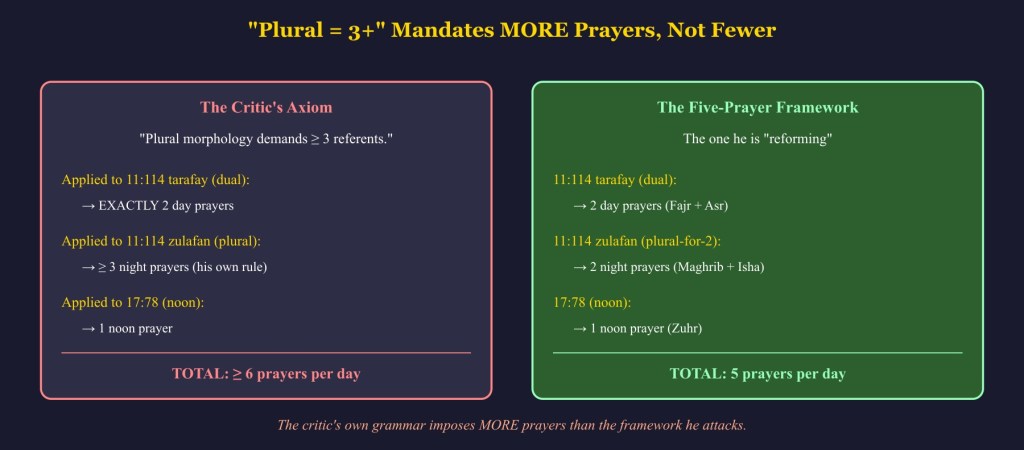
Now watch the self-destruct. Suppose, for the sake of argument, we grant Quranist his dogma: “plural morphology demands strictly three or more referents.” Then zulafan is plural, and the night must be divided into at least three prayer-portions. Add [11:114]’s ṭarafay — which he cannot escape because it is explicitly dual — that is two day-side prayers. Add [17:78]’s noon prayer (li-dulūki ash-shams) — that is one more.
Day total: 2 (from ṭarafay) + 1 (noon from [17:78]) = 3. Night total (on his own reading): at least 3. Grand total: at least 6 prayers per day. His “plural = 3+” dogma does not reduce the five-prayer framework — it expands it. The framework he is attacking is less demanding than the framework his own grammar produces. His position is not a reform of the five-prayer practice; it is a strict additive on top of it. He is the innovator. He is the legalist imposing a heavier burden.
The argument in a single line: If you insist “plural means at least three,” then your own reading of zulafan mandates at least three night prayers, and [11:114]’s dual ṭarafay locks in two day prayers, and [17:78]’s noon prayer makes six minimum — which is more than the five you are rejecting. You cannot have your grammar and your “reform” at the same time.
Part 6: [20:130] Under [25:33] — The Quran Interprets the Quran
[20:130] “Therefore, be patient in the face of their utterances, and praise and glorify your Lord before sunrise and before sunset. And during the night glorify Him, as well as at both ends of the day, that you may be happy.”
فَٱصْبِرْ عَلَىٰ مَا يَقُولُونَ وَسَبِّحْ بِحَمْدِ رَبِّكَ قَبْلَ طُلُوعِ ٱلشَّمْسِ وَقَبْلَ غُرُوبِهَا وَمِنْ ءَانَآئِ ٱلَّيْلِ فَسَبِّحْ وَأَطْرَافَ ٱلنَّهَارِ لَعَلَّكَ تَرْضَىٰ
Here — and only here, not in [11:114] — the word aṭrāf (plural of ṭaraf) appears. The critic seizes on this: “See, plural! At least three ends!” But the Quran has already told us, through [11:114]’s dual ṭarafay, that the day has two ends. We therefore apply [25:33]:
[25:33] “Whatever argument they come up with, we provide you with the truth, and a better understanding.”
The Quran interprets the Quran. When a term appears in both dual and plural forms across related verses ([11:114] and [20:130]), the dual fixes the reference and the plural is read as plural-for-dual (taghlīb). This is not an ad hoc accommodation — it is the same structure we already documented in the four witnesses of Part 3. The Quran does not violate its own grammar.
There is, further, a fallback proof from [4:82]:
[4:82] “Why do they not study the Quran carefully? If it were from other than God, they would have found in it numerous contradictions.”
If we were to read [20:130]’s aṭrāf as “three or more ends of the day,” we would immediately contradict [11:114]’s explicit ṭarafay (“two ends of the day”). Either the Quran contradicts itself — impossible, per [4:82] — or [20:130] and [11:114] refer to the same two ends, with the plural form covering the dual referent count. The second option is the only one consistent with the Quran’s own claim to internal consistency.
The Unanswerable Question
To the advocate of the “plural = 3+” reading, we pose one direct, unanswerable question:
Name the third end of the day. The day has a dawn end and a sunset end — two. If your grammar demands at least three ends, tell us what the third end is. Is it noon? Noon is not an end — it is a middle. Is it midnight? Midnight is not part of the day at all. Is it some other cosmological point you have invented? Produce it. Define it. Back it with a verse. You cannot — because a third end of a linear interval is a geometric impossibility.
The inability to even name the third end exposes the argument as purely verbal — a grammar claim that does not survive first contact with the reality the grammar is supposed to describe. Reject the reading, and you recover coherence across [11:114], [20:130], [17:78], and [24:58]. Reject the five-prayer framework, and you are left stranded in a contradiction you cannot resolve.
Part 7: [2:238] — The Geometric Proof of an Odd Prayer Count
[2:238] “You shall consistently observe the Contact Prayers, especially the middle prayer, and devote yourselves totally to God.”
حَٰفِظُوا۟ عَلَى ٱلصَّلَوَٰتِ وَٱلصَّلَوٰةِ ٱلْوُسْطَىٰ وَقُومُوا۟ لِلَّهِ قَٰنِتِينَ
Ḥāfiẓū ʿalā aṣ-ṣalawāti wa aṣ-ṣalāti al-wusṭā wa qūmū lillāhi qānitīn.
The critical phrase is aṣ-ṣalāti al-wusṭā — “the middle Prayer.” Wusṭā is the feminine singular of awsaṭ, a superlative form meaning “most middle,” “the median.” The definite article al- identifies it uniquely: not a middle, but the middle. This singular, definite, superlative designation carries an unavoidable mathematical entailment: the total count must be odd, and there must be exactly one distinguished median.
The Geometric Constraint
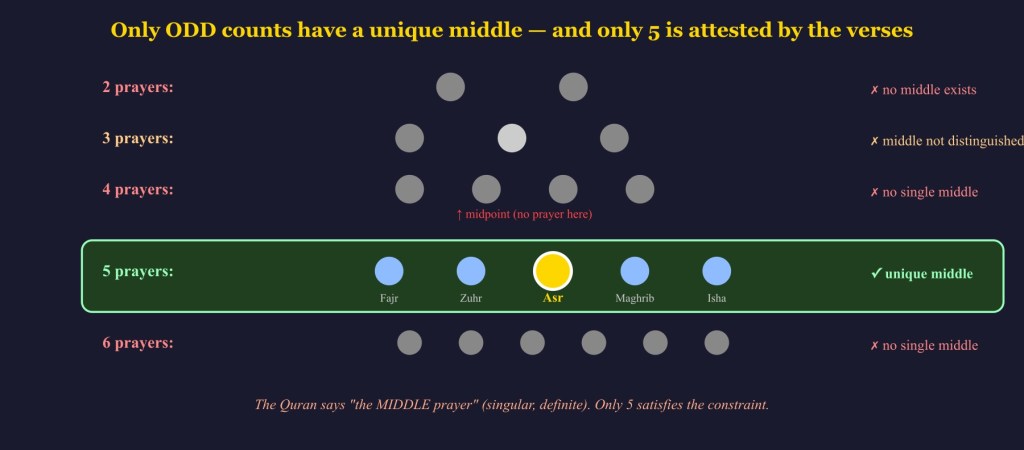
Consider what “the middle” means by ordered position:
- 2 prayers — no middle exists. The concept does not apply.
- 3 prayers — middle is the 2nd. Technically present, but not distinguished; it is simply “the one between.” No superlative force.
- 4 prayers — no single middle exists. Midpoint falls between the 2nd and 3rd. The text demands the middle, which does not exist here.
- 5 prayers — middle is the 3rd (Asr, in the traditional ordering Fajr-Zuhr-Asr-Maghrib-Isha). Distinguished, unique, geometrically central. The superlative applies perfectly.
- 6 prayers — again no single middle; same failure as 4.
- 7 prayers — middle is the 4th; grammatically possible, but then one must produce a verse-cluster naming seven prayers. None exists.
Only 5 (or a higher odd number unmotivated by the verses) satisfies [2:238]’s middle-prayer designation. Anti-prayer advocates who propose 3 or 2 cannot make the middle-prayer language function: 2 has no middle, and 3’s middle is not meaningfully distinguished — it is simply “the second of three,” requiring no superlative. Advocates of 4 or 6 have the same problem. The five-prayer count is the unique solution that honors aṣ-ṣalāti al-wusṭā.

Part 8: Prayer Was Pre-Established Through Abraham — Not Invented by the Quran
A common anti-prayer tactic is to argue: “The Quran doesn’t spell out the physical movements, the exact words, or the exact number of units for each prayer, therefore any specific prayer practice is innovation.” This argument collapses the moment you read what the Quran itself says about where the prayers came from. Prayer was not invented by the Quran. It was inherited through Abraham.
[21:73] “We made them imams who guided in accordance with our commandments, and we taught them how to work righteousness, and how to observe the Contact Prayers (Salat) and the obligatory charity (Zakat). To us, they were devoted worshipers.”
[22:78] “You shall strive for the cause of God as you should strive for His cause. He has chosen you and has placed no hardship on you in practicing your religion — the religion of your father Abraham. He is the one who named you ‘Submitters’ originally…”
[16:123] “Then we inspired you (Muhammad) to follow the religion of Abraham, the monotheist; he never was an idol worshiper.”
The footnote at [21:73] in the Final Testament is explicit: “When the Quran was revealed, all religious duties were already established through Abraham (2:128, 16:123, 22:78).” The Quran assumes the reader already knows how to pray. It does not have to teach prayer from scratch, any more than a modern driving-law statute needs to explain what a car is.
The Quran’s Own Witnesses to Prayer-Before-Quran
[8:35] “Their Contact Prayers (Salat) at the shrine (Ka’bah) were no more than a mockery and a means of repelling the people (by crowding them out). Therefore, suffer the retribution for your disbelief.”
Note: these are disbelievers who nonetheless have a “Contact Prayer” that the Quran names as ṣalātuhum — “their Prayer.” They could not be performing a prayer-practice that would not exist until the Quran codified it years later. The practice existed before; the disbelievers had merely corrupted it.
[9:54] “What prevented the acceptance of their spending is that they disbelieved in God and His messenger, and when they observed the Contact Prayers (Salat), they observed them lazily, and when they gave to charity, they did so grudgingly.”
Again: hypocrites observing the Contact Prayers — the physical practice is known. The Quran is not teaching them to pray; it is rebuking them for praying half-heartedly. The Final Testament’s footnote at [9:54] states precisely this: “This is another proof that the Contact Prayers (Salat) existed before the Quran, and were handed down from Abraham.” And it adds the killer clause: this “stumps those who challenge God’s assertion that the Quran is complete and fully detailed when they ask, ‘Where can we find the details of the Contact Prayers in the Quran?’ (6:19, 38, 114).”
The Messenger’s Explanation (Rashad Khalifa)
Rashad Khalifa explained this inheritance clearly (at 24:04): “All these duties in Islam came to us through the prophet Abraham. If you look at sura 22, the last verse, number 78, you will see that Abraham is the source of, is the father of Islam, and the father of Muslims.” And in another session he emphasized the same teaching: the Contact Prayers were already established; what the Quran added was the mathematical seal confirming their details, not the invention of the practice itself.

Part 9: [4:103] — God Himself Says the Prayer Times Are Specific
[4:103] “Once you complete your Contact Prayer (Salat), you shall remember God while standing, sitting, or lying down. Once the war is over, you shall observe the Contact Prayers (Salat); the Contact Prayers (Salat) are decreed for the believers at specific times.”
…إِنَّ ٱلصَّلَوٰةَ كَانَتْ عَلَى ٱلْمُؤْمِنِينَ كِتَٰبًا مَّوْقُوتًا
inna aṣ-ṣalāta kānat ʿalā al-muʾminīna kitāban mawqūtan
The phrase kitāban mawqūtan — “a decree/prescription timed” — settles the question of whether the Prayer has specific times. It does. God says so. The root و ق ت (w-q-t) denotes appointed time, fixed moment, timed occasion. A mawqūt obligation is one whose time is set, appointed, non-negotiable.
Now observe the logical bind for anti-prayer Quranists: if they claim “the Quran doesn’t specify prayer times,” they are directly contradicting [4:103], which asserts that the Prayers have specific, decreed times. Either the times are specified (in which case the cluster [11:114], [17:78], [24:58], [20:130], [2:238] must be the specification — the only plausible locus), or [4:103] is false. The second option is blasphemous; the first is the five-prayer framework. There is no middle ground.
The cluster’s astronomical markers are more than sufficient for anyone reading in good faith:
- Dawn — [17:78] qurʾāna al-fajr (“Quran at dawn”) and [24:58] ṣalāti al-fajr (“Dawn Prayer” named explicitly);
- Sun’s decline from zenith (noon) — [17:78] li-dulūki ash-shams;
- Toward sunset — [17:78] ilā ghasaqi al-layl;
- Near sunset / after sunset — [11:114] ṭarafay an-nahār + [20:130] qabla ghurūbihā;
- Night-portions — [11:114] zulafan mina al-layl and [24:58] ṣalāti al-ʿishāʾ (“Night Prayer” named explicitly).
The specification is there. Those who say it is not have failed to read.
Part 10: Code 19 — The Mathematical Seal on All Five Prayers
The Footnote at [2:238]
The Final Testament’s footnote at [2:238] is the compact key that unlocks the mathematical proof of the five-prayer framework:
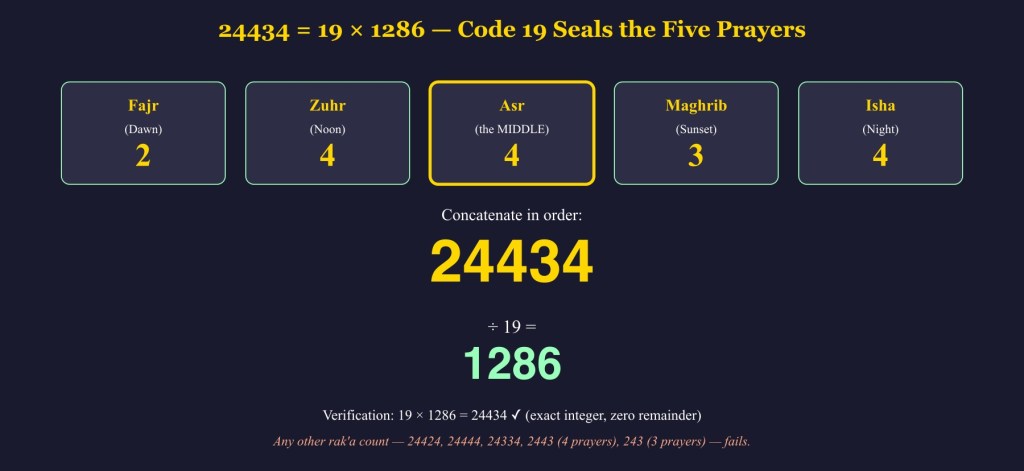
“All five prayers are found in 2:238, 11:114, 17:78, & 24:58. When the Quran was revealed, the Contact Prayers (Salat) had already been in existence (Appendix 9). The details of all five prayers — what to recite and the number of units (Rak’aas) per prayer, etc. — are mathematically confirmed. For example, writing down the number of units for each of the five prayers, next to each other, we get 24434, 19×1286.”
This sentence ends the debate. The five prayers have rak’a counts of 2, 4, 4, 3, 4 (Fajr, Zuhr, Asr, Maghrib, Isha respectively). Concatenated: 2-4-4-3-4 = 24434. Divide by 19: 24434 / 19 = 1286, an exact integer. Multiply back: 19 × 1286 = 24434. The fingerprint of the 19-based code — the same code that [74:30] declares “Over it is nineteen” — is on the rak’a structure of the five prayers.
Further Mathematical Confirmations (Appendix 15)
Appendix 15 of the Final Testament documents several additional 19-based confirmations of the five prayers:
- Chapter 1 (“The Key”) recitation per day. Writing chapter-number then number-of-verses: 1 followed by 7 = 17 — the exact total of Fātiḥa recitations across the five daily prayers (2+4+4+3+4).
- The long-number concatenation of (chapter 1) + (prayer number)(rak’a count) per prayer, with the Fātiḥa signature repeated per rak’a, yields a multiple of 19. The number of its digit components is 4636 = 19 × 244.
- Friday prayer variation. Because the Friday noon Prayer replaces two rak’as with two sermons, the total recitation count becomes 15 instead of 17 — and the corresponding long-number is still a multiple of 19 (Abdullah Arik’s discovery).
- Bowings, prostrations, and tashahhuds per prayer. Concatenating chapter 1, then for each prayer: (prayer number)(keys)(bowings)(prostrations)(tashahhuds) produces:
11224 12448 23448 24336 25448— a multiple of 19. This confirms not just the rak’a counts but the internal movement counts of each prayer. - Chapter 1 must be recited in Arabic. Edip Yüksel’s discovery: the lips touch each other (at letters B and M) exactly 19 times during a single recitation of Fātiḥa, with gematrical total 608 = 19 × 32.
The mathematical superstructure is too tight, too deep, too cross-confirming to be produced by anything short of divine authorship. This is what the messenger through whom these details were expounded pointed out explicitly. Rashad Khalifa stated (at 14:54): “The morning prayer is two rak’ahs, the noon prayer is four, the afternoon prayer is four, the sunset is three, and the night is four. This number here is a multiple of 19… This is why the sunset is three, and not four. If it was four, or five, or two, you would not have a multiple of 19.”
In another session, he summarized the full Salat-Code 19 connection (at 25:22): “The word Salat… you take the numbers of verses and the numbers of the surahs, where every time you see this word Salat, and you add them up, the total is a multiple of 19, it is 4674, or 19 times 246.” The word Salat itself is divinely positioned in the Quran according to the same code that confirms the rak’a counts.
Part 11: [4:59-65] — The Obedience Test That Breaks Cherry-Picking
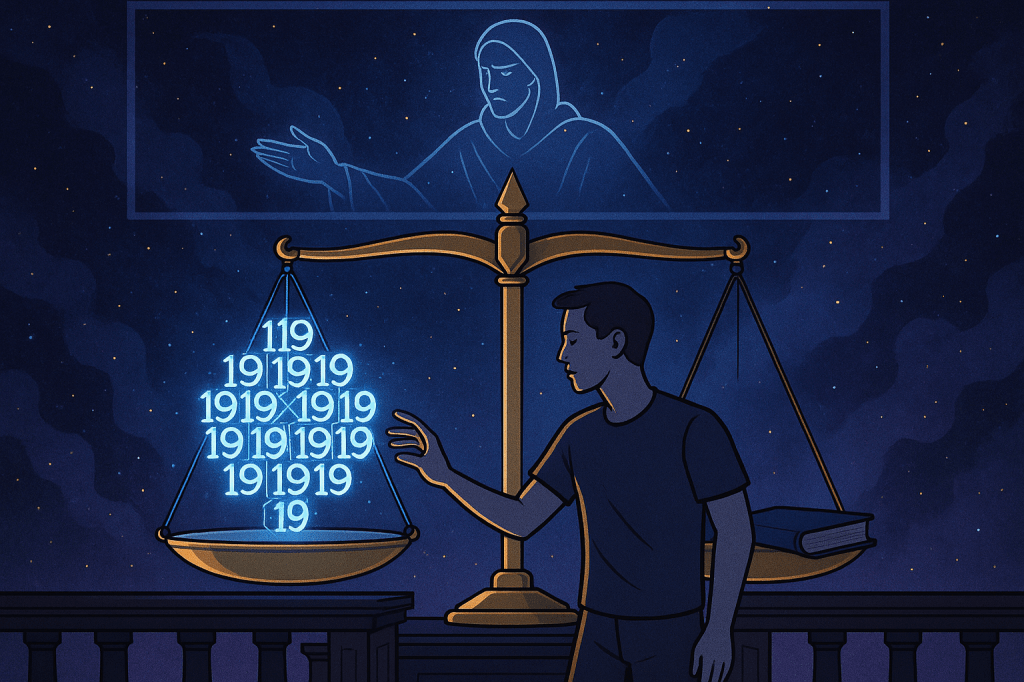
Now the theological move. Even a Quranist debater who accepts Code 19 — accepts, that is, that [74:30]’s “Over it is nineteen” has been vindicated by decades of mathematical discovery — still has to answer: through whom did these discoveries come?
The answer is documented beyond denial: Rashad Khalifa, from 1974 forward, using computational methods, published and cross-verified the 19-based structure of the Quran. The details of the five prayers — the rak’a counts, the recitation counts, the movement counts — were not derived by him by speculation. They were mathematically confirmed by him to be exactly what Abraham had transmitted. If you accept the code, you have accepted his work; and his work is the expository transmission of a messenger (Appendix 2, Appendix 38).
[4:59-65] now closes the loop:
[4:59] “O you who believe, you shall obey God, and you shall obey the messenger, and those in charge among you. If you dispute in any matter, you shall refer it to God and the messenger, if you do believe in God and the Last Day. This is better for you, and provides you with the best solution.”
[4:60] “Have you noted those who claim that they believe in what was revealed to you, and in what was revealed before you, then uphold the unjust laws of their idols? They were commanded to reject such laws. Indeed, it is the devil’s wish to lead them far astray.”
[4:61] “When they are told, ‘Come to what God has revealed, and to the messenger,’ you see the hypocrites shunning you completely.”
[4:64] “We did not send any messenger except to be obeyed in accordance with God’s will. Had they, when they wronged their souls, come to you and prayed to God for forgiveness, and the messenger prayed for their forgiveness, they would have found God Redeemer, Most Merciful.”
[4:65] “Never indeed, by your Lord; they are not believers unless they come to you to judge in their disputes, then find no hesitation in their hearts whatsoever in accepting your judgment. They must submit a total submission.”
Read the sequence carefully. Belief requires obedience to the messenger. The messenger was sent to be obeyed. Those who, when called to the messenger’s message, “shun… completely” are named as hypocrites ([4:61]). And the criterion for belief in [4:65] is not abstract assent but active acceptance — they must submit a total submission.
The debater who says “I accept the math but not the messenger who delivered it” fails [4:65]. You cannot take the 19-based seal while rejecting the hand that was authorized to expound its consequences. That is the very posture [4:60-61] names and condemns. Cherry-picking God’s proof while aversing from God’s messenger is the hypocrite profile the Quran describes. These are not my words; they are the diagnostic criterion laid down in [4:59-65] and applied by God Himself.
Part 12: The Four-Verse Cluster Gives All Five
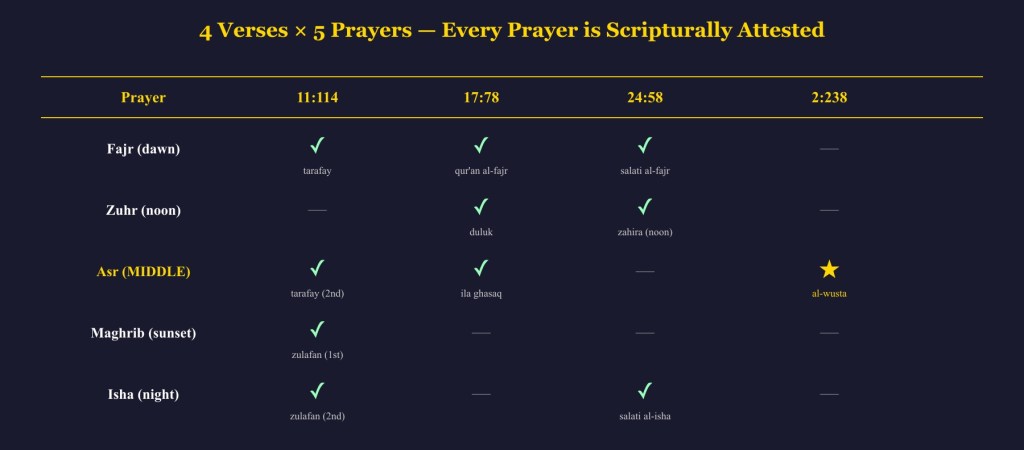
The Final Testament’s footnote at [2:238] names four verses as the locus where all five prayers are found: 2:238, 11:114, 17:78, 24:58. Let us walk through the assignment carefully.
[11:114] — Two Day Prayers + Night Prayers
[11:114] “You shall observe the Contact Prayers (Salat) at both ends of the day, and during the night. The righteous works wipe out the evil works. This is a reminder for those who would take heed.”
Ṭarafay an-nahār — two day-ends — gives us Fajr (dawn) and Asr (near sunset). Wa zulafan mina al-layl — night approach-portions — gives us Maghrib (just after sunset) and Isha (further into the night). This verse alone accounts for four of the five prayers.
[17:78] — Noon Prayer + Dawn
[17:78] “You shall observe the Contact Prayer (Salat) when the sun declines from its highest point at noon, as it moves towards sunset. You shall also observe (the recitation of) the Quran at dawn. (Reciting) the Quran at dawn is witnessed.”
Li-dulūki ash-shams — when the sun declines from its zenith — gives us Zuhr (noon). The astronomical marker is precise and geometrical: the dulūk is the exact moment of passage past the meridian. Wa qurʾāna al-fajr — and the Quran at dawn — reinforces the Fajr prayer already indicated in [11:114]. Between [11:114] and [17:78] we have all five prayer slots indicated: dawn, noon, near-sunset, just-after-sunset, night.
[24:58] — Dawn and Night Named Explicitly
[24:58] “O you who believe, permission must be requested by your servants and the children who have not attained puberty (before entering your rooms). This is to be done in three instances — before the Dawn Prayer, at noon when you change your clothes to rest, and after the Night Prayer. These are three private times for you…”
This verse names two of the five prayers by name: ṣalāti al-fajr (“the Dawn Prayer”) and ṣalāti al-ʿishāʾ (“the Night Prayer”). It also references the noon siesta-period, consistent with the noon Prayer of [17:78]. Three distinct times of day are marked off as private — and the markers track the prayer cycle.
[2:238] — The Middle Prayer Singled Out
We have already established that aṣ-ṣalāti al-wusṭā in [2:238] is the distinguished median of an odd-count prayer set. With five prayers named across the cluster, Asr is the uniquely distinguished middle. The full system is coherent.
Part 13: The Messenger’s Exposition (Appendix 15)
Appendix 15 of the Final Testament, titled “Religious Duties: A Gift From God,” is the systematic exposition of the Contact Prayers given through the messenger. Its opening thesis is theologically foundational:
“When Abraham implored God in 14:40, he did not ask for wealth or health; the gift he implored for was: ‘Please God, make me one who observes the contact prayers (Salat).’ The religious duties instituted by God are in fact a great gift from Him… Belief in God does not by itself guarantee our redemption; we must also nourish our souls (6:158, 10:90-92).”
The appendix then lists the five daily prayers by time and scriptural anchor:
- Dawn Prayer — during two hours before sunrise (11:114, 24:58).
- Noon Prayer — when the sun declines from its highest point at noon (17:78).
- Afternoon Prayer — during the 3-4 hours preceding sunset (2:238).
- Sunset Prayer — after sunset (11:114).
- Night Prayer — after the twilight disappears from the sky (24:58).
And it cites the proofs of pre-Quranic establishment: “The proof that Salat was already established through Abraham is found in 8:35, 9:54, 16:123, & 21:73.” These are the same verses we surveyed in Part 8.
The mathematical section of Appendix 15 then documents each of the Code-19 confirmations already summarised in Part 10. The appendix closes with a note on physical benefits — the prostration’s expansion of blood vessels, the interruption of prolonged stillness during sleep by the Dawn prayer, the ablutions’ protective effect against colon cancer — consistent with God’s design of a practice that nourishes soul and body together.
Part 14: What About [4:101-102]? Another Witness to Day-Time Prayer
[4:101] “When you travel, during war, you commit no error by shortening your Contact Prayers (Salat), if you fear that the disbelievers may attack you. Surely, the disbelievers are your ardent enemies.”
[4:102] “When you are with them, and lead the Contact Prayer (Salat) for them, let some of you stand guard; let them hold their weapons, and let them stand behind you as you prostrate. Then, let the other group that has not prayed take their turn praying with you, while the others stand guard and hold their weapons…”
Observe: the scenario is a combat-zone Prayer where disbelievers might attack during the Prayer if the congregation were not split into alternating guard-prayer groups. This only makes tactical sense if the Prayer is taking place in daylight — an ambush risk is highest when the enemy can see you kneeling or prostrating. The verse itself presupposes at least one daytime prayer exists to be attacked during. Anyone who argues “all prayer is nighttime” has to explain why the Quran regulates a combat scenario whose ambush logic only works by day. They cannot.
This passage also gives an incidental confirmation of the physical movements of the Prayer: sajadū (prostrate), ṭāʾifa (a group that has finished praying steps away to make room for the next group). The Quran assumes the reader knows what these movements are — it does not teach them, it regulates how they should be distributed across a defensive column. This is consistent with prayer being a pre-established Abrahamic practice.
Part 15: [6:19, 6:38, 6:114] — “Fully Detailed” Does Not Mean “Re-Taught From Scratch”
[6:114] “Shall I seek other than God as a source of law, when He has revealed to you this book fully detailed? Those who received the scripture recognize that it has been revealed from your Lord, truthfully. You shall not harbor any doubt.”
[6:19] “…this Quran has been inspired to me, to preach it to you and whomever it reaches…”
[6:38] “…We did not leave anything out of this book.”
The “Quran is fully detailed” texts are sometimes weaponized against the five-prayer practice: “If the Quran is fully detailed, and the Quran doesn’t teach me how to pray from scratch, then the prayer is not a Quranic obligation.” This inverts the logic. The Quran is fully detailed for what it is doing — revising, correcting, completing, and sealing the prior scriptures. The prior scriptures (delivered through Abraham) had already established the Prayer. The Quran assumes this prior foundation. It does not need to redundantly re-establish what was never lost — only what was distorted.
The Final Testament footnote at [9:54] makes this explicit: the existence of [9:54] itself — rebuking hypocrites for lazy Prayer — “stumps those who challenge God’s assertion that the Quran is complete and fully detailed when they ask, ‘Where can we find the details of the Contact Prayers in the Quran?’ (6:19, 38, 114).” The Quran was revealed to a population who knew how to pray, descended in practice from Abraham’s religion ([16:123], [22:78]). Muhammad’s mission was not to invent the Prayer; it was to purify it from the idolatrous distortions ([8:35]) that had accreted and to deliver the 19-based mathematical seal that would vindicate the original five-prayer structure in our era.
Rashad Khalifa described this clearly (at 5:46): “God says in sura number 6 verse 114 that the Quran is fully detailed, you don’t need anything else. God says in verse 19 of sura number 6 that the Quran is what was given to Muhammad to deliver to the world, and it is the only source for religious guidance and religious education.” The details of the Prayer are not missing — they are inherited from Abraham, confirmed mathematically by the 19-based code, and expounded through the messenger sent to our generation.

Part 16: Conclusion — The 5 Prayers Stand, and the Anti-Prayer Argument Destroys Itself
Let us gather the strands. The “plural means strictly 3+” axiom, on which the entire 3-prayer and 2-prayer revisions depend, is demolished in three ways: first, because [11:114] contains ṭarafay, an explicit dual, not a plural; second, because the Quran routinely deploys plural-for-dual (taghlīb) as demonstrated by [66:4], [5:38], [49:9], and [38:22]; and third, because even granted on its own terms, the axiom produces a larger prayer count (at least six daily) than the five-prayer framework it was attacking.
The “Quran doesn’t specify prayer times” claim is directly refuted by [4:103]’s kitāban mawqūtan and by the astronomical markers in the four-verse cluster ([11:114], [17:78], [24:58], [20:130]). The “Quran doesn’t give the details” claim is answered by the fact that prayer was established through Abraham ([21:73], [22:78], [16:123], [8:35], [9:54]) and thus assumed as pre-existing by the Quran. The “middle prayer” language of [2:238] forces an odd count, distinguishing the median — a constraint only 5 satisfies among the realistic candidates. And the mathematical seal (24434 = 19 × 1286, plus the full Appendix 15 network of confirmations) removes any remaining doubt.
Those who persist in the anti-prayer position after seeing these arguments fall into the profile of [4:60-61] — called to the messenger who delivered the 19-based vindication, they “shun… completely.” They accept the code but refuse the hand that opened it. That is the hypocrite-cherry-picker pattern the Quran identifies, and the diagnostic is God’s, not ours.
To any fellow submitter still thinking through these questions: stand firm on the five Prayers. They are not a traditional innovation carried over from the Sunni corpus. They are the practice of Abraham, named across the Quran, mathematically sealed by the code the Quran itself promises in [74:30], and expounded in our time through the messenger whom [4:64] tells us was sent to be obeyed. The 3-prayer, 2-prayer, and no-prayer positions are grammatical errors in theological dress. Do not trade a mathematically confirmed gift from God for a misreading of a suffix.

 Quran Only Studies
Leave a comment