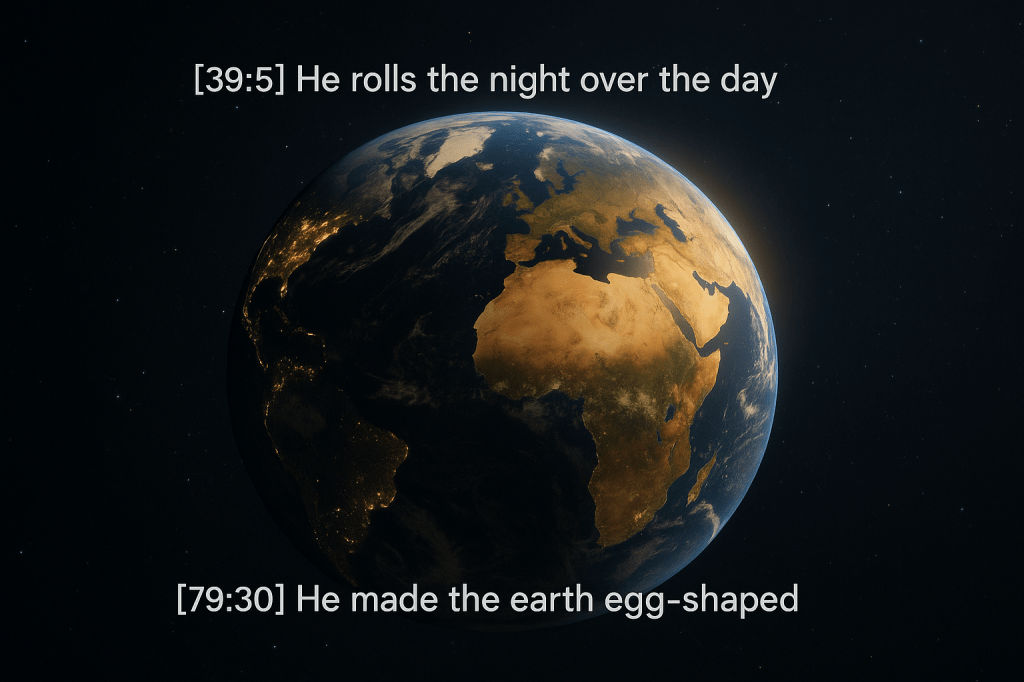
Introduction: The Verse They Always Forget
Few debates in Quranic interpretation generate as much heat and as little light as the argument over the word “dahaha” in verse 79:30. Critics from every direction — Sunni traditionalists, ex-Muslim polemicists, secular linguists, and certain Quranists — have seized upon this single Arabic word to attack Rashad Khalifa’s translation of the Quran. They claim that “dahaha” simply means “to spread” or “to flatten,” that Rashad invented the meaning “egg-shaped” out of thin air, and that he reversed the rules of Arabic morphology to reach his conclusion. The accusation is sharp: Rashad was the first translator in history to render 79:30 as “He made the earth egg-shaped,” and therefore his translation must be wrong.
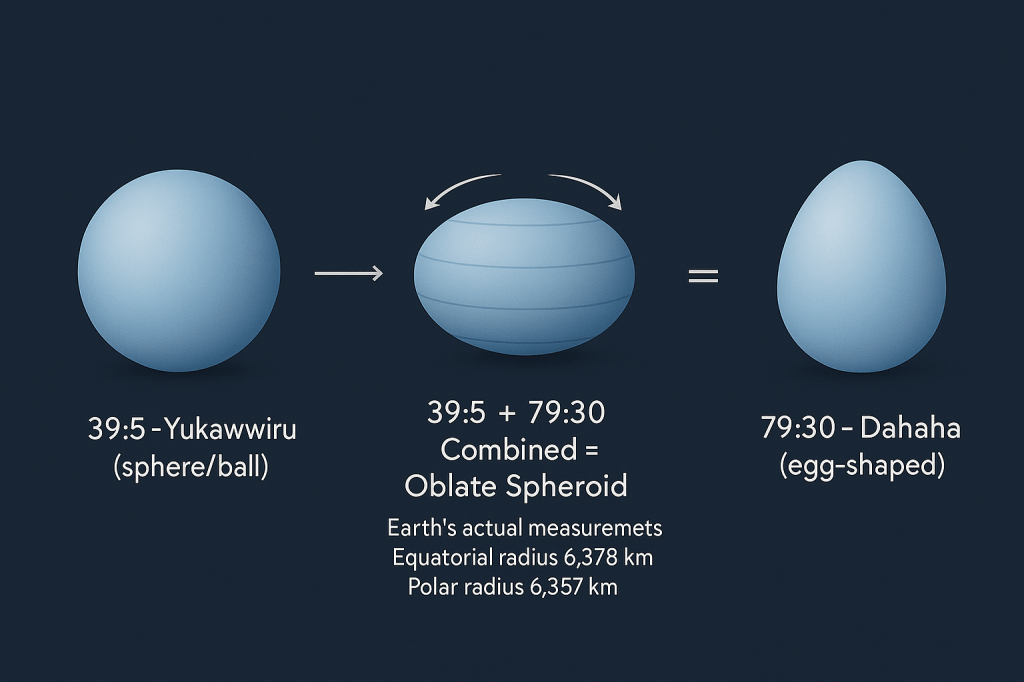
But every one of these critics makes the same fatal error. They isolate 79:30 from its companion verse, 39:5, which Rashad himself titled “The Shape of the Earth.” They argue endlessly about whether “dahaha” means “spread” or “egg” — while completely ignoring that God uses the verb “yukawwiru” (He rolls) in 39:5, a word derived from the Arabic “kurah” (ball/sphere). When you read the two verses together, as Rashad instructed, the Quran describes not a flat disc, not a perfect sphere, but an oblate spheroid — a sphere that has been spread outward at its equator. This is precisely what modern geodesy has confirmed. The critics, in their rush to discredit one verse, have missed the breathtaking scientific precision of two verses working in concert.
This article will systematically dismantle the argument against Rashad’s translation by examining the Arabic morphology, the classical lexicons, the scientific evidence, and most importantly, the Quran’s own internal cross-referencing system. We will show that every camp making this argument — whether they conclude “flat earth,” “just spread out,” or “round but not egg-shaped” — is working with an incomplete picture.
Part 1: The Two Verses That Describe Earth’s Shape
39:5 — The Sphere (Yukawwiru)
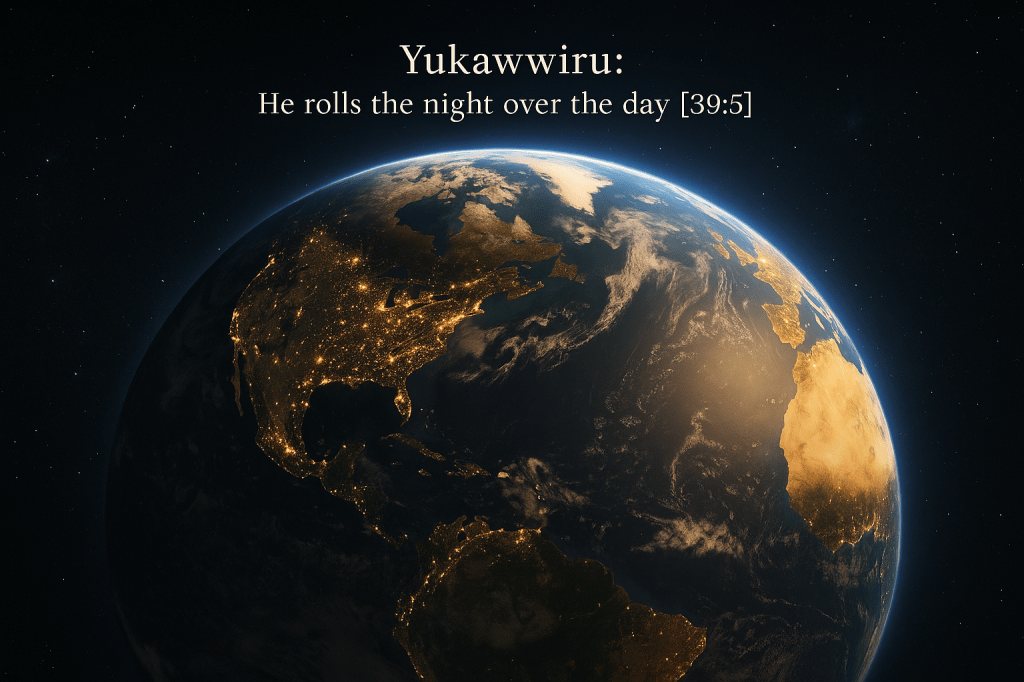
The first verse God uses to describe the shape of the Earth is 39:5, and it is no coincidence that Rashad Khalifa titled this verse “The Shape of the Earth” in the Final Testament. The Arabic verb “yukawwiru” appears twice in this verse, describing how God “rolls” the night over the day and the day over the night. This verb is derived from the root ك-و-ر (k-w-r), the same root that gives us the Arabic noun “kurah,” meaning ball or sphere. The act of rolling night over day can only occur on a spherical body — you cannot roll anything over a flat surface in the way this verse describes. The continuous, cyclical wrapping of light and darkness around a body is a description of planetary rotation on a spherical object.
[39:5] “He created the heavens and the earth truthfully. He rolls the night over the day, and rolls the day over the night. He committed the sun and the moon, each running for a finite period. Absolutely, He is the Almighty, the Forgiving.”
Rashad’s footnote to this verse states: “This verse clearly informs us that the earth is round. The Arabic for ‘He rolls’ (Yukawwir) is derived from the Arabic word for ‘ball’ (Kurah). Since the Earth is not exactly round, a specific reference to its shape is given in 79:30.” This footnote is the key that every critic ignores. Rashad never claimed that 79:30 alone describes the shape of the Earth. He explicitly stated that 39:5 establishes the sphere, and 79:30 refines the description. The two verses form a complementary pair — one describing the general spherical shape, the other describing the specific deviation from a perfect sphere.
The verb “yukawwiru” also appears in 81:1 in a different form: “When the sun is rolled” (kuwwirat). This confirms that the root k-w-r carries the meaning of wrapping, coiling, or rolling — actions that presuppose a three-dimensional, rounded object. When God says He rolls the night over the day, He is describing what every astronaut has witnessed from space: the terminator line — the boundary between day and night — sweeping continuously around a spherical Earth.
[81:1] “When the sun is rolled.”
79:30 — The Equatorial Bulge (Dahaha)
The second verse, 79:30, has been the center of the controversy. In the Final Testament, Rashad Khalifa translates it as “He made the earth egg-shaped,” with the footnote: “The Arabic word ‘dahhaahaa’ is derived from ‘Dahhyah’ which means ‘egg.’” Critics have attacked this translation from multiple angles, but their attacks consistently fail to account for the context established by 39:5. If 39:5 already establishes the Earth as spherical through the verb “yukawwiru,” then 79:30 must be adding new information — it must be describing something beyond simple sphericity.
[79:30] “He made the earth egg-shaped.”
The Arabic text reads: وَٱلْأَرْضَ بَعْدَ ذَٰلِكَ دَحَىٰهَآ (wal-arda ba’da dhalika dahaha). The root is د-ح-و (d-h-w), and it is this root that has been the subject of such intense debate. We will examine the morphological arguments in detail in the following sections. For now, the critical point is this: whatever “dahaha” means at its root level — whether “to spread,” “to push outward,” or “to shape like an egg” — it must be read in conjunction with 39:5. A sphere that has been “spread” or “pushed outward” is an oblate spheroid. An egg shape is an oblate spheroid. The two verses converge on the same scientific reality.
Part 2: The Morphological Refutation — What “Dahaha” Actually Means
The Root د-ح-و (D-H-W) in Classical Arabic
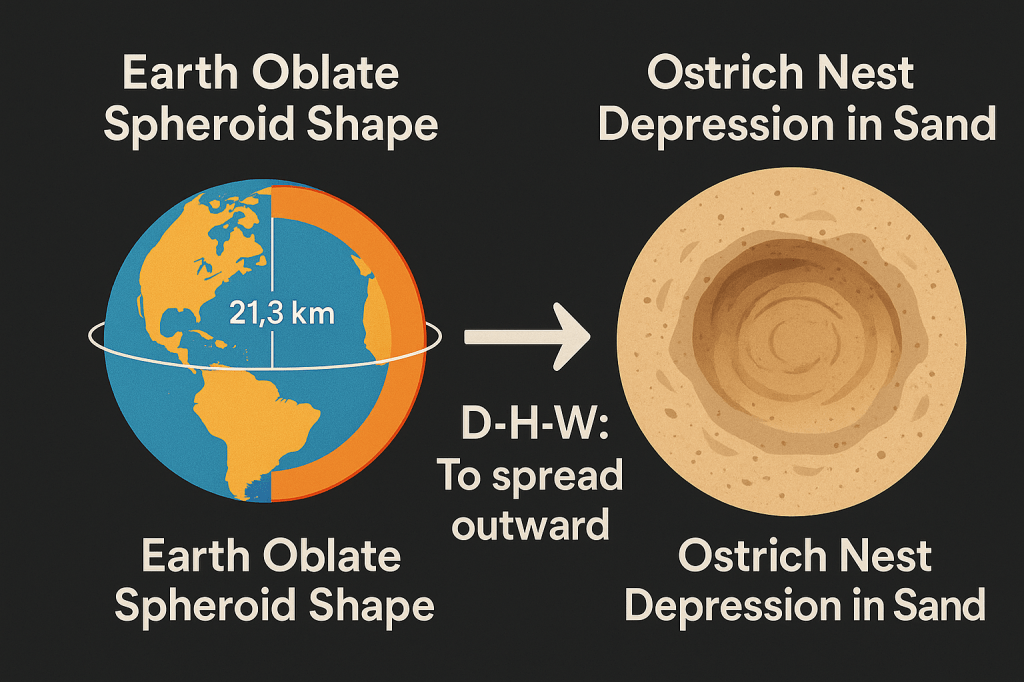
The critics’ strongest argument is linguistic. They point to every major classical Arabic dictionary — Lane’s Lexicon, Lisan al-Arab, Taj al-Arus, al-Qamus al-Muhit — and note that the root د-ح-و (d-h-w) consistently means “to spread out,” “to extend,” “to push,” or “to fling.” This is factually correct. The primary meaning of the root is indeed “to spread” or “to extend outward.” Lane’s Lexicon defines “dahaha” as “he spread it, expanded it, or extended it,” and cites the related noun “udhiyyah” (sometimes written “udhiyya”) as a shallow depression in the ground where an ostrich lays its eggs — not the egg itself. The critics are right that “udhiyyah” refers to the ostrich’s nest, not the ostrich’s egg. The Arabic word for egg is “baydah” (بيضة), not “dahhyah.”
However, the critics make a critical error in their reasoning. They assume that because the primary root meaning is “to spread,” the verse must describe a flat earth. This is a non sequitur. “To spread outward” is precisely what happens to a rotating sphere under centrifugal force — its equatorial region spreads outward, bulging away from the axis of rotation. The Earth’s equatorial diameter (12,756 km) is 43 kilometers greater than its polar diameter (12,714 km) because the Earth’s rotation has spread its mass outward at the equator. If you take the primary, undisputed root meaning of d-h-w — “to spread outward” — and apply it to the sphere established by 39:5, you get an oblate spheroid. The linguistic argument, far from disproving Rashad’s translation, actually confirms it when both verses are read together.
The Denominal Verb Problem
Some defenders of the “egg-shaped” translation have argued that “dahaha” is a denominal verb — a verb derived from a noun — and that it comes from “dahhyah” (egg), just as Rashad’s footnote suggests. The critics counter that Arabic verbs are derived from triliteral roots, not from nouns, and that the direction of derivation is root to verb to noun, not noun to verb. They argue that denominal verbs in Arabic do not carry the physical shape of the noun they derive from — for example, the verb “tammara” (derived from “tamr,” meaning dates) means “to dry dates,” not “to make something date-shaped.”
This is a legitimate linguistic point, and it deserves an honest response. Arabic does have denominal verbs, but they are less common than root-derived verbs, and the critics are correct that denominal verbs do not necessarily carry the shape properties of their parent noun. However, this objection is entirely moot when we understand Rashad’s actual argument. Rashad did not rely solely on the noun “dahhyah” to reach his translation. His footnote on 39:5 makes clear that the primary description of Earth’s shape comes from “yukawwiru” (sphere), and that 79:30 provides a refinement. Whether “dahaha” means “to shape like an egg” (denominal reading) or “to spread outward” (root reading), the result is the same: a sphere that is not perfectly round — an oblate spheroid. The morphological debate, while intellectually interesting, is a red herring that distracts from the complementary function of the two verses.
What the Ostrich Nest Actually Tells Us
The most frequently cited piece of evidence against the “egg” translation is the word “udhiyyah” (أُدْحِيَّة), which refers to the depression an ostrich makes in the sand to lay its eggs. Critics emphasize that this is a nest — a shallow, spread-out depression — not an egg. They are correct about the definition. But consider what an ostrich nest actually looks like: it is a shallow, rounded depression — wider at the middle than at the edges, gently curving inward. In other words, it is concave, not flat. The ostrich does not flatten the sand; it pushes the sand outward to create a rounded hollow. The action of “dahw” — spreading outward — creates a curved, bowl-like shape, not a flat plane. When this spreading action is applied to a sphere (as established by 39:5), it creates an oblate curve — wider at the equator, slightly compressed at the poles.
Furthermore, even if we accept that “udhiyyah” means only “nest” and has no connection to eggs, the physical action described by the root — pushing outward, spreading, extending — remains perfectly consistent with the equatorial bulge of an oblate spheroid. The ostrich pushes sand outward to make a nest; the Earth’s rotation pushes mass outward at the equator. The root meaning supports the scientific reality regardless of whether we accept the egg connection.
Part 3: Five Reasons the Ostrich Egg Argument Fails
A Systematic Dismantling
While the previous section addressed the morphological arguments in detail, it is worth consolidating the five most common claims about ostrich eggs into a single, definitive refutation. These five points are repeated endlessly in online debates, YouTube videos, and forum posts, often by people who have never read 39:5 or Rashad’s footnote to it. Let us address each one directly.
Claim 1: “Udhiyyah means ostrich nest, not ostrich egg.” This is correct, and no serious scholar of Arabic disputes it. The word “udhiyyah” refers to the shallow depression in sand where an ostrich lays its eggs. However, as we have shown, this does not undermine the translation. The action of making a nest — spreading sand outward to create a rounded depression — describes exactly what happens to a rotating sphere. The nest argument actually supports the oblate spheroid reading when combined with 39:5.
Claim 2: “Arabic verbs derive from roots, not from nouns.” Generally true, though Arabic does possess denominal verbs. But this point is irrelevant because Rashad’s argument does not depend on denominal derivation. His primary argument for Earth’s shape comes from “yukawwiru” in 39:5, with 79:30 serving as a refinement. Whether “dahaha” is root-derived (meaning “to spread”) or denominal (meaning “to egg-shape”), the conclusion is identical: an oblate spheroid.
Claim 3: “Denominal verbs don’t carry the shape of the parent noun.” This is a valid linguistic principle, but it is being applied to an argument that Rashad was not making. As stated above, the shape description comes from 39:5. The critics are refuting a strawman — they imagine Rashad was saying “dahaha = egg-shaped” in isolation, when he was actually saying “yukawwiru (sphere) + dahaha (spread/egg-shaped) = oblate spheroid.”
Claim 4: “No classical scholar interpreted dahaha as egg-shaped.” This is true, and it would be dishonest to claim otherwise. Classical scholars interpreted “dahaha” as “spread out” or “extended.” But classical scholars also did not know the Earth was an oblate spheroid. The Quran contains scientific information that was inaccessible to earlier generations — this is one of its stated functions. Rashad himself addressed this directly, explaining that there were “generations who didn’t understand what God meant by the earth being egg-shaped. That didn’t make sense to them” (at 0:54). The classical scholars’ inability to see the scientific meaning does not invalidate it — it confirms that the Quran was ahead of its time.
Claim 5: “An ostrich egg is prolate (elongated), but Earth is oblate (flattened at poles).” This is the most scientifically literate objection, and it deserves credit. An ostrich egg is indeed prolate spheroid — longer along its axis than across. Earth is oblate — shorter along its polar axis than across its equatorial plane. However, this objection assumes that 79:30 alone is meant to describe Earth’s precise geometry. It is not. The verse 39:5 establishes the sphere; 79:30 indicates the deviation from perfect sphericity. The “egg” reference in Rashad’s translation communicates to a general audience that the Earth is not a perfect ball — it has an asymmetric shape. The technical precision comes from reading both verses together, not from 79:30 alone.
Part 4: The Irony — “Why Didn’t God Use Kawwara for Earth?”
He Did. It Is Called 39:5.
Perhaps the most ironic argument leveled against Rashad’s translation comes from critics who ask: “If God wanted to say the Earth is round, why didn’t He use the verb ‘kawwara’ (to make round/spherical) for the Earth? He used ‘dahaha’ instead, which means to spread.” This argument is so common that it appears in nearly every online refutation of the “egg-shaped” translation. And it reveals, with devastating clarity, that the person making the argument has never read 39:5.
God did use the root k-w-r for the Earth. He used “yukawwiru” — He rolls — to describe the night rolling over the day on the Earth’s surface. This is the verb form of the exact root these critics demand. The subtitle Rashad gave to 39:5 is literally “The Shape of the Earth.” The footnote explicitly says: “The Arabic for ‘He rolls’ (Yukawwir) is derived from the Arabic word for ‘ball’ (Kurah).” The critics are asking for something that already exists in the Quran, in the very verse that Rashad flagged as describing Earth’s shape. Their ignorance of 39:5 is not an argument against the translation — it is an indictment of their own scholarship.
This irony deepens when we consider the complementary structure. If God had used “kawwara” in both 39:5 and 79:30, the description would have been “sphere + sphere” — a perfect ball. By using “kawwara” in 39:5 and “dahaha” in 79:30, God communicates “sphere + spread outward” — an oblate spheroid. The use of two different verbs is not a contradiction; it is precision. Each word adds a layer of meaning that the other does not carry. Critics who demand that God use the same word twice are actually asking for less precision, not more.
[3:191] “They remember God while standing, sitting, and on their sides, and they reflect upon the creation of the heavens and the earth: ‘Our Lord, You did not create all this in vain. Be You glorified. Save us from the retribution of Hell.’”
Part 5: The Scientific Evidence — Earth as an Oblate Spheroid
What Modern Geodesy Tells Us
The Earth is not a perfect sphere. This has been known with certainty since the 18th century, when French expeditions to Lapland (near the Arctic) and Peru (near the equator) measured the length of a degree of latitude at different points on the globe and confirmed that the Earth is flattened at the poles and bulges at the equator. Today, the science of geodesy provides extraordinarily precise measurements. The Earth’s equatorial radius is 6,378.137 km, while its polar radius is 6,356.752 km — a difference of 21.385 km. This gives the Earth an oblateness (flattening) of approximately 1/298.257, meaning the equatorial diameter is about 0.335% larger than the polar diameter (Source: NASA Earth Fact Sheet).
This shape — an oblate spheroid — is precisely what you get when a sphere is subjected to centrifugal force from rotation. The Earth rotates at approximately 1,670 km/h at the equator, and this rotation pushes mass outward at the equatorial plane. The result is a body that is primarily spherical (confirming 39:5’s “yukawwiru”) but has been spread outward at its middle (confirming 79:30’s “dahaha”). The scientific description of Earth’s shape requires both concepts — roundness and equatorial spreading — exactly as the Quran provides in these two verses.
The WGS-84 Reference Ellipsoid
The World Geodetic System 1984 (WGS-84) is the standard coordinate system used by GPS satellites and mapping systems worldwide. It models the Earth as a reference ellipsoid — a mathematically precise oblate spheroid. The WGS-84 ellipsoid has a semi-major axis (equatorial radius) of exactly 6,378,137 meters and a flattening of 1/298.257223563 (Source: National Geospatial-Intelligence Agency, WGS-84). Every GPS device, every satellite navigation system, and every digital map in the world is built on the assumption that the Earth is an oblate spheroid — not a flat plane, not a perfect sphere, but a sphere that has been spread outward at its equator.
It is worth pausing to appreciate the remarkable concordance between ancient scripture and modern science. The Quran, revealed in the 7th century CE to a society that had no means of measuring Earth’s oblateness, provides two complementary descriptions that together specify an oblate spheroid. The verb “yukawwiru” in 39:5 establishes sphericity. The verb “dahaha” in 79:30, whether read as “spread outward” or “egg-shaped,” establishes deviation from perfect sphericity. Together, they describe the WGS-84 reference ellipsoid fourteen centuries before its mathematical formulation. As God states in the Quran:
[41:39] “Among His proofs is that you see the land still, then, as soon as we shower it with water, it vibrates with life. Surely, the One who revived it can revive the dead. He is Omnipotent.”
[51:47] “We constructed the sky with our hands, and we will continue to expand it.”

Part 6: Rashad Khalifa’s Understanding — In His Own Words
The Messenger Taught Both Verses Together
One of the most important pieces of evidence in this debate is Rashad Khalifa’s own words. In his recorded teachings, Rashad consistently referred to the Earth as “egg-shaped” and explicitly connected this description to the Quran’s scientific information. In his lecture on the Theory of Evolution vs Creation, Rashad stated plainly: “And we learn that the earth is egg-shaped, as I mentioned before, not flat” (at 44:00). This was not an off-hand remark; it was part of a systematic presentation of scientific information in the Quran, listed alongside the expansion of the universe, the Big Bang theory, and the nature of sunlight versus moonlight.
In another recording, during a study of chapter 39 itself, Rashad discussed how earlier generations could not have understood the scientific content of the Quran. He explained: “There were generations who didn’t understand what God meant by the earth being egg-shaped. That didn’t make sense to them. And had they wasted their time trying to interpret that, they’d just do that, waste their time. And they may end up confused” (at 0:54). Rashad understood that the Quran’s scientific descriptions were designed to be recognized by future generations as knowledge advanced — a point that is itself a Quranic principle.
Perhaps most tellingly, in a conversation recorded in Messenger Audio 19.1, Rashad and his companions discussed the Earth’s shape with notable precision. One speaker remarked that “even the Earth being egg-shaped is not this perfect sphere,” to which Rashad’s response acknowledged the slight distortion while noting that it was not dramatically different from spherical (at 15:38). This exchange is revealing because it shows that Rashad and his community understood the Earth was primarily spherical with a deviation — exactly the oblate spheroid model.
The Introduction to the Blue Quran
In the Introduction to the Blue Quran recording, Rashad listed the Earth being egg-shaped as the first example of advanced scientific information in the Quran. He stated: “Number 1, the earth is egg-shaped. We give the verses. Number 2, the earth is not standing still. It moves constantly. Number 3, the sun is a source of light while the moon reflects it” (at 55:28). Notice the phrase “we give the verses” — plural. Rashad always pointed to multiple verses when discussing Earth’s shape, not just 79:30 in isolation. His approach was systematic and multi-verse, exactly as we have outlined in this article.
The messenger’s consistent teaching was clear: the Quran describes the Earth as a sphere (39:5) that is not perfectly round (79:30), which corresponds to the scientific term “oblate spheroid.” This was not a linguistic trick or a forced reading. It was a straightforward combination of two complementary verses, each contributing one aspect of the complete description. Critics who attack 79:30 in isolation are not just misunderstanding Arabic — they are misunderstanding Rashad’s entire methodology.
Part 7: The Different Camps — Same Argument, Opposite Conclusions
Strange Bedfellows in the Anti-Dahaha Coalition
One of the most revealing aspects of this debate is the bizarre coalition of groups who use the same linguistic argument to reach entirely different — and often contradictory — conclusions. At least four distinct camps attack Rashad’s translation of 79:30, and they cannot even agree with each other about what the verse means. This should give any honest observer pause: if the same argument leads to four mutually exclusive conclusions, the argument itself may be flawed.
Camp 1: Sunni Traditionalist Scholars. These scholars argue that “dahaha” means “to spread out” or “to extend,” citing classical dictionaries and tafsir (exegesis). However, most modern Sunni scholars also believe the Earth is round, based on other evidence and verses. They reconcile “spreading” with a round Earth by arguing that the Earth’s surface appears flat from any local vantage point — it is “spread out” from the observer’s perspective while being globally spherical. This is a reasonable interpretation, but it concedes the very point they claim to dispute: the Quran is not describing a flat earth, and “spreading” does not require flatness.
Camp 2: Ex-Muslim and Atheist Critics. These critics use the same classical dictionary entries as the Sunni scholars, but they reach the opposite conclusion. They argue that “dahaha” means “to flatten” and that this proves the Quran teaches a flat earth, thereby disproving its divine origin. They need 79:30 to mean “flat” because their entire argument for the Quran being a human product depends on it containing scientific errors. They conveniently ignore 39:5 because it would destroy their flat-earth reading.
Camp 3: Secular and Academic Linguists. These scholars approach the text purely as a linguistic artifact. They note that “dahaha” has a primary meaning of “to spread” and that the “egg” interpretation is not attested in classical Arabic literature. Their conclusion is typically agnostic — they describe what the word meant historically without making claims about Earth’s actual shape or the Quran’s divine origin. Their work is valuable for establishing the lexical range of the root d-h-w, but they do not engage with the cross-verse argument.
Camp 4: Some Quranists (Quran-Alone Groups). Perhaps the most surprising critics are certain Quranists — people who, like Submitters, reject the fabricated narrations and follow the Quran alone. Some of these individuals argue that Rashad’s “egg-shaped” translation is linguistically indefensible and that it damages the credibility of the Quran-alone movement. They prefer “spread out” or “made habitable” as translations. However, even these Quranists typically accept that the Earth is round; they simply dispute the specific word choice in translation.
The irony is thick. Four groups who disagree about nearly everything — the authority of fabricated narrations, the existence of God, the divine origin of the Quran, and the role of messengers — all converge on the same morphological argument against “dahaha = egg.” And yet they cannot agree on what the verse actually means or what conclusions to draw from it. This is the hallmark of an argument that serves as a convenient weapon rather than a sincere pursuit of truth.
Part 8: The Context of 79:27-33 — A Cosmic Construction Sequence
Reading Dahaha in Its Immediate Context
Critics who isolate 79:30 from its immediate context miss not only the connection to 39:5 but also the remarkable sequence within chapter 79 itself. Verses 27 through 33 describe a systematic construction of the cosmos — a creation narrative that moves from the heavens to the earth to life support systems. Reading “dahaha” within this sequence reveals that it describes a specific act of shaping or forming, not merely a passive state of being flat.
[79:27] “Are you more difficult to create than the heaven? He constructed it.”
[79:28] “He raised its masses, and perfected it.”
[79:29] “He made its night dark, and brightened its morn.”
[79:30] “He made the earth egg-shaped.”
[79:31] “From it, He produced its own water and pasture.”
[79:32] “He established the mountains.”
[79:33] “All this to provide life support for you and your animals.”
Notice the progression: God constructs the heaven (27), raises and perfects it (28), creates the day-night cycle (29), shapes the Earth (30), produces water and vegetation (31), establishes mountains (32), and declares the purpose — life support (33). Every verb in this sequence describes an active, intentional act of creation and shaping. The verb “dahaha” in verse 30 sits within a chain of formation verbs: constructed (banaaha), raised (rafa’a), perfected (sawwaaha), made dark (aghshaha), brightened (akhraja). In this context, “dahaha” must describe an act of physical shaping — giving the Earth its specific form — not merely spreading something flat.
If “dahaha” meant only “to spread flat,” it would be the single anomaly in a sequence of precision-engineering verbs. Every other verb in the passage describes a specific, purposeful act of design. It would be strange for God to describe constructing and perfecting the heavens, engineering the day-night cycle, and then merely “spreading” the Earth flat before going on to produce water and establish mountains. The contextual logic demands that “dahaha” describes giving the Earth its particular shape — which, as 39:5 already established, is a sphere that has been spread outward at its equator.
Part 9: The Quran’s Internal Cross-Referencing System
How Verses Explain Each Other
The Quran explicitly describes itself as a book whose verses explain and clarify one another. This is not a hermeneutical principle imposed from outside — it is a Quranic claim about its own structure. When we read 39:5 and 79:30 as complementary descriptions of Earth’s shape, we are following the Quran’s own methodology. The Quran uses different words in different verses to build a complete picture that no single verse provides alone. This is by design, not by accident.
[13:3] “He is the One who constructed the earth and placed on it mountains and rivers. And from the different kinds of fruits, He made them into pairs — males and females. The night overtakes the day. These are solid proofs for people who think.”
Consider the broader Quranic vocabulary for Earth. In 71:19, God says He made the earth “habitable” (bisatan). In 51:48, the Earth is described as “a perfect design.” In 20:53, God “paved roads” in the Earth. In 15:19, God “constructed” the Earth and placed stabilizers on it. In 88:20, the question is posed: “And the earth and how it is built.” None of these verses contradict the spherical-oblate model — they each describe a different aspect of Earth’s design. The word “bisatan” in 71:19 does not mean the Earth is a flat carpet any more than 79:30’s “dahaha” means it is a flat disc. These are descriptions of specific properties: habitability, design quality, surface features, and shape.
[71:19] “God made the earth habitable for you.”
[88:20] “And the earth and how it is built.”
[51:48] “And we made the earth habitable; a perfect design.”
The richness of the Quranic vocabulary for Earth should be seen as a feature, not a bug. Each verse illuminates a different facet: 39:5 tells us the shape is spherical, 79:30 tells us it deviates from a perfect sphere, 21:33 tells us celestial bodies float in orbits, 51:47 tells us the universe is expanding, and 36:40 tells us the sun and moon have independent orbital paths. Read together, these verses paint a picture of a cosmological understanding that would not be fully appreciated by science until the modern era.
[21:33] “And He is the One who created the night and the day, and the sun and the moon; each floating in its own orbit.”

Part 10: Code 19 — Mathematical Confirmation of Every Word
Why “Dahaha” Cannot Be an Error
For Submitters, there is a dimension to this debate that transcends linguistics and science: the mathematical code of the Quran. The Quran’s mathematical structure, based on the prime number 19, ensures that every word, every letter, and every verse is precisely placed by divine design. This code, discovered by Rashad Khalifa through computer analysis, provides physical, verifiable proof that the Quran’s text is exactly as God intended it. If the word “dahaha” in 79:30 were the wrong word — if God had intended “kawwara” or some other term — the entire mathematical structure would collapse.
[10:5] “He is the One who rendered the sun radiant, and the moon a light, and He designed its phases that you may learn to count the years and to calculate. God did not create all this, except for a specific purpose. He explains the revelations for people who know.”
The mathematical code operates at multiple levels: the number of chapters, the number of verses, the gematrical values of letters, the frequency of key words, and the positional relationships between all of these elements. Every component is interlocked in a system that is, as Rashad described it, “far beyond human ability.” This means that “dahaha” is the divinely selected word for 79:30 — not an approximation, not a poetic flourish, but the mathematically precise term that God chose for this position in this verse in this chapter. The critics who argue that God should have used a different word are, in effect, arguing against the mathematical structure of the Quran itself.
Rashad emphasized this point repeatedly in his lectures. In his presentation on the mathematical code, he explained: “Every letter, every word in the scripture was written by God and now we have this physical proof, the mathematical code that was discovered by computers recently, to let us know that every statement is a proven fact” (at 1:06). This is not a circular argument — the code is independently verifiable. Anyone with a computer can check the mathematical relationships. The code validates the text, and the text includes “dahaha” in 79:30, which means “dahaha” is the correct word by mathematical proof.
[55:5] “The sun and the moon are perfectly calculated.”
Part 11: The Night-Day Rolling Phenomenon and Orbital Mechanics
What “Yukawwiru” Describes Physically
To fully appreciate the scientific precision of 39:5, we must understand what the “rolling” of night over day actually describes in physical terms. The terminator — the line separating the illuminated day side of the Earth from the dark night side — is not a static boundary. As the Earth rotates on its axis, this terminator sweeps continuously across the surface, creating the experience of sunrise and sunset at every point on the globe. From space, the terminator appears as a curved band that wraps around the spherical Earth, perpetually rolling as the planet turns.
The verb “yukawwiru” captures this phenomenon with remarkable accuracy. The word implies wrapping or winding one thing around another — precisely what night does as it wraps around the illuminated hemisphere, and what day does as it wraps around the dark hemisphere. This wrapping can only occur on a spherical surface. On a flat plane, night and day would have a linear boundary, not a wrapping one. The use of “yukawwiru” is therefore not merely consistent with a spherical Earth — it requires one. There is no geometric configuration other than a sphere (or near-sphere) that produces the continuous wrapping of light and darkness described in this verse.
[36:40] “The sun is never to catch up with the moon — the night and the day never deviate — each of them is floating in its own orbit.”
[31:29] “Do you not realize that God merges the night into the day and merges the day into the night, and that He has committed the sun and the moon in your service, each running in its orbit for a specific life span, and that God is fully Cognizant of everything you do?”
The Quran uses additional related vocabulary to describe this phenomenon. In 31:29 and 35:13, God “merges” (yuliju) the night into the day and the day into the night. This merging — the gradual transition between light and darkness we experience as dawn and dusk — is another phenomenon that requires a curved surface. On a flat plane, the transition from light to dark would be abrupt, not gradual. The curved surface of a sphere creates the gradient of twilight as the terminator sweeps across, producing the beautiful gradations of dawn and dusk that we observe daily. Every aspect of the Quran’s description of night and day is consistent with — and in fact requires — a spherical Earth.
[35:13] “He merges the night into the day, and merges the day into the night. He has committed the sun and the moon to run for a predetermined period of time. Such is God your Lord; to Him belongs all kingship. Any idols you set up beside Him do not possess as much as a seed’s shell.”
Part 12: Responding to the “First Translator” Argument
Was Rashad Really the First?
A common rhetorical tactic used against Rashad’s translation is the claim that he was “the first translator in history” to render 79:30 as “egg-shaped,” and that this novelty is itself proof of error. The implication is that if no previous translator used this rendering, it must be wrong. But this argument confuses consensus with correctness. The history of Quranic translation is filled with improvements over earlier renderings as understanding of Arabic, science, and context has advanced. Being the first to get something right is not an error — it is the definition of discovery.
Moreover, the argument ignores a critical fact: Rashad Khalifa was not an ordinary translator. He was the messenger prophesied in 3:81, the one through whom God revealed the mathematical code of the Quran. His translation — the Final Testament — was produced under divine guidance, informed by the mathematical structure that no previous translator had access to. When Rashad translated “dahaha” as “egg-shaped” and titled 39:5 “The Shape of the Earth,” he was not guessing. He was reading the Quran with an understanding of its mathematical precision that previous translators simply did not possess. The “first translator” argument assumes that all translators have equal authority, which is manifestly untrue when one of them is God’s messenger.
It is also worth noting that several translators before Rashad used renderings that are compatible with the oblate spheroid reading. Some translated “dahaha” as “spread out” or “extended” — which, as we have shown, is perfectly consistent with the equatorial bulge when combined with 39:5’s spherical description. The innovation in Rashad’s translation was not the introduction of a foreign meaning but the explicit connection between the linguistic meaning and the scientific reality. He made explicit what was implicit: that the Quran describes an oblate spheroid through two complementary verses.
Part 13: The “Flat Earth” Verses — A False Problem
Why “Spread Out” Does Not Mean “Flat”
Ex-Muslim critics and flat-earth advocates often cite a collection of verses that they claim prove the Quran teaches a flat earth. In addition to 79:30, they point to verses like 71:19 (“God made the earth habitable for you”), 20:53 (“He is the One who made the earth habitable for you, and paved in it roads”), 51:48 (“And we made the earth habitable; a perfect design”), and 15:19 (“As for the earth, we constructed it, and placed on it stabilizers, and we grew on it a perfect balance of everything”). They argue that words like “bisatan” (habitable/spread), “farasha” (spread/furnish), and “mahd” (cradle/bed) all describe a flat surface.
[20:53] “He is the One who made the earth habitable for you, and paved in it roads for you. And He sends down from the sky water with which we produce many different kinds of plants.”
[15:19] “As for the earth, we constructed it, and placed on it stabilizers (mountains), and we grew on it a perfect balance of everything.”
This argument fails for a simple reason: describing properties of a surface does not define the shape of the object. When we say “the road stretches out before us” or “the sea spreads to the horizon,” we are not claiming the road or sea is flat in a geometric sense — we are describing their apparent extension from a local observer’s viewpoint. The Earth’s surface is locally flat at human scales because its curvature is so gentle — approximately 8 inches per mile (Source: United States Geological Survey). Describing the Earth as “spread out” or “habitable” is no more a flat-earth claim than saying “the floor is level” is a denial of planetary curvature.
Furthermore, the Final Testament’s translation of these verses does not use “flat” — it uses “habitable,” “perfect design,” and “constructed.” Rashad’s translation consistently avoids any rendering that would imply a flat earth, precisely because he understood these verses to be describing Earth’s habitability and design features, not its geometric shape. The shape is given in 39:5 and 79:30. The other verses describe what God did with that shape — made it livable, stable, productive, and navigable. Conflating shape descriptions with surface-property descriptions is a category error.
[2:22] “The One who made the earth habitable for you, and the sky a structure. He sends down from the sky water, to produce all kinds of fruits for your sustenance. You shall not set up idols to rival God, now that you know.”
Part 14: Why This Debate Matters — Beyond Linguistics
The Deeper Issue of Quranic Authority
Beneath the surface of the “dahaha” debate lies a far more consequential question: whose translation of the Quran carries divine authority? The critics’ real objection is not linguistic — it is theological. They object to the idea that Rashad Khalifa’s translation has any special authority, and attacking his rendering of 79:30 is a convenient way to undermine confidence in the Final Testament as a whole. If they can show that Rashad made an error in one verse, they can cast doubt on every verse. This is the actual stakes of the debate.
But the mathematical code makes this strategy futile. The Final Testament is not merely one translator’s opinion — it is a translation informed by the mathematical structure that proves every word of the Quran is divinely placed. When critics argue that “dahaha” should be translated differently, they are not just questioning Rashad’s Arabic skills. They are implicitly challenging the mathematical code that validates the text containing “dahaha.” They cannot have it both ways: they cannot accept the Quran’s text as authentic while rejecting the translation produced by the person who proved its mathematical authenticity.
[67:3] “He created seven universes in layers. You do not see any imperfection in the creation by the Most Gracious. Keep looking; do you see any flaw?”
For Submitters, the resolution of this debate is straightforward. God placed “yukawwiru” in 39:5 and “dahaha” in 79:30 because together they describe an oblate spheroid. Rashad recognized this complementary relationship and titled 39:5 accordingly. His footnotes direct the reader to consider both verses together. The mathematical code confirms that every letter and word is exactly where God intended. And modern science confirms that the Earth is, in fact, an oblate spheroid — a sphere that has been spread outward at its equator. The linguistics, the science, the mathematics, and the messenger’s teaching all converge on the same conclusion. This is not a weakness of the Quran’s description — it is its crowning strength.
[55:33] “O you jinns and humans, if you can penetrate the outer limits of the heavens and the earth, go ahead and penetrate. You cannot penetrate without authorization.”
Conclusion: Two Verses, One Truth
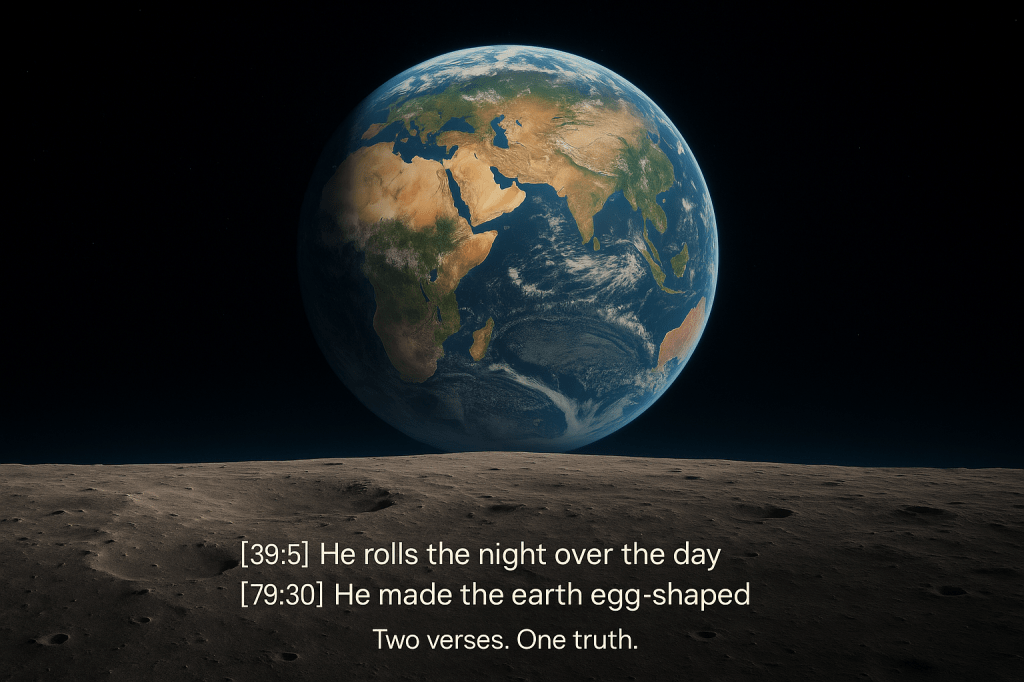
The argument against Rashad Khalifa’s translation of 79:30 collapses the moment you read 39:5. This is not a subtle point requiring advanced linguistic training — it is as simple as reading the footnote Rashad himself wrote: “Since the Earth is not exactly round, a specific reference to its shape is given in 79:30.” The two verses form a complementary pair. One establishes the sphere (yukawwiru, from kurah). The other describes the deviation from perfect sphericity (dahaha, to spread outward). Together, they describe an oblate spheroid — the exact shape confirmed by GPS satellites, geodetic surveys, and every space photograph ever taken of Earth.
The critics who attack 79:30 have done us a favor, in a sense. By forcing a detailed examination of the Arabic morphology, the classical dictionaries, and the scientific evidence, they have inadvertently demonstrated the Quran’s extraordinary precision. The root d-h-w means “to spread outward” — which is exactly what the equatorial bulge represents. The root k-w-r means “ball/sphere” — which is exactly what Earth fundamentally is. Two roots, two verses, two aspects of one shape. Fourteen centuries before the WGS-84 reference ellipsoid was formulated, the Quran provided its essential description in six words across two verses.
To the Sunni scholars who say “spread but still round” — we agree that the Earth is round, and we thank you for confirming that “spreading” does not require flatness. To the ex-Muslim critics who say “spread means flat” — you are ignoring 39:5, and your flat-earth reading is contradicted by every other Quranic description of celestial mechanics. To the secular linguists who note that classical dictionaries define d-h-w as “to spread” — we accept your scholarship and note that spreading a sphere produces an oblate spheroid. And to the Quranists who prefer “spread out” over “egg-shaped” — we respect your commitment to the Quran alone, and we invite you to read Rashad’s footnote on 39:5, where the argument is fully laid out.
The Quran describes the shape of the Earth with two carefully chosen words in two strategically placed verses. Read them together. The truth is not hidden.
[39:5] “He created the heavens and the earth truthfully. He rolls the night over the day, and rolls the day over the night. He committed the sun and the moon, each running for a finite period. Absolutely, He is the Almighty, the Forgiving.”
[79:30] “He made the earth egg-shaped.”

 Quran Only Studies
Leave a comment