Introduction: The Question No Other Religion Answers
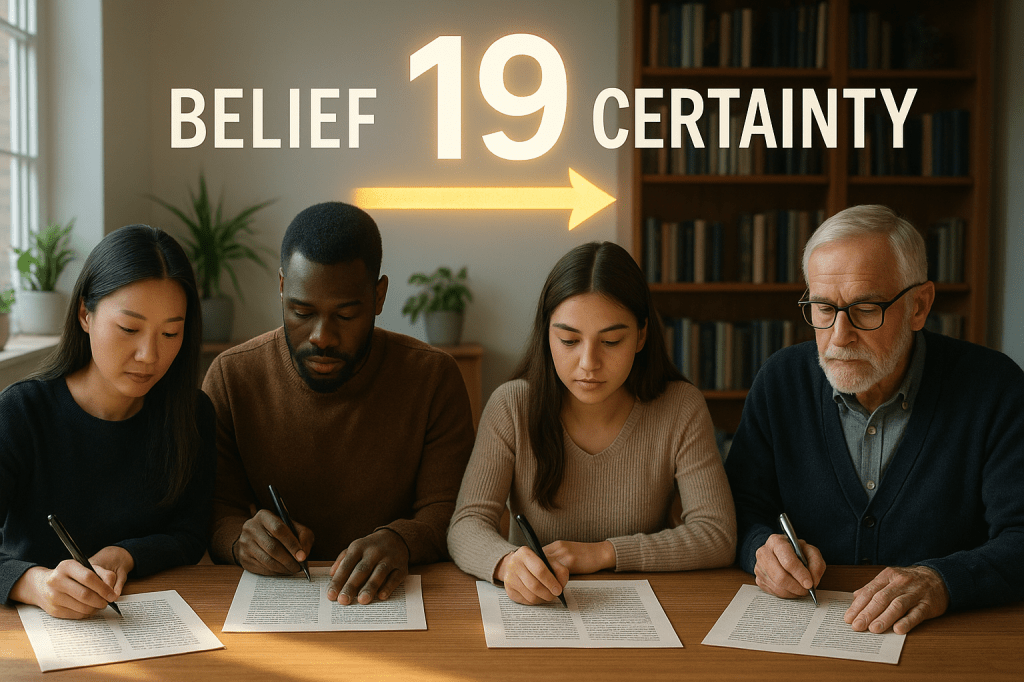
Every religion on earth asks the same thing of its adherents: believe. Believe in a book you did not see written, in a prophet you did not meet, in events you cannot witness, in a God you cannot touch. For most of human history the honest seeker has had to cross a chasm by faith alone. The chasm runs from the place where you say “I believe” to the place where you say “I know,” and every prior scripture has asked its readers to leap it without a bridge. The result, predictably, is a world full of believers who quietly doubt, dogmatists who bluff, and skeptics who reject the leap altogether. Belief without certainty is fragile. It can be flattered by agreement and shaken by grief. It can be inherited without being examined, professed without being felt, and lost without a warning.
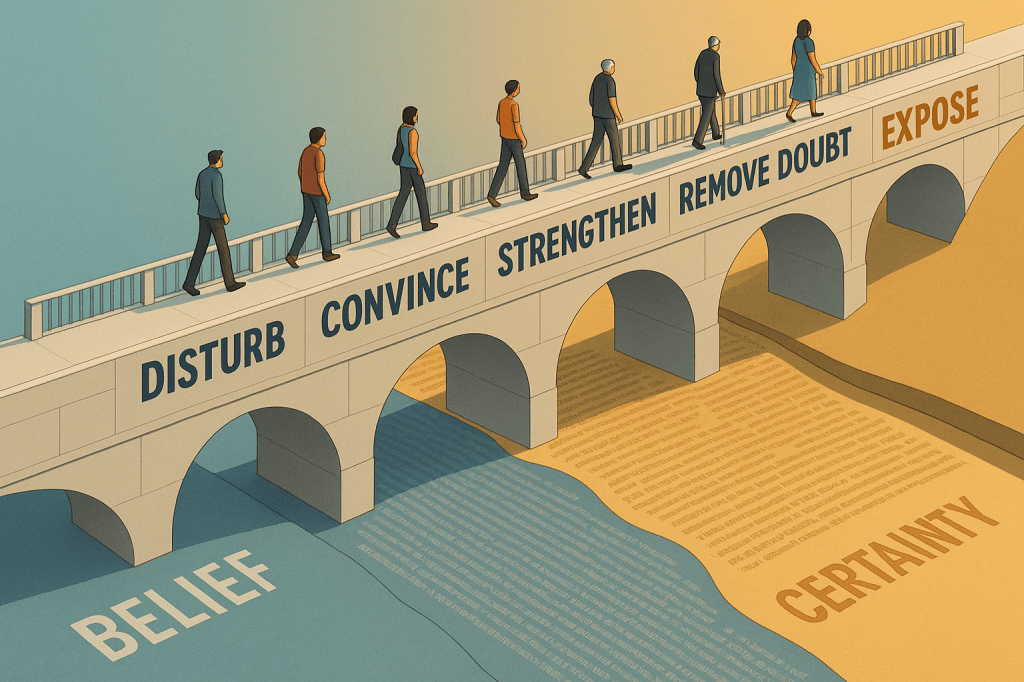
The Quran asks a different question. It does not ask you to leap — it asks you to count. Hidden inside the very chapter that rebukes a pagan for calling the scripture “human made” is a verse containing the Arabic verb liyastayqina, from the root Y-Q-N, meaning “so they may attain certainty.” God names, in His own words, the purpose of the number He assigned to the guardians of Hell: to move humanity from belief to certainty. Code 19 is not an embellishment on the Quran’s message — it is the epistemological bridge God built into the text so that no sincere seeker would ever have to leap by faith alone again. This article is about that bridge: what it is for, what it proves, and why understanding it changes the meaning of the word “believer.”
[39:9] “Say, ‘Are those who know equal to those who do not know?’ Only those who possess intelligence will take heed.”
Part 1: The Three Tiers of Certainty
How the Quran Defines What It Means to Know
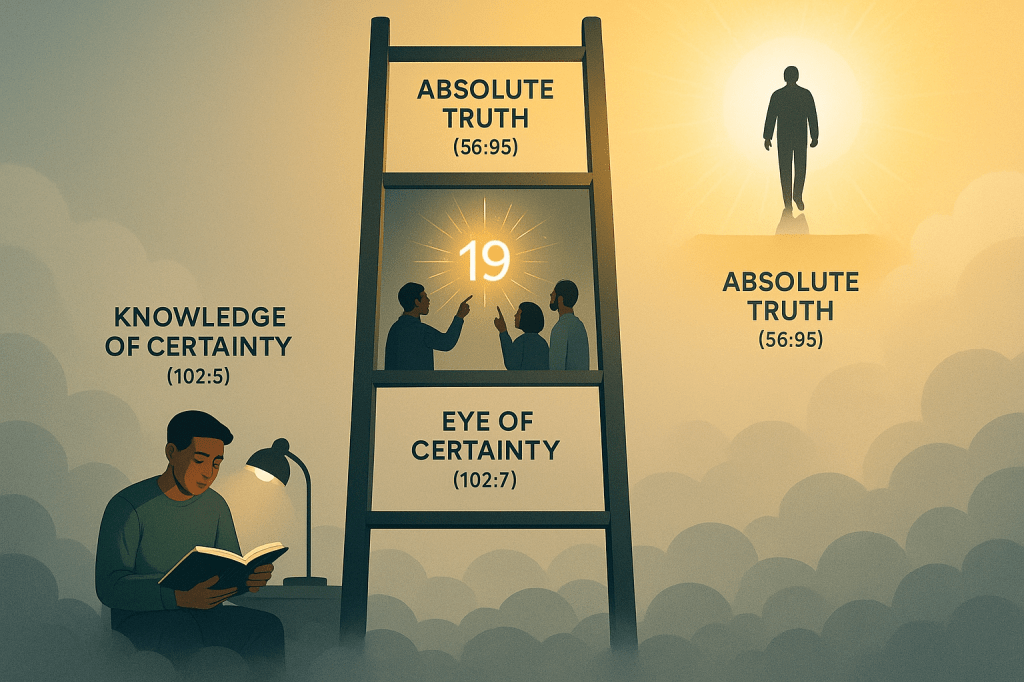
Long before Western philosophy mapped the difference between opinion, justified belief, and knowledge, the Quran had already named three distinct grades of certainty — and ranked them. The lowest tier is called knowledge of certainty: the conviction one arrives at through intellectual reasoning, when the argument is sound, the evidence lines up, and the mind says “this must be so.” It is genuine knowledge, but it remains cognitive, abstract, second-hand. You can reason your way to the existence of fire without ever feeling its heat. The Quran names this tier directly in a warning to those who hoard wealth in blind denial of the Hereafter.
[102:5] “If only you could find out for certain.”
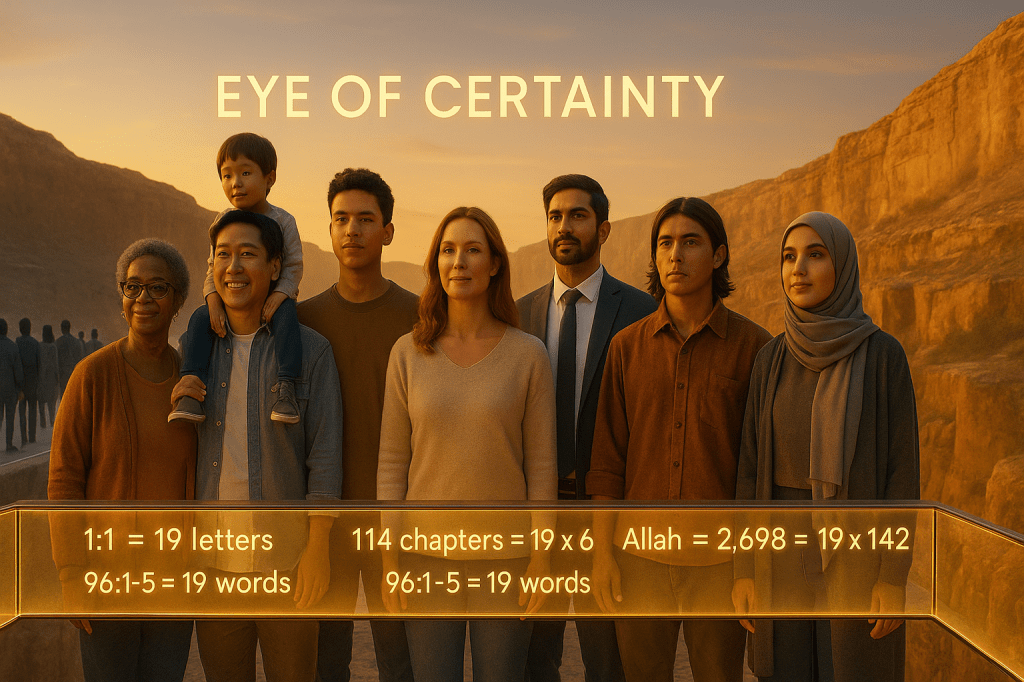
The second tier is called eye of certainty: the certainty of observation, of direct witness, of seeing the fire with your own eyes. Here the abstract becomes concrete. The argument is no longer only in the mind — it is also in front of you. And the Quran, two verses later, escalates the very same discussion:
[102:7] “Then you would see it with the eye of certainty.”
The third and highest tier is called absolute truth, the certainty of experience, of feeling the fire against your own skin. This is the certainty of the soul in Paradise or the damned in Hell — the certainty that no longer needs argument or witness because you are inside the thing itself. The Quran names this level twice, once at the end of chapter 56 and once at the end of chapter 69, and on both occasions it applies the term to the scripture itself.
[56:95] “This is the absolute truth.”
[69:51] “It is the absolute truth.”
What matters here is the architecture. The Quran does not treat certainty as a single state one either has or lacks. It treats certainty as a ladder, with three measurable rungs. And Code 19 — the mathematical signature of divine authorship running through the scripture — operates precisely on the middle rung. It is not asking you to reason abstractly about God. It is asking you to look, count, and see. It is the eye of certainty, offered to anyone willing to open their eyes while they still have time to use the information.
Part 2: The Forgotten Verb — Liyastayqina
God Names Code 19’s Purpose in His Own Words
The single most overlooked word in the entire Code 19 discussion is not a number. It is a verb. Buried inside verse 74:31 — the verse that explains why God assigned the number 19 to the guardians of Hell — sits the Arabic word liyastayqina. It is formed from the root letters ي ق ن (Y-Q-N), the same root that generates yaqeen (certainty), muqinoon (the certain ones), and ilm al-yaqeen (knowledge of certainty). The Final Testament renders this verb, in context, as “to convince the Christians and Jews” — but the literal Arabic is even sharper: “so that those who were given the scripture may attain certainty.” Not “may believe.” Not “may accept.” May attain certainty. The word for certainty is in the very verse that introduces Code 19.
This is not accidental. The root Y-Q-N appears twenty-eight times across the Quran in twenty different chapters, and the densest concentration in the entire scripture is found in chapter 74 itself — the chapter in which Code 19 is announced. The chapter that tells the disbelievers “this is one of the great miracles” is also the chapter in which God repeatedly deploys the vocabulary of certainty. The design is perfectly matched: the miracle is announced in the same chapter, and indeed the very verse, whose function God describes using the very word for certainty. The fingerprint is in the signature; the signature is in the fingerprint.
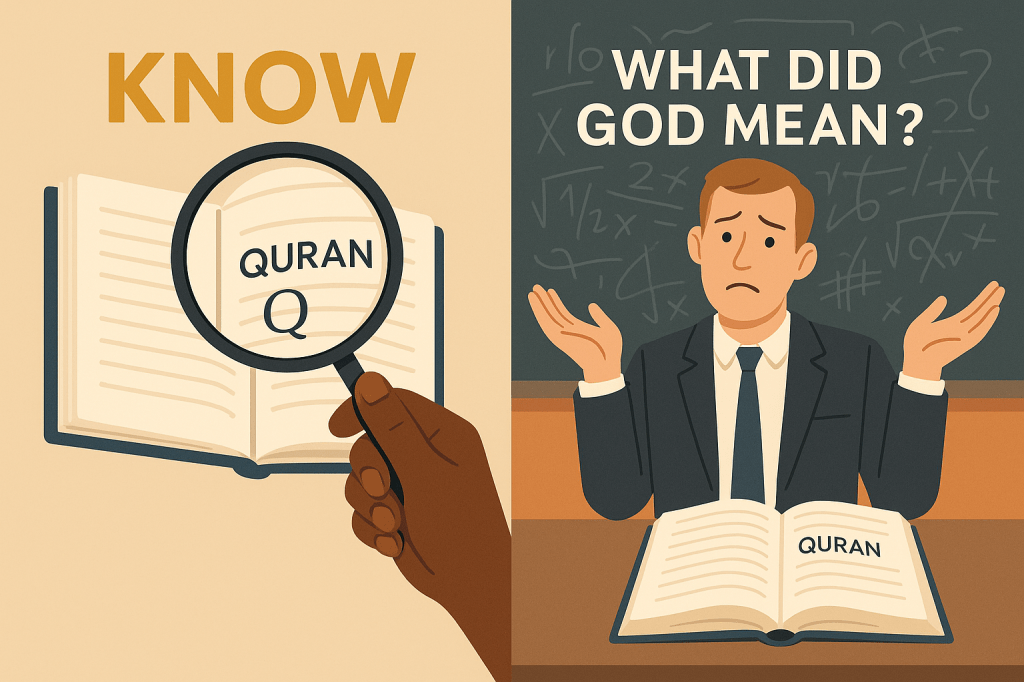
[74:31] “We appointed angels to be guardians of Hell, and we assigned their number (19) (1) to disturb the disbelievers, (2) to convince the Christians and Jews (that this is a divine scripture), (3) to strengthen the faith of the faithful, (4) to remove all traces of doubt from the hearts of Christians, Jews, as well as the believers, and (5) to expose those who harbor doubt in their hearts, and the disbelievers; they will say, ‘What did God mean by this allegory?’ God thus sends astray whomever He wills, and guides whomever He wills. None knows the soldiers of your Lord except He. This is a reminder for the people.”
Read slowly the five purposes listed in 74:31. Each of them is a variation on the same theme: shifting the state of a human being from ambiguity to resolution. Disbelievers are disturbed — their complacency is pierced. Christians and Jews are brought to certainty that the Quran is divine. The faithful are strengthened. Doubts are removed from three distinct classes of readers. Hypocrites are exposed. Every single function of the number 19 operates on the axis of doubt and certainty. There is no other function listed. God did not assign the number to make the Quran aesthetically pleasing, or numerologically cute, or esoterically mysterious. He assigned it for one reason: to convert belief into knowing.
Part 3: 74:30–37 — The Announcement in Full
Reading the Centrepiece Without Skipping
It is common for skeptics to quote verse 74:30 in isolation — “Over it is nineteen” — and dismiss it as an obscure reference to Hellfire’s angels. But the verse is not self-contained. It sits inside a tightly argued passage running from verse 25 to verse 37, in which God narrates an objection, issues a verdict, explains the mechanism, and then swears oaths confirming that the mechanism is “one of the great miracles.” Read the passage as a single argument and the role of the number 19 becomes unmistakable.
[74:25] “‘This is human made.’”
[74:26] “I will commit him to retribution.”
[74:27] “What retribution!”
[74:28] “Thorough and comprehensive.”
[74:29] “Obvious to all the people.”
[74:30] “Over it is nineteen.”
Notice the context. The pagan has sneered that the Quran is a human composition. God does not respond with poetry or thunder — He responds with a number. “Over it is nineteen.” The retribution God promises is described as thorough, comprehensive, and above all obvious to all the people. The word for “obvious” here is not metaphorical. It describes a phenomenon observable in the external world, open to the sight of every human being. And then comes the explanation, the verse we have already read: 74:31, which unpacks what “nineteen” means and why it exists — five precise functions, all of them governing the passage from doubt to certainty.
[74:32] “Absolutely, (I swear) by the moon.”
[74:33] “And the night as it passes.”
[74:34] “And the morning as it shines.”
[74:35] “This is one of the great miracles.”
[74:36] “A warning to the human race.”
[74:37] “For those among you who wish to advance, or regress.”
Three oaths — by the moon, by the passing night, by the shining morning — stand as witnesses to verse 35’s declaration: this is one of the great miracles. In classical Arabic oaths, God swears by realities only He controls in order to seal the truth of what follows. The moon, the night, and the morning are tidal, astronomical, and meteorological certainties. The implication is deliberate: Code 19 is as fixed as the lunar cycle, as reliable as sunrise, as unmanipulable as the passage of time. And finally, verse 37 clarifies that this great miracle will produce opposite reactions — some will advance, some will regress — depending on what they do with the evidence placed before them.
Part 4: The Structural Twin — Verse 2:26
Why 74:31 and 2:26 Must Be Read Together
Long before Rashad Khalifa decoded the mathematical signature in 1974, God had already hidden a structural twin of verse 74:31 near the opening of the scripture. Verse 2:26 does not mention the number nineteen. It mentions something humbler: a mosquito. And yet the language it uses is so close to 74:31 that the parallel can only be intentional.
[2:26] “God does not shy away from citing any kind of allegory, from the tiny mosquito and greater. As for those who believe, they know that it is the truth from their Lord. As for those who disbelieve, they say, ‘What did God mean by such an allegory?’ He misleads many thereby, and guides many thereby. But He never misleads thereby except the wicked,”
Compare the machinery of 2:26 with the five functions of 74:31. Both verses present an object — here a tiny allegory, there a single number — that serves as a test. Both verses divide humanity into two camps: one that recognises the signal as divine, one that sneers and asks, “What did God mean by this?” The identical rhetorical question appears in both places. Both verses announce that the same object simultaneously guides and misleads, depending on the reader’s posture. Both verses locate the outcome not in the object itself but in the honesty of the person encountering it. The number 19 is not God’s mosquito — it is God’s mosquito scaled up to a cosmic level. Small enough for a child to count. Large enough to shatter an empire of scholars who refuse to count it.
The reason this matters is that verse 2:26 proves, fourteen centuries before Code 19 was rediscovered, that God had already explained the psychology of what would happen when the signature was uncovered. People would split. Some would see the miracle and know. Others would stare at the miracle and ask, with a straight face, what God could possibly have meant. The split is not accidental. It is the stated purpose of the sign itself. Any sign that everyone accepted would be no test at all.
Part 5: Simple Facts Anyone Can Verify — No Computer Required
The Checklist God Left for the Honest Seeker
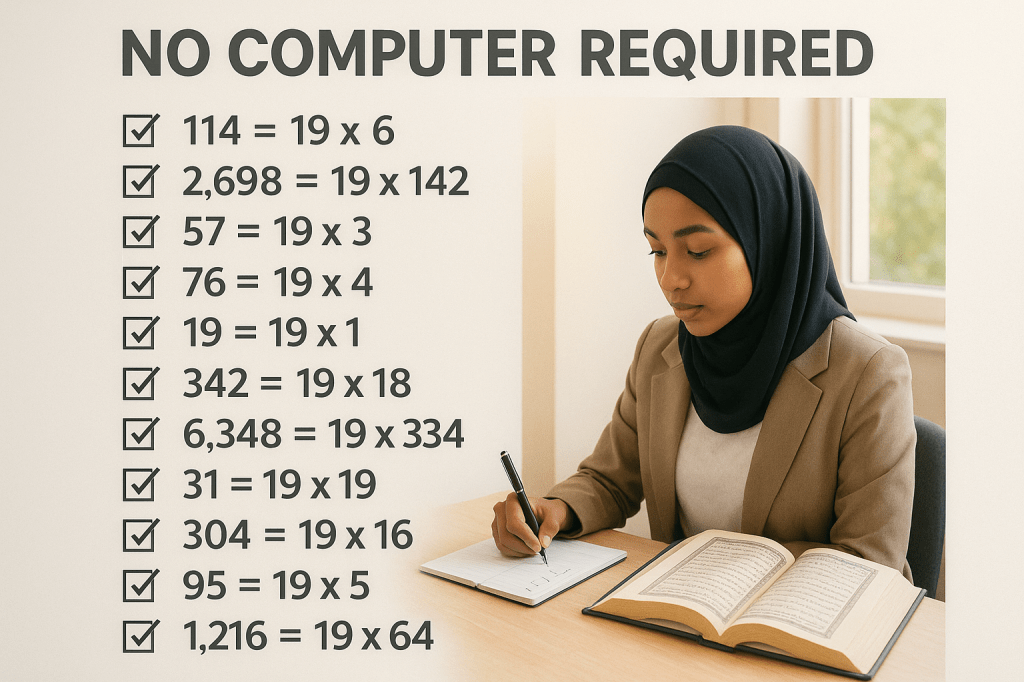
One of the most powerful features of Code 19 is that its foundational facts can be verified by any literate adult with a pen and a printed Quran. Rashad Khalifa — the messenger God chose to unveil the signature — repeatedly emphasised that the most devastating facts require no supercomputer, no advanced mathematics, no Arabic linguistics degree. They require only the willingness to count.
Below is the simple starting checklist. Anyone can run it in under an hour:
- The opening verse [1:1] — “In the name of God, Most Gracious, Most Merciful” — is composed of exactly 19 Arabic letters.
- The Quran contains exactly 114 chapters. 114 = 19 × 6.
- Chapter 96 — the first chapter ever revealed — contains exactly 19 verses.
- Chapter 96 is the 19th chapter from the end of the Quran.
- The first revelation (verses 96:1–5) is 19 words long, and those 19 words contain exactly 76 Arabic letters. 76 = 19 × 4.
- The word ism (“name”) occurs in the Quran exactly 19 times.
- The word Allah occurs exactly 2,698 times. 2,698 = 19 × 142.
- The word al-Rahman (“Most Gracious”) occurs exactly 57 times. 57 = 19 × 3.
- The word al-Raheem (“Most Merciful”) occurs exactly 114 times. 114 = 19 × 6.
- Chapter 9 is missing its opening Bismillah. Chapter 27 uniquely contains two Bismillahs (the second at 27:30). Between these two anomalies lies exactly 19 chapters — and the gap is restored precisely where expected.
- The initial letter “Q” appears in exactly two chapters (42 and 50). In each chapter the letter Q occurs exactly 57 times. 57 = 19 × 3. In both.
- The sum of all distinct chapter-and-verse numbers across the entire Quran totals 162,146. 162,146 = 19 × 8,534.
Rashad Khalifa captured the point in one of his lectures (at 16:36): “The first verse is 19 letters. The number of chapters is 114, 19 times 6. Is this simple enough? The first revelation was 19 words. The last revelation, 19 words. And these are very simple. They don’t require a computer. Is this difficult? A billion Muslims in the world, but none of them was allowed to find these very simple facts unless they have heard the Quran alone.” The scathing observation stands: the facts are trivial to count. What is missing is not intelligence. What is missing is willingness.
The messenger made the same point elsewhere (at 32:35): “Make them realize that there is a message from God. The first physical evidence in history. I’m going to share with you these simple but powerful facts. They’re very simple to understand, simple to present and simple to appreciate.” And again, reviewing the Basmalah’s four constituent words (at 8:10): “Every word, there are four words here, and every word is mentioned in the Quran a number of times, which is consistently a multiple of 19. The word ism, which means name, is mentioned in the Quran 19 times exactly. Allah is mentioned 2,698 times, or 19 times 142. Ar-Rahman is mentioned 57 times, or 19 times 3. Ar-Raheem 114 times, or 19 times 6.”
Part 6: Physical Facts vs Opinions — The Epistemic Upgrade
Why Code 19 is the Only “Indisputable” Miracle
Before 1974, every miracle attributed to the Quran was — to borrow Rashad Khalifa’s phrase — disputable. A Christian could read the Quran’s prophecies and attribute them to coincidence. A Hindu could admire its poetry and call it literary beauty. An atheist could examine its scientific allusions and say the translators had read modern findings back into ancient metaphor. Every category of argument for divine authorship could be defended, but also deflected. Belief was available; certainty was not. The messenger drew the contrast explicitly (at 1:42): “Well, this is the first physical evidence. The Quran is full of miracles, but all of them are disputable. The linguistic excellence, the scientific miracles, and all these things. The Quran is full of miracles, but the mathematical miracles are indisputable. It is physical, based on physical facts, like Bismillah ar-Rahman ar-Rahim being 19 letters, the number of chapters being 114. All these are physical facts, like the sun rising from the east. It is indisputable, unlike the previous miracles.”
The distinction he draws is not rhetorical — it is structural. A disputable miracle is one whose force depends on interpretation: how beautiful is this line of poetry, how scientific is this description, how improbable is this prophecy? Every such miracle lives on a spectrum. A physical miracle, by contrast, does not live on a spectrum. It is either true or false. The opening verse either has 19 letters or it does not. The word Allah either occurs 2,698 times or it does not. The number 2,698 is either divisible by 19 or it is not. Physical facts do not care about the reader’s mood, tradition, or theology. They are, as Rashad put it in a different lecture (at 30:07): “just as powerful as mathematics. So all of these are not anybody’s opinion. These are all physical facts. Every element in the Quran is mathematically structured far beyond human capability. The number of chapters, the number of verses, the numbers assigned, the frequency and occurrence of three key expressions, the number of words, the number of letters…”
And elsewhere (at 19:02): “Now you notice these are physical facts. Nobody is saying, in my opinion, the total of the numbers in the Quran is 162,146. It’s a physical fact. So this is a physical fact. It is nobody’s opinion. And all you need to do is find the numbers in the Quran and add them up.” This is the precise epistemic upgrade the Quran promised. Read alongside verse 41:53 — “We will show them our proofs in the horizons, and within themselves, until they realize that this is the truth” — the mathematical signature is the fulfilment of a scriptural promise made fourteen centuries earlier.
[41:53] “We will show them our proofs in the horizons, and within themselves, until they realize that this is the truth. Is your Lord not sufficient, as a witness of all things?”
The Arabic text of 41:53 contains, itself, exactly 19 Arabic letters in its key phrase and has a gematrical value of 1,387 = 19 × 73. The verse promising the proofs is itself stamped with the seal of the proofs. God did not leave the promise unguarded — He wrote the signature directly into the text that foretells the signature.
Part 7: Belief ≠ Submission ≠ Certainty
The Three-Tier Ladder of 49:14–15
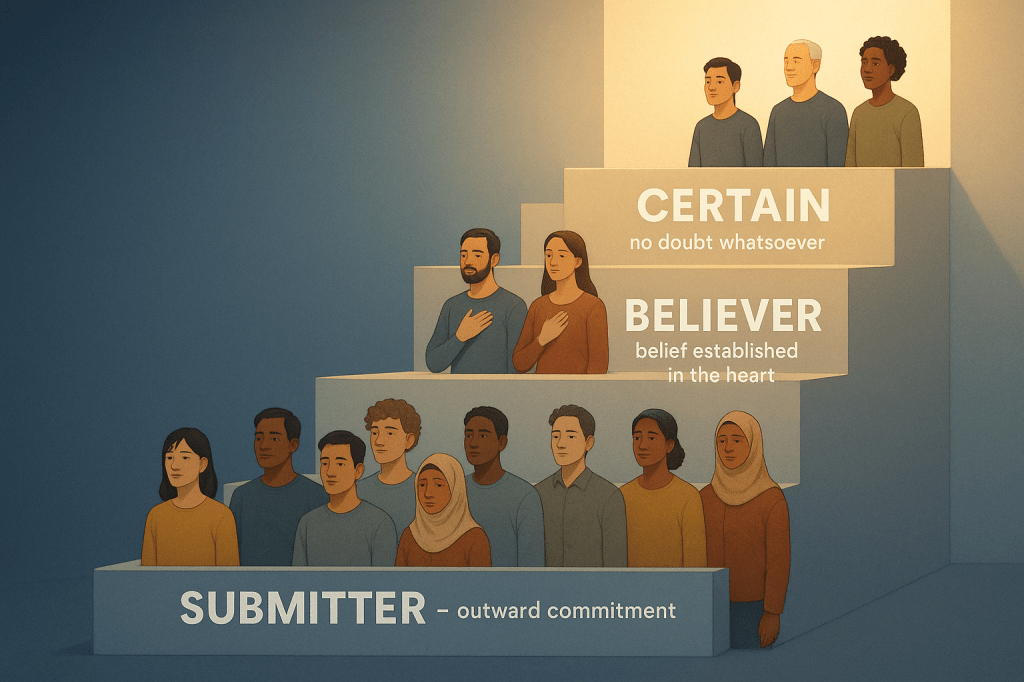
Once the epistemic distinction is clear, the Quran’s treatment of faith itself becomes sharply three-dimensional. Most religious traditions collapse “belief” into a single flat category — you either have it or you lack it. The Quran refuses that collapse. It explicitly distinguishes three states: submitter (one who accepts the outward commitment), believer (one whose heart has been penetrated by conviction), and certainty-attained (one in whom no doubt remains). The clearest statement of this ladder comes in chapter 49.
[49:14] “The Arabs said, ‘We are Mu’mens (believers).’ Say, ‘You have not believed; what you should say is, “We are Muslims (submitters),” until belief is established in your hearts.’ If you obey God and His messenger, He will not put any of your works to waste. God is Forgiver, Most Merciful.”
[49:15] “Mu’mens (believers) are those who believe in God and His messenger, then attain the status of having no doubt whatsoever, and strive with their money and their lives in the cause of God. These are the truthful ones.”
Read carefully: a tribe of Arabs claims the title believers, and God corrects them through His messenger. Begin by calling yourselves submitters. Belief must first be established in the heart. And what qualifies as real belief? Not mere profession, not repetition, not tradition — but the specific state of having no doubt whatsoever. In modern English we might translate “no doubt whatsoever” as certainty. The Quran’s technical definition of a true believer, then, is: a person in whom doubt has been extinguished. Rashad Khalifa stated this point with uncommon directness (at 1:14:28): “One of the functions of the miracle of Quran is to establish certainty, remove all doubts. So a person who understands the miracle of Quran will have no doubts. This is at 74:31. The difference between a submitter and a believer is the doubt. If there is doubt, the person is not a believer yet.”
Multiple other verses confirm the pattern. The Quran repeatedly describes the righteous as those who observe the Contact Prayers, give the obligatory charity, “and, as regards the Hereafter, they are absolutely certain.” It is not hope for the Hereafter, not believe in the Hereafter — but absolutely certain about it. The word is yaqeen. The level is non-negotiable.
[2:4] “And they believe in what was revealed to you, and in what was revealed before you, and with regard to the Hereafter, they are absolutely certain.”
[27:3] “Who observe the Contact Prayers (Salat), give the obligatory charity (Zakat), and they are, with regard to the Hereafter, absolutely certain.”
[31:4] “Who observe the Contact Prayers (Salat), give the obligatory charity (Zakat), and as regards the Hereafter, they are absolutely certain.”
Three separate chapters, three separate passages, one consistent definition. If the Quran’s righteous are defined by yaqeen, then the question every professed Submitter must ask is: have I reached it? And if not, by what road does one arrive? The answer is given in the same scripture that raises the question: through the physical, verifiable, mathematical signature that God announced in chapter 74.
Part 8: The Preemptive Rebuttal — “If Only a Sign Came”
Why “Give Me a Miracle” Is Not an Honest Request
Ask any modern skeptic what would convince them of God and many will answer: a miracle, a sign, something undeniable. The Quran anticipates this demand and deflates it in advance. Fourteen centuries before Code 19 was found, God dismissed the entire premise.
[6:109] “They swore by God, solemnly, that if a miracle came to them, they would surely believe. Say, ‘Miracles come only from God.’ For all you know, if a miracle did come to them, they would continue to disbelieve.”
This is a remarkable verse. God effectively says: do not take their oath seriously. They swear by My name that a miracle would convince them, but they are not telling the truth — not because they are lying deliberately, but because they misunderstand themselves. The honest response to a miracle requires a prior honesty in the soul that most demanding skeptics have not yet achieved. And the Quran shows this exact pattern playing out with every prior community: signs arrived, signs were seen, and signs were rejected anyway. The ancients did not reject the signs because the signs were weak. They rejected the signs because rejection was already in them before the sign arrived. The sign merely revealed what was already there.
[2:118] “Those who possess no knowledge say, ‘If only God could speak to us, or some miracle could come to us!’ Others before them have uttered similar utterances; their minds are similar. We do manifest the miracles for those who have attained certainty.”
Notice the ending. Miracles are not manifested in order to create certainty out of thin air — they are manifested for those who have attained certainty. Certainty is not a prize given to a skeptic who demands proof. It is a posture cultivated by the honest seeker who comes ready to see what is already there. This is why, even after Code 19 was published in peer-reviewed journals in the 1970s, most of the world’s religious scholars ignored or attacked it. Not because the evidence was weak. Because they were weak. Certainty does not come to those who approach miracles with a fist in the air. It comes to those who approach them with a pen in the hand.
Part 9: Exposing the Doubters — Function 5 of 74:31
When a Scholar Cannot Count to Nineteen
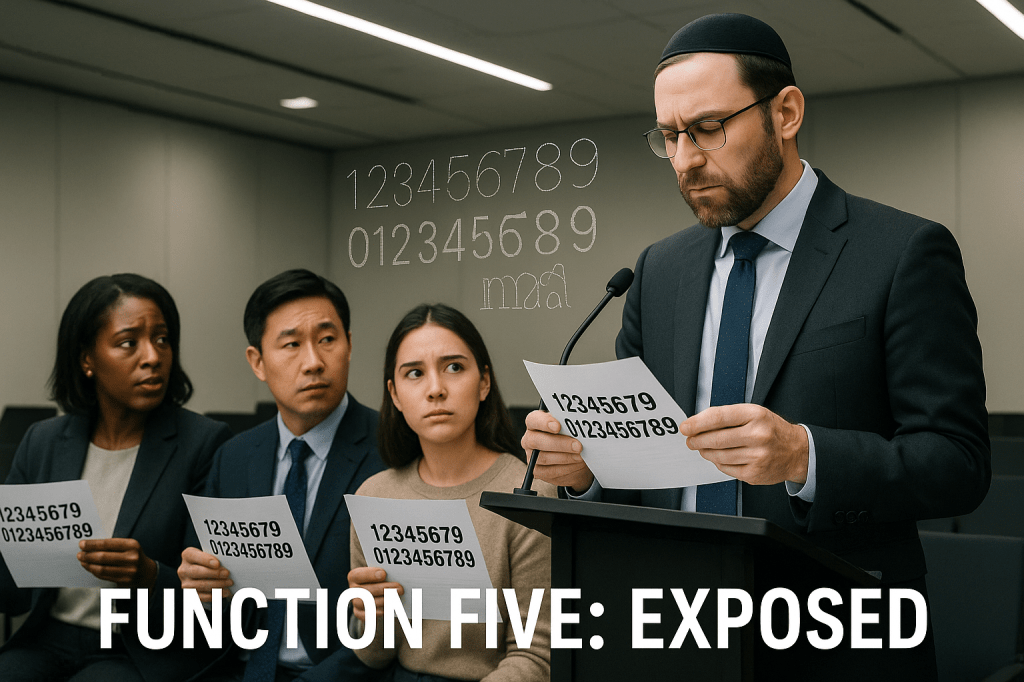
Among the five purposes God assigns to Code 19 in verse 74:31, the fifth is the most devastating: “to expose those who harbor doubt in their hearts, and the disbelievers; they will say, ‘What did God mean by this allegory?’” God is not merely predicting that people will reject the sign. He is explicitly exposing the rejectors through the sign. The miracle is a diagnostic tool. It sorts humanity not by intelligence, not by piety, not by literacy, but by honesty. And the sorting is brutal.
Rashad Khalifa told a story that has become a standard illustration among Submitters (at 0:21). A prominent religious scholar began his response to Code 19 by denying the most elementary fact: that the opening verse contains 19 Arabic letters. Rashad’s sister, present for the encounter, simply handed him a pen and asked him to write the verse and count the letters. He wrote 19 letters. Then — in front of her — “he started counting invisible letters.” Letters that were not on the page. Letters that had never been on the page. Letters that no Arabic-speaking child would ever count. He invented them in real time to avoid arriving at the number 19.
This is the point. Function 5 of the sign is not to enlighten the disbeliever — the disbeliever has rejected the enlightenment — but to expose him, to force him into a public position so absurd that anyone watching can see what is happening. A scholar counting invisible letters is not a scholar. He is an exposed man. His doctorate cannot save him. His fame cannot save him. His tradition cannot save him. The pen in his hand, the page in front of him, the 19 letters he just wrote, and the invisible letters he is now conjuring into existence all stand as silent witnesses against him.
The messenger extended the same principle to the question of tampering. He observed (at 5:17): “In the Quran, the discovery that came out of this mosque, we have no choice, we cannot manipulate the data. We have two verses initialed with the letter Q. We didn’t choose Q. The author of the Quran, almighty Allah, chose Q. You count the letter Q in chapter 42, and you have 57 Qs, 19 times 3. You count the letter Q in chapter 50, which is half as long as 42, and you also get the same number, 57, which is 19 times 3. We have proof that every letter in Quran, every word, was mathematically composed beyond human intelligence.” A human author writing a longer chapter and a shorter chapter cannot produce the same letter-count in both without either massive coincidence or supernatural control. The physical fact refutes every evasion.
Part 10: Certainty NOW vs Certainty TOO LATE
The Only Certainty That Matters Is the One Attained Before Death
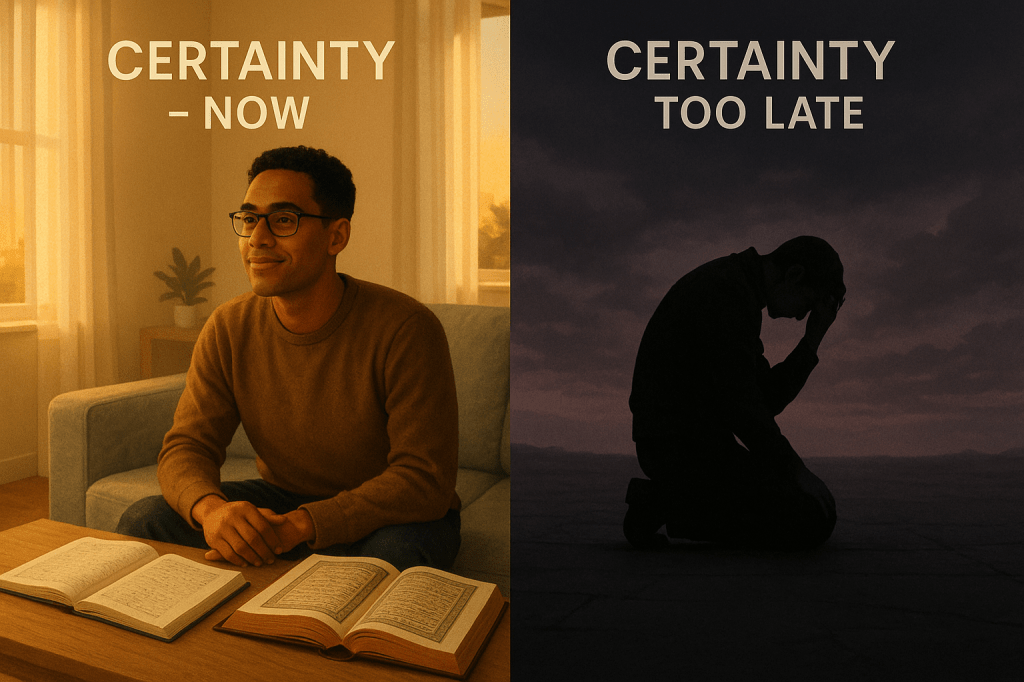
The Quran draws an agonising contrast between two kinds of certainty: the certainty a believer attains in this life, and the certainty a disbeliever is forced into after death. Both are real. Both are absolute. But only one is useful. Chapter 74 itself, the chapter that announces Code 19, quotes the damned lamenting in Hell:
[74:47] “‘Until certainty came to us now.’”
The phrase is devastating. Certainty came — now. After death. After the gates closed. After every opportunity to act on the truth had expired. The word yaqeen appears in the mouth of a soul who finally, irreversibly, knows — but whose knowing is too late to save anything. Compare the plea of the guilty standing before their Lord at the Resurrection:
[32:12] “If only you could see the guilty when they bow down their heads before their Lord: ‘Our Lord, now we have seen and we have heard. Send us back and we will be righteous. Now we have attained certainty.’”
Again the word: now we have attained certainty. The grammar is cruel. The verb is active. The attainment is real. The request — send us back — is denied. Certainty arrived; the time to use it did not. This is precisely the horror Code 19 is designed to avert. The entire mathematical signature exists so that certainty can be attained now, while the hands still work, while the pen still writes, while the feet can still walk in the direction of God. The scripture commands the Prophet directly:
[15:99] “And worship your Lord, in order to attain certainty.”
Certainty is the goal of worship. It is not a bonus gift for the elite. It is the designed endpoint of a correctly lived spiritual life. And God, knowing that the human heart left to its own devices will slide into speculation, dogmatism, or despair, has placed in His final scripture a mathematical signature — counted in letters, words, chapters, and verses — to ensure that any honest seeker can reach yaqeen while still alive. The damned get certainty too late. The righteous get it in time. Code 19 is the difference.
Part 11: The Mathematical Guarantee of Preservation
The Code Is Also the Preservation Mechanism
A book cannot be proved divine if its text has been altered. This is the first objection raised against every scripture: “How do you know it was not changed?” Christianity and Judaism confess, with varying degrees of openness, that their scriptures passed through layers of translation, redaction, and scribal error. The Quran, uniquely among the world’s sacred texts, claims that not one letter of its received text has been altered since revelation. That is an astonishing claim. And God Himself, in the scripture, pairs the claim with a guarantee.
[15:9] “Absolutely, we have revealed the reminder, and, absolutely, we will preserve it.”
The claim is easy to make. The guarantee is hard to enforce. Every book transmitted through human hands over fourteen centuries is a candidate for corruption. Scribes err. Editors meddle. Political regimes prefer certain readings. How, mechanically, does God preserve a text through fourteen centuries of human custodianship? The answer emerges only when Code 19 is uncovered. The mathematical signature is the preservation mechanism. Every letter, every word, every verse, every chapter is locked into a multiple-of-19 lattice. Remove a single letter from chapter 50 and the Q-count of 57 collapses. Remove a single word from the Basmalah and the total letter count of 19 breaks. Add a line to any chapter and the 114-chapter structure shatters. The text cannot be altered without the alteration announcing itself mathematically.
The Quran itself confirms that God has counted the numbers of all things:
[72:28] “This is to ascertain that they have delivered their Lord’s messages. He is fully aware of what they have. He has counted the numbers of all things.”
And elsewhere, challenging humanity to produce even a single chapter equal to the Quran’s composition:
[17:88] “Say, ‘If all the humans and all the jinns banded together in order to produce a Quran like this, they can never produce anything like it, no matter how much assistance they lent one another.’”
[2:23] “If you have any doubt regarding what we revealed to our servant, then produce one sura like these, and call upon your own witnesses against God, if you are truthful.”
[2:24] “If you cannot do this — and you can never do this — then beware of the Hellfire, whose fuel is people and rocks; it awaits the disbelievers.”
The challenge is rarely taken seriously because most readers do not understand what the challenge actually is. It is not a challenge to write Arabic prose. It is a challenge to produce a text in which every letter, every word, and every chapter count interlocks in a verifiable multiple-of-19 lattice — and which reads as coherent, consistent, and spiritually profound across twenty-three years of disparate historical circumstances. Poets can imitate poetry. Nobody can imitate a 114-chapter mathematically sealed scripture. And none has.
[4:82] “Why do they not study the Quran carefully? If it were from other than God, they would have found in it numerous contradictions.”
[10:37] “This Quran could not possibly be authored by other than God. It confirms all previous messages, and provides a fully detailed scripture. It is infallible; for it comes from the Lord of the universe.”
The mathematical signature and the textual preservation are the same phenomenon viewed from two angles. The Quran is preserved because the mathematical signature forbids corruption. And the mathematical signature is detectable because the text is preserved. God built into the text the means of its own proof-of-integrity — an architectural feat no human author could achieve and no human custodian could maintain without supernatural instruction.
Rashad Khalifa emphasised the same point in his lectures (at 3:47): “In the next fifty minutes or so I will share with you the real scientific discovery of a coded message from outer space, from deep space, and the message will represent the first physical evidence ever for the existence of God. We have been talking about God, and those who believe in God have been doing so on faith. Now we have physical evidence.” And again (at 0:10): “We’ve been fortunate to receive a message from God that is proven with tangible evidence, physical evidence, for the first time in history.” For the first time in history — not because God was silent before, but because no prior scripture was locked into a mathematical signature the way the Quran is. Earlier scriptures were meant to be believed. The Final Testament is meant to be known.
Part 12: The Five Purposes — Rashad’s Exposition of 74:31
Present Tense, Five Functions, One Epistemic Goal
One further linguistic point completes the picture of why Code 19 is the pivot between belief and knowing. Rashad Khalifa noted that the five functions listed in 74:31 are all written in the present tense in the original Arabic (at 41:32): “Verse 31 by itself, it is all in present tense. We made the guardians of hell angels, and we assigned their numbers 19. To disturb the disbelievers, to convince the Christians and Jews, the faith of the faithful, to remove all the traces of doubt, to expose those who harbor doubt in their hearts…” Present tense. Not past, not future, not conditional. The functions of Code 19 are not being completed — they are ongoing. Every time a sincere seeker counts the letters of the Basmalah, function 2 is activated. Every time a scholar counts invisible letters, function 5 is activated. Every time a doubter has a trace of doubt removed, function 4 is activated. The verse is not historical narration. It is live machinery.
Arrange the five functions against the three-tier ladder of certainty and the design becomes transparent:
- Function 1 — Disturb the disbelievers. The complacent non-believer cannot encounter Code 19 without cognitive disturbance. Their intellectual ease is broken. This is the opening move: shaking the dust off the mind so that genuine thought can begin.
- Function 2 — Convince the Christians and Jews that this is a divine scripture. This is the liyastayqina function. Those already committed to earlier scriptures are given a reason to recognise the seal of God on the Final Testament. Belief in the prior revelations is honoured by being elevated to certainty about the current one.
- Function 3 — Strengthen the faith of the faithful. Existing submitters, whose faith may have been tradition-based or inherited, have that faith strengthened. Weak belief is fortified into strong belief, and strong belief into certainty.
- Function 4 — Remove all traces of doubt. Not some doubts. All traces. The verb is exhaustive. This is the move from believer to certainty-attained in 49:15’s sense.
- Function 5 — Expose those who harbor doubt in their hearts, and the disbelievers. The diagnostic function. Hypocrisy cannot survive a test that can be run with a pen.
Every function operates on the single axis of doubt vs certainty. There is no function about beauty, no function about poetry, no function about piety, no function about reward. Code 19 has one mission and one only: to convert the world’s belief into knowledge. The number 19 is not a curiosity. It is the engineering specification of the bridge God built from iman to yaqeen.
Part 13: What You Do With Certainty
Knowing Is the Beginning, Not the End
It would be a mistake to imagine that attaining certainty is the finish line. In the Quran, yaqeen is a starting condition for a particular kind of life. Once the bridge is crossed and doubt is extinguished, a different mode of existence becomes possible — one defined by sustained striving, radical honesty, and the specific posture of one who is with regard to the Hereafter, absolutely certain. The first thing a certain believer does, according to verse 49:15, is “strive with their money and their lives in the cause of God.” Certainty is not inward luxury. It is outward fuel.
[39:9] “Is it not better to be one of those who meditate in the night, prostrating and staying up, being aware of the Hereafter, and seeking the mercy of their Lord? Say, ‘Are those who know equal to those who do not know?’ Only those who possess intelligence will take heed.”
[58:11] “O you who believe, if you are told, ‘Please make room,’ you shall make room for each other to sit. God will then make room for you. If you are asked to get up and move, get up and move. God raises those among you who believe, and those who acquire knowledge to higher ranks. God is fully Cognizant of everything you do.”
Notice how the scripture pairs belief and knowledge in 58:11. God raises, to higher ranks, those among you who believe, and those who acquire knowledge. Two categories, listed sequentially, both rewarded. The Submitter who merely believes is honoured. The Submitter who also knows — who has acquired the kind of certainty Code 19 supplies — is raised higher still. This is the practical payoff of the journey this article has described. Moving from tradition-based belief to mathematically-grounded certainty is not spiritual flourish. It is a specific, scripturally named rank, and those who attain it are elevated accordingly.
One final verse completes the picture:
[2:118] “Those who possess no knowledge say, ‘If only God could speak to us, or some miracle could come to us!’ Others before them have uttered similar utterances; their minds are similar. We do manifest the miracles for those who have attained certainty.”
Re-read the ending: we do manifest the miracles for those who have attained certainty. This is the most humbling line in the conversation. God does not scatter miracles as consolation for the doubtful. He manifests miracles for those who have already crossed the bridge. Certainty comes first; further miracles follow. The reader who walks through Code 19 honestly and attains yaqeen is not a person who has been spoon-fed evidence — they are a person who has become qualified to receive more. The door opens inward. Those who push on it find that behind it stands a larger door, and behind that a larger still, until the horizon itself is signs of God, exactly as 41:53 promised.
Conclusion: Count the Letters. Cross the Bridge.
The thesis of this article reduces to a single sentence. Every prior religion asked for faith; the Quran uniquely provides physical, mathematically verifiable evidence that converts belief into certainty. The scripture does not beg you to leap. It hands you a pen. The opening verse has 19 letters; the number of chapters is 19 times six; the first revelation is 19 words; the word Allah occurs 2,698 times, which is 19 times 142. These are not opinions. They are physical facts, as the messenger put it — as hard as the arithmetic of sunrise. You can dispute the beauty of a verse, the interpretation of a prophecy, or the flavour of a parable. You cannot dispute that 2,698 divides evenly by 19.
The buried verb liyastayqina in 74:31 names this entire project in God’s own Arabic: so that they may attain certainty. Not believe. Not hope. Not submit politely. Attain certainty. And the Quran, in verse 49:15, defines a true believer as one who has “attained the status of having no doubt whatsoever.” Belief without certainty is the Arab tribe in 49:14 that claimed the title and was corrected. Belief with certainty is the believer whose doubt has been extinguished by evidence that cannot be argued away. One is a profession; the other is a station. The difference, God tells us through the messenger, is Code 19.
The only question left, at the end of every article on this subject, is the one 74:37 asks directly: do you wish to advance, or regress? Certainty will come to every human being eventually. The damned in 74:47 attain it in Hell, “until certainty came to us now” — too late. The guilty in 32:12 attain it at the Resurrection, “now we have attained certainty” — too late. The only certainty worth having is the one attained while there is still time to act on it. Verse 15:99 names this goal as the very purpose of worship: “worship your Lord, in order to attain certainty.” That instruction was waiting in the scripture for fourteen centuries before the mathematical key to it was discovered in a mosque in Tucson, Arizona in 1974. It is no longer waiting. The key is on the table. The letters are on the page. The pen is in your hand. Count them, and cross the bridge.
If you want to study this further with other Submitters, or share the simple facts with someone you love, join the community at discord.gg/submission. The conversation has moved past faith alone. It has moved, as God always intended, into the country of yaqeen.


 Quran Only Studies
Leave a comment