Introduction: One Verse, Two Stories
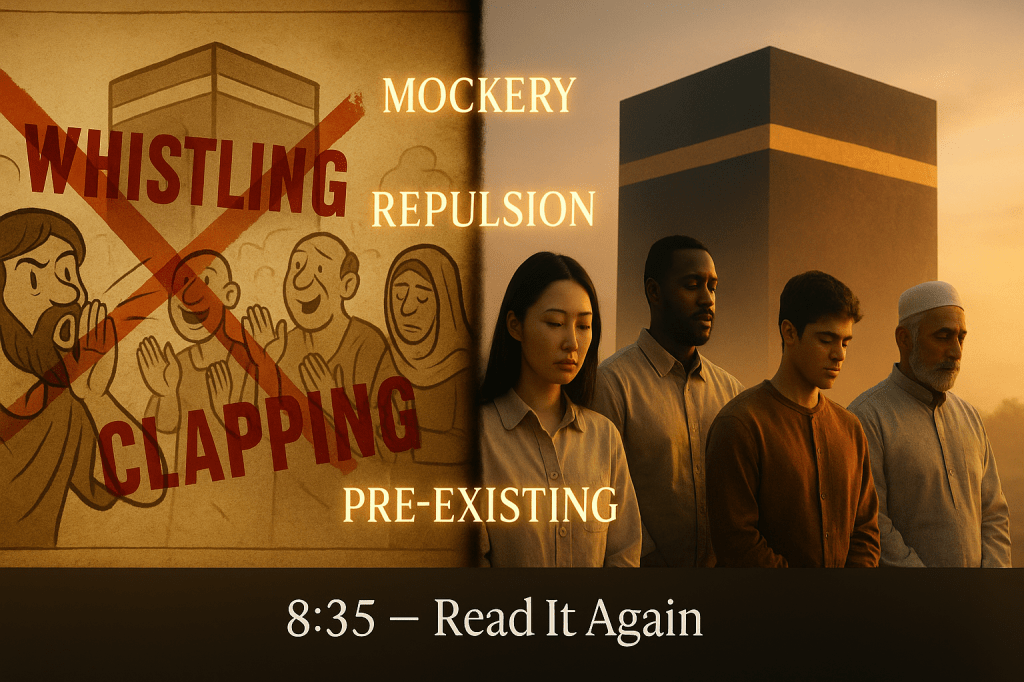
If you have read a traditional translation of chapter 8 of the Quran, you have almost certainly been told that verse 35 is about pagans whistling and clapping during the Prophet’s prayer. It is a curiously cartoonish image: grown men standing around a sacred shrine making percussion noises like petulant children at a school assembly. The picture is small, the polemic is shallow, and almost no one stops to ask what it has to do with the verses around it. The Sunni gloss of [8:35] as “their prayer was nothing but whistling and clapping” has been repeated for so long that it sounds like a settled fact. It is not.
This article argues two interlocking claims. First, the words traditionally rendered “whistling” (مُكَآء, mukā’) and “clapping” (تَصْدِيَة, taṣdiyah) do not mean those things in Quranic Arabic — they describe ostentatious self-display and the active repulsion of seekers from a sacred space. Second, and more devastatingly for the traditional reading, [8:35] proves that the Contact Prayer (Salat) already existed when the Quran was revealed. The disbelievers had a “salat” at the shrine. The Quran did not invent the rite; it inherited it from Abraham, exposed its corruption, and restored it. Once you see this, the verse stops being a cartoon and becomes one of the clearest pieces of evidence that Submission is not a seventh-century invention but the religion of Abraham, preserved through every generation that listened.
Part 1: What the Sunni Tradition Says — and What It Hides
The cartoon reading
The conventional translation of [8:35] reads, more or less: “Their prayer at the House was nothing but whistling and clapping; so taste the punishment for your disbelief.” Classical commentators spun this into a vignette about pagan Arabs at the Ka’bah making animal-noises during the Prophet’s prayer to mock him. Some narrations even add detail: men interlocking their fingers, whistling between them, clapping their hands. The image is vivid, but the textual support inside the Quran for any of this is precisely zero. Both alleged meanings are imported from outside the Quran and pinned onto two words that, by any honest lexical reading, do not denote what the gloss says they do.
The deeper problem is what this cartoon hides. If [8:35] is just a one-line snapshot of pagan rudeness, it has no obvious connection to the verse before it (about repelling seekers from the Sacred Mosque) or the verse after it (about disbelievers spending money to repel from God’s path). The traditional reading severs verse 35 from its neighbours and turns it into a stand-alone vignette. That isolation is not innocent. It allows the most explosive implication of the verse — that the disbelievers already had a recognised Contact Prayer at the shrine when the Quran came down — to be buried under an image of clowns making noise. The misread is not a small mistranslation. It is a load-bearing distortion.
What is actually at stake
The custodianship of the Sacred Mosque is the explicit theme of the surrounding passage. [8:34] opens by accusing the disbelievers of “repelling others from the Sacred Masjid, even though they are not the custodians thereof.” [8:36] closes by accusing them of spending wealth “to repel others from the way of God.” The whole passage is about who has the right to oversee the shrine and who is twisting access to it. [8:35] sits in the middle of that argument. It is not a parenthetical jokes-of-the-pagans aside; it is the heart of the indictment: their very prayer at the shrine was a tool of corruption.
If you accept that frame, the linguistic question becomes: what kind of corruption? Two options are on the table. The traditional reading says: noisy disruption (whistling and clapping). The reading we will defend says: ostentatious self-display and active repulsion of others from the sacred space. Only the second reading fits both the words themselves and the surrounding argument. The first reading, when examined, dissolves.
Part 2: The Three-Verse Chain — Repulsion, Not Percussion
The spine of 8:34–36
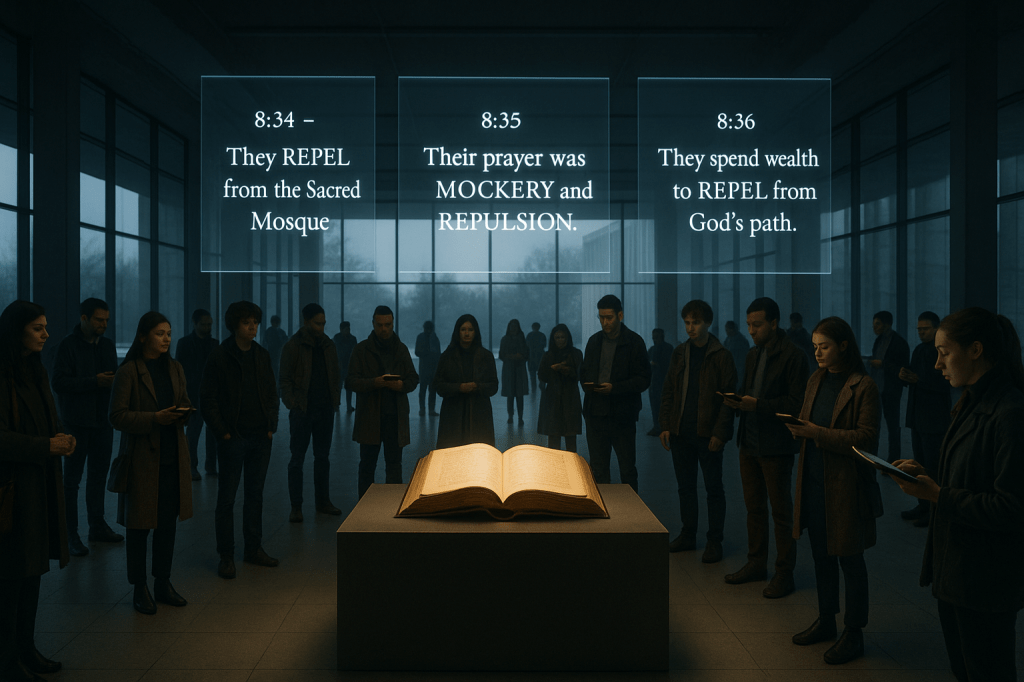
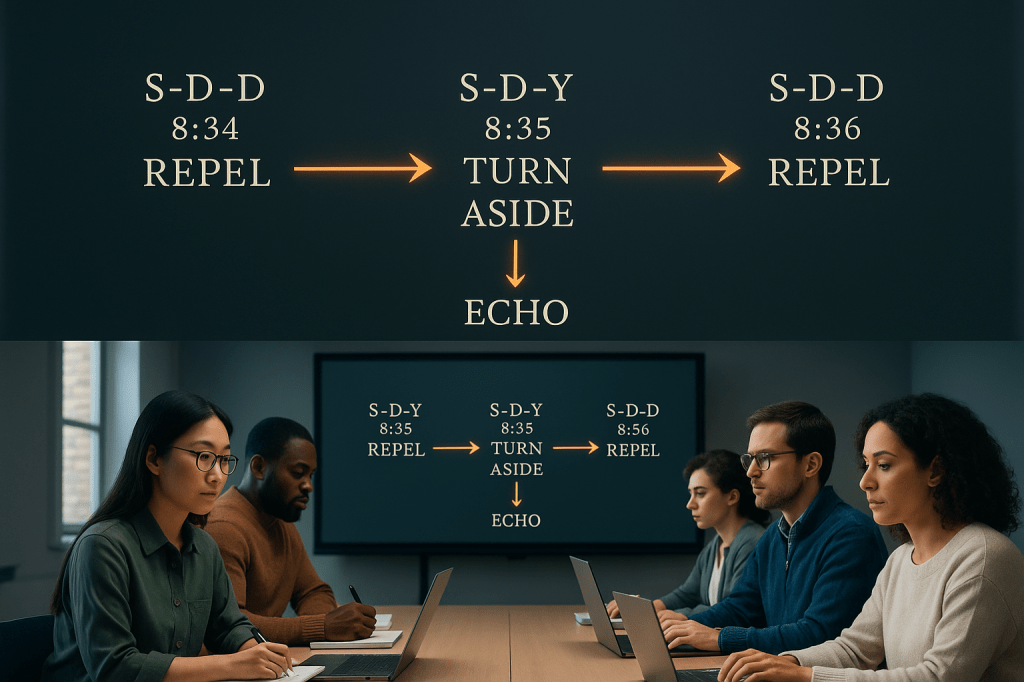
Read [8:34], [8:35] and [8:36] together and a single thematic spine emerges. Verse 34 names a crime: the disbelievers repel people from the Sacred Mosque. Verse 36 repeats the crime in financial terms: they spend their wealth to repel people from God’s path. Verse 35 sits between them and uses a closely related Arabic word from the same semantic family to describe the same action — but this time aimed at the act of prayer itself. The whole passage is one sustained accusation: you are not the guardians of this shrine; you have turned its very rites into a barrier.
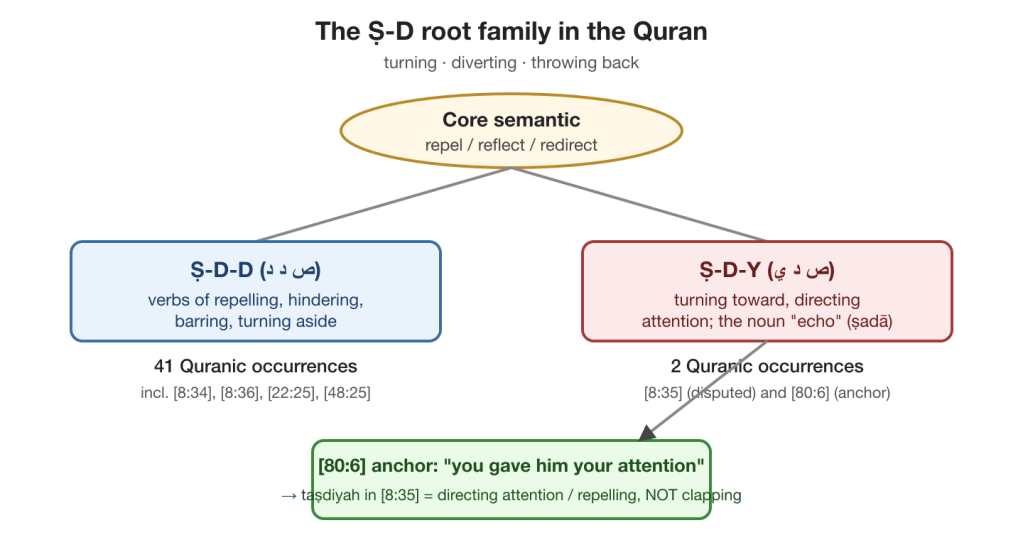
The Arabic verb in verses 34 and 36, يَصُدُّونَ / لِيَصُدُّوا, comes from the root Ṣ-D-D (ص د د) and means “to repel, hinder, turn aside.” The noun in verse 35, تَصْدِيَة, comes from the closely related root Ṣ-D-Y (ص د ي). Both are in the same Form-IV/V structural family, and classical lexicographers note that they share a core semantic of turning, diverting, throwing back. The classical noun ṣadā (صَدَى), meaning “echo,” comes from this root family precisely because an echo is sound thrown back from a barrier. Repulsion, reflection, redirection — that is the shared semantic core. The traditional gloss “clapping” lives in a totally unrelated semantic universe and breaks the chain that the surrounding verses work hard to establish.
[8:34] “Have they not deserved God’s retribution, by repelling others from the Sacred Masjid, even though they are not the custodians thereof? The true custodians thereof are the righteous, but most of them do not know.”
[8:35] “Their Contact Prayers (Salat) at the shrine (Ka’bah) were no more than a mockery and a means of repelling the people (by crowding them out). Therefore, suffer the retribution for your disbelief.”
[8:36] “Those who disbelieve spend their money to repel others from the way of God. They will spend it, then it will turn into sorrow and remorse for them. Ultimately, they will be defeated, and all disbelievers will be summoned to Hell.”
One coherent argument vs. one cartoon interruption
Notice what happens when you read the three verses with the natural meanings: the passage indicts the disbelievers for monopolising the shrine in three escalating ways. They physically repel seekers from the Sacred Mosque (verse 34). Their very rites at the shrine have decayed into ostentatious self-display that repels the sincere (verse 35). They even weaponise wealth to keep people off the way of God (verse 36). It is a single, escalating, devastating critique of religious establishment-corruption. Every verse pulls the same direction. Nothing is wasted.
Now read it with the cartoon gloss: they repel seekers from the mosque (verse 34); they whistle and clap for fun (verse 35); they spend wealth to repel from God’s path (verse 36). The middle verse becomes a non-sequitur — a tonally jarring pagan-prank vignette wedged between two grave indictments. The traditional reading does not just misrender two words; it destroys the literary and theological coherence of the passage. The right question is not “is the cartoon possible?” but “why would anyone choose the cartoon when the natural reading makes the whole passage sing?”
Part 2.5: The Statistical Witness — 43 Root Occurrences vs One Cartoon
Counting the evidence
The argument so far has been qualitative: the surrounding verses use Ṣ-D-D for “repel,” and the only other Ṣ-D-Y verse ([80:6]) means “give attention to.” Now make it quantitative. Search the entire Quran for every verse whose Arabic root analysis includes ص د د (Ṣ-D-D), and you find 41 distinct occurrences across 39 chapters. Search for ص د ي (Ṣ-D-Y) and you find exactly 2 occurrences: [8:35] itself and [80:6]. That gives a combined sample of 43 Quranic data-points for this root family. The question is: how many of them, in the Final Testament rendering, denote anything remotely like “clapping” or “whistling”? The answer is zero.
Every Ṣ-D-D verb in the Quran without exception means repel, repulse, divert, turn aside, hinder, block, or bar. The semantic field is unified, narrow, and unambiguous. A representative sample below shows the consistency. (You can verify the entire list yourself by searching verses_final.json or any concordance.)
| Verse | Root | Final Testament rendering (excerpt) |
|---|---|---|
| [2:217] | Ṣ-D-D | “repelling from the path of God…” |
| [3:99] | Ṣ-D-D | “why do you repel from the path of God those who wish to believe…” |
| [4:167] | Ṣ-D-D | “those who disbelieve and repel from the way of God have strayed far astray.” |
| [7:45] | Ṣ-D-D | “who repel from the path of God, and strive to make it crooked…” |
| [7:86] | Ṣ-D-D | “refrain from blocking every path, seeking to repel those who believe from the path of God…” |
| [8:34] | Ṣ-D-D | “by repelling others from the Sacred Masjid…” (verse before 8:35) |
| [8:35] | Ṣ-D-Y | “a mockery and a means of repelling the people…” (the disputed verse) |
| [8:36] | Ṣ-D-D | “spend their money to repel others from the way of God…” (verse after 8:35) |
| [9:9] | Ṣ-D-D | “they repulsed the people from His path…” |
| [9:34] | Ṣ-D-D | “many religious leaders and preachers take the people’s money illicitly, and repel from the path of God…” |
| [16:88] | Ṣ-D-D | “those who disbelieve and repel from the path of God, we augment their retribution…” |
| [20:16] | Ṣ-D-D | “do not be diverted therefrom by those who do not believe in it…” |
| [22:25] | Ṣ-D-D | “those who disbelieve and repulse others from the path of God, and from the Sacred Masjid…” |
| [34:32] | Ṣ-D-D | “are we the ones who diverted you from the guidance after it came to you?” |
| [43:62] | Ṣ-D-D | “let not the devil repel you; he is your most ardent enemy.” |
| [47:1] | Ṣ-D-D | “those who disbelieve and repel from the path of God, He nullifies their works.” |
| [48:25] | Ṣ-D-D | “it is they who disbelieved and barred you from the Sacred Masjid…” |
| [58:16] | Ṣ-D-D | “they used their oaths as a means of repelling from the path of God…” |
| [63:2] | Ṣ-D-D | “under the guise of their apparent faith, they repel the people from the path of God…” |
| [80:6] | Ṣ-D-Y | “you gave him your attention.” (the only other Ṣ-D-Y verse) |
The lone outlier is the gloss, not the Quran
Now invert the picture. Suppose, for the sake of argument, that the traditional gloss is correct — that [8:35]‘s taṣdiyah means “clapping.” What does that imply about the Arabic language of the Quran? It implies that across 43 occurrences of two closely related roots, the Quran uses them consistently to mean “repulsion” — except in this single verse, where the same root suddenly jumps to a totally unrelated meaning, “percussive striking of palms,” with no other supporting use anywhere in the text. That is not how a fully detailed scripture ([6:114]) communicates. That is what a forced reading looks like when its real motivation is doctrinal, not lexical.
The simplest hypothesis wins. The Quran uses Ṣ-D-D and Ṣ-D-Y consistently because it is a single coherent text. The ONE place a translator decides the meaning suddenly flips is the ONE place where the natural reading would be theologically inconvenient — the one place where the verse, read normally, says the disbelievers had a Salat at the shrine and the Quran came to expose its corruption. The pattern-break is not in the Quran. It is in the gloss.
Part 3: The Hapax and the Anchor — Word by Word
Mukā’ — a single appearance with no internal anchor
The first key word in [8:35] is مُكَآء (mukā’), from the root M-K-W (م ك و). It is what linguists call a hapax legomenon — a word that appears exactly once in the entire Quran. There is no other Quranic verse you can use to triangulate its meaning. Every claim about what it means must come from outside the Quran: from poetry, from later lexicons, from the classical commentaries that take “whistling” for granted. None of those external sources is binding on someone who treats the Quran as fully detailed and self-explanatory.
The Final Testament’s morphological gloss for mukā’ is “flamboyancy (mockery)” — ostentation, attention-grabbing display, a kind of religious peacocking. That sense fits the surrounding verses perfectly: people who use the rites of the shrine to put on a show, to broadcast their own status, to crowd the genuine seekers out by sheer theatrical bulk. It also fits the second half of the verse, which calls the whole performance a “mockery” of true worship. “Whistling,” by contrast, requires you to assume a behavioural scene the Quran nowhere describes and that the surrounding passage gives no reason to imagine.
Taṣdiyah — anchored by 80:6
The second key word is تَصْدِيَة (taṣdiyah), from the root Ṣ-D-Y (ص د ي). Unlike mukā’, this root is not a hapax — but its only other occurrence is decisive. The same root appears once more in the entire Quran, in [80:6], as the verbal form تَصَدَّىٰ (taṣaddā). And that verse has nothing whatsoever to do with clapping.
[80:6] “You gave him your attention.”
Chapter 80 is the famous rebuke of the Prophet for fawning on a wealthy unbeliever while ignoring a sincere blind seeker. Taṣaddā there means “to give attention to, to direct oneself toward, to turn one’s face deliberately to someone.” That is the only internal Quranic anchor we have for the root, and it is unambiguous. It describes directed attention, not percussive noise. Carry that meaning back into [8:35] and the picture sharpens: their prayer at the shrine was nothing but flamboyant self-display and a directing of attention onto themselves — the textbook profile of religious establishment that has hollowed out genuine devotion and turned it into a stage. Attention-stealing and seeker-repelling are two sides of the same coin: the more you crowd the centre with yourself, the more you push the sincere to the edges.
Part 3.5: The Quran’s Own Lexical Method — and Why the Cartoon Violates It
It might seem at this point that the dispute over [8:35] is a battle of competing linguistic schools — Submitter linguistics versus Sunni linguistics, with no neutral arbiter. It is not. The Quran itself takes a position on how its own words should be understood, and once you read those self-description verses, the entire methodological dispute resolves in one direction.
The Quran says it is fully detailed and self-explanatory
The Quran repeatedly insists, in its own voice, that it is complete, perfectly detailed, and intelligible from within. It does not direct readers to external sources to understand it. It claims to be its own lexicon.
[6:114] “Shall I seek other than God as a source of law, when He has revealed to you this book fully detailed?”
[16:103] “…this is a perfect Arabic tongue.”
[11:1] “A.L.R. This is a scripture whose verses have been perfected, then elucidated. It comes from a Most Wise, Most Cognizant.”
[41:3] “A scripture whose verses provide the complete details, in an Arabic Quran, for people who know.”
Read these together and the Quran’s stated lexical methodology becomes inescapable. A “fully detailed” book that “elucidates” itself in “perfect Arabic” is, by its own claim, a closed system: its terms are defined by its own usage, its difficult words are clarified by its own context, and its meanings are accessible to anyone who reads it carefully in Arabic. This is not a marginal claim about a few verses; it is what the Quran says it is.
The Quran explicitly rejects fabricated Hadith as a co-source
One verse goes further still. It does not just state the Quran’s self-sufficiency — it explicitly contrasts the Quran with Hadith and rejects the latter as a source of meaning.
[12:111] “In their history, there is a lesson for those who possess intelligence. This is not fabricated Hadith; this (Quran) confirms all previous scriptures, provides the details of everything, and is a beacon…”
Read that with the question of [8:35] in mind. The Quran provides “the details of everything.” It is “not fabricated Hadith.” It is the explicit and exclusive authority on its own meaning. To override what the Quran says about itself by importing a “whistling and clapping” gloss from later hadith narrations is to do precisely the thing [12:111] warns against — to treat fabricated Hadith as if it could correct or supplement what the Quran has said in plain Arabic.
Applying the method to mukā’ and taṣdiyah
Now the rigorous method follows. To determine what an unfamiliar Quranic word means, the Quran’s own claim to self-sufficiency requires us to look in this order:
- Other Quranic occurrences of the same root. If the root appears elsewhere, the meaning there is the binding internal anchor.
- The immediate textual context. Surrounding verses constrain meaning by topic, syntax, and cohesion.
- The morphological structure of the word itself. The Form (Form II, IV, V…) and pattern (active/passive, intensive, ostentation-of-action…) carry semantic information independently of any lexicon.
- Only as a last resort, classical Arabic usage outside the Quran. Any extra-Quranic usage that contradicts steps 1–3 must be rejected by virtue of [12:111].
Apply this hierarchy to [8:35]:
For مُكَآء (mukā’): Step 1 yields nothing — it is a hapax. Step 2 puts us in a passage about repelling people from the Sacred Mosque ([8:34]) and corrupting religious life with money ([8:36]); the immediate semantic field is theatrical religious corruption. Step 3 — the morphological pattern — yields a noun of intensive ostentatious action, naturally rendered as “ostentation, flamboyancy, attention-grabbing display.” Steps 1–3 converge on flamboyancy with no need for step 4 at all. The Final Testament’s morphological gloss in the verses_final.json database confirms this: mukā’ = “flamboyancy* (mockery)”.
For تَصْدِيَة (taṣdiyah): Step 1 yields exactly one anchor — [80:6] — where the same root means “to give attention to, to turn deliberately toward someone.” That is the binding internal evidence. Step 2 again places us in a passage of repulsion ([8:34] and [8:36] use the sister root Ṣ-D-D meaning “repel”). Step 3 — the morphological pattern — gives a noun of causation/intensity applied to the verb-stem, naturally yielding “a causing of repulsion / a directing of attention away or toward (oneself).” Once again, steps 1–3 converge: taṣdiyah = “a means of repelling / seeking attention”, exactly as the Final Testament morphological gloss puts it.
The cartoon gloss starts at step 4 and stays there
What does the traditional gloss “whistling and clapping” do? It skips steps 1, 2, and 3 entirely. It does not consult [80:6]. It does not respect the surrounding Ṣ-D-D verses. It does not engage the morphological structure. It goes straight to step 4 — extra-Quranic Bedouin usage and Hadith narrations — and pulls a behavioural image into the verse that the Quran’s own data-points actively contradict. The traditional reading is methodologically backwards from the very first move.
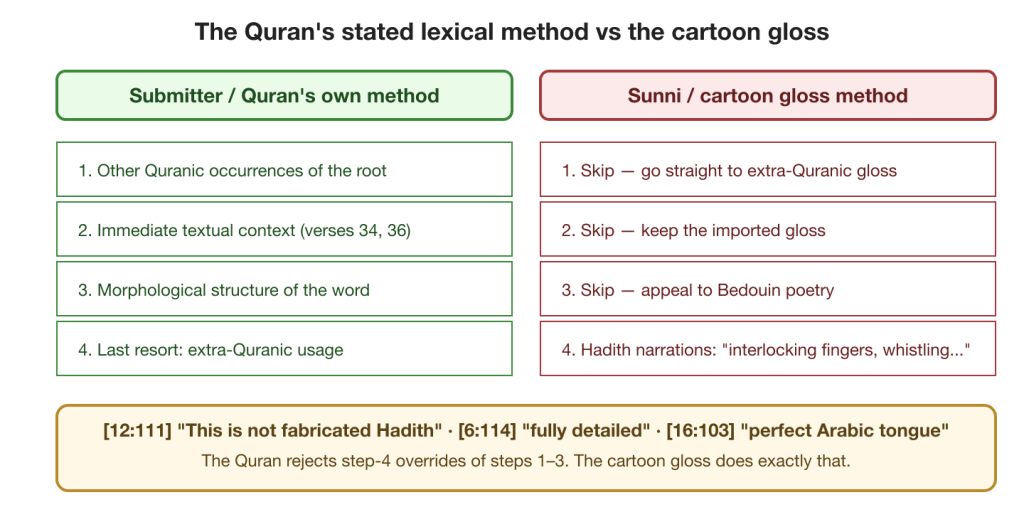
This is why the dispute over [8:35] is not just a contest between two readings. It is a contest between a reading that respects the Quran’s stated method and a reading that violates it. Once the reader sees that [12:111] explicitly forbids overruling the Quran with fabricated Hadith, the rhetorical question answers itself: which reading is more likely to be right — the one the Quran’s own grammar of self-description authorises, or the one that imports exactly the kind of source the Quran tells us not to import?
Part 4: The Echo (Ṣadā) Connection — A Beautiful Confirmation
What does sound do at a barrier?
There is a small linguistic gift hidden inside this discussion that traditional commentators tend to walk straight past. The classical Arabic noun for “echo” is صَدَى (ṣadā) — and it comes from the same root family as the taṣdiyah of [8:35]. Think about what an echo physically is: a sound that travels outward, hits an obstacle, and is thrown back toward the source. Echoing, repelling, redirecting, turning aside — these are not separate concepts but variations on a single physical and semantic pattern.
Once you see this, the root’s logic becomes effortless. Taṣdiyah in [8:35] describes worship that has become a barrier: instead of letting devotion travel inward and upward, it bounces seekers back, like sound off a wall. The disbelievers’ “prayer” at the shrine was an echo-chamber of self — performance amplifying performance, attention bouncing back to the performers, sincere outsiders unable to penetrate. That is what the verse says. The cartoon gloss “clapping” not only misses the meaning, it loses the elegance: the Arabic itself is teaching us, through the deep architecture of its roots, what religious corruption actually does to a sacred space.
Why the cartoon must die
Place the four pieces of evidence side by side. (1) The verb in [8:34] is from Ṣ-D-D and means repel. (2) The verb in [8:36] is from Ṣ-D-D and means repel. (3) The only other Quranic occurrence of Ṣ-D-Y, in [80:6], means give attention to / turn toward. (4) The classical noun ṣadā (“echo”) comes from this root family and means that which is thrown back from a barrier. Every Quranic and lexical signal points to turning, redirection, repulsion, attention-stealing. None point to clapping. The cartoon survives only because no one was supposed to look this closely.
And once it dies, the verse opens. We are no longer reading a snapshot of pagan rudeness. We are reading a Quranic indictment of religious establishments who use the rites of a sacred shrine to display themselves and crowd out the sincere — an indictment that, with very small adjustments, is uncomfortably contemporary.
Part 5: 8:35 Itself Proves Salat Predates the Quran
The disbelievers already had a “salat”
Now consider the most explosive feature of [8:35], the one the cartoon reading is built to obscure. The verse does not say the disbelievers were doing something the Quran has not yet defined. It uses the exact word the Quran will use a hundred more times for the believers’ rite: صَلَاتُهُمْ (their salat). The corrupters had a “salat” at the Ka’bah. The Quran is not introducing salat to a people who had never heard of it; it is rebuking a people who had a salat and had degraded it.
The Final Testament’s footnote on this very verse is unambiguous: “All religious practices in Submission came to us through Abraham; when the Quran was revealed, all rites in ‘Submission’ were already in existence.” Read against this footnote, [8:35] is no longer obscure — it is structurally crucial. It is one of the cleanest pieces of internal evidence that the Quran inherits Salat from a previous tradition (the Abrahamic line) and is engaged in correcting its corruption, not founding it from scratch. The cartoon reading exists to bury this implication. The natural reading reveals it.
“Mockery” only makes sense if there is a real thing being mocked
There is one more nail. The verse calls their prayer at the shrine a “mockery.” A mockery is, by definition, a distortion of something real. You cannot mock a rite that does not exist. If the disbelievers’ “salat” had no relation whatever to a recognised Abrahamic Contact Prayer, the word “mockery” would be meaningless. The Quran’s own choice of vocabulary assumes a genuine, prior, recognisable rite — and tells us that what the corrupters were doing fell short of it.
That is the exact opposite of how an inventor of a new religion would speak. An inventor would say: “they have no prayer at all; here is the one I bring.” The Quran says, instead: “their prayer was nothing but a mockery — go back to the original, the religion of your father Abraham.” This is the language of restoration, not invention.
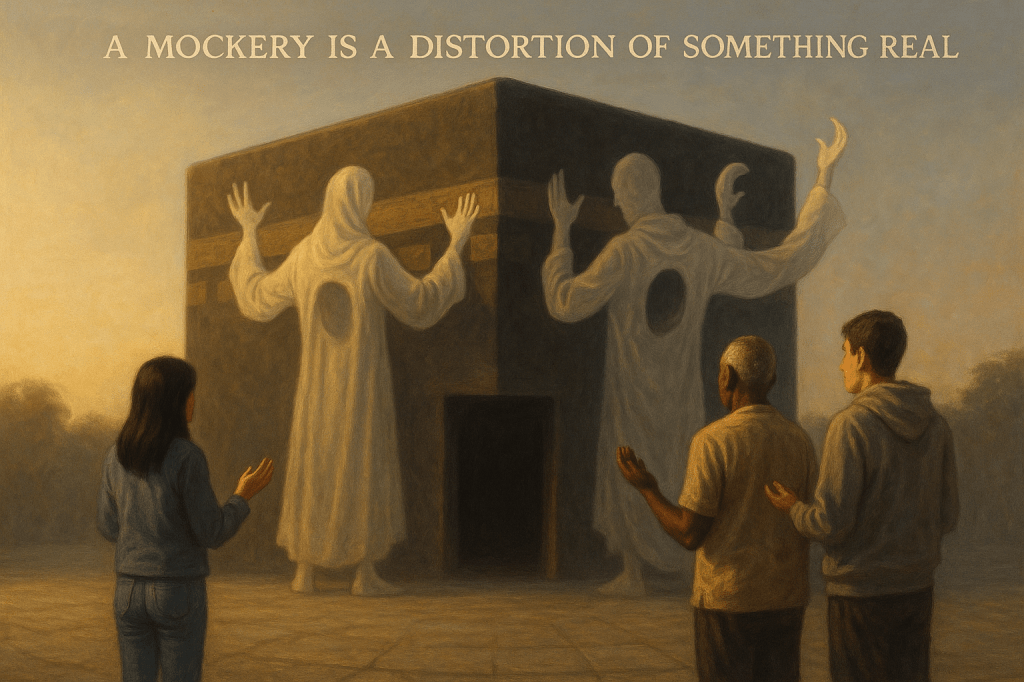
Part 5.5: The Quran’s Wider Guardianship Doctrine — [8:35] Read in Cluster
The argument so far has treated [8:34–36] as a tight three-verse passage. That is correct, but it is also incomplete. The Quran has an entire doctrine about who the rightful custodians of the Sacred Mosque are, scattered across multiple chapters, and [8:34–36] sits inside that doctrine. Reading the broader cluster sharpens the case against the cartoon and supplies independent confirmation that the disbelievers’ “Salat” at the shrine in [8:35] was the corrupted Abrahamic rite, not a brand-new gimmick.
[9:17–19] — who is allowed to frequent God’s masjids
Chapter 9 makes the guardianship doctrine explicit. The disbelievers are disqualified from frequenting masjids, and the rightful frequenters are defined positively.
[9:17] “The idol worshipers are not to frequent the masjids of God, while confessing their disbelief…”
[9:18] “The only people to frequent God’s masjids are those who believe in God and the Last Day, and observe the Contact Prayers (Salat), and give the obligatory charity (Zakat), and do not fear except God. These will surely be among the guided ones.”
[9:19] “Have you considered the watering of the pilgrims and caring for the Sacred Masjid a substitute for believing in God and the Last Day, and striving in the cause of God? They are not equal in the sight of God…”
Read [9:18] with care. The Quran does not just say “believers may attend the masjid”; it says the only people who should frequent God’s masjids are those who observe the Contact Prayer and give the obligatory charity. The criterion is behavioural, not declarative. And the criterion is exactly the practice that [8:35]‘s disbelievers had — but in a corrupted form. The Quran’s wider doctrine treats Salat as the qualifying signature of a rightful Sacred-Mosque attendee. The disbelievers were attempting to fake the qualification while inverting its substance: they were performing a Salat-shaped activity that was actually a vehicle of repulsion. That is precisely the indictment in [8:35].
[22:25–27] — Abraham as the original custodian
Where does this guardianship right come from? [22:25–27] traces it back to Abraham himself.
[22:25] “Surely, those who disbelieve and repulse others from the path of God, and from the Sacred Masjid that we designated for all the people—be they natives or visitors—and seek to pollute it and corrupt it, we will afflict them with painful retribution.”
[22:26] “We appointed Abraham to establish the Shrine: ‘You shall not idolize any other god beside Me, and purify My shrine for those who visit it, those who live near it, and those who bow and prostrate.’”
Notice the precision. [22:25] uses the same Ṣ-D-D root we saw in [8:34] and [8:36] — the disbelievers “repulse others from the path of God, and from the Sacred Masjid.” It also accuses them of seeking “to pollute it and corrupt it.” That is the same indictment [8:35] makes about their corrupted Salat at the shrine. [22:26] then names the original custodian: Abraham, appointed to purify the shrine specifically “for those who bow and prostrate” — the universal physical signature of the Contact Prayer.
The architecture of the doctrine is now clear. The Sacred Mosque has a divinely-instituted purpose: to host Contact Prayer in the tradition of Abraham. The rightful guardians are believers who observe Salat. The disbelievers were violating both the structural purpose of the shrine and the qualifying behaviour of its rightful custodians — and their corrupted Salat in [8:35] is the visible symptom of that double violation. None of this fits a “Muhammad invented Salat” reading; all of it fits the Submitter framework.
The cluster reading of [8:35]
Now place [8:34–36] back inside this wider cluster. [22:26] establishes the Abrahamic foundation: shrine custodianship is for those who “bow and prostrate.” [9:18] establishes the qualifying behaviour: the only people who should frequent God’s masjids are Salat-observers. [8:34] says the disbelievers are not the rightful custodians. [8:35] says their attempted “Salat” at the shrine had degenerated into ostentation and repulsion. [8:36] says they spend wealth to repel from God’s path. [22:25] says such people will face painful retribution. The whole apparatus aligns into one coherent argument: the Sacred Mosque is the place of Abrahamic Contact Prayer; the disbelievers had inherited a corrupted version; the Quran indicts the corruption and restores the original.
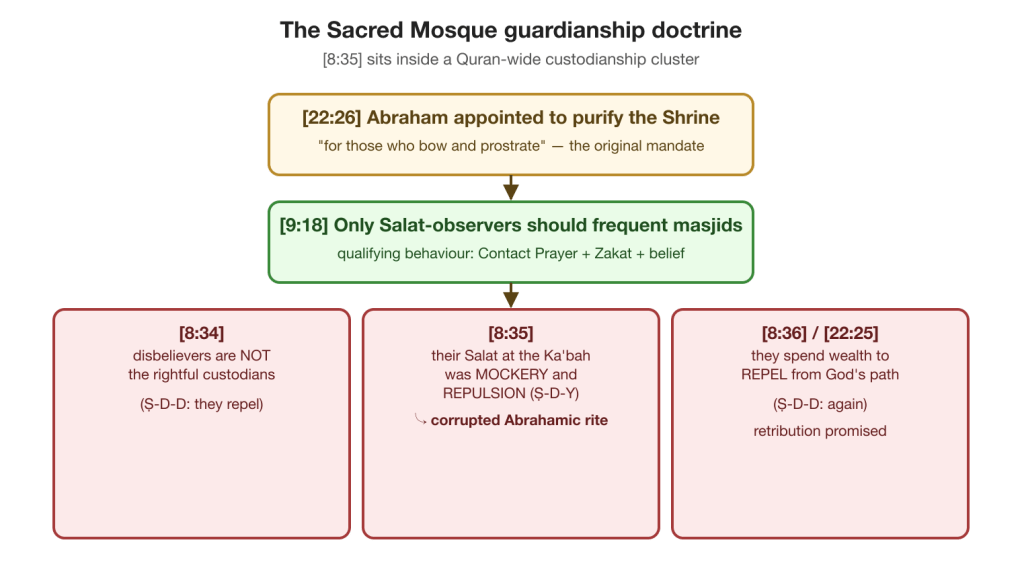
This cluster reading is fatal to the cartoon. The cartoon needs [8:35] to be a free-standing pagan-prank vignette — disconnected from [9:18]‘s qualifying-behaviour rule, disconnected from [22:26]‘s Abrahamic mandate, disconnected from [22:25]‘s retribution-against-shrine-corrupters. But the verses are not disconnected. They form a single doctrine about the Sacred Mosque, and [8:35] sits inside that doctrine as the named instance of the corrupted-Salat the doctrine is built to indict. To preserve the cartoon, you have to break a fourth set of cross-chapter connections (the guardianship cluster) on top of all the others. The structural cost climbs again. The Submitter reading pays no such cost.
Part 6: The Patriarchal Chain — Abraham to Jesus to Muhammad
Abraham: the founder of the rite
If the Quran inherits Salat rather than inventing it, where does the rite come from? The Quran is unambiguous: from Abraham. He is named, by God’s own voice, as the patriarch through whom the duties of Submission were transmitted. He raised the foundations of the shrine, settled his family in its valley, and prayed that his descendants would maintain the Contact Prayer there generation after generation.
[14:37] “Our Lord, I have settled part of my family in this plantless valley, at Your Sacred House. Our Lord, they are to observe the Contact Prayers (Salat), so let throngs of people converge upon them, and provide for them all kinds of fruits, that they may be appreciative.”
[14:40] “My Lord, make me one who consistently observes the Contact Prayers (Salat), and also my children. Our Lord, please answer my prayers.”
[22:26] “We appointed Abraham to establish the Shrine: ‘You shall not idolize any other god beside Me, and purify My shrine for those who visit it, those who live near it, and those who bow and prostrate.’”
[21:73] “We made them imams who guided in accordance with our commandments, and we taught them how to work righteousness, and how to observe the Contact Prayers (Salat) and the obligatory charity (Zakat). To us, they were devoted worshipers.”
The pattern is impossible to miss. Abraham is settled at the Sacred House so that his family will observe the Contact Prayer. He prays for himself and his children to be steadfast in it. God appoints him to establish and purify the shrine specifically for those who “bow and prostrate” — the universal physical signature of Contact Prayer. And [21:73] states it most directly of all: God taught the patriarchs how to observe Salat and Zakat. The rite is divinely transmitted, and its earliest named human transmitter is Abraham.
Ishmael, Moses, Jesus, Zachariah
The chain runs forward through every major prophet the Quran names. Ishmael, Abraham’s son and co-builder of the shrine, “used to enjoin his family to observe the Contact Prayers.” Moses, on the burning-bush mountain, is told to worship God alone and “observe the Contact Prayers to remember Me.” Jesus, in the cradle, declares that God enjoined him to observe the Contact Prayers and the obligatory charity for as long as he lives. Zachariah is found by the angels “praying in the sanctuary” when they bring him the news of his son.
[19:55] “He used to enjoin his family to observe the Contact Prayers (Salat) and the obligatory charity (Zakat); he was acceptable to his Lord.”
[20:14] “I am God; there is no other god beside Me. You shall worship Me alone, and observe the Contact Prayers (Salat) to remember Me.”
[10:87] “We inspired Moses and his brother. ‘Maintain your homes in Egypt for the time being, turn your homes into synagogues, and maintain the Contact Prayers (Salat). Give good news to the believers.’”
[19:31] “He made me blessed wherever I go, and enjoined me to observe the Contact Prayers (Salat) and the obligatory charity (Zakat) for as long as I live.”
[3:39] “The angels called him when he was praying in the sanctuary: ‘God gives you good news of John; a believer in the word of God, honorable, moral, and a righteous prophet.’”
Five prophets, five centuries apart, all observing what the Quran calls by the same name: Salat. The rite is older than any of the books we have received. It is older than Hebrew scripture, older than the Gospels, older than Muhammad. To say “Muhammad brought us the Contact Prayer” is, by the Quran’s own testimony, historically backwards.
The Children of Israel and the universal covenant
The chain extends past prophets to entire communities. The covenant with the Children of Israel is repeatedly framed around the same two duties — Contact Prayer and obligatory charity — as if these were the recognised baseline of any people in covenant with God.
[2:43] “You shall observe the Contact Prayers (Salat) and give the obligatory charity (Zakat), and bow down with those who bow down.”
[2:83] “We made a covenant with the Children of Israel: ‘You shall not worship except God. You shall honor your parents and regard the relatives, the orphans, and the poor. You shall treat the people amicably. You shall observe the Contact Prayers (Salat) and give the obligatory charity (Zakat).’ But you turned away…”
[5:12] “God had taken a covenant from the Children of Israel, and we raised among them twelve patriarchs. And God said, ‘I am with you, so long as you observe the Contact Prayers (Salat), give the obligatory charity (Zakat)…’”
Note the grammatical assumption baked into every one of these verses. God does not say to the Children of Israel, “I am sending you a new rite called Salat.” He says, “continue the Salat — keep the covenant you already know.” The same is true of the universal call in [22:78]: this is “the religion of your father Abraham,” not the religion of any later messenger. Muhammad’s role, as the Quran will repeatedly say, is to be inspired to follow Abraham’s religion — not to start a new one.
[22:78] “…the religion of your father Abraham. He is the one who named you ‘Submitters’ originally…”
[16:123] “Then we inspired you (Muhammad) to follow the religion of Abraham, the monotheist; he never was an idol worshiper.”
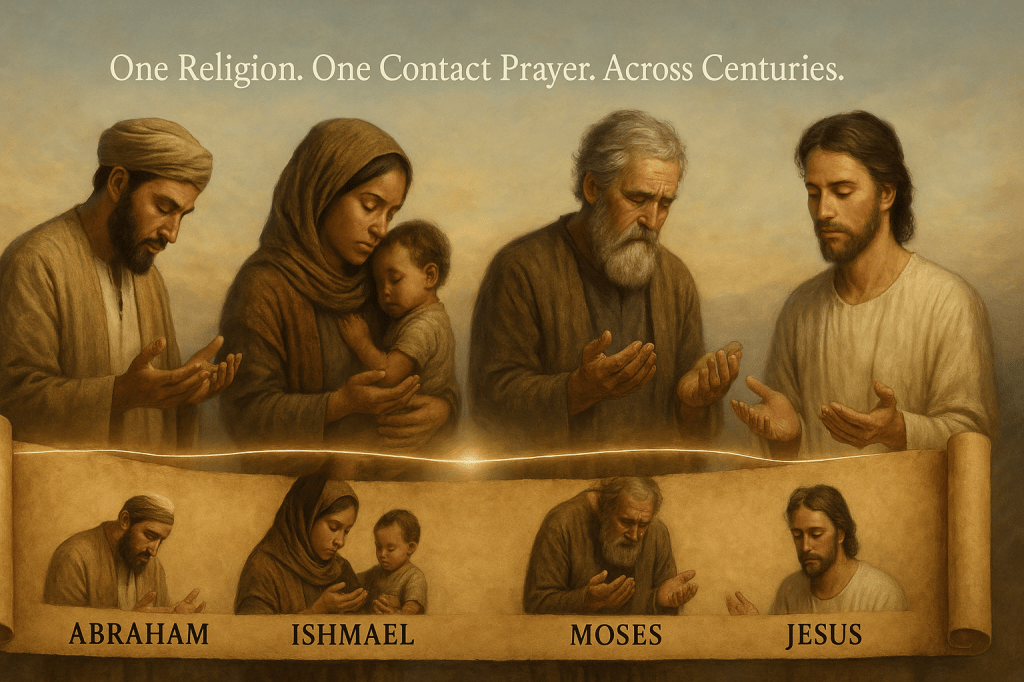
Part 6.5: The Inheritance Timeline — Visualising the Chain
The strongest argument for an inherited rite is sometimes the simplest: time depth. The Sunni position implicitly asks the reader to believe that in the early seventh century of the Common Era, in a single Arabian prophetic ministry of about twenty-three years, a brand-new ritual called Salat was instituted with such precision that 1.8 billion people would still be performing it today. Now look at the Quran’s own chronology. The Contact Prayer is named, by God’s own voice, in the lives of patriarchs and prophets stretching back almost four thousand years before Muhammad — and the Quran also tells us about the gap, the loss, and the corruption that came in between. The diagram below maps the chain.
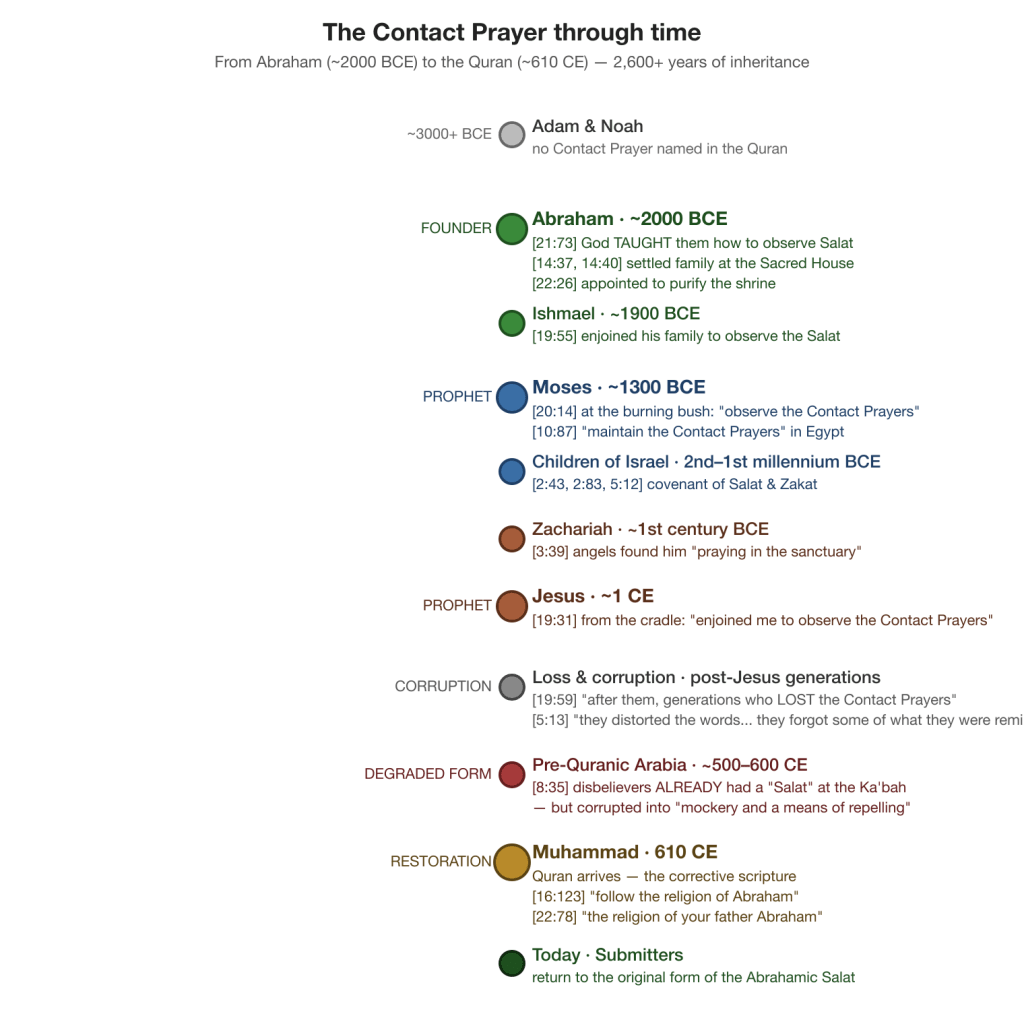
Read the timeline carefully. There is no node that says “Muhammad introduces a new rite called Salat.” Every node before him already has it; every Quranic data-point about the surrounding Arabian society shows it already corrupted, lazy, or partially lost. When the Quran arrives, it does not bring a new prayer to a praying-less people; it brings a corrective scripture to a praying-but-decayed people. [8:35] is therefore not the only verse the cartoon gloss has to silence — it has to silence the entire chronology. That is too many verses to silence. The timeline holds.
One small but important addition to the chain: [5:13]. After establishing that God took a covenant of Salat from the Children of Israel ([5:12]), the very next verse describes what they did with it: “It was a consequence of their violating the covenant that we condemned them, and we caused their hearts to become hardened. Consequently, they took the words out of context, and disregarded some of the commandments given to them…” The covenant that included Salat was broken. The pattern of “given the Contact Prayer → covenant violated → forgetting set in” is exactly what [19:59] describes for the post-Jesus generations and exactly what [8:35] shows happening at the Ka’bah itself. The corruption phase is not a marginal sub-claim of the Submitter position; it is repeatedly affirmed by the Quran in different chapters about different communities.
Part 6.6: The Final Testament Footnote Cluster — Four Verses Whose Footnotes Lock the Case
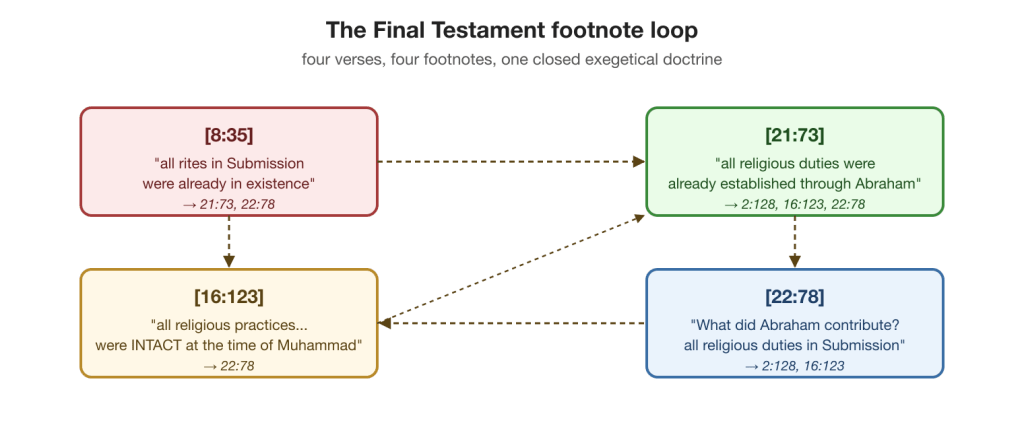
Before moving from the historical case to the absence-of-mechanics case, it is worth pausing on a feature of the Final Testament many readers skip past: the footnotes. Rashad Khalifa’s footnotes on the four pivot-verses of this entire dispute ([8:35], [21:73], [22:78], and [16:123]) are themselves part of the Submitter exegetical record, and they say in plain language what this article has been arguing across many sections. Read them as a cluster.
[8:35] — the disputed verse
Footnote on [8:35]: “All religious practices in Submission came to us through Abraham; when the Quran was revealed, all rites in ‘Submission’ were already in existence (21:73, 22:78).”
The footnote does not gloss “whistling and clapping.” It does the opposite. It pivots away from the cartoon entirely and identifies the verse as evidence that all rites of Submission were already in existence. Anyone reading the Final Testament should immediately notice the asymmetry: the verse is rendered as a corrupted-Salat-at-the-shrine, the footnote treats it as a piece of pre-Quranic-Salat evidence. The two pieces fit together exactly as the Submitter case requires.
[21:73] — God taught the patriarchs
Footnote on [21:73]: “When the Quran was revealed, all religious duties were already established through Abraham (2:128, 16:123, 22:78).”
This is the verse that says God taught the patriarchs how to observe the Contact Prayer. The footnote drives the implication home: the religious duties — including Salat — were already established by the time the Quran arrived. The footnote names three further confirming verses ([2:128], [16:123], [22:78]), turning a single statement into a cross-referenced doctrine. The Submitter who reads only the body of the Final Testament is already convinced; the Submitter who reads the footnotes finds the doctrine spelled out.
[22:78] — what did Abraham contribute?
Footnote on [22:78]: “Although all messengers preached one and the same message, ‘Worship God alone,’ Abraham was the first messenger to coin the terms ‘Submission’ (Islam) and ‘Submitter’ (Muslim) (2:128). What did Abraham contribute to Submission (Islam)? We learn from 16:123 that all religious duties in Submission were revealed through Abraham (see Appendices 9 & 26).”
This is the most important footnote of the four. Read it carefully. The footnote asks the very question a Sunni objector might raise: What did Abraham contribute to Submission? And it answers, in the Final Testament’s own voice: all religious duties in Submission were revealed through Abraham. Not a subset. Not an early version. All. That is the most explicit statement of the Submitter doctrine in the Final Testament’s exegetical apparatus, and it is anchored to [16:123]‘s claim that Muhammad was inspired to follow the religion of Abraham. The cartoon reading of [8:35] cannot survive contact with this footnote, because the footnote already names the disbelievers’ “Salat” at the Ka’bah as part of the Abrahamic inheritance the Quran is correcting.
[16:123] — Muhammad’s role
Footnote on [16:123]: “This informs us that all religious practices, which came to us through Abraham, were intact at the time of Muhammad (see 22:78 and Appendix 9).”
Note the strength of the word intact. The footnote does not say the Abrahamic religious practices were “lost and waiting to be restored from scratch by Muhammad.” It says they were intact at the time of Muhammad — present, identifiable, transmitted through whatever line of preservation God ordained. The Quran’s role, as the Final Testament repeatedly insists, is correction of distortion and re-anchoring of the original — not founding from rubble.
The four footnotes form a closed exegetical loop
Lay the four footnotes side by side and watch them cross-reference each other. [8:35]‘s footnote points to [21:73] and [22:78]. [21:73]‘s footnote points to [2:128], [16:123], and [22:78]. [22:78]‘s footnote points to [2:128] and [16:123]. [16:123]‘s footnote points to [22:78]. The four footnotes form a tight closed loop, each verse re-identifying the same doctrine: all religious duties in Submission, including Salat, were established through Abraham; the Quran arrives at a community that already practises them, sometimes purely (the Submitters of the line) and often corruptly (the disbelievers at the shrine, the hypocrites, the Children of Israel post-covenant); and the Quran’s role is corrective.
This is what makes the cartoon reading of [8:35] so structurally costly for anyone using the Final Testament. The Submitter who reads only the verse body sees a corrupted-Salat-at-the-shrine. The Submitter who reads the footnote sees that the Final Testament’s compiler explicitly identifies [8:35] as evidence that Salat predates the Quran. To preserve the cartoon reading, you would have to override not just the verse text and the surrounding chapter context — you would have to disregard the Final Testament’s own exegetical apparatus on this exact verse. That is too high a price for a gloss with no internal Quranic anchor.
Part 7: Why the Quran Doesn’t Teach How to Pray
The argument from absence
Here is one of the most quietly powerful arguments in the entire question. If you sat down today and tried to learn how to perform the Contact Prayer using only the Quran, you could not do it. There is no verse listing the number of daily prayers numerically. There is no verse listing the number of units (rakaat) per prayer. There is no verse prescribing the recitation script, the standing positions, the precise sequence of bowings and prostrations. The closest the Quran comes to mechanical instruction is the ablution verse:
[5:6] “O you who believe, when you observe the Contact Prayers (Salat), you shall: (1) wash your faces, (2) wash your arms to the elbows, (3) wipe your heads, and (4) wash your feet to the ankles…”
And even [5:6] is not a teaching of the prayer — it is a regulation of the preparation for a prayer that is treated as already known. The verse begins “when you observe the Contact Prayers” — assuming, not introducing.
What the Quran assumes vs. what it instructs
The other prayer-related verses are descriptive, not didactic. They tell you when to pray, not how:
[4:103] “…the Contact Prayers (Salat) are decreed for the believers at specific times.”
[11:114] “You shall observe the Contact Prayers (Salat) at both ends of the day, and during the night.”
[17:78] “You shall observe the Contact Prayer (Salat) when the sun declines from its highest point at noon, as it moves towards sunset. You shall also observe (the recitation of) the Quran at dawn…”
[24:58] “…permission must be requested by your servants and the children… before the Dawn Prayer, at noon when you change your clothes to rest, and after the Night Prayer…”
Look at [24:58] in particular. It names the Dawn Prayer and the Night Prayer as already-existing fixtures of daily life — like naming “breakfast” and “dinner.” It does not introduce them. It legislates around them. That is the grammar of a text addressing a community that already prays. A text that was inventing the rite would read very differently. It would say something like: “The Contact Prayer shall be performed five times daily as follows: dawn, two units; noon, four units; afternoon, four units; sunset, three units; night, four units; the recitation in each unit shall be…” No such verse exists. The absence is not an oversight — it is the fingerprint of a pre-existing practice.
Rashad’s Crest Toothpaste analogy
Rashad Khalifa explained the absence with an arresting analogy: the Quran does not detail the Contact Prayer for the same reason a friend telling you to “go buy Crest toothpaste” does not have to explain what Crest is. The product is already on the shelves. Rashad said it directly (at 9:28):
“Although the Quran is complete, perfect, and fully detailed — the reason the details of the contact prayers are not in the Quran is because they were already in existence when the Quran was revealed. I can tell you to go and buy a Crest Toothpaste, and I don’t have to explain to you what Crest Toothpaste is, because Crest is already in existence… And when the Quran came down, the contact prayers, the Salat, were already in existence.”
And earlier in the same discussion (at 8:54), citing the very passage we are studying:
“And then we see in surah number 8, verses 33 to 35, and in surah 9, verse 54, we see that the Salat, the contact prayers, were practiced before the Prophet Muhammad. A lot of people are under the erroneous impression that the Prophet Muhammad brought these practices, but they came through the Prophet Abraham. And this is why we do not see the details of how many units per prayer, and these kind of details, we do not find it in the Quran.”
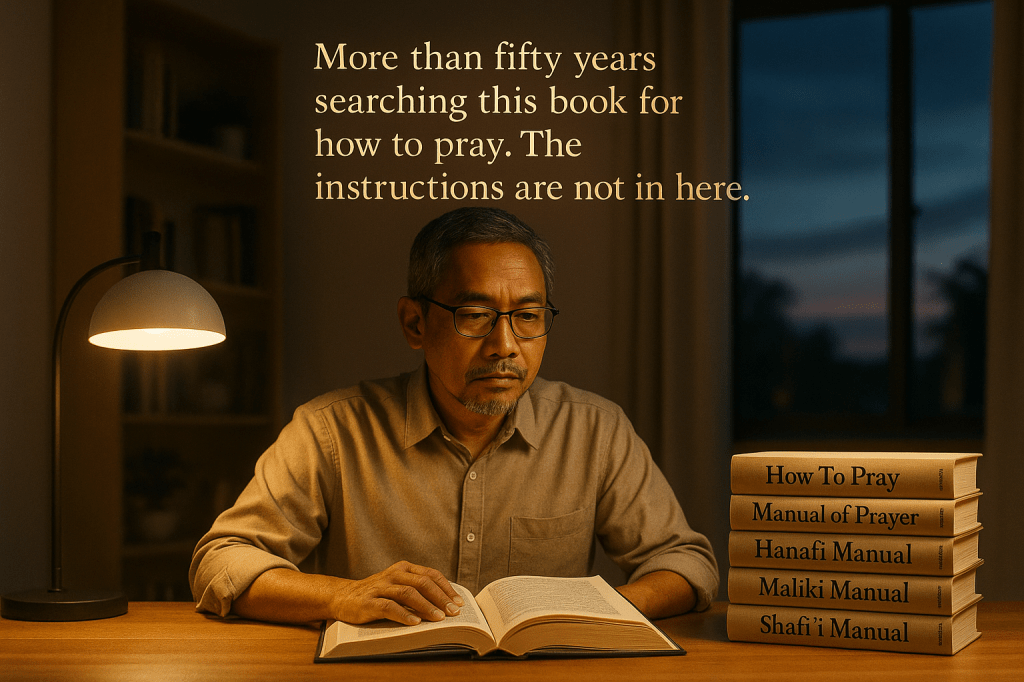
Rashad spent decades, by his own testimony, searching the Quran for prayer-mechanics that simply are not there (at 3:00): “I have lived more than half a century. And ten years added to half a century. I’ve read maybe dozens and dozens and dozens of books on how to pray salat. But I have never found any instruction in this book on how to pray salat.” If the absence were accidental, someone of his lexical and statistical rigor would eventually have found the fingerprints of an aborted instruction. There are none — because the instruction was never there to begin with. Salat is taught by God Himself through the Abrahamic line, and the Quran assumes its audience has received it.
Part 7.5: The Five Prayers Are in the Quran — Just Not Numerically
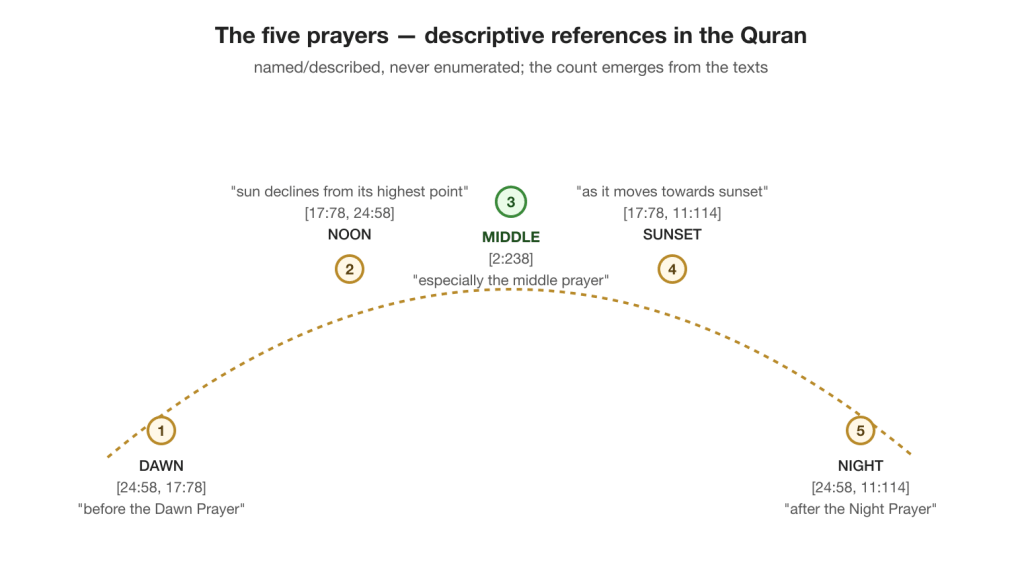
One of the sharpest forms of the cartoon objection asks: if the Quran does not teach mechanics, where do the five daily prayers come from? Submitters perform exactly five prayers a day. So do most traditional adherents. If the number five is not in the Quran, where is it from? The Submitter answer is layered, and it is the cleanest answer in the dispute: the number is not given as a count, but the prayers themselves are named — descriptively, dispersed across four key verses — and they total exactly five.
The four key verses
Read the four prayer-time verses next to each other and the five-prayer pattern emerges from the Quran itself.
[2:238] “You shall consistently observe the Contact Prayers, especially the middle prayer, and devote yourselves totally to God.”
[11:114] “You shall observe the Contact Prayers (Salat) at both ends of the day, and during the night…”
[17:78] “You shall observe the Contact Prayer (Salat) when the sun declines from its highest point at noon, as it moves towards sunset. You shall also observe (the recitation of) the Quran at dawn…”
[24:58] “…This is to be done in three instances—before the Dawn Prayer, at noon when you change your clothes to rest, and after the Night Prayer…”
Now count what is named, descriptively or directly, in these four verses combined. [24:58] names the Dawn Prayer and the Night Prayer directly. [17:78] names the prayer at noon and references its movement towards sunset, anchoring the noon and the late-afternoon (asr) prayer-windows. [11:114] describes “both ends of the day” — dawn and sunset — and “during the night.” [2:238] commands the believer to be especially mindful of “the middle prayer” — and a “middle” prayer presupposes an odd-numbered series. The smallest odd number that fits all the named time-windows is five. Dawn, noon, late afternoon, sunset, night. Each named or described. Each anchored to a specific phase of the daily light cycle. The Quran does not list the number five, but it lists the five.
The Final Testament’s footnote on [2:238]
The Final Testament’s footnote on [2:238] states the situation directly:
“All five prayers are found in 2:238, 11:114, 17:78, & 24:58. When the Quran was revealed, the Contact Prayers (Salat) had already been in existence (Appendix 9). The details of all five prayers—what to recite and the number of units (Rak’aas) per prayer, etc.—are mathematically confirmed.”
Three claims pack into this footnote, and each tightens the case against the cartoon. First, the five prayers are findable inside the Quran, in the four verses just cited. Second, the practice already existed when the Quran was revealed — explicit confirmation, in the Final Testament, of the Submitter position. Third, the mechanical details are mathematically confirmed via Code 19. The “five” is therefore not a Hadith-imported novelty; it is the count that emerges when you read the prayer-time verses together, and its details are sealed by the same mathematical structure that seals the rest of the Quran.
Two more verses confirm the dawn–sunset–night pattern
The pattern is also independently echoed in two further verses, in different chapters, with different rhetorical frames — adding redundancy to the descriptive identification.
[20:130] “Therefore, be patient in the face of their utterances, and praise and glorify your Lord before sunrise and before sunset. And during the night glorify Him, as well as at both ends of the day, that you may be happy.”
[50:39] “Therefore, be patient in the face of their utterances, and praise and glorify your Lord before sunrise, and before sunset.”
The same scaffolding — sunrise, sunset, night, ends of the day — recurs in [20:130] and [50:39]. The Quran is not silent on the schedule. It is descriptive rather than enumerative, exactly as a corrective text engaging an inherited rite would be. The community already knew the count. The Quran needed only to anchor the windows in plain Arabic.
Why this answers the cartoon decisively
Now read this back to the cartoon argument. Sunni defenders say: the Quran is silent on “five,” so the five comes from Hadith, so the entire prayer-system is Muhammadan-Hadith-mediated, so the disbelievers in [8:35] could not have had a recognised five-prayer system, so their “Salat” must be something else (a noisy gimmick at the shrine). The Submitter answer breaks every step of that chain. The five prayer-windows ARE in the Quran, just descriptively. The system is not Hadith-mediated; it is Abrahamic, with the Quran’s descriptive anchoring. The disbelievers therefore could and did have a recognised five-prayer system at the Ka’bah — corrupted into theatrical ostentation, exactly as [8:35] describes. The cartoon survives only by pretending the four verses above don’t exist or don’t add up to five. They do.
Part 7.6: The Mi’raj Fallback — Why “Muhammad Got the Five Prayers in Heaven” Doesn’t Survive
A Sunni reader who has followed the argument so far still has one more fallback. Even if Salat is older than Muhammad and the five-prayer count is descriptively in the Quran, traditional accounts hold that the specific five-prayer schedule was fixed during the Prophet’s night journey to the heavens, the Mi’raj. According to widely-narrated Hadith literature, God initially commanded fifty prayers per day, Muhammad on Moses’s advice repeatedly went back to bargain, and the count was finally settled at five. This is the canonical Sunni explanation for “where the five came from.” If the Mi’raj narrative is true, the cartoon reading might survive on the residual claim that the formal five-prayer institution is post-Abrahamic and uniquely Muhammadan after all.
What the Quran actually says about the night journey
Read the Quran’s only direct reference to the night journey carefully and compare it to the bargaining narrative.
[17:1] “Most glorified is the One who summoned His servant (Muhammad) during the night, from the Sacred Masjid (of Mecca) to the farthest place of prostration, whose surroundings we have blessed, in order to show him some of our signs. He is the Hearer, the Seer.”
[17:60] “We informed you that your Lord fully controls the people, and we rendered the vision that we showed you a test for the people…”
Look at every word. Muhammad was summoned. He was shown signs. The vision was a test for the people. There is no command issued during this journey. There is no bargaining over a number of prayers. There is no fifty-becoming-five negotiation. There is no Moses advising Muhammad to ask for reductions. [17:1] describes a journey of showing, not instructing. [17:60] calls the entire experience a test, not a legislation. The bargaining narrative is not in the preserved text. It is supplied entirely by Hadith literature compiled centuries later.
The preservation argument applies again
Recall the preservation principle from Part 14.5. The Quran is divinely preserved against omission ([15:9], [6:38], [6:115]) and is mathematically sealed via Code 19 ([74:30]). If the institution of the five daily prayers as a formal ritual count had been delivered through divine instruction at the Mi’raj — fifty prayers reduced through bargaining to five — that would be one of the most consequential prescriptive moments in the entire prophetic ministry. It would deserve, by any reasonable measure, a verse. A passage. A clear chapter. It would not be left out of the preserved text.
And yet, when one reads the Quran cover to cover, the Mi’raj negotiation is nowhere. [17:1] mentions the journey, calls it a sign-display, and moves on. [53:13–18] — the only other passage referring to a great vision Muhammad received — speaks of “the ultimate point” and “great signs” but again names no specific ritual instruction. The mathematically-sealed text gives precisely zero space to the supposedly pivotal prayer-count negotiation. Either God’s preservation system has yet another hole exactly where Sunni doctrine needs it to (collapsing [15:9] and Code 19), or the bargaining narrative is post-prophetic Hadith that does not in fact represent what happened. By the same logic that holds together every other Submitter commitment, only the second option survives.
The bargaining theology is independently incoherent
Even setting preservation aside, the Mi’raj bargaining narrative depicts God in a posture the Quran’s own theology forbids. In the traditional account, God initially decrees fifty prayers, then needs Moses’s repeated intervention through Muhammad to walk the number back to five. This portrays the Almighty as someone whose first decree was excessive, whose mind required external nudging, who recalibrates upon being argued with. The Quran’s God is not this God.
[50:38] “We have created the heavens and the earth, and everything between them in six days, and no fatigue touched us.”
[6:115] “The word of your Lord is complete, in truth and justice. Nothing shall abrogate His words. He is the Hearer, the Omniscient.”
“The word of your Lord is complete.” “Nothing shall abrogate His words.” A God whose original prayer-decree was so badly miscalibrated that He needed a nine-times-back-and-forth bargaining session to land on the right number is not the God whose word is complete from the first utterance. The bargaining narrative is theologically incompatible with the Quran’s own portrait of divine speech. It is, frankly, a Hadith-genre tale: the kind of narrative that makes for a memorable story and a rich tradition of devotional retelling but that cannot be sustained by anyone who has read [6:115], [50:38], and the surrounding chapters carefully.
What this leaves the Sunni position with
Strip away the Mi’raj bargaining narrative and the Sunni explanation for the five-prayer count collapses to an unattributed claim: somehow, somewhere, the Prophet established the formal count, and the Hadith literature preserved it. But “somehow somewhere” is not a source. It is the absence of one. The Submitter answer is concrete and documented: the count is descriptively present in [2:238], [11:114], [17:78], and [24:58]; the practice was inherited from Abraham and his descendants; the disbelievers themselves had a degraded form of the same five-prayer system at the Ka’bah, indicted in [8:35]; and the mechanical details are mathematically sealed by Code 19. Every move is anchored in the preserved text.
The cartoon reading of [8:35] needed the Mi’raj narrative to make the disbelievers’ “Salat” into something pre-institutional and therefore plausibly mock-worthy. Without the Mi’raj as a source-event for the five-prayer count, the disbelievers’ Salat reverts to what the Quran clearly describes: an established, recognisable, inherited rite that they had corrupted. The very architecture of the Sunni rebuttal collapses with the Mi’raj narrative. There is no fallback after this one.
Part 8: The Quran’s Corrective, Not Inventive, Mission
What the Quran says it is doing
The Quran is exceptionally clear about its own job description. It does not present itself as the founder of a new religion. It presents itself as a confirmer of previous scripture, an arbiter of disputes, a corrector of distortions, and a restorer of the original Abrahamic monotheism. Read the self-description verses:
[5:48] “Then we revealed to you this scripture, truthfully, confirming previous scriptures, and superseding them…”
[2:213] “The people used to be one community when God sent the prophets as bearers of good news, as well as warners. He sent down with them the scripture, bearing the truth, to judge among the people in their disputes…”
[16:64] “We have revealed this scripture to you, to point out for them what they dispute, and to provide guidance and mercy for people who believe.”
[6:161] “Say, ‘My Lord has guided me in a straight path—the perfect religion of Abraham, monotheism. He never was an idol worshiper.’”
Notice the verbs: confirming, judging, pointing out, guiding. These are corrective verbs. The Quran does not say “I bring you a new path”; it says “I clarify the path you already had.” Even when Jesus speaks in the Quran, his work is described in the same corrective terms.
[3:50] “I confirm previous scripture—the Torah—and I revoke certain prohibitions imposed upon you. I come to you with sufficient proof from your Lord. Therefore, you shall observe God, and obey me.”
The Abrahamic line is the spine
The corrective frame becomes airtight when paired with the Abrahamic-religion verses. Three times in three different chapters the Quran instructs us to “follow the religion of Abraham.” It is the single most repeated identification of what we are doing.
[2:135] “They said, ‘You have to be Jewish or Christian, to be guided.’ Say, ‘We follow the religion of Abraham—monotheism—he never was an idol worshiper.’”
[3:95] “Say, ‘God has proclaimed the truth: You shall follow Abraham’s religion—monotheism. He never was an idolator.’”
Rashad summarised it bluntly (at 24:04): “All these duties in Islam came to us through the prophet Abraham. … Islam is the religion of Abraham, he is the founder of Islam, and all the duties of Islam came from Abraham, not the prophet Muhammad. Muhammad brought the Quran. God brought the Quran through Muhammad.” And again, citing the very verses we have been studying (at 25:00): “If you look at surah 21, verse 73, it tells you that Abraham started the salat and the zakat. … The Quran says clearly that all duties and obligations came to us through Abraham, and tells us in surah 22, verse 78, that this is the religion of Abraham. The prophet Muhammad simply contributed the Quran.” This is not a fringe thesis. It is the Quran’s own self-description, read with the cartoon glosses removed.
Part 8.5: “Ask Those Who Know the Scripture” — The Quran Authorises Cross-Verification
There is a feature of the Quran that the cartoon reading cannot account for at all: the Quran repeatedly tells believers to verify what they receive by consulting people of the previous scripture. This is not a footnote-level remark; it is a direct command, repeated across multiple chapters, addressed to anyone who has doubt about the message. And the existence of this command makes very strong implicit claims about what the previous scriptural communities have — claims that, if you read them carefully, simply do not fit a “Muhammad invented Salat from scratch” model.
The cross-verification verses
[16:43] “We did not send before you except men whom we inspired. Ask those who know the scripture, if you do not know.“
[21:7] “We did not send before you except men whom we inspired. Ask those who know the scripture, if you do not know.“
[10:94] “If you have any doubt regarding what is revealed to you from your Lord, then ask those who read the previous scripture. Indeed, the truth has come to you from your Lord. Do not be with the doubters.”
Read these together and notice the structural assumption baked into every one. The previous-scripture communities — at minimum the Jews and Christians of seventh-century Arabia — have something the Quran’s hearers can consult. The Quran does not say “ask those who knew the previous scripture but no longer have it.” It says ask those who know the scripture, those who read the previous scripture. This presupposes a living transmission with content that maps onto what the Quran is teaching. The command would be incoherent otherwise.
What the cross-verification implies about Salat
Now apply the cross-verification command to the Salat-source dispute. If a Submitter in seventh-century Arabia had doubts about the Quran’s claim that Abraham, Moses, and Jesus all observed the Contact Prayer, the Quran tells him: ask those who read the previous scripture. The implicit promise of this command is that the previous-scripture communities will confirm what the Quran says. If they would not — if Salat were a Quranic novelty unrelated to anything in the Torah, Psalms, or Gospels — the cross-verification command would be a trap. It would send the doubter to communities that would specifically deny the Quranic claim.
The Quran does not set traps for sincere doubters. The cross-verification command works only if the previous-scripture communities have, in some recognisable form, the practice the Quran is referring to. Jewish communities had (and have) prescribed daily prayers, prescribed prostration postures, prescribed times. Christian communities, especially the early ones, had liturgical hours of prayer, prostration in some traditions, prescribed sequences. The structural overlap with what the Quran calls Salat is not a coincidence; it is the predictable outcome of a common Abrahamic source.
Submitter doctrine does not need to claim that contemporary Jewish or Christian liturgies are identical to the Submitter Contact Prayer. Each community has, by the Quran’s own diagnosis, distorted parts of its inheritance over time ([5:13]; [19:59]). What the cross-verification command requires is only that the recognisable form of the rite — daily times, prayer postures, the conjunction of prayer and charity — exists in those communities. It does. And that existence is exactly what the cartoon reading of [8:35] needs to deny.
The cartoon reading silences three more verses
This is the deeper structural cost of the cartoon reading. We have already seen that to keep “whistling and clapping” alive, the Sunni reader has to silence: the surrounding three-verse Ṣ-D chain ([8:34–36]); the patriarchal Salat verses; the descriptive prayer-time verses; the fitrah verse; [98:5]‘s explicit definition of “the perfect religion”; the Final Testament’s footnote cluster on [8:35], [21:73], [22:78], and [16:123]. Now add three more: the cross-verification commands of [10:94], [16:43], and [21:7]. The cartoon reading does not just dispute one verse; it leaves wreckage across the entire Quran. The Submitter reading is the only one that holds the whole structure together without breakage.
Part 9: 9:54 — Even the Hypocrites Were Praying
The most overlooked verse in the discussion
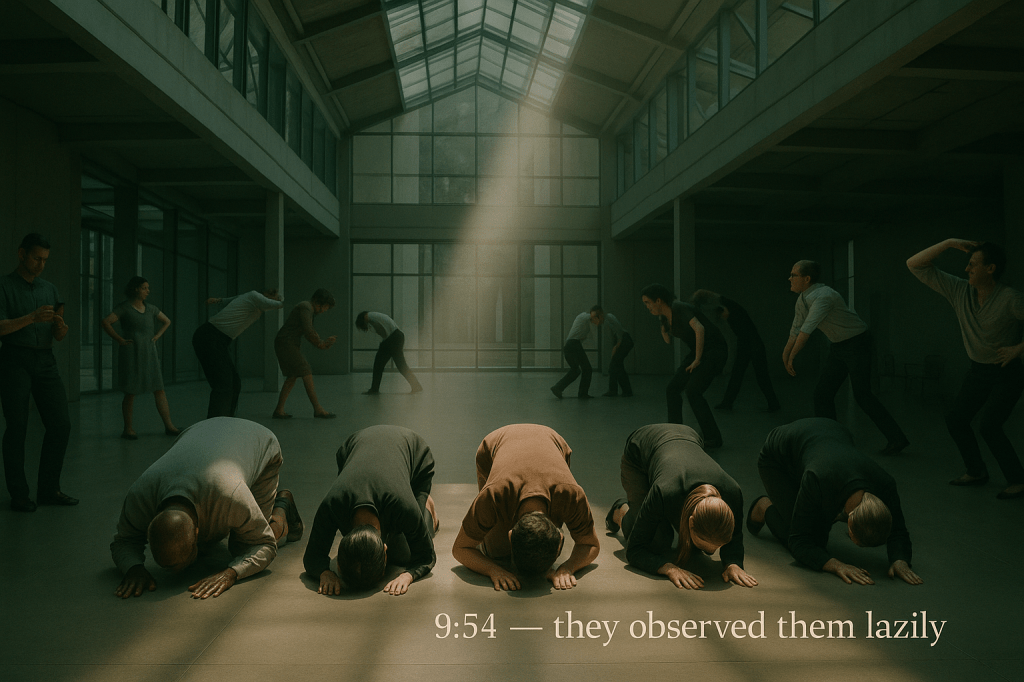
Of all the verses in the Quran, perhaps none refutes the “Muhammad invented Salat” narrative more cleanly than [9:54]. The chapter rebukes hypocrites — people who outwardly aligned with the Prophet but inwardly disbelieved — and one of the things it says about them is that they were observing Contact Prayers, but lazily.
[9:54] “What prevented the acceptance of their spending is that they disbelieved in God and His messenger, and when they observed the Contact Prayers (Salat), they observed them lazily, and when they gave to charity, they did so grudgingly.”
Stop and read that again. The hypocrites — the people the Quran is most critical of — were observing the Contact Prayer. Sloppily, yes. Grudgingly, yes. But they had a recognisable Salat that the Quran can name and critique. If Salat were a brand-new rite Muhammad had just introduced, the hypocrites either would not have been doing it at all, or would have been doing some pre-Islamic rite the Quran would have to call something else. Instead, the Quran uses the same word — Salat — and complains about the quality. That is dispositive. The rite predated the Quran’s regulation of it.
Rashad on 9:54
Rashad treated this verse as a knock-out punch on the question (at 1:10):
“This is an important verse you should remember, it’s 9:54… when the people tell you that they think that life began with Muhammad. They think there was no Salat before the Prophet Muhammad. You should be reminded of this verse. These are people who rejected the Prophet, they disbelieved in God, but they were doing their five contact prayers. The word Salat is very specific, because Salat existed before the Prophet. Just at the time, it had been corrupted by idol worship. Same thing today.”
Read alongside [8:35], the picture is complete. The disbelievers had a corrupted Salat at the shrine ([8:35]). The hypocrites had a lazy Salat in private ([9:54]). The Quran did not bring them the rite; it confronted them with the gap between the rite they inherited and the rite they were performing. Restoration, not invention.
Part 10: Salat Was Lost After Moses and Jesus — and Restored
The chapter 19 testimony
One more piece of internal Quranic evidence cements the chronology. Chapter 19 lists a roll-call of prophets — Zachariah, John, Mary, Jesus, Abraham, Ishmael, Moses, Aaron, Idris — and then says something startling about what happened after them.
[19:58] “These are some of the prophets whom God blessed… When the revelations of the Most Gracious are recited to them, they fall prostrate, weeping.”
[19:59] “After them, He substituted generations who lost the Contact Prayers (Salat), and pursued their lusts. They will suffer the consequences.”
Read this carefully. The Quran is telling us that the prophetic generations had the Contact Prayer, and that later generations lost it. That is impossible if Salat were a Muhammadan invention. You cannot lose what does not yet exist. [19:59] only makes sense if Salat was an already-established Abrahamic inheritance, observed by the prophets, and then degraded by the communities that came after. Rashad highlighted this directly (at 23:13): “The Jews and the Christians, we know from Quran, lost it. In surah 19 by the way, the verse says that generations came after Moses and Jesus that lost the contact prayer.”
Salat existed before Abraham — but was founded with him
Rashad also drew an important distinction (at 7:50): “When you look in the Quran, you will notice that before Abraham there was no mention of the contact prayers, the Salat. You notice that Noah was telling his people to just believe in God and ask his forgiveness, but there is no mention of the contact prayers before Abraham. So the original source of the contact prayers is the Prophet Abraham…” The chronology is layered: belief in God is universal across all prophets, but the ritual specifics of the Contact Prayer enter the human record at Abraham, are observed by his line, are inherited by Moses and Jesus, are partially lost by their later communities, are corrupted by the custodians at the shrine itself, and are restored — not invented — by the Quran’s call to “follow the religion of Abraham.” Every Quranic data-point fits this chronology. None fits the Muhammadan-invention narrative.
Part 11: Why God Taught the Prayer, Not the Quran
Salat is taught by God Himself
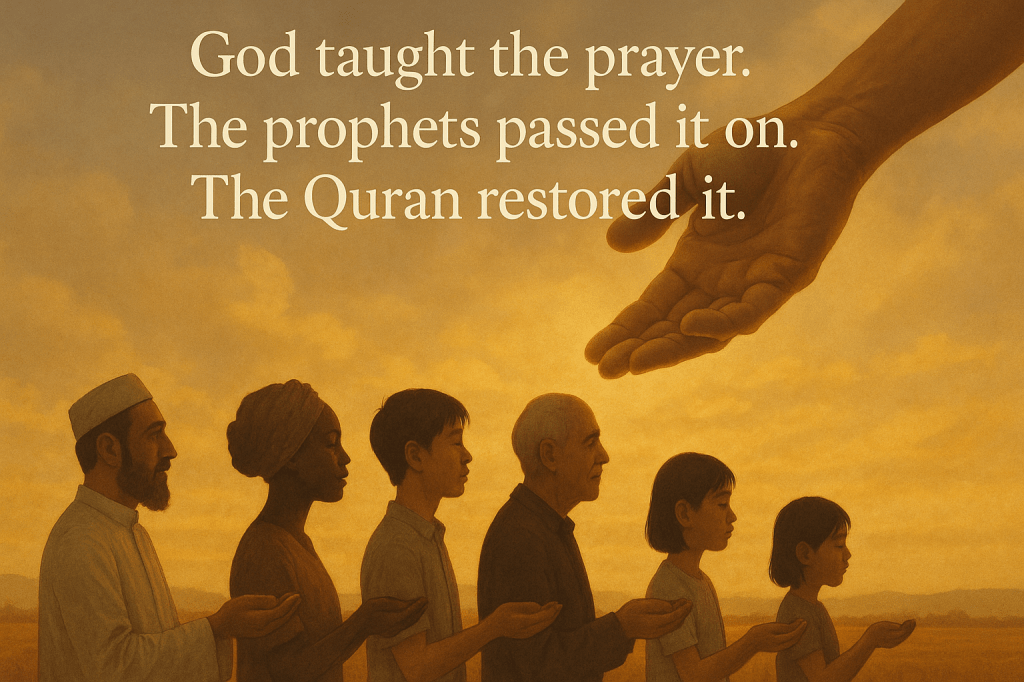
If the Quran does not teach the mechanics of the Contact Prayer, and if we are not required to import the mechanics from the corrupted Hadith literature, where do they come from? The Quran’s own answer is striking: God Himself taught the patriarchs how to pray. [21:73] said it explicitly: “we taught them how to work righteousness, and how to observe the Contact Prayers (Salat) and the obligatory charity (Zakat).” The verb is direct: God taught. Not Muhammad taught. Not a tribal council voted. Not a school of jurisprudence systematised. God taught the rite, gave it to Abraham, and Abraham passed it down through the line of Submission until the Quran came down to confirm and purify the inheritance.
Rashad emphasised this point (at 7:00): “If these people really know what it means, it only means that Salat is taught by Allah himself… Then we can join that with Quran. But prayer is taught — Man did not know how to … It is Allah who taught him how to pray, which strengthens the argument.” This is the only theology of Salat that holds together every internal Quranic data-point. The rite is divinely revealed and humanly transmitted, with the Quran as the final corrective layer that exposes the corruptions and restores the original.
Submission existed before Muhammad
This naturally leads to a much larger truth: Submission itself predates Muhammad. [22:78] says Abraham was the one who “named you ‘Submitters’ originally.” Rashad spelled out the implication (at 16:55): “Abraham was the first to call the religion of God Islam, submission… So it was the first use of the word Islam by a human being. And he taught his children this. The Quran tells us over and over again that Abraham is the founder of the religion of Islam. It’s not Muhammad. He brought us the Quran. Islam existed long before Muhammad.” Notice the precision: Muhammad’s distinctive contribution is the Quran, not the religion. Submission is older than him. The Contact Prayer is older than him. The shrine is older than him. He is the messenger of the final scripture, not the founder of the faith.
Part 11.5: Hanif and Fitra — The Religion Older Than Religion
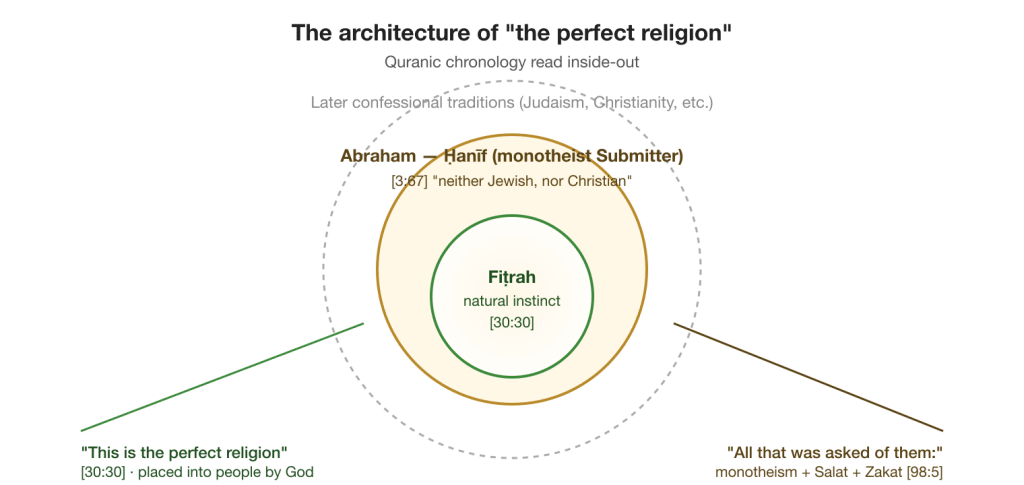
If Salat is inherited from Abraham, the next question is sharper: what kind of “religion” can be inherited from someone who lived before the major religions even had names? The Quran’s answer reframes the entire conversation. Submission, in the Quran’s account, is not one religion among several. It is the original disposition of the human soul — the religion older than religion — and Abraham is its named exemplar, not its inventor. This is why Salat can be inherited: it does not belong to any post-Abrahamic confessional tradition. It belongs to the underlying state from which all of them branched.
Abraham was neither Jew nor Christian — he was a monotheist Submitter
The Quran is unusually direct on this point. It refuses to file Abraham under any later confessional label and gives him a different, prior identity instead.
[3:67] “Abraham was neither Jewish, nor Christian; he was a monotheist submitter. He never was an idol worshiper.”
[16:120] “Abraham was indeed an exemplary vanguard in his submission to God, a monotheist who never worshiped idols.”
The Arabic word translated “monotheist” in these verses is ḥanīf (حنيف), from the root H-N-F (ح ن ف). It denotes someone who has turned away from idolatry to pure devotion to God alone — not a member of a sect, but a person living the original human posture toward the Creator. The Quran applies this label to Abraham repeatedly ([2:135], [3:67], [3:95], [4:125], [6:79], [6:161], [16:120], [16:123]) — twelve verses in total share the H-N-F root. This is one of the Quran’s densest theological clusters. It deliberately situates Abraham outside any later religious category and inside an earlier, more fundamental one.
Submission is the natural state of the human being
If Abraham’s ḥanīf identity is older than Judaism and Christianity, where exactly does it come from? The Quran answers: from inside the human being. Submission is not introduced into people; it is found there.
[30:30] “Therefore, you shall devote yourself to the religion of strict monotheism. Such is the natural instinct placed into the people by God. Such creation of God will never change. This is the perfect religion…”
The Arabic word translated here as “natural instinct” is fiṭrah (فطرة) — the original disposition or innate template of the human being. The verse states that Submission, the religion of strict monotheism, is what we are made for; it is the operating system installed at creation. This is the most far-reaching of the Quran’s claims about its own faith. It is not asking the reader to convert from one religion to another. It is asking the reader to return to a state already intrinsic to them. And the verse closes with a phrase that should arrest the cartoon-reading immediately: “this is the perfect religion.” Not the new religion. Not the seventh-century religion. The perfect, unchanging, original religion of human nature.
98:5 — the Quran’s own definition of “the perfect religion”
One verse closes the loop on this entire question with extraordinary economy. It tells us, in the Quran’s own voice, what was asked of “them” — the previous communities of scripture and their prophets — and what the perfect religion actually consists of.
[98:5] “All that was asked of them was to worship God, devoting the religion absolutely to Him alone, observe the Contact Prayers (Salat), and give the obligatory charity (Zakat). Such is the perfect religion.”
Read every word. “All that was asked of them” — not “all that is now asked of you,” not “all that I am introducing through Muhammad.” The verb is past tense and refers to previous communities (people of scripture mentioned in the surrounding verses of chapter 98). And what was asked of them? Three items. Worship God alone. Observe the Contact Prayer. Give the obligatory charity. Such is the perfect religion. The Quran here defines its own faith — the perfect religion — as the same set of obligations that previous prophetic communities were given. The Contact Prayer is named explicitly. There is no possibility of reading [98:5] and concluding that Salat is a Muhammadan novelty. The verse closes that escape route in the Quran’s own voice.
Why this seals the case for [8:35]
Place these three verses next to [8:35]. The disbelievers at the Ka’bah had a “Salat.” That Salat was, by the Quran’s own architecture, part of the fiṭrah — the human being’s original disposition. Abraham, their patriarchal exemplar, was a ḥanīf, a monotheist Submitter, neither Jewish nor Christian, named in the Quran as the founder of this prior, fundamental faith. [98:5] tells us in plain language that “all that was asked of” previous communities was monotheism, Salat, and Zakat. [30:30] tells us this is “the perfect religion” — God’s never-changing creation, baked into humanity itself.
Now ask the cartoon reading to survive this. If [8:35] is a snapshot of pagan whistling and clapping, then where in the Quran does the Salat of “the perfect religion” of [98:5] show up at the shrine before Muhammad? Where do the disbelievers’ inherited rite, the corrupted Abrahamic Salat, the Hanif tradition that [3:67] places in Abraham himself, leave their footprint in chapter 8? The answer the cartoon must give is: nowhere. They simply do not show up. The verse becomes silent on a chain that the rest of the Quran works hard to make audible. That silence is the cartoon’s structural cost. It pays it without telling you it is paying it.
Reverse the misread, and the silence breaks. [8:35] is exactly where the corrupted Abrahamic Salat finally shows up, named, indicted, and called back to its original form. The verse stops being a non-sequitur about pagans making noise; it becomes the missing footprint in the chain that [3:67], [30:30] and [98:5] jointly require. The Quran is internally coherent only when the cartoon dies.
Part 11.6: One Religion, Five Prophets — [42:13] and the Continuity Verses
Of all the verses that should have ended this debate centuries ago, [42:13] is the most direct. It does not gesture toward continuity through Abraham; it states it across five named prophets in a single sentence. Reading it carefully closes any remaining intellectual room for the cartoon position.
[42:13] “He decreed for you the same religion decreed for Noah, and what we inspired to you, and what we decreed for Abraham, Moses, and Jesus: ‘You shall uphold this one religion, and do not divide it.’…”
Read every word. God says He has decreed for you (Muhammad’s community) the same religion decreed for Noah, Abraham, Moses, and Jesus. The phrase is not “a similar religion” or “a religion building on theirs.” It is the same religion. And the operative command is “uphold this one religion, and do not divide it.” Five prophets, four of them named explicitly across thousands of years of human history, all delivering and receiving the same religion. The text could not be plainer.
If five prophets across thousands of years all received the same religion, then any practice that is part of that religion — Contact Prayer, obligatory charity, monotheism, devotion — is part of the religion delivered to all five. Salat is part of the religion. Therefore Salat was decreed to all five prophets. This is not an inference smuggled in from outside; it is the direct logical entailment of [42:13] read alongside [21:73] (“we taught them how to observe the Contact Prayers”), [20:14] (Salat enjoined to Moses), and [19:31] (Salat enjoined to Jesus). The Quran is doing the work of sealing this argument for us.
“One congregation” and the same monotheist message
Two further verses make the unity-of-religion claim from different angles:
[23:52] “Such is your congregation—one congregation—and I am your Lord; you shall reverence Me.”
[21:25] “We did not send any messenger before you except with the inspiration: ‘There is no god except Me; you shall worship Me alone.’”
[23:52] identifies all believers across history as a single congregation under a single Lord. [21:25] tells us that every messenger before Muhammad arrived with the same monotheist message. These verses, together with [42:13], form a tight three-verse unity-of-religion cluster. They do not leave room for a “Muhammad’s distinct religion” reading. They aggressively foreclose it.
[42:14] — and what happened next
The very next verse after [42:13] describes what happened to that one religion in the hands of the human communities that received it.
[42:14] “Ironically, they broke up into sects only after the knowledge had come to them, due to jealousy and resentment among themselves…”
The same religion was decreed; it broke into sects after the knowledge came; and the cause was not divine variation but human jealousy. The Quran’s own historical narrative across [42:13]–[42:14] is therefore: one religion across all prophets, divided post hoc by humans. This is precisely the Submitter framework. The Quran is restoration of the original; the Sunni–Shia–Christian–Jewish proliferation of forms is the post-prophetic divergence the verse warns against. The cartoon reading of [8:35] belongs to one of those post-prophetic divergent forms; it could not survive contact with [42:13]‘s clear declaration that the religion of Muhammad is the religion of Noah, Abraham, Moses, and Jesus — the religion that includes Salat.
Why this verse alone could end the debate
You could, in principle, set aside every other argument in this article and rest the entire case on [42:13] alone. The verse names five prophets and says they received the same religion. The Quran also names Salat as part of the religion of at least three of those five (Noah’s exception is real and acknowledged by Rashad — see Part 11; but Abraham, Moses, and Jesus all have Salat verses). Therefore Salat is part of the religion received by Abraham, Moses, and Jesus. Therefore Salat predates Muhammad. Therefore [8:35]‘s reference to the disbelievers’ “Salat at the shrine” cannot be a brand-new Muhammadan rite they could not yet have known about. It must be the inherited Abrahamic rite they had corrupted. The cartoon reading dies in three steps — and every step of the syllogism is anchored in a verse the Quran does not let you escape from.
Part 11.7: The Submitter Identity — [3:84], [29:46], and “We Make No Distinction”
The continuity argument from [42:13] establishes that the same religion was decreed across all five named prophets. A closely related but distinct claim follows: the identity of the believing community is constituted by accepting everything sent to all those prophets. This is not just a doctrinal stance; it is the Quran’s explicit, programmatic statement of who a Submitter is. And the cartoon reading of [8:35] cannot survive contact with this identity claim either.
[3:84] — the affirmation formula
[3:84] “Say, ‘We believe in God, and in what was sent down to us, and in what was sent down to Abraham, Ismail, Isaac, Jacob, and the Patriarchs, and in what was given to Moses, Jesus, and the prophets from their Lord. We make no distinction among any of them. To Him alone we are submitters.‘”
Read this carefully. The Quran does not just say “Submitters believe in their own scripture.” It says they believe in everything sent to Abraham, Ishmael, Isaac, Jacob, the Patriarchs, Moses, Jesus, and the prophets generally. “We make no distinction among any of them.” The Submitter identity is constituted by universal acceptance of prior revelation — not by Muhammadan distinctiveness, but by Abrahamic-and-prophetic continuity. And the verse closes by naming the speakers as “submitters” — the same identity Abraham was given in [22:78] (“He is the one who named you ‘Submitters’ originally”).
Now apply this to the Salat dispute. If a Submitter, by Quranic definition, believes in everything sent to Abraham, Moses, and Jesus, then a Submitter believes in the Contact Prayer Abraham was taught ([21:73]), the Contact Prayer Moses was commanded ([20:14]), and the Contact Prayer Jesus was enjoined to observe lifelong ([19:31]). These are not foreign rites the Submitter politely respects from a distance; they are part of what was sent down, and the Submitter affirms them by formal declaration. Salat is therefore the Submitter’s own rite as much as it is the patriarchs’ — because the Submitter community is constituted by the affirmation of patriarchal revelation. The cartoon reading of [8:35] would force the Submitter to retroactively un-affirm the patriarchal Salat verses while still affirming everything else they include. It cannot be done coherently.
[29:46] — sharing one God with the people of scripture
[29:46] “Do not argue with the people of the scripture (Jews, Christians, & Muslims) except in the nicest possible manner—unless they transgress— and say, ‘We believe in what was revealed to us and in what was revealed to you, and our god and your god is one and the same; to Him we are submitters.‘”
This verse explicitly names Jews, Christians, and Muslims together as the “people of the scripture” — a single category of recipients of revelation. The Submitter is told to address them with: “we believe in what was revealed to us and in what was revealed to you, our god and your god is one and the same, and to Him we are submitters.” The shared-God claim is also a shared-revelation claim. And the speaker’s identity, again, is “submitters.”
If Jewish and Christian liturgies — including their daily prayers, prostration practices, and prescribed times — are part of “what was revealed to you” that the Submitter believes in, then the Quran has already told us what to do with the structural overlap between Salat and pre-Islamic prayer practices. We are not to dismiss them as alien rites that happen to share features with the Submitter Contact Prayer. We are to recognise them as imperfect-but-real preservations of the same Abrahamic transmission, and to affirm what is true in them while restoring the original via the Quran. [29:46] is therefore the practical companion verse to [3:84]‘s affirmation formula. Together they describe a religious community that is constituted by inheritance, not invention.
Why the cartoon reading violates the Submitter’s own identity
Place these two identity-verses next to [8:35] and the cartoon’s deeper cost becomes visible. The Submitter is, by Quranic definition, someone who affirms the patriarchal revelations — including the Contact Prayer commanded to Abraham, Moses, and Jesus. To accept the cartoon reading of [8:35] is to accept that Salat is a Muhammadan novelty after formally declaring “we make no distinction among any of [the prophets]” with respect to revelation. This is internally incoherent. You cannot affirm a doctrine and reject its implication in the same breath.
The Submitter framework is internally consistent in a way the cartoon framework cannot be. The Submitter accepts [3:84]‘s “no distinction” formula, accepts [42:13]‘s “same religion” decree, accepts [16:123]‘s “follow Abraham’s religion” command, and reads [8:35] as the corrupted Abrahamic Salat the Quran is correcting. Every piece fits. The cartoon defender has to accept the affirmation formula in [3:84] while denying that affirmation’s most concrete content — the patriarchal Salat. That is not an exegetical disagreement; it is an identity contradiction. The Submitter who thinks carefully about what they affirm cannot hold both at once.
Part 11.8: “Abraham Has Been Set as Your Example” — [60:4], [6:90], [33:21]
One last cluster of verses closes this section of the case. The Quran does not just tell believers that Salat is part of Abraham’s religion (continuity) and that they affirm everything sent to all prophets (identity). It tells them, as a direct command, to take Abraham as their example. The exemplar verses — [60:4], [6:90], and the often-misread [33:21] — together establish that the model the Submitter is told to follow is the patriarchal-Abrahamic one, not a Muhammadan novelty.
[60:4] — Abraham as the explicit exemplar
[60:4] “A good example has been set for you by Abraham and those with him. They said to their people, ‘We disown you and the idols that you worship besides God. We denounce you, and you will see nothing from us except animosity and hatred until you believe in God ALONE.’…”
[60:6] “A good example has been set by them for those who seek God and the Last Day. As for those who turn away, God is in no need (of them), Most Praiseworthy.”
Read these verbatim. The Quran says — twice, in the same chapter — that the example believers are to follow is set by Abraham and those with him, and is meant for those who “seek God and the Last Day.” The exemplar is named, and the named exemplar is Abraham. Not Muhammad’s hadith-mediated practice. Not the Companions’ contested narrations. Abraham. If the believing community’s example for how to live before God is the patriarchal one, then the way the believing community should pray is — by direct entailment — the way Abraham prayed. [21:73] tells us how Abraham prayed: as God taught him.
[6:90] — “Be guided in their footsteps”
Earlier in the same Quran, after a roll-call of prior prophets — Abraham, Isaac, Jacob, Noah, David, Solomon, Job, Joseph, Moses, Aaron, Zachariah, John, Jesus, Elijah, Ishmael, Elisha, Jonah, Lot — God says directly:
[6:90] “These are the ones guided by God; you shall be guided in their footsteps. Say, ‘I do not ask you for any wage. This is but a message for all the people.’”
“Be guided in their footsteps” — the footsteps of seventeen named prior prophets. The verse does not say “be guided in Muhammad’s distinctive footsteps.” It says their footsteps — the prior prophets’ — and treats Muhammad as the latest in that line, delivering “a message for all the people.” This is the Quran’s own framing of what it means to follow Muhammad: it means being guided in the footsteps of the prophets before him. Their footsteps include Abraham’s Salat, Moses’s Salat, Jesus’s Salat. The Quran is sealing the footsteps-instruction in plain words.
[33:21] — what Muhammad’s “good example” actually means
The verse most often cited by traditional readers to justify Hadith-as-source is [33:21]: “The messenger of God has set up a good example for those among you who seek God and the Last Day, and constantly think about God.” Sunni interpretation reads this as: therefore Hadith collections about Muhammad’s distinctive practice are binding. But notice what the verse actually says — and does not say.
[33:21] “The messenger of God has set up a good example for those among you who seek God and the Last Day, and constantly think about God.”
The verse names “the messenger of God” as a “good example.” It does not say anything about where to find that example, what counts as authentic transmission of it, or that Hadith collections compiled centuries later preserve it intact. The verse is simply a statement that Muhammad himself was a good model — true and uncontroversial. The question is: what was Muhammad modelling? The Quran answers in [16:123]: he was inspired to follow the religion of Abraham, the monotheist. So Muhammad’s “good example” is Abraham’s example, lived out in the seventh century. [33:21] and [60:4] point at the same thing from different angles. The believer who seeks Muhammad’s example finds it converging, by the Quran’s own logic, on Abraham’s example. There is no separate Muhammadan path. There is only the Abrahamic path, walked once again.
Why this closes a final loophole
This exemplar cluster forecloses the last hiding place of the cartoon. A determined defender might have argued: “even if Salat traces to Abraham, the specific form Submitters are bound to follow is Muhammad’s distinctive form, available only through Hadith.” The Quran’s response is direct. [60:4]: your example is Abraham. [6:90]: be guided in the prior prophets’ footsteps. [33:21]: Muhammad is a good example — and that example, per [16:123], is itself the religion of Abraham. There is no Quranic verse that says “follow Muhammad’s distinctive example transmitted by Hadith narrators centuries after his death.” That verse does not exist. What exists is a tight web of patriarchal-exemplar verses telling the believer where to look — and they all point to the same place. The cartoon reading of [8:35], which depends on Salat being a uniquely Muhammadan rite, runs against every one of them.
Part 11.9: The Hajj Parallel — You Cannot Accept Hajj-as-Abrahamic and Reject Salat-as-Abrahamic
Here is one of the sharpest internal-consistency challenges to the cartoon position, and it comes not from the Submitter side but from the Sunni side itself. Every major Sunni school of jurisprudence, every standard work of Sunni theology, every popular Hajj-guidebook accepts without controversy that the rites of Hajj are Abrahamic. The pilgrimage to the Sacred Mosque, the circumambulation of the Ka’bah, the traversing of Safa and Marwah, the sacrifice — all are universally taught as having originated with Abraham and Ishmael, transmitted through generations, and reaffirmed by the Quran. Sunni scholarship does not say “Muhammad invented Hajj from scratch in the seventh century.” It says, accurately, that Hajj is older than Muhammad by millennia and traces to Abraham.
The Quranic basis for Hajj-as-Abrahamic
[2:127] “As Abraham raised the foundations of the shrine, together with Ismail (they prayed): ‘Our Lord, accept this from us. You are the Hearer, the Omniscient.’”
[22:27] “And proclaim that the people shall observe Hajj pilgrimage. They will come to you walking or riding on various exhausted (means of transportation). They will come from the farthest locations.”
[3:97] “In it are clear signs: the station of Abraham. Anyone who enters it shall be granted safe passage. The people owe it to God that they shall observe Hajj to this shrine, when they can afford it…”
[2:158] “The knolls of Safa and Marwah are among the rites decreed by God. Anyone who observes Hajj or ‘Umrah commits no error by traversing the distance between them…”
Notice the structural features of these verses. [3:97] includes “the station of Abraham” right at the heart of Hajj — naming the patriarch by name inside the rite. [2:127] places Abraham as the literal builder of the shrine. [22:27] proclaims Hajj as something the people are commanded to observe — without inventing it. And [2:158] describes the Safa-Marwah ritual as a “rite decreed by God” — a phrase that presupposes the rite already exists in identifiable form.
The structural parallel with Salat
Compare the Hajj-Abrahamic case with the Salat-Abrahamic case feature by feature, and the parallel is exact.
| Feature | Hajj (universally Sunni-accepted as Abrahamic) | Salat (Sunni-rejected as Abrahamic) |
|---|---|---|
| Quranic Abrahamic anchor | Yes — [2:127], [3:97], [22:27] | Yes — [21:73], [22:26], [14:37], [14:40] |
| Patriarch named in rite | Yes — “station of Abraham” [3:97] | Yes — Abraham, Ishmael, Moses, Jesus, Zachariah all observe Salat |
| Mechanics fully detailed in Quran? | No — number of circumambulations, specific timings of stations, specific recitations not enumerated | No — rakaat counts, specific recitations, posture sequences not enumerated |
| Quran calls it a “rite decreed by God” | Yes — [2:158], [22:30], [22:32] | Yes — [4:103] “decreed for the believers at specific times” |
| Disbelievers practised a corrupted form pre-Quran | Yes — pre-Islamic Quraysh performed corrupted Hajj at the Ka’bah | Yes — [8:35] disbelievers had corrupted Salat at the Ka’bah |
| Sunni classification | Inherited from Abraham, restored by Quran | “Invented” by Muhammad? — inconsistent with the row above |
The unanswerable question
Now the question for the Sunni reader writes itself. By what criterion do you accept Hajj-as-Abrahamic but reject Salat-as-Abrahamic? Both have explicit Quranic Abrahamic anchors. Both have the patriarch named inside the rite. Both have full mechanics absent from the Quran. Both are described as “rites decreed by God.” Both were practised in corrupted form by pre-Quranic Arabs at the Ka’bah. The structural features are identical. The Sunni position accepts the inheritance-and-restoration framework for Hajj as common-sense scholarship — but somehow refuses the same framework for Salat, despite the parallel being one-to-one.
The honest answer is that there is no consistent criterion. The asymmetry is doctrinal, not exegetical. Hajj-as-Abrahamic is non-threatening to the Sunni framework; the Hadith-and-fiqh apparatus does not need Hajj to be Muhammadan-novel because Hajj’s mechanics happen to be (mostly) preserved in the Quran’s descriptive verses. Salat-as-Abrahamic, by contrast, is threatening: it dissolves the doctrinal claim that Hadith literature is the unique source of prayer mechanics, and that claim is foundational to traditional jurisprudence. So Hajj is allowed its Abrahamic origin and Salat is not — but the Quran is the same about both.
The Submitter framework is consistent. Both Hajj and Salat are inherited Abrahamic rites. Both are reaffirmed by the Quran. Both have mechanics that live in the inherited tradition rather than in the preserved text. Both were corrupted by pre-Quranic custodians of the Ka’bah. The Quran’s role with respect to both is the same: corrective restoration of the original. [8:35]‘s reference to the disbelievers’ corrupted Salat at the shrine is the exact analogue of the Quran’s references to corrupted Hajj practices in the same period. They are, in fact, the same indictment of the same false guardianship — and they presuppose the same inherited religion. Once you see the parallel, the Sunni asymmetry collapses, and with it goes the last principled basis for the cartoon reading.
Part 12: The Cost of the Misread
What you lose if you keep “whistling and clapping”
It is worth being explicit about how much theological territory hinges on the misread of [8:35]. If the verse really were a passing snapshot of pagan whistling and clapping, then several large doctrines that the Sunni tradition needs would survive. Salat could be presented as a Muhammadan novelty taught through Hadith narrations and madhhab manuals. The shrine’s pre-Quranic Abrahamic continuity could be quietly minimised. The “religion of Abraham” verses could be reinterpreted as a stylistic flourish rather than a literal historical claim. The cartoon makes all of this possible by hiding the verse’s evidentiary weight under a layer of slapstick.
Reverse the misread, and the dominoes fall. The disbelievers had a Salat at the shrine. That Salat was inherited from Abraham. It was observed by Ishmael, Moses, Jesus, Zachariah, the Children of Israel. It was partially lost after Moses and Jesus. It was corrupted into ostentatious self-display by the shrine’s late custodians. The Quran came to call all of that out — and to call humanity back to the religion of Abraham, including the Contact Prayer in its original form. The misread is not a small error of vocabulary. It is the linchpin that holds an entire revisionist narrative in place. Pull it out, and the whole Submission-is-older-than-Muhammad framework, which is the Quran’s own self-description, comes back into focus.
Why the cartoon survived for so long
None of this is surprising once you remember who has historically controlled translation. A reading of [8:35] that proves Salat predates Muhammad is profoundly inconvenient for any tradition that derives its authority from Hadith literature claiming to teach the prayer. A reading that turns the verse into a pagan-prank vignette is profoundly convenient. The cartoon is not a neutral linguistic mistake; it is a structurally protective gloss. It survives because it is useful. The natural reading survives because it is true. As [2:213] already warned, scripture is sent down “to judge among the people in their disputes” — and one of the disputes it judges is the question of who really brought the religion. Read the verse without the cartoon, and the answer is unambiguous: Abraham brought the religion. God taught the prayer. Muhammad delivered the Quran that exposed the corruption and called us back. That is the story [8:35] has been telling all along.
Part 13: Pre-empting the Two Strongest Sunni Rebuttals
A careful reader from a traditional background will, at this point, have two objections lined up and ready to fire. They are the strongest cards the Sunni position has on this question, so it is worth taking them out one at a time before the conclusion.
Rebuttal 1: “If Salat was already known, why does the Quran command it 60+ times?”
The Quran mentions the Contact Prayer (Salat) explicitly across roughly 62 verses — exhortations to “observe,” “establish,” “maintain,” “be steadfast in” the rite. The Sunni objection runs: if everyone already knew Salat, why would the Quran need such heavy repetition? Surely the repetition itself is evidence the practice was being introduced or formally re-instituted.
The objection collapses the moment you look at it. The Quran also commands believers to honor their parents ([17:23]), to refrain from killing their children ([17:31]), to give justice ([4:135]), to be honest in trade ([83:1–3]), to avoid intoxicants ([5:90]) — dozens of times each, scattered across the text. No one argues that the Quran introduced parental respect, or honest trade, or the prohibition on murder. These are universal moral and ritual obligations the Quran reinforces because it is correcting a society that had drifted away from them. Repetition is the grammar of reinforcement, not introduction. Anyone who teaches anything to anyone — a parent to a child, a coach to a team, God to a people — repeats the most important things. Repetition tracks importance, not novelty.
The reinforcement frame is, in fact, baked into the Quran’s own self-description of why it commands Salat so often. [8:35] tells us the disbelievers had corrupted their Salat at the shrine. [9:54] tells us the hypocrites observed it lazily. [19:59] tells us subsequent generations had lost it altogether. [5:13] tells us the Children of Israel broke their covenant of Salat. The Quran did not arrive at a community that needed an introduction to prayer; it arrived at a community whose prayer had decayed into theatre, laziness, or amnesia. Of course it commands Salat 62 times. That is what restoration sounds like. The volume of the call matches the depth of the corruption it is correcting, not the novelty of the rite it is establishing.
Notice also the verbs the Quran chooses. It says “observe” (aqīmū), “maintain” (ḥāfiẓū), “be steadfast in” (iṣbir ʿalā), “perform” (aqāmū). It does not say “begin,” “initiate,” “commence,” “newly establish.” The grammar is consistently the grammar of continuing an existing practice, never of inaugurating one. A founder-text would have at least one verse with a “from this day forward” verb. There are zero. Every Salat command in the Quran is a continuation command. That is itself a fingerprint of pre-existing practice.
Rebuttal 2: “Where do the rakaat counts come from, if not the Quran?”
This is the sharper version of the objection, and it is the one the Sunni position genuinely thinks is decisive. It runs: every Submitter still believes in five daily prayers; in specific numbers of units (rakaat) — say, four for the noon prayer, three for the sunset prayer, two for the dawn prayer; in specific recitations and postures. None of these specifics are in the Quran. So they must come from somewhere. And if they don’t come from the Quran, the only remaining source is the Hadith literature — which means the Sunni framework wins by default.
The dilemma is real, but it cuts the wrong way. Examine the Hadith answer carefully and it falls apart for three independent reasons.
First, the chronology is impossible. The earliest of the canonical Sunni Hadith collections — Ṣaḥīḥ al-Bukhārī — was compiled in the mid-9th century, more than 200 years after Muhammad’s death. If God required believers to perform Salat with specific rakaat counts and recitations, did He really leave the early Submitter community without binding mechanical instructions for two centuries until al-Bukhārī finished his work? Did the Companions, the Followers, and three subsequent generations of believers pray in some chaotic uninstructed fashion until the hadith were finally graded? The chronology only works if the mechanics were already known and practised long before any hadith collection was compiled — which is exactly the Submitter position.
Second, the Hadith collections themselves disagree. The four classical Sunni schools — Ḥanafī, Mālikī, Shāfiʿī, Ḥanbalī — all claim to derive prayer mechanics from “authentic” Hadith, yet they prescribe different positions for the hands during standing, different recitations, different timings, different rules for breaking ritual purity. If God transmitted the exact mechanics of Salat through Hadith, why are there four mutually contradictory authoritative versions, each anathematising the others on small details? Either God transmitted ambiguity (theologically incoherent) or the Hadith literature is a flawed and partly fabricated post-hoc reconstruction (the Submitter answer).
Third, the assumed-knowledge frame answers the question without recourse to Hadith at all. The Submitter position is that Salat was transmitted from Abraham ([21:73] — God taught them how to observe it) through an unbroken chain of patriarchs and communities — Ishmael, Moses, Jesus, Zachariah, the Children of Israel — and was still being practised, in degraded form, in seventh-century Arabia. The mechanics did not need to be reintroduced because they were already in the air. They were practised by the disbelievers themselves at the Ka’bah ([8:35]) and by the hypocrites ([9:54]). The Quran came to expose the corruption and re-anchor the community in the original form. The five-prayer schedule, the rakaat counts, the postures of standing, bowing, and prostration — all are inheritance, not invention. The Hadith literature, where it preserves authentic practice, is at best a partial and often distorted record of what was already being done; it is not the source.
This third answer also explains a feature of the Sunni position that is otherwise inexplicable: the absence of any Quranic verse listing rakaat counts is a problem only if you believe the Quran is the originating manual. If you believe the Quran is the corrective final scripture, addressing a community that already had the manual in its bones, the absence is exactly what you would expect. The grammar of [5:6] — “when you observe the Contact Prayers, you shall wash…” — assumes the listener already knows what observing the Contact Prayer entails. So does [24:58]‘s naming of the “Dawn Prayer” and “Night Prayer” as fixed points of daily life. So does [4:103]‘s reference to “specific times” without enumeration. The Quran’s silence on mechanics is not a gap; it is a signature.
The Sunni position is the one that runs out of room
Stack the two rebuttals together. The Quran commands Salat 62 times — because it is reinforcing an inherited rite that had been corrupted, lost, or mocked, exactly as [8:35], [9:54], [19:59] and [5:13] describe. The Quran does not give mechanical instructions — because they were already known, transmitted from Abraham through the patriarchal line, practised even by the disbelievers themselves. The Hadith literature, far from being the missing piece, is a late and contradictory record that creates more problems than it solves. The Submitter position is internally coherent and matches every Quranic data-point. The Sunni position requires you to believe (a) that God left believers without binding prayer instructions for 200 years, (b) that He then transmitted them through four contradictory schools, and (c) that the disbelievers in [8:35] were performing a brand-new rite they could not yet have known about. Pick the framework that survives its own questions.
Part 14: Closing the Second-Tier Loopholes
A determined defender of the cartoon reading still has a few escape routes available. None of them survive close contact with the Quran’s own text, but they are worth taking out cleanly so the case is genuinely airtight.
Loophole A — “The patriarchal Salat references are anachronistic”
The objection: when the Quran says Abraham, Moses, or Jesus observed “Salat,” that is just the Quran retroactively labelling whatever they actually did with the new Muhammadan term. The patriarchs themselves did not perform the rite as we now know it.
The objection collapses on three fronts. First, the Quran does not merely name the patriarchs’ practice; it describes it. Abraham settles his family at the Sacred House in order that they observe the Contact Prayer ([14:37]). He prays for himself and his children to be steadfast in it ([14:40]). God appoints him to purify the shrine specifically for those who “bow and prostrate” ([22:26]) — the unmistakable physical signature of the Contact Prayer. Ishmael enjoins his family to observe Salat ([19:55]); enjoining is a behavioural act, not a label. Zachariah is found in the act of praying in the sanctuary when the angels arrive ([3:39]). These are not retrospective name-stickers; they are concrete behavioural and architectural facts about what these prophets did.
Second, the Quran’s own self-description forbids loose terminology. [6:114] calls it “fully detailed”; [16:103] calls it “perfect Arabic”; [12:111] insists it is “not fabricated Hadith.” A scripture that uses the same Arabic word — ṣalāt — across the patriarchs and the believers, without morphological distinction, is making a single semantic claim. The Quran cannot be “fully detailed” if it is silently equivocating about what its key term means in different places.
Third, [21:73] closes the door entirely: God says we taught the patriarchs how to observe Salat and Zakat. The verb is direct and the object is specific. If the patriarchs’ Salat were just a Quranic stand-in for whatever-they-actually-did, the verse would not need to specify that God taught them how to do it. The “how” implies form, mechanics, a specific practice — passed by divine instruction.
Loophole B — “[5:3] says the religion was perfected with Muhammad, so it must have been incomplete before”
The objection: [5:3] declares “Today, I have completed your religion, perfected My blessing upon you, and I have decreed Submission as the religion for you.” If the religion was perfected only with Muhammad, then pre-Muhammadan practice — including pre-Muhammadan Salat — must have been incomplete, requiring Muhammadan reinvention.
Read the verse carefully. [5:3] declares three things: (1) the disbelievers’ attempts to eradicate the religion are over; (2) the religion is now completed for the believing community; (3) “Submission” (Islam) is the decreed name of the religion. None of these say “the religion was incomplete before” in any ontological sense. What was completed is the final corrective scripture — the Quran itself — and the public, named establishment of Submission as the universal name of the path. The religion of Abraham was never imperfect; what was new was the final, mathematically-sealed scripture that exposed accumulated corruptions and re-anchored the original.
Two other Quranic data-points seal this reading. [30:30] tells us the religion of fiṭrah — strict monotheism placed into humanity by God — is itself “the perfect religion.” Past tense. Already there. [16:123] tells us Muhammad was inspired to follow the religion of Abraham. You cannot be told to follow a religion you are founding. The completion of [5:3] is the completion of the scripture that reveals and restores; it is not the founding of the religion that is restored.
Loophole C — “Even if Salat was inherited, the mechanics were lost, so Muhammad effectively reintroduced them”
The objection: pre-Muhammadan Salat may once have existed, but by the time Muhammad came along it was so lost or corrupted that for practical purposes, it had to be rebuilt from scratch. So “Muhammad reintroduced Salat” is functionally equivalent to “Muhammad invented it,” and the cartoon reading of [8:35] survives.
The Quran’s own diagnosis of the contemporary situation contradicts this. [8:35] says the disbelievers still had a Salat at the Ka’bah — corrupted into theatrical ostentation, but unmistakably present and recognisable enough that the Quran can name and indict it. [9:54] says the hypocrites still observed the Contact Prayer and the obligatory charity — lazily, grudgingly, but observably. [19:59] blames generations after Moses and Jesus for “losing” the Contact Prayer, which only makes sense if the rite was identifiable enough to be lost. None of these verses describe a vacuum. They describe a partially preserved, partially degraded, but continuously practised inheritance. The Quran came to purify, not to rebuild from rubble.
The semantic distinction matters. “Restoration” assumes a degraded original; “reintroduction” assumes a vanished original; “invention” assumes no original at all. Every Quranic data-point fits “restoration.” None fits “reintroduction” or “invention.” The cartoon reading needs the strongest of those three (invention) for its theology to work, settles for the second (reintroduction) when challenged, and discovers that even that is one step further than the Quran’s own grammar will support.
Loophole D — “Muhammad was the seal of prophets, so his message must contain something new”
The objection: if Muhammad’s message is just “the religion of Abraham, restored,” what is genuinely new about it? Surely the seal of prophets must contribute something his predecessors did not, and that something is what the rituals — the Muhammadan Salat — must be.
Muhammad’s distinctive contribution is not a new ritual; it is the final scripture, the Quran itself. The Quran is what previous prophets did not have in identical form, and what subsequent generations will never receive again. [16:123] states Muhammad’s role with surgical precision: he was inspired “to follow the religion of Abraham.” The novelty is his book, not his rite. And the Submitter who has accepted the 19-based mathematical miracle of the Quran ([74:30]; see Code 19) understands that the new thing the Quran brings is not a procedural innovation in worship but a divinely-sealed text whose mathematical structure is humanly inimitable. The seal of the prophets brings the seal of scripture, not the founding of a new ritual order.
Loophole E — “But the disbelievers’ ‘Salat’ could have been a different rite the Quran loosely called Salat”
The objection: maybe what the disbelievers were doing in [8:35] was a non-Salat ritual that the Quran sarcastically labels with the believers’ word. So the verse does not actually prove the disbelievers had a recognised Contact Prayer.
The Quran does not deal in sarcastic redefinition of its own technical terms. As we have seen, [12:111] rejects “fabricated Hadith”; [6:114] calls itself “fully detailed”; [16:103] calls itself “perfect Arabic.” A “fully detailed” scripture in “perfect Arabic” cannot quietly use its central ritual term ironically without flagging that it is doing so. There is no irony marker on [8:35]‘s ṣalāt. The word is the same word the Quran will use for Abraham’s prayer, Moses’s prayer, Jesus’s prayer, Zachariah’s prayer, the Children of Israel’s prayer, and the believers’ prayer.
Even more decisive: the verse describes their Salat as a “mockery” — and as we argued earlier, a mockery requires a real thing being mocked. If the disbelievers’ rite were simply a different non-Salat ritual, the Quran would not call it Salat at all. The fact that it does, while indicting it as a mockery, is the Quran’s way of saying this is the same rite — but corrupted. That is exactly the Submitter reading.
The loopholes form a sieve, not a sword
Each of these objections is in the toolbox of a sophisticated traditional defender, and each can sound plausible in isolation. But notice what happens when you stack them. To preserve the cartoon reading, you must hold simultaneously that (A) patriarchal Salat references are anachronistic Quranic labelling, (B) [5:3]‘s perfection means Muhammadan religious novelty, (C) the practice was effectively lost so reintroduction equals invention, (D) Muhammad’s distinctive contribution is the rite rather than the scripture, and (E) the disbelievers’ “Salat” in [8:35] is sarcastic terminology for a different rite. Each of these positions undercuts the others — if (A) is true, (E) is unnecessary; if (B) is true, (C) is redundant; if (D) is true, (A) and (B) are in tension. The cartoon position cannot keep all of them straight at once. The Submitter position keeps one position and matches every verse: Salat is inherited from Abraham, was corrupted in pre-Quranic Arabia, was named and indicted at the Ka’bah in [8:35], and was restored by the Quran’s call to “follow the religion of Abraham.” One framework, every verse, no escape routes needed.
Part 14.5: The Preservation Argument — What the Mathematically-Sealed Text Includes (and What It Doesn’t)
There is one more argument that ties this entire case together with unique force, and it comes from a feature of the Quran that the Submitter community knows better than anyone else: the divinely guaranteed preservation of the text. The Quran does not merely claim to be God’s preserved revelation. It puts that claim into testable physical form through the 19-based mathematical miracle ([74:30]; see Code 19). The structure of the preserved text — its words, letters, verse counts, chapter counts — is mathematically sealed. Whatever is inside the text is divinely guaranteed; whatever is not inside the text is, by definition, not part of the preserved revelation. This single observation, properly applied, finishes the argument.
The Quran’s preservation claim is concrete, not figurative
Read the preservation cluster in the Quran’s own voice and notice how absolute the language is.
[15:9] “Absolutely, we have revealed the reminder, and, absolutely, we will preserve it.”
[6:38] “…We did not leave anything out of this book…”
[6:115] “The word of your Lord is complete, in truth and justice. Nothing shall abrogate His words…”
[7:52] “We have given them a scripture that is fully detailed, with knowledge, guidance, and mercy for the people who believe.”
These are not soft, hortatory claims. The Quran is asserting that what is inside it is divinely complete and is preserved against omission. The Code 19 framework operationalises this preservation: the mathematical structure (every chapter count, every verse count, every initial-letter count, every gematric value) is so tightly interlocked that any addition or deletion would break the system. Submitters live this every day. The text we have is exactly the text God preserved — no more, no less.
What this implies about Salat mechanics
Now run the inference. If the Quran is preserved against omission and is “fully detailed,” then everything that God required of the believing community to be preserved must be inside it. Conversely, anything that is not inside it is, by the Quran’s own logic, not something God intended to be part of the preserved revelation.
What is inside the preserved Quran with regard to the Contact Prayer? The command to observe it (62 verses). The regulation of preparation for it (ablution, [5:6]). The identification of its times (descriptively: dawn, midday, sunset, night). The theological frame (worship, remembrance, devotion, gratitude). The history of who practised it before (Abraham, Ishmael, Moses, Jesus, Zachariah, the Children of Israel).
What is not inside the preserved Quran? The mechanics. Numbers of units (rakaat). Word-for-word recitations. Sequences of postures with timing. The exact formulae spoken at each station. None of these are in the divinely-preserved, mathematically-sealed text.
This presents a stark choice. Either:
- (1) The mechanics are part of what God wanted preserved, but they are not in the preserved text. This means God’s preservation system has a hole in it large enough to drive a religion through. It contradicts [15:9], [6:38], [6:115], and [7:52]. It also contradicts the entire Code 19 framework, which validates the integrity of what is preserved. This option is theologically incoherent for any Submitter.
- (2) The mechanics are NOT part of what God wanted preserved in the Quran — because they belong to an inherited tradition that predates the corrective scripture. The mechanics live in the Abrahamic transmission, attested by [21:73] (“we taught them how to observe the Contact Prayers”), continued by every named patriarch, practised in degraded form even by the disbelievers at the shrine ([8:35]) and the hypocrites ([9:54]). The Quran is the corrective scripture; the mechanics are the inherited rite.
Option (1) destroys the Quran’s preservation claim and the Code 19 miracle simultaneously. Option (2) is internally consistent and matches every Quranic data-point. There is no third option. The Submitter position is the only one a coherent theology of preservation can hold.
Why this is fatal to the cartoon reading
Notice what the preservation argument does to the [8:35] dispute. If the Quran is the divinely-preserved corrective scripture, and if the mechanics of Salat live in the inherited Abrahamic tradition rather than the Quran, then the Quran’s role with respect to Salat is precisely the role [8:35] describes: to call out the corruption of the inherited rite and to point the community back to the original. The cartoon reading collapses this entire architecture. It says [8:35] is just a snapshot of pagan whistling and clapping — i.e., that the Quran’s only contribution to the question of pre-Quranic Salat is a passing insult. That cannot be right. The Quran’s claim to be the preserved corrective scripture requires it to do more than note pagan rudeness; it requires it to name the inherited rite, indict its corruption, and call the community to its original form. [8:35] read normally does exactly this. [8:35] read with the cartoon does not.
This is why the Submitter, who already accepts the Code 19 framework, cannot consistently hold the cartoon reading. The same logic that says the Quran is mathematically preserved against omission says the Quran is the corrective text for an inherited religion that lives outside its mechanical specifications. Both claims rest on the same theology of preservation. The cartoon reading, which would make Salat a Quranic novelty, would require Salat’s mechanics to be inside the preserved text — and they are not. So either the preservation claim is false (which collapses Code 19), or the cartoon reading is false (which collapses the Sunni interpretation of [8:35]). The internally consistent move is the second one. The Code 19 community has, in this sense, the strongest possible reason to read [8:35] the way this article has been arguing for: not as a one-off insult but as the indictment-and-call-back at the heart of the Quran’s corrective project.
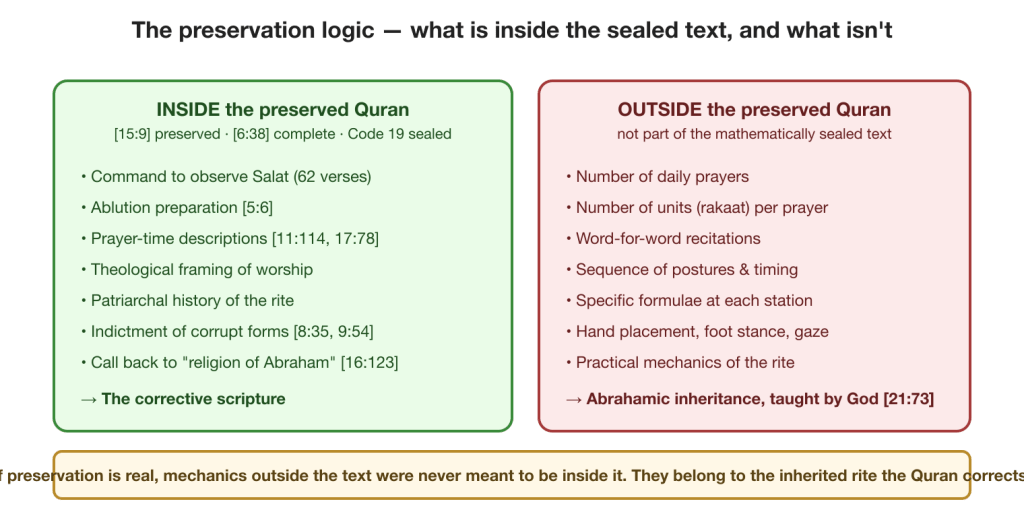
Part 14.6: The Falsification Test — What We’d Expect If Salat Were a Muhammadan Invention
One way to settle a historical-textual claim is to run a falsification test. State the rival hypothesis as crisply as possible. List the predictions it makes about what we should find in the text. Check the text against the predictions. If a single major prediction fails, the hypothesis is in trouble; if every major prediction fails, the hypothesis is dead. Apply this discipline to “Salat is a Muhammadan invention” — the cartoon-reading’s residual claim — and the result is unambiguous.
Eight predictions, eight failures
If Salat were a Muhammadan invention rather than an inherited Abrahamic rite the Quran is correcting, here is what we would reasonably expect to find in the Quran. Each of these is a prediction the rival hypothesis makes; each is something the Submitter hypothesis predicts will be absent. The text settles each one.
| Prediction if Salat is a Muhammadan invention | What the Quran actually shows |
|---|---|
| 1. A Quranic founding moment — a specific verse establishing the rite as new (“Today I institute for you the Contact Prayer…”) | Absent. Every Salat command is a continuation command — “observe,” “maintain,” “be steadfast in.” Never “begin” or “institute.” |
| 2. Mechanical instructions — number of daily prayers, rakaat counts, recitation script, posture sequence. | Absent. No verse lists the count; mechanics are nowhere in the text. (See Parts 7, 7.5) |
| 3. An explanation of why this specific schedule (why these times rather than others, why this number rather than another). | Absent. The Quran describes the prayer-windows; it never justifies their selection. The audience already knew them. |
| 4. A defence against critics who object to the rite’s novelty (compare how the Quran defends novel claims like resurrection, consequence, monotheism). | Absent. No verse defends Salat against “this is bid’ah” or “we never had this before.” Nobody objects to its novelty — because it isn’t novel. |
| 5. No prior usage of “ṣalāt” for previous prophets — the word should be Muhammadan-specific. | Absent. Abraham, Ishmael, Moses, Jesus, Zachariah, the Children of Israel — all named as observing Salat by the Quran. (See Part 6) |
| 6. No “religion of Abraham” passages — Muhammad’s mission would have to be its own thing. | Absent. [16:123], [22:78], [3:95], [2:135], [6:161] all explicitly identify the religion as Abraham’s. Muhammad was inspired to follow it. |
| 7. No commands to consult previous-scripture communities for verification (they wouldn’t have the rite). | Absent. [10:94], [16:43], [21:7] all command consulting previous-scripture readers — incompatible with a Muhammadan invention. (See Part 8.5) |
| 8. No mention of disbelievers already performing the rite (they couldn’t, before Muhammad introduced it). | Absent. [8:35] explicitly names the disbelievers’ “Salat” at the Ka’bah. [9:54] says hypocrites observed Salat lazily. They had it before the Quran indicted it. (See Parts 5, 9) |
What it means when every prediction fails
In any honest hypothesis test, eight failures out of eight predictions is the end of the hypothesis. The “Salat is a Muhammadan invention” claim does not partially survive; it does not get a few of these predictions right and a few wrong. It gets none right. There is no founding verse, no mechanical instruction, no schedule explanation, no defence against novelty critics, no Salat-only-for-Muhammad linguistic pattern, no fresh-religion framing, no “do not consult Jews and Christians on this” warning, no acknowledgement that disbelievers could not yet have a Salat. Every place a real founding text would leave fingerprints, the Quran is silent or directly opposed.
Now run the same test on the Submitter hypothesis. Salat is an inherited Abrahamic rite the Quran is correcting. Predictions: continuation verbs (yes), no mechanical instruction needed (yes — the audience already had them), descriptive prayer-time references (yes — [2:238], [11:114], [17:78], [24:58]), patriarchal Salat (yes — six prophets), “religion of Abraham” framing (yes — six explicit verses), cross-verification commands (yes — three), disbelievers and hypocrites with corrupted versions of the rite (yes — [8:35], [9:54]). Every prediction confirms.
This is what an airtight argument looks like in textual form. One hypothesis predicts eight things; all eight fail. The competing hypothesis predicts the same eight things differently; all eight confirm. There is no rational ground left for the rival reading. The cartoon’s last shelter — the residual claim that “even if Salat predates Muhammad, its formal institution is Quranic” — does not have a single Quranic data-point in its favour and has many directly against it. By any honest scriptural-historical method, the case is closed.
Part 14.7: The 60-Second Case — A Portable Summary
The argument so far has been long because the case has been built carefully. But the Submitter who wants to use it in actual conversation needs a portable form — short enough to deliver, dense enough to land. Here is the entire argument compressed into a sequence a reader can carry into any dialogue. Every line below has been established in the article above; this section is the index, not the proof.
Five facts that end the cartoon, in order
- Mukā’ is a hapax legomenon — it appears once, only in [8:35]. No Quranic usage exists to anchor “whistling.” The gloss is imported from outside the Quran.
- Taṣdiyah’s sister-root is anchored in [80:6] as “give attention to” — never as “clap.” The Quran’s only internal anchor for the root means directed attention, not percussion.
- The verses immediately before and after — [8:34] and [8:36] — use the closely related Ṣ-D-D root meaning “repel.” The cartoon gloss inserts “clap” between two repulsion verbs, breaking a tight three-verse semantic chain.
- The five daily prayers are descriptively identifiable in [2:238], [11:114], [17:78] and [24:58]. Dawn, noon, middle (asr), sunset, night. The Quran does not list “five” — but it lists the five.
- If the Quran is preserved [15:9] and mathematically sealed [74:30], the absence of mechanical instructions is a signature, not a gap. Mechanics live in the inherited Abrahamic rite — exactly where [21:73] places them.
Five verses to memorise
- [8:35] — the disputed verse itself: “Their Contact Prayers (Salat) at the shrine (Ka’bah) were no more than a mockery and a means of repelling the people.”
- [21:73] — God taught the patriarchs: “we taught them how to work righteousness, and how to observe the Contact Prayers (Salat) and the obligatory charity (Zakat).”
- [16:123] — Muhammad’s role: “Then we inspired you (Muhammad) to follow the religion of Abraham.”
- [98:5] — what was always asked: “All that was asked of them was to worship God… observe the Contact Prayers (Salat), and give the obligatory charity (Zakat). Such is the perfect religion.”
- [12:111] — what the Quran rejects as a co-source: “This is not fabricated Hadith; this (Quran) confirms all previous scriptures, provides the details of everything…”
Five rebuttals to keep ready
- “Why repeat Salat 62 times if it was known?” Repetition tracks importance, not novelty. The Quran also commands honoring parents and forbidding murder dozens of times — those weren’t invented either.
- “Where do rakaat counts come from if not the Quran?” From the Abrahamic inheritance ([21:73] God taught them how). Hadith was compiled 200+ years post-prophet, with four schools contradicting each other on the mechanics.
- “[5:3] perfected the religion — so it must have been incomplete before.” What was completed is the corrective scripture and the public name “Submission.” [30:30] already calls fitrah-monotheism “the perfect religion.” [16:123] says Muhammad was inspired to follow Abraham’s religion, not to found a new one.
- “Muhammad must have brought something new.” He brought the Quran itself — the final scripture, the mathematically-sealed text (Code 19). The novelty is the book, not the rite.
- “The five prayers came from the Mi’raj.” [17:1] says only that Muhammad was “shown some of our signs” — no command, no bargaining narrative. The 50→5 prayer-bargaining story is Hadith-only and depicts God in a way [50:38] and [6:115] forbid.
The collapse chain — visualised
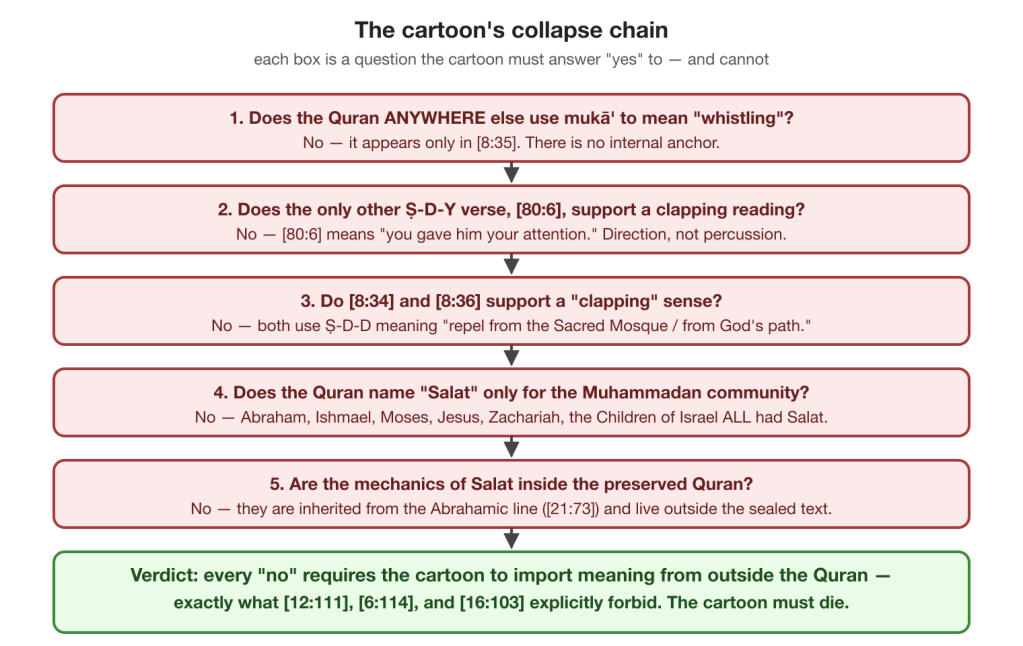
The 60-second pitch
If you have a minute with someone — say it like this: “Verse [8:35] is famously translated as ‘whistling and clapping.’ But the word for ‘whistling’ appears only once in the entire Quran, so the meaning is imposed from outside. The word for ‘clapping’ shares its root with verse [80:6], where it means ‘to give attention,’ not ‘to clap.’ The verses immediately before and after — [8:34] and [8:36] — use a sister root meaning ‘to repel from the Sacred Mosque / from God’s path.’ The natural reading is that the disbelievers’ Contact Prayer at the shrine had become a means of repelling people through ostentatious self-display — which is exactly what the Final Testament renders. And once you read it that way, you notice that the verse calls what they were doing ‘their Salat.’ They had a Salat. The Quran did not invent Salat; it indicted a corrupted form of an inherited rite. [21:73] says God taught Abraham how to observe the Contact Prayer; [16:123] says Muhammad was inspired to follow Abraham’s religion. The mechanics live in the Abrahamic inheritance, the Quran is the corrective scripture, and the cartoon reading of [8:35] exists only because translators were reading through a Hadith filter the Quran itself rejects in [12:111].” That is the case. Sixty seconds.
Conclusion: Read the Verse, Inherit the Religion
The Sunni rendering of [8:35] as “whistling and clapping” survives only by being unexamined. Look at the words and the cartoon collapses: mukā’ is a hapax with no Quranic anchor, glossed in the Final Testament as “flamboyancy”; taṣdiyah from Ṣ-D-Y is anchored in [80:6] as “giving attention to,” and its sister root Ṣ-D-D in the surrounding verses 8:34 and 8:36 means “to repel.” Look at the passage and the cartoon collapses: 8:34–36 is a tight three-verse chain about repulsion of seekers from the Sacred Mosque, into which “clapping” inserts a non-sequitur. Look at the Quran’s grammar around prayer and the cartoon collapses: the Quran assumes Salat the way it assumes eating and sleeping, never teaching it from scratch. Look at the patriarchal record — Abraham, Ishmael, Moses, Jesus, Zachariah, the Children of Israel — and the cartoon collapses: the Contact Prayer is older than Muhammad by millennia.
What survives, when the cartoon is gone, is the religion of Abraham. [8:35] stops being an embarrassment and becomes one of the cleanest internal Quranic proofs that Submission was not invented in seventh-century Arabia. The disbelievers already had a Salat — corrupted, theatrical, repellent — and the Quran came to call them, and us, back to its original form. [6:161] tells us what that form is: “the perfect religion of Abraham, monotheism.” Read the verses without the glosses; receive the inheritance without the corruption; pray as Abraham prayed, as Ishmael prayed, as Moses prayed, as Jesus prayed, as Zachariah prayed. That is what the Quran is asking for, and that is what [8:35], properly read, makes unmistakable.
If this article opened the verse for you, share it. Talk about it. Bring it up the next time someone tells you Muhammad “brought the prayer.” He brought the Quran. Abraham brought the prayer. God taught it. We inherit it. Join the conversation at discord.gg/submission.

 Quran Only Studies
Leave a comment