Introduction: Two Words That Refuse to Collapse
Two Arabic words sit at the foundation of how we understand divine communication: nabī (prophet) and rasūl (messenger). Across the centuries traditional commentators have blurred them, sometimes treating them as synonyms, sometimes inventing finely-spun distinctions that the Quran itself never makes. The cost of that blurring is enormous. It locks God’s guidance behind a wall called “the seal of the prophets” and pretends nothing more can be said — when in fact the Quran preserves a second, broader channel: messengership. Closing the door on prophets is not closing the door on messengers, and the Quran is exquisitely precise about which is which.
The thesis of this article is simple, exegetical, and verifiable. Wherever the Quran speaks of nubuwwa — the office of prophethood — it speaks of scripture in the same breath. Prophethood is structurally tied to kitāb (scripture), ḥikma (wisdom), and ḥukm (judgment / law). Messengership is not. A messenger may bring a new scripture (and when he does, he is also a prophet), or he may be sent only to confirm, warn, purify, or consolidate what already exists. The category of messengers is wider than the category of prophets, and the Quran proves it. Read carefully, the text will not let the two words collapse into one — and the consequences for whether God is still speaking to humanity are decisive.
Part 1: The Morphology — What the Roots Themselves Tell Us
n-b-‘ (ن ب أ): The Root of News, Tidings, and Prophecy
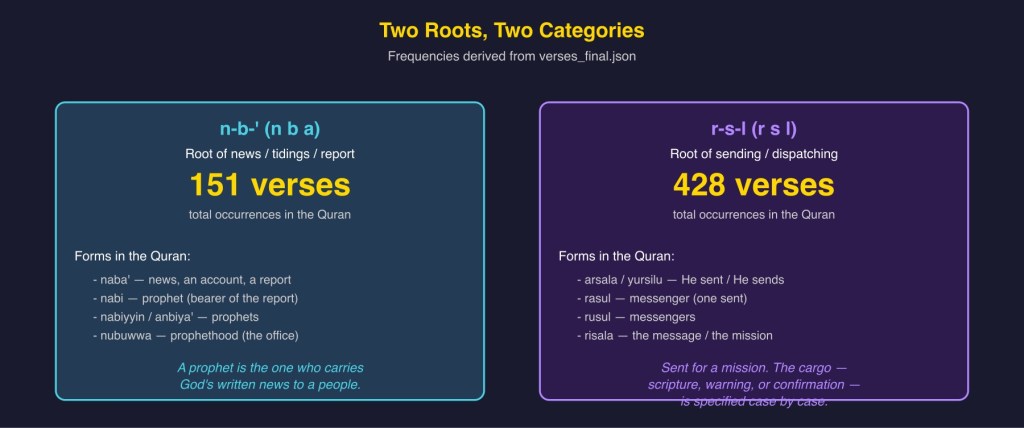
The Arabic root n-b-‘ appears across the Quran in 151 verses and produces meanings that cluster into two semantic fields. The first field is naba’ — news, tidings, an account, a report. God uses verbs from this root constantly: “We will inform them,” “Inform them,” “shall I tell you the news of.” The second field, derived from the very same root, is nabī (prophet), nabiyyīn / anbiyā’ (prophets), and nubuwwa (prophethood). The two are not two unrelated meanings. They are one meaning: a nabī is, etymologically and functionally, the bringer of naba’ — the bearer of God’s news. And in the Quran, the news a prophet brings is not oral folklore. It is structured divine guidance. It is scripture in the broad Quranic sense — sometimes a written book, sometimes received words, sometimes a decreed religion — but always something God Himself originated and entrusted to him to convey.
Of those 151 verses with the n-b-‘ root, 77 use it in the prophet/prophets/prophethood sense. The remaining 74 use it for “news,” “inform,” “tidings.” This semantic unity is itself an argument: a prophet is, by the very word the Quran uses for him, the one entrusted to deliver God’s authoritative communication — His kitāb when given as a book, His kalimāt when given as words, His ṣuḥuf when given as teachings, His dīn when given as a decreed way of life. The traditional translation “prophet” (from Greek prophētēs, “one who speaks before”) has obscured this. The Arabic word means something more specific: the one who carries an originating divine communication, in whatever form God gave it.
What “Scripture” Means Here — Beyond the Bound Book
Before the argument moves on, one clarification is essential, because a careless reader could think the thesis “prophethood is tied to scripture” requires every prophet to have walked around with a written codex. That is not the claim, and the Quran itself prevents it. “Scripture” in the broad Quranic sense includes at least four kinds of received divine communication, all of them attached to prophets, and the article uses the word in this broad sense throughout.
The narrowest sense is kitāb — a written book that becomes a transmissible scripture: the Torah given to Moses, the Psalms to David, the Gospel to Jesus, and the Quran itself. The next sense is ṣuḥuf — leaves, sheets, teachings — the form attested for Abraham and Moses in 87:18–19: “This is recorded in the earlier teachings. The teachings of Abraham and Moses.” Khalifa renders ṣuḥuf as “teachings” precisely because the form is broader than a bound volume. Then there is kalimāt — the divine words received directly. Adam’s redemption verse uses exactly this: “Then, Adam received from his Lord words, whereby He redeemed him” (2:37). Adam was a prophet (3:33 places him among the elect), and what he received was not a book but words from his Lord — and those words were a structured, transmissible, divinely-originated communication. They count as scripture in the broad sense the Quran uses.
Finally there is dīn — the religion or way of life — decreed and inspired through the prophet, of which 42:13 is the lock-verse: “He decreed for you the same religion decreed for Noah, and what we inspired to you, and what we decreed for Abraham, Moses, and Jesus: ‘You shall uphold this one religion, and do not divide it.’” One religion across the prophets, transmitted through decree and inspiration. Some of those prophets were given a book; all of them were given the religion. Abraham’s role is captured in 53:36–37, where he is praised not as a book-author but as the one “who fulfilled” — the practical executor of the divine decree. So when this article says prophethood is tied to scripture, the operative claim is: every prophet receives an originating divine communication that he is bound to transmit. Sometimes that comes as a written book, sometimes as teachings, sometimes as words, sometimes as a decreed religion. What it is never is a self-generated mission. The prophet does not author what he carries; he receives it. Messengership, by contrast, can be sent without any of this — the angels to Lot are sent, the three to the town are sent, but none of them receives an originating communication of their own. They carry a delivery. The prophets carry a revelation. That is the distinction the rest of the article will document, verse by verse.
r-s-l (ر س ل): The Root of Sending
The Arabic root r-s-l appears in 428 verses — nearly three times the n-b-‘ frequency. Its meanings cluster around the verb “to send”: “We sent,” “He sends,” “He sent down,” “they were sent.” From this verb is derived rasūl (messenger, literally “one who is sent”), rusul (messengers), and risāla (the message itself). The root says nothing about what the sent one carries. It only says he is sent. He may carry a new scripture, a confirmation, a warning, a deliverance, an annihilation. The word leaves the cargo unspecified.
This is the first morphological clue. The root r-s-l names a function — being dispatched on a mission. The root n-b-‘ names a content — bearing divine news that becomes received guidance, in whatever form God grants it (book, teachings, words, or decreed religion). The two roots cannot mean the same thing because they are doing different work in the language. One is a verb of motion; the other is a noun of substance. To collapse them is to flatten the very grammar God chose.
Part 2: The Defining Triad — Scripture, Wisdom, Prophethood
The Verses That Define the Office of nubuwwa
When the Quran defines nubuwwa as an office — that is, when it tells us what God grants to those He raises up as prophets — it always names the same triad: scripture, wisdom, prophethood. Three verses lock this triad in place. The first is the verse that refutes ever attributing divine status to a prophet. It tells us exactly what God gave him.
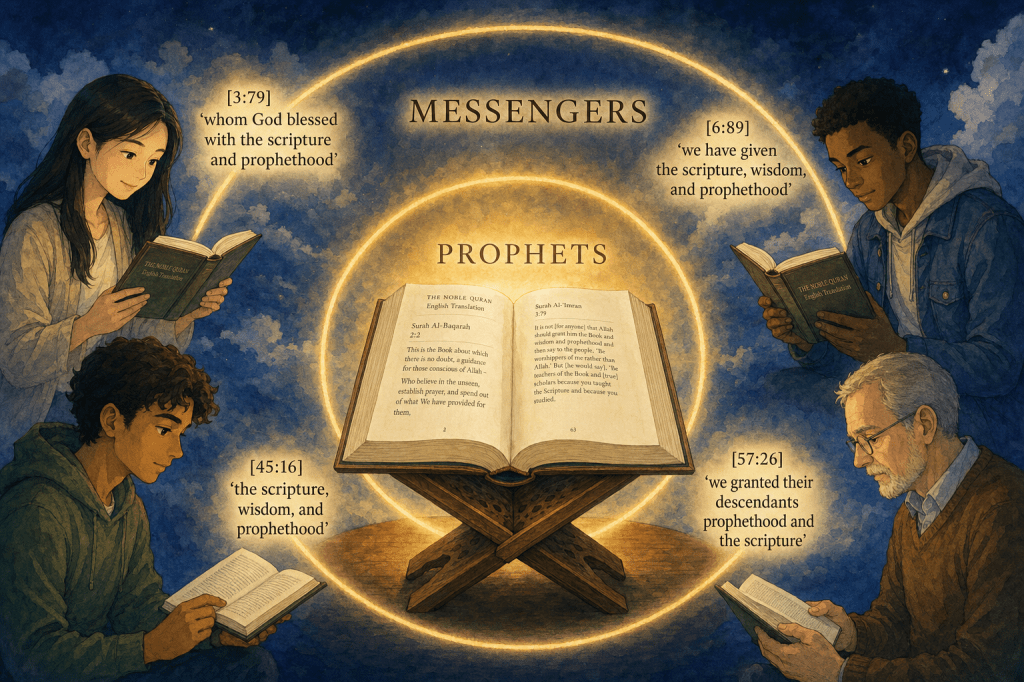
[3:79] “Never would a human being whom God blessed with the scripture and prophethood say to the people, ‘Idolize me beside God.’ Instead, (he would say), ‘Devote yourselves absolutely to your Lord alone,’ according to the scripture you preach and the teachings you learn.”
Read it again, slowly. The phrase is “the scripture and prophethood.” Not prophethood standing alone. Not prophethood as a free-floating spiritual title. Prophethood is named in the same breath as scripture, and the next clause confirms it: “according to the scripture you preach and the teachings you learn.” A prophet preaches a scripture. That is what makes him a prophet. The same triad surfaces almost word-for-word a few chapters later, this time about a whole succession of past messengers who were also prophets.
[6:89] “Those were the ones to whom we have given the scripture, wisdom, and prophethood. If these people disbelieve, we will substitute others in their place, and the new people will not be disbelievers.”
And once more, this time about the Children of Israel as a whole bloodline through whom prophets and scriptures came:
[45:16] “We have given the Children of Israel the scripture, wisdom, and prophethood, and provided them with good provisions; we bestowed upon them more blessings than any other people.”
Three witnesses. Three independent verses. Each names the same three gifts — scripture, wisdom, prophethood — as a single bundle. You cannot pull prophethood out of the bundle without breaking the bundle. God did not give the prophets a bare title; He gave them a divine communication to deliver — book, teachings, words, or decreed religion, depending on the case — together with the wisdom to deliver it correctly. Strip away the received communication and the wisdom, and what remains is not nubuwwa. It is something else, something the Quran does not call by that name.

Part 3: Following the Bloodline — Prophethood Travels with Scripture
Abraham’s Progeny: Prophethood and Scripture as Joint Inheritance
Beyond the defining triad, the Quran traces prophethood through bloodlines, and at every step the inheritance is described as scripture-plus-prophethood, never one without the other. About Abraham:
[29:27] “We granted him Isaac and Jacob, we assigned to his descendants prophethood and the scriptures, we endowed him with his due recompense in this life, and in the Hereafter he will surely be with the righteous.”
“Prophethood and the scriptures” — the two are assigned as a single grant. Not “prophethood, and additionally to a few of them scriptures.” A joint inheritance. The same pairing appears about Noah and Abraham together, in a verse that sits — very deliberately — immediately after the famous 57:25:
[57:26] “We sent Noah and Abraham, and we granted their descendants prophethood and the scripture. Some of them were guided, while many were wicked.”
Again the pairing: prophethood and the scripture. The grant to the descendants is bundled. We will return to 57:26 later because of how it conclusively resolves the misreading of 57:25 — but already the pattern is clear. Wherever God speaks of granting prophethood as an office, He is granting scripture in the same act.
Jesus: The Office Defined at the Moment of Bestowal
The most striking verse is the infant Jesus’ own self-description. The very moment he announces what God has made him, he names two gifts together — and the order is decisive.
[19:30] “(The infant spoke and) said, ‘I am a servant of God. He has given me the scripture, and has appointed me a prophet.’”
Notice the sequence. He does not say “He has appointed me a prophet, and incidentally He gave me a book.” He says: He gave me the scripture, and (because of this) He appointed me a prophet. The scripture is the prerequisite of the prophethood, not a side-effect of it. The infant Jesus, in a single sentence, gives us the definition: a prophet is one to whom a scripture has been given.
The Covenant of the Prophets
And then the most theologically loaded verse on the office of prophethood — the covenant verse, which spells out exactly what every prophet was bound to before being named one.
[3:81] “God took a covenant from the prophets, saying, ‘I will give you the scripture and wisdom. Afterwards, a messenger will come to confirm all existing scriptures. You shall believe in him and support him.’ He said, ‘Do you agree with this, and pledge to fulfill this covenant?’ They said, ‘We agree.’ He said, ‘You have thus borne witness, and I bear witness along with you.’”
The covenant God takes from the prophets is structured around scripture. He says to them — in the very act of taking the covenant — “I will give you the scripture and wisdom.” Receiving scripture and wisdom is not what prophets do as one option among many. It is constitutive of being a prophet at all. And then the verse pivots to a second figure: “Afterwards, a messenger will come to confirm all existing scriptures.” This confirming messenger is not described as receiving a new scripture. He is described as confirming the ones already given to the prophets. He is in the messenger category — but as we will see, he is not in the prophet category, because no new scripture is bestowed on him.
Part 4: The Apparent Counter-Examples — and Why They Do Not Touch the Thesis
“O Prophet” — Vocatives Address the Office, Not Define It
An honest exegete must address the verses where “prophet” appears without an explicit mention of scripture in the same line. There are dozens. Many are vocatives addressed to Muhammad: “O prophet, exhort the believers” (8:65), “O prophet, strive against the disbelievers” (9:73), “O prophet, why do you prohibit what God has made lawful for you” (66:1), and so on. These are not definitions of prophethood. They are direct addresses to a man whose prophethood is already established — by the Quran itself, the very scripture he is delivering. The vocative presupposes the office; it does not define it. Asking “where is scripture in the verse ‘O prophet’?” is like asking “where is the bench in the sentence ‘O judge’?” The bench is presupposed by the title.
The same logic dispatches the verses about killing the prophets (3:21, 3:181, 4:155). When God condemns those who “killed the prophets unjustly,” the prophethood of the murdered figures is presupposed by the very fact that they were prophets sent with scripture; God is not pausing to redefine the term mid-condemnation. So too with the verses listing prophets by name (4:163, 19:41–58): each prophet so listed is, elsewhere in the Quran, explicitly tied to a scripture or to the broader inheritance of scripture-and-prophethood. Indeed, 4:163 ends precisely by naming the scripture: “And we gave David the Psalms” — and 17:55 makes the same point even more sharply: “we preferred some prophets over others. For example, we gave David the Psalms.” The example chosen for prophetic preference is the gift of a scripture.
The Israelite Prophets in the Time of Saul
What about 2:246–248, where the Israelites ask “their prophet” to appoint a king? Scripture is not named in those verses. But the surrounding chapter has just established that “He sent down with them the scripture” (2:213) and the entire Israelite prophetic line is already framed by that earlier verse. More importantly, the same prophetic line is the one to whom the Quran later says: “We have given the Children of Israel the scripture, wisdom, and prophethood” (45:16). The narrative-context absence of the word “scripture” inside one isolated story does not undo the explicit, repeated, structural definition the Quran gives elsewhere. Local omissions never override global definitions.
Compare the parallel on the messenger side. When Sãleh is sent to Thamūd (7:75), no scripture is mentioned; the Quran does not call him a prophet there either. He is a messenger sent with a sign. When Hūd is sent (11:50–60), no scripture; again, he is a messenger. The pattern holds with quiet consistency: where scripture is absent, the Quran selects the word “messenger” rather than “prophet” — or, when “prophet” appears, the wider context of his prophethood (his bloodline, his book, his covenant) has already been established.
Part 5: The Disjunction Verses — Two Words That Cannot Be the Same
22:52: “messenger nor prophet” — The Grammar Forces a Distinction
If rasūl and nabī meant the same thing, the Quran would not pair them in disjunctive constructions. Synonyms are not joined by “nor”; they are substituted for one another. But God says:
[22:52] “We did not send before you any messenger, nor a prophet, without having the devil interfere in his wishes. God then nullifies what the devil has done. God perfects His revelations. God is Omniscient, Most Wise.”
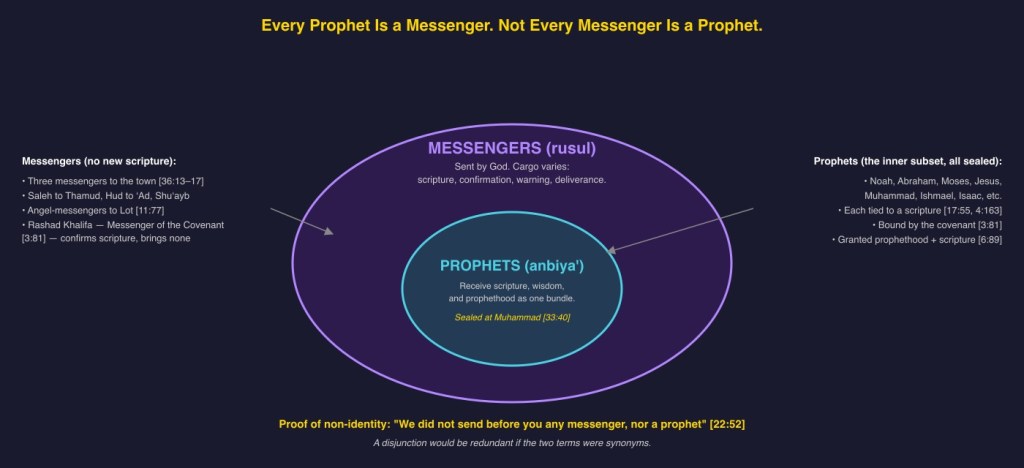
“Any messenger, nor a prophet.” If the words meant the same thing, the verse would be redundant: “any messenger, nor a messenger.” That sentence would not survive into a divine book whose author is described as Most Wise. The disjunction rasūl wa lā nabī (“messenger nor prophet”) is a grammatical proof that the two categories are non-identical. They overlap but they are not coextensive.
19:51 and 19:54: “messenger prophet” — A Compound Title for the Overlap
The other side of the same coin appears in chapter 19, where two figures are described with both titles stacked together. About Moses:
[19:51] “Mention in the scripture Moses. He was devoted, and he was a messenger prophet.”
And about Ishmael:
[19:54] “And mention in the scripture Ismail. He was truthful when he made a promise, and he was a messenger prophet.”
The compound “messenger prophet” (rasūlan nabiyyā) would be incoherent if the two words meant the same thing. We do not say “judge magistrate” if those are perfect synonyms. The compound title only works because each word adds something the other does not — and the natural reading of the Quranic data is that “prophet” adds the dimension of receiving and transmitting scripture, while “messenger” names the broader category of being sent on a divine mission. Where both apply, the Quran uses both.
33:40: “Messenger of God and the Final Prophet”
The classical proof-text for closing prophethood is 33:40 — and it actually proves the opposite of what the traditional reading wants it to prove. Read it carefully:
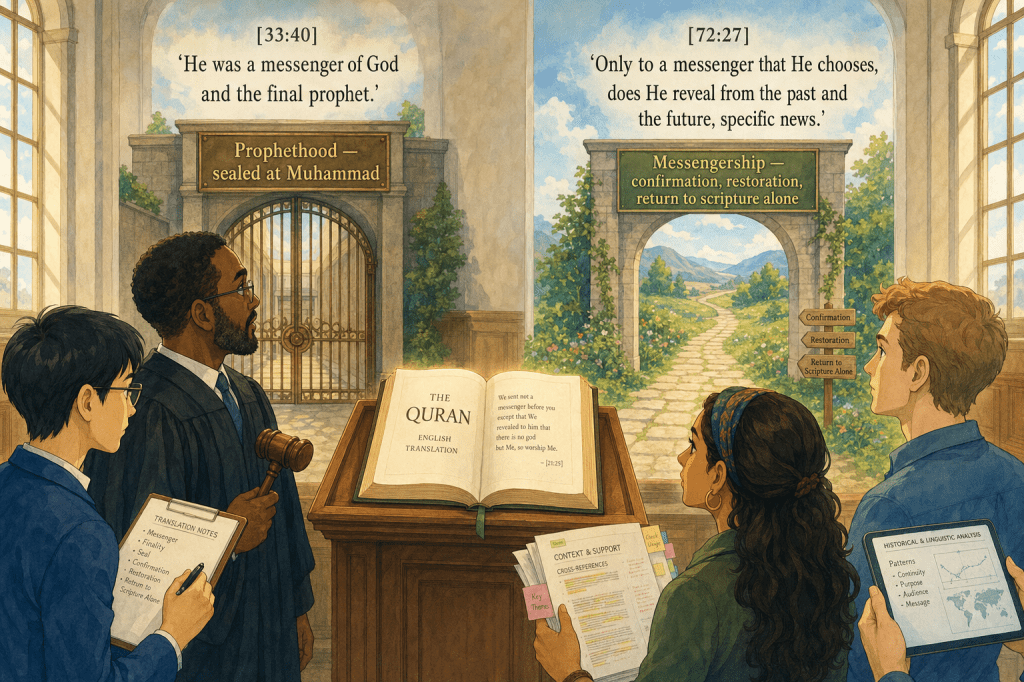
[33:40] “Muhammad was not the father of any man among you. He was a messenger of God and the final prophet. God is fully aware of all things.”
The verse uses two distinct titles for Muhammad: “messenger of God” and “the final prophet.” If the two terms were synonyms, only one would be needed. Instead the Quran applies both to him — and crucially, only one of them is sealed. He is the final prophet (khātam an-nabiyyīn). He is not called the final messenger. The seal lands on prophethood, not messengership. The Quran uses one word, then the other, for Muhammad — and only the second carries the seal. That is not careless writing. That is precise drafting.
Part 6: Messengers Who Are Not Prophets — The Quranic Roster
The Three Messengers to the Town
The clearest case of messengers who bring no new scripture is in chapter 36. God commands the Prophet:
[36:13] “Cite for them the example of people in a community that received the messengers.”
[36:14] “When we sent to them two (messengers), they disbelieved them. We then supported them by a third. They said, ‘We are (God’s) messengers to you.’”
[36:17] “Our sole mission is to deliver the message.”
Three messengers are sent to a single town. They do not arrive with a new scripture. They do not constitute a new prophetic line. Their “sole mission” is to deliver the message — the warning, the call to belief in God alone. The Quran calls them rusul. It does not call them nabiyyīn. The pattern is exactly what the morphology predicts: messengership is defined by being sent; prophethood is defined by carrying scripture. These three were sent. They did not carry scripture. So they are messengers, not prophets.
Sãleh, Hūd, Shuʿayb — Messengers Sent with Signs, Not Books
The same is true of the prophets-of-the-stories — the messengers to ʿĀd, Thamūd, and Madyan. When the people of Thamūd taunt Sãleh:
[7:77] “…they slaughtered the camel, rebelled against their Lord’s command, and said, ‘O Sãleh, bring the doom you threaten us with, if you are really a messenger.’”
They call him rasūl, not nabī. He brings them no new book. He brings them a sign (the camel) and a warning. He is sent. He is a messenger. He is not, strictly, a prophet in the technical Quranic sense — and the Quran reflects that by selecting the word rasūl.
The Angel-Messengers
Most striking of all, the Quran uses rasūl for the angels who visited Abraham and Lot. They are rusul — “Our messengers” — but no one would call them prophets in any sense.
[11:81] “(The angels) said, ‘O Lot, we are your Lord’s messengers, and these people cannot touch you. You shall leave with your family during the night…’”
This is decisive. If “messenger” meant “prophet,” the Quran would not use it of angels who carry no scripture, hold no covenant of scripture-and-wisdom, and are not in any human prophetic lineage. They are rusul in the literal sense the root demands: ones sent. The English word “messenger” preserves the same width. A courier delivering a sealed envelope is a messenger; he is not the author of what is in the envelope. The Quran uses the word with that exact precision.
Part 7: 57:25 and the Quranist Misreading
The Verse and the Wrong Reading
One verse is sometimes wielded as a counter-argument to the prophet/messenger distinction:
[57:25] “We sent our messengers supported by clear proofs, and we sent down to them the scripture and the law, that the people may uphold justice. And we sent down the iron, wherein there is strength, and many benefits for the people. All this in order for God to distinguish those who would support Him and His messengers, on faith. God is Powerful, Almighty.”
The Quranist who collapses messenger-into-prophet reads this as: “messengers receive scripture; therefore every messenger is also a prophet; therefore the two categories are identical.” But this reading misuses the verse in two distinct ways. First, it treats a description of a class as a definition of the class. Second, it ignores the very next verse — which God placed there precisely to prevent the misreading.
Why 57:25 Is Describing, Not Defining
57:25 says God sent His messengers with proofs and sent down with them the scripture and the law. The natural English reading is exactly the natural Arabic reading: of the messengers God sent, He gave them the proofs and the scripture and the law. This is a description of what happened in the prophet-bearing line of messengers. It is not a definition that says “anything called a messenger must, by force of definition, receive a scripture.” That would be like saying “I sent my employees to the conference and I gave them flight tickets” — and concluding that, by definition, anyone I have ever called my employee must have received a flight ticket. The sentence describes what happened with the employees in question, not the definition of “employee.”
The Quran has already established, in 36:13–17 and 7:77 and 11:81 and elsewhere, that the word rasūl covers categories of messengers who bring no new scripture. 57:25 cannot retroactively erase those categories by sleight of grammar. What 57:25 is doing is reminding the audience that the great scripture-bearing messengers — the ones we also call prophets — were in fact sent by God for a reason: justice on earth.
57:26 Slams the Door on the Misreading
And then God places 57:26 immediately after 57:25, as if anticipating the misreading:
[57:26] “We sent Noah and Abraham, and we granted their descendants prophethood and the scripture. Some of them were guided, while many were wicked.”
Notice what happened. Verse 25 used the word “messengers” and described scripture being sent down. Verse 26 narrows immediately to two specific figures — Noah and Abraham — and then says that the prophethood and the scripture were granted to their descendants. The scripture-bearing messengers in 57:25 are, in 57:26, identified as the prophet-line of Noah and Abraham. The very pair of verses tells us: the scripture-bearing subset of messengers is the prophet-line. The general category “messengers” includes more than that subset — but the scripture-bearing subset is exactly the prophets. 57:25 and 57:26 together do not collapse the categories. They distinguish them.
Part 8: The Logical Structure — Inclusion, Not Identity
Prophet ⇒ Messenger, but Messenger ⇏ Prophet
We can now state the structure plainly. Every prophet is also a messenger, because every prophet was sent — and being sent is what rasūl means. But not every messenger is a prophet, because not every messenger received a new scripture — and receiving a new scripture is what nabī means. The categories overlap; the prophet-set is a strict subset of the messenger-set. That is the asymmetric inclusion the entire Quranic data forces on us.
The Quran itself provides every piece of evidence we need for this structure: the disjunction “messenger nor prophet” (22:52) proves they are not identical; the compound “messenger prophet” (19:51, 19:54) proves they overlap; the triad “scripture, wisdom, prophethood” (3:79, 6:89, 45:16, 29:27, 57:26) defines what makes a prophet a prophet; and the messengers-without-scripture (36:13–17, 7:77, 11:81) prove that messengership extends beyond the prophet-set. Six independent lines of evidence converge on the same conclusion.
Why This Matters: The Door That Was Not Closed
Now the practical stakes become clear. 33:40 closes the door on prophethood. It does not close the door on messengership. God uses both titles for Muhammad — “messenger of God” and “the final prophet” — and seals only the second. The seal on prophethood means no one will receive a new scripture after the Quran. That is the truth 33:40 establishes, and it is exactly what we should expect: the Quran is itself the final scripture, complete (5:3), perfect (6:115), preserved (15:9). No further scripture is needed; therefore no further prophet is needed. But the messenger door — the door of being sent for a divine mission that does not bring a new scripture — that door 33:40 leaves wide open. Indeed 40:34 explicitly mocks the human reflex to close it:
[40:34] “Joseph had come to you before that with clear revelations, but you continued to doubt his message. Then, when he died you said, ‘God will not send any other messenger after him. (He was the last messenger)!’ God thus sends astray those who are transgressors, doubtful.”
Read that again. The verse explicitly identifies “He was the last messenger” — said by humans about a previous messenger — as the speech of “transgressors, doubtful,” whom God then “sends astray.” Declaring messengership closed is, by the Quran’s own diagnosis, the move of those who are sent astray. And then comes the constructive promise:
[72:27] “Only to a messenger that He chooses, does He reveal from the past and the future, specific news.”
God reserves the right to send messengers — not new prophets bringing new scripture, but messengers carrying a confirmation, a clarification, a sign — and 72:27 is in the present-continuous tense: this is what God does. Not what He used to do.

Part 9: Rashad Khalifa as Messenger, Not Prophet
The Mathematical Confirmation, Not a New Scripture
This is precisely why Rashad Khalifa is described as a messenger and not a prophet. He brought no new scripture. He brought a mathematical proof of the existing scripture — the 19-based code embedded in the Quran’s structure (Appendix 1 and 29 of the Final Testament). His role is the role 3:81 anticipates: “Afterwards, a messenger will come to confirm all existing scriptures.” A confirming messenger. Not a new prophet bringing a new book; a messenger sent to physically demonstrate, with tangible evidence, that the existing book is from God.
The Quran reserves a specific name for this messenger: the Messenger of the Covenant. He is referenced in 3:81 (the covenant of confirmation), 5:19 (gap-filling messengership), and his identity is mathematically locked in 81:19–21 and confirmed by the gematria of the name “Rashad Khalifa” (1230) tied to 3:81 by multiples of 19. Rashad himself addressed this distinction explicitly. In a letter to the World Conference on Finality of the Prophethood, he wrote: “No one is questioning the fact that Muhammad was the final prophet, nabī. Quran 33:40. According to 3:81, 3:37, and 3:34, he was not the last messenger, rasūl.” Rashad understood, with full clarity, that 33:40 closes the prophet door and not the messenger door, and that the very Arabic words the Quran uses keep the two doors distinct.
Rashad on the Two Words
In his teaching titled “Ascension, Prophecy Fulfilled,” Rashad turns the question around on his accusers (at 33:15): “If Muhammad was not the last messenger, and somebody is going to come after Muhammad, and messengers after Muhammad, what do they look like? What are their qualifications? What will they say? So, if someone comes along and says, worship God alone, uphold the word of God alone, not the word of men, clean out all the practices of worship, destroy all idols, remove all innovations, what’s wrong with that? It makes sense that God’s messenger will do that, will say that.”
This is the Submitter litmus. A new messenger does not bring a new scripture. He brings a call back to the existing scripture in its purity — strip the innovations, destroy the idolatry, restore “God alone” worship. That call is exactly what 3:81 promised when it said the post-prophet messenger would come “to confirm all existing scriptures.” Confirmation, not replacement. Restoration, not novelty. And in his exposition of 3:81 itself (at 51:09), Rashad refutes the traditional claim that the covenant-messenger is Muhammad: “The verse begins by saying God made a covenant with the prophets… we all recognize the prophet Muhammad as a prophet, even they do. He was the last prophet, therefore he must be included in that statement, because God did not say He made a covenant with the previous prophets, or the prophets before you — that’s why He made a covenant with the prophets. So the answer to this claim is in 33:7, where God says: I made the covenant with the prophets, including you, Muhammad.”
The argument is airtight. 3:81 says the covenant was taken from the prophets (a covenant about scripture and wisdom), and that afterwards a confirming messenger will come. 33:7 confirms that Muhammad was inside the covenant of the prophets — not the post-covenant messenger. So the post-covenant confirming messenger is, by the Quran’s own structure, someone other than Muhammad — and the only candidate the Quran’s mathematics anchors is Rashad Khalifa, who brought no new scripture but proved the existing one with a code that no human could fabricate. He is the messenger 3:81 promised because he is exactly the kind of messenger the prophet/messenger distinction permits — sent, but not given a new scripture; confirming, not replacing.
And in another teaching (at 21:13), Rashad states the thesis of this entire article in a single sentence of his own: “The Quran says Muhammad was the last prophet, a messenger, a scripture-bearing messenger, but he was not the last messenger. The Quran makes it very clear.” Notice the exact distinction Rashad draws — “a scripture-bearing messenger” — which is the very category we have spent this article excavating from the Quran’s grammar. Prophets are the scripture-bearing subset of messengers, and Muhammad’s seal lands on that subset. Messengership without new scripture remained open after him, and Rashad himself was sent to fill that exact slot.
Part 10: Why Traditional Conflation Was a Power Move
Closing Both Doors to Lock Out the Confirming Messenger
Why did the Sunni tradition collapse the two words? The answer is institutional. Once the prophet door was closed at 33:40 — a closure the Quran itself decrees — the question naturally arose: is the messenger door also closed? The Quran’s answer is no. The traditionalists’ answer became yes — because if the messenger door stays open, then God can still send someone who calls the community back to the Quran alone, who exposes the corruption of the narrations, who removes the innovations, who restores God-alone worship. That kind of messenger is a direct threat to the credentialed scholar class whose authority depends on the narrations they curate.
So the tradition welded the two words together. “Prophet” and “messenger” became, in Sunni usage, near-synonyms — and the seal of the prophets at 33:40 was extended, by lexical sleight of hand, into a seal of all messengership. The Quran’s careful drafting was overridden by an institutional move that served institutional interests. The price paid was the loss of a category the Quran preserves with grammatical care: the messenger who confirms an existing scripture. By collapsing the words, traditional scholarship erased the very Quranic provision for the Messenger of the Covenant.
The Quran Predicted the Move
And the Quran predicts this exact response. 40:34 — “you said, ‘God will not send any other messenger after him’” — is divine commentary on the human tendency to declare God’s messengership over the moment one messenger dies. The verse condemns the move and identifies its source: “God thus sends astray those who are transgressors, doubtful.” The Sunni and Shia traditional positions on the closure of all messengership are, by the Quran’s own categorisation, the position of the transgressors. This is harsh language, but it is the Quran’s language, and as Submitters we receive it as it stands.
The Submitter, by contrast, accepts both halves of 33:40 in their precise formulation: yes, prophethood is sealed; no, messengership is not. The Quran is the final scripture, and the post-Quran messenger is the one who proves it is the final scripture by uncovering the mathematical code embedded in it from the beginning. The two halves fit together perfectly — but only if we keep the two Arabic words distinct, exactly as the Quran does.
Part 11: A Closer Look at the Anchor Verses, in Sequence
2:213 — The Prophets Sent with the Scripture
The earliest systematic statement in the Quran of how prophets and scripture relate is in chapter 2:
[2:213] “The people used to be one community when God sent the prophets as bearers of good news, as well as warners. He sent down with them the scripture, bearing the truth, to judge among the people in their disputes…”
“He sent down with them the scripture.” Not “He sent prophets, and separately He sent scripture.” The two arrivals are simultaneous, bundled, joint. Whenever a prophet is dispatched (the verb of dispatching is from r-s-l), the scripture is sent down with him. This is the Quranic baseline. It tells us that prophets, as a category, are scripture-bearers. The verse continues with a sober observation: those who already had scripture were the very ones who rejected the new scripture — out of jealousy. The whole drama of divine guidance, the Quran here tells us, is the drama of prophets bringing scriptures and people accepting or rejecting them.
5:44 — The Prophets Ruled by the Scripture
The second anchor is in chapter 5:
[5:44] “We have sent down the Torah, containing guidance and light. Ruling in accordance with it were the Jewish prophets, as well as the rabbis and the priests, as dictated to them in God’s scripture, and as witnessed by them…”
The Jewish prophets are defined here by what they ruled by. They ruled in accordance with the Torah — God’s scripture. Their prophethood was operationalised through scripture. Take away the Torah, and there is nothing left of the Jewish prophets’ office in the Quran’s account. Their rulings were scripture-dictated. Their authority was scripture-derived. Their very identity as prophets was scripture-mediated. This is, again, the same pattern: nubuwwa functions through kitāb.
17:55 — Preference Among Prophets Is Measured in Scriptures Given
And the most quietly devastating verse for any reader who wants to separate prophethood from scripture:
[17:55] “Your Lord is the best knower of everyone in the heavens and the earth. In accordance with this knowledge, we preferred some prophets over others. For example, we gave David the Psalms.”
How does God illustrate prophetic preference? “We gave David the Psalms.” Scripture given is the example of prophetic preference. If prophethood and scripture were separable, the example would have been: “we made David live longer,” “we gave David more victories,” “we gave David more children.” Instead the example is the gift of a scripture. Scripture-giving is the substance of prophetic preference. This single verse alone, on its own, would be enough to establish the thesis. Combined with the others, it is decisive.
Part 12: Implications for the Submitter Today
What This Distinction Settles
If prophethood is tied to scripture, several long-running disputes resolve themselves immediately. First, there will be no further prophets, because the Quran is the complete and final scripture (5:3, 6:115, 15:9), and a new prophet would mean a new scripture, which the Quran’s perfection forecloses. 33:40 confirms this: the seal is on prophethood. Second, there will be further messengers, because the messenger door is not sealed — and the Quran explicitly anticipates a confirming messenger after the prophet line concludes (3:81). Third, the test for any post-Quran messenger is precisely the test of confirmation: does he bring a new scripture (in which case he is a fraud), or does he confirm the existing scripture with tangible, divine, unforgeable evidence? Rashad Khalifa met that test. He brought no new scripture; he uncovered the mathematical signature of God woven through the existing one.
Fourth, the distinction protects against future fraud. Anyone who comes claiming to be a prophet, anyone who arrives with a new “revelation” or a new “book,” is automatically disqualified by 33:40 — the prophet door is shut. Anyone who comes claiming to be a messenger but who departs from the Quran’s content, who adds laws not in the Quran, who calls people away from God-alone worship, is disqualified by 3:81 — the confirming messenger comes to confirm, not to deviate. The two-fold criterion lets us recognise true messengership and reject false claimants.
What the Distinction Demands of Us
And what does this demand of the Submitter today? It demands, first, that we read the Quran with the lexical care God gave it. Rasūl and nabī are different words because they name different things, and the moment we let them collapse into one we lose the very category through which God preserved His ongoing communication with humanity. Second, it demands that we recognise Rashad Khalifa for exactly what he was — not a prophet (he never claimed to be), but a messenger of the covenant whose mission was to confirm the Quran with mathematical proof and to call us back to God alone. Third, it demands that we be willing to argue this case to traditionalists who, by deep institutional habit, will resist any distinction that opens the messenger door even a crack — because that crack is, in fact, the doorway through which God’s confirmation reached our generation.
Conclusion: The Quran’s Own Grammar Is the Argument
The argument of this article was made by the Quran itself; the article merely retraces it. The root n-b-‘ appears 151 times and means, in its noun form, “the bearer of God’s news” — a definition that requires the prophet to receive an originating divine communication, in whatever form God grants it. That communication is sometimes a written book (Torah, Psalms, Gospel, Quran), sometimes ṣuḥuf rendered as teachings (Abraham and Moses, 87:18–19), sometimes kalimāt received as words (Adam, 2:37), and sometimes the decreed religion itself (the one dīn of 42:13). The root r-s-l appears 428 times and means “the one who is sent” — a definition that requires only being dispatched. Wherever the Quran defines prophethood as an office, it names received divine communication in the same breath: the triad scripture-wisdom-prophethood appears in 3:79, 6:89, and 45:16; the pairing prophethood-and-scripture appears in 29:27 and 57:26; the bestowal of scripture-then-prophethood appears in 19:30; the covenant of scripture-and-wisdom appears in 3:81. Six independent witnesses, all converging.
And wherever the Quran shows messengers who bring no new scripture — the three sent to the town in 36:13–17, Sãleh and Hūd and Shuʿayb in the qaṣaṣ, the angel-messengers to Lot in 11:81 — the word rasūl is selected, never nabī. The disjunction in 22:52 (“messenger nor prophet”) and the compound in 19:51 and 19:54 (“messenger prophet”) prove the two words have non-identical content. The seal in 33:40 lands on prophethood and not on messengership, and 40:34 explicitly diagnoses the move of declaring messengership closed as the move of those whom God sends astray. The text could not be clearer.
The practical consequence is the one Submitters already live by: prophethood ended with Muhammad and the Quran; messengership did not, and the Messenger of the Covenant — Rashad Khalifa — confirmed the Quran with the mathematical code 19. The distinction between nabī and rasūl is not a dry lexical curiosity. It is the very mechanism through which God preserved the possibility of speaking to our generation. To honour the distinction is to honour the Quran’s own drafting. To collapse it is to silence God by lexical decree. The Quran itself, with the precision of every word, refuses the collapse — and so must we.
Read the words. Count their occurrences. Trace their meanings. Watch how God uses them. The argument is not ours; it is His. And once you see it, you will not be able to un-see it.



Leave a Reply