Introduction: A Calendar Question That Most People Have Never Asked
Almost every Muslim is told from childhood that the four Sacred Months named in chapter 9 of the Quran are Rajab, Dhul-Qadah, Dhul-Hijjah, and Muharram. Three of those are bunched together at the end of the year, and Rajab is dropped in by itself, five months earlier, with no Quranic reason given. Most people never pause to ask whether that arrangement actually fits the Quran’s own language. They inherit the list, repeat the list, and assume the list is settled. But the moment we let the Quran speak for itself, the traditional list disintegrates and a much cleaner pattern emerges: four consecutive months, beginning with the month of the Hajj pilgrimage itself.
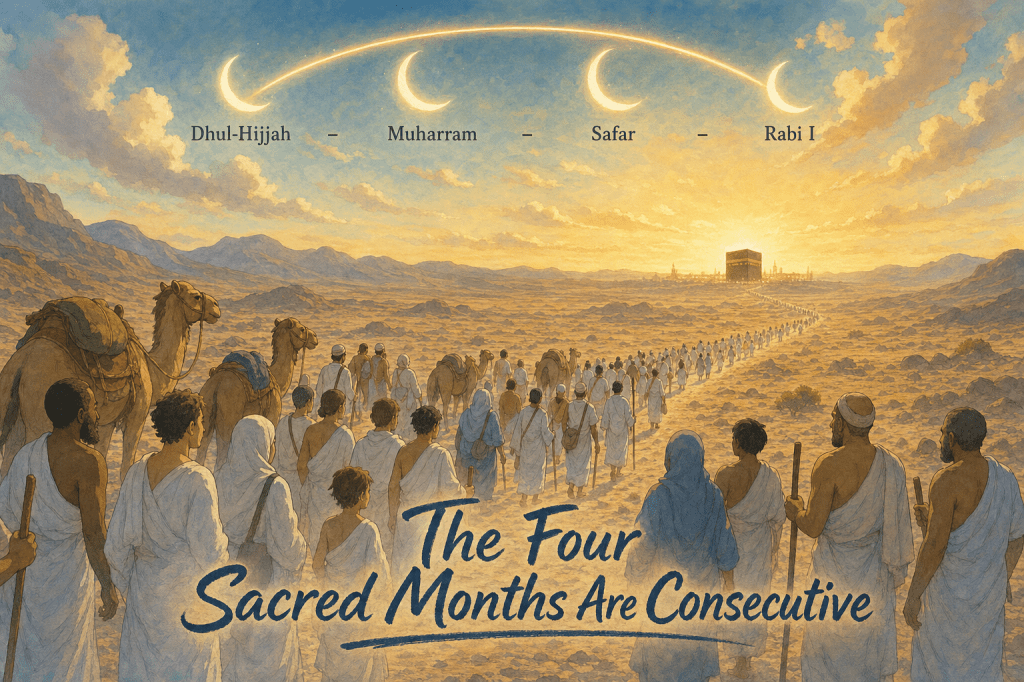
This article makes a single claim and defends it from every angle. The four Sacred Months are Dhul-Hijjah, Muharram, Safar, and Rabi I (months 12, 1, 2, 3 of the lunar year), and they are continuous. They wrap the Hajj pilgrimage in a protective cloak of safe travel: time to journey toward Mecca, time to perform the rites, and time to journey home. The Quran says it directly, the logistics of long-distance pilgrimage demand it, and even the traditional hadith collections – read carefully – admit that three of the four months are consecutive, contradicting the very dogma they are used to defend. The argument that follows is built first from the Quran’s own structure, second from internal consistency across multiple chapters, and third from the practical reality of what a Hajj season actually requires.
What the Quran Actually Says About the Four Sacred Months
Twelve Months, Four Sacred
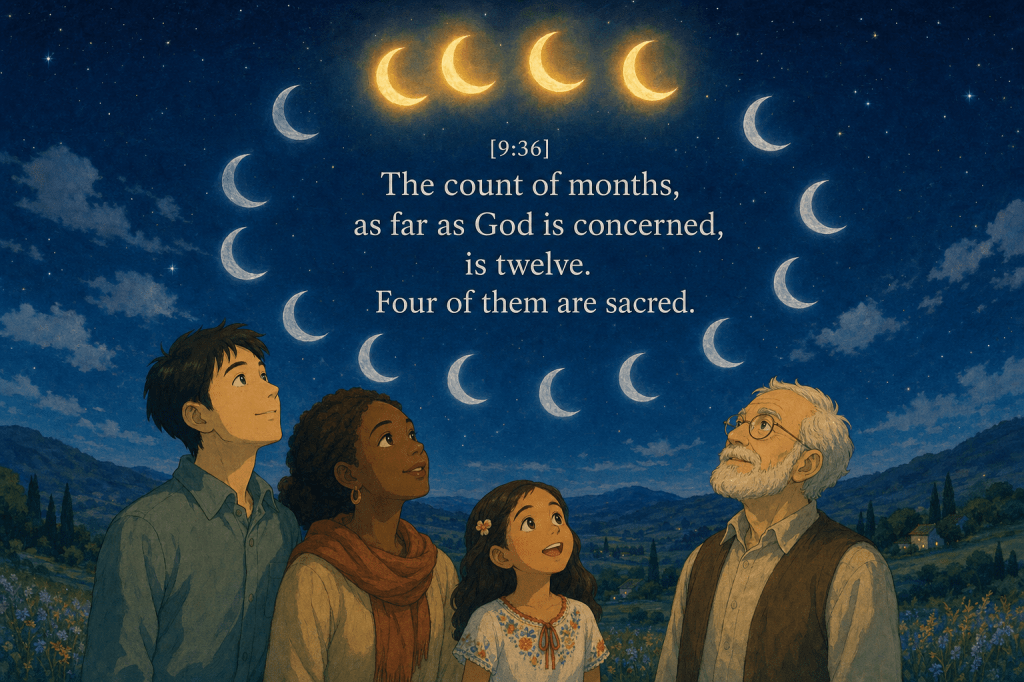
The foundational verse names the count without naming the months. God establishes the calendar, fixes its size at twelve, and then sets aside four of those twelve as sacred. The exact identities of those four are not handed to us as a list of names. Instead, the Quran trusts us to figure out which four by reading the rest of the scripture intelligently. That is not an oversight – it is a test of whether the reader will take the Quran as the criterion or take an outside list and read it back into the verse.
[9:36] “The count of months, as far as God is concerned, is twelve. This has been God’s law, since the day He created the heavens and the earth. Four of them are sacred. This is the perfect religion; you shall not wrong your souls (by fighting) during the Sacred Months. However, you may declare all-out war against the idol worshipers (even during the Sacred Months), when they declare all-out war against you, and know that God is on the side of the righteous.”
The verse links the four Sacred Months to “the perfect religion” and to a prohibition against self-harm through unprovoked fighting. Whatever those four months are, they are a unit, a coherent block of time during which a particular standard of conduct applies. The Quran will go on to specify that this block of time is the season of pilgrimage, and that the standard of conduct is the protection of pilgrims travelling to and from the Sacred Shrine. The traditional list of Rajab plus three others fragments this block into pieces and severs the link to Hajj entirely. The consecutive reading restores both the unity and the purpose.
Hajj Is Observed in Specified Months – Plural
The single most decisive verse in the entire discussion is the one that names the season directly. The Quran says Hajj is observed in months. Not a month. Not five days. Months, plural, specified. The Arabic word used is ashhurun ma’lumat – “specified months” – and the plural form rules out the modern Saudi reduction of Hajj to a five-day event in early Dhul-Hijjah.
[2:197] “Hajj shall be observed in the specified months. Whoever sets out to observe Hajj shall refrain from sexual intercourse, misconduct, and arguments throughout Hajj. Whatever good you do, God is fully aware thereof. As you prepare your provisions for the journey, the best provision is righteousness. You shall observe Me, O you who possess intelligence.”
If Hajj is observed in months (plural), and if four months out of twelve are sacred (per 9:36), and if both passages address pilgrimage conduct using the same vocabulary of restraint and reverence, then the simplest explanation – and the one that does not require importing outside lists – is that the four Sacred Months and the months of Hajj are the same four months. The Quran is doing the work for us, if we let it. The phrase “you shall observe Me, O you who possess intelligence” at the end of the verse is not decorative. It is an invitation to actually think the verse through.
The Traditional Sunni Position – and Why It Breaks the Quran’s Logic
The Inherited List: Rajab, Dhul-Qadah, Dhul-Hijjah, Muharram
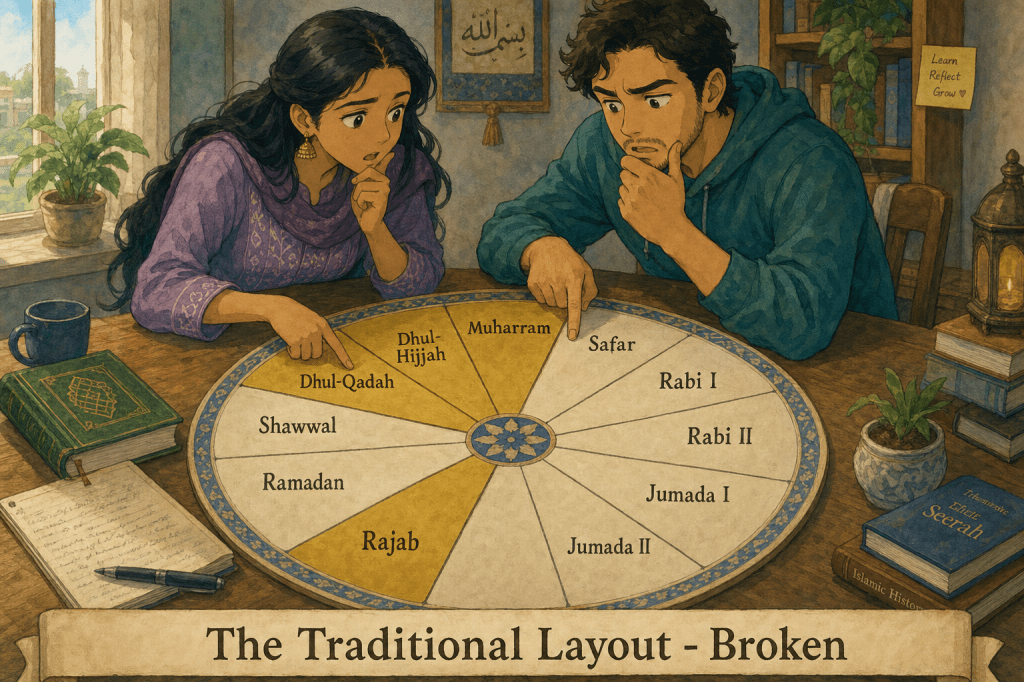
The traditional Sunni position holds that the four Sacred Months are Rajab (month 7), Dhul-Qadah (11), Dhul-Hijjah (12), and Muharram (1). Three of those sit shoulder to shoulder at the year’s end – already an admission that consecutive sanctity is the natural pattern – and Rajab is awkwardly inserted on its own, half a year away. This list is not derived from the Quran. It comes from a pre-Quranic Arab tribal calendar preserved in narrations attributed to Muhammad’s farewell address, and it was simply baptised into orthodoxy without being tested against the scripture.
The problem with this list is structural, not historical. It severs the link between the Sacred Months and Hajj. It detaches the protected travel period from the actual pilgrimage that needed protecting. It fragments a unit that the Quran explicitly treats as a unit. And it relies on the assumption that the reader will accept an external four-name list rather than read 9:36 alongside 2:197, 9:2, and 9:5 to derive the answer from the Quran itself. The moment we make the Quran the criterion, the traditional list collapses.
The Hadith Evidence Quietly Contradicts the Hadith Position
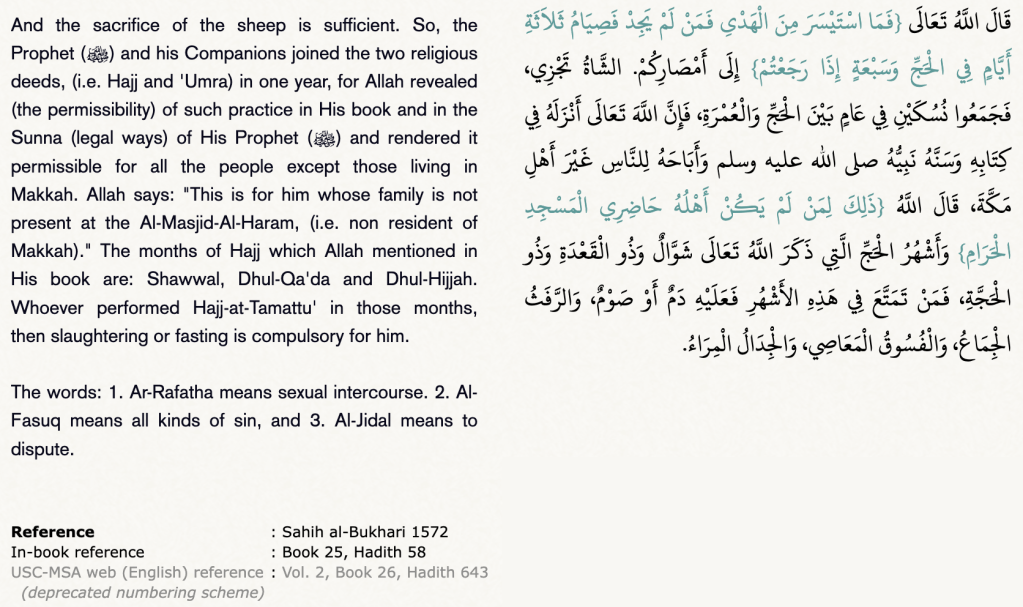
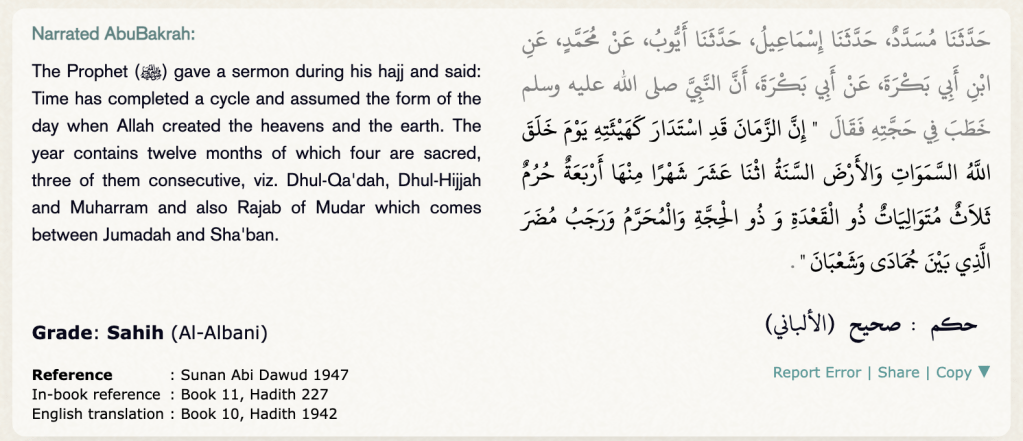
Here is where the traditional position becomes self-defeating. The very hadith collections used to defend the non-consecutive list contain narrations admitting that three of the four months are consecutive. Sahih Bukhari 1572 records a description of the Sacred Months in which three are explicitly continuous – Dhul-Qadah, Dhul-Hijjah, Muharram – and Rajab is awkwardly tacked on as the lone outlier. Sunan Abu Dawud 1947 carries similar wording. The narrations themselves cannot get away from the obvious fact that consecutive sanctity is the natural pattern, and they admit it for three of the four months while preserving Rajab only as a tribute to pre-Quranic tribal practice.
Once you concede that three of the four are consecutive, the case for the fourth being non-consecutive evaporates. There is no Quranic reason given. There is no logistical reason given. There is only inertia – the inertia of a list inherited from idol-worshipping Arab tribes who had their own reasons for consecrating Rajab, reasons which the Quran in 9:37 explicitly identifies as the kind of calendar tampering it came to abolish. The Submitter reading restores consistency: if three are consecutive, then the fourth is the one that completes the run, not the one that breaks it. And the Quranic anchor for that run is Hajj itself.

The actual scanned pages of those narrations, as published online, are reproduced below. They are presented not as religious authority – we accept the Quran alone – but as a self-witnessing exhibit: the same tradition that claims four non-consecutive Sacred Months also records three consecutive ones in its own pages.
The Consecutive Solution: Dhul-Hijjah, Muharram, Safar, Rabi I
Anchored on the Month of Pilgrimage
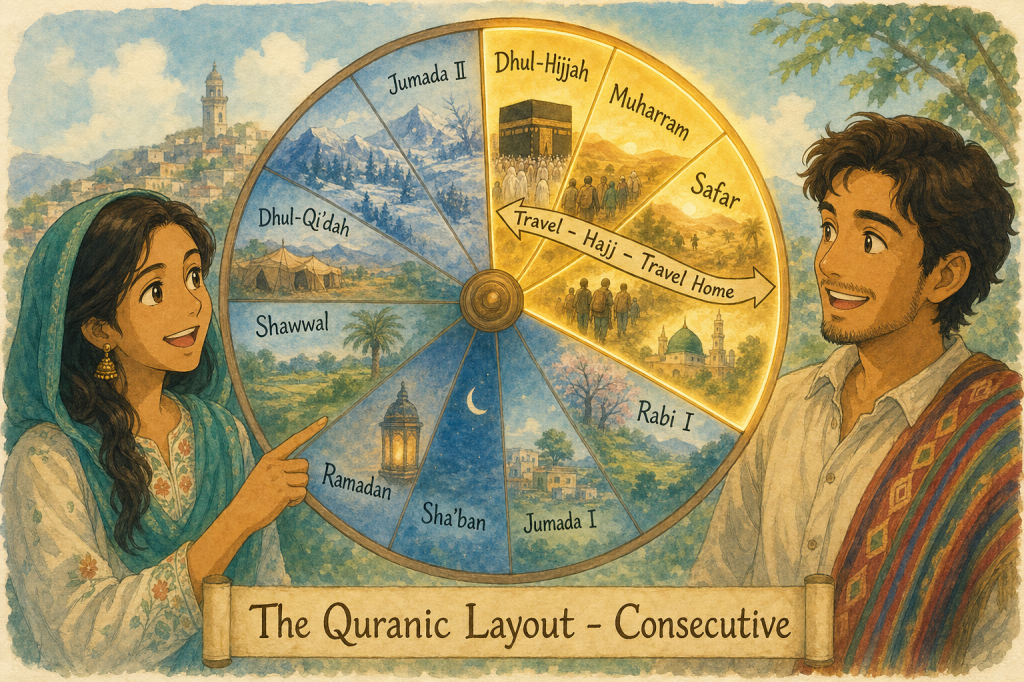
The Quran teaches that Hajj is observed in months and that those months are specified. The most natural anchor is Dhul-Hijjah – the month named for Hajj itself, the month whose first ten days carry the rites at Mecca. From that anchor we count forward: Muharram (month 1), then Safar (month 2), then Rabi I (month 3). Four consecutive months, beginning with the pilgrimage month and continuing through the early new year, form a single unbroken protected season. This is not a clever rearrangement; it is the only arrangement that lets every Quranic clue line up at once.
The Submitter case for this layout rests on three converging lines of evidence. First, the Quran’s own description of the Sacred Months as a unit (9:36) requires a unit, not a fragment-set. Second, the Quran’s description of Hajj as occurring in months, plural (2:197), requires multiple months for the pilgrimage itself. Third, the Quran’s grant of “four months” of safe passage to declared enemies (9:2) is given immediately in the context of the pilgrimage proclamation (9:3), tying the four months directly to the Hajj season. Each of these three converges on the same answer: Dhul-Hijjah, Muharram, Safar, Rabi I.
Four Months of Free Roaming, Right After the Pilgrimage Proclamation
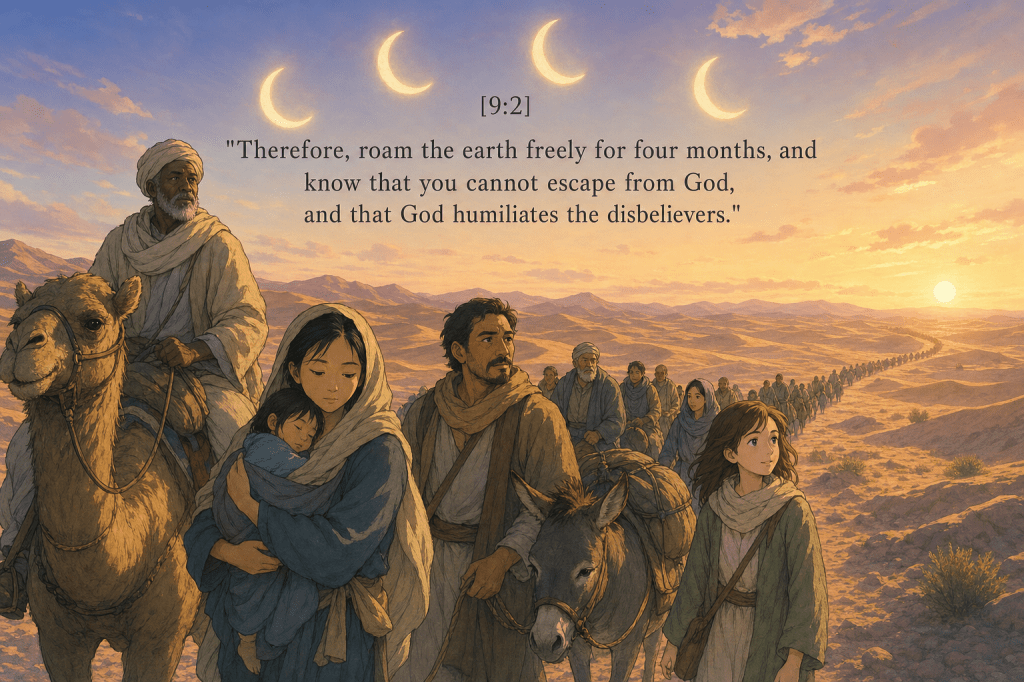
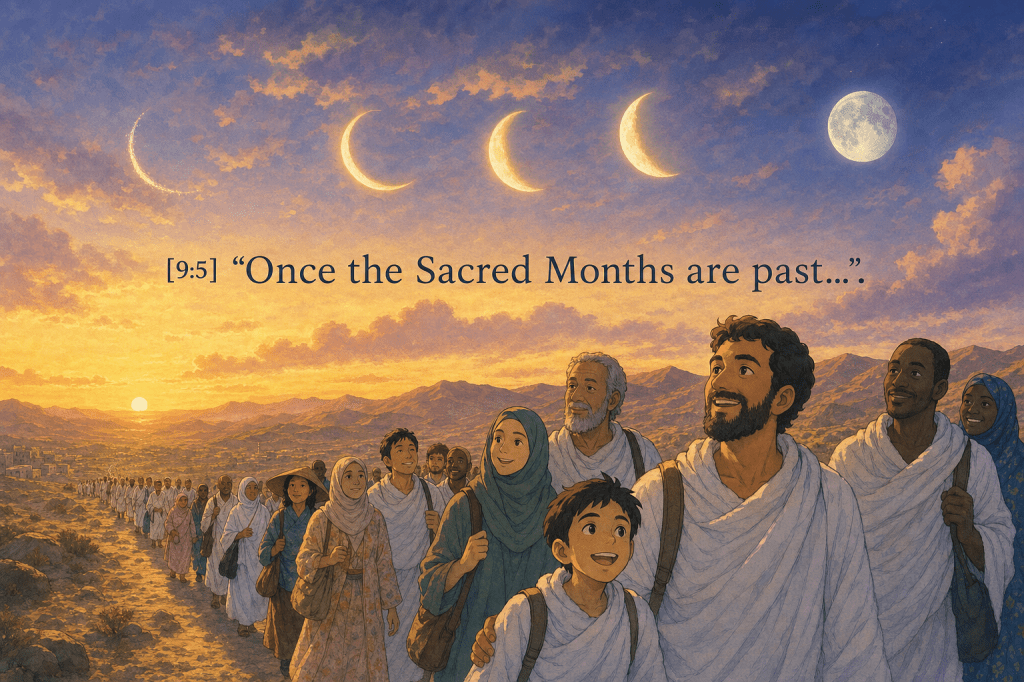
Consider the textual sequence in chapter 9. Verse 1 issues an ultimatum to idol worshipers under treaty. Verse 2 grants those same idol worshipers four months of safe travel. Verse 3 makes a proclamation “on the great day of pilgrimage” – explicitly placing the entire passage in the Hajj season. Verse 4 honours existing treaties to their term. Verse 5 commands action “once the Sacred Months are past.” The flow is unmistakable: the four months of free roaming begin from the Hajj proclamation and end when the Sacred Months end. The four months of 9:2 are the same four months of 9:36, and they begin at Hajj.
[9:2] “Therefore, roam the earth freely for four months, and know that you cannot escape from God, and that God humiliates the disbelievers.”
[9:3] “A proclamation is herein issued from God and His messenger to all the people on the great day of pilgrimage, that God has disowned the idol worshipers, and so did His messenger.”
[9:5] “Once the Sacred Months are past, (and they refuse to make peace) you may kill the idol worshipers when you encounter them, punish them, and resist every move they make. If they repent and observe the Contact Prayers (Salat) and give the obligatory charity (Zakat), you shall let them go. God is Forgiver, Most Merciful.”
Notice the elegance of the structure. The proclamation is made on the day of Hajj. From that day, four months of safe passage begin. When those four months are over, the protected period ends. There is no need to invent a separate Rajab somewhere five months earlier – that breaks the entire flow. The four months in 9:2 are the same four months in 9:36, and they are launched from the Hajj day in 9:3. This is one of the cleanest internal-consistency arguments in the Quran, and the traditional list cannot accommodate it.
Hajj as a Travel Season, Not a Five-Day Event
Pilgrims Came From the Farthest Locations
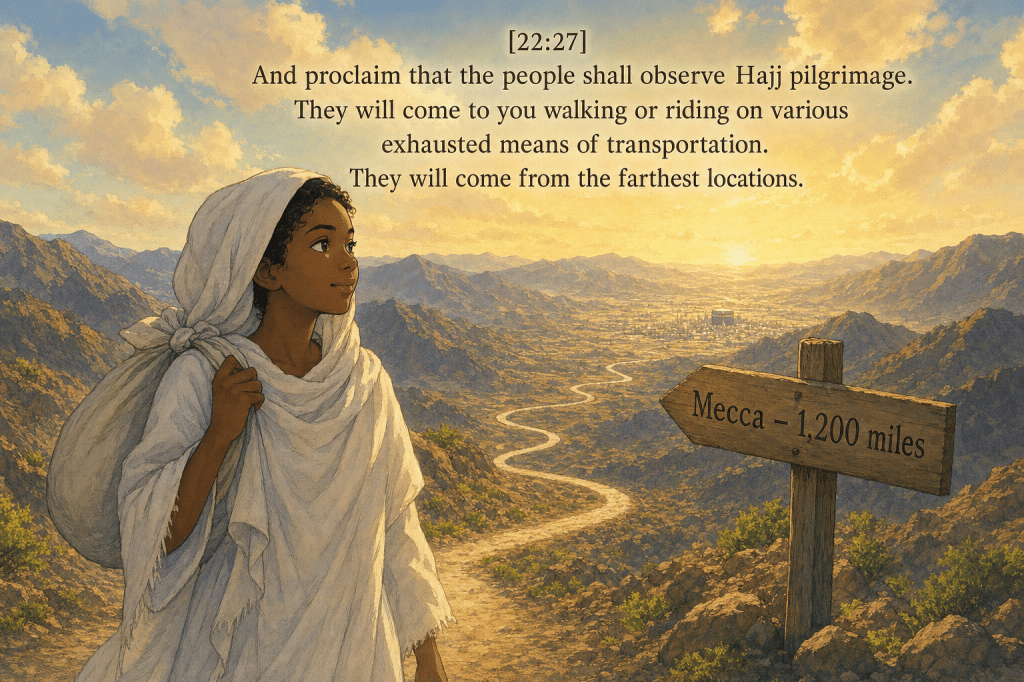
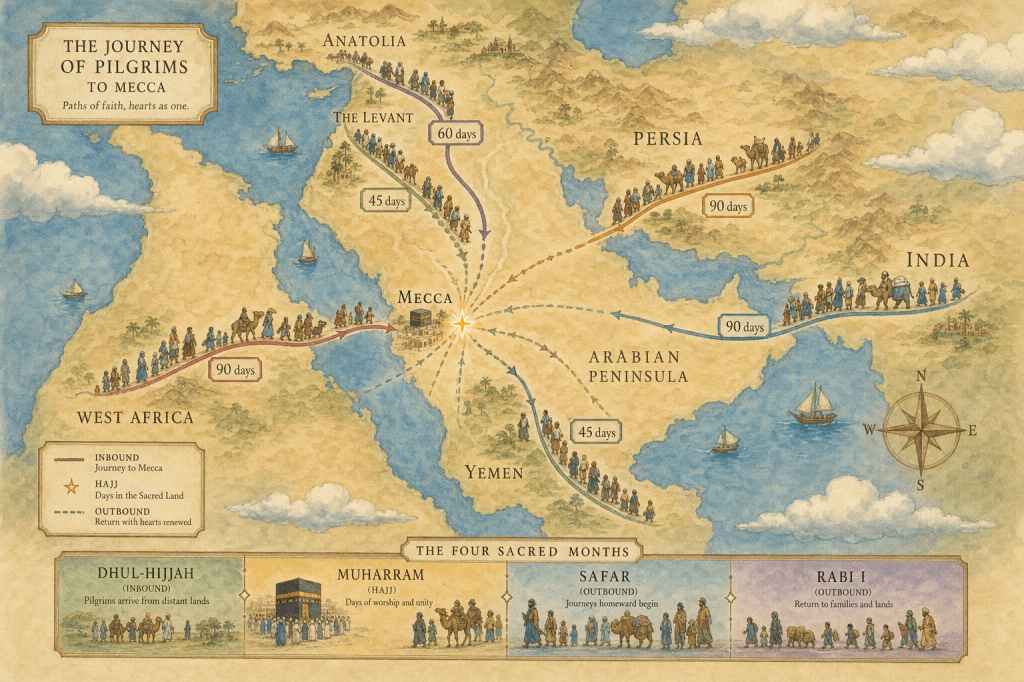
The Quran describes Hajj as a season that pulls people in from across the known world. Pilgrims arrive on foot, on exhausted mounts, having travelled for months from the farthest locations. This is not the modern image of a chartered flight, a five-day stay, and a return. This is a living, multi-month migration of believers, traders, scholars, and families converging on Mecca, performing the rites, and dispersing home. The Quran captures it with a single, vivid clause.
[22:27] “And proclaim that the people shall observe Hajj pilgrimage. They will come to you walking or riding on various exhausted (means of transportation). They will come from the farthest locations.”
[22:28] “They may seek commercial benefits, and they shall commemorate God’s name during the specified days for providing them with livestock. ‘Eat therefrom and feed the despondent and the poor.’”
If pilgrims are arriving from the farthest locations, then by definition they need months of safe travel inbound, days of secure rites at Mecca, and months of safe travel outbound. A single Sacred Month would mean leaving home before sanctity begins and returning home after sanctity ends – exposed on both legs of the journey. A Sacred Month inserted halfway across the year, like Rajab, makes even less sense, because it does not coincide with travel to or from any pilgrimage. The four-consecutive-month solution is the only arrangement that protects the actual journey the Quran describes.
The Logistical Argument From Geography
Apply simple geography. A pilgrim travelling on foot or by camel from West Africa, the Indian subcontinent, Anatolia, Persia, or the Sahel could easily spend forty-five to ninety days each way reaching Mecca. Add the actual pilgrimage rites, the time for trade and commemoration described in 22:28, and the rest needed before turning back, and the round-trip naturally fills around four lunar months. Anything shorter strands pilgrims away from home during unprotected months. Anything longer would be wasteful of the believer’s productive year. Four consecutive months is the smallest envelope that comfortably covers the inbound journey, the rites, and the outbound journey for the bulk of the world’s pilgrims.
The traditional list of Rajab plus a clump in months 11-12-1 fails this logistical test entirely. It would offer protection during a single random month half a year before Hajj, then nothing during most of the inbound travel window, then a brief protection at the end. That is not a coherent sanctity scheme – it is the leftover scaffolding of pre-Quranic tribal politics. The four-consecutive-month layout, by contrast, builds a single envelope around the actual journey: Dhul-Hijjah for the rites, Muharram and Safar for the bulk of the homeward leg, and Rabi I as the buffer that ensures even the slowest travellers reach home in safety.
Verses That Lock the Reading In Place
The Sacred Month, the Offerings, the Garlands
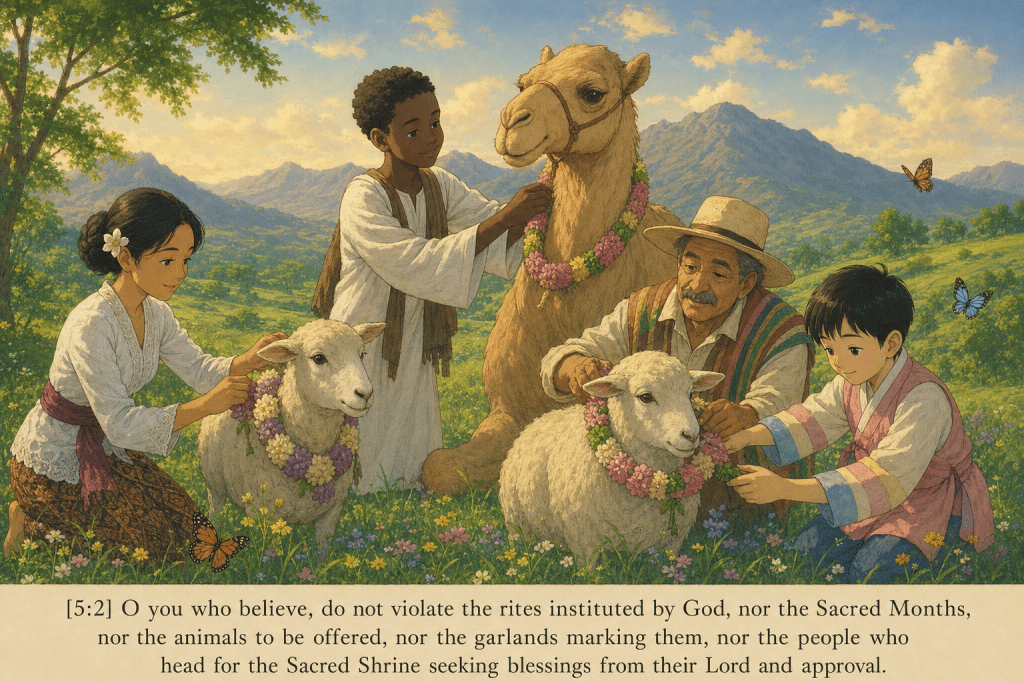
Two further verses bundle the Sacred Months together with the physical infrastructure of Hajj – the Sacred Shrine itself, the animal offerings, and the cloth garlands marking those animals as consecrated. These verses make no sense if the Sacred Months are scattered across the year. They only make sense if the Sacred Months are the season during which pilgrims, offerings, and garlands are simultaneously in motion toward Mecca.
[5:2] “O you who believe, do not violate the rites instituted by God, nor the Sacred Months, nor the animals to be offered, nor the garlands marking them, nor the people who head for the Sacred Shrine (Ka’bah) seeking blessings from their Lord and approval. Once you complete the pilgrimage, you may hunt…”
[5:97] “God has appointed the Ka’bah, the Sacred Masjid, to be a sanctuary for the people, and also the Sacred Months, the offerings (to the Sacred Masjid), and the garlands marking them. You should know that God knows everything in the heavens and the earth, and that God is Omniscient.”
Read these passages with the consecutive layout in mind. The Sacred Shrine is a fixed place. The Sacred Months are a continuous time. The offerings and garlands are a moving population of consecrated animals being walked toward that place during that time. The whole picture is one unified sanctuary in space and time, surrounding a single annual event. The traditional non-consecutive layout produces an incoherent picture: garlanded animals would have to wait around for half a year until the next disconnected Sacred Month rolled in. The consecutive layout produces a coherent picture: the animals are marked, herded, brought to Mecca, offered, and the surplus driven home to feed the poor described in 22:28 – all within one continuous protected season.
Aggression During the Sacred Months
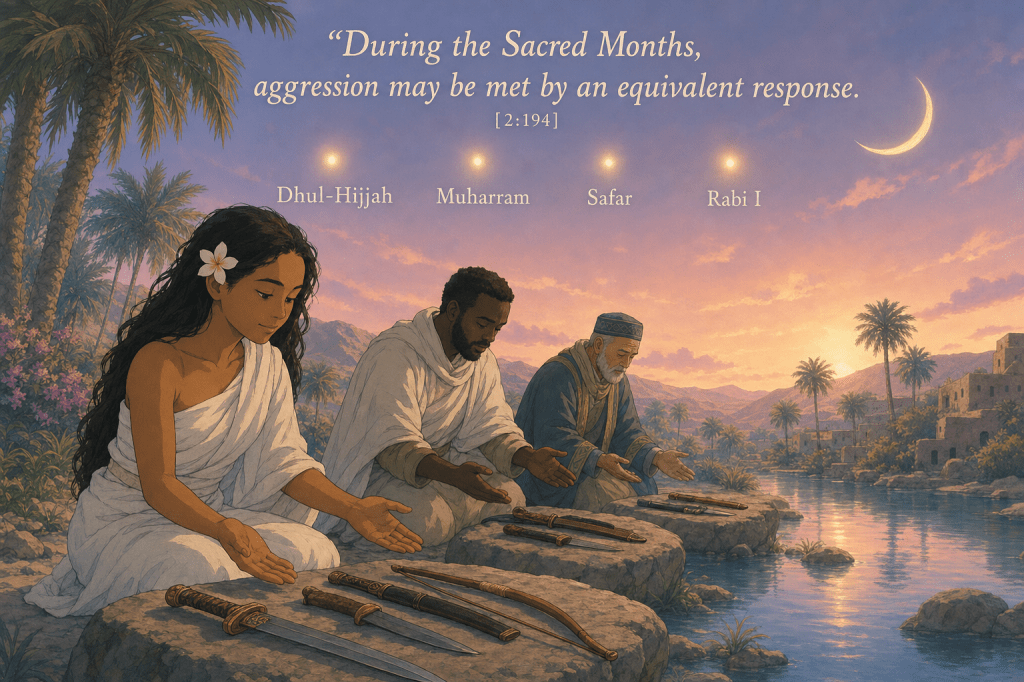
The Quran’s rules of engagement during the Sacred Months only make sense as a continuous protected window. Fighting in the Sacred Month is described as a sacrilege; aggression must be answered with equivalent response, not pre-emptive war. These rules are designed to protect the pilgrim corridor – the routes by which pilgrims travel to and from Mecca – and they require an unbroken stretch of protection.
[2:194] “During the Sacred Months, aggression may be met by an equivalent response. If they attack you, you may retaliate by inflicting an equitable retribution. You shall observe God and know that God is with the righteous.”
[2:217] “They ask you about the Sacred Months and fighting therein: say, ‘Fighting therein is a sacrilege. However, repelling from the path of God and disbelieving in Him and in the sanctity of the Sacred Mosque (Masjid), and evicting its people, are greater sacrileges in the sight of God. Oppression is worse than murder.’”
If a pilgrim is on the road home in Safar and gets ambushed, the protection has to still apply. If a pilgrim is preparing to depart in late Dhul-Hijjah, the protection has to still apply. Continuous sanctity makes the law simple to obey and the corridor easy to protect. A patchwork of one isolated Rajab plus three months at year’s end produces a logistical nightmare in which sanctity flickers on and off as pilgrims travel, leaving them vulnerable for the bulk of the journey. The Quran’s rule presumes a continuous window because it is the only kind of window that does the job.
Calendar Tampering: The Warning of 9:37
God Predicted This Confusion
The verse immediately following the four-Sacred-Months announcement is a direct warning against calendar manipulation. God describes a particular kind of disbelief – altering and alternating the Sacred Months while pretending to preserve the count of twelve. This is not a hypothetical sin; this is the exact behaviour the pre-Quranic Arabs engaged in (a practice called nasi’) and that the inherited Sunni list quietly perpetuates by detaching one Sacred Month from the others and reassigning it to Rajab for tribal-political reasons.
[9:37] “Altering the Sacred Months is a sign of excessive disbelief; it augments the straying of those who have disbelieved. They alternate the Sacred Months and the regular months, while preserving the number of months consecrated by God. They thus violate what God has consecrated. Their evil works are adorned in their eyes. God does not guide the disbelieving people.”
Notice the precise mechanism of the violation: they alternate the Sacred Months with the regular months while preserving the count. That is exactly what producing a list of Rajab plus three end-of-year months does. The count of four is preserved, but their position is alternated – one in month 7, three in months 11-12-1 – rather than left in their natural consecutive arrangement. The Quran is identifying, with surgical accuracy, the kind of error the inherited tradition has made. To recover the original Sacred Months we have to reverse the alternation and restore the consecutive run that begins with Hajj.
The Plural in 2:197 Is Not Decorative
One last grammatical point seals the case. In 2:197 the Quran says Hajj is observed in ashhurun ma’lumat – “specified months”, plural. Modern Saudi practice compresses Hajj to roughly five days, treating those five days as the answer to “the specified months.” But you cannot make a five-day event satisfy a plural-month phrase. The grammar refuses. If Hajj is observed in months, plural, then either the Quran is wrong (which we reject) or the modern practice has compressed something the Quran left expansive. The natural plural-month reading is that Hajj was always intended to be a multi-month season – the four Sacred Months – during which travel, rites, commerce, commemoration, and return all take place under divine protection.
Putting the Whole Picture Together
One Coherent Reading of Six Verses
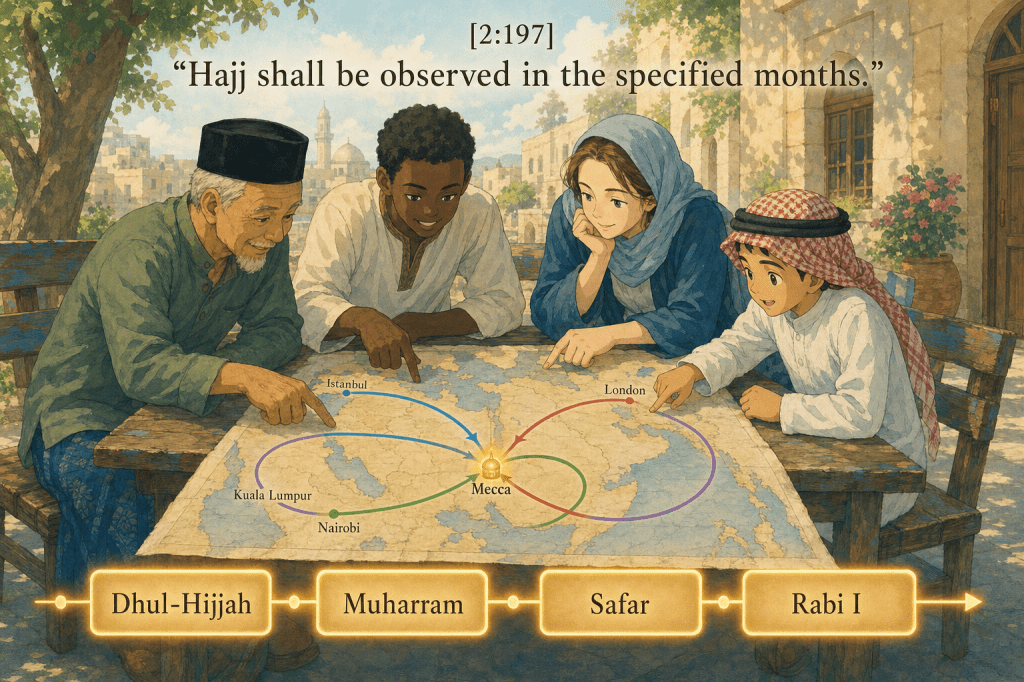
Lay the verses side by side and the consecutive reading writes itself. [9:36] says four of twelve months are sacred. [2:197] says Hajj is in those specified months, plural. [22:27-29] describes pilgrims arriving on exhausted transport from the farthest locations. [9:2-5] grants four months of safe travel beginning at the day of Hajj and ending when the Sacred Months end. [5:2] and [5:97] bundle the Sacred Months with the physical apparatus of pilgrimage – shrine, offerings, garlands. [2:194] and [2:217] demand a continuous protected pilgrim corridor. [9:37] warns that the most common abuse will be alternating the Sacred Months while preserving the count of four.
Every one of these verses lines up under the consecutive reading: Dhul-Hijjah, Muharram, Safar, Rabi I. Not one of them lines up cleanly under the inherited Sunni list. That is what internal consistency looks like. The Quran is not asking us to take an outside list as gospel; it is asking us to think the verses through together, recognise the unified picture, and let the scripture self-correct the tradition. The Submitter approach is simply to do that work and accept the outcome.
Why This Matters Beyond Calendar Trivia
This is not a small bookkeeping question. The boundaries of the Sacred Months determine when a believer must refrain from aggression, when pilgrims have a right to safe passage, when offerings and garlands must be respected, and when the entire community has a duty to preserve the pilgrim corridor. Getting those boundaries wrong distorts the practice of the religion itself. It also leaves the door open to political manipulation – exactly the kind of nasi’ calendar tampering 9:37 condemns. Restoring the consecutive reading is therefore an act of obedience to the Quran’s plain instructions, not an academic indulgence. It puts the Hajj back in its natural place at the heart of a four-month protected season, the way the scripture describes it.
The Quran has no interest in preserving inherited mistakes for their own sake. It anticipates them, names them, and gives readers everything they need to correct them. The four Sacred Months are consecutive. They begin with the month of Hajj. They cover Dhul-Hijjah, Muharram, Safar, and Rabi I. Pilgrims travelling from the farthest locations always knew this in their bones – their journey demanded it. Submitters today, reading the Quran as the criterion, can know it again.
Conclusion: A Calendar Restored to Its Quranic Shape
The argument we have walked through is not subtle, not strained, and not novel. It is what the Quran says when read on its own terms. Four sacred months out of twelve, observed during the season of Hajj, granting four months of safe travel after the day of pilgrimage, protecting the route of pilgrims arriving from the farthest locations, surrounding the offerings and the garlands and the Sacred Shrine in a single unified envelope – all of this fits the consecutive layout from Dhul-Hijjah to Rabi I and none of it fits the broken Rajab-plus-three layout of the inherited tradition. Even the hadith collections, when their own pages are read carefully, admit that three of the four are consecutive and quietly contradict the dogma they are supposed to support.
The right answer was always available. It was sitting in the verses, waiting for readers to take 9:36 seriously, take the plural in 2:197 seriously, take 9:2-5 in their proper sequential context, take 5:2 and 5:97 as a unified picture, and take 9:37 as the warning that it is. The Quran is the criterion. The criterion has spoken. The four Sacred Months are consecutive, they begin with the month of Hajj, and the whole pilgrimage is meant to be a protected multi-month season – not a five-day compressed event drained of its travel infrastructure. Restoring this picture restores the religion’s own logistics to the shape its scripture describes.
The work of recovering the pure religion from the layers of inherited tradition is not done in isolation – it is done in conversation with people willing to let the scripture have the last word.


Leave a Reply