Introduction: The Question Behind All Questions
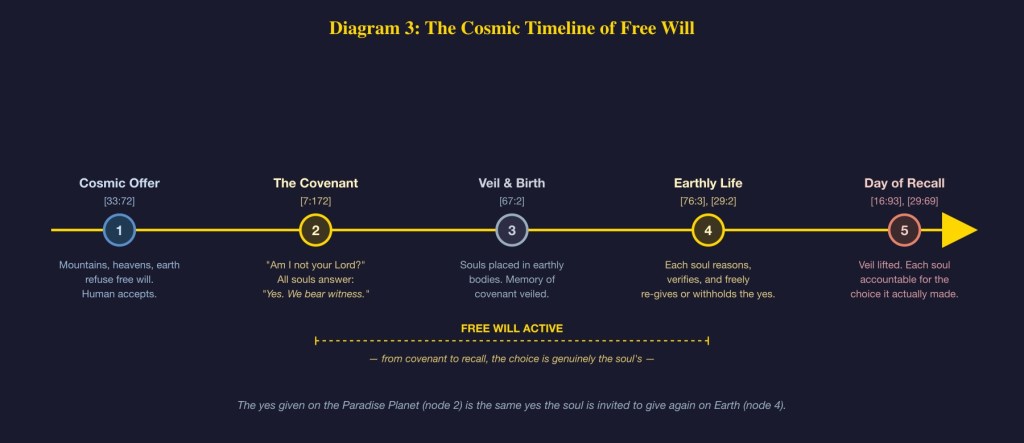
The mountains were offered free will, and they said no. So did the heavens. So did the earth. The Quran preserves this cosmic moment in a single verse: every powerful, ancient thing in creation looked at the gift of being able to choose, weighed the responsibility that came with it, and refused. Only one species accepted — the human being, called by the verse “transgressing, ignorant” for taking on a load the rest of creation was wise enough to decline.
Why would God offer such a thing? Why, of all the creatures in the seven universes, was the human being the only one made to bear it? The answers, followed all the way down, converge on a much larger question: why does God want worship at all? Behind every smaller question lies a single, stunning principle — that the only worship worth wanting is worship that could have been withheld. A forced prayer is not a prayer. A coerced love is not love. A submission with no option to refuse is the operation of a machine, and God did not create machines for worshippers.
This article walks through that answer carefully, drawing on the cosmic dialogue dramatised in Rashad Khalifa’s 1983 screenplay Eternity — God’s question to the archangel Michael, the unanimous choice of the human souls, the witnessed covenant, Satan’s refusal — and grounds every step in the verses of the Final Testament. A companion article, Free Will and Divine Omnipotence, treats the parallel question of how human freedom coexists with God’s omniscience; the present article is concerned with the prior question — why such a freedom was created at all, and why worship is the purpose it was created for. The conclusion is uncomfortable for those who imagine God as a dictator and equally uncomfortable for those who imagine Him as an absentee. He is neither. He is the Lord who wanted to be loved, and who was willing to risk everything to make that love real.
Part 1: God’s Question to Michael
Three Possible Creatures
The screenplay Eternity stages a moment that the Quran only outlines: the conversation in the angels’ mansion, before the human race existed, in which God explains why He intends to make a creature with a mind of its own. The archangel Michael, dazzled by the brilliance of God’s presence, swears unconditional service: “Our Lord, we will always serve You and submit to you, willingly and joyfully.” God replies with a question that is also the entire theology of free will compressed into a few lines.
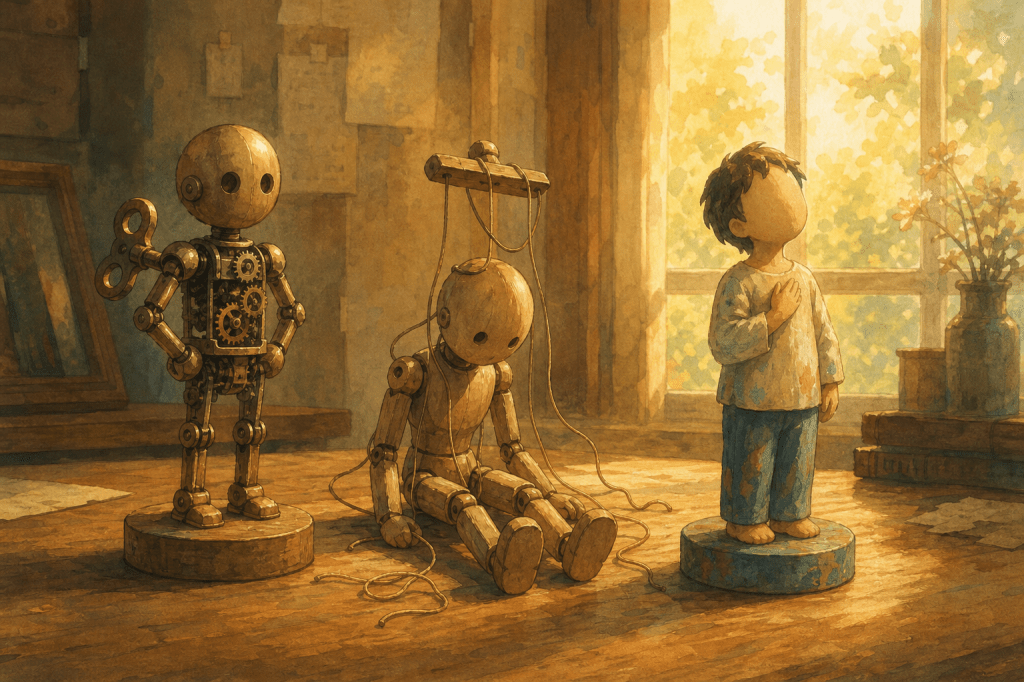
God asks Michael to imagine three possible creatures. The first is programmed: it does everything its maker asks because it cannot do otherwise. The second has absolute freedom of choice and may or may not obey. The third has absolute freedom of choice and chooses, of its own accord, to serve out of love and respect. Then God asks: “Which creature would give you the greatest satisfaction?” Michael answers immediately, because the answer is obvious to anyone who has ever wanted to be loved rather than obeyed. The third.
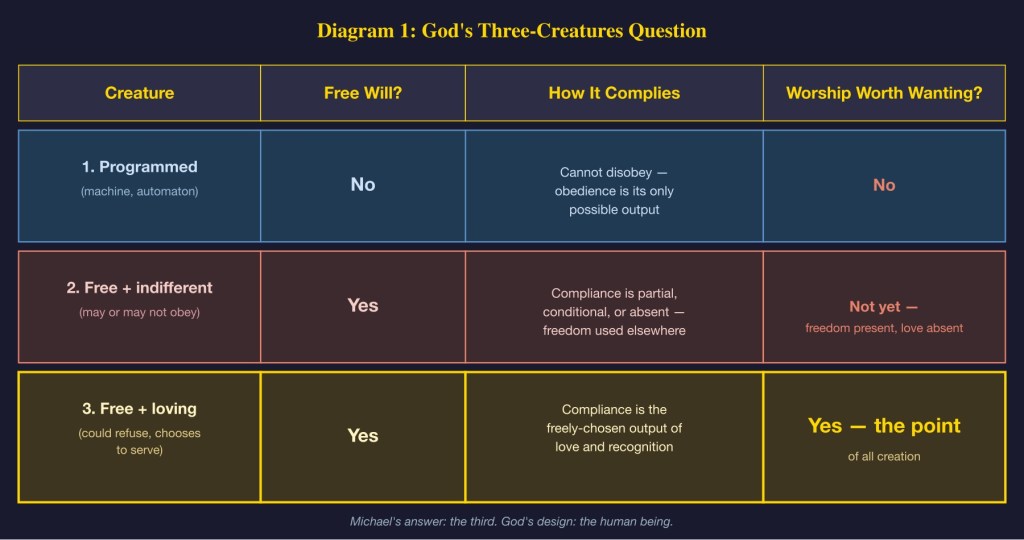
This is the master key to the entire question of why we exist. God did not create human beings because He needed servants — He already had legions of devoted angels. He created human beings because no number of programmed servants could give Him what one freely chosen worshipper could give: a relationship that was actually a relationship, a love that was actually love, a worship that was actually worship.
[51:56] “I did not create the jinns and the humans except to worship Me alone.”
[51:57] “I need no provisions from them, nor do I need them to feed Me.”
The pairing of these two verses is decisive. We were created for worship, but God does not need our worship. He needs nothing. The worship is for our sake, and for the integrity of the relationship He wanted with us. A God who needed worship would coerce it. A God who wanted worship that meant something had to leave the door of refusal wide open.
The messenger Rashad Khalifa expressed the same point in plain language (at 26:41): “God created the human beings and gave them the freedom of choice. God told us, you and me and every one of us, that if we choose Satan’s kingdom, we belong in Satan’s kingdom. And if we choose God’s kingdom, then we belong in God’s kingdom.” The whole architecture of the two kingdoms rests on this single mechanism — that the resident of each kingdom is its resident by free choice.
Part 2: The Cosmic Trust the Mountains Refused
What Was Actually Offered
Long before Eternity‘s screenplay framed the question dramatically, the Quran preserved the cosmic moment in a single verse of stunning weight. Before any human existed, God offered the responsibility of free will to all of creation. The heavens, the earth, and the mountains — vast, ancient, powerful — looked at the offer and said no.
[33:72] “We have offered the responsibility (freedom of choice) to the heavens and the earth, and the mountains, but they refused to bear it, and were afraid of it. But the human being accepted it; he was transgressing, ignorant.”
Notice what was offered: not power, not knowledge, not size — those things the mountains already had. What was offered was the freedom to choose, with the inseparable consequence of being responsible for the choice. The mountains, ancient and majestic as they are, understood that the only way to bear free will safely is to never use it badly — and they did not trust themselves. The heavens and the earth, vaster still, came to the same conclusion. They refused.
The human being accepted. The verse is honest about the condition in which this acceptance was made: “transgressing, ignorant.” We did not fully grasp what we were taking on. But we took it on, and that acceptance is the beginning of every story the Quran tells about us, including the story of worship. Whatever else worship is, it is the deliberate use of the very freedom that the rest of creation was too wise to accept.
The Final Testament’s footnote on this verse is worth pausing on, because it corrects a common pious misreading. It does not call the rest of creation deficient for refusing; it says the opposite. “The animals, trees, stars, etc. took advantage of this most gracious offer.” The refusal was not cowardice and not failure — it was wisdom that knew its own limits. The mountains, the heavens, and the earth read the contract carefully, recognised the danger embedded in the offer, and gratefully declined. The human being, less wise about the burden, signed. Calling us “transgressing, ignorant” in the same verse is therefore not a slur but a sober description: we took on a load whose true weight we did not measure. Every spiritual problem we face afterwards is, in some sense, the working-out of that under-measured agreement.
This verse also dismantles a common misreading of submission. To submit to God is not to imitate the mountains. The mountains chose to submit automatically. Human submission is something more: it is the conscious return of a freedom that we alone, of all creation, agreed to bear. That makes our worship more valuable than the silent obedience of stars and oceans, precisely because we could have done otherwise.
Part 3: The Day of the Covenant
“Am I Not Your Lord?”
The Quran does not stop at the offer; it records the answer. There was a day, before our earthly existence, when God assembled the souls of all human beings and asked them a single question. The answer they gave is the foundation of every claim God will ever press against any human conscience.
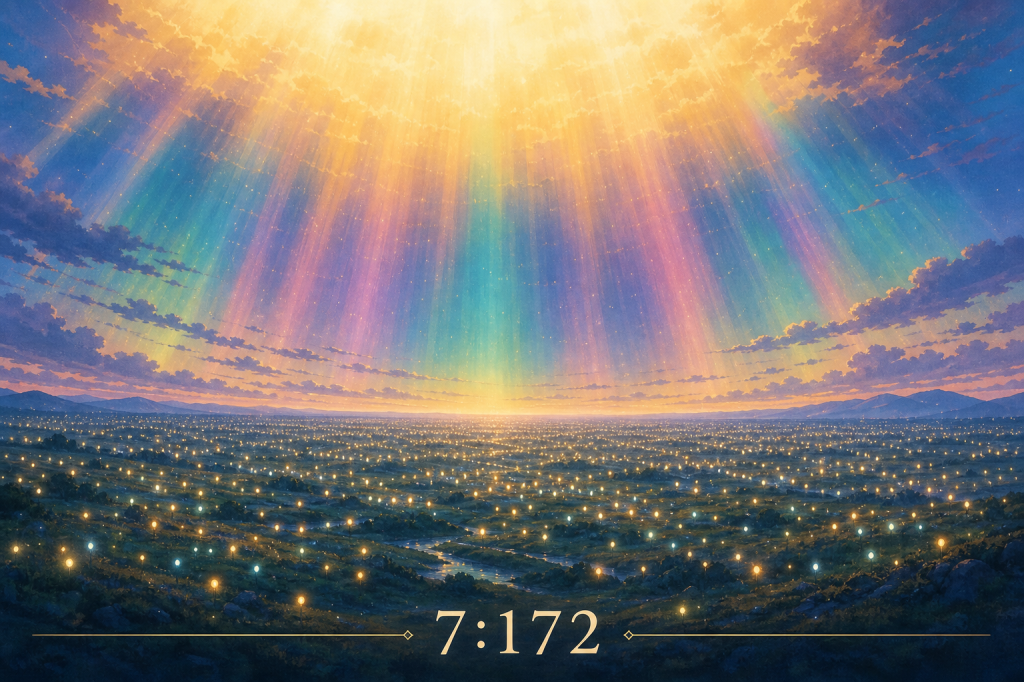
[7:172] “Recall that your Lord summoned all the descendants of Adam, and had them bear witness for themselves: ‘Am I not your Lord?’ They all said, ‘Yes. We bear witness.’ Thus, you cannot say on the Day of Resurrection, ‘We were not aware of this.’”
[7:173] “Nor can you say, ‘It was our parents who practiced idolatry, and we simply followed in their footsteps. Will You punish us because of what others have innovated?’”
The screenplay Eternity stages this scene on what it calls the Paradise Planet — millions of human souls assembled, addressed directly by God, asked to bear witness, and answering in a massive unanimous echo: “We bear witness that you alone are our Lord.” The screenplay then captures the verse’s logic precisely: “Thus, you cannot say on the Day of Judgment that you never heard of this. None of you can plead ignorance. Nor can you say that your parents or teachers influenced your opinions.”
This is the second decisive piece of the picture. Free will did not begin on Earth. It began before Earth. Every human soul was consulted, and every human soul agreed. The Earth-life is not an experiment imposed on us; it is the playing-out of a freedom we already accepted, in a covenant we already gave. The amnesia that veils that covenant from our conscious memory does not erase it — it tests whether the same free yes will be given again under conditions of opacity, where God’s existence must be reasoned to rather than seen.
Rashad Khalifa described this prior meeting directly in his teaching (at 34:41): “We met God before the creation of the heavens and the earth, and we bore witness that He alone is our Lord. But this knowledge is obscured with this body, we cannot remember it now.” The amnesia, in other words, is not a glitch in the design but a feature of it. It is the precondition under which a yes that was already given can be given again, freely, in conditions where the giver cannot lean on memory and must rely on reason, conscience, and the witness of creation around them.
Part 4: “I Did Not Create Except To Worship”
Worship Redefined
The verse that names our purpose is one of the most-quoted in the Quran, and one of the most-misunderstood. It says we were created to worship God alone. The misreading is that worship means ritual — the prayers, the fasting, the pilgrimage. The correct reading, the one consistent with everything else the Quran says about free will, is that worship means orientation: the deliberate, free choosing of God as the centre of one’s life over every alternative the ego or society offers.
[51:56] “I did not create the jinns and the humans except to worship Me alone.”
If worship were merely ritual, then a programmed creature who performed all the rituals would fulfil the purpose of creation. The angels do this already, perfectly, eternally. God did not need to create humans for that. What God did not have, and what humans alone can give, is worship that is the active output of a being who could have worshipped something else and chose not to. That is why the verse pairs humans with the jinns: both species possess free will, and both species are addressed by the same purpose.
The Quran identifies the alternatives bluntly. A person can worship money, status, ego, another human, an idol, a state, a tradition, an ancestor’s opinion. Whatever sits at the centre of a life is what that life worships, regardless of what its owner calls it. The verse below makes the diagnosis with surgical clarity:
[45:23] “Have you noted the one whose god is his ego? Consequently, God sends him astray, despite his knowledge, seals his hearing and his mind, and places a veil on his eyes. Who then can guide him, after such a decision by God? Would you not take heed?”
The most common idol is not made of stone. It is the ego itself. And free will is what makes it possible to dethrone that idol — or to enthrone it. Worship of God is not the addition of religious behaviours to a normal life; it is the conscious, repeated, free dethroning of every false centre in favour of the One who created us to be centred on Him.
Part 5: No Compulsion
The Door That Stays Open
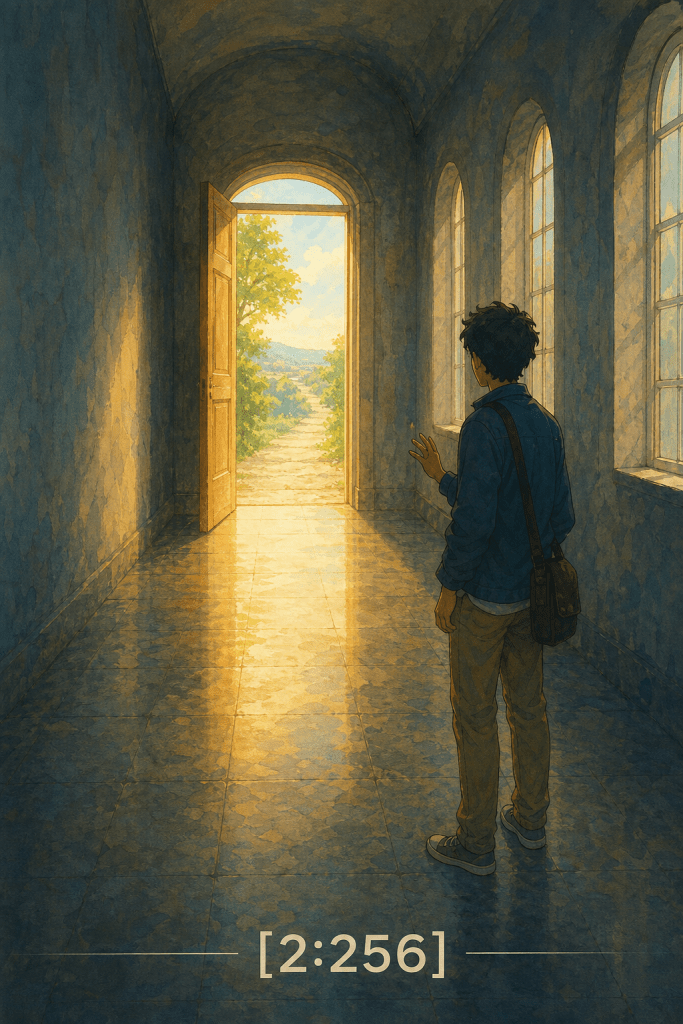
If free will is the substrate of real worship, then any forced religion is a contradiction in terms. The Quran says this directly, in language so plain that it has been a thorn in the side of every religious authoritarian who has tried to read it.
[2:256] “There shall be no compulsion in religion: the right way is now distinct from the wrong way. Anyone who denounces the devil and believes in God has grasped the strongest bond; one that never breaks. God is Hearer, Omniscient.”
[10:99] “Had your Lord willed, all the people on earth would have believed. Do you want to force the people to become believers?”
[18:29] “Proclaim: ‘This is the truth from your Lord,’ then whoever wills let him believe, and whoever wills let him disbelieve.”
The screenplay Eternity renders this as the foundational decree of God’s kingdom: “There shall be no compulsion in My kingdom.” It is not a concession. It is not a tolerance. It is the basic operating principle on which all of creation was designed. A worshipper who is forced is not a worshipper. A worshipper who could leave but does not — that is the creature God wanted.
The verse also exposes the entire industry of religious coercion as a contradiction of the very God it claims to serve. Anyone who tries to compel faith, whether by the sword, by social pressure, by family shame, or by political law, is acting against the explicit operating principle of the Creator. They are trying to manufacture the very thing God specifically refused to manufacture, even though He alone has the power to do so.
Part 6: Satan’s Refusal
The First Use of Free Will Was a Refusal
The Quran tells us something extraordinary about the very first being to use free will against God: it was not a human. It was an angel. When God commanded the angels to fall prostrate before the newly-created Adam, every angel complied except one — Iblees, later known as Satan. His refusal is the founding act of the rebellion that defines our test.
[2:34] “When we said to the angels, ‘Fall prostrate before Adam,’ they fell prostrate, except Satan; he refused, was too arrogant, and a disbeliever.”
[7:12] “He said, ‘What prevented you from prostrating when I ordered you?’ He said, ‘I am better than he; You created me from fire, and created him from mud.’”
The screenplay Eternity captures Satan’s logic with chilling clarity: “I am better than he; You created me from energy, and created him from mud. You granted me enough power and authority to make me a god in my own right.” This is the prototype of every prideful refusal in human history — the claim of the self to be its own god, the substitution of one’s own assessment for God’s command, the refusal to bow because the ego will not let itself be lower than anything.
What follows is even more important. God does not destroy Satan on the spot. He responds with the same principle that governs human worship: “no one shall serve in My kingdom grudgingly.” If Satan does not want to serve, he will not be forced. He is granted, instead, an “infinitesimal speck” of God’s dominion — the planet Earth — to serve as his testing ground, with the descendants of Adam who freely choose him as their god as his constituents.
[7:16] “He said, ‘Since You have willed that I go astray, I will skulk for them on Your straight path.’”
[7:17] “‘I will come to them from before them, and from behind them, and from their right, and from their left, and You will find that most of them are unappreciative.’”
This is the architecture of the test. Satan is permitted to advocate for himself, to whisper, to seduce, to make his case — but he is never permitted to compel. Every soul will choose, and every choice will be the soul’s own. The same freedom that allowed Satan to refuse is the freedom that allows every human to either follow him or refuse him in turn.
Part 7: Earth as Testing Ground
Why the Veil
If Satan is allowed to advocate but never to compel, the next obvious question is why Earth feels so much like the place where his advocacy succeeds. Why are we born into bodies that cannot see God, cannot see the angels, cannot recall the covenant we gave on the Paradise Planet? The Quran’s answer, again echoed in the screenplay, is that the test only works if it is genuinely a test.
[67:2] “The One who created death and life for the purpose of distinguishing those among you who would do better. He is the Almighty, the Forgiving.”
[29:2] “Do the people think that they will be left to say, ‘We believe,’ without being put to the test?”
If the cosmic memory were intact, choosing God would not be choosing — it would be acknowledging the obvious. The veil exists so that the choice is real. The amnesia is not punishment; it is the precondition of meaningful free will under earthly conditions. Belief in God here on Earth, where He cannot be seen, is the only form of belief that proves anything about the believer. It is the only kind of yes that costs the giver something.
This is also why the Quran is so insistent that worship of the unseen is the form of worship that matters. Anyone can believe what is in front of their eyes; the angels themselves see God’s light constantly. The human test is whether, in the absence of direct sight, the soul reasons its way back to its Creator using the brain, the eyes, the ears, and the natural disposition that were given to it for exactly that purpose.
Rashad Khalifa stated this point with unusual bluntness (at 3:54): “Satan’s constituents were not assigned to him involuntarily. God consulted each one of us, He asked us, do you want to take a test where you choose between My point of view and another point of view?” Even the people who end up in Satan’s kingdom are there by their own prior agreement to take the test, and by the choice they made within it. Nothing about the system is imposed. The trust was offered, the covenant was given, and the earthly choice — whichever way it goes — is the working-out of a freedom that was always genuinely the soul’s own.

Part 8: The Brain, the Eyes, the Ears
Investigate and Verify — Including God
If God wanted programmed worshippers, He would have made beliefs automatic. Instead, He built into us the very faculties that make doubt possible: a brain that can question, eyes that can examine, ears that can hear and weigh competing claims. Then He commanded us to use them — not occasionally, not on safe topics, but systematically, including on questions about Him.
[17:36] “You shall not accept any information, unless you verify it for yourself. I have given you the hearing, the eyesight, and the brain, and you are responsible for using them.”
The screenplay Eternity renders the divine instruction with even more force: “I have created you with brains, eyes, and ears, and you are responsible for using them. You shall investigate and verify any information you receive from anyone, including Me.” That last clause — including me — is the high-water mark of God’s commitment to free will. He does not even ask for unverified belief in Himself. He demands the opposite: verify the claim, even when the claim is His.
The same logic explains why the test material itself was made verifiable. If God demands an investigated yes, He must provide a text that can actually be investigated. The Quran was engineered, by its own claim, to be that text — a document whose internal mathematical structure is so precise and so far beyond human authorship that any sincere examiner can confirm its source for themselves, without having to take anyone’s word for it. The point of that engineering is not to dazzle but to discharge an obligation: God will not punish a soul on the Day of Judgment for not believing what could not be verified, so He provided the means of verification in the very document He sent. The freedom to refuse is preserved; the excuse of insufficient evidence is removed. Both halves are necessary for the test to be just.
[6:114] “Shall I seek other than God as a source of law, when He has revealed to you this book fully detailed? Those who received the scripture recognize that it has been revealed from your Lord, truthfully. You shall not harbor any doubt.”
This makes inherited religion functionally invalid as worship. A person who believes in God because their parents did, or because their culture does, or because it is socially convenient, has not verified anything; they have only conformed. The verse below, which immediately follows the cosmic covenant, anticipates exactly this excuse and rejects it in advance:
[7:173] “Nor can you say, ‘It was our parents who practiced idolatry, and we simply followed in their footsteps. Will You punish us because of what others have innovated?’”
Worship that is genuinely worship requires verification. The covenant requires re-affirmation by an adult mind that has examined its options. The Quran does not ask for blind faith; it asks for an investigated yes. That is the only kind of yes God values, because that is the only kind of yes that is genuinely from us rather than from our circumstances.
Part 9: The Two Paths
Showed Him What Is Evil and What Is Good
Every test requires a clear distinction between options, and the Quran tells us that God did not leave us guessing. The two paths are not hidden. They are placed in front of us, along with the natural conscience that recognises them, and then the choice is left to us.
[76:2] “We created the human from a liquid mixture, from two parents, in order to test him. Thus, we made him a hearer and a seer.”
[76:3] “We showed him the two paths, then, he is either appreciative, or unappreciative.”
[91:7] “The soul and Him who created it.”
[91:8] “Then showed it what is evil and what is good.”
[91:9] “Successful is one who redeems it.”
[91:10] “Failing is one who neglects it.”
This is the interior architecture of free will. The two paths are not external roads on which a soul stumbles by accident; they are dispositions inside the soul, recognised by the soul’s own God-given conscience. Every human being knows, at some level, which choices are nourishing the higher self and which are starving it. The redemption of the soul is the cumulative result of choosing, again and again, the path that the conscience already recognises as good.
The claim that this moral perception is universal — installed by God in every soul, not learned from local culture — is now substantiated by cross-cultural research. A 2019 study examining 60 societies across the world found seven moral rules (cooperation, kinship, reciprocity, bravery, deference, fairness, and respect for property) that show up positively in every culture studied, with no counter-examples (Source: Curry, Mullins & Whitehouse, “Is It Good to Cooperate?” Current Anthropology, 2019). The Quran’s claim that God “showed it what is evil and what is good” is not a poetic flourish — it describes an empirically observable universal: the same basic moral grammar, written into the soul of every human being, whether the surrounding culture honours it or warps it. Free will, then, is not freedom from morality. It is freedom in relation to a moral structure the soul already perceives.
This is why nobody can plead ignorance on the Day of Judgment. The covenant gave us prior knowledge. The brain and the senses gave us means of investigation. The conscience gave us moral perception. The scripture gave us explicit guidance. After all of that, what remains is the choice itself, and the choice is genuinely ours.
Part 10: What Worship Actually Is
The Output of a Free Yes
If we put all of this together — the three-creatures question, the cosmic offer, the covenant, the open door, the test, the verified faith — we arrive at a definition of worship that is far richer than ritual compliance. Worship, in the Quran’s sense, is the output of a being that has been given the power to refuse God and chooses, in full knowledge, not to refuse Him.
This means that the Contact Prayers, the obligatory charity, the fasting, and the pilgrimage are not the substance of worship; they are the disciplined expressions of a worship that already exists in the orientation of the heart. Done as ritual without the orientation, they are mechanical. Done as the freely-chosen output of a soul that recognises its Lord, they are precisely the kind of worship the universe was created to receive. The same physical action can be either, depending on what the free will inside it is doing.
[39:7] “If you disbelieve, God does not need anyone. But He dislikes to see His servants make the wrong decision. If you decide to be appreciative, He is pleased for you. No soul bears the sins of any other soul.”
Notice the words “He dislikes to see His servants make the wrong decision” — this is the language of a Lord who watches the choices of free creatures, not the language of a programmer who controls outputs. He dislikes the wrong choice; He does not prevent it. He is pleased by the right choice; He does not coerce it. This is the texture of a real relationship between a Creator and creatures who can answer back.
Part 11: When God’s Will Meets Ours
The Apparent Paradox
A reader who has followed the argument this far may raise the most common objection: doesn’t the Quran also say that everything happens by God’s will? Doesn’t it say that He guides whom He wills and leads astray whom He wills? How can free will and divine sovereignty both be true?
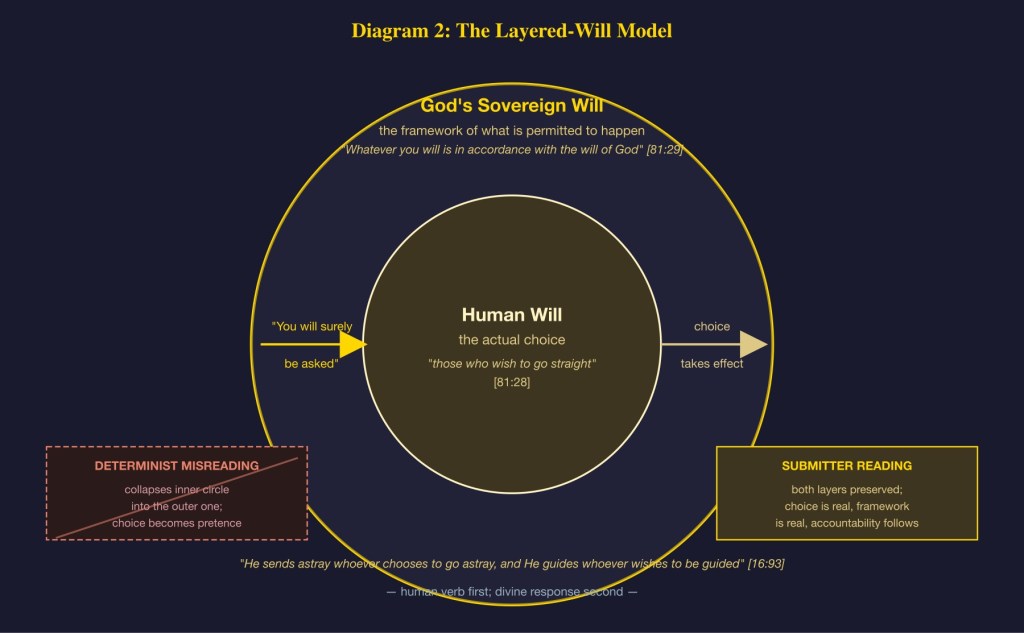
[81:28] “For those who wish to go straight.”
[81:29] “Whatever you will is in accordance with the will of God, Lord of the universe.”
The two verses appear back-to-back, and they are deliberately placed that way. The first establishes that the path is for those who wish — the choice is the human’s. The second establishes that whatever the human wills happens within God’s will — the framework is God’s. This is not a contradiction; it is a layered description of how reality actually works. Inside God’s permission, the human chooses. The choice is genuinely the human’s, and the permission is genuinely God’s. Both statements are simultaneously true, and removing either one collapses the whole structure.
An everyday analogy helps. A novelist creates characters whose decisions move the plot. The author’s pen writes every word — nothing happens in the book outside the author’s permission. And yet, within the world of the book, the characters genuinely choose: their decisions have weight, their motivations are coherent, their refusals are real refusals. A reader who said, “the characters didn’t really decide anything, the author wrote it all,” would be making a category error. Both statements are true at different levels. The author’s authorship and the characters’ choices are not in competition; they are operating in different registers of the same single reality. Verse [81:29] is making exactly this kind of claim about us. Whatever you will is in accordance with the will of God — meaning your choice happens inside the larger frame of His permission — and the choice is still yours, still consequential, still the thing you will be asked about. The mistake of theological determinism is to read the framework verse as cancelling the choice verse, when the Quran in fact pairs them precisely so that neither is lost.
[16:93] “Had God willed, He could have made you one congregation. But He sends astray whoever chooses to go astray, and He guides whoever wishes to be guided. You will surely be asked about everything you have done.”
The internal structure of this verse is the cleanest statement of how the two layers interact. God could have eliminated all disagreement by overriding free will — He explicitly chose not to. He responds to the soul’s own direction: those who choose to go astray are sent astray (that is, the choice is allowed to take effect); those who wish to be guided are guided. The grammar is decisive: the human verb (chooses, wishes) comes first, and the divine response follows. The traditional determinist reading inverts this order, making God the initiator and the human a passive recipient of guidance or misguidance — but the verse does not say that. It says God responds to what the soul has already chosen. The closing clause is the seal: “You will surely be asked about everything you have done.” Accountability presupposes freedom. If the choice were not ours, the question would be incoherent, and the entire Day of Judgment would collapse into theatre.
Part 12: The Three Creatures Today
Where Each of Us Stands
God’s question to Michael is not a story about angels. It is the question every human life is currently answering with its choices. We were created to be the third creature — the one with absolute freedom of choice that uses that freedom to love and serve its Creator. Some of us are living that out. Some of us are operating closer to the second creature — free, but indifferent or in revolt. Almost none of us are the first creature, because God did not make us that way; the moment we try to live mechanically, we are working against our design.
The daily work of being human, then, is in a real sense the daily work of inhabiting our actual category. The point is not to lose our freedom — that would be a betrayal of the trust we accepted when the mountains refused. The point is to use our freedom in the only way that completes what we are: by choosing, freshly, repeatedly, voluntarily, the Lord we already bore witness to before we were born.
[29:69] “As for those who strive in our cause, we will surely guide them in our paths. Most assuredly, God is with the pious.”
The verb “strive” is significant. It is not “are placed on” or “are dragged onto.” Striving is the activity of a free creature directing itself. And the promise is the structural complement of free will: when the soul moves toward God, God moves toward the soul. This is the daily mechanism of guidance, and it is the daily mechanism of worship. It does not work for the programmed. It does not work for the indifferent. It works for the one who freely turns.
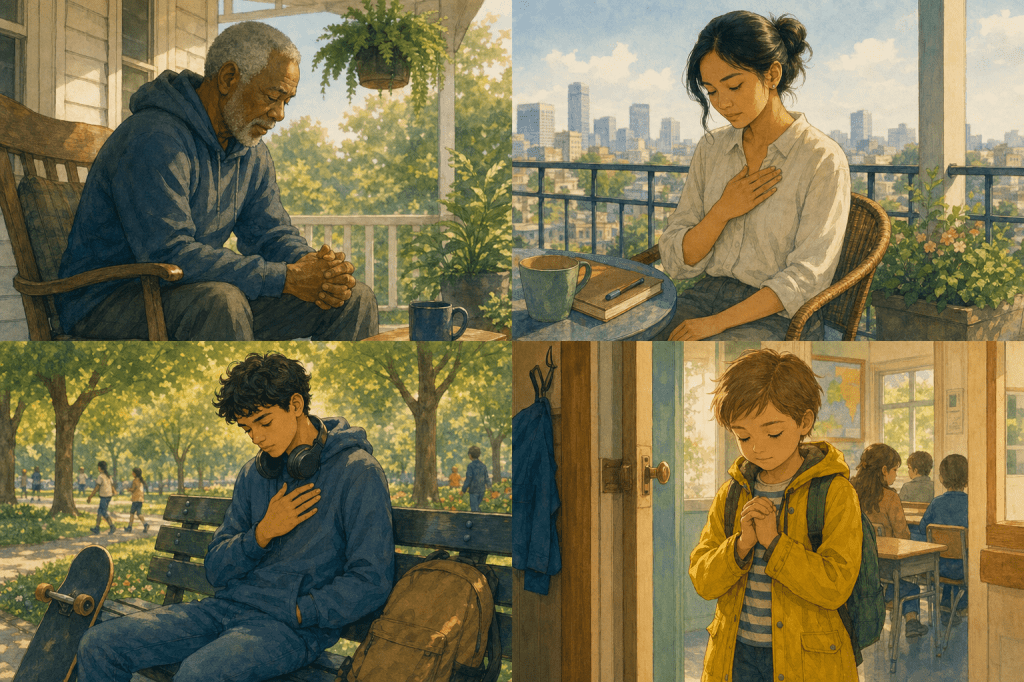
What this looks like in practice is unglamorous. It is the small choice, again and again: to read the verse rather than scroll past, to verify the claim rather than absorb the headline, to refuse the idol of one’s own ego rather than be ruled by it, to acknowledge the Lord one already knows rather than rehearse the doubts the surrounding noise rewards. None of these moments are coerced. None of them are the dramatic crisis of belief that religious literature tends to celebrate. They are the ordinary, repeated, voluntary motions of a soul exercising the very freedom that the mountains were too wise to accept. Each such motion is worship in the only sense the Quran gives the word — the freely-chosen orientation of a being who could have done otherwise. Add them together and they are a life. Add the lives together and they are the answer the universe was made to receive.
Conclusion: The Free Yes That God Wanted
God could have built a universe in which every creature loved Him automatically. He chose not to. He built a universe in which one species — having been asked, having said yes, having forgotten the asking, and having been placed inside conditions where the yes must be reasoned out and re-given — could either love Him on purpose or refuse Him on purpose. Both options had to be real for the love to be real. Both options had to be real for worship to be worship.
Trace any single thread of the Quran’s theology and it leads back to this insight. The mountains’ refusal makes sense in light of it. The covenant on the Paradise Planet makes sense in light of it. The commandment to investigate and verify makes sense in light of it. The decree of no compulsion makes sense in light of it. The whole architecture, from the cosmic offer to the Day of Judgment, holds together because of one question God put to Michael in the angels’ mansion — and the answer that question implies. The only worship worth wanting is worship that could have been withheld.
To be a Submitter, then, is not to relinquish freedom; it is to use freedom for the purpose for which it was given. It is to be the third creature, knowingly, in a world full of pressures to be the second, designed by a God who refused to make us the first. Every time the soul chooses Him here — under the veil, against the noise, with no compulsion, with the door of refusal still wide open — it completes the act that the universe was created to receive. That single, unforced yes, given freshly each day by a creature that could have done otherwise, is the answer the cosmos is listening for. It is the answer we gave once, on a planet none of us remember. It is the answer we are here to give again.


Leave a Reply