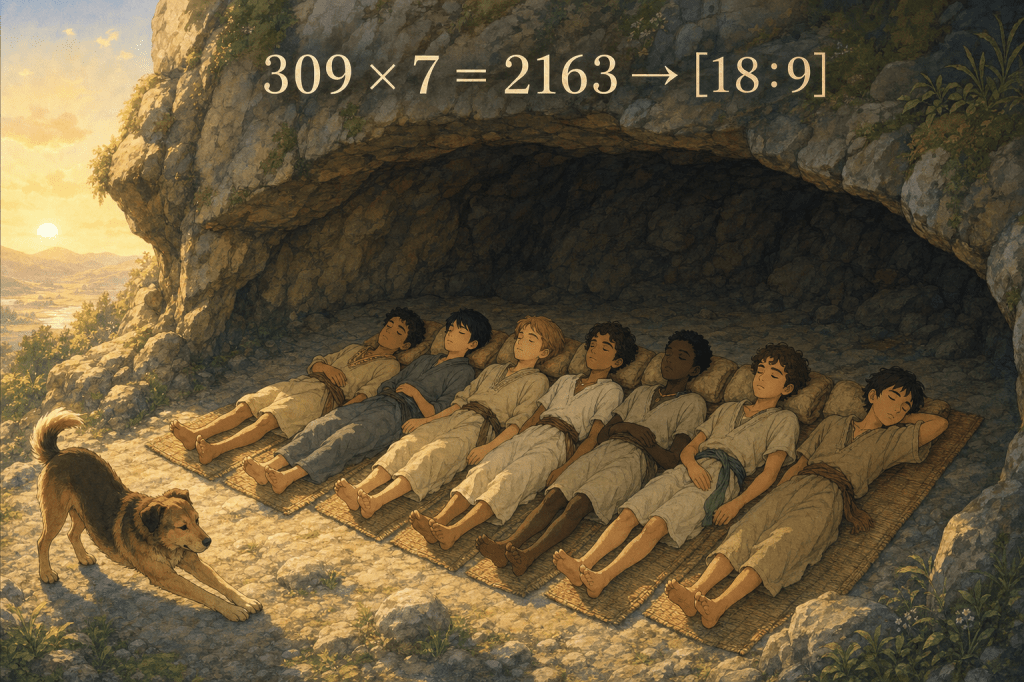
Introduction: A Number That Names Itself
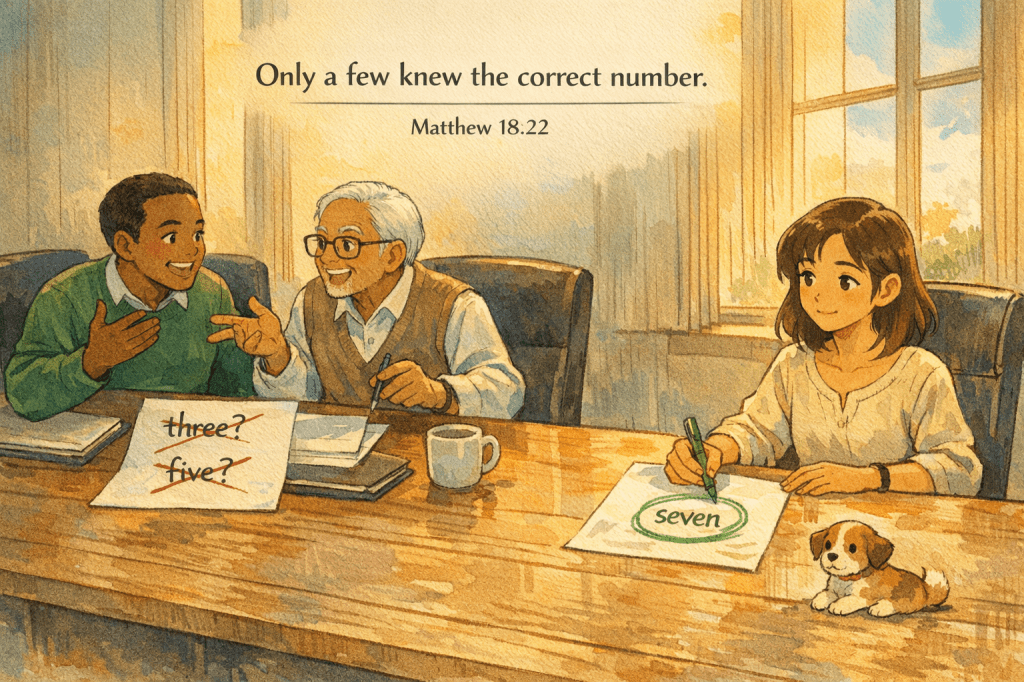
The story of the people of the cave occupies the first quarter of chapter 18 in the Final Testament. For fourteen centuries readers have asked the obvious question: how many sleepers were there? The text presents three options — three, five, and seven — then refuses to spell out the answer in plain prose, instead saying, “Only a few knew the correct number” [18:22]. That refusal has been read for centuries as a closed door. It is not. It is an invitation to count.
This article walks through the proof that the answer is seven, hidden not in commentary or hadith but in the verse-positions of The Final Testament itself. The cumulative position of the introduction-verse, [18:9], counted from the very first verse [1:1], is exactly 2,163 — and 2,163 is exactly 309 multiplied by 7. The same 309 that names the duration of their sleep [18:25] names the position of the verse that introduces them when multiplied by their count. God has signed the answer in arithmetic.
The argument that follows assembles the proof from seven independent angles, matching the seven sleepers themselves: the verse-position arithmetic, the grammar of the Arabic conjunction in [18:22], the displacement of the Arabic phrase rajman bil-ghayb (“guessing in the unseen”), the dating implied by Rashad’s footnote at [18:16], the chronological position of chapter 18 in the order of revelation, the resolution of the apparent paradox in [18:13]’s past tense, and finally the integration of the 309 figure into the wider end-of-world timeline of Appendix 25. By the end of the article it should be clear that the cave is not a folk tale tucked into a long chapter — it is a tightly engineered timestamp, and the answer to its central riddle is signed in plain numbers.
Part 1: The Count Proof — 309 × 7 = 2,163 → [18:9]
The Cumulative Position
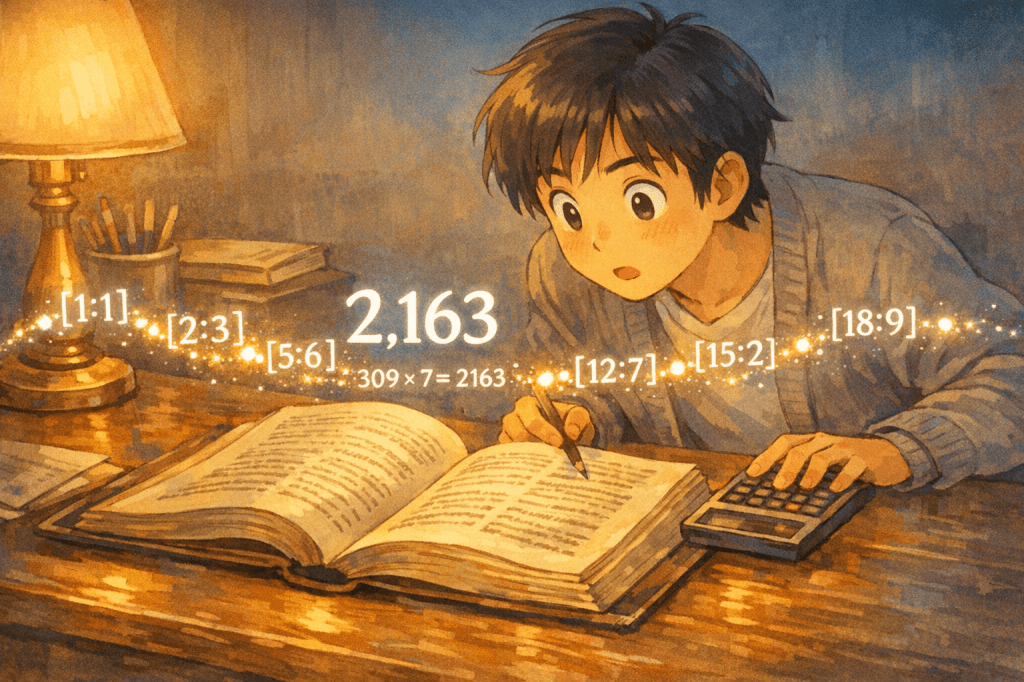
The Final Testament is a fixed sequence. From [1:1] through [114:6] there are exactly 6,346 numbered verses, and each verse occupies a single, unambiguous position in that sequence. If you count [1:1] as position 1, [1:2] as position 2, and continue all the way to the introduction of the cave-dwellers’ story, the cumulative position of [18:9] is 2,163. That number is not a coincidence. It is precisely 309 × 7 — the duration of their sleep multiplied by their count.
Verse [18:25] gives the duration: “They stayed in their cave three hundred years, increased by nine.” That phrasing — three hundred plus nine — is the Quran’s only numeric anchor for the sleep itself, and it appears nowhere else in scripture. Verse [18:9], in turn, is the verse that opens the cave narrative. It explicitly tells the reader that this story is being told to make a point about numbers:
[18:9] “Why else do you think we are telling you about the people of the cave, and the numbers connected with them? They are among our wondrous signs.”
Read this verse carefully. The Final Testament does not describe a quaint historical episode here — it advertises a numerical sign. “Why else do you think we are telling you…?” The question is rhetorical and the answer is built into the verse-position itself. The cumulative location of this verse, in the fixed sequence of revelation, equals the duration of the sleep multiplied by the count of sleepers. The single verse that names “the numbers connected with them” is itself one of those numbers.
Why Only the Count of Seven Maps to a Sign-Verse
The mathematical claim is testable in seconds with any copy of the Final Testament. Multiply the duration (309) by each of the three candidate counts presented in [18:22]:
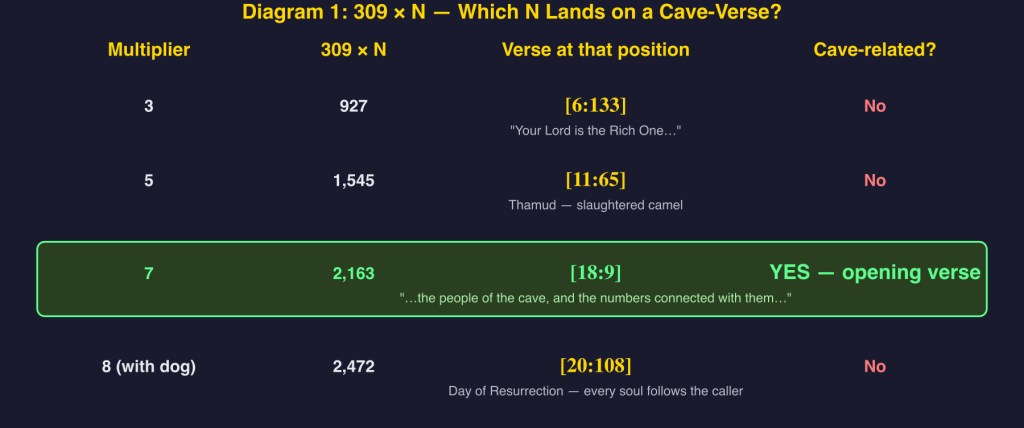
Three of the four products land on verses that have nothing whatsoever to do with caves, sleepers, signs, or numbers. The 309 × 3 product hits a verse about God replacing one generation with another. The 309 × 5 product hits a Thamud passage about a slaughtered camel. The 309 × 8 product — the count that includes the dog — lands on a verse about everyone following the caller on the Day of Resurrection. None of those three products produces a cave-verse. None of them is a numerical sign.
Only one product — 309 × 7 — lands directly on the introduction-verse of the cave narrative itself, the very verse that announces, “the numbers connected with them.” The arithmetic is binary: either the multiplier produces a cave-verse, or it does not. Of the four candidate counts, only seven does. The dog is not part of the count, because the count that includes the dog produces no sign at all. The seven are seven. The eighth is the dog, separately.
Part 2: The Three Textual Signals in [18:22]
Signal 1 — The Placement of “Guessing in the Unseen”
The verse that gives us the three candidate counts is itself constructed with surgical precision. Read it slowly:
[18:22] “Some would say, ‘They were three; their dog being the fourth,’ while others would say, ‘Five; the sixth being their dog,’ as they guessed. Others said, ‘Seven,’ and the eighth was their dog. Say, ‘My Lord is the best knower of their number.’ Only a few knew the correct number. Therefore, do not argue with them; just go along with them. You need not consult anyone about this.”
The phrase translated “as they guessed” — in Arabic rajman bil-ghayb, “throwing-stones at the unseen,” a vivid idiom for blind speculation — appears in the middle of the verse. Where exactly? Not after the third option. Not after all three options. It appears between the second and third options, immediately following the “five” hypothesis. It dismisses the first two as guesses; it does not dismiss the third.
This is not a stylistic flourish. The Quran is written with extreme economy. Every clause sits where it sits because it does the work that needs doing. By placing the dismissal between options two and three, the text marks options one and two as guesses and leaves option three undismissed. The structural argument is not subtle once you see it: God dismisses two of the three candidates by placement and grammar, and only one survives the dismissal.
Signal 2 — The “And” That Separates the Dog
The second signal is a single Arabic letter — the conjunction wa (و), “and.” Look carefully at how each of the three options describes its sleeper-count relative to the dog:
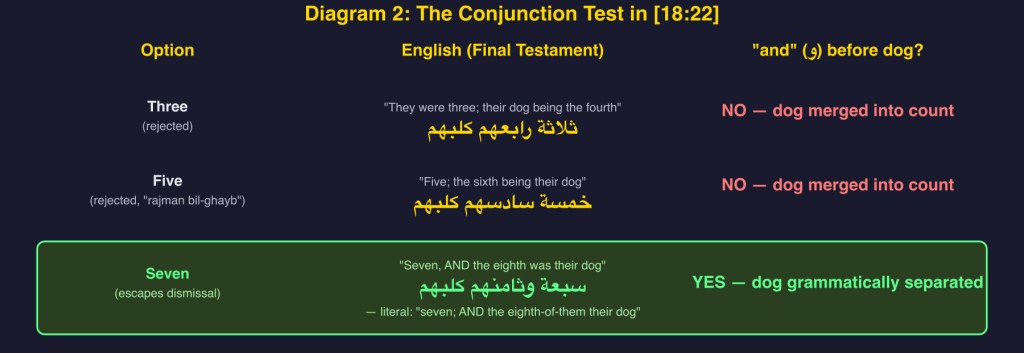
In options one and two, the Arabic structure is an apposition: thalāthatun rābi’uhum kalbuhum (literally “three, their-fourth their-dog”) and khamsatun sādisuhum kalbuhum (“five, their-sixth their-dog”). There is no conjunction. The dog is grammatically counted in. If the sleepers were three, the dog is the fourth of them. If the sleepers were five, the dog is the sixth of them.
Then comes option three, and the grammar visibly changes: sab’atun wa-thāminuhum kalbuhum — “seven, AND the eighth-of-them their dog.” That single conjunction wa, absent in the prior two formulations, breaks the apposition. The dog is no longer counted in; the dog is the eighth, separate from the seven. The sleepers are seven, and there is also a dog. The Final Testament writes the third option differently because the third option is the truth, and the truth requires a different grammar.
Signal 3 — “Only a Few Knew the Correct Number”
The verse closes with a remark that, taken alone, sounds like a dismissive shrug: “Only a few knew the correct number.” But “only a few” is not a denial — it is a discriminator. The text does not say no one knew. It says a minority knew. It then instructs the messenger to “not argue with them; just go along with them. You need not consult anyone about this.”
The implication is unmistakable for anyone tracking the structural signals already given. The majority guess “three” or “five” — both options dismissed by placement and grammar. A minority correctly identifies “seven” — the option that the verse itself constructs differently and leaves undismissed. The instruction not to argue is not because the answer is hidden; it is because, in the relevant historical moment, contesting public guesswork would have been fruitless. The text encodes the answer for a future reader who would do the arithmetic. We are that future reader.
Part 3: When Did the Sleepers Live? — The Post-Nicene Dating
Rashad’s Footnote at [18:16]
Most popular accounts of the Seven Sleepers — Christian or otherwise — date the persecution they fled to the reign of the Roman emperor Decius around 250 AD. That dating comes from the Latin and Syriac hagiographies that took shape in the fifth and sixth centuries. The Final Testament’s footnote tells a different story. At [18:16] Rashad writes:
Footnote at [18:16-20]: “Ephesus is located about 200 miles south of ancient Nicene, and 30 miles south of today’s Izmir in Turkey. The dwellers of the cave were young Christians who wanted to follow the teachings of Jesus, and worship God alone. They were fleeing the persecution of neo-Christians who proclaimed a corrupted Christianity three centuries after Jesus, following the Nicene Conferences, when the Trinity doctrine was announced. In 1928, Franz Miltner, an Austrian archeologist discovered the tomb of the seven sleepers of Ephesus. Their history is well documented in several encyclopedias.”
Three centuries after Jesus places the persecution after roughly 325 AD — the year the First Council of Nicaea formalised the Trinitarian creed. The sleepers in this telling were not fleeing pagan emperors; they were fleeing fellow “Christians” who had imposed a tritheist doctrine on what had been a strictly monotheist movement. They were submitters refusing to compromise on the oneness of God, and they fled the very people who claimed to be carrying Jesus’ message forward.
The verse itself supports the framing. They fled, in their own words, those who worshipped “other than God” [18:16]. That is not how Greco-Roman pagans would be described in a few-word summary — they openly worshipped many gods. It is, however, exactly how the Final Testament repeatedly describes Trinitarian Christianity: a religion that says it is monotheist but in practice idolises Jesus and the supposed third person of the trinity beside the one God.
Reinforcement from Appendix 33
Appendix 33, “Why Did God Send A Messenger Now?”, explicitly identifies the same turning point. Rashad writes:
Appendix 33: “Outstanding Christian scholars have reached solid conclusions that today’s Christianity has nothing to do with Jesus, and that its doctrine was mortally distorted at the infamous Nicene Conferences (325 A.D.).”
The choice of word “mortally” is striking. The doctrine did not merely drift — it was, at Nicaea, distorted in a way that killed the original monotheism. The Submitters Perspective newsletter of June 1989 used the same language: “The original Christian doctrine was mortally corrupted during the Nicene Conferences (325 AD).” This is the consistent Submitter reading. The post-Nicene period is when monotheist Christianity was driven underground — and it is in that exact period that the cave-dwellers fled their fellow professing Christians who had, in real and not merely rhetorical sense, set up partners with God.
Working forward from this dating: a group of young monotheist Christians fleeing post-Nicene persecution sometime between 325 and 380 AD, sleeping for 309 lunar years (roughly 300 solar years), would awaken between approximately 625 and 680 AD. That timing places their awakening squarely in the lifetime of the early Submitter community in Arabia and the immediate generations after — the era of the revelation of the Quran and its earliest dissemination. The story is not abstract folklore; its temporal coordinates land it deliberately at the moment Submission was being re-articulated.
Part 4: When Was Chapter 18 Revealed? — Appendix 23
The 69th Chapter in the Order of Revelation
Rashad’s Appendix 23 lists the chronological sequence of revelation — the order in which the 114 chapters were given to the prophet Muhammad. The compiled Final Testament is arranged for liturgical and structural reasons rather than by date of revelation, but the underlying order is preserved in tradition and confirmed by the appendix. Reading Appendix 23 directly:
Appendix 23 (Chronological Sequence of Revelation): “69 …….. 18” — chapter 18 was the sixty-ninth chapter revealed.
This places chapter 18 in the late-Meccan period of revelation, before the migration to Medina. The first ten chapters revealed (96, 68, 73, 74, 1, 111, 81, 87, 92, 89) are short Meccan exhortations. The Medinan-period chapters cluster from roughly position 87 onward in the appendix — beginning with chapter 2, al-Baqarah, at position 87. Chapter 18 sits comfortably in the Meccan run: it was given before the Submitter community had a state, when the prophet was still being persecuted in his home city.
By conventional biographical reckoning the late-Meccan period spans roughly 615 to 619 AD. The Quran itself does not specify a calendar year; that detail comes from later biographical traditions, and one should treat the precise year with caution. What the Quran does commit to, through Appendix 23 which Rashad endorses, is the order. Chapter 18 was the 69th chapter delivered, well before the central legal chapters of the Medinan period. The cave-dwellers’ story was therefore revealed roughly half a century before 309 lunar years from the persecution-era starting point would conclude — a fact that creates the apparent paradox the next section resolves.
Why the Ordering Matters for the Argument
Knowing when chapter 18 was revealed forces a precise question. If the sleepers fled around 330 AD and slept 309 lunar years (roughly 300 solar years), they woke around 630 AD. If the chapter that tells their story was revealed circa 615 to 619 AD, then in calendar terms the chapter was given about a decade before the awakening. Yet [18:13] uses past tense: “We narrate to you their history (naba’ahum).” History, in ordinary usage, refers to the past. How can the chapter speak of an awakening that hadn’t yet physically occurred?
This is where the Submitter reading parts company sharply with the conventional reading. The conventional reading either backdates the awakening to make the past tense work, or treats the past tense as loose. Neither is necessary. The Final Testament has a very specific way of using past tense — the divine past tense of sealed decree — and this story is one of its clearest examples.
Part 5: The Past-Tense Paradox — How Can [18:13] Call the Awakening “History”?
The Apparent Problem
Chapter 18 verse 13 says:
[18:13] “We narrate to you their history, truthfully. They were youths who believed in their Lord, and we increased their guidance.”
The Arabic word translated “history” here is naba’ — a noun related to news, account, or what was told. It generally implies a settled past event. In other places the same root marks past narratives unambiguously: [12:111] speaks of “lessons in their stories,” [11:120] of “the histories of the messengers,” [7:101] of “the histories of those communities.” The plain reading in all of these is past-tense storytelling.
So the worry surfaces: if the sleepers awoke around 630 AD and chapter 18 was revealed around 615 to 619 AD, then the awakening had not yet physically occurred when the chapter was given. How can the awakening be narrated as history? Two cheap answers exist and both must be rejected. The first is to backdate the awakening to before 619 AD — but that contradicts the post-Nicene starting point and the 309 lunar duration, both of which Rashad endorses. The second is to claim the past tense is loose — but the Quran is not loose with tense. The right answer is more interesting and more typically Quranic.
The Divine Past Tense of Sealed Decree
The Final Testament repeatedly narrates events that have not yet physically happened in past tense, because from God’s vantage they are already settled. The end-of-world passage in chapter 81 is the classic example:
[81:1-3] “When the sun is rolled. The stars are crashed into each other. The mountains are wiped out.”
The sun has not been rolled. The stars have not crashed. The mountains stand. Yet the verse uses the perfective. The reason is theological: from God’s perspective the sealed decree is already complete, and the human reader is told it as past because it cannot be otherwise once God has decreed it. The same pattern occurs at the Garden in [7:19], where God addresses Adam in past-perfect tones about events that, narratively, are still unfolding. Rashad himself articulates this principle clearly in a 1989 study session, stating (at 1:21:44): “That’s why God tells us about the resurrection in the past tense, as if it’s happening… as far as God is concerned, it’s happening, everything is done.”
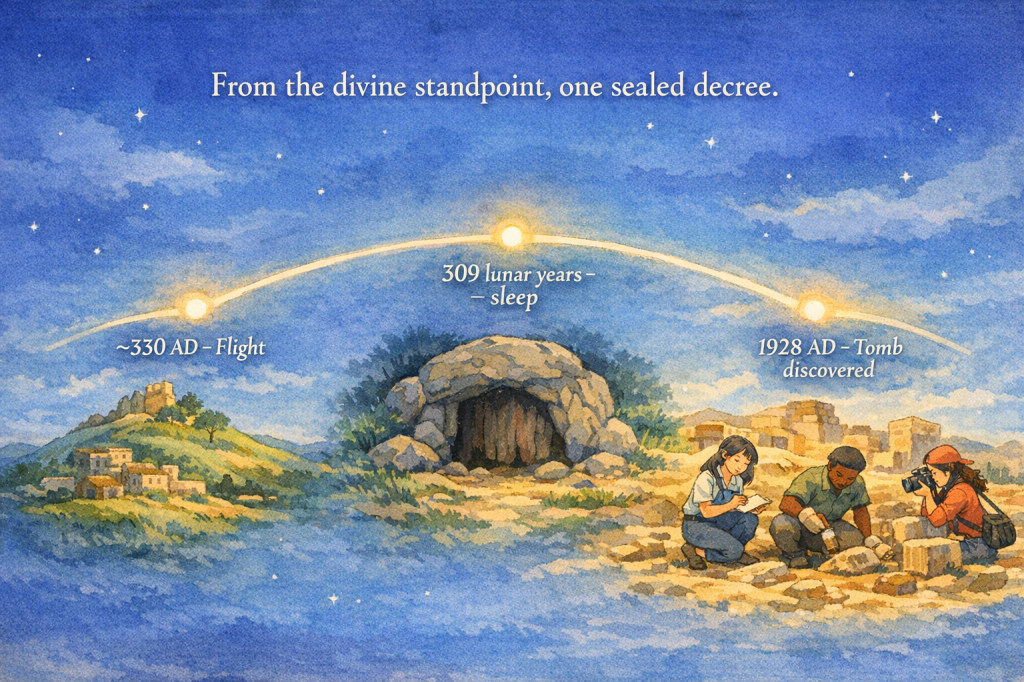
Apply this principle to chapter 18. The flight from persecution around 330 AD is genuine past from any reader’s perspective at any time after that date — including the prophet’s. The 309-year sleep is a sealed decree announced in [18:11]: “We then sealed their ears in the cave for a predetermined number of years.” The awakening, as a divine decree, is already complete in God’s knowledge before it becomes complete in calendar time. So the chapter narrates the whole arc — flight, sleep, awakening, dispute over their tomb — as their history, because the divine standpoint has no temporal slack between decree and event.
The Awakening as Sign for the End of the World
The awakening verse itself, [18:21], gives the strongest signal that this is operating on the divine timescale, not merely the chronicler’s:
[18:21] “We caused them to be discovered, to let everyone know that God’s promise is true, and to remove all doubt concerning the end of the world. The people then disputed among themselves regarding them. Some said, ‘Let us build a building around them.’ Their Lord is the best knower about them. Those who prevailed said, ‘We will build a place of worship around them.’”
Rashad’s footnote at [18:21] reads: “As detailed in Appendix 25, this story helped pinpoint the end of the world.” The discovery is not narrated as a one-off seventh-century event whose only function is local — it is presented as a sign whose payload is end-of-world arithmetic, of the kind that comes due only in the messenger of the covenant’s lifetime, in 1980 AD. The past tense of [18:13] and [18:21] therefore covers events whose function unfolds across more than a millennium. From the divine standpoint that span is one settled act.
It is also worth noting that the dispute about the sleepers’ numbers in [18:22] was already an ancient disagreement by the time chapter 18 was revealed. Christian sources had been writing contradictory accounts for over a century: Jacob of Sarug composed a metrical homily about the seven sleepers around 500 AD, and Gregory of Tours included his account around 580 AD — both decades before chapter 18 was given. The wrangle over “three or five or seven” was already centuries old when the Quran intervened with its mathematical answer. The story was, in that sense, genuinely history at the moment of revelation, even if its end-of-world payload still lay 1,400 years downstream.
Part 6: The Number 309 as End-of-World Timestamp — Appendix 25
The 1980 → 2280 Timeline
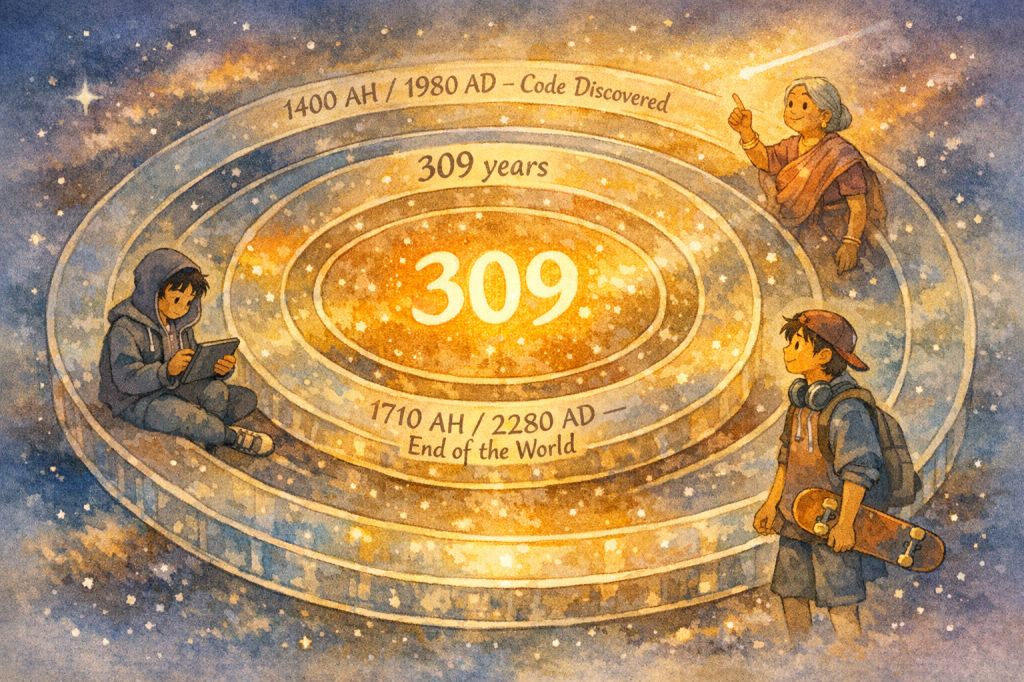
Appendix 25 of the Final Testament — “End of the World” — works through the gematrical totals of the fourteen Quranic Initials and arrives at 1709 as the lifespan of the Quran’s relevance, with the world ending in the year 1710 AH (Hijri). 1710 is exactly 19 × 90, a multiple of 19 in keeping with the Quran’s mathematical code. The corresponding solar year is 2280 AD, which is exactly 19 × 120 — also a multiple of 19. Two flags, both signed in 19s.
The discovery of this timeline took place in 1400 AH (1980 AD) — the year Rashad finalized the Quran’s mathematical code and identified its end-of-world implications. The arithmetic is beautifully simple: 1709 minus 1400 equals 309. The exact same 309 that names the duration of the cave-sleep in [18:25] is the gap, in lunar years, between the discovery of the mathematical code and the prophesied end of the world. Rashad spelled this out plainly in his 1989 talk on the end of the world (at 22:41): “309. And immediately a flag goes up. We find in surah 18, the people of the cave… God didn’t tell us how many there are in the cave… but He tells us how long they lasted in the cave. 300 increased by nine. Why? This is a Quranic number. And… it tells us about the failure of the cave. It says to remove all doubt about the end of the world.”
309 as a Two-Layered Number
The 309 figure therefore carries two loads simultaneously. On its surface it is the lunar duration of the cave-dwellers’ sleep — a roughly three-hundred-year nap recorded in [18:25] with the unusual “three hundred years, increased by nine” formulation. Below the surface it is a prophetic timestamp: the gap between the year the mathematical code was unveiled (1400 AH / 1980 AD) and the year the world ends (1710 AH / 2280 AD).

Now bring the verse-position result back into view. The cumulative location of [18:9] — the introduction to the cave story, the verse that says “the numbers connected with them” — is exactly 309 × 7. The 309 that encodes the end-of-world timeline is the same 309 that, multiplied by the count of sleepers, hits the address of the verse that introduces the count. The story does not merely contain the number 309. It is positioned at 309 × 7 in the master sequence. The arithmetic is not loose; it folds the duration, the count, and the introduction-verse into a single signed equation.
The discovery of the tomb of the Seven Sleepers of Ephesus by Franz Miltner in 1928 — referenced in the [18:16] footnote — sits as the physical, archaeological half of the sign. The numerical half is the equation just laid out. Together they form a two-handed proof: a tomb you can visit and an arithmetic you can verify, both signed and dated in advance.
Part 7: Trinitarians, Not Pagans — Why the Cave Speaks to Submitters Today
The Quran’s Verdict on the Trinity Doctrine
The post-Nicene reading of the cave story is not a peripheral exegetical choice. It is the only reading that fits with how the Final Testament systematically describes Trinitarian Christianity. The Quran is unambiguous about the doctrine: it is shirk — the setting up of partners with God — wrapped in a monotheist costume.
[5:72] “Pagans indeed are those who say that God is the Messiah, son of Mary. The Messiah himself said, ‘O Children of Israel, you shall worship God; my Lord and your Lord.’ Anyone who sets up any idol beside God, God has forbidden Paradise for him, and his destiny is Hell. The wicked have no helpers.”
[5:73] “Pagans indeed are those who say that God is a third in a trinity. There is no God except the one God. Unless they refrain from saying this, those who disbelieve among them will incur a painful retribution.”
[4:171] “O people of the scripture, do not transgress the limits of your religion, and do not say about God except the truth. The Messiah, Jesus, the son of Mary, was a messenger of God, and His word that He had sent to Mary, and a revelation from Him. Therefore, you shall believe in God and His messengers. You shall not say, ‘Trinity.’ You shall refrain from this for your own good. God is only one God. Be He glorified; He is much too glorious to have a son.”
Notice how [5:72] phrases the indictment. The Christians who deify Christ idolize him beside God. They claim to be monotheists; the Quran calls them pagans. The verb is not euphemistic. The category-error is structural: an entity worshipped beside God is, in scriptural terms, a god — regardless of whether the worshipper claims it is “really” the same one God in three persons. Rashad’s footnote at [5:72] cites scholars Hyam Maccoby and the contributors to The Myth of God Incarnate, who concluded after careful research “that today’s Christianity is not the same Christianity taught by Jesus.”
Two Christianities, One Cave
This is the framing that makes the cave story directly relevant for submitters in the present day. There are, in the Final Testament’s reading, two “Christianities.” The first is the original message of Jesus — pure monotheism, “you shall worship God; my Lord and your Lord” [5:72]. The second is the post-Nicene Trinitarian construction that idolizes Jesus and a third person beside God. The cave-dwellers belonged to the first; they fled the second.
The Final Testament is willing to name this distinction even when speaking ecumenically. Verse [22:17] lists the religions God will judge among on the Day of Resurrection: “Those who believe, those who are Jewish, the converts, the Christians, the Zoroastrians, and the idol worshipers.” Christians are listed separately from idol-worshippers — but [98:1] and [98:6] then divide further: among the Christians are those who reject God’s proof, and they incur the fire alongside the idol worshippers despite the surface label. The label does not save you. Your actual belief and practice does.
[98:6] “Those who disbelieved among the people of the scripture, and the idol worshipers have incurred the fire of Gehenna forever. They are the worst creatures.”
The Cave’s Lesson for Today’s Submitter
The cave-dwellers were not an isolated quirk. They were a template. Whenever a religious majority drifts into idolatry while keeping the original name — Christianity becoming Trinitarianism, Submission becoming today’s “Islam” with its accumulated traditions — the line drawn by the cave-dwellers becomes the relevant line. You do not negotiate the doctrine of God’s oneness for cultural cohesion. You separate.
The same scripture that condemns Trinitarianism also condemns the corruption of Submission itself. Appendix 33 lists the litany: idolizing the prophet Muhammad against his will, adding his name to the prayers and to the declaration of faith, inventing a sunna parallel to the Quran, ascribing intercessory power to him, oppressing women in the name of religion. “If Muhammad came back to this world,” Rashad writes, “the ‘Muslims’ would stone him to death. The religion they follow today has nothing to do with the Islam, i.e. Submission, preached by Abraham and Muhammad.” The cave-dwellers’ separation from corrupted Christianity rhymes exactly with the modern submitter’s separation from corrupted “Islam.” Both groups are doing the same thing: refusing to compromise on the oneness of God when the ambient religion has drifted into shirk.
The line is not racial, ethnic, or geographic. The Quran does not say submitters must avoid contact with Christians, Jews, or anyone else who does not actively persecute them. Verse [60:8] makes the rule explicit:
[60:8] “God does not enjoin you from befriending those who do not fight you because of religion, and do not evict you from your homes. You may befriend them and be equitable towards them. God loves the equitable.”
The cave-dwellers fled because they were being actively persecuted by the post-Nicene authorities. In peaceful times the rule is openness and equity. The doctrinal line — God is one, no partners — is uncompromisable. The personal line — friendship, neighbourliness, fair dealing — is generous. Both rules come from the same scripture, and the cave story holds them together: separate from the doctrine, befriend the people who do not fight you.
Conclusion: The Signed Answer
Step back and look at what has been assembled. The Final Testament asks a question in [18:9] — “the people of the cave, and the numbers connected with them” — and presents three candidate answers in [18:22]. By placement of rajman bil-ghayb, the first two candidates are dismissed as guesswork. By the addition of the conjunction wa in the third option, the dog is grammatically separated from the count. By the closing remark, only a few are said to know the correct number. By the cumulative verse-position arithmetic — 309 × 7 = 2,163 = position of [18:9] — the answer is signed in the master sequence of the scripture itself. By the dating in the [18:16] footnote, the persecution is identified as post-Nicene Trinitarian, not pagan Roman. By the Appendix 23 ordering, the chapter is placed in the late-Meccan period, before the awakening had physically occurred — which is reconciled by the divine past tense pattern that the Final Testament uses elsewhere for the resurrection and the end of the world. By Appendix 25, the same 309 turns out to be the lunar gap between the unveiling of the mathematical code in 1980 AD and the prophesied end of the world in 2280 AD. The number is not casual; it is a stamp.
The cave-dwellers were submitters. They believed in their Lord, refused to compromise on His oneness, and separated from a religious majority that had set up partners beside Him. They were preserved by God for three centuries, awakened to bear witness, and their tomb was discovered in 1928 to seal the prophetic timeline. The numbers connected with them — three hundred years, increased by nine; seven sleepers; an eighth being a dog — are not narrative texture. They are an arithmetic signature, and the signature reads: end-of-the-world / 309 / 7 / [18:9].
For the submitter today the cave is a model. The doctrine of God’s oneness is not negotiable. When the ambient religion has drifted into shirk — whether the shirk wears a Trinitarian costume in fourth-century Anatolia or a saint-veneration costume in twenty-first-century mainstream “Islam” — the move is the same. You separate. You take refuge in the cave that God provides, which today is His scripture and His messenger of the covenant’s clarifying word. You sleep through the corruption if that is what is decreed for you, or you bear witness in your own time if that is what is decreed. Either way, God preserves and resurrects monotheists who refuse to compromise. The seven sleepers are seven, the answer is signed, and the same God who preserved them through the post-Nicene night preserves the submitter today through whatever is required.



Leave a Reply