
Introduction: A Smear in Search of a Verse
A claim has been circulating in submitter Discord communities: that anyone who refers to themselves as a leader of submission is, by the very act of making that claim, automatically a hypocrite. The argument is usually propped up by a paraphrase attributed to Rashad Khalifa, framed roughly as “the worst hypocrites are the ones who believe they are the leaders of submission.” Dressed up in this borrowed authority, the claim functions as a pre-emptive disqualification: any organiser, teacher, study-circle host, or coordinator who steps forward is suspected, accused, and dismissed without examination of their actual work.
The claim does not survive contact with either the source it pretends to quote or the scripture it pretends to defend. Rashad never said “leaders of submission” in this context. The verses on which the smear depends say the opposite of what it asserts. And the Quran’s own diagnostic for the hypocrite is the speech of the hypocrite — what comes out of the mouth, weighed against what God has revealed and against what the same mouth says in other rooms. This article walks through both fronts of the refutation, then draws the line where it actually belongs — between leaders whose teaching matches God’s revealed word and leaders whose teaching contradicts it.
1. The Smear and Its Origin: What Rashad Actually Said
The Sura 64 study, 1989
The phrase the smear is built on comes from a Quran Study session covering Chapter 64. The discussion turns to the lowest pit of Hell mentioned in Chapter 4 and a question is raised about who exactly inhabits it. Rashad answers with a concrete contemporary example. The transcript is preserved verbatim on the recording, including the timestamps and the named exemplar.
“There is a statement in surah 4 that says, the hypocrites are in the lowest pit… A good example of the hypocrite, if I may say so, is Khomeini, for example… Because before the whole world, the whole world looks at them as Muslims. They are acting in the name of Islam. And in the last four weeks, they executed 400 people…”
— Rashad Khalifa, Quran Study, Chapter 64 (at 59:50)
The named exemplar is Khomeini. The institutional frame is Islam. The marker is executing four hundred people in a four-week span while presenting the killing as religion. Rashad does not say “leaders of submission.” He does not say submission at all. He gives a single living example of a Shia Ayatollah ruling Iran in the name of traditional Islam, sentencing dissenters to death, and being mistaken by the world for a religious authority. That is the actual content of the quote being twisted.
The same example, almost identical wording, appears one year earlier in the Chapter 59 study. The transcript places Rashad at 31:42 referring to “the hypocrites are worse, in the lowest pit of hell, because before the whole world, the whole world looks at them as Muslims. They are acting in the name of Islam. From the last four weeks, they executed 400 people.” Same template, same exemplar, same institutional frame. The cross-reference confirms this was a settled illustration in his teaching, not an off-the-cuff line.
“The hypocrites are worse, in the lowest pit of hell. Because before the whole world, the whole world looks at them as Muslims. They are acting in the name of Islam…”
— Rashad Khalifa, Quran Study, Chapter 59 (at 31:42)
The category swap
The Discord paraphrase performs a single, decisive operation: it replaces “Khomeini” with “leaders of submission,” and “acting in the name of Islam” with “claiming leadership of submission.” That swap looks small. It is not. It moves the indictment from a specific man heading a specific traditional regime that executes people, to a categorical accusation against anyone in the submitter community who steps into a coordinating role. The two are not related claims. They are not even claims about the same religion.
Rashad’s example was directed outward at the institutional traditions Submission was sent to correct — the systems that take scholars and clerics as authorities beside God, that kill in the name of God, that present themselves to the world as bearers of God’s religion while suppressing it. Substituting “leaders of submission” turns his teaching inside-out. It weaponises a quote about the priestly classes of traditional Islam against the very community Rashad spent his life building.

2. What a Hypocrite Actually Is, According to the Quran
The Quranic definition — believing one thing, saying another
The Quran does not leave the definition of the hypocrite vague. It states it directly, and it ties the test to a single observable fact: the hypocrite’s tongue speaks what the hypocrite’s heart does not hold. The opening of Chapter 2 introduces them in exactly this form — people who declare belief while not actually believing.
[2:8] “Then there are those who say, ‘We believe in God and the Last Day,’ while they are not believers.”
This is the structural pattern, stated in a single verse. The marker is not the title held, the office filled, the visibility gained, or the followers gathered. The marker is the gap between what comes out of the mouth and what sits in the heart. A few verses later, the same chapter exposes the doubled-tongue version of the same pattern — believers hearing one declaration, allies hearing the opposite:
[2:14] “When they meet the believers, they say, ‘We believe,’ but when alone with their devils, they say, ‘We are with you; we were only mocking.’”
This is the operational shape of hypocrisy in scripture. It is not opacity, not invisibility, not internal mystery. It is detectable contradiction — between what the mouth says and what the heart holds, and between what is said to one audience and what is said to another. The hypocrite says X to one room and not-X to another, says X with the tongue while holding not-X in the heart. Wherever the contradiction surfaces, the diagnostic fires.
Chapter 47:30 — recognised by the way they talk
The Quran does not leave this test abstract. It explicitly tells the believers how to detect a hypocrite — and the means it names is the hypocrite’s speech. Chapter 47 closes a passage on those who “harbour doubts in their hearts” with a direct instruction to the believers:
[47:30] “If we will, we can expose them for you, so that you can recognize them just by looking at them. However, you can recognize them by the way they talk. God is fully aware of all your works.”
The verse states two things at once. First, God can expose the hypocrite to the believers — meaning the hypocrite is not invisible to honest scrutiny, and the believers are not commanded to act as though detection is impossible. Second, the actual route the verse names is the way they talk. Their speech gives them away. The full diagnostic equipment the Quran issues to the community is built around what comes out of the hypocrite’s mouth.
This places the question of detection on solid ground. Believers are not asked to peer into hidden hearts they cannot see. They are asked to listen to what is openly said — to compare the spoken claim against the revealed word, to compare what is said in one room with what is said in another, to compare the loud declaration of faith with the content of the sentences that follow it. That listening is the test the Quran prescribes, and it is the test any community member can run on any other community member without inventing private knowledge.
The mocking tongue — Chapter 9
Chapter 9 catches hypocrites mid-speech. They mock God’s revelations openly, and then plead, when caught, that they were “only mocking and kidding.” The chapter does not let the plea stand — it names the mockery itself as the offence, and identifies the hypocrite by what came out of the mouth before the apology was performed.
[9:64-65] “The hypocrites worry that a sura may be revealed exposing what is inside their hearts. Say, ‘Go ahead and mock. God will expose exactly what you are afraid of.’ If you ask them, they would say, ‘We were only mocking and kidding.’ Say, ‘Do you realize that you are mocking God, and His revelations, and His messenger?’”
[9:67] “The hypocrite men and the hypocrite women belong with each other—they advocate evil and prohibit righteousness, and they are stingy. They forgot God, so He forgot them. The hypocrites are truly wicked.”
Notice that 9:67 lists the operational signs: they advocate evil, they prohibit righteousness, they hoard. The first two are public statements. They can be heard, recorded, contradicted from scripture. The Quran does not direct the believer to a hidden register the believer cannot access. It directs the believer to what the hypocrite advocates and what the hypocrite prohibits — out loud, in plain hearing.
The Chapter 63 portrait — eloquent and empty
Chapter 63, named “The Hypocrites,” sharpens the same speech-based pattern with a portrait of polished eloquence. The hypocrites swear oaths, declare faith in extravagant terms, present beautifully, and speak persuasively — and the chapter’s verdict turns on the gap between that polished speech and the heart it pretends to express.
[63:1] “When the hypocrites come to you they say, ‘We bear witness that you are the messenger of God.’ God knows that you are His messenger, and God bears witness that the hypocrites are liars.”
[63:2] “Under the guise of their apparent faith, they repel the people from the path of God. Miserable indeed is what they do.”
[63:4] “When you see them, you may be impressed by their looks. And when they speak, you may listen to their eloquence. They are like standing logs. They think that every call is intended against them. These are the real enemies; beware of them. God condemns them; they have deviated.”
“When the hypocrites come to you they say… God bears witness that the hypocrites are liars.” “Under the guise of their apparent faith, they repel the people from the path of God.” “When they speak, you may listen to their eloquence.” Every verse in the portrait is anchored in speech. The hypocrite’s testimony is impressive on the surface and false underneath. Detection is not a matter of suspicion in the absence of evidence. It is a matter of testing the spoken claim against what the same speaker says elsewhere — and against the revealed word, which is the fixed point that cannot drift.
Rashad picked up this exact image in his own teaching, warning that the most dangerous figure is the one who appears most righteous, prays in front of the congregation, carries scripture under his armpit, and then quietly contradicts what God says. The scene is built entirely out of what the man says — not what he wears, what title he holds, or what role he claims.
“When a person comes to you with a Quran under his armpit and says, you don’t believe that this is complete, and he’s righteous and then he gets up to pray the noon with you and then he says, this is not complete. God says, this is complete and he says, this is not complete. That’s a hypocrite. And he’s worse because he appears to be righteous and you think he’s a great Muslim and you listen… usually by very eloquent. That’s the worst, that’s the worst kind. The Quran says that you’ll be in the lowest pit of hell because of that.”
— Rashad Khalifa, Messenger Audio 29 (at 39:21)
The scene Rashad describes is not abstract. It is a man saying something — that the Quran is not complete — in direct contradiction of what God has said in the Quran itself. The diagnostic is exactly what Chapter 47:30 names: the comparison between what the man’s mouth utters and what the revelation states. The eloquence is the surface; the contradiction is the substance; and the contradiction is detected through the speech.
Chapter 4 — the shifting tongue, the lazy prayer
Chapter 4 collects the same diagnostic in tighter form, with the alignment dimension added — what the hypocrite says to one camp versus what they say to the other when the political wind shifts. The chapter does not summarise this as a vague disposition. It quotes the speech directly, on both sides of the line:
[4:140] “He has instructed you in the scripture that: if you hear God’s revelations being mocked and ridiculed, you shall not sit with them, unless they delve into another subject. Otherwise, you will be as guilty as they are. God will gather the hypocrites and the disbelievers together in Hell.”
[4:141] “They watch you and wait; if you attain victory from God, they say (to you), ‘Were we not with you?’ But if the disbelievers get a turn, they say (to them), ‘Did we not side with you, and protect you from the believers?’”
Two declarations, two audiences, contradictory content. Same speaker. This is the 2:14 pattern in its operational form — said to the believers when believers prevail, said to the disbelievers when disbelievers prevail. The diagnostic is the words and the audiences they shift between.
[4:142] “The hypocrites think that they are deceiving God, but He is the One who leads them on. When they get up for the Contact Prayer (Salat), they get up lazily. That is because they only show off in front of the people, and rarely do they think of God.”
[4:143] “They waver in between, neither belonging to this group, nor that group. Whomever God sends astray, you will never find a way to guide him.”
[4:145] “The hypocrites will be committed to the lowest pit of Hell, and you will find no one to help them.”
The Contact Prayer reference in 4:142 is observable conduct, and it is also a kind of speech — a kind of declaration. To stand for the Prayer is to declare, with the whole body, that the worshipper is turning to God. The hypocrite performs the declaration lazily and for show, contradicting the declared meaning by the visible manner. Again the same pattern: the outward performance says one thing, the inward orientation holds another, and the gap between them is the offence.
The lowest pit of Hell — the same pit Rashad invoked when discussing Khomeini — is reached through this specific complex: a tongue that says what the heart does not hold, a stance that shifts with the audience, mockery of God’s revelations spoken openly and then covered with disclaimers, eloquent declaration of faith without the content of faith. A person who claims leadership of submission and does not display these markers in speech has not become a hypocrite by holding a title. A person who displays all of these markers in speech is a hypocrite whether they hold a title or not. The title was never the question. The speech against the word is.
The institutional pattern: Chapter 9:107
The institutional version of the same pattern is sketched in Chapter 9:107. A faction in the early community of believers builds a rival place of worship — not to remember God, but to fracture the believers, give cover to those opposing the messenger, and conceal hostile intent under the appearance of piety. The verse does not say their hypocrisy lies in calling themselves coordinators of a masjid. It says their hypocrisy lies in what they swore with their tongues compared to what they actually built.
[9:107] “There are those who abuse the masjid by practicing idol worship, dividing the believers, and providing comfort to those who oppose God and His messenger. They solemnly swear: ‘Our intentions are honorable!’ God bears witness that they are liars.”
“They solemnly swear: ‘Our intentions are honorable!’ God bears witness that they are liars.” The institutional hypocrite is exposed in exactly the same place as the individual hypocrite: the gap between the spoken claim and the actual content. The diagnostic again — what is said, weighed against what God has revealed, and weighed against what the same speaker does and says elsewhere. Title-holders are not exempt from this test. But neither are they convicted by it on the basis of title alone. The test is performed against the speech.

3. Leadership Is a Quranic Category, Not a Slur
God appoints leaders
Far from condemning the category of leadership, the Quran repeatedly presents it as a divine commission and as a status God grants to people He honours. The case of Abraham is the foundational example. After a series of tests Abraham fulfilled, God did not punish him for being elevated, did not warn him that becoming visible to the community would corrupt him, and did not treat his prominence as suspect. God appointed him a leader of the people, in the very same breath as confirming his righteousness.
[2:124] “Recall that Abraham was put to the test by his Lord, through certain commands, and he fulfilled them. (God) said, ‘I am appointing you an imam for the people.’ He said, ‘And also my descendants?’ He said, ‘My covenant does not include the transgressors.’”
The Arabic word here is imam, which the translation preserves in this verse because the term is doing specific scriptural work. In ordinary English the concept is simply “leader.” The point of the verse is unmistakable: God appoints leaders. Leadership over a community of believers is not an accusation. It is a station God gives to the tested and the faithful. The clause that follows — “My covenant does not include the transgressors” — is the qualifier: leadership is honourable when filled by the righteous and forfeited by the corrupt. It is not the title that is contested. It is the conduct of the title-holder.
The pattern is repeated across the scripture. Leaders who guide by God’s commandments are not flagged as suspect. They are described as the very model God appoints when a community perseveres in faith.
[21:73] “We made them imams who guided in accordance with our commandments, and we taught them how to work righteousness, and how to observe the Contact Prayers (Salat) and the obligatory charity (Zakat). To us, they were devoted worshipers.”
[32:24] “We appointed from among them imams who guided in accordance with our commandments, because they steadfastly persevered and attained certainty about our revelations.”
Both verses tie leadership to a specific qualification: guiding in accordance with God’s commandments. The qualification is not “having no title.” The qualification is “the title is filled by someone who upholds revealed instruction.” A community whose leaders guide by God’s commandments is the community God describes approvingly. To declare that any such leader must be a hypocrite by virtue of being a leader is to invert the verse — to make God’s praise into God’s indictment.
Leadership is something the righteous request
The supplications of the righteous in the Quran include a prayer that they themselves be made leaders. This alone is decisive against the Discord smear. If self-identification as a leader of submission were automatic hypocrisy, the righteous would not be quoted asking God for that very station. They are.
[25:74] “And they say, ‘Our Lord, let our spouses and children be a source of joy for us, and keep us in the forefront of the righteous.’”
The Arabic clause behind “keep us in the forefront of the righteous” uses the same root as imam — literally “make us a leader for the righteous.” The supplication is praised. The aspiration is praised. The category is praised. God is being asked to grant the petitioner the very thing the smear claims convicts a person of hypocrisy. The two readings cannot both be true. One of them is in the Quran. The other is in a Discord paraphrase.
[28:5] “We willed to compensate those who were oppressed on earth, and to turn them into leaders, and make them the inheritors.”
And here the verse explicitly describes God’s will for the oppressed believers: He wills to make them leaders. Leadership of the believing community is what God promises the faithful when they have been crushed under unjust regimes. It is the form of vindication God names. To label that promised station as a hypocrisy-marker is to side, on the Discord battleground, against the very gift God describes giving His servants.

4. Chapter 4:59 and the Conditional Obedience to Leaders
Obedience to leaders is commanded — under a condition
Chapter 4 contains the verse that anchors the whole question of legitimate authority among the believers. It commands obedience to God, to the messenger, and to “those in charge among you.” Three objects of obedience are named. Two of them — God and the messenger — are unconditional. The third — those in charge among the believers — is conditional, and the condition is set by the dispute-resolution clause that immediately follows.
[4:59] “O you who believe, you shall obey God, and you shall obey the messenger, and those in charge among you. If you dispute in any matter, you shall refer it to God and the messenger, if you do believe in God and the Last Day. This is better for you, and provides you with the best solution.”
The verse establishes that authority among the believers exists, that obedience to that authority is part of believing conduct, and that disputes are resolved by returning to God and the messenger as the higher and final reference. The third tier is not free-floating. It is anchored to the first two. A “leader among you” who can be obeyed in the sense Chapter 4:59 commands is a leader whose direction can be traced back to God’s revealed word and the messenger’s faithful exposition of it. That is the only legitimate connection point.
Rashad made this conditional structure unmistakable. In his Messenger Audio 38.2 exposition of Chapter 9:31 and Chapter 4:59, he laid out the criterion exactly as the verse implies — obedience to scholars, leaders, priests, and rabbis is worship of God only insofar as their speech is identical to God’s speech, and worship of them as lords besides God if their speech diverges. Notice how naturally this fuses with the Chapter 47:30 diagnostic: the test of the claimed leader is run on what they say.
“The criterion is, if the scholar or the priest or the rabbi or the scholar is saying something that is identical to what God says, then you are not worshipping, you are also worshipping God. Because God says, you shall obey God, the messenger, and those in charge among you, or the imams among you, or the priests or the rabbis for this message. Among you, because it’s you believers. Because they utter the same things that God is uttering.”
— Rashad Khalifa, Messenger Audio 38.2 (at 5:16)
And the corresponding warning, from a few minutes earlier in the same recording, frames the inverse case: when religious authorities speak independently of God’s revealed word and people follow them in that capacity, the relationship becomes the idolatry Chapter 9:31 condemns.
“Surah 9, verse 31. Top of page 129. Says they have taken their priests and rabbis as lords besides God, or gods besides God. As well as Christ, the son of Mary. They were commanded not to worship but the one God. There is no God except He. Much too glorious to have partners. Now I want you to notice the first part of the verse. They have taken their priests and rabbis as lords besides God. This was revealed to Muhammad. And it applies to every congregation…”
— Rashad Khalifa, Messenger Audio 38.2 (at 3:46)
[9:31] “They have set up their religious leaders and scholars as lords, instead of God. Others deified the Messiah, son of Mary. They were all commanded to worship only one god. There is no god except He. Be He glorified, high above having any partners.”
This pair of verses, read together, gives the actual structure. Chapter 4:59 commands obedience to leaders-who-speak-God’s-word. Chapter 9:31 condemns elevating leaders to lordship — following them when they speak independently of God’s word as if their speech itself were the source of authority. Both verses are essential. Neither verse, on its own, is enough. And neither verse provides any support for the categorical claim that all who claim leadership are hypocrites.
What the two-front structure rules out
Held together, Chapter 4:59 and Chapter 9:31 rule out three wrong positions and leave only one right one. The first wrong position is blind obedience to anyone with a title — exactly the trap Chapter 9:31 names as idolatry. The second wrong position is blanket rejection of all leadership — the Discord smear under examination here, which contradicts Chapter 2:124, Chapter 21:73, Chapter 32:24, Chapter 25:74, Chapter 28:5, and Chapter 4:59. The third wrong position is the lazy synthesis “leaders are fine as long as they’re sincere” — sincerity is not the criterion; alignment between the leader’s speech and God’s revealed word is.
The right position is the one Rashad articulated and the one the verses jointly establish: leadership among the believers is a real and commanded category, and the legitimacy of any particular leader is tested by whether their teaching and direction match what God revealed. The title does not confer legitimacy. The title does not destroy legitimacy. The work performed under the title — measured, per Chapter 47:30, by the way the leader talks weighed against the revealed word — is the only thing that does either.

5. The Real Test: Speech Against the Revealed Word
What to actually check
If the title alone is neither indictment nor shield, then any evaluation of a person who claims to lead within submission has to come down to specifics. The Quran’s diagnostics in Chapter 47:30, Chapter 4:140-145, Chapter 63, and Chapter 9:107 give a checklist that any community member can run on the speech and the work of any claimed leader. The checklist is not secret, not esoteric, and does not require credentialed expertise. It asks about claims that are publicly stated and public conduct that follows from them.
Does the leader’s teaching match the Quran’s plain instruction when you compare the words side by side? Do they uphold the Contact Prayers, the obligatory charity, the fast, the pilgrimage as the Quran lays them out, without smuggling in fabricated traditions when they speak about them? Do they reject the elevation of hadith and traditions to the level of scripture, as Rashad reminded the community must be rejected? Do they preach the unified message — that God alone is to be worshipped, that all the messengers brought the same religion, that no human authority can be invoked beside God? Do they avoid the lordship trap of Chapter 9:31 — refusing to be invoked as authorities independent of revelation, redirecting questioners back to the scripture in the words they actually say?
If the answers are yes, the leader is doing the work the Quran honours. They may be obeyed in the sense Chapter 4:59 commands. They may be supported. They may be defended when attacked. Their claim to leadership is the routine matter of a believer fulfilling a Quranically-described function — exactly the function Chapter 21:73 and Chapter 32:24 describe approvingly. Treating such a person as automatically a hypocrite for the bare fact of organising a study circle, running a translation project, leading a Contact Prayer, or coordinating outreach is not vigilance. It is fitna in the form of vigilance.
And when the answers are no
If the answers are no — if the claimed leader smuggles in fabricated traditions in their teaching, divides the believing community on the basis of personal authority, repels people from the Quran toward extra-scriptural sources, sides verbally with whichever party prevails to protect their position, mocks God’s revelations or sits with those who do, or builds an institution that fractures rather than gathers — then the speech and conduct match the criteria of Chapter 4:140-145, Chapter 63, and Chapter 47:30 directly. The verdict is the same as it would be for anyone showing those markers. The leader title does not insulate them, and never could.
This is the point at which the smear’s worry has a kernel of truth and deserves to be acknowledged. There have been false claimants throughout history. There have been corrupt teachers, dividing builders, eloquent log-people, and would-be lords-beside-God. The Quran warns about all of them, and Rashad warned about them in his own teaching. The error of the smear is not the worry. The error is the diagnostic. The smear shortcuts the actual test — the speech against the word, the way they talk — and substitutes a frictionless title-check that lets the accuser skip the labour of looking at what the claimed leader actually says.

6. Why the Smear Itself Is Fitna
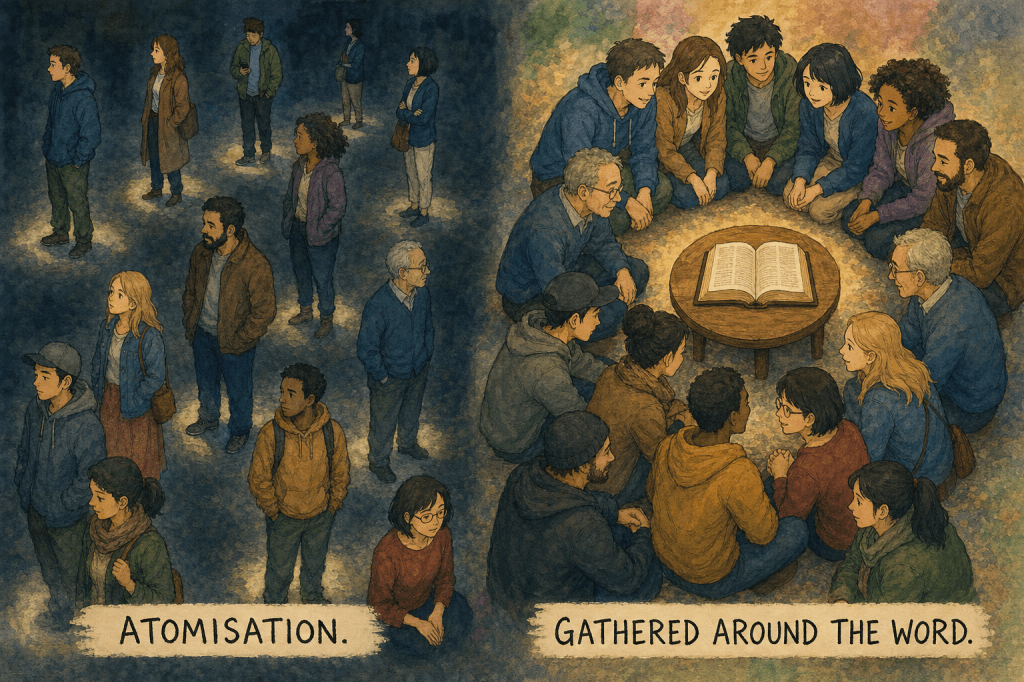
Atomisation as theology
A community needs coordination to do anything together. Translation projects need leads. Study circles need conveners. Contact Prayers in gathered settings need someone to begin. Outreach efforts need organisers. Defense of the message against distortion needs people willing to step forward and be visible. If every form of stepping forward is pre-emptively framed as evidence of hypocrisy, the practical result is not a purified community. The practical result is paralysis — a leaderless atomised crowd unable to organise, unable to teach, unable to project the message, unable to defend itself.
The Quran does not envision the believing community as a leaderless crowd. Chapter 4:59 commands obedience to those in charge among the believers. Chapter 21:73 and Chapter 32:24 describe communities God blessed by appointing leaders among them. Chapter 28:5 describes God’s will to make leaders out of the oppressed believers. Chapter 25:74 has the righteous praying to be granted such leadership. The shape the scripture describes is a community with leaders. The shape the smear projects is a community without any. The smear is not just inaccurate about the source. It is structurally hostile to the form the Quran prescribes.
Who benefits
It is worth asking who actually benefits when leadership claims within submission are pre-emptively delegitimised. The believing community becomes harder to organise. The message becomes harder to project. Newcomers find it harder to identify trustworthy teachers, because every teacher gets the same brushed-on hypocrite label without examination of what they actually say. The work of upholding the Quran against fabricated traditions falls on no one in particular and therefore on nobody. The fragmentation serves the same outcome as the institutional fitna of Chapter 9:107 — dividing the believers and giving comfort to those opposing the message — even though it dresses up in the opposite costume.
None of this means the community should be uncritical of any specific leader, nor that any specific dispute about specific people is being adjudicated here. The argument is structural. It is about the diagnostic the community uses. A community that uses a title-check diagnostic will misfire constantly — convicting the faithful for stepping forward and exonerating the corrupt who simply decline to take a title. A community that uses the diagnostic the Quran actually supplies — Chapter 47:30 read against the speech of any claimed leader, Chapter 4:140-145, Chapter 63, Chapter 9:107, and Chapter 9:31 read against what the leader actually says — will be slow, careful, and accurate.
7. Drawing the Line Honestly
What this article is not arguing
This article is not arguing that anyone calling themselves a leader of submission should be obeyed. It is not arguing that critique of specific teachers is improper. It is not arguing that the community should be naïve about the existence of false claimants, that title-bearers should be shielded from scrutiny, or that any contemporary dispute about any particular person is being settled in these paragraphs. None of those claims would be defensible from the same set of verses being cited.
The hypocrite is real. Chapter 2, Chapter 4, Chapter 9, Chapter 47, and Chapter 63 spend many verses portraying him precisely so that the believers can recognise the pattern when it appears — and the pattern is in the speech. The lord-besides-God dynamic Chapter 9:31 condemns is real and recurring — Rashad warned the community about it from inside the community. The institutional fitna of Chapter 9:107 is real and operational in religious history. Vigilance is required. The question this article addresses is what the vigilance actually consists of, and the Quran’s answer in Chapter 47:30 is unambiguous: listen to how they talk.
What this article is arguing
The actual argument is narrow and structural. Hypocrisy is identified in the Quran by speech against the revealed word and against the same speaker’s own words in other rooms — showy declarations of faith without the content of faith, eloquence that conceals a deviating heart, oaths that contradict the speaker’s other oaths, mockery of God’s revelations followed by deniability disclaimers, prayer performed lazily for the audience while the heart is absent. The Quran does not identify hypocrisy by title. Leadership of a community of believers is, in the Quran, a station God grants, a station the righteous request, and a station obedience to which is conditionally commanded. The two categories overlap only when a specific leader’s speech and conduct match the specific Quranic diagnostics — never by virtue of the title alone.
The Discord smear collapses this structure. By making “claim of leadership” sufficient for the hypocrisy verdict, it skips the actual diagnostic Chapter 47:30 names and replaces listening-to-speech with reading-off-a-title. The result is not stricter than the Quran. It is looser, because it grants the accuser the right to convict without examining what the accused actually says. And it is at the same time wider than the Quran, because it condemns a station the Quran honours.
Conclusion: Listen First, Then Apply the Commands
A hypocrite is a hypocrite. A leader is a leader. The two overlap only when a specific person’s speech and conduct match what the Quran lays down in Chapter 2, Chapter 4, Chapter 9, Chapter 47, and Chapter 63 — and the overlap is not detected by reading off a title. It is detected by listening to the teaching, watching the prayers, comparing what is said to one audience against what is said to another, and weighing every claim against the revealed word as the fixed reference. The Discord smear that says “any claim of leadership equals hypocrisy” tries to skip that listening. The honest position refuses to skip it.
But the honest position does not stop at refusal. The Quran is not neutral once the diagnostic fires. Once a person has been heard out and the pattern of Chapter 47:30 has been confirmed — once duplicity has stopped being an occasional slip and become an established identity — the believer is commanded to act, and to act in named, specific ways:
[33:1] “O you prophet, you shall reverence God and do not obey the disbelievers and the hypocrites. God is Omniscient, Most Wise.”
[33:48] “Do not obey the disbelievers and the hypocrites, disregard their insults, and put your trust in God; God suffices as an advocate.”
[9:73] “O you prophet, strive against the disbelievers and the hypocrites, and be stern in dealing with them. Their destiny is Hell; what a miserable abode!”
[66:9] “O prophet, struggle against the disbelievers and the hypocrites and be stern with them. Their abode is Gehenna, and a miserable destiny.”
[4:138] “Inform the hypocrites that they have incurred painful retribution.”
[4:81] “They pledge obedience, but as soon as they leave you, some of them harbor intentions contrary to what they say. God records their innermost intentions. You shall disregard them, and put your trust in God. God suffices as an advocate.”
[9:84] “You shall not observe the funeral prayer for any of them when he dies, nor shall you stand at his grave. They have disbelieved in God and His messenger, and died in a state of wickedness.”
[60:13] “O you who believe, do not befriend people with whom God is angry, and who are hopelessly stuck in disbelief; they are just as hopeless as the disbelievers who are already in the graves.”
These are not suggestions. They are direct commands to the believer who has already done the diagnostic work — already listened, already weighed, already seen the pattern of contradiction settle into identity. Every one of them presupposes that the believer has identified the hypocrite by name and category. You cannot strive against a category you refuse to name. You cannot decline obedience to people you have decided in advance you will not classify. You cannot withhold funeral prayer from someone whose hypocrite status you treat as unsayable. You cannot disregard the insults of someone you cannot call by what they are. The verses make labelling mandatory, not optional — because the action God commands cannot be performed without the identification.
Rashad preached this directly. Quoting Chapter 5:54 in his Sura 2 study, he summarised the believer’s two-sided posture: God will substitute “people who are humble with the believers, but stern with the disbelievers, and who strive in the cause of God without fear of any blamer.” Rashad followed that with a single image — “with the believers you are a pussy cat. With the disbelievers you are a lion” — and tied the verse directly to the work of carrying the message without fear of being blamed for naming what one sees (at 28:35). On the strict line for hypocrites specifically, in his Sura 70 study, he taught that the sternness itself is an act of mercy for the falling person: “strive against the disbelievers and the hypocrites… It’s for their own good… if somebody’s going to fall in a ditch, that you hold them by the clothes and shake them up. Be stern, otherwise they’ll fall in the ditch” (at 49:14). Rashad did not preach a polite refusal to identify. He preached identification followed by stern action — for the benefit of the one being held by the clothes as much as for the community holding them.
So the right structure is two-stage, not one. Stage one: run the Chapter 47:30 diagnostic. Listen to how they talk. Compare their speech to the revealed word and to what the same speaker says in other rooms. Do not convict on a title. Stage two: when the diagnostic confirms — when duplicity has become identity — label, name, and act according to the commands God has already given. Disregard them. Do not obey them. Be stern with them. Inform them of the painful retribution. Do not befriend them. Do not observe their funeral prayers. Pretending these commands do not apply, or that “judging” is forbidden once the identification has been honestly made, is itself a contradiction of Chapter 33:1, Chapter 9:73, and Chapter 66:9 — it makes the believer disobey one set of commands in the name of being too refined to obey another. That is not piety. That is the same compromiser softness Chapter 4:140-145 portrays.
The community of submission needs people who will translate, teach, gather, coordinate, and defend the message. The Quran describes such people as imams who guide by God’s commandments, leaders God makes out of the oppressed believers, those in charge among you whom God commands you to obey. The same community must also be willing to identify by name — once the Chapter 47:30 listening has confirmed it — those whose speech against the word has become an established pattern, and then to apply the actions the Quran has prescribed for that case. Refusing the smear’s frictionless title-check is not refusing to label. It is refusing to label without listening. After the listening, the label is the obedience.



Leave a comment