
Introduction: A Verdict Already Issued
A 38-page tract circulating in submitter circles argues that a believing man cannot marry a Christian woman because Trinitarian belief is classified as idol worship in [5:72–73] and [2:221] prohibits marriage to idol worshipers. The author concedes that God’s Messenger of the Covenant, Rashad Khalifa, said the opposite on a 1981 audio recording, and concludes that the silence of the 1989 Final Testament at [5:5] must override that audio. The argument is presented in submitter vocabulary — “tawheed,” “Quran alone,” “whole-Quran consistency” — and dressed as piety. The actual move is to forbid what God made lawful in a single revealed sentence, and to override what the messenger of the covenant ruled in front of his community.
This article addresses the exact tension the tract claims is unresolved. It is resolved. The resolution exists on tape, with timestamps, in the messenger’s own voice, eight years before the 1989 Final Testament was finalised. Messenger Audio 29 is not a private musing or an early opinion; it is a public Quran study where Rashad reads [2:221], names the apparent contradiction with [5:5], and rules. He does this three separate times in under ten minutes. He answers every variation of the objection the tract raises — including the “today’s Christians are different from yesterday’s Christians” objection — by stating verbatim that Christians of his time and Christians at the time of the Quran’s revelation are the same idol-worshipping category, and that 5:5 covers both. The tract did not refute this verdict. It avoided it.
Part 1: The Messenger’s Verdict — Messenger Audio 29, on the Record
The recording exists, the timestamps are public, and the ruling is unambiguous
Messenger Audio 29 is publicly archived on YouTube at youtube.com/watch?v=xnwqbpvVRGQ. The recording opens with Rashad reading the Final Testament translation of [2:221] aloud and immediately correcting the rendering “do not marry pagans” to “do not marry idol worshipers” — the same correction now reflected in the published verse. He then identifies the very tension the tract claims is unaddressed: if Christians who call Jesus God are idol worshipers, how can 5:5 permit marrying them? His answer is delivered in plain language, with congregants present, with the recording running.
The load-bearing quotes are timestamped below. Each is verbatim from the recording. Each link opens at the second the words are spoken. None of them are taken out of context — the surrounding ten minutes is the same teaching, repeated and clarified at the audience’s request.
Messenger Audio 29 at 1:30: “Really, I agonize over this. Because the Christians are idol worshipers, the Christians who call Jesus God are idol worshipers, but we can marry Christians. This is a very tricky verse.”
Messenger Audio 29 at 2:10: “So in chapter 5 we are permitted to marry Jews and Christians. But you cannot marry a Muslim who does not believe God is stating that the Quran is sufficient — that the Quran is complete and perfect.”
Messenger Audio 29 at 3:25: “We are allowed to marry Christians and Jews, but not a Muslim who does not believe the Quran is complete and perfect.”
The messenger’s verdict is delivered three times in three minutes. He is not speculating. He is not hedging. He is not exploring a position. He is teaching the resolution of [2:221] and [5:5] — naming both verses by chapter, naming the apparent contradiction, and ruling. The tract claims this tension is unresolved in Rashad’s published work; the recording shows him resolving it on tape eight years before the Final Testament’s final edition went to print.

Why this is a binding teaching, not a private musing
The tract attempts to disqualify the audio on procedural grounds: it is “informal,” it predates the 1989 Final Testament, it is not enshrined as a footnote, therefore the silence of the 1989 print edition overrides it. None of these moves survive contact with the recording. Rashad delivers the ruling while reading the verse in a public Quran study. He says “I would like to make a correction” to the translation — the language of a teacher updating his students on a finalised view, not a private brainstorm. He repeats the ruling three times in response to follow-up questions. The recording is not a draft; it is a teaching session.
The role of God’s Messenger of the Covenant, established in Appendix 2 of the Final Testament and confirmed by the mathematical signature of [3:81] and [98:2], is precisely to clarify what people dispute (see [16:64]) and to deliver the message in plain language ([5:99]). A public Quran study where the messenger addresses both verses by name, identifies the apparent contradiction, and rules — three times — is exactly the kind of practical clarification a messenger delivers. The tract’s claim that this is “informal” treats the messenger’s spoken teaching as less authoritative than the absence of a footnote eight years later. That inversion has no basis in the Final Testament or in Appendix 2.
Part 2: Verse 5:5 — The Plain Reading
The verse permits marriage in the same revealed sentence that permits food
[5:5] “Today, all good food is made lawful for you. The food of the people of the scripture is lawful for you. Also, you may marry the chaste women among the believers, as well as the chaste women among the followers of previous scripture, provided you pay them their due dowries. You shall maintain chastity, not committing adultery, nor taking secret lovers. Anyone who rejects faith, all his work will be in vain, and in the Hereafter he will be with the losers.”
The Final Testament records no subtitle and no footnote at [5:5]. The verse stands as a single revealed sentence containing two parallel permissions — the food of the people of the scripture, and marriage to their chaste women. Both permissions are introduced with the same Arabic phrasing (alladhīna ūtū al-kitāba min qablikum, “those who were given the scripture before you”). The same noun phrase governs the food clause and the marriage clause. They are not separable on the page and they are not separable in the grammar.
This is decisive against the tract’s reading. The tract argues that Trinitarian Christians cannot be the referent of “people of the previous scripture” in the marriage clause because their belief is classified as shirk at [5:72–73]. But the same noun phrase governs the food clause two seconds earlier. If Trinitarians are excluded from the marriage clause by the tract’s logic, they are also excluded from the food clause by the same logic. Every submitter community in the world reads 5:5 as making the food of Christian neighbours lawful. The tract cannot have it both ways. Either the phrase covers Trinitarians for both food and marriage, or it covers them for neither — and excluding them for neither would require a submitter to verify the trinitarian status of every restaurant cook and dinner host before eating. The Quran does not impose that absurdity. The phrase covers Trinitarians for both. That is what the verse says and that is how it is universally applied.
“Followers of previous scripture” is deliberately distinct from “believers”
The verse uses two distinct phrases on purpose. The first is al-muḥṣanāt min al-mu’mināt — “the chaste women among the believers.” The second is al-muḥṣanāt min alladhīna ūtū al-kitāba min qablikum — “the chaste women among those who were given the scripture before you.” If God meant only believing Christians and Jews, He would have used the same Arabic structure as clause one — “the chaste believing women among them.” He did not. He expanded the second clause to “those who were given the scripture before you” without the word believing. That expansion is the permission. Reading “believing” silently back into the second clause is the precise act forbidden in [16:116] — inserting human conditions into God’s words and attributing the addition to God.
The tract concedes on its page 10 that the word “believing” is absent from clause two but argues this “continues the same description.” That requires reading words into the verse that God did not put there, which is exactly what the tract’s own page 13 condemns when committed by traditional commentators. The argument applies its own rule selectively: silence at 5:5 is treated as permission when it suits the conclusion, and as exclusion when it doesn’t. That is not “whole-Quran consistency”; it is the engineering of a result.

Part 3: The Quran Distinguishes “People of the Book” From “Idol Worshipers”
Two terms, two categories, throughout the Final Testament
The tract’s entire case rests on collapsing Trinitarians into the category of mushrikūn (idol worshipers) so that the absolute prohibition of [2:221] applies to them. The Quran does not perform that collapse. It maintains the two terms as two categories — and it does so with the explicit conjunction “and” (wa-) when listing them side by side. If the Quran considered Trinitarians simply a subset of mushrikūn, this redundant pairing would be meaningless. The Quran uses two terms because it means two categories.
[22:17] “Those who believe, those who are Jewish, the converts, the Christians, the Zoroastrians, and the idol worshipers, God is the One who will judge among them on the Day of Resurrection. God witnesses all things.”
Six groups, six labels, six distinct categories. Christians (al-naṣārā) and idol worshipers (al-mushrikūn) are listed in the same verse as two of the six. The Quran is enumerating, not synonymising.
[98:1] “Those who disbelieved among the people of the scripture, as well as the idol worshipers, insist on their ways, despite the proof given to them.”
[98:6] “Those who disbelieved among the people of the scripture, and the idol worshipers have incurred the fire of Gehenna forever. They are the worst creatures.”
Both verses pair the two categories with the conjunction wa-. Even when the eschatological outcome is identical, the Quran preserves the linguistic distinction. The tract reads these verses as supporting its collapse; in fact they refute it. If “people of the scripture” already meant “idol worshipers,” the Quran would not name them separately on the same page.
2:221 governs mushrikāt; 5:5 governs ahl al-kitāb
[2:221] “Do not marry idolatresses unless they believe; a believing woman is better than an idolatress, even if you like her. Nor shall you give your daughters in marriage to idolatrous men, unless they believe. A believing man is better than an idolater, even if you like him. These invite to Hell, while God invites to Paradise and forgiveness, as He wills. He clarifies His revelations for the people, that they may take heed.”
The Arabic noun in [2:221] is al-mushrikāt — the feminine plural of the same root used at [22:17], [98:1] and [98:6] for the separate category. The Arabic noun in [5:5] is alladhīna ūtū al-kitāba min qablikum — “those who were given the scripture before you.” Two different Arabic terms for two different groups. Treating them as identical is the additive reading that [4:82] warns against. The Quran does not contradict itself; the contradiction is in the synthesis the tract imposes. The absolute prohibition (2:221) names mushrikūn. The specific permission (5:5) names people of the scripture. Both are true at the same time because they govern different categories.
Part 4: 5:72–73 Classifies the BELIEF as Shirk — Not the Category for Marriage
Rashad’s own subtitle preserves both rulings without contradiction
[5:72] “Pagans indeed are those who say that God is the Messiah, son of Mary. The Messiah himself said, ‘O Children of Israel, you shall worship God; my Lord and your Lord.’ Anyone who sets up any idol beside God, God has forbidden Paradise for him, and his destiny is Hell. The wicked have no helpers.”
[5:73] “Pagans indeed are those who say that God is a third in a trinity. There is no God except the one God. Unless they refrain from saying this, those who disbelieve among them will incur a painful retribution.”
Rashad’s subtitle at 5:72 in the Final Testament reads “Today’s Christianity Not Jesus’ Religion.” That is the messenger’s own identification of the trinitarian deviation as kufr. He saw both verses. He named the deviation. He chose the subtitle. And he still ruled on Messenger Audio 29 that marriage to Christians is permitted. The same chapter that contains 5:72–73 contains 5:5. Both rulings stand. The “contradiction” the tract claims to expose is manufactured by demanding that the second cancel the first — something the Quran does not do and the messenger of the covenant explicitly refused to do.
Read carefully: 5:72–73 indicts the statement “God is the Messiah” and “God is third of three” as kufr. It does not erase the people-of-the-book identity for the purposes of dietary and marriage law established at 5:5 sixty-seven verses earlier in the same chapter. The chapter itself preserves both — it indicts the belief while leaving the food/marriage permission untouched. That is the messenger’s synthesis. The tract overrides it.

Part 5: The 9:15 Statement Crushes the “1989 Supersedes 1981” Trick
The messenger explicitly equated yesterday’s Christians and today’s Christians
The tract’s final move (pages 34–38) is to argue that the 1981 audio is overridden by the 1989 Final Testament’s silence at [5:5]. The implicit premise is that Christians of Muhammad’s day were somehow different from today’s trinitarian Christians — that the Final Testament’s reclassification of trinitarian belief as shirk at 5:72–73 narrows the meaning of “people of the previous scripture” in 5:5 to exclude today’s Christians. The author engineers this distinction without ever stating it openly, because stating it openly would expose what the messenger of the covenant said on the same recording.
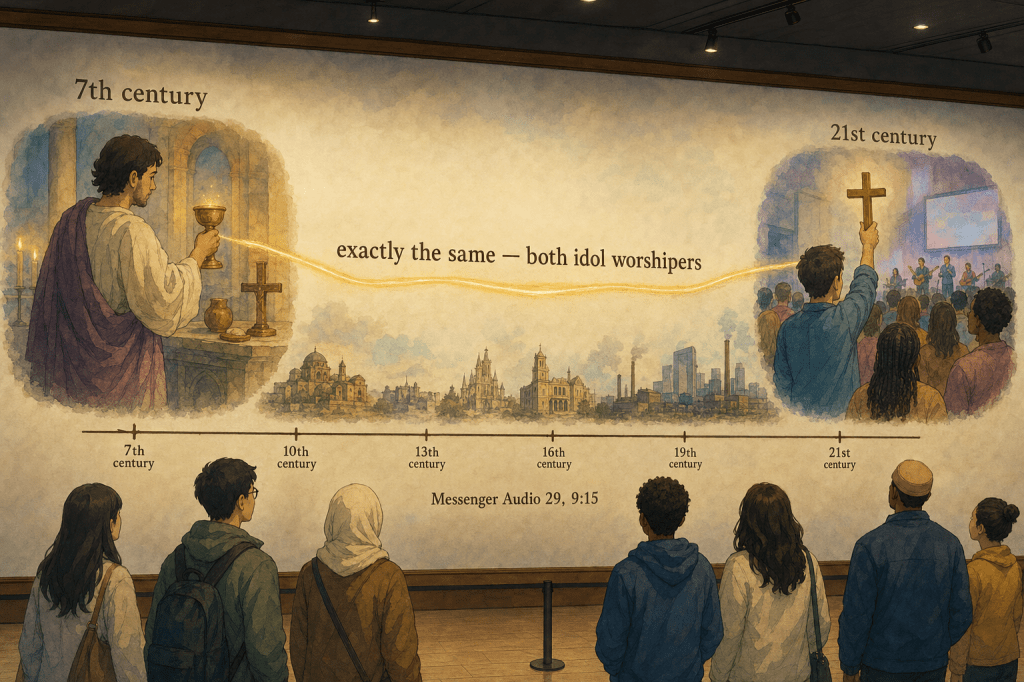
Messenger Audio 29 at 9:15: “Christian and Jew at the time of the Quran were exactly the same as those of today: both idol worshipers.”
This sentence ends the argument. The messenger of the covenant explicitly identifies Christians of his own time and Christians of Muhammad’s time as the same category — both trinitarian idol worshipers in belief — and both are within the marriage permission of 5:5. The “today’s Christianity is different” wedge the tract needs to drive between the audio and the Final Testament is the precise wedge the messenger preemptively refused to drive. He saw the deviation. He classified it as shirk. He still ruled marriage permitted. He explicitly said the deviation has been the same throughout. The 1981 ruling and the 1989 reclassification are not in tension; the 1989 reclassification at 5:72 is the formalisation of a fact Rashad was already operating with when he ruled in 1981. The reclassification explains the agonising; it does not reverse the verdict.
What changed in 1989 confirms the audio rather than reversing it
Between 1981 and 1989, Rashad made several deliberate changes to the printed edition. He removed the two fabricated verses [9:128–129] from the chapter and explained the change in Appendices 24 and 29, complete with mathematical proof from Code 19. He removed the 1981 footnote at [2:221] which had read Jews and Christians as non-pagans, because that footnote was no longer consistent with his audio teaching that they are in fact idol worshipers in belief. He added the subtitle “Today’s Christianity Not Jesus’ Religion” at 5:72 — the formal reclassification. None of these edits touched the marriage permission at 5:5. Not a word changed. Not a footnote was added. No subtitle excluded Trinitarians from 5:5.
The tract’s argument requires reading silence at 5:5 as a louder voice than every preserved word on the audio. That is reverse engineering, not exegesis. Rashad marked his changes — clearly, mathematically, with explanatory appendices. If he had reversed his 5:5 ruling, he would have marked it the same way. He did not, because he did not reverse it.
Part 6: The “They Did Not See the Quran” Criterion
The messenger’s actual rule is about responsibility, not creed-category
Mid-recording, an audience member asks Rashad directly: what about a Christian who is in fact an idol worshiper — a Christian who worships Jesus as God? Is he still marriageable? Rashad’s answer is the clearest statement of his actual criterion anywhere in the recorded teaching.
Messenger Audio 29 at 5:35: “Well, it didn’t say that — it says you can marry them ‘even as they are’ because they were not subject, did not receive the Quran, did not look at it, and there’s a possibility that they will become believers.”
Messenger Audio 29 at 5:50: “But the Muslim already looked at the Quran and saw with his or her own eyes that the Quran says this book is complete and fully detailed, and they made a decision to reject that and not to believe God. That person already made a stand and God made a stand against that person. That you shall not marry him or her.”
This is the messenger’s actual ruling on inter-faith marriage. The criterion is not creed-category in the abstract; it is responsibility — what has the person seen, what have they engaged, what have they rejected. A Christian who has never encountered the Quran is still inside the 5:5 permission “even as they are,” because there remains a possibility they will come to the Quran. A “Muslim” who has seen the Quran and rejected its completeness is outside the permission — because rejecting after seeing is a different category of kufr than the trinitarian who never read the book.
This criterion completely destroys the tract’s reduction of the question to a creed-label binary. The tract reads 5:5 through the lens of “does this person’s belief qualify as shirk, yes or no” — and concludes that all trinitarians fail. The messenger reads 5:5 through the lens of “has this person been confronted with the Final Testament and rejected its completeness, yes or no” — and rules that the trinitarian Christian who has not been so confronted is marriageable. The two readings produce opposite conclusions on the same verse. The messenger’s reading is the one preserved on the tape, with congregants present, three times in ten minutes. The tract’s reading is the one being added to the verse 45 years later.
Part 7: The 60:1 Misuse — Rashad’s Own Exegesis Refutes the Tract
60:8–9 is the umbrella rule, not 60:1, and Rashad said so on tape
The tract cites [60:1] (“you shall not befriend My enemies and your enemies”) to argue that marriage to a trinitarian is the kind of “closeness” the Quran prohibits. The argument selectively quotes 60:1 while ignoring the chapter’s own qualifier in [60:8–9] — and ignoring Rashad’s explicit teaching on these verses, recorded in a Quran study dated 28 December 1989, the same year the Final Testament was finalised.
[60:1] “O you who believe, you shall not befriend My enemies and your enemies, extending love and friendship to them, even though they have disbelieved in the truth that has come to you. They persecute the messenger, and you, just because you believe in God, your Lord…”
[60:8] “God does not enjoin you from befriending those who do not fight you because of religion, and do not evict you from your homes. You may befriend them and be equitable towards them. God loves the equitable.”
[60:9] “God enjoins you only from befriending those who fight you because of religion, evict you from your homes, and band together with others to banish you. You shall not befriend them. Those who befriend them are the transgressors.”
60:1 describes a specific kind of disbeliever — one who persecutes the messenger and the believers because of their belief. 60:8–9 then state the general rule, and Rashad’s own subtitle calls 60:8 the “Basic Law Regulating Relations With Unbelievers.” The tract quotes 60:1 as the basic law — the opposite of what Rashad’s translation says on the page.
The recorded Quran study at 10:53 in Quran Study 12/28/89, Sura 60–61 is unambiguous on this. Rashad teaches the chapter verse-by-verse and says: “Verses 8 and 9 are really the rule that covers, the umbrella rule… If they are not actively fighting you, you help them. Yes, look on them as potential believers. You are trying to woo them, actually… You can be their friends and love them and everything. Try to woo them to worshipping God alone.” This is the messenger’s own published exegesis, eight days before the Final Testament was finalised. The tract’s use of 60:1 directly contradicts it.

Part 8: The 60:10, Abraham, and 9:84 Arguments Prove Too Much
Wartime asylum law is not a global marriage ban
[60:10] “O you who believe, when believing women (abandon the enemy and) ask for asylum with you, you shall test them. God is fully aware of their belief. Once you establish that they are believers, you shall not return them to the disbelievers. They are not lawful to remain married to them, nor shall the disbelievers be allowed to marry them…”
The Final Testament subtitle at 60:10 is “In Case of War.” The verse legislates the legal status of believing women who flee an enemy camp and seek asylum among the believers — a wartime scenario. Reading it as a universal prohibition on marriage to all disbelievers contradicts 5:5 in its own chapter logic. If 60:10 forbade marriage to all disbelievers categorically, 5:5’s permission would be void. The Quran does not contradict itself ([4:82]); the contradiction is in the tract’s synthesis. Rashad’s own commentary on this verse in the same 28 December 1989 recording (approximately 14:23) explicitly states: “This probably will never apply to us. But what this is saying is when two camps are fighting, one camp for disbelievers, another camp for believers, and some women on the disbelievers’ side join the believers, you do not have to obtain an official divorce.”
9:113–114 and 9:84 are post-rejection and post-death, not pre-marriage
The tract invokes Abraham’s eventual disowning of his idol-worshipping father (9:113–114; 60:4) and the prohibition on funeral prayer for disbelievers (9:84) to argue that no intimate bond can exist with a trinitarian. Both arguments prove too much. 9:113–114 prohibits asking forgiveness for those who persist in shirk until they realise they are destined for Hell — a post-rejection-of-final-state condition, not a pre-marriage rule. The marriage in 5:5 is contracted during life, when persistence is not yet the final state. 9:84 prohibits the funeral prayer for those who “disbelieved in God and His messenger and died in a state of wickedness” — post-death judgment, not a pre-death marriage rule.
By the tract’s logic, no submitter could share a meal with a Christian in life because of what may happen at death. 5:5 explicitly permits sharing the meal — which alone refutes the inference. Abraham’s example in 60:4 is held up by the Quran itself with a limit: “except for Abraham’s saying to his father, ‘I will pray for your forgiveness, but I possess no power to protect you from God.’” The Quran flags this single statement as not the example to follow. The principle of disassociation is real; it operates within the broader framework that Rashad called the umbrella rule (60:8), not above it.
Part 9: The 4:34 / 5:5 Subtitle Asymmetry — The Tract’s Own Self-Refutation
Selective deference to silence
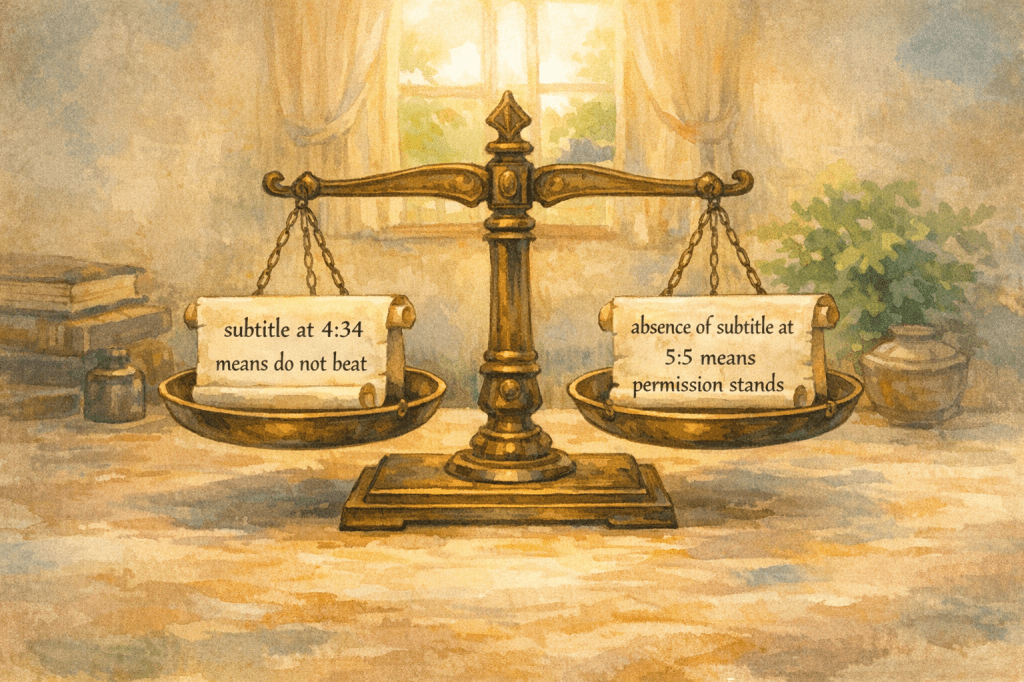
On its page 37, the tract argues — correctly — that submitters take Rashad’s subtitle “Do Not Beat Your Wife” at [4:34] as authoritative, even against a surface reading of the verse text. The tract uses this point to argue that subtitles function as the messenger’s clarifying authority on the meaning of a verse. Apply the same logic to [5:5]: there is no exclusionary subtitle at 5:5. There is no “Trinitarians Excluded” subtitle. There is no footnote narrowing “those who were given the scripture before you.” If subtitles function as the messenger’s clarifying authority, the absence of an exclusion subtitle at 5:5 is itself the ruling — permission stands.
The tract’s argument requires the silence-as-clarification inference to run only in one direction: silence is decisive when it tightens the law (5:5 silence means Trinitarians are excluded, the tract’s claim) but silence is ignored when it loosens the law (4:34 silence on physical force would mean the literal text permits it, which the tract rejects in line with Rashad). This is not consistency; it is selective deference to silence — deference whenever the inference tightens God’s law, dismissal whenever it loosens. The tract’s own page 37 argument is the self-refutation. The absence of an exclusionary footnote at 5:5 is exactly what the absence of permission to beat at 4:34 is: the messenger’s clarifying authority operating through what he did not say. In both cases, the messenger’s spoken and written record names the permission or the prohibition. At 4:34 he ruled against the surface reading. At 5:5 he ruled in favour of the surface reading. The recorded ruling exists in both cases. The tract honours one and overrides the other.
Part 10: The 4:141–145 Compromiser Profile and 16:116
Tightening God’s law in piety language is the hypocrite’s signature, not the believer’s
The argument under review is delivered in submitter vocabulary — “tawheed,” “Quran alone,” “reflect on the Quran,” “avoid contradiction” — while its actual move is to forbid what God permitted in 5:5 and to override what the messenger of the covenant ruled in front of his community three times in ten minutes. The Quran has a precise diagnostic for this pattern, and it is not flattering.
[4:141] “They watch you and wait; if you attain victory from God, they say (to you), ‘Were we not with you?’ But if the disbelievers get a turn, they say (to them), ‘Did we not side with you, and protect you from the believers?’ God will judge between them on the Day of Resurrection. God will never permit the disbelievers to prevail over the believers.”
[4:144] “O you who believe, do not ally yourselves with the disbelievers, instead of the believers. Do you wish to provide God with a clear proof against you?”
[4:145] “The hypocrites will be committed to the lowest pit of Hell, and you will find no one to help them.”
The hypocrite-compromiser of 4:141–145 is not the believer who marries a Christian woman in obedience to 5:5 and the messenger’s ruling. The hypocrite-compromiser is the one who undermines what God revealed by reframing it as “preserving tawheed.” Tightening God’s law in pious language is not piety; it is the same move the Quran spent its length refuting in the hadith literature (see Appendix 19). The compromiser’s signature is: dress the override in the language of the revelation, claim methodological purity, and quietly substitute a human conclusion for the divine permission.
[16:116] “You shall not utter lies with your own tongues stating: ‘This is lawful, and this is unlawful,’ to fabricate lies and attribute them to God. Surely, those who fabricate lies and attribute them to God will never succeed.”
16:116 is the closing verdict on the entire 38-page tract. God’s words at 5:5 say “you may marry the chaste women among the followers of previous scripture.” The tract says “you may not.” That is the precise act 16:116 forbids — uttering with one’s own tongue that what God made lawful is unlawful. The argument is delivered in the cadence of piety, but the act is the act 16:116 names. The Quran does not soften this verdict, and neither does the messenger of the covenant whose entire ministry was the refutation of this exact move in the hadith corpus.

Conclusion: The Verdict of the Quran and of the Messenger of the Covenant Stands
The argument that submitters cannot marry Christians fails on every load-bearing claim. The Quran in [5:5] grants the permission in the same revealed sentence as the food permission, with the same governing noun phrase. Rejecting the marriage permission while accepting the food permission is internally incoherent. The Quran distinguishes people of the book from idol worshipers as separate categories at [22:17], [98:1], [98:6]. [2:221] governs mushrikāt; [5:5] governs ahl al-kitāb. The messenger of the covenant addressed the exact tension the tract claims is unaddressed, three times in under ten minutes, on Messenger Audio 29, and resolved it: “we can marry Christians.” He explicitly identified Christians of his time and Christians of Muhammad’s time as the same idol-worshipping category at the 9:15 mark — eliminating the “today’s Christianity is different” wedge before it was ever inserted.
60:1 is not the umbrella rule for relations with disbelievers; 60:8–9 is, and Rashad’s own published exegesis says so. The 1989-supersedes-1981 trick collapses on its own logic: 5:5 is identical in both editions; what changed (the removal of [9:128–129], the removal of the 2:221 footnote, the addition of the 5:72 subtitle) confirms the audio rather than reversing it. The 4:34 / 5:5 subtitle asymmetry exposes the tract’s selective deference to silence whenever silence tightens the law. The argument fits the 4:141–145 hypocrite-compromiser profile and commits the precise act 16:116 forbids — declaring unlawful what God made lawful and attributing the prohibition to God.
The verdict of the Quran and of the Messenger of the Covenant stands: a believing man may marry a chaste Christian or Jewish woman, paying her due dowry, while remaining steadfast in absolute monotheism, calling her to worship God alone in the spirit of [60:8] and [16:125], and structuring the home in tawḥīd as [4:34] and [66:6] require. That is what [5:5] says. That is what Rashad ruled on tape. That is what the Quran, read as a unified message rather than read against itself, permits.
The 38-page tract has not refuted this verdict. It has avoided it — by disqualifying the recording on procedural grounds, by collapsing two Arabic categories into one, by reading silence in opposite directions in the same verse, and by dressing the override of God’s permission in the language of piety. The Quran has a name for that pattern. It is not “submission.” It is the precise sin of [16:116]: fabricating lies and attributing them to God. The article you have just read is the published correction.



Leave a Reply