
Introduction: A Title That Was Never Unpacked
There is a kind of word that sounds profound the moment you say it and then quietly evaporates if you never explain it. “Kanban” is one of those words. It has appeared in the title of a meditation on trust in God, promising a bridge between the disciplined world of the factory floor and the inner world of the believing heart, and then left that bridge half-built — gesturing at the manufacturing metaphor while staying comfortably abstract about faith. The result was a beautiful intuition without its engine. This article is written to finish the build: to take the Toyota Production System seriously, to learn precisely how a pull system differs from a push system, and then to map that mechanism, gear for gear, onto the way God actually provisions a human life.
The claim at the heart of everything that follows is deceptively simple. God does not require us to manufacture our own outcomes by force. He has already prepared the positions we will one day fill, and He draws the right person into the right place at the exact moment a genuine need appears — never sooner, never later. Our task is not to predict the future and frantically pre-build solutions for it. Our task is to keep ourselves stocked: righteous, prepared, patient, and trusting, so that when the signal comes, we are drawn forward into the role that was waiting for us all along. The Quran calls this trust, and it promises something the anxious heart can scarcely believe: provision from a direction we never expected.
Part 1: Two Ways to Run a Factory
The Push System and the Mathematics of Waste
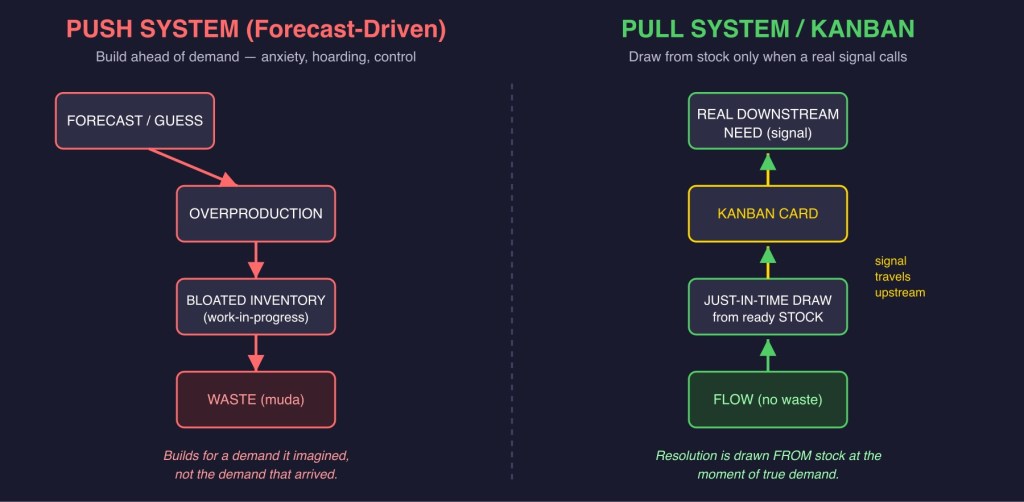
For most of the twentieth century, manufacturing ran on what engineers call a push system. A central planner studies a forecast — last quarter’s sales, a projection, a guess dressed in confidence — and then issues production orders based on what the future is predicted to demand. Each workstation builds as fast as it can and pushes its output downstream to the next station whether or not that station actually needs it yet. Material is shoved forward into inventory, piling up as work-in-progress, sitting in warehouses, tying up capital, aging, sometimes becoming obsolete before anyone ever asks for it. The system is producing for a demand it imagined rather than the demand that genuinely arrived.
The Toyota engineer Taiichi Ohno catalogued the cost of this approach as the seven wastes — in the original, muda. The very first and most dangerous of them is overproduction: making more than is needed, earlier than it is needed. Overproduction is the parent waste because it manufactures all the others — excess inventory, unnecessary transport, wasted motion, defects hidden inside huge batches, and the slow rot of capital frozen in goods nobody wanted yet. A push system feels productive. Everyone is busy, every machine is running, the warehouse is full. But fullness is not the same as readiness, and a warehouse stuffed with the wrong things is not wealth — it is fragility wearing the costume of abundance.
The Pull System: Nothing Moves Until a Real Signal Calls
Ohno’s revolution was to invert the entire logic. In a pull system, nothing is produced until a real downstream signal requests it. The signal is a physical card — kanban literally means “signboard” — that travels backward up the line. When a downstream station consumes a part, it sends its kanban card upstream, and only then is the replacement drawn from stock and produced. Demand is not predicted and forced into the schedule ahead of time; the resolution is pulled from ready stock at the precise moment a true need appears. This is the meaning of “just-in-time”: the part arrives exactly when it is wanted, and not one minute before.
The consequences are almost spiritual in their elegance. Inventory shrinks to a minimum because nothing accumulates that nobody has called for. Waste collapses because production is yoked to reality rather than to a forecast. Flow becomes smooth, because the whole system is breathing in time with genuine demand instead of choking on its own surplus. The factory stops trying to outguess the future and instead becomes responsive, supple, and trustworthy. It keeps its shelves stocked with what is genuinely useful, and then it waits — calmly, attentively — for the signal that says: now.
Part 2: The Push Life and the Anxious Heart
Pre-Manufacturing Solutions to Problems That Have Not Arrived
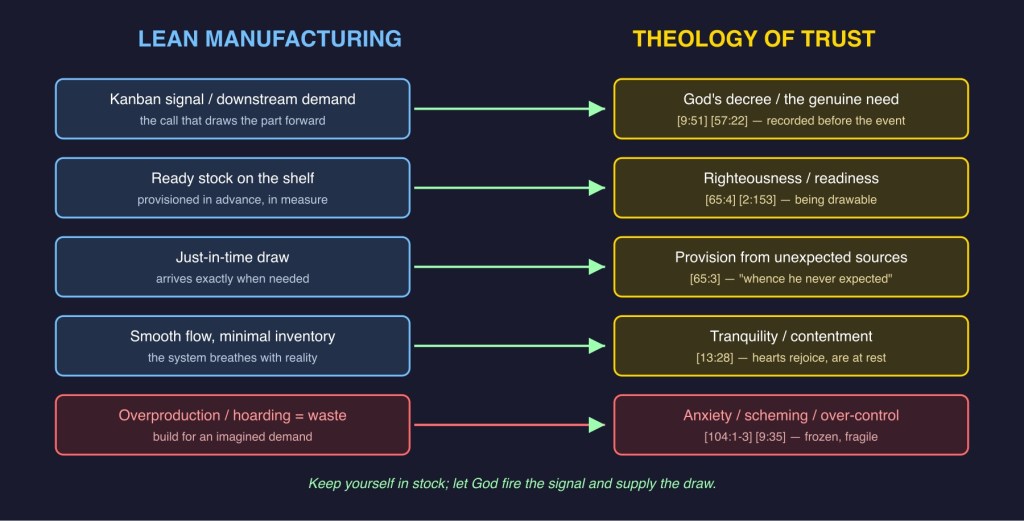
Now translate the factory into a soul. A push life is one lived on forecast. We lie awake assembling elaborate solutions to crises that have not occurred and may never occur. We hoard money against an imagined catastrophe, we scheme to control people and outcomes, we over-prepare, over-explain, over-grip. We are, in the precise language of manufacturing, trying to push the resolution into the requirement before the requirement has even appeared — building inventory of worry, stacking it in the warehouse of the mind until the shelves groan. And like the overstocked factory, the anxious heart mistakes its busyness for security. It feels responsible. It feels diligent. But it is producing waste.
This is overproduction of the spirit, and it carries the same hidden costs Ohno catalogued on the factory floor: frozen capital in the form of attention spent on phantoms, defects hidden inside great batches of fear, and a fragility that masquerades as control. The Quran addresses this exact disorder by relocating the source of every event outside our hands entirely. If nothing reaches us except what has already been decreed, then the entire industry of anxious forecasting is producing for a future that is not ours to manufacture.
[9:51] “Say, ‘Nothing happens to us, except what God has decreed for us. He is our Lord and Master. In God the believers shall trust.’”
Read that as an engineer reads a spec. The schedule is not set by our forecast; it is set by a decree that precedes the event. Our frantic push-production is therefore not merely exhausting — it is building for an order that has already been placed by Someone else, in quantities we cannot know, on a timeline we did not draft. The believer’s relief is not laziness; it is the recognition that the planning function has been handled by a planner of perfect knowledge, and that our job has shrunk to something far smaller and far more peaceful.
Part 3: The Stock Already Exists Before the Need Appears
The Decree That Precedes the Event
The deepest reason a pull system works is that the upstream stock is already there when the downstream signal fires. You cannot draw from an empty shelf. In a well-run lean operation, the right components sit ready — provisioned in advance, in precise measure — so that the instant a genuine need is signaled, the resolution can flow without delay. The Quran describes reality itself as built on exactly this architecture: the outcome is recorded before it is brought about, the provision is laid up before the creature is hungry, the exit is prepared before the trial arrives.
[57:22] “Anything that happens on earth, or to you, has already been recorded, even before the creation. This is easy for God to do.”
The record precedes the event the way the stocked shelf precedes the kanban card. And this is not a doctrine of fatalistic gloom; it is, properly understood, the most liberating fact a person can hold. It means the position you are anxious about filling is not something you must fabricate against the odds. It already exists. It was provisioned before you arrived. Notice, too, how the Quran frames the cosmic inventory: God owns infinite amounts of everything, but releases each thing in exact, measured quantity — the very signature of just-in-time provisioning rather than wasteful overproduction.
[15:21] “There is nothing that we do not own infinite amounts thereof. But we send it down in precise measure.”
Infinite stock upstream; precise, measured release downstream. This is the lean ideal stated with a perfection no factory will ever reach. And the guarantee of provision is not vague — it is underwritten for every living thing, recorded in a book, its course and destiny already known. The shelf is never bare.
[11:6] “There is not a creature on earth whose provision is not guaranteed by God. And He knows its course and its final destiny. All are recorded in a profound record.”

Part 4: God Creates the Position We End Up Filling
Drawn Forward When the Signal Comes
Here is the thesis in its sharpest form. We do not manufacture our station in life by force; God creates the position and then pulls the right person into it at the right time. The believer who has kept himself in stock — ready, righteous, attentive — finds that when the genuine need surfaces, he is drawn forward into a role that was prepared before he knew it existed. This is why the most pivotal turns in a faithful life so often feel less like achievements seized and more like doors that opened from the other side, like a kanban card firing somewhere upstream and a person being smoothly drawn into the gap.
The single verse that anchors the entire theology of the pull system is the promise attached to reverence and trust. It does not say God will reward your forecasting. It says God will provide from a direction your forecasting could never have predicted — the unexpected upstream supply that no human planner had on the schedule.
[65:2] “…Anyone who reverences God, He will create an exit for him.”
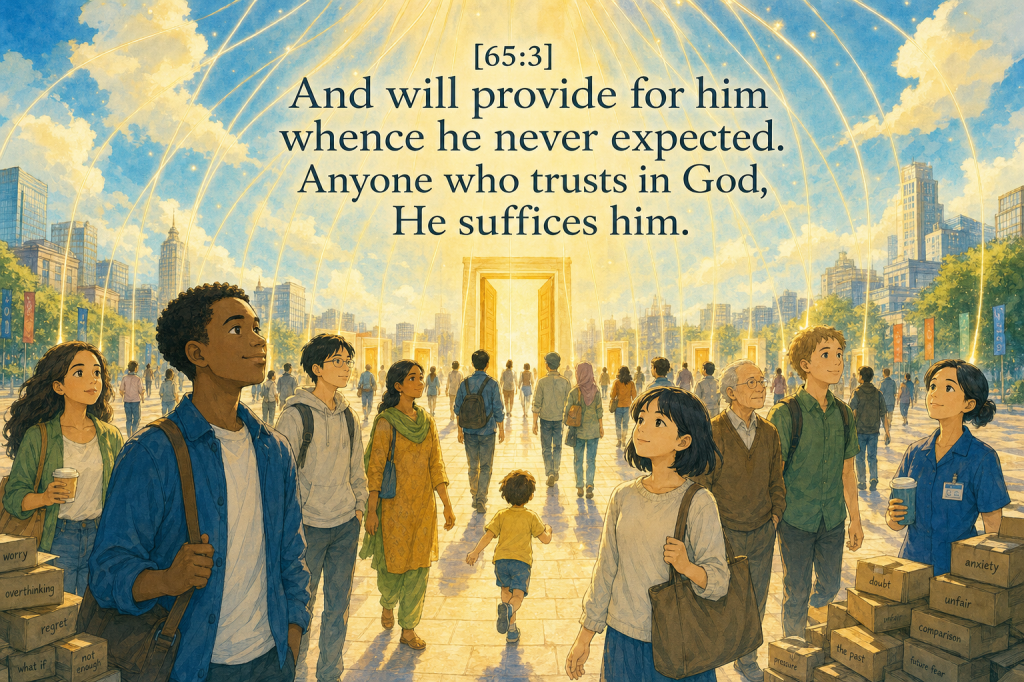
[65:3] “And will provide for him whence he never expected. Anyone who trusts in God, He suffices him. God’s commands are done. God has decreed for everything its fate.”
Look at the engineering of that sentence. “He will create an exit” — God provisions the resolution. “From whence he never expected” — the supply comes from stock you did not forecast and could not see. “He suffices him” — the just-in-time draw meets the need completely. “God’s commands are done… has decreed for everything its fate” — the schedule was set in advance. The reverent, trusting person is simply the station whose shelf was kept stocked, so that when the signal fired, God could pull him into the exact position prepared for him. Righteousness, in this reading, is not a transaction that pressures God. It is the readiness that makes us drawable.
Part 5: The Deepest Pull — Even Our Own Hands
“It Was Not You Who Threw”
If the pull system only governed our provision, it would already be a profound comfort. But the Quran extends it into a place far more radical: even our own decisive actions, the very movements of our hands at the moment of crisis, trace back to God’s orchestration. After the early believers prevailed in battle, they were told plainly that the victory was not their manufacture. They had been the station; the supply that flowed through them was not theirs.
[8:17] “It was not you who killed them; God is the One who killed them. It was not you who threw when you threw; God is the One who threw. But He thus gives the believers a chance to earn a lot of credit. God is Hearer, Omniscient.”
This is the deepest pull statement in all of scripture. “When you threw, it was not you who threw.” The action appeared to originate in the human hand, but the resolution was supplied from upstream; the believer merely received the signal and was drawn into his role at the decisive instant. And then the astonishing grace of the closing clause: God lets us earn credit for the part we played in receiving it. The pull system does not erase human responsibility — it relocates the source. We are accountable for keeping ourselves in stock and for responding when the signal comes, while the supply itself, the power, the timing, and the outcome belong to God. Notice also that the angels themselves work in shifts, stationed before and behind us, executing God’s commands — the unseen logistics of a system we never built.
[13:11] “Shifts (of angels) take turns, staying with each one of you—they are in front of you and behind you. They stay with you, and guard you in accordance with God’s commands…”

Part 6: Just-in-Time Provision and the Sin of Hoarding
The Manna That Could Not Be Stockpiled
The most vivid lesson against overproduction in all of scripture is the daily bread of the Israelites in the wilderness. God shaded them with clouds and sent down manna and quails — a provision that arrived fresh each day, exactly when needed, the very definition of just-in-time. The instruction was to eat from the good things provided, not to transgress by trying to seize and stockpile what God had promised to deliver again tomorrow.
[20:80] “O Children of Israel, we delivered you from your enemy, summoned you to the right side of Mount Sinai, and we sent down to you manna and quails.”
[20:81] “Eat from the good things we provided for you, and do not transgress, lest you incur My wrath. Whoever incurs My wrath has fallen.”
The same scene recurs with the twelve springs gushing from the rock, each tribe knowing its own water, each provisioned in measure: “Eat from the good things we provided for you. It is not us that they wronged; it is they who wronged their own souls” [7:160]. The lesson is the lean lesson exactly. To hoard tomorrow’s manna today is to distrust the system that has never once failed to deliver — to convert a perfect pull system into an anxious push system by force, and in doing so to spoil the very abundance you were trying to protect.
Hoarding as Spoilage, Not Security
The Quran’s condemnation of hoarding is severe precisely because hoarding is the spiritual form of overproduction — accumulating stock against a forecast of fear, freezing capital that was meant to flow. The miser believes his pile is his immortality; the Quran calls it his ruin.
[104:1] “Woe to every backbiter, slanderer.”
[104:2] “He hoards money and counts it.”
[104:3] “As if his money will make him immortal.”
And the warning sharpens against those who hoard precious metal out of the cause of God: their hoard becomes the very instrument of their punishment, heated and pressed against them with the verdict, “This is what you hoarded for yourselves, so taste what you have hoarded” [9:35]. In manufacturing terms, the bloated warehouse does not save the company; it sinks it. The wealth that does not flow is not wealth at all — it is frozen waste pretending to be a safeguard. Trust dissolves the need to hoard, because trust knows the shelf will be restocked at the moment of true need.
Part 7: Being “In Stock” — The Discipline of Readiness
Righteousness, Patience, and Prayer as Inventory of the Soul
If God pulls the prepared person into the prepared position, then the one discipline entirely within our power is to remain in stock. We cannot fire the signal — that is God’s decree. We cannot manufacture the position — that is God’s provision. But we can ensure that when the call comes, there is something on the shelf to draw from: a soul stocked with righteousness, steadied by patience, and connected through prayer. The Quran ties the exit and the ease directly to reverence; righteousness is the inventory that makes the just-in-time draw possible.
[65:4] “…Anyone who reverences God, He makes everything easy for him.”
And the means of restocking are named explicitly. Steadfastness and the Contact Prayers are the replenishment cycle of the believing heart — the daily, weekly rhythm by which the shelves are kept full so that no signal finds us empty-handed.
[2:153] “O you who believe, seek help through steadfastness and the Contact Prayers (Salat). God is with those who steadfastly persevere.”
Patience here is not passivity. In a pull system, the stations are not idle while they wait; they are maintained, ready, kept in tolerance. The patient believer is doing the active work of staying prepared — observing the prayers, holding to righteousness, refusing to spoil his peace by pre-manufacturing disasters — so that the moment God’s command arrives, he is precisely the component that fits the position. God Himself guarantees the system never overloads any station beyond its rated capacity.
[2:286] “God never burdens a soul beyond its means: to its credit is what it earns, and against it is what it commits…”
That single line is a load-balancing specification. No real pull system pushes more onto a station than it can handle, and God designs the demand on each soul to match the capacity He gave it. The fear of being overwhelmed is, strictly, a push-mind fear — the dread of a forecast that the actual system will never issue.
Part 8: The Cosmic Stock Was Set in Advance
Penrose and the Improbability of an Unprovisioned Universe
The architecture of trust is not only attested in scripture; it is written into the initial conditions of the cosmos. The mathematical physicist Roger Penrose calculated the precision required for our universe’s low-entropy starting state — the exquisitely ordered condition that makes a coherent, life-permitting cosmos possible at all — and arrived at a figure so vast it strains comprehension: the odds against such order arising by chance are roughly one in ten to the power of ten to the power of one hundred and twenty-three (Source: Roger Penrose, The Emperor’s New Mind, Oxford University Press, 1989; elaborated in The Road to Reality, 2004). Written out, the exponent alone would have more zeros than there are particles in the observable universe.
Read that number as a manufacturing engineer. A push universe — one that simply churned out matter on a blind forecast of chance — would, with overwhelming probability, have produced disordered waste, a high-entropy mess of no use to anyone. Instead, the cosmic stock was provisioned in advance with breathtaking, measured precision, exactly as a master planner stocks the upstream shelves before the first downstream signal ever fires. The universe was not pushed by accident; it was provisioned just-in-time-perfect, its initial conditions set so that life, mind, and the very possibility of the trusting heart could one day be drawn forward into existence. The Quran said it with serene economy long before Penrose computed it: provision laid up in the heaven, in precise measure, by the Lord of the heaven and the earth.
[51:22] “In the heaven is your provision, and everything that is promised to you.”
[51:23] “By the Lord of the heaven and the earth, this is as true as the fact that you speak.”
Part 9: Trust as the Operating Principle
Carry Out Your Plan, Then Let Go
It would be a misreading to take the pull system as an excuse for inertia. A lean factory is intensely disciplined; it simply refuses to overproduce. So too, the Quran commands decisive action followed by the release of the outcome to God. We make our decision, we execute our plan with full effort, and then — at the precise point where the push-mind would begin to grip and forecast and worry — we hand the result upstream.
[3:159] “…Once you make a decision, carry out your plan, and trust in God. God loves those who trust in Him.”
[3:160] “If God supports you, none can defeat you. And if He abandons you, who else can support you? In God the believers shall trust.”
This is the rhythm of every faithful life that has accomplished anything real: act fully, then release completely. The prophets modeled it. One declared that his very guidance and capacity depended entirely on God, not on his own forecasting power — “My guidance depends totally on God; I have put my trust in Him. To Him I have totally submitted” [11:88]. Another generation of messengers reasoned their way to trust as the only rational stance: “Why should we not trust in God, when He has guided us in our paths?” [14:12]. The believer trusts not the Living, the One who never dies — never a forecast, never a hoard, never the fragile pile of pre-manufactured solutions.
[25:58] “You shall put your trust in the One who is Alive—the One who never dies—and praise Him and glorify Him. He is fully Cognizant of His creatures’ sins.”
The Messenger on Provision You Never Expect
God’s messenger Rashad Khalifa taught this principle with striking directness, fixing it to the very verse that anchors the pull system. Commenting on the promise of [65:2-3], he explained (at 6:54): “Whoever observes righteousness towards God, He will create an exit for him. And provide for him whence he never expects. Anyone who trusts in God, God will surprise him. God always carries out his decisions… You must have absolute confidence in it.” That phrase — “God will surprise him” — is the pull system in three words: the supply arrives from the one direction the forecast never covered.
He was equally clear that the mechanism only works on full confidence, never on hesitation. Speaking about going to God as the single solution to any problem — health, finance, marriage, anything — he said (at 14:34): “God says it will come once you never expect. And if you expect it, the rest will not be correct. But it will come. Your problems will be over… But you have to have that confidence. You cannot do it with hesitation.” A pull system run with one foot still in the push-mind is no pull system at all. Half-trust re-introduces the very forecasting and hoarding the system was meant to abolish. The signal is honored only by the shelf that is genuinely, confidently stocked.
Part 10: The Practices That Keep Us Attuned to the Signal
Night Meditation, Glorification, and the Liberation of Accepting Fate
How does a person actually stay in stock and stay attuned, so as to recognize the signal when it fires rather than thrashing in the noise of his own forecasting? The Quran prescribes a concrete maintenance routine, and at its center is the meditation of the night — the quiet hours when the push-mind finally sets down its boxes and the heart can listen. The night devotion is named as the most effective, the most righteous, the very practice that raises a soul to an honorable rank.
[73:6] “The meditation at night is more effective, and more righteous.”
[17:79] “During the night, you shall meditate for extra credit, that your Lord may raise you to an honorable rank.”
Alongside the night vigil runs the discipline of constant glorification — the frequent remembrance of God by day and night that keeps the channel open and the heart calibrated to its source [33:41-42; 50:39-40]. These are not idle rituals; they are the equivalent of preventive maintenance and signal-tuning in a lean operation, the daily attention that keeps every station ready and responsive. And the fruit of all of it is the single most counter-cultural promise in the believer’s economy: that remembrance produces not anxiety but rest. The contented heart is the well-run system that no longer overproduces fear.
[13:28] “They are the ones whose hearts rejoice in remembering God. Absolutely, by remembering God, the hearts rejoice.”
Finally, accepting fate is not resignation; it is the operational decision to stop running a push system in a universe that runs on pull. Because every disaster and every relief is already recorded before it is brought about, the believer is freed from the exhausting industry of worry. With hardship, the Quran insists, ease has already been provisioned and is on its way — twice stated for emphasis, so that no anxious heart can miss it.
[94:5] “With pain there is gain.”
[94:6] “Indeed, with pain there is gain.”

Part 11: Why the Pull Life Is Not Passive
Maximum Effort, Zero Overproduction
A frequent objection deserves a direct answer: does trusting God mean we sit still and wait? The lean factory answers for us. A just-in-time operation is among the most demanding environments in industry — every station maintained to tolerance, every worker alert, every process refined. What it does not do is overproduce. The difference between the pull life and laziness is the same as the difference between a Toyota line and an abandoned warehouse: one is intensely active in the present moment of real demand, the other is simply inert. The believer works hard, plans carefully, and executes fully — and then declines to manufacture inventory of worry for a future he cannot see.
The messenger Rashad Khalifa was emphatic that trust does not abolish prudent means; it reorders their priority. Asked whether trusting God meant refusing lawful provisions like insurance, he distinguished between buying what the law requires and placing one’s actual security in God rather than in the policy (at 6:54 onward): “If you are with God, you have the best insurance… you just have to have the confidence that when you have insurance with God, nothing will happen to you.” Take the lawful means; refuse to make them your god. Stock the shelf with diligence; let God fire the signal and supply the draw. That is the whole discipline — and it is anything but passive.
Part 12: The Provision You Could Never Have Forecast
From Sources Beyond Imagination
The signature of the pull system, the thing that distinguishes it most sharply from every push system, is that the supply comes from where you were not looking. A forecast can only plan for sources it already knows. But God’s provision arrives from outside the forecast entirely — from the creature that does not even carry its own provision and is fed regardless, from the abundance that pours from heaven and earth upon a community that turns righteous, from directions no spreadsheet could contain.
[29:60] “Many a creature that does not carry its provision, God provides for it, as well as for you. He is the Hearer, the Omniscient.”
[7:96] “Had the people of those communities believed and turned righteous, we would have showered them with blessings from the heaven and the earth…”
This is why the trusting heart can release its grip without falling. It is not betting on its own ability to foresee and arrange; it is resting on the demonstrated fact that the supply network is run by the One who owns infinite stock and knows the destiny of every creature. The believer who has internalized this stops asking the push question — “How will I manufacture what I need?” — and begins living the pull answer: God has already provisioned it; my task is to stay in stock, stay righteous, and be drawn forward when the call comes. The position is prepared. The signal will fire. The draw will be exact.
Conclusion: Let Go of the Forecast
We began with a title that promised a bridge and never built it, and we end having walked all the way across. The push system and the pull system are not merely a chapter in the history of manufacturing; they are two ways of being a human being before God. The push life forecasts, overproduces, hoards, and schemes, building towering inventories of worry against demands that were never ours to predict — and it calls this fragility “responsibility.” The pull life keeps itself in stock through righteousness, patience, prayer, and the meditation of the night, and then trusts the One who recorded every event before creation to fire the signal and supply the draw at the exact moment of true need. One system breathes with reality. The other suffocates on its own surplus.
The central promise stands like a load-bearing wall: God creates the position, and He pulls the prepared person into it from a direction that person never expected. We do not throw; God throws through us. We do not manufacture our station; we make ourselves drawable and let the call come. And the evidence runs from the daily manna in the wilderness to the provision that arrives “whence he never expected,” all the way out to the staggering precision of a cosmos provisioned in advance against odds of ten to the power of ten to the power of one hundred and twenty-three. Nothing in this universe was pushed by accident. Everything was provisioned just in time.
So lay down the boxes. Stop pre-manufacturing the future. Do your work, make your decision, carry out your plan — and then trust in God, who suffices the one who trusts in Him, whose commands are always done, who has already decreed for everything its fate. Keep your shelf stocked with righteousness and your heart attuned in the quiet of the night, and when the signal fires, you will find yourself drawn, calmly and exactly, into the position He created for you to fill.


 Quran Only Studies
Leave a comment