Introduction: The Question God Will Ask
There is a moment in the Final Testament so quiet and so terrible that it stops the reader cold. On the Day when the sun is folded and the heavens are torn open, when every soul is brought to account, God turns and asks one specific question — not of the murderer, but of the murdered. He asks the infant girl who was put into the earth while her heart still beat. The pre-Islamic Arabs called it a custom. They called it honour. They called it the protection of the family name. God calls it a crime, and He gives the slain child a voice she was never allowed to use in life.
[81:8] “The girl who was buried alive is asked:”
[81:9] “For what crime was she killed?”
This article argues that the buried girl is not only a historical figure from a dark Arabian past. She is a lens. The same mentality that put a living daughter into the sand — the conviction that the female body is a source of shame to be hidden, controlled, and erased — did not die when the Quran condemned it. It mutated. It put on respectable clothing and gave itself a religious name. Today that mentality wraps living women in cloth from the crown of the head to the soles of the feet, polices them on the street, and calls the wrapping a divine commandment. The messenger Rashad Khalifa saw the connection with piercing clarity: the woman forced to disappear behind a veil, he taught, is “actually buried alive.” The grave simply changed shape.
We will show three things from the scripture itself. First, that the Quran nowhere commands a woman to cover her hair, her face, or her body — it commands only modesty: cover the chest, lengthen the garment. Second, that forcing or fabricating a religious dress code where God left freedom is not piety but innovation — the planting of what the Final Testament calls a satanic addition to God’s perfect, fully detailed religion. Third, that the modern enforcement of compulsory covering, with Iran as the starkest case, is exactly the “terrible oppression” Rashad named — a living burial of half of humanity in the name of a God who never asked for it.
Part 1: The Crime God Refuses to Forget
A Voice Given to the Voiceless
To understand what is at stake in a discussion about cloth, we have to begin with the body underneath it. The Quran does not treat the killing of infant girls as a minor footnote of ancient Arabian life. It returns to the subject again and again, and it does something extraordinary: it puts the slain daughter on the witness stand at the end of the world. In the great resurrection chapter, the rolling of the sun and the scattering of the stars are listed beside the questioning of the murdered girl, as if her death were an event on the same cosmic scale as the unmaking of the universe.
[81:1] “When the sun is rolled.”
[81:8] “The girl who was buried alive is asked:”
[81:9] “For what crime was she killed?”
Notice the precision of God’s grammar. He does not ask the father what excuse he had. He asks the girl what crime she committed — and the question is rhetorical, devastating, because the answer is nothing. She did nothing. Her only offence was being born female in a culture that regarded a daughter as a humiliation to be disposed of. The Quran exposes the psychology behind the crime with surgical honesty, describing the father’s reaction to the news of a daughter:
[16:58] “When one of them gets a baby girl, his face becomes darkened with overwhelming grief.”
[16:59] “Ashamed, he hides from the people, because of the bad news given to him. He even ponders: should he keep the baby grudgingly, or bury her in the dust. Miserable indeed is their judgment.”
The Root Was Shame
Read those verses carefully and you find the engine of the atrocity is a single emotion: shame. The daughter is “bad news.” Her existence “darkens” the father’s face. He “hides from the people” as though she were a stain on his honour, and the dust of the grave is presented to him as a way to make the shame disappear. This is the crucial point for everything that follows. Female infanticide was never fundamentally about poverty or survival — the Quran addresses that fear separately and forbids it too. At its core it was about a culture that experienced the female as something shameful, something to be concealed from public sight, something whose visibility threatened a man’s standing.
Hold that thought, because it is the thread that runs through this entire article. The instinct that says “her body brings me shame, so she must be removed from view” is the same instinct whether it expresses itself with a shovel or with a sheet of black cloth. God did not merely forbid the most violent expression of that instinct; He condemned the instinct itself. He declared the female not a shame but a sign, not a liability but a soul who will one day be asked, in front of all creation, what crime was committed against her. Any system that treats the sight of a woman as a scandal to be buried under fabric has not escaped the mentality of [81:9]. It has only found a quieter grave.
Part 2: What the Quran Actually Commands About Women’s Dress
Cover the Chest — Not the Hair
If God intended to mandate the covering of a woman’s hair, face, or entire body, He had every opportunity to say so plainly. He is the Author of a book He describes as fully detailed, and He is not incapable of naming a body part. So let us go to the single most important verse on women’s modesty and read exactly what it says — and, just as importantly, what it does not say.
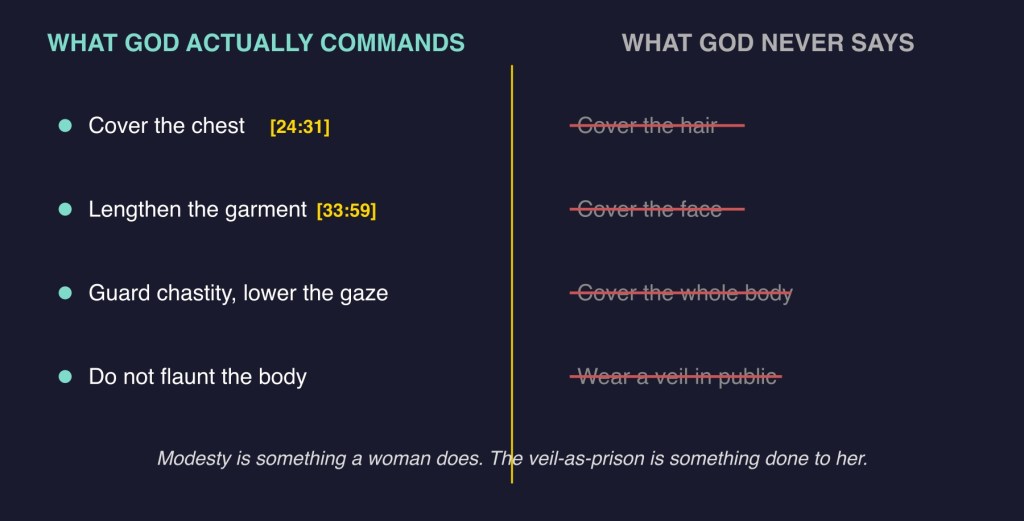
[24:31] “And tell the believing women to subdue their eyes, and maintain their chastity. They shall not reveal any parts of their bodies, except that which is necessary. They shall cover their chests, and shall not relax this code in the presence of other than their husbands, their fathers, the fathers of their husbands, their sons, the sons of their husbands, their brothers, the sons of their brothers, the sons of their sisters, other women, the male servants or employees whose sexual drive has been nullified, or the children who have not reached puberty. They shall not strike their feet when they walk in order to shake and reveal certain details of their bodies. All of you shall repent to God, O you believers, that you may succeed.”
The single concrete instruction about covering in this verse is unmistakable: “They shall cover their chests.” The Arabic word rendered here is khimar — a garment, a cover, a shawl — and the command is to draw it over the juyub, the bosom or chest. The grammatical object of the verb “cover” is the chest. It is not the head. It is not the hair. It is not the face. The verse was revealed in a context where women already wore loose head-cloths but left the neckline and chest exposed; the instruction corrects the exposed area. To read “cover your chests” as “cover your hair and face and entire body” is not translation. It is invention laid on top of the text.
The Words That Are Simply Not There
This is worth stating as bluntly as possible, because the entire global edifice of compulsory veiling rests on the opposite assumption. Search the Final Testament from the first chapter to the last. The instruction “cover your hair” does not appear. The instruction “cover your face” does not appear. The instruction “cover your whole body” or “wear a sheet over yourself in public” does not appear. The only garment-related commands given to women are to guard their chastity, to cover the chest, to not flaunt the body’s “details” through provocative movement, and — in one other verse — to lengthen the garment for modesty. That is the totality of the divine dress code.
God even legislates a fascinating detail: women should “not strike their feet when they walk in order to shake and reveal certain details of their bodies.” Think about what this implies. The concern of the verse is the deliberate, provocative display of the body’s contours — not the mere visibility of a woman as a human being in public. A code obsessed with the deliberate jangling of anklets to draw sexual attention is plainly not the same code that demands a woman erase herself entirely from sight. The Quran regulates modesty of intention and presentation. It does not demand the disappearance of the woman.
Lengthen the Garment — A Mark of Dignity, Not a Cage
The second and final dress verse confirms the same principle and adds the reason behind it. God addresses the prophet and tells him to convey a simple instruction to the believing women:
[33:59] “O prophet, tell your wives, your daughters, and the wives of the believers that they shall lengthen their garments. Thus, they will be recognized (as righteous women) and avoid being insulted. God is Forgiver, Most Merciful.”
Again the command is concrete and limited: lengthen the garment. Make the outer dress longer, more covering, more dignified than the scant clothing of the immodest. And God supplies the purpose explicitly — so that righteous women “will be recognized” and protected from harassment. The goal is recognition and safety, achieved through dignified length. There is no mention here of hair, of face, of veiling the head, of a tent of cloth from crown to ankle. A longer garment is a longer garment. The verse that the entire veil industry leans on, when read in God’s own words, asks only that a believing woman dress with covering dignity so that she is known and left in peace.
When you place [24:31] and [33:59] side by side, the divine dress code for women is complete and humane: maintain chastity, lower the gaze, cover the chest, do not flaunt the body provocatively, and wear a garment of dignified length. Every one of these is a principle of modesty that a woman can fulfil while her face is seen and her hair is uncovered. Modesty, in God’s law, is something a woman does. The veil-as-prison is something that is done to her.
Part 3: Innovation Is the Banner of Satan
God Alone Decrees What Is Lawful and Unlawful
Here we arrive at the heart of the matter. Even if someone concedes that the Quran does not explicitly command hair and face covering, they may argue it is a praiseworthy extra — a voluntary going-above-and-beyond. But the Final Testament closes that door completely. In the religion of God, you do not earn merit by adding obligations He never legislated. You commit a grave offence. The exclusive right to declare any act lawful or unlawful, mandatory or forbidden, belongs to God alone, and He exercises that right through a book He insists is already complete.
[6:114] “Shall I seek other than God as a source of law, when He has revealed to you this book fully detailed? Those who received the scripture recognize that it has been revealed from your Lord, truthfully. You shall not harbor any doubt.”
If the book is “fully detailed,” then the absence of a command to veil the hair and face is not an oversight to be corrected by scholars and clerics. It is a deliberate divine silence — a freedom God intentionally left open. To rush in and fill that silence with a binding rule is to appoint oneself “other than God as a source of law,” the precise act this verse forbids. The clerics who declared the head-cover obligatory did not discover a hidden command. They manufactured one, and in doing so they answered God’s rhetorical question — “Shall I seek other than God as a source of law?” — with a defiant yes.
Who Dared Prohibit the Things God Made Lawful?
The Quran goes further still. It treats the prohibition of permitted things as an act of cosmic arrogance, a usurpation of divine authority. When religious authorities forbid a woman from showing her hair or her face — things God never forbade — they are doing exactly what this verse condemns:
[7:32] “Say, “Who prohibited the nice things God has created for His creatures, and the good provisions?” Say, “Such provisions are to be enjoyed in this life by those who believe. Moreover, the good provisions will be exclusively theirs on the Day of Resurrection.” We thus explain the revelations for people who know.”
A woman’s hair, her face, her natural appearance in the light of day — these are among “the nice things God has created.” God’s challenge rings across the centuries: Who prohibited them? Who gave any cleric, any jurist, any morality officer the authority to take what God left free and stamp it forbidden? The answer the Quran gives elsewhere is chilling: those who do this are following idols. They “decree for them religious laws never authorized by God” [42:21]. Every fabricated obligation is, in effect, a second god enthroned beside the One — a human or institutional authority claiming the legislative power that belongs to God alone.
Do Not Say “This Is Lawful and This Is Unlawful”
And then comes the verse that names the crime with absolute clarity. To declare something lawful or unlawful on God’s behalf, without His authorization, is to fabricate a lie and attribute it to God — and the Quran promises that those who do this will never succeed:
[16:116] “You shall not utter lies with your own tongues stating: “This is lawful, and this is unlawful,” to fabricate lies and attribute them to God. Surely, those who fabricate lies and attribute them to God will never succeed.”
This is the verse that turns the entire veil debate on its head. The believer who declines to veil her hair is not the one taking a risk with God; she is simply living within the freedom He gave her. It is the one who proclaims “the hijab is unlawful to abandon, the niqab is mandatory, the uncovered woman is sinful” who stands exposed by [16:116]. They have taken their own tongue, declared a man-made rule lawful and its absence unlawful, and stitched it onto God’s religion as though He had said it. This is what the messenger called a banner of Satan: not a sin of the flesh, but the deeper sin of forgery — adding to God’s perfect, complete, fully detailed law and calling the addition divine. The forced veil is not a higher piety. It is a fabricated prohibition wearing the costume of devotion.
Part 4: How the Veil Crept In — A History of Borrowed Cloth
An Elite Custom, Not a Revelation
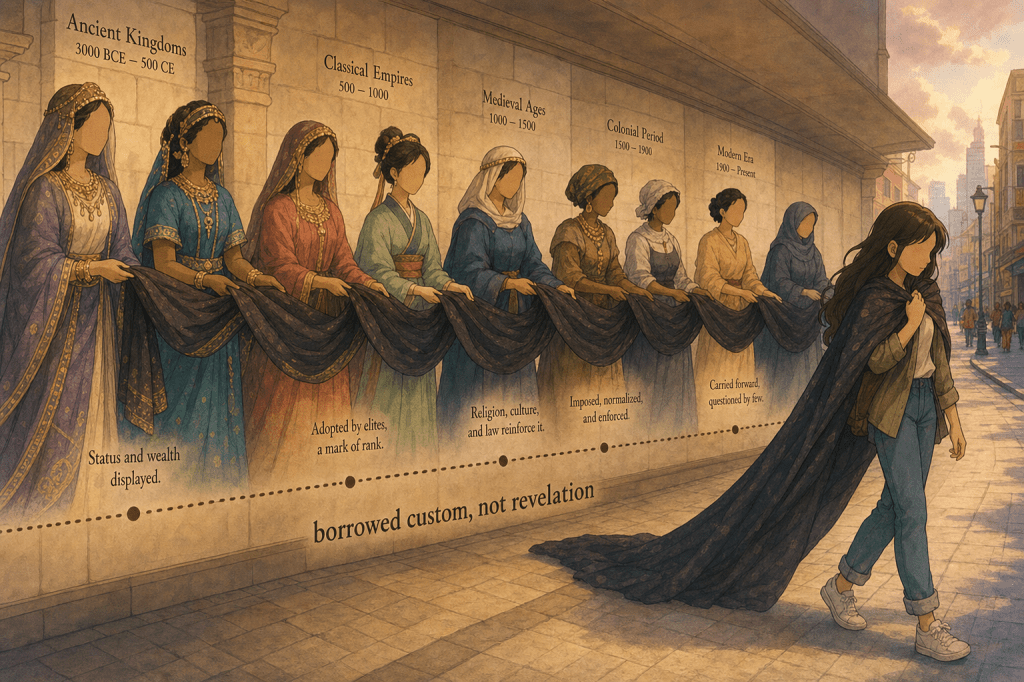
If the Quran never commanded the veil, where did the global obligation come from? The honest answer, traced through history, is that it came from everywhere except revelation. The full-body veiling and seclusion of women was a status marker of the ancient Near East long before the Quran was revealed. Assyrian law from the second millennium before the common era already restricted the veil to respectable upper-class wives and explicitly forbade slave women and prostitutes from wearing it — the veil was a badge of class privilege and male ownership, not a sign of God-consciousness. In the Persian and Byzantine empires that bordered Arabia, the secluded, veiled aristocratic woman was a symbol of wealth and honour, a sign that her household was rich enough that she never had to labour in public view.
When the early empire of the self-described Muslims expanded into these conquered Persian and Byzantine territories, it absorbed their elite customs along with their lands. The seclusion and veiling of women, originally the luxury of foreign aristocracies, was gradually adopted, theologised, and then projected backwards onto the religion as though it had always been a divine command. What began as a borrowed marker of social class was slowly reclassified as an act of worship. The cloth was foreign. The status anxiety was ancient. Only the religious label was new.
Codified Through Narrations, Not Through God’s Book
The mechanism by which this borrowed custom was welded onto the religion has a name, and it is the same mechanism that corrupted countless other practices: the body of fabricated narrations and traditions attributed to the prophet generations after his death. The Quran’s clean, limited instruction — cover the chest, lengthen the garment — was buried under layer upon layer of narration-based rulings specifying exactly how much of a woman must vanish: the hair, the neck, the ears, the wrists, the ankles, and in the harshest schools the face and hands as well. None of this granular legislation exists in the Final Testament. All of it was sourced from narrations and the jurists who systematised them — the very secondary sources the Quran warns against treating as a parallel revelation.
This matters because God explicitly condemns those who “follow idols who decree for them religious laws never authorized by God” [42:21]. The narration-based veil laws are precisely such unauthorized decrees. The messenger Rashad Khalifa identified this corruption at its source. Discussing the resurrection chapter and the buried-girl verses, he pointed straight at the religious culture that grew up around fabricated tradition and observed how they “make up stories” and harbour “this severe complex” about women — a culture so distorted that the mere sight of a woman’s hair in a place of worship sends its adherents fleeing (at 58:46). The veil obligation was never God’s word. It was the sediment of empire and narration, mistaken for revelation.
Part 5: The Messenger’s Verdict — Rashad Khalifa on the Innovation
Appendix 33: Forced Head-Covers Listed as a Satanic Innovation
The connection between forced covering and innovation is not an inference we are imposing on the messenger’s teaching; he wrote it down explicitly. In Appendix 33 of Quran: The Final Testament, titled “Why Did God Send a Messenger Now?”, Rashad Khalifa catalogued the specific innovations of fabricated tradition that corrupted the religion of submission and provoked God to send a purifying messenger. Among that list of satanic additions, he named — in plain words — the oppression of women through compulsory dress:
“Oppressing women and forcing them to wear head-covers and unreasonable clothes; and depriving them of all rights in marriage, divorce, inheritance, etc.”
This single entry is decisive. Rashad did not file the head-cover under “recommended modesty” or “cultural preference.” He filed it under innovations that corrupted the religion — the same category as the fabricated rituals and man-made prohibitions that the messenger spent his life exposing. And he cited the Quranic principles these innovations violate: the equitable rights of women in [2:228], the equality of male and female before God in [3:195], the command to treat women nicely and never by force in [4:19], the distinct God-given qualities of each in [4:32], and the alliance of believing men and women in [9:71]. Forcing the head-cover is, by the messenger’s own reckoning, a banner of Satan flown over the religion of God.
The Equality the Veil Erases
Look at the verses Rashad cited and the picture becomes unmistakable. God does not place the woman beneath the man as a body to be managed and hidden. He declares them spiritual equals and mutual allies:
[3:195] “Their Lord responded to them: “I never fail to reward any worker among you for any work you do, be you male or female—you are equal to one another…””
[9:71] “The believing men and women are allies of one another. They advocate righteousness and forbid evil, they observe the Contact Prayers (Salat) and give the obligatory charity (Zakat), and they obey God and His messenger. These will be showered by God’s mercy. God is Almighty, Most Wise.”
Allies do not bury one another. Equals do not erase one another from public sight. The Quran commands that women be treated nicely and never coerced — “You shall treat them nicely” [4:19] — and it grounds all human worth in righteousness alone, not in how thoroughly a person is hidden: “The best among you in the sight of God is the most righteous” [49:13]. A regime that strips a woman of the freedom God gave her, that polices her hair as though it were a weapon, has inverted the entire Quranic order. It has taken God’s ally and treated her as God’s problem. That inversion, Rashad taught, is innovation — and innovation is the banner under which Satan marches into the religion.
Part 6: “Buried Alive” — The Messenger Names the Connection
The Same Mentality That Killed the Baby Girls
Now we reach the teaching that gives this article its title. In his study of the resurrection chapter — the very chapter that asks the buried girl “for what crime was she killed” — Rashad Khalifa drew the line directly from the ancient grave to the modern veil. Speaking of the religious culture built on fabricated tradition, and of its visceral horror at the sight of an uncovered woman, he said:
“I call it a cultural disaster. This is why when they walk into this mosque, they are shocked to see a woman’s hair. They run away. They cover up the woman, and they regard them in such a disastrous way that they used to kill the baby girls in the past.”
He said this at the 57:46 mark of the recorded study (at 57:46). Read it again and feel the weight of the claim. The messenger is not saying the forced veil is merely like female infanticide in some loose, rhetorical sense. He is saying it springs from the same mentality — the same revulsion at the female, the same compulsion to make her disappear, the same conviction that her visibility is a disaster to be corrected. The men who flee at the sight of a woman’s hair are the cultural descendants of the men who buried their daughters in the dust. The shovel became a sheet, but the contempt is identical.
The Living Burial
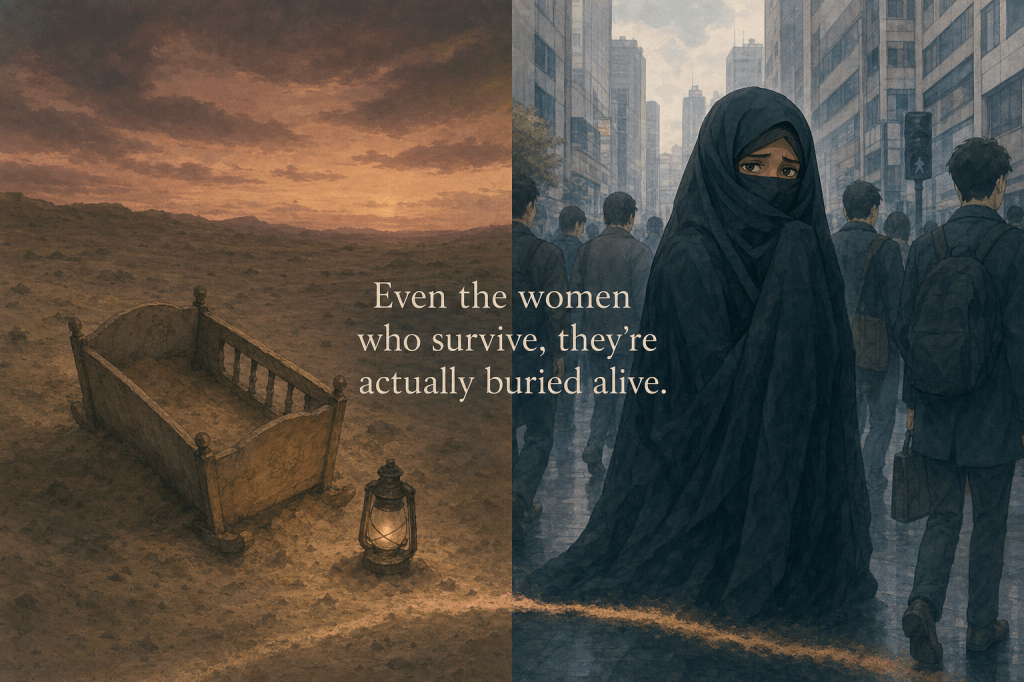
And then the messenger made the connection explicit, in words that name the veil for exactly what it is. Having reflected on the slain infant girls of [81:8-9], he turned to the women who were permitted to live, and delivered the verdict that titles this piece:
“Even the women who survive, they’re actually buried alive, the way they demand that they’re covered up this way.”
This statement, delivered at 1:01:22 of the study (at 1:01:22), is the thesis of this entire article compressed into a single sentence. The girl in [81:8] was buried in sand. Her surviving sisters are buried in cloth. Both burials erase the woman from the world of the living — one by stopping her heart, the other by extinguishing her face, her voice in public life, her freedom to walk in the light as a recognized human being. God gave the slain girl a voice at the resurrection so that her crime-less death would be exposed forever. The messenger, reading that same chapter, heard the muffled voices of the living buried and called the demand to cover them what it is: a living grave.
Part 7: Iran — The State as Gravedigger
A Whole Society Forced Into the Grave
What happens when the mentality of the buried girl captures not just a family or a sect but an entire state apparatus? You get a country where the living burial of women is written into law and enforced by police. In the same study, Rashad turned to a first-hand report from a Submitter named Ismail who had just returned from Iran, and asked how the streets there treat women. The answer was stark: “They have to be covered up.” The messenger then relayed Ismail’s observation that this was not a freely chosen piety but a resented imposition, met with quiet rebellion that the regime crushes:
“Ismail says that there is rebellion against this forced dress in Iran, but they can do nothing about it if they speak. So it is a terrible oppression. This is a form of burial, of being buried alive.”
Rashad delivered this assessment at roughly 1:01:30 to 1:02:32 of the recording (from 1:01:30). His chosen words are precise and damning: a “terrible oppression,” “a form of burial, of being buried alive.” This is not the language of a man describing an optional act of devotion. It is the language of a man describing a crime against humanity dressed in religious clothing — the institutionalisation, by a self-described Islamic state, of the very mentality God condemned in [81:8-9].
Rebellion Is the Proof
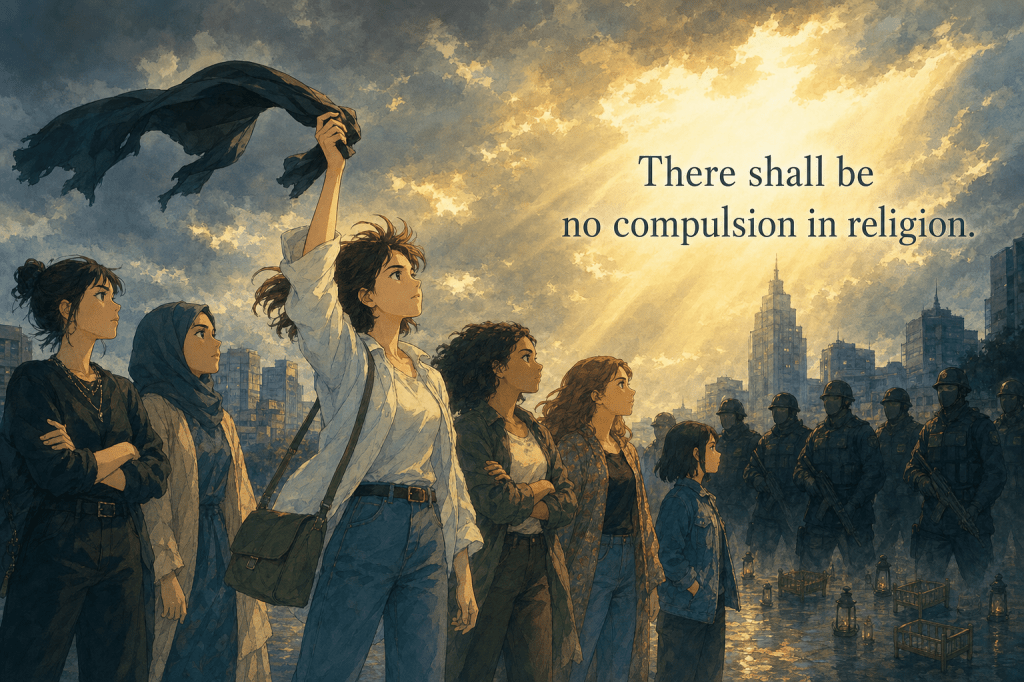
Consider the most telling detail in the messenger’s report: there is rebellion against the forced dress. The women of Iran do not experience compulsory covering as a beloved expression of their faith that they would freely choose. They experience it as a cage, and they push against the bars at the risk of arrest, beating, and worse. The existence of morality police, of detentions for “improper” covering, of women losing their lives in custody for a strand of visible hair, is the loudest possible confession that this is compulsion, not religion. Where God said “There shall be no compulsion in religion,” the gravedigger-state says obey or be buried. The two cannot both be speaking for God.
And here the buried-girl motif completes its circuit. The pre-Islamic father buried his daughter to erase a perceived shame and silence her forever. The modern theocratic state covers its daughters by force to erase their visible presence and silence their dissent — and when they refuse to stay silent, it buries some of them for real. The continuity is exact. The Quran gave the slain girl a question that will ring out at the end of the world: “For what crime was she killed?” Every woman dragged away by a morality patrol, every woman who dies for showing her hair, is asking that same question now, in this life. The forced veil is not the answer to immodesty. It is the latest uniform of the oldest crime against women.
Part 8: Modesty Is Chosen, Never Compelled
The Difference Between Worship and Coercion
Nothing in this article is an attack on modesty. Modesty is a genuine Quranic value, commanded for both men and women, and a woman who freely chooses to cover more of herself — even her hair — as a personal expression of devotion commits no sin whatsoever. The Quran leaves her free to do so, just as it leaves her free not to. The entire argument turns on a single word: chosen. Worship, by its nature, must be voluntary, because a forced act of devotion is a contradiction in terms. God Himself, who could compel the entire human race to believe in an instant, refuses to do so, because compelled faith is worthless to Him.
This is why the forced veil is spiritually self-defeating even on its own terms. A woman compelled by a morality officer to cover her hair earns no merit before God, because she has not chosen anything — she has merely obeyed a man with the power to punish her. The coercion empties the act of all the devotion that would have given it value. The state that forces the veil does not produce a single additional act of worship; it produces only fear, resentment, and rebellion. Meanwhile it commits the grave sin of fabricating a divine command, flying the banner of Satan over a populace it claims to be guiding to God. Compulsion does not add piety to the world. It subtracts freedom and adds forgery.
God Honours the Woman as a Soul, Not a Shape
When you strip away the borrowed cloth and the fabricated narrations, the Quran’s view of woman shines through with startling dignity. She is not a temptation to be neutralised by erasure. She is a soul, equal in worth and reward to the man, an ally in righteousness, and a being whose value God measures by her piety and never by her invisibility. The same God who will demand justice for the buried infant girl declares that the female worker is rewarded exactly as the male, that believing men and women are one another’s protectors, and that the only ranking He recognises is the ranking of righteousness.
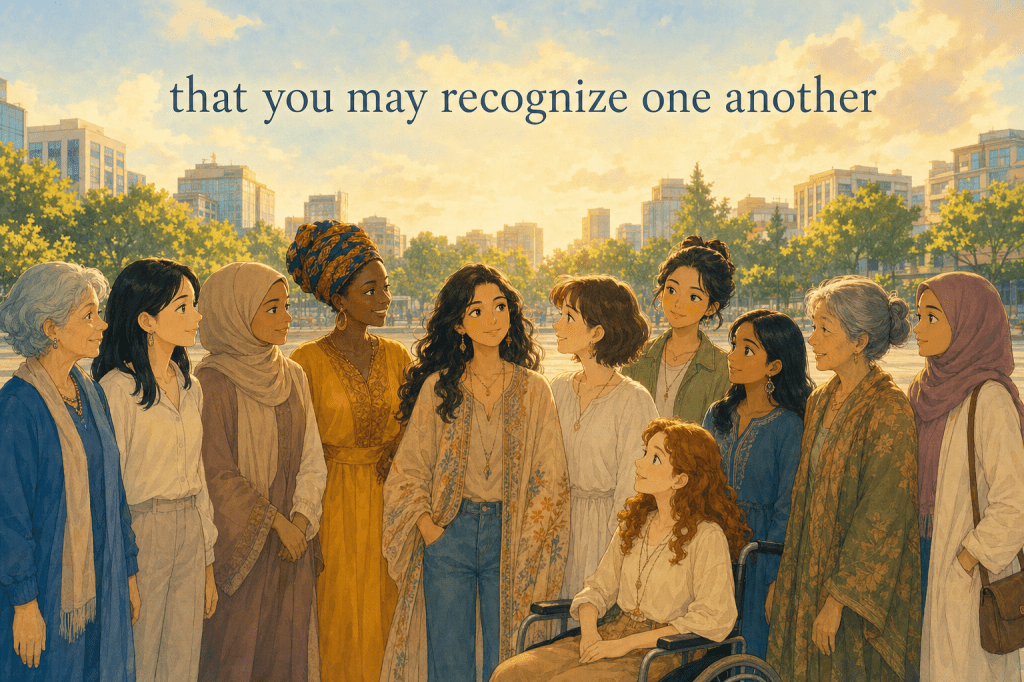
[49:13] “O people, we created you from the same male and female, and rendered you distinct peoples and tribes, that you may recognize one another. The best among you in the sight of God is the most righteous. God is Omniscient, Cognizant.”
“That you may recognize one another.” Recognition — the very thing the all-enclosing veil makes impossible. God created human variety so that we would know each other, see each other, recognise the soul in the face of our neighbour. A society that wraps its women into anonymous identical shadows has defeated this divine purpose at the most basic level: it has made half its members un-recognisable, un-seeable, un-knowable in the public square. True modesty, freely chosen, never required a woman to become invisible. It only ever asked her to carry herself with dignity. The banner of Satan added the rest.
Part 9: Lifting the Banner — The Return to God’s Simple Code
Two Sources of Law, Two Destinies
Every dispute in the religion of submission ultimately reduces to one question: from whom will you take your law? The Quran allows only one answer. Either your code of life comes from God, through His complete and fully detailed book, or it comes from “other than God” — from clerics, jurists, narrators, states, and the accumulated anxieties of dead empires. There is no third source. The forced veil forces this choice into the open, because it does not come from the book. It comes from everywhere else. To uphold it as a divine obligation is to seat a second legislator beside God.
[6:114] “Shall I seek other than God as a source of law, when He has revealed to you this book fully detailed? Those who received the scripture recognize that it has been revealed from your Lord, truthfully. You shall not harbor any doubt.”
The Submitter’s path is therefore clear and clean. We do not need to consult fourteen centuries of accumulated narration to learn how a woman should dress, any more than we need it to learn how to pray or fast. We go to the book, and the book says: maintain chastity, lower the gaze, cover the chest, do not flaunt the body, lengthen the garment. Five clear principles, all rooted in dignity, all fulfillable in freedom, none requiring the erasure of a single woman’s face. Anything beyond that, presented as a binding command from God, is the addition the Quran calls a lie attributed to Him — and we reject it not out of laxity but out of reverence for the completeness of His law.
To Lift the Veil-as-Banner Is to Honour God
Lifting the banner of Satan does not mean despising the woman who covers. It means refusing to let any human authority counterfeit God’s signature. It means restoring to women the freedom God gave them and never authorized any man to take away. It means recognising that the demand to bury a woman in cloth, far from being an act of devotion, is a continuation of the oldest contempt — the contempt that once buried her in sand. And it means returning, with relief and gratitude, to the simple and humane modesty code that God actually revealed, a code a woman fulfils with her face in the sunlight and her dignity intact.
The messenger Rashad Khalifa spent his life pulling down these banners — the fabricated prayers, the invented prohibitions, the man-made rituals — and restoring the pure, complete religion of Abraham. The forced veil is one banner among many, but it is a particularly cruel one, because its victims are not abstractions; they are living women, half of humanity, buried alive in plain sight. To take down this banner is to answer God’s question in [81:9] before it is ever asked again. It is to ensure that no woman, living or dead, must wait until the end of the world to be seen, heard, and recognised as the equal soul God created her to be.
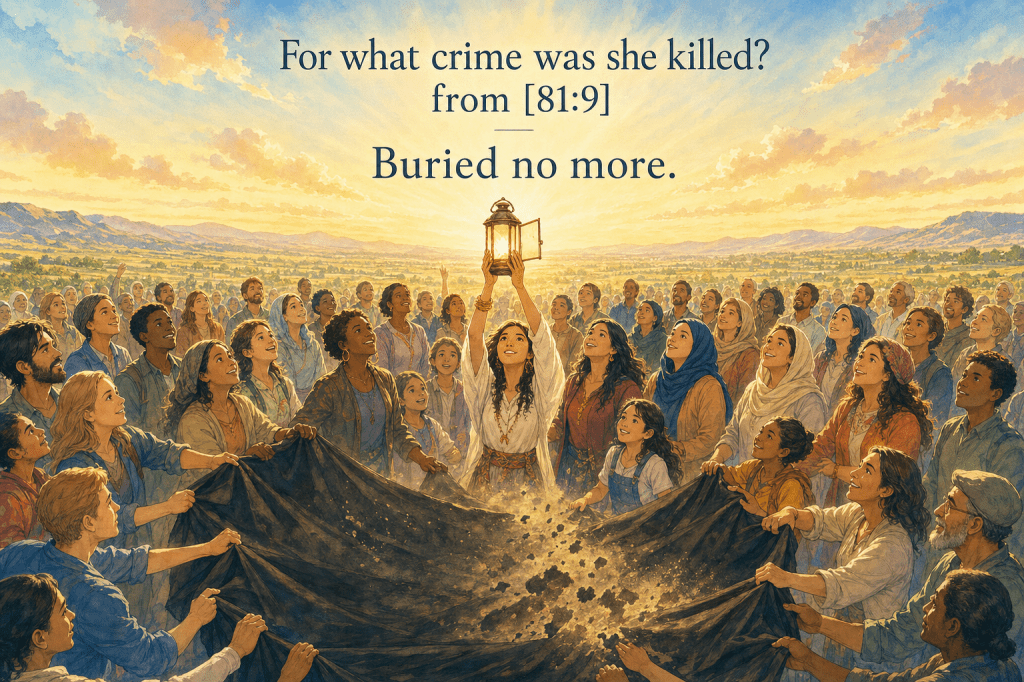
Conclusion: She Will Be Asked, and So Will They
We began with a question God will ask at the end of the world, and we end with the same question, because it has never stopped being relevant. “For what crime was she killed?” The pre-Islamic father had no answer, because there was no crime — only shame, only the conviction that a daughter’s existence was a thing to be buried. The Quran exposed that mentality and condemned it forever, giving the silenced girl a voice and a verdict. But the mentality did not die. It changed its instrument from sand to cloth and its name from custom to religion, and it now buries living women across half the world under the banner of a God who never commanded it.
The scripture is unambiguous, and we have let it speak for itself. The Quran commands modesty and nothing more: cover the chest [24:31], lengthen the garment [33:59]. It never once commands a woman to cover her hair, her face, or her body. To add such a command and brand it divine is to do exactly what God forbids — to seek “other than God as a source of law” [6:114], to prohibit “the nice things God has created” [7:32], to “fabricate lies and attribute them to God” [16:116]. The messenger Rashad Khalifa named the forced head-cover for what it is: an innovation, an oppression, a banner of Satan, and — in his unforgettable phrase — a way of burying living women alive. Iran shows us the banner raised to the level of the state, and the rebellion of its women shows us, beyond any doubt, that this is compulsion and not faith.
So the question turns. At the resurrection, the buried girl will be asked for what crime she was killed — and standing beside her will be those who buried her sisters in cloth and called it the will of God. They too will be asked: by what authority did you prohibit what God made free? By what right did you forge a command and stitch it onto His perfect book? The Submitter need not wait for that day to choose sides. We choose the freedom God gave, the dignity He decreed, and the simple modesty He actually revealed. We lift the banner of Satan off the bodies of women, and we let them walk, at last, in the light — recognised, equal, and buried no more.


 Quran Only Studies
Leave a comment