
Introduction: The Word That Is Stronger Than “Forbidden”
There is a quiet argument that surfaces whenever the subject of intoxicants comes up among people who read the Quran. It goes like this: the Arabic verb ḥurrima (حُرِّمَ, “is forbidden”) — the very word God uses to outlaw pork and carrion in [5:3] — is never once applied to alcohol anywhere in the entire scripture. From this silence a conclusion is smuggled in: that alcohol must therefore occupy some softer, greyer, lesser category, a strong suggestion rather than a hard line. This article exists to demolish that conclusion completely. The premise is true; the inference is exactly backwards.
God did not forget to forbid alcohol. He deliberately reached past ḥurrima and chose a heavier word. When you trace what the Quran actually does with intoxicants — across three separate revelations, with the precise verbs and nouns it selects at each stage — you discover that [5:90] carries the single most intensified, escalated, and reinforced prohibition-command in the whole book. Its command verb, فَٱجْتَنِبُوهُ (fajtanibūhu, “you shall avoid them / shun them”), is stronger in its language than even the legendary command God gave Adam: “do not even come near this tree.” The absence of ḥurrima is not a downgrade. It is a substitution upward.
Part One: God’s Three Registers of Forbidding
How the Quran says “no” in three different keys
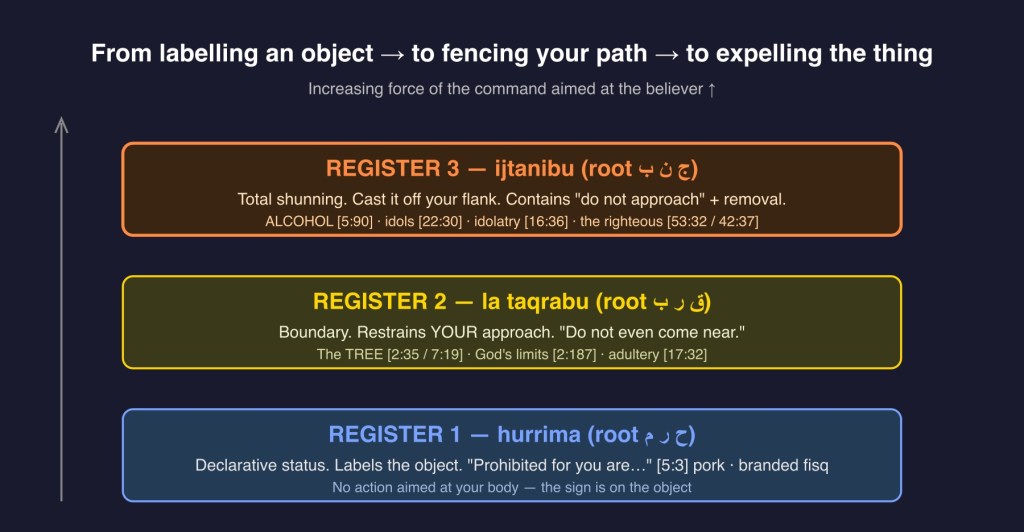
To see why [5:90] stands at the summit, you first have to notice that the Quran does not forbid everything the same way. It has at least three distinct grammatical registers for prohibition, and they are not interchangeable. Each one aims at a different distance from the act, and each one demands a different motion from the believer. Read carelessly in English, they all flatten into “don’t.” Read in the Arabic, they form a clear ladder of force.
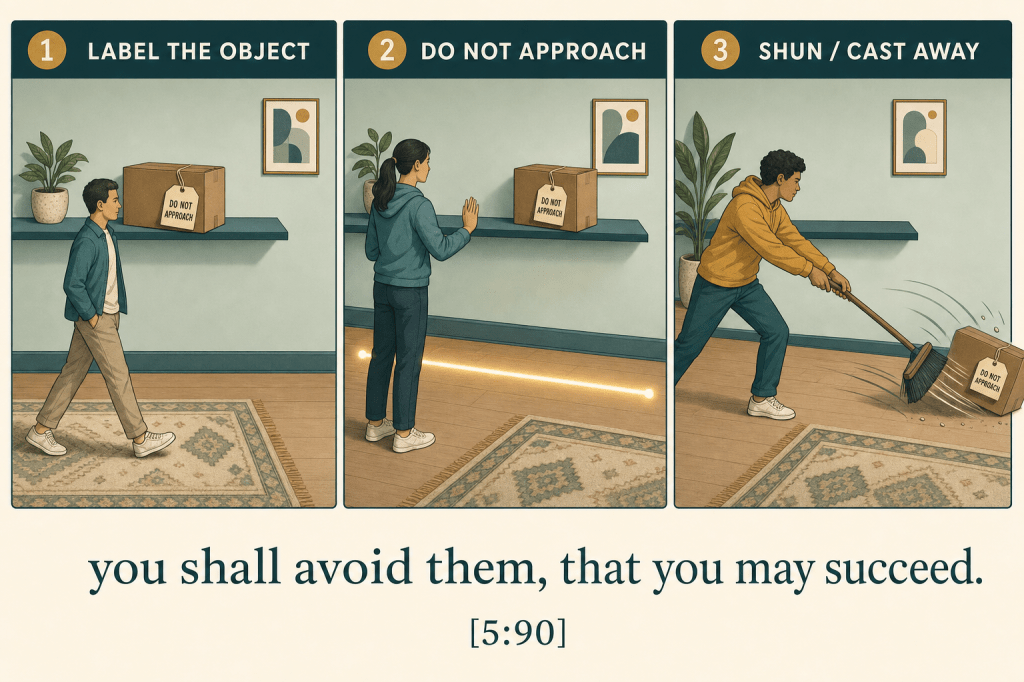
The first register is the declarative status verb حُرِّمَ / حُرِّمَتْ (ḥurrima / ḥurrimat, root ح ر م), the verb of the dietary list in [5:3]. This verb labels a thing’s legal status — it tells you what an object is in the law. It is passive and declarative: “prohibited for you are…” Notice what it does not do. It does not aim an action at your body or order you to move. It posts a sign on the object. The pig is in the forbidden drawer; that is its classification. The verse then brands the violation فِسْق (fisq, “wickedness”), not رِجْس (rijs, “abomination”) — a detail that will matter enormously in a moment.
[5:3] “Prohibited for you are animals that die of themselves, blood, the meat of pigs,* and animals dedicated to other than God… this is an abomination… Today, I have completed your religion, perfected My blessing upon you, and I have decreed Submission as the religion for you…”
The second register is the boundary verb لَا تَقْرَبُوا (lā taqrabū, “do not approach,” root ق ر ب). This is a far more aggressive instruction than ḥurrima, because it does not merely classify the object — it restrains you. It builds a fence at a distance and forbids you to cross it. The thing stays put; you are commanded not to move toward it. This is the verb God uses to fence off the tree from Adam, to fence off adultery in [17:32], to fence off the orphan’s wealth in [6:152], and — decisively — it is the verb God attaches to His own “limits” in [2:187], where the Arabic reads تِلْكَ حُدُودُ ٱللَّهِ فَلَا تَقْرَبُوهَا (tilka ḥudūdu llāhi fa-lā taqrabūhā) — literally “these are God’s limits (ḥudūd), so do not approach them.” The translation renders this idiomatically as “you shall not transgress them,” but the Arabic verb is unmistakably lā taqrabū: God’s boundary-stone verb.
The third register is the total-shunning verb ٱجْتَنِبُوا (ijtanibū, “shun it, cast it away,” root ج ن ب). This is the verb of [5:90]. It is built from the noun جَنْب (janb, “side, flank”) in the reflexive Form VIII, and its literal force is staggering: “put the whole of yourself away from it; drive it off to your own far side.” Where ḥurrima labels an object and lā taqrabū restrains your approach, ijtanibū commands an active, omnidirectional expulsion — you do not merely refrain from walking toward it, you push it off your flank entirely. Logically, ijtanibū already contains “do not approach” and then adds the removal step on top. You cannot shun a thing while also approaching it.
Part Two: The Tree — “Do Not Even Come Near”
The famous archetype of strictness
When people want an example of God’s strictness, they reach instinctively for the tree. And rightly so. Look closely at the command God actually gave Adam: He did not say “do not eat from this tree.” He said وَلَا تَقْرَبَا هَٰذِهِ ٱلشَّجَرَةَ (wa-lā taqrabā hādhihi l-shajara) — “do not even approach this tree.” The prohibition is set one full step back from the act itself. Eating was never the line; nearness was the line. God bars the road that leads to the act, not merely the act.
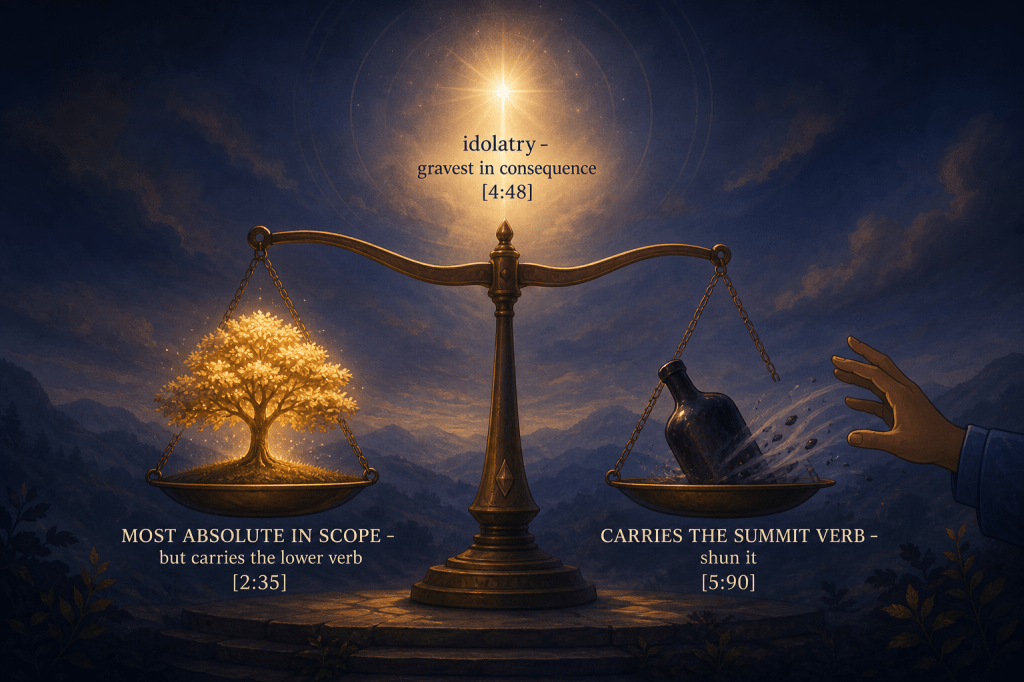
[2:35] “We said, “O Adam, live with your wife in Paradise, and eat therefrom generously, as you please, but do not approach this tree, lest you sin.””
[7:19] “As for you, Adam, dwell with your wife in Paradise, and eat therefrom as you please, but do not approach this one tree, lest you fall in sin.”
This is why “do not even come near” has become, across centuries, the very picture of an uncrossable line. And we can confirm beyond dispute that this is God’s deliberate boundary verb, not a casual phrase, because He uses the identical verb for His own legal limits. In [2:187], immediately after laying down the rules of fasting and marital intimacy, God seals them with تِلْكَ حُدُودُ ٱللَّهِ فَلَا تَقْرَبُوهَا — “these are God’s limits, do not approach them.” The same root ق ر ب that fences the tree fences every limit God draws. It is the architecture of His boundaries.
So lā taqrabū — “do not even come near” — must be the absolute ceiling of God’s restraint, the strongest a prohibition can possibly be phrased. Surely nothing climbs higher than forbidding you even to draw close. Hold that assumption firmly in mind. Now watch what God does with intoxicants.
Part Three: The Decisive Proof — God Climbs ABOVE the Tree’s Verb
Alcohol is the only prohibition God legislates in three escalating stages
Here is a fact about the Quran that, once seen, cannot be unseen. Of all the things God prohibits, intoxicants are the only subject He legislates across three separate, escalating revelations — and at each stage He upgrades the command to a stronger verb. Pork is forbidden once, flatly. Adultery is fenced once. Theft is ruled once. But alcohol receives a staged, deliberate, rising legislative sequence, and the direction of that rise is the entire proof.
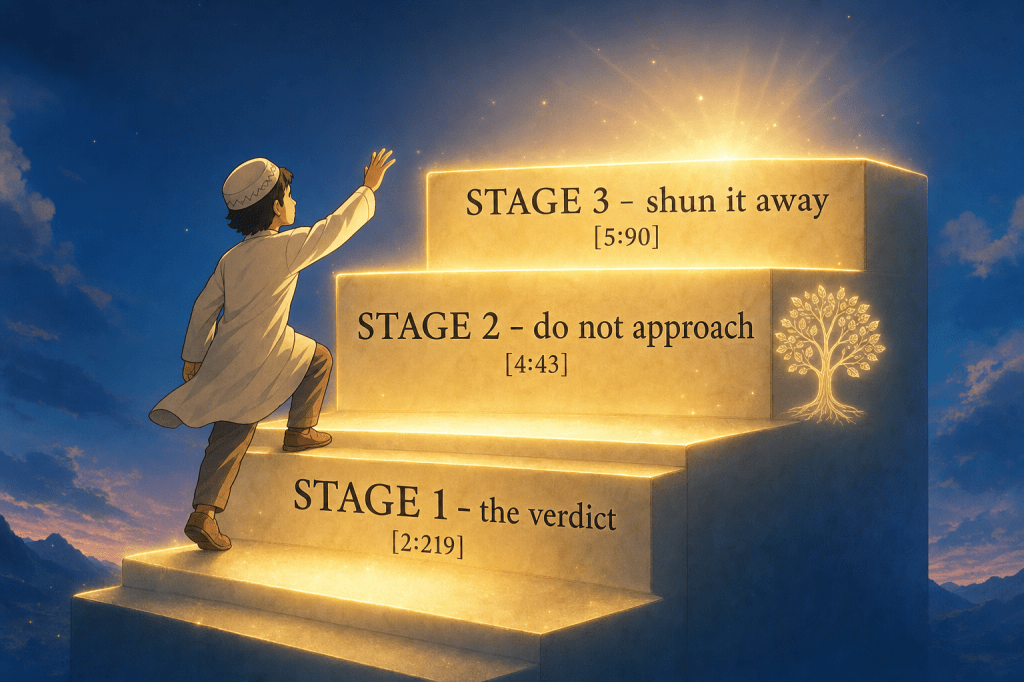
Stage One — the moral verdict, with no command verb at all. The first revelation on the subject does not yet issue an order. It delivers a judgment and lets it land. In [2:219] God weighs intoxicants and gambling on a scale and announces the result: their harm crushes their benefit. There is no imperative here — no “do,” no “do not.” It is the verdict that sets up everything to come.
[2:219] “They ask you about intoxicants and gambling: say, “In them there is a gross sin, and some benefits for the people. But their sinfulness far outweighs their benefit.” …”
Stage Two — the boundary verb, the exact verb of the tree. The second revelation, [4:43], finally issues a command — and the command is لَا تَقْرَبُوا (lā taqrabū), the very same verb God used for Adam and the tree. “Do not approach the Contact Prayers while intoxicated.” This is a partial, situational boundary: it fences a specific zone (the prayer) against a specific state (intoxication). At this stage, God places alcohol at exactly the level of the tree — “do not approach.” The same root ق ر ب. The same ceiling.
[4:43] “O you who believe, do not observe the Contact Prayers (Salat) while intoxicated, so that you know what you are saying…”
Stage Three — total shunning, a verb the tree never received. Then comes the final revelation, [5:90], and God does something He never does for the tree: He climbs above the boundary verb. He abandons lā taqrabū and reaches for فَٱجْتَنِبُوهُ (fajtanibūhu) — total expulsion. The prohibition is no longer “do not approach the prayer while drunk”; it is “shun the thing itself, drive it off your flank, that you may succeed.”
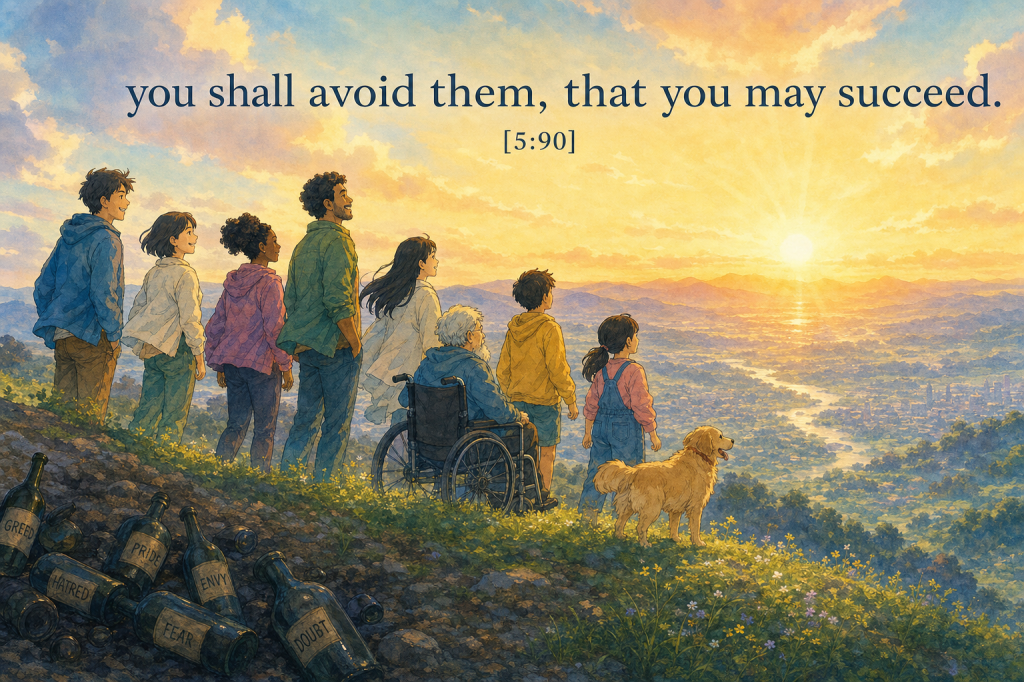
[5:90] “O you who believe, intoxicants, and gambling, and the altars of idols, and the games of chance are abominations of the devil; you shall avoid them, that you may succeed.”
This is the irrefutable internal point, and it is internal to the Quran’s own legislation: God Himself moved alcohol up from the tree’s verb to the shunning verb. [4:43] placed it at lā taqrabū; [5:90] raised it to ijtanibū. The Quran’s own legislative sequence therefore ranks ijtanaba above taqraba for this subject. The verb that was the absolute ceiling for the tree turns out to be merely the middle rung of alcohol’s ladder. The tree’s command was where alcohol’s escalation paused on its way up.
One honest precision, because precision is what makes this proof unbreakable. This is not the claim that the bare root ج ن ب always outranks ق ر ب as dictionary words. The Quran uses ijtanibū even for mere “suspicion” in [49:12] (“you shall avoid any suspicion”), and it uses lā taqrabū for the gross sin of adultery in [17:32]. Verbs take their weight from context. The proof here is not a lexical ranking of two words in the abstract — it is the escalation within alcohol’s own three stages, where God demonstrably treated lā taqrabū as a stepping-stone and ijtanibū as the summit. That escalation is the scripture’s own internal testimony, and it is decisive.

Part Four: The Company It Keeps — Filed With Idol-Worship
The exact verb and exact noun belong to the register of idolatry
If the escalation proves how high God lifted alcohol, the next observation proves into which drawer He lifted it. The command in [5:90] is not a lonely, one-off phrasing. The pairing of the verb ijtanibū with the noun rijs (“abomination”) is a fixed collocation in the Quran — and the other place it appears is the command to shun idols. Look at [22:30], where God says فَٱجْتَنِبُوا ٱلرِّجْسَ مِنَ ٱلْأَوْثَٰنِ (fajtanibū l-rijsa mina l-awthān) — “shun the abomination of idols.” It is the same verb (ج ن ب) governing the same noun (رِجْس) that [5:90] aims at intoxicants.
[22:30] “…You shall avoid the abomination of idol worship, and avoid bearing false witness.”
And this is no isolated overlap. The same shunning verb is the verb of the universal message every messenger was sent to deliver. In [16:36], God summarizes the mission of every prophet to every community in two commands: worship God, and shun idolatry — ٱعْبُدُوا ٱللَّهَ وَٱجْتَنِبُوا ٱلطَّٰغُوتَ (uʿbudū llāha wa-jtanibū l-ṭāghūt). To shun is the verb of pure monotheism itself.
[16:36] “We have sent a messenger to every community, saying, “You shall worship God, and avoid idolatry.” …”
The same verb, moreover, is what defines the righteous. Twice God describes the saved by this single action: ٱلَّذِينَ يَجْتَنِبُونَ كَبَٰٓئِرَ ٱلْإِثْمِ (alladhīna yajtanibūna kabā’ira l-ithm) — “those who shun the cardinal sins” — in both [53:32] and [42:37]. The character of a believer, in God’s own description, is literally the person who performs ijtanibū upon the great sins. Alcohol is named with that exact verb.
[53:32] “They avoid gross sins and transgressions, except for minor offenses…”
[42:37] “They avoid gross sins and vice, and when angered they forgive.”
Then God welds the two roots together with His own hand. In [4:31] He writes إِن تَجْتَنِبُوا كَبَآئِرَ مَا تُنْهَوْنَ عَنْهُ (in tajtanibū kabā’ira mā tunhawna ʿanhu) — “if you shun the great sins that you are forbidden.” Here the shunning verb (ج ن ب) directly governs “what you are forbidden,” and “forbidden” here is the root ن ه ي — the root of nahy, the Arabic word for “prohibition” itself. The Quran’s own vocabulary equates the thing you must ijtanibū with the thing you are prohibited from. That settles it grammatically: ijtanibū carries the full force of prohibition, by God’s own definition.
[4:31] “If you refrain from committing the gross sins that are prohibited for you, we will remit your sins, and admit you an honorable admittance.”
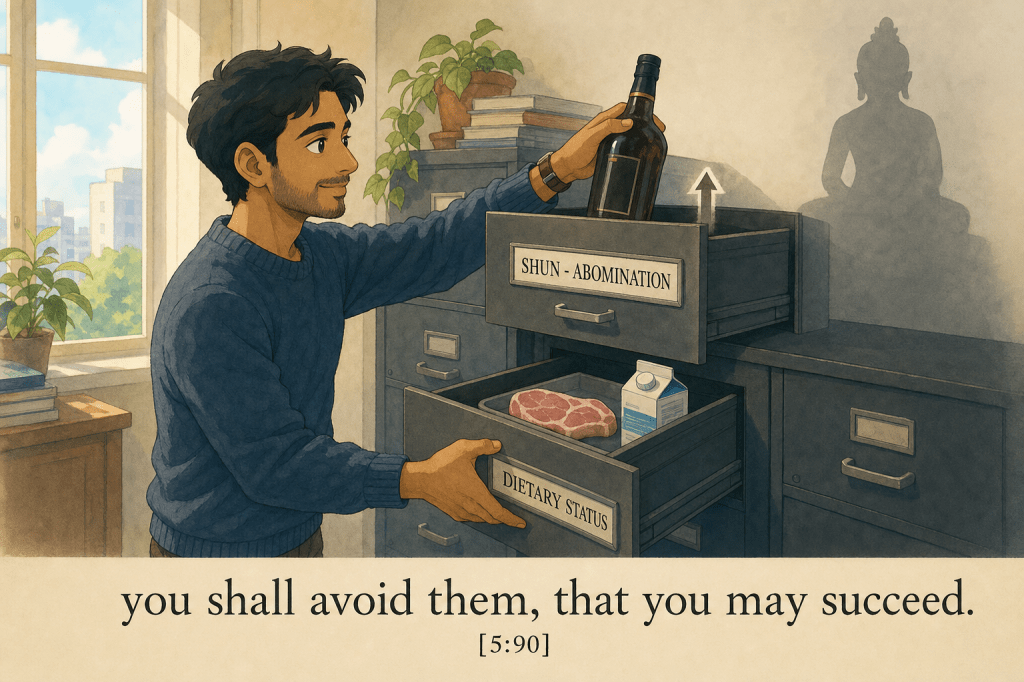
Now the objection collapses entirely. “Alcohol isn’t really forbidden because the Quran never says ḥurrima for it” — the very absence the objector points to is the proof against him. God did not classify alcohol with the food-status verb (ḥurrima) and brand it mere fisq the way He did the pig in [5:3]. He pulled it out of the dietary-status drawer altogether and filed it in the idolatry-shunning drawer: the ijtanibū/rijs register, the register of shirk. The missing ḥurrima is not a softer label. It is a harder one. Alcohol does not sit beside the pork chop; it sits beside the idol.
This is precisely how the messenger Rashad Khalifa explained it. Confronted in a 1989 study session by a man insisting that the word ḥarām is the strongest term and that alcohol, lacking it, must be a “different category,” Rashad answered directly (at 40:43): “God calls alcohol and gambling in Arabic, rijsun min amal al shaytan. It is an abomination and the work of the devil. So it is very, very strong prohibition… And then He says, you shall avoid them. That’s a commandment from God.” He had already insisted moments earlier (at 40:01): “God uses the strongest prohibition in the Quran when it comes to alcohol and gambling.”
Part Five: The Densest Stack of Intensifiers in the Quran
No other single prohibition piles on this much reinforcement
Beyond the escalation and the company it keeps, [5:90] and its companion verse [5:91] carry a concentration of reinforcing language that no other single prohibition in the Quran approaches. Count them. The thing is branded رِجْس (rijs, “abomination”). It is attributed to عَمَلِ ٱلشَّيْطَٰن (“the work of the devil”) — a phrase never used of forbidden food. Your very success is conditioned on avoiding it: لَعَلَّكُمْ تُفْلِحُونَ (“that you may succeed”). And then [5:91] itemizes the precise cost of disobedience — the devil’s aim through intoxicants is to “provoke animosity and hatred among you,” and “to distract you from remembering God, and from observing the Contact Prayers.”
[5:91] “The devil wants to provoke animosity and hatred among you through intoxicants and gambling, and to distract you from remembering God, and from observing the Contact Prayers (Salat). Will you then refrain?”
And then comes the seal that names the entire passage for what it is. The verse closes with فَهَلْ أَنتُم مُّنتَهُونَ (fa-hal antum muntahūn, “Will you then refrain?”) — and that word, muntahūn, is built on the root ن ه ي, the precise root of nahy, the Arabic word for “prohibition” itself. God ends the passage by asking, in effect, “Will you now prohibit-yourselves?” The command literally names itself as the prohibition. Stack it together — abomination + the devil’s work + your success staked on it + named social and spiritual costs + a closing that invokes the very root of the word “prohibition” — and you are looking at the most reinforced single prohibition-command in the scripture. Nothing else is loaded this heavily.
Part Six: Two Honest Limits That Sharpen the Case
Where alcohol is not the absolute maximum — and why that proves the point
A real argument names its own limits, and naming them here only strengthens the verdict. There are two axes on which [5:90] is not the single maximum in the Quran, and an honest submitter should hold both.
The first honest limit: idolatry is graver in consequence. Setting up partners with God — shirk — is the one sin God declares unforgivable if one dies upon it. [4:48] is explicit: God forgives anything but that. So in terms of ultimate consequence, idolatry stands above everything, alcohol included. But notice what that comparison actually does to alcohol’s standing. God did not place intoxicants one notch below the pig; He placed them one notch below the unforgivable sin, sharing the very same shunning verb (ijtanibū) and the very same “abomination” noun (rijs) that He uses for idols. Alcohol sits inside the shirk register — one rung down from the gravest sin in existence, not down in the dietary drawer.
[4:48] “God does not forgive idolatry, but He forgives lesser offenses for whomever He wills. Anyone who sets up idols beside God, has forged a horrendous offense.”
The second honest limit: the tree is more absolute in scope. The tree was a single named object, with no exception clause and an instant penalty — approach it once and you fall. In raw scope, that is more total than the prohibition of intoxicants. But here is the blade of it: the tree, for all its absoluteness, was forbidden with the lower verb — the very lā taqrabū that God treated, in alcohol’s own three-stage legislation, as a mere stepping-stone on the way up to ijtanibū. The most absolute-in-scope prohibition in scripture carries the middle-rung verb. The verb God reserved for the summit, He spent on intoxicants. That contrast does not weaken the case; it is the case.
This is exactly the pairing the messenger drew. Pressed in that same 1989 session on how strong the prohibition of alcohol really is, Rashad reached, unprompted, for the tree (at 36:26): “It’s a very strong prohibition. This is what God told Adam and Eve. God told Adam and Eve, don’t come close to this tree.” He set alcohol and the tree side by side because they belong to the same conversation about the very ceiling of God’s “do not even approach” — and then the scripture itself shows alcohol climbing one rung higher.
Conclusion: The Summit of God’s Forbidding
Strip the question down to what it is really asking — not “which sin has the worst afterlife consequence,” and not “which object is most absolutely sealed,” but “where does God aim the most forceful prohibition-language directly at the believer?” On that axis, the one the objection is actually about, the answer is settled and singular. [5:90] stands at the summit. Even the tree — the archetype of “do not even come near,” the phrase that has meant uncrossable for as long as the story has been told — was forbidden with a verb that God Himself ranked beneath the one He chose to end alcohol’s legislation upon. He started intoxicants at a verdict, raised them to the tree’s own verb, and then climbed past it to total expulsion.
So the next time someone whispers that alcohol “isn’t really forbidden” because the word ḥurrima never touches it, you can answer with the scripture’s own grammar. The missing ḥurrima is not a loophole; it is a promotion. God lifted intoxicants out of the food-status drawer and set them in the idol-shunning drawer — branded them an abomination, called them the devil’s work, named the enmity and the distraction from God they breed, staked your success on avoiding them, and sealed the passage with the very root of the word “prohibition.” For a submitter, there is no ambiguity to manage and no soft recommendation to weigh. Alcohol is shunned with the language of idolatry, and our success — tuflihūn — is explicitly conditioned on casting it to the far side. فَٱجْتَنِبُوهُ. Shun it. That you may succeed.

 Quran Only Studies
Leave a comment