
Before You Read: This Is About the Faculty, Not the Chronology
There is a question older than history, and you have already answered it once — you simply do not remember answering it. The Quran reports that every human soul stood before God and was asked, point-blank, whether He is our Lord, and that every one of us said yes. Then we were born, and the entire transcript was erased. Most people treat that erasure as a tragedy or a cruelty: how can we be tested on a covenant we cannot recall? This article makes the opposite case. The forgetting is not a flaw in the test. It is the mercy that makes the test fair, clean, and winnable. A wiped memory is not God withholding something from you. It is God handing you the one thing a guilty soul most needs — a genuinely fresh start.
We have already mapped the when of all this elsewhere. Our companion article, The Pre-Genesis Chronology: Understanding God’s Kingdom Before Time, lays out the timeline of God’s kingdom before time — the original rebellion, the covenant, the descent to earth. That piece owns the chronology, and we will not re-run it here. This article is about something different and more intimate: the faculty of memory itself. How does forgetting actually work? Why was it given? And how is it restored? We will travel from the smallest daily scale — the habit of starting your morning fresh — up through the ethics of forgiving a person who wronged you, into the cosmic architecture of the soul, and finally to the courtroom of the Day of Resurrection, where the wiped memory becomes the very reason no one has an excuse. Along the way we will let neuroscience and computer architecture confirm what revelation declared first: forgetting is engineered, and it is a gift.
The Everyday: Start Each Day With a Fresh Memory
The Smallest Scale of Mercy
Begin where the mercy is most ordinary, where you can practice it tomorrow morning. Every functioning human being already knows the relief of a clean slate: the new week that lets you abandon last week’s failures, the birthday that quietly retires an older self, the night’s sleep that hands you back a mind no longer crowded with yesterday’s noise. We do not usually call this forgetting, but that is exactly what it is — a controlled, partial release of what we were carrying. And it is not weakness. It is the design working as intended. The capacity to set down the running tally and begin again is not a defect in human memory; it is one of its most life-sustaining features.
The Quran builds a habit around precisely this. When you slip, you are not instructed to brood, archive the failure, or replay it. You are instructed to turn immediately back toward God and ask to do better:
[18:24] “without saying, ‘God willing.’* If you forget to do this, you must immediately remember your Lord and say, ‘May my Lord guide me to do better next time.’”
Notice the verb: immediately. There is no penitential dwelling, no demand to relive the lapse. The instant you notice you forgot, you remember God and move forward. This is a micro-version of the entire thesis of this article — forgetting is met not with despair but with re-remembering, and the re-remembering is what restarts you clean. And the reward attached to that turning is not abstract. God promises a direct, reciprocal response:
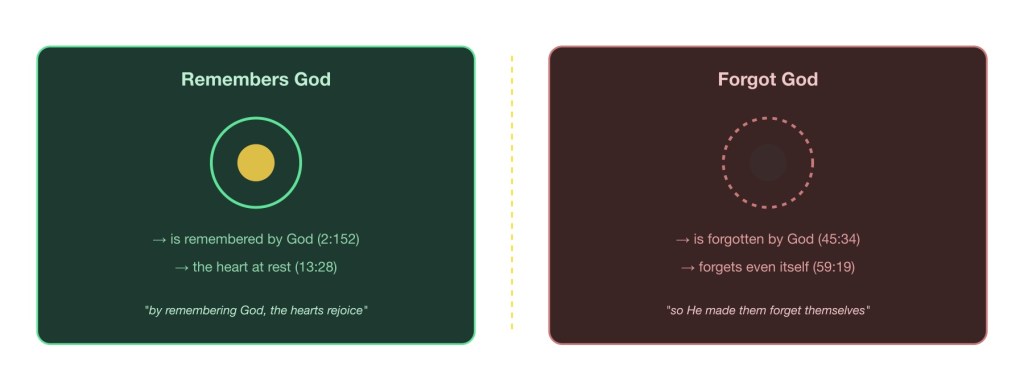
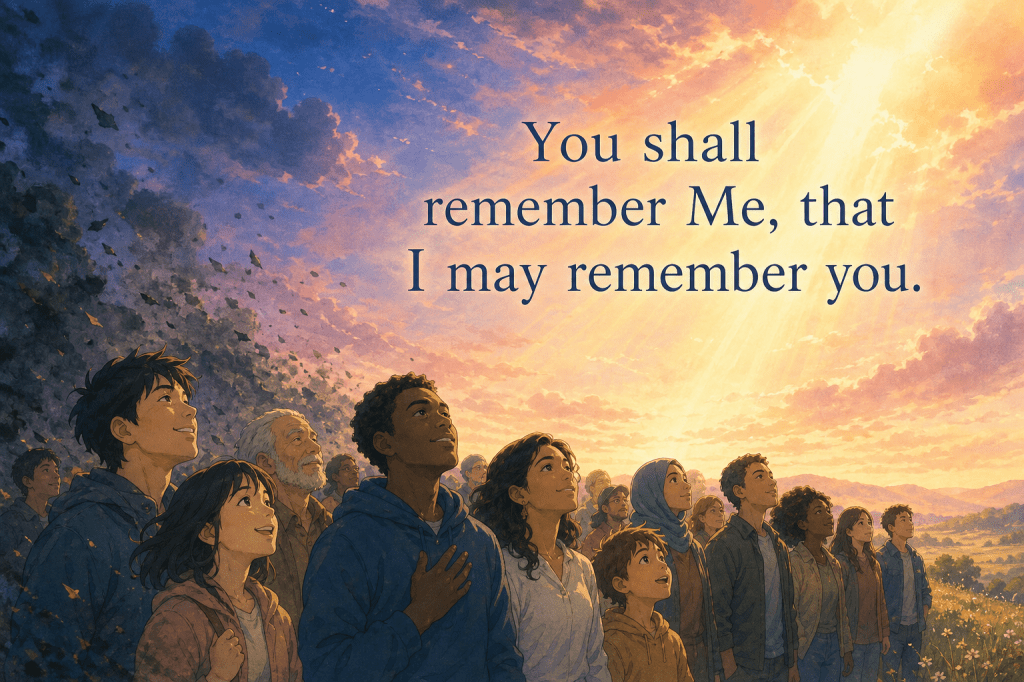
[2:152] “You shall remember Me, that I may remember you, and be thankful to Me; do not be unappreciative.”
This is the symmetry we will return to at the very end of the article, the hinge the whole argument swings on: remember Me, and I remember you. But notice what it does at the daily scale. It makes the fresh start a relationship, not a willpower exercise. You are not white-knuckling your way past yesterday; you are turning toward Someone who turns toward you. And the felt result of that turning is not grim duty but relief:
[13:28] “They are the ones whose hearts rejoice in remembering God. Absolutely, by remembering God, the hearts rejoice.”
The messenger Rashad Khalifa located this same daily renewal in the Contact Prayer itself, framing it as the engineered antidote to our built-in tendency to forget. Drawing directly on the language of Chapter 59, he taught (at 34:07): “In the Quran, it says Adam and Eve forgot. So they forgot God. And the prayer makes you remember God… Do not be like those who forgot God, so He made them forget their own souls. These are the wicked… So it says when people forget God, God makes them forget themselves.” The prayer, on this reading, is a scheduled re-remembering — five fixed appointments a day at which the working memory is wiped of distraction and re-pointed at its Lord. It is the fresh-start effect built into the structure of the day.
Behavioral science has measured exactly this effect. Researchers found that “temporal landmarks” — the start of a new week, month, year, a birthday, a holiday — produce a measurable surge in aspirational behavior: spikes in gym attendance, dieting searches, and goal-commitment, because the landmark psychologically relegates the flawed past self to a closed prior chapter and licenses a new beginning (Source: Dai, Milkman & Riis, Management Science 60(10):2563-2582, 2014). The ability to mentally close the book on who you were and start as who you intend to be is not a comforting illusion. It is a documented motivational engine. The Quran simply institutionalizes it — and reschedules it five times a day rather than once a year.
The computing parallel is the cleanest of all. A long-running process slowly accretes leaked references, fragmented memory, and stale running state; you restart it, and it returns to a known-good initial condition while the program on disk and its configuration are completely untouched. Starting your day fresh is exactly that operation. You drop yesterday’s resentments and grievance-tallies from working memory without losing your identity or your record. The binary is unchanged. Only the transient heap is reinitialized. That is what every morning is meant to be: a cold start that loses nothing that matters.

The Human Covenant of Forgiveness: Meet Them For the First Time
Scaling the Mercy Up to Other People
If the smallest scale of forgetting is the morning restart, the next scale up is the hardest one we practice: releasing a person who wronged us. Here forgetting stops being a private comfort and becomes an act of moral discipline. We are extraordinarily good at archiving injuries. We keep them indexed, timestamped, and instantly retrievable, and we serve them up on every future encounter with the person who caused them — so that we are never actually meeting them, only our stored verdict about them. The Quran’s prescription cuts directly against this instinct, and Rashad Khalifa gave the most radical formulation of it on record.
Teaching his community about repentance, he located the real target of repentance not in some abstract sin but in the wedges that resentment drives between believers, and he prescribed a deliberate, total amnesia toward the offense:
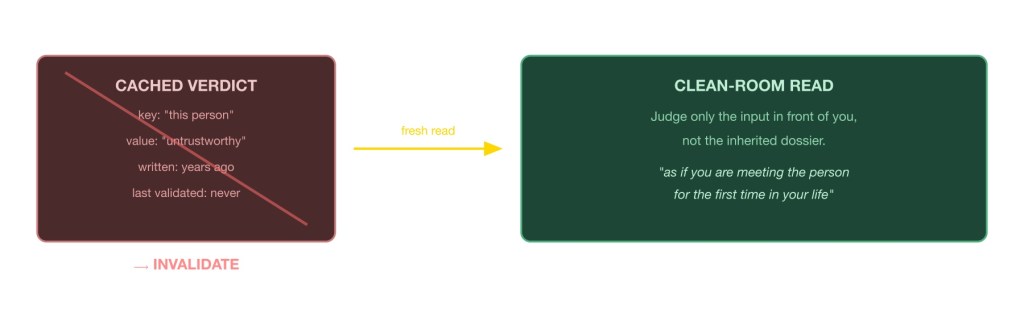
“I want you all, you and me, to direct this repentance to the wedges that Satan may have driven between you and me, or you and a brother, or you and a sister. And the way to do it is to absolutely forget the past. As if you are meeting the person for the first time in your life. You concentrate on that… I forgot everything Wali did to me, and he will say, I forgot everything Rashad did to me, anything bad, and I’m going to meet Wali for the first time. As if he’s getting used to me for the first time… The Quran repeats, over and over, that you must forgive and forget. So let us give each other a chance. And start all over again, as far as hard feelings are concerned.”
— Rashad Khalifa, Messenger Audio 14.1, at 21:10
“As if you are meeting the person for the first time in your life.” This is the human mirror of the cosmic wipe we will reach in the next section. God lets us be born with no memory of our prior rebellion so that we can re-choose Him cleanly; Rashad asks us to meet our brother with no memory of his prior offense so that we can re-meet him cleanly. The mechanism is identical. The grudge is a saved file; forgiveness is the decision to stop opening it. And the Quran underwrites this with its own protocol for the one who has wronged you and the one who has wronged God alike — turn to God, ask forgiveness, do not persist:
[3:135] “If they fall in sin or wrong their souls, they remember God and ask forgiveness for their sins—and who forgives the sins except God—and they do not persist in sins, knowingly.”
And it gives us the very words to pray when our own forgetfulness and error become a source of fear, words that ask God not to hold our lapses against us:
[2:286] “God never burdens a soul beyond its means: to its credit is what it earns, and against it is what it commits. ‘Our Lord, do not condemn us if we forget or make mistakes…’”
The body keeps the receipts for this in a way that should end the debate about whether letting go is “weakness.” In a controlled study, participants who rehearsed a hurtful memory while nursing a grudge showed significantly elevated heart rate, blood pressure, skin conductance, and tension in the brow muscles — a full sympathetic stress response — while those who shifted to empathy and imagined forgiveness saw these markers return toward baseline (Source: Witvliet, Ludwig & Vander Laan, Psychological Science 12(2):117-123, 2001). Holding the grudge is not a position of strength; it is a chronic, self-inflicted stress load with a known pathway to hypertension and cardiovascular disease. Releasing it is, literally, restorative. The inability to forget the injury is the documented pathology. The capacity to let it go is the mercy built into us.
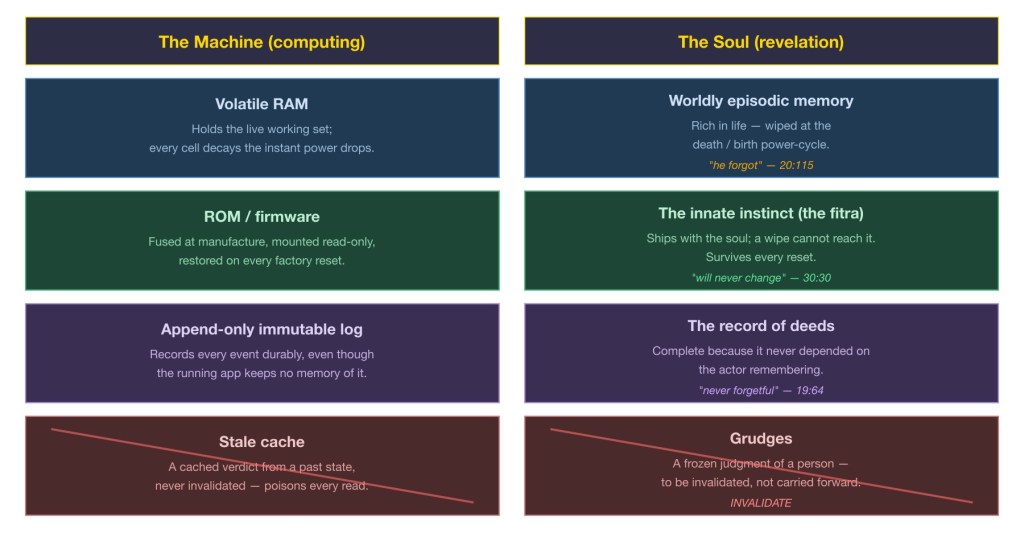
The computing image for the grudge is the stale cache. A cache is a stored answer you keep serving to avoid recomputing it — and it becomes a liability the moment the underlying truth changes but the cached value keeps being returned anyway, silently poisoning every read that trusts it. A grudge is exactly a cached verdict about a person, computed from a past state and never invalidated, so it overrides who they actually are now. The bug is never the cache itself; the bug is the missing invalidation. To meet someone “for the first time” is to perform the invalidation — to throw away the cached verdict and read the person fresh. In software we even have a name for the deliberate version of this: a clean-room re-implementation, where an engineer is intentionally walled off from prior, possibly tainted history, so the result derives only from the observable interface in front of them. Judging a person amnesiacally is the same discipline: evaluate the input in front of you, not the inherited dossier.
The Guardrail: Discerning Mercy, Not Naivety
This clean-slate ethic must not be confused with naivety toward genuine, unrepented harm. Meeting someone “for the first time” is the right posture toward a brother who wronged you and is now before you; it is not a command to ignore a persistent, unrepentant aggressor or to hand your trust to a hypocrite who advocates evil. The Quran itself draws the boundary sharply. There is one offense God does not erase on a whim:
[4:48] “God does not forgive idolatry,* but He forgives lesser offenses for whomever He wills. Anyone who sets up idols beside God, has forged a horrendous offense.”
And the door back is opened only to those who actually turn — repentance, reform, and absolute devotion to God alone are the conditions, not mere proximity:
[4:146] “Only those who repent, reform, hold fast to God, and devote their religion absolutely to God alone, will be counted with the believers. God will bless the believers with a great recompense.”
The hypocrite is the test case that keeps the mercy honest. The Quran describes hypocrites with precision — they “advocate evil and prohibit righteousness,” they pray lazily and only to be seen — and it does not counsel the believer to pretend they are something else:
[4:142] “The hypocrites think that they are deceiving God, but He is the One who leads them on. When they get up for the Contact Prayer (Salat), they get up lazily. That is because they only show off in front of the people, and rarely do they think of God.”
So the discipline is twofold and it is not a contradiction. You extend maximum benefit of the doubt to the person in front of you — you do not pre-load the encounter with a cached verdict. But you do not extend benefit of the doubt to a known, unrepented pattern of advocating evil, because that is not a stale cache; that is a live, current reading. The clean-room re-implementation derives its judgment from the observable interface — and if the observable interface is presently outputting hostility to God’s message, the clean read returns that, honestly, without manufacturing a softer result. Mercy toward the repentant and clarity toward the persistent are the same faculty, pointed correctly. Our companion piece Forgiveness in the Quran develops this balance in full, and The Hierarchy of Belief traces where duplicity hardens past the point of return.
The Cosmic Design: The Covenant You Swore and Forgot
Why We Forget At All
Now we reach the metaphysical core. The everyday fresh start and the human forgiveness we have just described are not arbitrary good advice — they are echoes of the single largest act of forgetting in the human story, the one built into the structure of birth itself. The Quran reports that the human soul made a direct, conscious covenant with God before this life, and then was made to forget it:
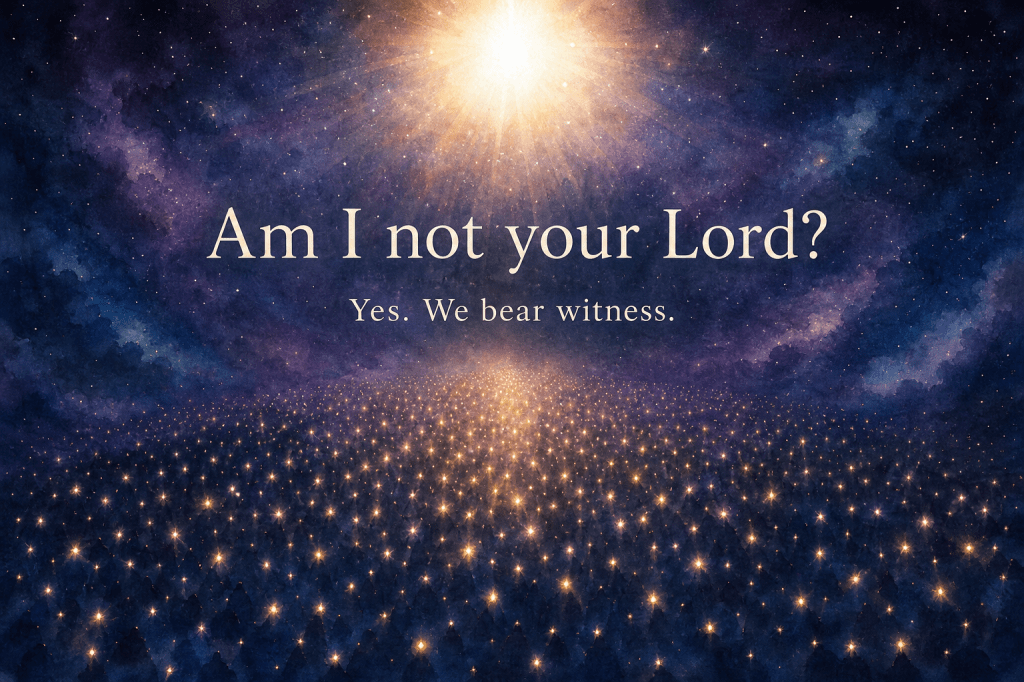
[7:172] “Recall that your Lord summoned all the descendants of Adam, and had them bear witness for themselves: ‘Am I not your Lord?’ They all said, ‘Yes. We bear witness.’ Thus, you cannot say on the Day of Resurrection, ‘We were not aware of this.’”
[7:173] “Nor can you say, ‘It was our parents who practiced idolatry, and we simply followed in their footsteps. Will You punish us because of what others have innovated?’”
[7:174] “We thus explain the revelations, to enable the people to redeem themselves.*”
Read those three verses as a unit and the purpose announces itself in the last word: redeem. The covenant is recalled, the excuses are pre-emptively closed off, and the stated reason for explaining all of it is to enable people to redeem themselves. Rashad Khalifa identified this covenant as the bedrock of our nature — something we carry even while having no conscious recollection of signing it. He taught (at 24:25): “That’s the covenant… this is the original covenant when Allah asked the descendants of Adam, am I not your Lord? And mankind says, yeah, that is a covenant… All of us have entered a covenant with Allah. It’s part of our nature, part of our mental, biological, physical, spiritual makeup to accept Allah as a Lord.”
And the Quran is direct about the second half of that nature — that we forget. The forgetting is not a peripheral accident; it is named as the original human condition, set at the very beginning with Adam:
[20:115] “We tested Adam in the past, but he forgot, and we found him indecisive.”
[36:78] “He raises a question to us—while forgetting his initial creation—’Who can resurrect the bones after they had rotted?’”
The human being literally forgets his own origin and then doubts the One who made him from it. The Quran even challenges us, gently, to push back against this amnesia with reason where memory fails:
[56:62] “You know about the first creation. Do you not remember?”
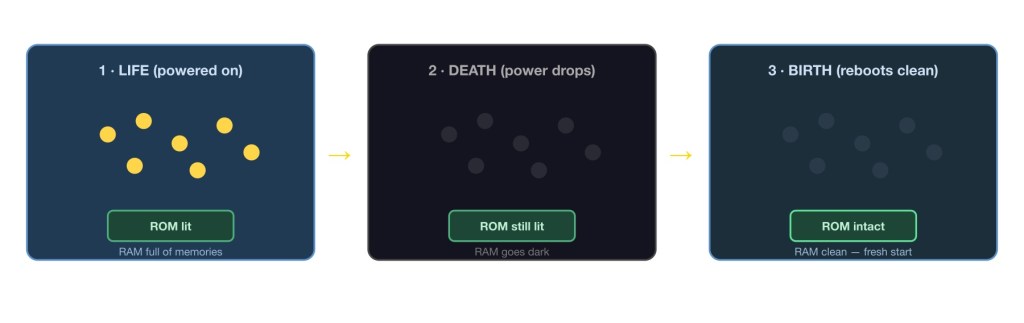
What is the architecture that allows this — a soul that swore a real covenant, yet is born with no memory of it? The cleanest description comes from the very machine Rashad said God controls. A computer has volatile memory (RAM) and non-volatile memory (ROM, firmware). RAM holds the live working state only while the power is on; the instant the rails drop, every cell decays and the contents are gone — nothing in RAM survives the power-cycle, by definition. That is worldly episodic memory: vivid and detailed in life, and cleared at the death/birth power-cycle. But the firmware is fused into the device at manufacture, mounted read-only, and restored on every factory reset, precisely because it lives below the layer a wipe can reach. That is the fitra — the innate instinct — which God describes as shipping with the soul and never changing:
[30:30] “Therefore, you shall devote yourself to the religion of strict monotheism. Such is the natural instinct placed into the people by God. Such creation of God will never change. This is the perfect religion, but most people do not know.”
This is why a memory wipe does not erase who you are. Neuroscience demonstrated this decisively. After the bilateral removal of his medial temporal lobes, the patient known as H.M. lost the ability to form new lasting memories entirely — yet his personality, his intelligence, his language, and his ability to learn new motor skills remained fully intact; he would improve at a task with practice while having no memory whatsoever of having practiced (Source: Scoville & Milner, J. Neurol. Neurosurg. Psychiatry 20(1):11-21, 1957). Memory-formation is neurologically separable from selfhood. You can lose the RAM and keep the firmware. The self persists when the memory fails — which is exactly the condition the covenant requires: the soul that said “yes” is still here, intact, even though the transcript is gone.
Rashad described the experiential side of this wipe with great tenderness, as the second chance it actually is (at 5:39): “God is giving us a second chance to denounce the blasphemy of challenging his absolute authority. And to come now in these circumstances where we started clean, we are born into this world, forgetting everything else, starting all over again. And now we can denounce any shirk, any idea of having another god besides God, and believe in the absolute authority of God alone. If we can do this, then we go back to the kingdom of God.” Born forgetting everything — but the firmware survived.
Why the Wipe Is Mercy: The Firmware Survives, and Time to Choose
A Clean, Unbiased Re-Choice
Here is the pivot of the whole article. The wipe is not a cruelty layered on top of the test; the wipe is what makes the test winnable. Strip the memory of the prior rebellion, leave the firmware of innate God-knowledge intact, and you have manufactured the one condition under which a guilty soul can choose freely: a clean slate with a working conscience. Rashad described God’s deliberation over exactly this design — what to do with souls that had rebelled — and the merciful verdict God reached:
“So what does God do with the rebels? The angels suggested, put them in hell. The angels said, put them all in hell. God said, I know what you do not know. I’m going to give them another chance. So the plan calls for putting all of them to death, bringing them in this earth, having no recollection at all of what happened in the past. It’s a fresh start. It’s a whole new chance. And we are giving God’s message and Satan’s message. We’re making a choice. As you see, the vast majority of humans are still sticking to their old rebellion.”
— Rashad Khalifa, Quran Study, Sura 7, at 1:02:53
“Having no recollection at all of what happened in the past. It’s a fresh start. It’s a whole new chance.” The amnesia is the chance. And the chance is real because the test is not rigged — God explicitly does not want forced compliance. As Rashad explained in his study of Chapter 10, the entire point is that we are not robots (at 50:16): “We make the choices. God does not want robots. In fact, this rebellion here, the purpose of it, one of the most important objectives is to show all God’s creatures that we have the freedom of choice. We will never know it if Satan did not rebel.” A choice you cannot lose is not a choice; a choice made under the weight of remembered guilt is not free. The wipe removes the weight so the choice can be genuinely yours. This is the free-will engine our companion article Free Will and Divine Omnipotence examines at length.
And God did not make the window narrow. Rashad repeatedly stressed the sheer mercy of its length — a full lifetime, with a floor of forty years, to look around, study, and decide (at 12:02): “Allah subhanahu wa ta’ala gives the human being 40 years to make up his or her mind, 40 years of research, looking around, studying, and then deciding… God decided that he wants to give us 40 years, to look around, and study, and thank God… God is merciful, because we would be in deep trouble if it was shorter than 40 years.” And those who die before that threshold are, by the same mercy, redeemed (at 14:45): “This minor rebellion proves to us that God’s creatures have a freedom of choice… and this is why millions of people die before the age of 40 and are redeemed.” The forgetting buys the fresh start; the long window and the under-40 redemption are the mercy stacked on top of the mercy.
The firmware does its work throughout. Even amnesiac of the covenant, the righteous soul still has the factory image intact, and it fires the instant temptation approaches:
[7:201] “Those who are righteous, whenever the devil approaches them with an idea, they remember, whereupon they become seers.”
That word — they remember — is the firmware booting. Not a recovered memory of the pre-life, but the innate instinct asserting itself, the read-only knowledge that no wipe could reach. Conversely, the soul that ignores the firmware reverts to type the moment comfort returns:
[39:8] “When the human being is afflicted, he implores his Lord, sincerely devoted to Him. But as soon as He blesses him, he forgets his previous imploring, sets up idols to rank with God and to divert others from His path. Say, ‘Enjoy your disbelief temporarily; you have incurred the hellfire.’”
Science confirms that forgetting itself is not the brain malfunctioning but the brain working — there is dedicated machinery whose job is to forget. The prefrontal cortex exerts active, top-down inhibitory control to suppress unwanted memories, clear interference between competing traces, and regulate emotion (Source: Anderson & Hulbert, Annual Review of Psychology 72:1-36, 2021). Forgetting is a regulated faculty for minimizing error and protecting wellbeing — engineered, not broken. In computing terms it is garbage collection: the runtime reclaims allocations no longer reachable so the system stays responsive and does not exhaust its memory. The pathology is never the collector; the pathology is an unbounded heap that never collects. A mind that could never forget, like a heap that never sweeps, would seize. The wipe is hygiene at the scale of a soul.
The Proof It’s Mercy, Not Defect: They Would Do It Again
The Forensic Payoff
If the wiped memory were really the problem — if souls fail only because they cannot remember the covenant — then restoring the memory would fix them. The Quran performs exactly this thought experiment, and the result is devastating. On the Day of Resurrection the disbelievers, now seeing the full truth, beg to be sent back, certain they would do better. God’s verdict is that they are lying, and that given the very same fresh start they would commit the very same crimes:
[6:27] “If only you could see them when they face the hellfire! They would say then, ‘Woe to us. Oh, we wish if we could go back, and never reject our Lord’s revelations, and join the believers.’”
[6:28] “As a matter of fact, (they only say this because) their secrets have been exposed. If they go back, they will commit exactly the same crimes.* They are liars.”
This is the forensic linchpin of the entire argument. “If they go back, they will commit exactly the same crimes.” The wipe is exonerated. The problem was never the missing memory; it was the rebellious will, which a fresh start does not cure because the soul keeps choosing it. The Quran hammers the point with repetition, recording the same doomed plea in voice after voice:
[23:99] “When death comes to one of them, he says, ‘My Lord, send me back.’”
[23:100] “‘I will then work righteousness in everything I left.’ Not true. This is a false claim that he makes. A barrier will separate his soul from this world until resurrection.”
[32:12] “If only you could see the guilty when they bow down their heads before their Lord: ‘Our Lord, now we have seen and we have heard. Send us back and we will be righteous. Now we have attained certainty.’*”
[7:53] “…those who disregarded it in the past will say, ‘The messengers of our Lord have brought the truth. Are there any intercessors to intercede on our behalf? Would you send us back, so that we change our behavior, and do better works than what we did?’ They have lost their souls, and their own innovations have caused their doom.”
[44:13] “Now that it is too late, they remember! An enlightening messenger had come to them.*”
“Now that it is too late, they remember.” The remembering finally arrives — and it changes nothing, because the nature underneath it never changed. Rashad’s redemption-design teaching states the bleak plainly: even after the merciful fresh start, “the vast majority of humans are still sticking to their old rebellion.” The repeat-transgression is constitutional. And this is precisely why the covenant of 7:172 forecloses every excuse: “you cannot say on the Day of Resurrection, ‘We were not aware of this.’” The wipe did not leave you ignorant — the firmware carried the knowledge through — so the courtroom is just. Our article Tolerance documents the parallel sealing of this verdict, where the guards of Hell themselves close the door on the excuse:
[39:71] “…its guards will say, ‘Did you not receive messengers from among you, who recited to you the revelations of your Lord, and warned you about meeting this day?’ They will answer, ‘Yes indeed. But the word retribution was already stamped upon the disbelievers.’”
Here neuroscience adds a precise and humbling caution. Their tearful certainty that they would do better is not reliable evidence of a changed nature, because human memory is not a faithful archive — it is a present reconstruction. Every time a stored memory is recalled it becomes temporarily unstable and must be biochemically rebuilt to persist, and the very act of retrieval edits the trace. Researchers showed that reactivating a consolidated fear memory while blocking protein synthesis could erase it, and that in humans the act of remembering systematically distorts the memory’s details (Source: Nader, Schafe & LeDoux, Nature 406:722-726, 2000; Bridge & Paller, J. Neurosci. 32(35):12144-12151, 2012). The “remorse” of 6:27 is a reconstruction generated in the moment of exposure, not proof of a reformed will. God, who reads the will and not the performance, returns the only honest verdict: they are liars.
And what they forgot has no bearing on what was written, because the record was never kept by them. Their recollection being wiped is irrelevant to the ledger, because the writer is not the actor:
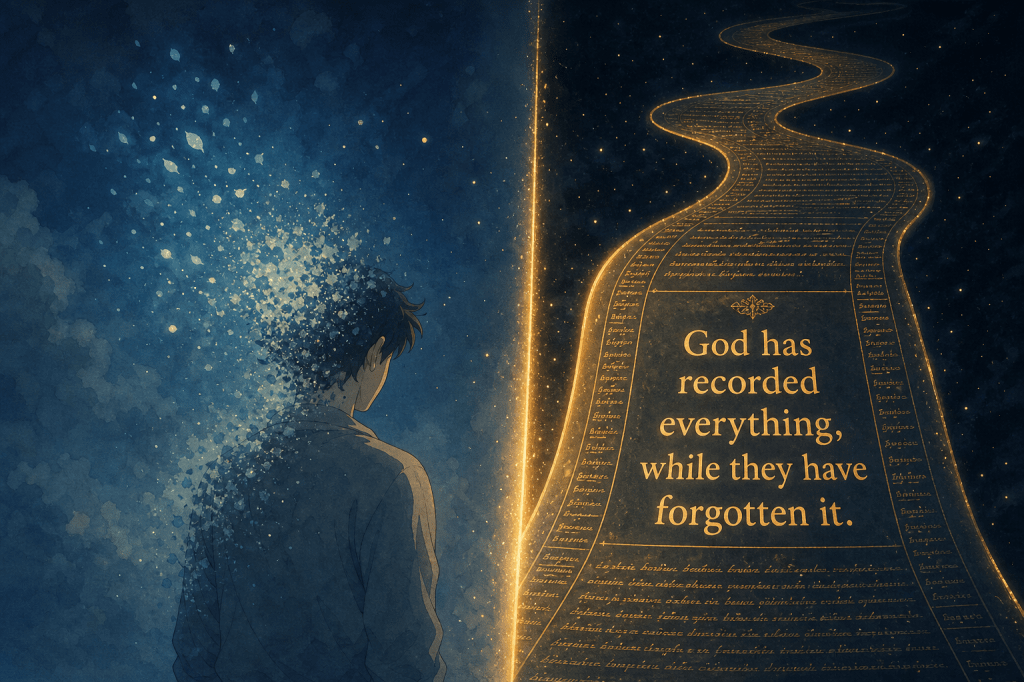
[58:6] “The day will come when God will resurrect them all, then inform them of everything they had done. God has recorded everything, while they have forgotten it. God witnesses all things.”
Science Confirms: Forgetting Is Adaptive
The Forgetful Goldfish Is Itself a False Memory
Our culture’s favorite emblem of a useless mind is the goldfish with a three-second memory. It is a perfect place to start, because the belief is itself false — a kind of cultural false-memory we keep retrieving and never invalidating. Fish in fact retain learned associations for weeks, months, and years; one study found fish retained a learned escape route for at least eleven months, and goldfish are a standard laboratory model precisely because they form durable memories (Source: Brown, Animal Cognition 4:109-113, 2001; review in Brown, Animal Cognition 18:1-17, 2015). The “three-second” figure traces to no study at all; it simply materialized in popular culture as an assumption. The lesson is delicious: the symbol we use to mock forgetting is a memory error we ourselves refuse to correct. We mistake forgetting for defect so reflexively that we will believe a fish forgets in three seconds rather than question the cliché.
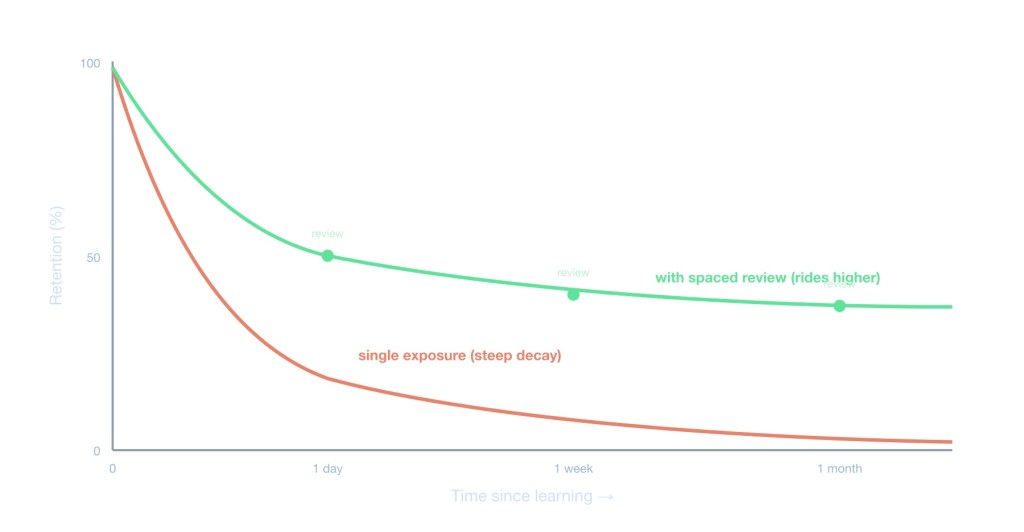
Once we drop the cliché, the real science says the opposite of what the goldfish myth implies: forgetting, in creatures actually built to forget, is functional. It is lawful, predictable, and engineered. Hermann Ebbinghaus, learning lists of meaningless nonsense syllables on himself and measuring how much faster he could relearn them after a delay, discovered that retention drops steeply within the first hours and day, then flattens into a stable curve — the famous forgetting curve — and that the cure is not cramming but spaced review distributed over time (Source: Hermann Ebbinghaus, Über das Gedächtnis, 1885; English trans. Ruger & Bussenius, 1913). Forgetting is the default trajectory of an unrehearsed trace; durable memory is something the brain must deliberately re-invest in. A designed memory that clears whatever is not actively renewed is behaving exactly as a well-engineered system should.
Forgetting is not only lawful by day; it is actively performed every night. Sleep does not merely strengthen memories — it prunes them. The synaptic homeostasis hypothesis holds that waking experience produces a net, unsustainable increase in synaptic strength, and that slow-wave sleep renormalizes the brain by downscaling synapses toward baseline, proportionally erasing weak and redundant connections (“noise”) while sparing the strong ones (“signal”) (Source: Walker & Stickgold, Neuron 44(1):121-133, 2004; Tononi & Cirelli, Neuron 81(1):12-34, 2014). Forgetting is a nightly restorative, life-sustaining function — the brain sheds each day’s excess so it can wake renewed and able to learn again. Every detail of this tells the same story the Quran tells: the system was built to let go of what is not worth keeping, so that it never saturates and seizes.
Against this lawful internal decay, God provided an external, incorruptible memory-aid — a record that does not fade with the forgetting curve. To His messenger He promised a recitation that would not be lost, and to humanity He guaranteed the preservation of the Reminder itself:
[87:6] “We will recite to you; do not forget.”
[15:9] “Absolutely, we have revealed the reminder, and, absolutely, we will preserve it.*”
This is the system completed: internal memory is allowed to decay because it is meant to, and an external, preserved Reminder is provided to carry the signal that internal decay would otherwise lose. The biology and the revelation are not in tension. They are two halves of one design — a forgetting that clears, and a Reminder that restores.
The Quran as the Reminder, and Satan as the Agent of Forgetting
Forgetting Is Induced; Revelation Is the Antidote
If forgetting were only ever neutral hygiene, the spiritual battle would not turn on it. But the Quran reveals a second kind of forgetting — not the merciful clearing of noise, but a forgetting that is actively induced, a weaponized heedlessness whose author is named. The devil literally causes people to forget. The Quran shows it happening twice in narrative — to the prison companion of Joseph, and to the young man with Moses:
[12:42] “He then said to the one to be saved ‘Remember me at your lord.’* Thus, the devil caused him to forget his Lord, and, consequently, he remained in prison a few more years.”
[18:63] “He said, ‘Remember when we sat by the rock back there? I paid no attention to the fish. It was the devil who made me forget it, and it found its way back to the river, strangely.’”
And it generalizes from incident to strategy. The devil’s whole project is to distract the soul from remembrance — to fill the working memory with noise so there is no room left for God:
[5:91] “The devil wants to provoke animosity and hatred among you through intoxicants and gambling, and to distract you from remembering God, and from observing the Contact Prayers (Salat). Will you then refrain?”
[58:19] “The devil has possessed them, and has caused them to disregard God’s message. These are the party of the devil. Absolutely, the party of the devil are the losers.”
This induced forgetting is the spiritual analogue of the stale cache, deliberately poisoned: the adversary’s project is to keep you serving an old, God-less verdict about reality, to prevent the fresh read that revelation would force. And the antidote is named throughout the Quran with a single word — the Quran is the Reminder (in Arabic, al-Dhikr, “the Remembrance”). It exists precisely to overwrite the induced forgetting:
[38:87] “‘This is a reminder for the world.’”
[54:17] “We made the Quran easy to learn. Does any of you wish to learn?”
Rashad Khalifa taught that remembrance of God — in Arabic dhikrullah — is the one act of worship with no upper limit, the constant re-remembering the devil most wants to interrupt (at 7:44): “In surah 63 verse 9 God is talking to the believers… do not be distracted by your money and your children from commemorating God, or mentioning God, or remembering God. The word is dhikrullah in Arabic… In surah 18 verse 28… do not obey those whose hearts are diverted from commemorating and mentioning God.” And he identified Satan’s masterstroke against the previous community as exactly a corruption of remembrance — redirecting the command to commemorate God day and night into the commemoration of a man instead (at 38:48): “satan messed up this verse for the Muslims… satan decided that it is going to make the people commemorate Muhammad day and night… instead of God. So shaytan succeeded in tricking and duping the Muslims into commemorating Muhammad instead of God.” The agent of forgetting does not merely erase remembrance; he reroutes it to a false target.
And there is a distinctly modern front in this campaign — the very age we live in. Rashad observed that God foreknew the explosion of new knowledge in our era would overwhelm people into forgetting Him entirely, and gave reassurance aimed squarely at us. This is the quote that hands us the computing register of this whole article:
“God knew that all this new knowledge would overwhelm the people and even make people suppose that they had discovered the computer independently of God’s will and even forget God entirely. God wanted to reassure the believers who would be living in such a fantastically new world… God wanted to let us know, us people who are living in the age of computers, to clearly know that he fully controls the computers along with the rest of his creation.”
— Rashad Khalifa, Messenger Audio 44, at 10:19
This is why the computing parallels in this article are not a cute conceit. The machine that the modern world treats as proof it has outgrown God is, in Rashad’s framing, fully under God’s control — and, read rightly, its own architecture testifies to the design we have been describing. The volatile RAM that forgets on power loss, the read-only firmware that survives every wipe, the append-only log that records what the running program never remembers, the stale cache that must be invalidated: these are not metaphors imposed on revelation. They are the same logic of memory, mercy, and record, discovered independently by engineers, and pointing back to the One who, as Rashad insisted, controls the computers along with the rest of His creation. The age that forgot God built, in silicon, a working diagram of why forgetting is a gift.

The Symmetry of Remembering and Being Remembered
The Crescendo
Everything in this article converges on a single, perfect symmetry, and it is the most consequential sentence about memory in all of scripture. Return to where we began:
[2:152] “You shall remember Me, that I may remember you, and be thankful to Me; do not be unappreciative.”
Remember God, and God remembers you. The relationship is reciprocal, and so is its inverse. The soul that forgets God is met, with terrible exactness, by being forgotten — and the Quran states this not once but as a settled law, in voice after voice across the scripture:
[7:51] “Those who do not take their religion seriously, and are totally preoccupied with this worldly life, we forget them on that day, because they forgot that day, and because they spurned our revelations.”
[45:34] “It will be proclaimed: ‘Today we forget you, just as you forgot the meeting of this day. Your abode is the hellfire, and you will have no helpers.’”
[9:67] “The hypocrite men and the hypocrite women belong with each other—they advocate evil and prohibit righteousness, and they are stingy. They forgot God, so He forgot them. The hypocrites are truly wicked.”
And the most chilling turn of the symmetry: to forget God is, in the end, to forget yourself. The soul that loses its Lord loses its own bearings, its own meaning, its own self:
[59:19] “Do not be like those who forgot God, so He made them forget themselves. These are the wicked.”
Rashad drew exactly this thread together in the teaching we opened with — Adam and Eve forgot, the prayer is the technique against forgetting, and the penalty for forgetting God is self-forgetting (at 34:07): “when people forget God, God makes them forget themselves. So they neglect themselves.” This is the deepest stake of the whole subject. We tend to fear forgetting because we think it threatens the self. The Quran inverts the fear: the self is not threatened by forgetting the world; the self is threatened by forgetting God. Lose your memories and you remain yourself — the firmware survives, as H.M. proved and as 30:30 declares. Lose God and you lose the self entirely.
And here is the final asymmetry that crowns all the symmetry, the note the whole article has been climbing toward: God Himself never forgets. The reciprocal forgetting of the disbelievers is a judicial act, not a divine limitation — God “forgets” them in the sense of abandoning them to the consequences they chose, but His knowledge is perfect and His record is complete. The ledger never had a gap:
[20:52] “He said, ‘The knowledge thereof is with my Lord in a record. My Lord never errs, nor does He forget.’”
[19:64] “We do not come down except by the command of your Lord. To Him belongs our past, our future, and everything between them. Your Lord is never forgetful.”
So assemble the full architecture one last time. The volatile RAM of worldly memory is wiped at the death-and-birth power-cycle — and that wipe is the mercy, the fresh start, the clean slate on which a guilty soul can re-choose freely. The read-only firmware of the fitra survives every wipe, carrying through the innate knowledge of the one God, so that no one is left without the means to choose and no one can plead ignorance. The append-only log of deeds records everything durably, independent of whether the actor remembers, because the writer is God, who never forgets. And the stale cache of grudges — toward others, and the devil’s induced grudge against God — is the one thing we are commanded to invalidate, to throw away, to overwrite with a fresh read. You are not the volatile working set you mistake for yourself. You are the firmware that survived the wipe, and the record that will outlive it. And the single faculty that decides your destiny is the one this whole article has been about: whether, in the clean and merciful silence of a forgotten covenant, you choose to remember.
[13:28] “They are the ones whose hearts rejoice in remembering God. Absolutely, by remembering God, the hearts rejoice.”
Conclusion: The Cleanest Gift
We began with a question you already answered and cannot remember answering, and we end by seeing that the forgetting was the kindest thing God could have done with your answer. A wiped memory is not a withholding; it is a clearing. It is the volatile store flushed so that a soul carrying a real history of rebellion can stand at the start of a life unweighted by it, with the firmware of innate God-knowledge intact, and a full lifetime — a floor of forty merciful years — to look around, to study, to remember, and to choose freely what it once chose under different conditions. The disbelievers who beg to return prove the wipe was never the problem: returned to the same fresh start, they would transgress again, because a clean slate cannot cure a will that keeps choosing the smudge. The fault was never in the forgetting. The mercy was entirely in it.
And the gift is not only cosmic; it is in your hands tomorrow morning. The same mercy that flushed the pre-life is offered to you at every scale: in the daily Contact Prayer that re-remembers God five times over and resets the working memory of the day; in the discipline of meeting the person who wronged you “as if for the first time,” invalidating the stale verdict and reading them fresh; in the simple turning back to God the instant you notice you have slipped. To remember God is to be remembered by Him, and to feel the heart come to rest. To forget Him is to be forgotten, and to lose, in the end, even yourself. But He Himself never forgets — the record is complete, the knowledge perfect, and nothing you did or were is lost to the One who wrote it down.
So do not mourn the covenant you cannot recall. It was erased on purpose, by Mercy, so that you could swear it again — freely, cleanly, with nothing held against you — and mean it. You are not the memories that fade. You are the firmware that survived the wipe and the record that will outlast it. The only question the whole design leaves to you is the one it was built to ask: will you remember?

 Quran Only Studies
Leave a comment