Introduction: A Strange Thing to Defend
A discussion recently unfolded among a group of submitters in which one participant — we will call him by the name he was addressed by throughout, Rangas — set himself the task of defending a remarkable proposition: that it is a righteous act to pay someone to be your imam. Not merely to tolerate it, not to excuse it as a desperate last resort, but to affirm it as something God authorizes and rewards. Pressed by the others, he went further still: that one could lawfully hire a hypocrite, a non-submitter, even “the crackhead on the corner” or a laborer picked up outside a hardware store, hand him a sermon to read, pay him twenty or thirty dollars, and thereby fulfill the Congregational Friday Prayer in a manner pleasing to God.
The others in the room recoiled, and rightly so. Their instinct was sound, but instinct is not enough — a position must be answered with the scripture, because the scripture is the only authority any submitter recognizes. So let us answer it completely. This article will take every argument Rangas raised, lay it beside the Final Testament, and show that the idea of a purchased pulpit is not a clever edge-case God forgot to legislate. It is the precise practice God condemned in every scripture He ever sent, the very mechanism by which Judaism, Christianity, and traditional Islam were each hollowed out from the inside. The hired imam is not a loophole in God’s religion. He is the oldest corruption of it.
Part 1: The One Criterion God Gave Us — Ask No Wage
The Single Test for Whom to Follow
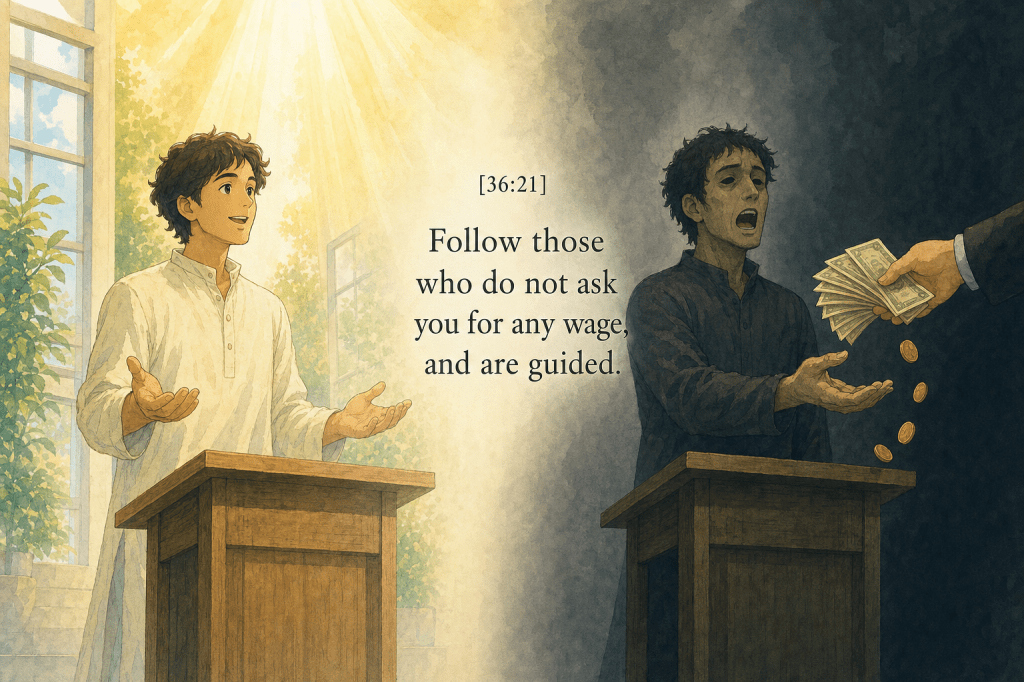
When God wanted to tell humanity how to recognize a true guide in religion — how to tell the genuine caller to God from the impostor — He did not give a long checklist. He gave one decisive test, and money is its hinge. In the story of the man who came running from the far end of the city to warn his people, God preserved his words as a permanent criterion:
[36:21] “Follow those who do not ask you for any wage, and are guided.”
Read it as the command it is. It is not descriptive trivia; it is prescriptive. Follow — the ones who ask you for no wage. The asking of payment is the disqualifier. A man who must be paid to lead you has already failed the only entrance exam God set. Rangas’s entire proposal collapses on this single verse, because he is not merely permitting a paid leader — he is recommending that you go out and seek one, hire one, install one. He is telling you to follow exactly the kind of man the Quran tells you not to follow.
This is no isolated proof-text. It is the consistent signature of every messenger God ever sent. They all said the same sentence, across centuries and languages, as if reciting from one script — because they were:
[26:109] “I do not ask you for any wage. My wage comes from the Lord of the universe.”
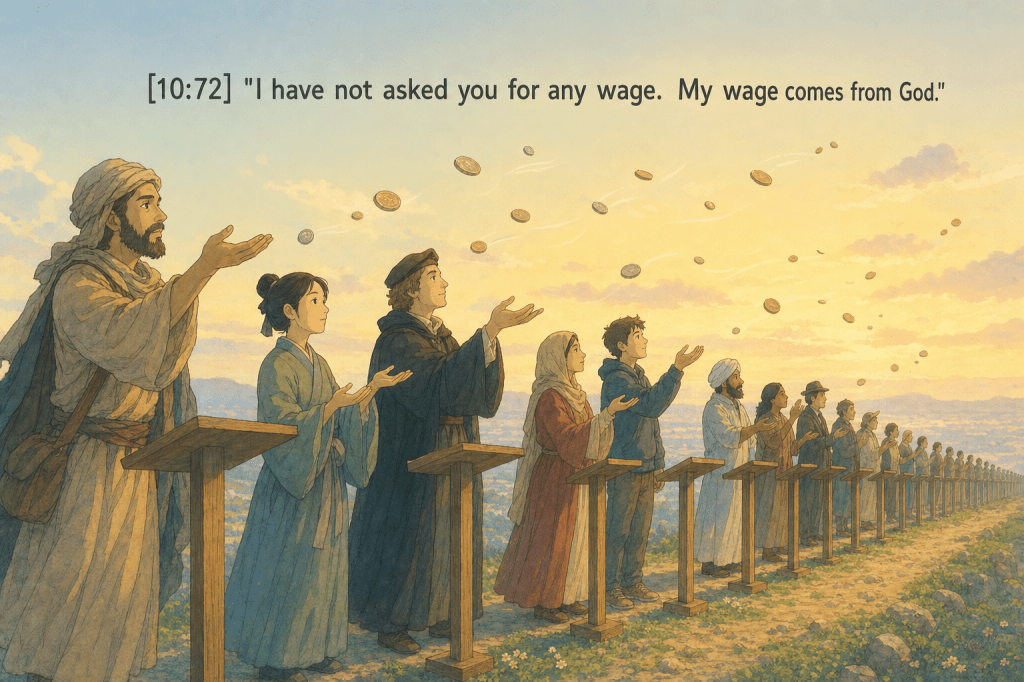
[10:72] “If you turn away, then I have not asked you for any wage. My wage comes from God. I have been commanded to be a submitter.”
[11:29] “O my people, I do not ask you for any money; my wage comes only from God…”
[34:47] “I do not ask you for any wage; you can keep it. My wage comes only from God. He witnesses all things.”
Noah said it. Hud said it. Saleh, Lot, and Shu’aib each said it (see [26:127], [26:145], [26:164], [26:180]). Muhammad was commanded to say it. The financial independence of the man who leads you to God is not a personality trait of a few unusually generous prophets — it is a structural law of how true religion is delivered. The instant a wage is attached to the office, the office is counterfeit. As we have detailed elsewhere, refusing personal benefit is one of the irreducible Quranic criteria of a genuine messenger (see our study “Quranic Criteria for Messengers,” §2 — No Personal Wage or Benefit, and “The Eternal Pattern of Rejection,” Criterion 2: Ask for No Wage).
Part 2: The Purchased Pulpit Is the Condemned Class
God Named This Sin Directly
Rangas’s strongest move in the discussion was to demand a “specific commandment” being broken — as though, in the absence of an explicit verse saying “thou shalt not pay an imam,” the act must be permitted. We will dismantle that burden-shifting fallacy in Part 6. But first observe that the demand fails even on its own terms, because God did name this sin directly, in language that fits the case with eerie precision:
[9:34] “O you who believe, many religious leaders and preachers take the people’s money illicitly, and repel from the path of God. Those who hoard the gold and silver, and do not spend them in the cause of God, promise them a painful retribution.”
“Many religious leaders and preachers take the people’s money illicitly.” This is the only verse in the entire Quran that addresses the economics of religious leadership directly, and its verdict is total condemnation. The paid preacher is not a neutral category that can be filled with good or bad intentions; God presents the very combination of “religious leader” plus “people’s money” as the engine that “repels from the path of God.” Rangas wants to take the people’s money and pour it into this exact machine. He calls it striving in the cause of God. God calls it the thing that repels people from His cause.
The same indictment falls on the clergy of every earlier scripture, condemned not for their robes but for their revenue:
[5:63] “If only the rabbis and the priests enjoin them from their sinful utterances and illicit earnings! Miserable indeed is what they commit.”
[2:174] “Those who conceal God’s revelations in the scripture, in exchange for a cheap material gain, eat but fire into their bellies. God will not speak to them on the Day of Resurrection, nor will He purify them. They have incurred a painful retribution.”
And God reserves a specific “woe” for those who attach a price tag to the handling of His words:
[2:79] “Therefore, woe to those who distort the scripture with their own hands, then say, ‘This is what God has revealed,’ seeking a cheap material gain. Woe to them for such distortion, and woe to them for their illicit gains.”
Notice the pattern across all four verses: the indictment is not aimed at men who happened to be evil and also happened to be clergy. The indictment is aimed at the transaction itself — at the fusion of religious function and material payment. That fusion is precisely what Rangas proposes to build, deliberately, with a budget, as an act of worship.
Part 3: An Imam Is Appointed by God, Never Hired by Man
What the Word Actually Means in the Quran
The deepest error in the entire proposal is a misunderstanding of what an imam is. Rangas treats “imam” as a job — a function that anyone can be slotted into for a fee, the way one hires a plumber or a presenter. But the Quran never uses the word that way. In the Final Testament, the Arabic word imam means leader, and every time God describes how someone becomes one, the answer is the same: God appoints him, and He appoints him by righteousness, never by purchase.
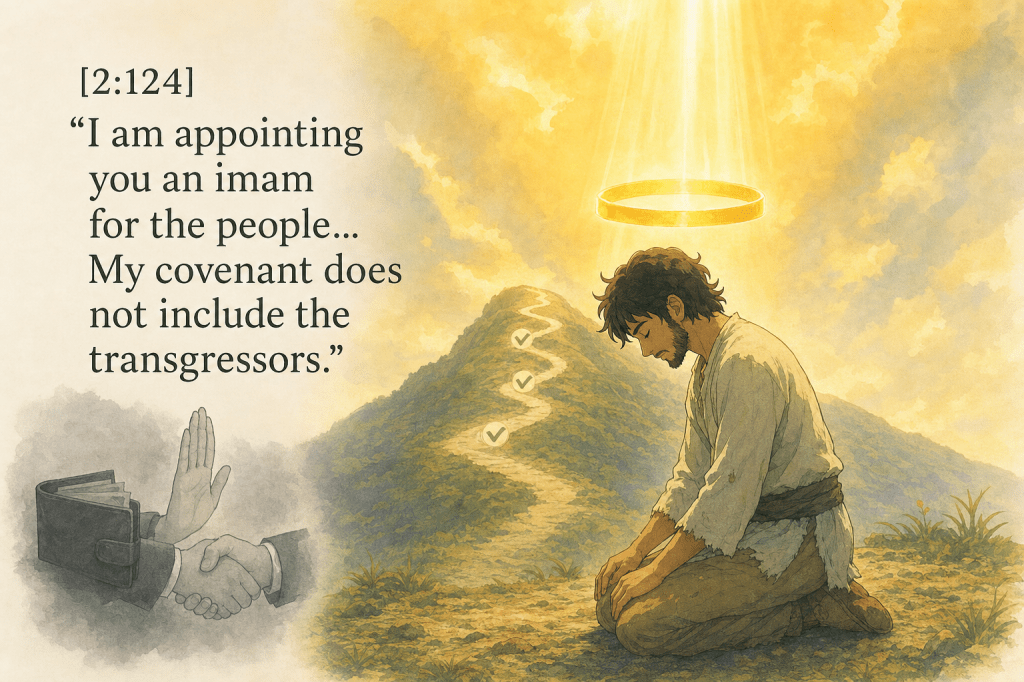
[2:124] “Recall that Abraham was put to the test by his Lord, through certain commands, and he fulfilled them. (God) said, ‘I am appointing you an imam for the people.’ He said, ‘And also my descendants?’ He said, ‘My covenant does not include the transgressors.’”
Read what disqualifies a man from the office of imam: being a transgressor. “My covenant does not include the transgressors.” Abraham earned the rank by passing tests God set for him; it was conferred from above as the reward of proven righteousness, and God explicitly warned that it can never extend to the unrighteous — not even to a prophet’s own descendants, if they fall short. Now place Rangas’s candidate beside Abraham: a hypocrite or non-believer, hired off the street, who does not believe a word he recites. He is, by God’s own definition, a transgressor — the one category the covenant of imamship explicitly excludes. You cannot pay your way into a station that God grants only to those He has tested and found righteous.
[21:73] “We made them imams who guided in accordance with our commandments, and we taught them how to work righteousness, and how to observe the Contact Prayers and the obligatory charity. To us, they were devoted worshipers.”
[32:24] “We appointed from among them imams who guided in accordance with our commandments, because they steadfastly persevered and attained certainty about our revelations.”
“We made them imams.” “We appointed them” — “because they steadfastly persevered and attained certainty.” The subject of the verb is always God, and the qualification is always righteousness and certainty of faith. There is no verse anywhere in which a community manufactures an imam by paying for one. The model Rangas defends is not a minor variation on the Quranic imam; it is the inversion of it. Our companion study on who may lead the prayer reaches the same conclusion from the same verse (“Praying Behind Hypocrites: The Quranic Proof of Prohibition” — Who Can Lead Prayer? Only the Righteous).
Part 4: “He Only Has to Say the Words” — Refuting the Hired Liar
Why a Mouth Without a Heart Is Worse Than Silence
Cornered on the matter of belief, Rangas advanced his most revealing argument: that the only thing which qualifies an imam is that he recites God’s words — his sincerity, his faith, even whether he means the repentance he leads, are all irrelevant, because “everyone repents for themselves.” On this view a tape recorder would make a fine imam, and a paid atheist mouthing a script is no different from a devout believer. This is not a defense of the proposal; it is its exposure. It reduces the worship of God to the mechanical vibration of correct syllables, drained of the one thing God actually weighs: the heart behind them.
Consider what you are actually purchasing when you pay a non-believer to stand up and declare “There is no god but God” and lead a sermon he does not believe. You are paying a man to bear false witness. And God has already described that exact transaction:
[63:1] “When the hypocrites come to you they say, ‘We bear witness that you are the messenger of God.’ God knows that you are His messenger, and God bears witness that the hypocrites are liars.”
[63:2] “Under the guise of their apparent faith, they repel the people from the path of God. Miserable indeed is what they do.”
The hypocrite utters a true sentence — “you are the messenger of God” — and God still calls him a liar, because the words are not matched by belief. The proposition is not “did the correct syllables get pronounced,” but “is the speaker truthful before God.” A hired imam who recites the declaration of faith without faith is manufacturing, on purpose and for a fee, the precise false witness of [63:1]. And note the closing phrase of [63:2] — “they repel the people from the path of God” — the identical charge leveled at the paid preachers of [9:34]. The text is telling you twice, in two places, that the paid mouth and the faithless mouth do the same damage: they push people away from God while wearing the costume of bringing them closer.
What of the worship itself? Rangas waved away the question of whether the prayer would even be valid as “none of my business — between him and God.” But God has made it very much our business to know that the worship of a disbeliever is not accepted at all:
[9:54] “What prevented the acceptance of their spending is that they disbelieved in God and His messenger, and when they observed the Contact Prayers, they observed them lazily, and when they gave to charity, they did so grudgingly.”
[107:4-7] “And woe to those who observe the contact prayers — who are totally heedless of their prayers. They only show off. And they forbid charity.”
[4:142] “…When they get up for the Contact Prayer, they get up lazily. That is because they only show off in front of the people, and rarely do they think of God.”
The disbeliever’s prayer is not a half-valid prayer that the congregation can ride along on. It is rejected — “what prevented the acceptance of their spending is that they disbelieved.” So Rangas’s plan purchases nothing: an unaccepted ritual, led by a paid liar, that the worshippers behind him cannot benefit from either. He spends real money to buy a void, and stains it with a lie on the way out. His opponents put it plainly in the discussion — “paying someone to lie is a sin, and I will not participate in somebody else’s sin.” They were exactly right, and [63:1], [9:54], and [107:4-7] are the proof.
Part 5: The Salami Slice — “You Can Pay Someone to Read the Quran, So…”
How a False Equivalence Smuggles in the Conclusion
Much of Rangas’s case was built by incremental steps: You can pay someone to read the Quran, can’t you? And reading the Quran is a righteous act. And leading the prayer is just reading God’s words too. So you can pay someone to lead the prayer. Each step is made to look like a tiny, harmless extension of the last, until you arrive at the purchased pulpit without ever feeling you crossed a line. This is the classic salami-slice — and it works only by hiding a false equivalence in the middle.
Paying a person with a beautiful voice to record a recitation for a documentary is a one-off service; you are buying audio, not a leader. Being the imam is not a service — it is an office of guidance and example. We saw in Part 3 that God reserves it for the tested and the righteous ([2:124], [21:73], [32:24]). To slide from “buy a recitation” to “buy a prayer-leader” is to equate a vendor with a guide, a microphone with a man God appoints. The two things are not points on one continuum; they are different in kind. The opponents in the discussion caught this immediately: paying a professional to read a verse on camera “is not the same as a religious practice where you tell someone to go get the homeless man to be your imam.”
And even the first slice is not as clean as Rangas pretends. The moment you pay specifically so that a religious act is performed on your behalf as worship, you are at the doorstep of the very sin of [2:174] and [2:79] — turning the handling of God’s revelation into “a cheap material gain.” Money changes the nature of the act. As one participant observed, attach a fee and the incentive is no longer God alone; it becomes, in their words, “a money salat.” Intention is not a footnote in God’s religion — it is the substance God judges:
[9:53] “Say, ‘Spend, willingly or unwillingly. Nothing will be accepted from you, for you are evil people.’”
Then comes the self-refutation Rangas never escaped. He conceded the prayer would not be valid, yet still urged a sister with no congregation to pay a stranger so as not to “miss” the Friday Prayer. But if the prayer is invalid, attending it fulfills nothing — there is no Friday Prayer there to attend. He asks her to spend her money to purchase the appearance of an obligation discharged, when no obligation has been discharged at all. That is not striving in the cause of God. That is buying a stage prop and calling it worship.

Part 6: “Show Me the Verse” — The Burden Is on the Innovator
Who Has to Prove What
Rangas’s procedural trick was to demand that his opponents produce a single verse that says, in so many words, “do not pay an imam,” and to treat their inability to quote such a sentence as a victory. This inverts the burden exactly backwards, and it is worth naming why, because it is the same maneuver by which traditional religion smuggled in mountains of innovation.
God did not legislate the entire universe of forbidden inventions by listing each one. He gave a positive model and commanded us to follow it. The model for whoever leads people to God is fixed and repeated until it cannot be missed: he asks no wage ([36:21], [26:109], [10:72], [11:29], [34:47]); he is appointed by God through righteousness ([2:124], [32:24]); he is sincere, not a hireling. A paid imam contradicts the model at every point. You do not need a verse that anticipates each novel corruption by name when you have been handed the blueprint of the genuine article — anything that departs from the blueprint is, by definition, the departure. The opponents actually did supply the explicit verse anyway, [9:34], but they were under no obligation to: the one introducing a practice unknown to the messengers is the one who must justify it from scripture.
[2:44] “Do you exhort the people to be righteous, while forgetting yourselves, though you read the scripture? Do you not understand?”
When the demand for an explicit prohibition failed, Rangas retreated to a softer scene: he was merely “teaching a non-believer how to do a God-alone prayer, and giving them some cookies and ten dollars as an incentive.” But this is a bait-and-switch, swapping the original claim — pay an imam to lead your congregation — for a different act entirely, the teaching of a seeker. Calling people to God, da’wah, is itself part of the messengers’ unpaid work; you do not bill for it, and you certainly do not pay the student to be taught. The instant a wage is bound to the religious office, you have created precisely the professional-religion class of [9:34], whatever warm packaging you wrap it in. The opponents pressed this relentlessly, and Rangas could never return to defend his original sentence, because the original sentence is indefensible.
Part 7: The Gate Is Belief — You Cannot Pay Past “O You Who Believe”
Every Ritual Command Is Addressed to the Believer First
This is the argument that ends the discussion, and it turns on a single word God places at the front of His ritual commands. When Rangas was finally pinned down, his fallback was that incentivizing a disbeliever to perform a “God-alone prayer” — paying him, feeding him cookies, slipping him ten dollars to go through the motions — is itself a righteous act, because a righteous act was performed. But look at how God actually issues the command to pray, and notice precisely to whom it is addressed:
[5:6] “O you who believe, when you observe the Contact Prayers, you shall: (1) wash your faces, (2) wash your arms to the elbows, (3) wipe your heads, and (4) wash your feet to the ankles… God does not wish to make the religion difficult for you; He wishes to cleanse you and to perfect His blessing upon you, that you may be appreciative.”
“O you who believe.” The ablution — the very gateway that makes the Contact Prayer valid — is not commanded to humanity at large. It is commanded to the believers. The same address opens the command to the worship itself: “O you who believe, you shall bow, prostrate, worship your Lord, and work righteousness” [22:77]. The ritual apparatus of submission is, by God’s own framing, the believer’s act. A disbeliever rinsing his arms to the elbows is washing; he is not performing the ablution God legislated, because the legislation was never addressed to him. A paid non-believer dropping to the floor is bending his body; he is not prostrating in the sense [22:77] commands, because that command begins with a precondition he has not met. You cannot pay a man into the category “O you who believe.” It is not for sale.
This is why the wudu question — which Rangas himself raised and then fled from in the discussion (“if the imam didn’t do the ablution, does that prayer count?”) — is fatal to his own position rather than a clever trap for his opponents. Press his logic to its conclusion: can you pay someone to perform ablution? The question collapses on contact. Ablution is a believer purifying himself to stand before his Lord; strip out the belief and the standing-before-God, and all that remains is a man washing his hands for money. The cleansing [5:6] speaks of is the cleansing of one who has already said “yes” to God — “He wishes to cleanse you,” the believing addressee — not a mechanical rinse you can commission from a stranger.
So God has fixed the order, and it cannot be reversed. First you make the choice to stand with God; only then do all the other actions come into play. Belief is the gate, and every ritual — ablution, the Contact Prayer, prostration, repentance — lies on the far side of it. You cannot manufacture the worship and back-fill the belief afterward, and you certainly cannot purchase the belief with cookies and a banknote. And what becomes of the act performed by one who never passed through the gate? God already told us in the very next breath after these commands are violated by the insincere:
[5:27] “…God accepts only from the righteous.”
[9:54] “What prevented the acceptance of their spending is that they disbelieved in God and His messenger, and when they observed the Contact Prayers, they observed them lazily…”
“God accepts only from the righteous.” The disbeliever’s motions are not a righteous act that happens to be done by an unrighteous man — they are not accepted at all, because acceptance was conditional on the doer, not merely on the choreography. Incentivizing a disbeliever to “pray,” then, is not the manufacture of a righteous deed. It is paying real money to produce a religious-looking nothing that God does not receive, while telling yourself worship has occurred. The act does not sanctify the man; the man’s submission is what God required before the act could mean anything at all. Rangas inverted God’s order — he tried to buy the action and skip the allegiance. But there is no shortcut around “O you who believe,” and there is no price that opens that gate.

Part 8: “But Rashad Paid Presenters” — A Category Error
A Media Voice-Over Is Not a Standing Imam
The proposal’s final prop, offered in Rangas’s support, was that Rashad Khalifa once paid professional presenters to read Quranic verses for a video about the mathematical miracle (the “Signature of the Creator” production), and that this licenses paying for religious recitation generally — and onward to paying an imam. This is the salami slice of Part 5 dressed in the messenger’s authority, and it commits the same category error.
Paying a skilled voice to narrate verses for a documentary is buying a media service for an educational broadcast. It appoints no one to lead anyone in worship; it installs no imam; it convenes no congregation; it asks no one to bear false witness in prayer. To leap from “a presenter was paid to read on camera” to “therefore hire the homeless man to be the standing imam of your Friday Prayer” is to confuse a one-time vendor with a religious office — the very confusion Part 5 exposed. The opponents said it cleanly: “Rashad never paid anyone to be the imam. They used someone’s services to make a video. These are not the same.”
What did the messenger actually teach about religious leadership and money? The opposite of Rangas’s thesis. Rashad taught that submission has no priesthood at all — “at least now, we have no organized clergy” (Messenger Audio lecture). And he taught, expounding [9:31], that the very mechanism of religious corruption is the elevation of paid religious functionaries above God’s word:
[9:31] “They have set up their religious leaders and scholars as lords, instead of God. Others deified the Messiah, son of Mary. They were all commanded to worship only one god. There is no god except He. Be He glorified, high above having any partners.”
In his own words on this verse, the messenger said: “They have taken their priests and rabbis — and I can add to this, and imams and scholars and ulema — as gods besides God. This is straightforward” (Messenger Audio, at 33:57). He laid down the only criterion by which a religious figure may ever be followed — and it is a criterion of truth, not of hire: “if the imam or the priest or the rabbi is saying something that is identical to what God said, then you are worshipping God… however, if he says something different, you are worshipping the imams” (Messenger Audio, from 5:00). Rashad’s footnote to [9:31] in the Final Testament drives it home: if you obey the “scholars” whose advice is contrary to God’s teachings, you have set them up as lords beside God. The messenger’s whole teaching runs against the purchased pulpit, not toward it.
Part 9: The Real Stakes — This Is How Every Religion Was Corrupted
The Oldest Trojan Horse in Scripture
Step back from the individual verses and look at the shape of the thing. Why does the Quran return, again and again, to clergy and their earnings — the rabbis’ “illicit earnings” ([5:63]), the preachers who “take the people’s money illicitly” ([9:34]), those who trade God’s revelations “for a cheap price” ([2:41], [3:77], [9:9])? Because the professionalization of religion is the single most reliable way to destroy it, and God is warning us about a pattern, not just scolding individuals.
The sequence is always the same. A religious function acquires a price. A class of people now earns its living from that price. Their income depends on the congregation’s continued dependence on them, so they have a permanent material incentive to keep people dependent — to stand between the believer and the scripture, to complicate what God made simple, to “repel from the path of God” exactly as [9:34] and [63:2] describe. Within a generation the hired functionary is no longer a convenience but an authority, and the authority is no longer measured against God’s word but obeyed in place of it — and now the people have “set up their religious leaders and scholars as lords, instead of God” ([9:31]). That is not a slippery-slope hypothetical. It is the documented biography of Judaism, of Christianity, and of the traditional Islam that buried the Quran under the paid scholarship of centuries.
Rangas, perhaps without realizing it, was arguing for the first link of that chain — and his opponents saw the whole chain. “You’re breeding hypocrisy,” one of them warned: pay a man once to perform religion and he learns that religion pays; he comes back; a profession is born; and you have funded into existence the very thing the Quran condemns. The same dynamic of accommodating and subsidizing those who compromise God’s religion, rather than separating from it, is the compromiser’s instinct we have examined before (see “Praying Behind Hypocrites”). Submission was sent, in part, to break that chain — to restore a religion with no priesthood, no intermediary, no man you must pay to reach your Lord:
[6:51] “And preach with this (Quran) to those who reverence the summoning before their Lord — they have none beside Him as a Lord and Master, nor an intercessor — that they may attain salvation.”
[53:38] “No soul bears the sins of another soul.”
No one stands between you and God; no one can carry your burden for a fee; no one can repent on your behalf, as the discussion itself eventually conceded. If no man can be your intercessor, then no man is worth paying to be one. The purchased pulpit is not a service to God’s religion. It is the reintroduction of the exact disease God sent this religion to cure.
Conclusion: Buy Nothing, Follow the Free
Rangas built an elaborate structure — strive with your money, the imam only recites, you can pay for recitation, show me the verse, Rashad paid presenters, teach them with cookies — and every beam of it rests on one buried assumption: that the office of leading people to God is a commodity that can be bought and sold. The Quran denies that assumption on every page it touches the subject. The true guide asks no wage and is the only one you may follow ([36:21]). The paid preacher is the condemned class who repels people from God’s path ([9:34]). The imam is appointed by God through righteousness and the covenant excludes transgressors ([2:124]). The hired liar manufactures the hypocrite’s false witness ([63:1]) and his worship is not even accepted ([9:54]). And the whole scheme is simply the first move in the oldest corruption in scripture — the one that turned rabbis, priests, and scholars into lords beside God ([9:31]).
The instinct of the submitters who pushed back in that room was correct, and now it has its full scriptural spine. You do not solve a missing congregation by purchasing a counterfeit one. If a sincere believer cannot find a righteous person to lead the Friday Prayer, she has missed nothing she will be held accountable for, because “no soul bears the sins of another soul” — far better to commemorate God alone or with her family than to hand her worship to a paid stranger who does not believe a word of it. God did not ask us to buy His religion back into our lives. He asked us to follow those who ask for nothing.
And beneath every one of Rangas’s moves lay the same reversal of God’s order: he wanted the actions without the allegiance, the prayer without the belief, the imam without the righteousness — all of it available for a fee. But God built His religion as a gate before a garden. First you make the choice to stand with God; only then do all the other actions come into play — the ablution, the prayer, the prostration, the repentance, the leadership. That is why every ritual command opens with “O you who believe,” and why “God accepts only from the righteous.” You cannot purchase your way past the gate, you cannot pay another to pass through it for you, and you cannot hire a man who has never entered it to stand at its threshold and lead. The choice is the price, and it is the one price money cannot pay.
Let the final word be the first criterion, because nothing has answered it and nothing can: follow those who do not ask you for any wage, and are guided. The man with his hand out has already told you everything you need to know.


 Quran Only Studies
Leave a comment