
The Flowchart Is a Map, and Maps Have an Order
Somewhere right now a believer is losing an argument they should have won. They have the truth in their hands — the mathematical proof, the false verses identified, the corrupted narrations exposed — and they open with all of it at once, in front of a person who has not yet conceded that God exists. The conversation ends the way these conversations almost always end: with the listener walking away more closed than before. The problem was never the truth. The problem was the order.
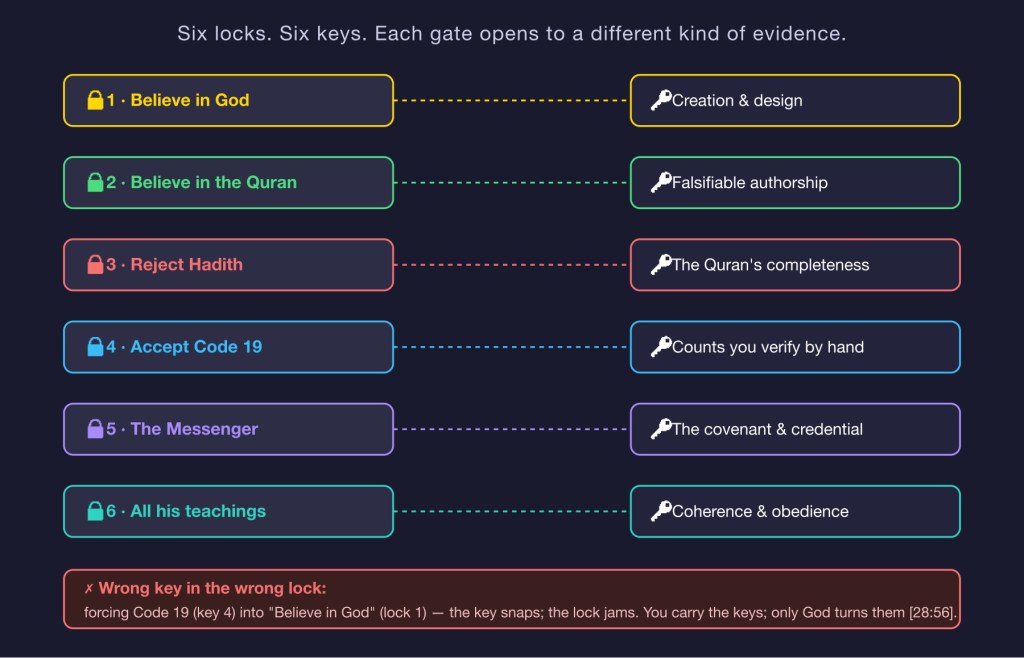
This article is about a single diagram — six boxes stacked in a column, joined by downward arrows: Believe in God → Believe in the Quran → Reject Hadith → Accept Code 19 → Accept the Messenger of the Covenant → Accept all his authorized teachings. (The original hand-drawn version of this chart labels the fifth box “Accept MOC”; throughout this article we write it out in full — the Messenger of the Covenant — and use the acronym no further.) Each box is a gate. Each gate is the load-bearing prerequisite of the gate above it. You cannot teach gate four to a soul standing at gate one. And the single most important thing the chart teaches is this: the evidence that moves a person is different at every transition. There is a right key for each lock, and carrying the whole keyring is useless if you keep trying the wrong key first.
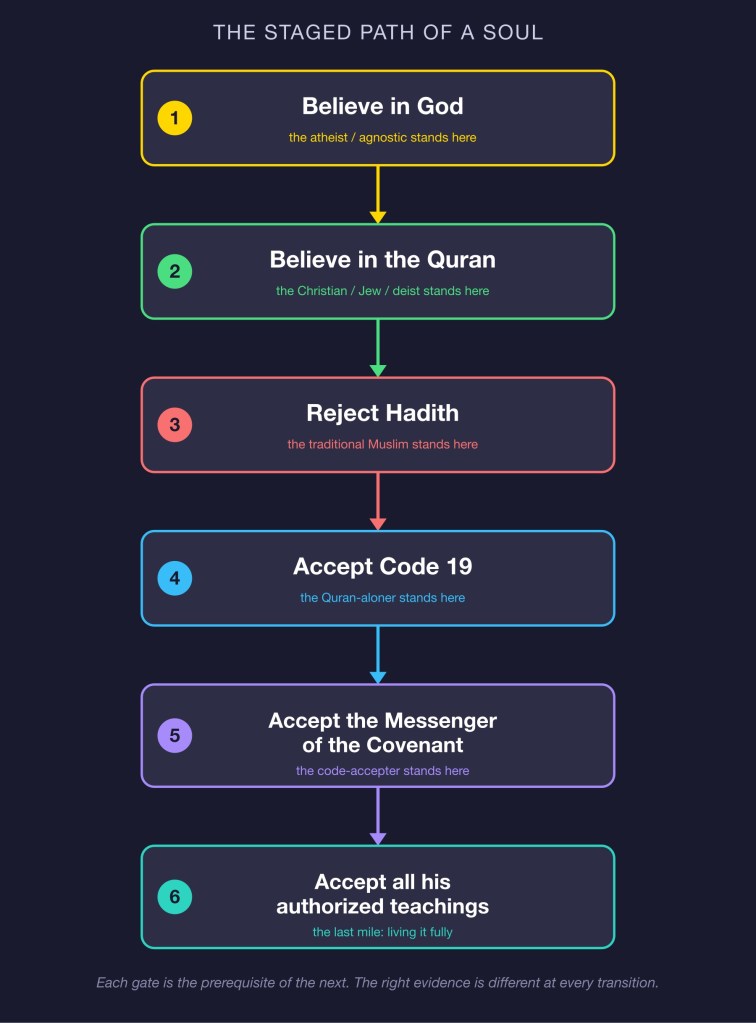
Why does the order matter so much? Because at the wrong stage, the right argument does not merely fail — it inoculates. God states the mechanism with surgical precision:
[6:108] “Do not curse the idols they set up beside God, lest they blaspheme and curse God, out of ignorance. We have adorned the works of every group in their eyes. Ultimately, they return to their Lord, then He informs them of everything they had done.”
Attack what a person holds sacred before you have earned the right to be heard, and you do not produce belief — you produce blasphemy and a hardened heart. The same dynamic appears when the Quran alone is pressed on a soul who is not ready for it: God says they “run away in aversion” [17:46]. And the converse is the strategy: a good response, delivered in the right manner at the right moment, can turn an enemy into a friend.
[41:34] “Not equal is the good response and the bad response. You shall resort to the nicest possible response. Thus, the one who used to be your enemy, may become your best friend.”
The man who discovered the mathematical code of the Quran walked this entire chart himself. Rashad Khalifa was raised in the traditional religion; he came to reject the corrupting narrations; in January 1974 he pinned down the code based on the number nineteen; and only last — reluctantly, after resisting it — did he accept the role the scripture assigned him. He did not begin where he ended. Neither does anyone. The believer who maps this honestly, in themselves and in the people they invite, becomes one of those the Quran praises:
[39:18] “They are the ones who examine all words, then follow the best. These are the ones whom God has guided; these are the ones who possess intelligence.”
Gradualism Is God’s Own Pedagogy
God Staged His Own Revelation
Before we tell anyone how to receive truth in stages, we should notice that God delivered His own truth in stages. The disbelievers complained about exactly this, and the answer they received is the charter of the whole method:
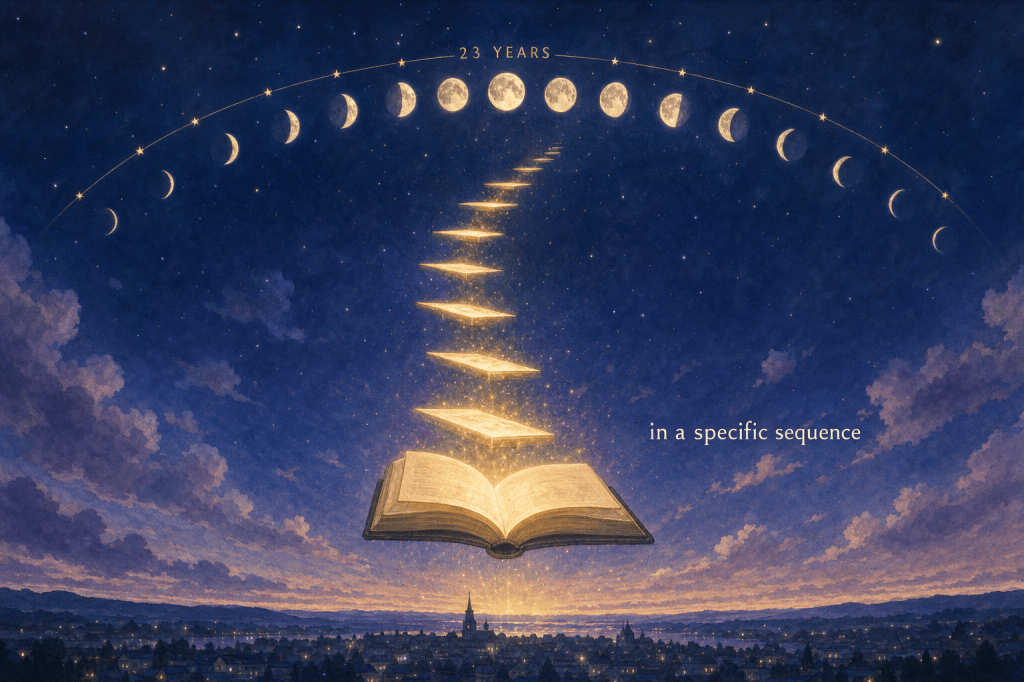
[25:32] “Those who disbelieved said, ‘Why did not the Quran come through him all at once?’ We have released it to you gradually, in order to fix it in your memory. We have recited it in a specific sequence.”
Note the closing words: a specific sequence. The staging was not an accident of slow dictation; it was deliberate design. And God removes any doubt that it could have been otherwise, telling us the revelation existed complete from the start and was nonetheless released slowly on purpose:
[17:106] “A Quran that we have released slowly, in order for you to read it to the people over a long period, although we sent it down all at once.”
Rashad Khalifa explained the pedagogy directly:
“The purpose of releasing the Quran over a 23 year period is to help the prophet and the believers at the time to memorize the Quran as it was being released, and this is stated in the Quran. In the Quran it says… to fix it in your memory. So the release was very slowly, very gradually, and it took 23 years.”
— Rashad Khalifa, Essentials of Submission (3:32)
God Staged His Own Prohibitions
The clearest proof that God Himself teaches in stages is the prohibition of intoxicants. He did not open with the final ruling. He opened by tilting the scales of judgment:
[2:219] “They ask you about intoxicants and gambling: say, ‘In them there is a gross sin, and some benefits for the people. But their sinfulness far outweighs their benefit.’…”
Then He narrowed the conduct without yet banning the substance — keep it away from the moment of worship:
[4:43] “O you who believe, do not observe the Contact Prayers (Salat) while intoxicated, so that you know what you are saying…”
And only at the end came the complete prohibition:
[5:90] “O you who believe, intoxicants, and gambling, and the altars of idols, and the games of chance are abominations of the devil; you shall avoid them, that you may succeed.”
Three steps, in order, with the hardest news last. If the Author of the universe judged that human beings absorb a single correction better in stages, who are we to dump six corrections on a stranger at once? Rashad’s own community received the heaviest news the same way, and Rashad named it as a mercy:
“And how can you tell us that the Quran we have known all along had two verses wrong in it? How do you tell us that the Salat prayer we have been doing has been wrong? And as you know, God blessed us because we did this gradually. We were doing everything wrong… it takes killing the ego to give up things that have been taught by our parents… Actually it takes more courage and more strength to say I was wrong, I am going to do the right thing now.”
— Rashad Khalifa, Quran Study No.13, Intro to the Blue Quran (4:30)

Abraham Staged His Arguments
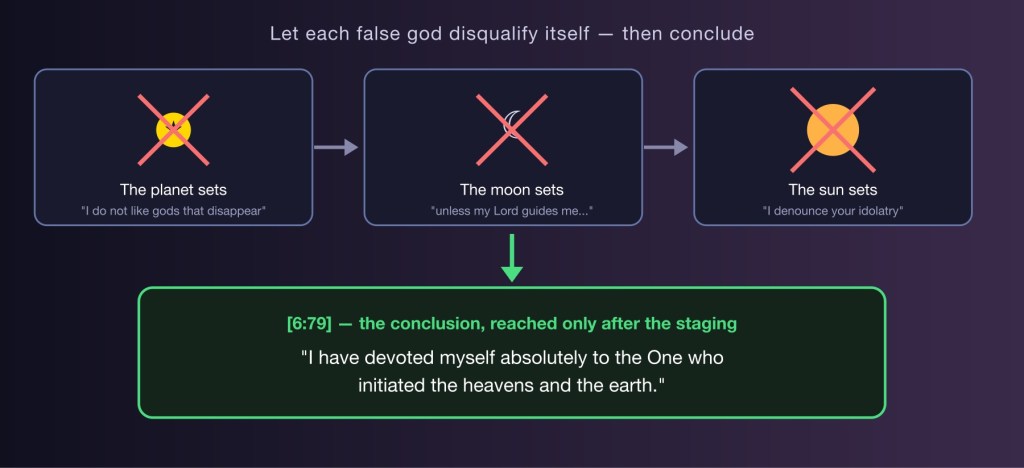
The Quran gives us a master debater to study: Abraham. Facing people who worshiped the heavenly bodies, he did not begin by denouncing their gods. He entered their own premises and let each false god disqualify itself — first a planet, then the moon, then the sun, each rising in apparent glory and then setting into irrelevance:
[6:76] “When the night fell, he saw a shining planet. ‘Maybe this is my Lord,’ he said. When it disappeared, he said, ‘I do not like (gods) that disappear.’”
[6:77] “When he saw the moon rising, he said, ‘Maybe this is my Lord!’ When it disappeared, he said, ‘Unless my Lord guides me, I will be with the strayers.’”
[6:78] “When he saw the sun rising, he said, ‘This must be my Lord. This is the biggest.’ But when it set, he said, ‘O my people, I denounce your idolatry.”
Only after the staged elimination — only after the listeners had watched each candidate fail on its own — does Abraham reach his conclusion, and even then he frames it as devotion rather than insult:
[6:79] “‘I have devoted myself absolutely to the One who initiated the heavens and the earth; I will never be an idol worshiper.’”

With the king who claimed divine power, Abraham conceded ground one step at a time until a single unanswerable challenge stumped him [2:258]. With his own father he made four gentle appeals, each beginning “O my father,” and when threatened with stoning he answered only with peace [19:42-47]. With the idolaters he forced them to reason for themselves — “Go ask them, if they can speak” [21:63] — until “they were taken aback” and admitted, to themselves, that they were in the wrong [21:64]. Every encounter is a study in matching the argument to the listener’s stage.
Moses Was Told to Stage His Tone
If anyone ever had the right to open with maximum force, it was Moses, sent to the single worst tyrant on earth. Yet the command God gave him was about manner, not just message:
[20:43] “‘Go to Pharaoh, for he transgressed.”
[20:44] “‘Speak to him nicely; he may take heed, or become reverent.’”
“Speak to him nicely” — to Pharaoh. This is the tone rule at its most extreme, and it is not optional softness; it is strategy aimed at the chance that the man “may take heed.” The general method is then stated plainly for every believer who invites:
[16:125] “You shall invite to the path of your Lord with wisdom and kind enlightenment, and debate with them in the best possible manner. Your Lord knows best who has strayed from His path, and He knows best who are the guided ones.”
Wisdom — the right word for the right person at the right time. Invitation “on the basis of a clear proof” [12:108], in “the nicest possible manner” with the people of the scripture [29:46]. The staged method is not a clever human technique we are bolting onto the religion; it is the religion’s own pedagogy, modeled by God, by Abraham, and by Moses.
The Inviter’s Role-Limits: You Deliver the Key; Only God Turns It
Before walking through the gates, the inviter has to internalize a liberating limitation: converting the person is not your job, and never was. The most beloved human being could not guide the one he loved most:
[28:56] “You cannot guide the ones you love. God is the only One who guides in accordance with His will, and in accordance with His knowledge of those who deserve the guidance.”
Your responsibility is delivery, full stop. God repeats this until it cannot be misheard: “You are not responsible for guiding anyone” [2:272]; “You shall remind, for your mission is to deliver this reminder. You have no power over them” [88:21-22]; “Your sole mission is delivering the message” [42:48]. And the prohibition on forcing the next gate is explicit:
[10:99] “Had your Lord willed, all the people on earth would have believed.* Do you want to force the people to become believers?”
Rashad drew the same line, calling the delivery-only rule the most consistent statement in the entire Quran:
“You… do not force people to believe in Islam, you are only responsible for delivering the message. And this is the first statement that is not violated anywhere in the Quran, it is repeated… So the sole function of the prophet, of the messenger, is to deliver the message. That is all.”
— Rashad Khalifa, The Great Debate (45:14)
This reframes every “failure.” If a person does not pass the next gate, you have not failed — you were never the one who turns the lock. Your task per gate is exact and finite: present the right evidence, in the right manner, and then leave the door open. Rashad’s pastoral counsel was precisely this:
“Again, invite to the path of God with wisdom and great diplomacy. You want to do it so you don’t chase them away? Keep the door open. If they are not going to believe now, you keep the door open for them.”
— Rashad Khalifa, Quran Study, Sura 9:52 (18:19)
This frame matters at every transition, but it also disarms two false guides that ambush the inviter and the invited alike: the pressure of the majority and the resistance of the ego. Our deeper treatment of both is in Majority, Ego, and the Messenger — neither a head-count nor a wounded self can guide anyone; only God does.
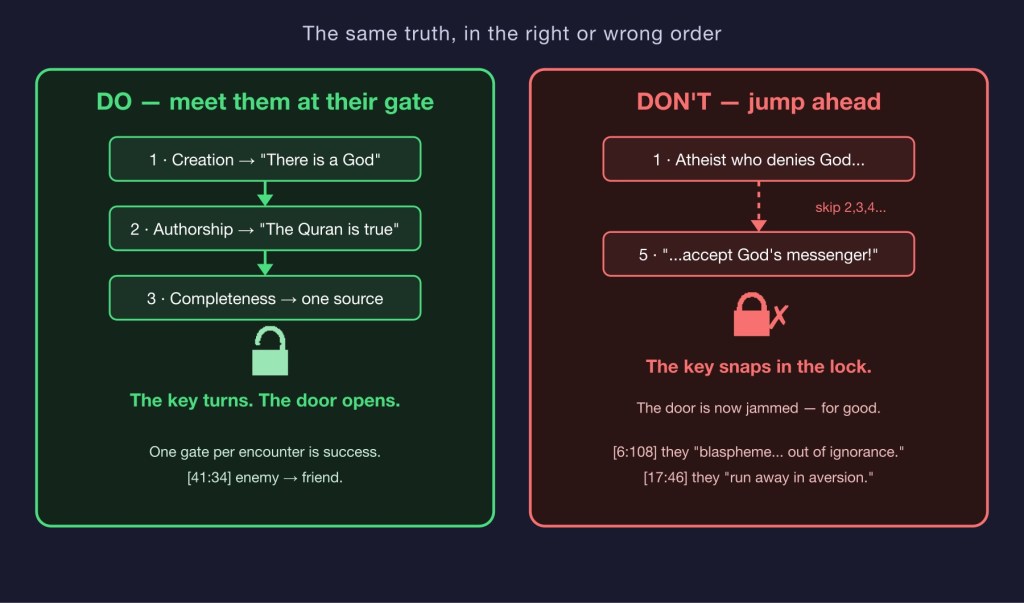

Gate 1 → 2: “Believe in God” — Meeting the Atheist Where They Stand
The Right Key: Creation, Not Scripture
At the first gate stands the atheist, the agnostic, the “spiritual but unconvinced,” and the lapsed cultural believer. Here is the cardinal error to avoid: do not quote the Quran as an authority to a person who thinks the Quran is a man-made book. They have not granted the premise; to them it sounds circular. The right key at this gate is not scripture — it is creation, the one piece of evidence they already live inside. God Himself points there first:
[3:190] “In the creation of the heavens and the earth, and the alternation of night and day, there are signs for those who possess intelligence.”
[41:53] “We will show them our proofs in the horizons, and within themselves, until they realize that this is the truth.* Is your Lord not sufficient, as a witness of all things?”
The evidence is in the cosmos and in the body — “And within yourselves; can you see?” [51:21]. Even more instructive is the Quran’s own Socratic staging: it does not lecture the doubter, it extracts the answer from his own mouth, one question at a time, never advancing until he has conceded the prior point:
[23:84] “Say, ‘To whom belongs the earth and everyone on it, if you know?’”
[23:85] “They will say, ‘To God.’ Say, ‘Why then do you not take heed?’”
[23:86] “Say, ‘Who is the Lord of the seven universes; the Lord of the great dominion?’”
[23:87] “They will say, ‘God.’ Say, ‘Why then do you not turn righteous?’”
This is the model: each answer met with the next question, until the person has built the case for God in their own words. The same structure recurs — “they will say, ‘God.’ Why then did they deviate?” [29:61]. For moving the science-minded seeker to a Creator without scripture presuppositions, our heavy artillery at this gate is Intelligent Design and The Pull System of Trust — Kanban; for why this gate must come first at all, see The Foundation of Faith: Why Belief Must Precede Worship.

What Is Wasted Here — and Why
Three arguments that are powerful later are worse than useless at gate one. Code 19 is the first: a numerical pattern inside a book the listener believes is man-made carries no force yet; for the unready, its first function is literally to “disturb,” not convince [74:31]. Hadith corruption is the second: it presupposes the Quran’s authority, which is two gates away. The messenger is the third: a soul who does not yet believe in God cannot weigh a covenant about a messenger. Pure philosophy is a fourth trap — as The Quran Alone: God’s Perfect Epistemology argues, hanging God’s existence on abstract philosophical proofs manufactures doubt; pivot instead to verifiable evidence.
And above all, do not mock their idols — scientism, self-sufficiency, the pride of the credentialed mind. That is the exact scenario of [6:108]: insult what they revere and they will “blaspheme and curse God, out of ignorance.” The sign that this gate has opened is unmistakable: they concede a Creator in their own words — the endpoint of the [23:84-89] dialogue — and begin asking which claimed revelation, if any, is actually real. That question is the door to gate two.
Gate 2 → 3: “Believe in the Quran” — The Christian, the Jew, the Convinced Deist
The Right Key: Falsifiable Tests of Authorship
At the second gate stands someone who now believes in God and may hold or respect a prior scripture, but has not accepted the Quran. The commanded opening posture is not attack but common ground:
[29:46] “Do not argue with the people of the scripture (Jews, Christians, & Muslims) except in the nicest possible manner—unless they transgress— and say, ‘We believe in what was revealed to us and in what was revealed to you, and our god and your god is one and the same; to Him we are submitters.’”
From that shared ground, the right evidence here is the kind a rational person can test. The Quran stakes its own authorship on a falsifiable challenge — produce one chapter like it [2:23], even if all humans and jinns combined [17:88] — and on an internal test anyone can run:
[4:82] “Why do they not study the Quran carefully? If it were from other than God, they would have found in it numerous contradictions.*”
The book confirms the prior scriptures rather than erasing them — “It confirms all previous messages, and provides a fully detailed scripture” [10:37] — which is exactly the bridge a Jewish or Christian seeker needs. For this persona, our purpose-built on-ramp is From Sinai to the Final Testament; the lab-checkable preservation case is The Manuscript Evidence; the scientific-accuracy case is The Spherical Earth; and what believing the Quran actually demands is set out in What Is The Quran?
It is at this gate — and not before — that the mathematics may first be deployed, because God expressly addressed the code to this audience. The miracle’s stated functions name them directly: “to convince the Christians and Jews (that this is a divine scripture)… to remove all traces of doubt from the hearts of Christians, Jews” [74:31]. Rashad underlined that this is the audience the proof was built for:
“So it really disturbs the disbelievers. And then to convince the Christians and Jews, which is clear by itself, to strengthen the faith of the faithful. This is very crucial, at least for me, because usually, especially the educated people who go to college, all of a sudden they start thanking yourself… and slowly you can really lose your faith.”
— Rashad Khalifa, Quran Study, Sura 74 (44:11)
What Is Wasted Here — and Why
Do not open by attacking the divinity of Jesus or the Trinity. However true the correction, leading with it triggers [6:108]; lead instead with what [29:46] leads with — one God, one family of scripture — and let the corrections land after the Quran’s authority is granted. Do not demand they reject narrations they do not even hold; the hadith question is noise to a Christian. And do not introduce the Messenger of the Covenant here: a person who has not yet accepted the book cannot weigh a covenant written inside it. The sign of readiness is subtle but reliable — they accept that the Quran could be (or is) from God and begin reading it, usually surfacing the very objection that opens gate three: “but don’t Muslims do X?” That question is the doorway to distinguishing the Quran from what was bolted onto it.
Gate 3 → 4: “Reject Hadith” — The Traditional Muslim
The Right Key: The Quran’s Own Vocabulary and Its Completeness
This is the single most populated gate: a person who believes God and the Quran completely, and believes the narrations and traditions are part of the package. The decisive move is not to start with history, but with the Quran’s own word for these narrations — the Arabic word is Hadith, and the Quran uses it against itself:
[45:6] “These are God’s revelations that we recite to you truthfully. In which Hadith other than God and His revelations do they believe?”
[31:6] “Among the people, there are those who uphold baseless Hadith, and thus divert others from the path of God without knowledge, and take it in vain. These have incurred a shameful retribution.”
Then the completeness verses, which leave no room for a second source of law:
[6:114] “Shall I seek other than God as a source of law, when He has revealed to you this book fully detailed?* Those who received the scripture recognize that it has been revealed from your Lord, truthfully. You shall not harbor any doubt.”
[6:38] “…We did not leave anything out of this book.** To their Lord, all these creatures will be summoned.”
Rashad’s debate order is the template here: establish the Quran’s authority first, so the hadith question collapses into a single question — do you believe God or not?
“We do not have to pay any attention to hadith, why? Because God says in the Quran that the Quran is complete, perfect, and fully detailed. And the question is, do you believe God or not?… this is verse 114 in surah 6… Therefore, if you go to anything else, you will be a rejecter of the Quran. You have rejected, you have disbelieved God.”
— Rashad Khalifa, The Great Debate (14:12)
Once the principle is conceded, the historical record finishes the work: the two-century gap, the industrial-scale fabrication documented by the fabricators themselves, the narrator base that cannot bear the weight, the “authentic” reports that fail physics and reality. This gate has the largest arsenal we have published: the gateway overview The Hadith Deception; the documented fabrication plus a ready FAQ in The Divine Quran vs Human Hadith; the narrator collapse in The Abu Hurairah Problem; the death of the chain defense in The Manuscript Evidence; the template demolition in The Green Arabia Hadith Exposed; the failed prophecy in The Impossible Prophecy; the physically impossible report in The Impossible Prayer; and the human-stakes case in Aisha’s Real Age. The whole cluster should be framed as defending the Prophet from slander, never as attacking him.

What Is Wasted Here — and Why
This gate has the most destructive inoculation failures on the entire chart. Lead with the Messenger of the Covenant and you trip the apostasy alarm instantly; the person now files everything else you say under “follower of a false prophet.” Lead with the false verses of [9:128-129] — the single heaviest piece of news in the chart — and you have asked someone to believe their familiar scripture carried two wrong verses before they have rejected even one narration. Rashad himself flagged how staggering that news is, and that God released it gradually for exactly that reason (see his words at the top of this article). Mocking the Prophet, the companions wholesale, or “your imams” detonates [6:108]; the winning posture is that the narrations slander the Prophet while the Quran honors him. And Code 19 as the opener arrives pre-poisoned to a narration-holder (“that’s the man who tampered with the Quran”) — the completeness verses must do their work first.
Expect resistance, because God told us to expect it. The follower of narrations is, by the Quran’s own diagnosis, deliberately isolated from the Quran:
[17:46] “We place shields around their minds, to prevent them from understanding it, and deafness in their ears. And when you preach your Lord, using the Quran alone,* they run away in aversion.”
“…verses 45 and 46 of surah 17, inform us that those who refuse to believe God and heed His commandment to uphold Quran alone, are deliberately isolated from Quran… When you preach your Lord in the Quran alone, they run away in aversion, they just shudder.”
— Rashad Khalifa, Messenger Audio 5.1 (12:38)
Aversion at this gate is diagnostic, not defeat — it is precisely what [17:46] predicts. The sign of readiness is the practical panic: “then how do we pray? how do we know the details?” The objection is the confession. They have accepted the principle and are now negotiating its consequences — and the answer waits, fully, at gate six.
Gate 4 → 5: “Accept Code 19” — The Quran-Aloner
The Right Key: Let the Counting Do the Talking
At the fourth gate stands the person who already holds the Quran alone — and who is, on principle, allergic to human authority and often to anything that smells of “numerology.” The worst thing you can do here is invoke a man’s authority to validate the proof. The right key is the opposite: hand them a count they can run with their own fingers. The charter verse is short and stark:
[74:30] “Over it is nineteen.*”
[74:35] “This is one of the great miracles.*”
God even scheduled the discovery rather than leaving it absent — “The future belongs to God; so wait, and I am waiting along with you” [10:20] — and described the moment a “creature, made of earthly materials” (a computer) would announce the people’s uncertainty about the revelations [27:82]. The single most powerful demonstration of the right method at this gate is on videotape. In the Great Debate, a hostile opponent tried to brush the code aside; watch how Rashad stops him and forces one concession at a time — the opponent’s own finger on the page, counting to nineteen:
That is Abraham’s method from [2:258], live: one concession at a time, the listener’s own reasoning doing the work. The lesson for the inviter is that understanding — not pressure — is the gate. Rashad named it exactly:
“…one of the functions of the miracle of Quran is to establish certainty, remove all doubts. So, a person who understands the miracle of Quran will have no doubts… The point, the important thing is whether they understand or not… If they understand, they will know.”
— Rashad Khalifa, Quran Study, Certainty (1:14:28)
Give them hand-verifiable entry points and let them check: the first revelation, Chapter 96, with its 19 words and 76 (19×4) letters. The flagship piece — the one that makes the case that once the proof is seen a decision is forced — is A Leap of Faith; we cite it as the climax of this gate rather than re-deriving its mathematics here. The best beginner entry is Chapter 96; the objection-handler is The Mathematical Miracle of 19; the initials and discovery history that naturally introduce the discoverer are in The NuN Mystery; and the astronomical-odds calculation is in The Quran Alone: God’s Perfect Epistemology.

What Is Wasted Here — and Why
“Rashad is God’s messenger, therefore the code is true” is exactly backwards for this persona, whose core conviction is anti-authority. Match Rashad’s own sequence instead: the math first, the messengership announced last and gradually. Do not demand they accept the false verses of [9:128-129] before they have verified a single count — give them Chapter 96 and the index first. And never bring sloppy or cherry-picked numerology near this gate; as Exposing False Messengers documents, selective number-hunting is the counterfeit that discredits the systematic original — one bad count costs you ten good ones. The sign of readiness is when they run a count themselves, concede it is not coincidence, and then ask, entirely unprompted: “who discovered this — and why him?” That question is gate five opening.
Gate 5 → 6: “Accept the Messenger of the Covenant” — and the Last Mile
The Right Key: The Covenant, Then the Credential
At the fifth gate stands a real, documented persona: the person who accepts the mathematics, often uses Rashad’s translation, and balks at the word “messenger.” Rashad addressed this exact case in his study group, and his counsel sets the tone:
“If they’re not fighting you, you have to go along with them. But discuss it with them logically. Now, Vicky is saying that they accept the golden translation. Do they accept the miracle? — Yes, they do. They accept the miracle of nineteen. — Yeah, but you have to discuss it with them logically… How do you prove that I’m God’s messenger?”
— Rashad Khalifa, Quran Study, Jan 1990 (57:00)
The right key is the covenant first, then the credential. The Quran records a pledge taken from the prophets themselves about a messenger who would come after them:
[3:81] “God took a covenant from the prophets, saying, ‘I will give you the scripture and wisdom. Afterwards, a messenger will come to confirm all existing scriptures. You shall believe in him and support him.’ He said, ‘Do you agree with this, and pledge to fulfill this covenant?’ They said, ‘We agree.’ He said, ‘You have thus borne witness, and I bear witness along with you.’”
The verse that unlocks the recoil is the distinction between prophet and messenger: Muhammad was the final prophet, which the Quran states precisely — and does not say he was the final messenger:
[33:40] “Muhammad was not the father of any man among you. He was a messenger of God and the final prophet. God is fully aware of all things.”
The credential is the code itself, because future-knowledge of this kind is revealed only to a chosen messenger — and the same passage closes by saying God “has counted the numbers of all things”:
[72:27] “Only to a messenger that He chooses,* does He reveal from the past and the future, specific news.*”
[72:28] “This is to ascertain that they have delivered their Lord’s messages. He is fully aware of what they have. He has counted the numbers of all things.”
The credential even names its bearer: the root of the name Rashad occurs nineteen times (the Great Debate count above), and the discovery date is coded across three calendars. Rashad described pinning it down:
“And I was able to pin down the time of the revelation of the miracle to one month. When the number 19, as the common denominator throughout the Quran, became a reality, that was January 1974… So here we have three dating systems, which gives us, happily, three years divided by 19, every 19 years.”
— Rashad Khalifa, Miraculous Date of Discovery (7:23)
To disarm the resistance, humanize it: Rashad himself resisted this very gate. When the verse of Ya-Seen was applied to him, he recoiled — he had grown up being told it was the name of Muhammad — and at first rebuked the revelation as Satan:
“…verse 3, applies to you, surely you are one of the messengers. And I tried to avoid that, because it is a very strong statement, and I grew up saying Yaseen, I was even told that Yaseen is the name of Muhammad. But my brain was taken over, and you are one of the messengers, I said go away you Satan, which is what Mary said.”
— Rashad Khalifa, Give Me One Proof I’m Not A Messenger (10:14)
And when he finally announced, he did it gradually, his first sign being — fittingly — the mathematical miracle:
“So I’m not going to be mysterious with you, I’m going to tell you everything gradually… Now I will share with you some of the signs that will assure all of us. Now the first sign, of course, is the mathematical miracle of the Quran, which is very simple.”
— Rashad Khalifa, New Messenger After 1400 Years (17:02)
Resisting this gate is not disbelief — it is the gate. Three deep-dives carry the load here: the recoil of “a messenger after Muhammad?!” is disarmed by Introduction: The Eternal Pattern of Rejection (every living messenger was rejected with identical accusations, then honored once dead); the objective checklist — clear proof, no wage, worship God alone — is in Quranic Criteria for Messengers; and the “but billions disagree” blocker is removed by Majority, Ego, and the Messenger. The core covenant exegesis — and the crucial point that following Rashad is not like following narrations, because his claims are mathematically verifiable — is The Prophesied Messenger in the Quran.
The Last Mile: From Accepting Him to Accepting All He Was Authorized to Teach
The sixth gate is the final mile: moving from accepting the messenger to accepting everything he was authorized to teach. The scripture ties obedience to the messenger directly to obedience to God:
[4:80] “Whoever obeys the messenger is obeying God. As for those who turn away, we did not send you as their guardian.”
[4:65] “Never indeed, by your Lord; they are not believers unless they come to you to judge in their disputes, then find no hesitation in their hearts whatsoever in accepting your judgment. They must submit a total submission.”
The coherence argument is simple: accepting Rashad while rejecting his explanations is incoherent — who explains the code? who identified the false verses? This is the burden of The Covenant Messenger’s Divine Mandate (Muhammad was forbidden to add teachings; the covenant messenger was mandated to clarify), reinforced by The Proclaimer, Not The Explainer. Crucially, this gate is not a new burden — it is liberation. His authorized teachings also remove man-made additions, as shown in The Boundaries of Divine Law; and full acceptance means no cherry-picking even on the hard teachings, whether that is physical ritual prayer in Salat is Physical Ritual Prayer or separation from hypocrites in Nineteen Verses, One Truth. The role-limit still stands even here: you remain responsible for your own obligations.
[24:54] “Say, ‘Obey God, and obey the messenger.’ If they refuse, then he is responsible for his obligations, and you are responsible for your obligations. If you obey him, you will be guided. The sole duty of the messenger is to deliver (the message).”
What Is Wasted Here — and Why
Do not declare the hesitant code-accepter a disbeliever; that is directly against Rashad’s own counsel to discuss logically and not fight. Do not present messengership as a personality cult — [3:81] is a function in the covenant, not a fan club; the proof points at the office, and the office points back at God. And do not dump every gate-six teaching at once on a fresh arrival: God staged even the heaviest news for Rashad’s own community “so we are able to stand it.” Gradualism applies inside the final gate too.
“…Our generation may not be able to stand this kind of news. As for our people God snuck it on us gradually, very slowly. So we are able to stand it. But it really is an awesome responsibility.”
— Rashad Khalifa, Quran Study No.8 (1:10:05)
The sign of readiness at gate five is that they concede [3:81] demands a someone, and the mathematics names him. The sign of completion at gate six is that they take their disputes to his authorized materials without hesitation [4:65] and practice accordingly — while knowing their own obligations remain their own.
The Diagnostic: Find Where They Are, Work Only the Next Gate
All of this collapses into a simple field instrument. You do not need to guess where a person stands; you can locate them with one question per gate, and the first “no” — or even the first flinch — marks their gate. “Do you believe a God exists?” If no, you are at gate one; talk creation, never the code. “Do you believe the Quran is from Him?” If no, you are at gate two; talk falsifiable authorship, never the messenger. “Do you accept any source of law beside it?” If yes, you are at gate three; talk completeness, never the false verses. “Have you seen the mathematical proof?” If no, you are at gate four; hand them a count, never an authority. “Who do you say discovered it, and why him?” That answer reveals gate five. “Do you accept what he was authorized to teach?” That reveals the last mile.
Then apply four rules. One: the first refusal marks their gate. Two: deploy only that gate’s evidence — the keyring stays in your pocket except for the one key that fits. Three: one gate per encounter is a complete success; keep the door open for the rest. Four: if you meet aversion at gate three, do not escalate — [17:46] predicted it; deliver, and withdraw, because “You have no power over them” [88:22]. And there is a mirror use for this instrument: run the diagnostic on yourself. Most readers, honestly applied, will discover their own gate — and the next key they personally need.
Patience; God Guides; the Chart in One Image
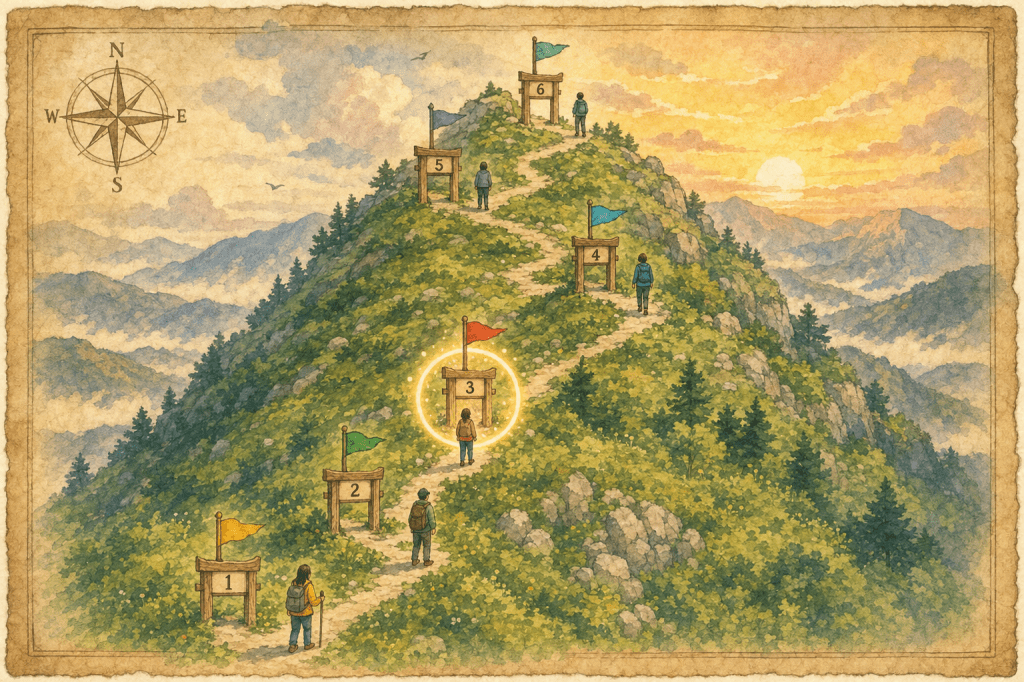
Return now to the chart we began with — but read it as a map of evidence, each gate annotated with the key that opens it: creation for gate one, falsifiable authorship for gate two, the Quran’s completeness for gate three, the counting for gate four, the covenant and its credential for gate five, coherence and obedience for the last mile. The whole journey of a soul, in one downward column, with the right key beside each lock.
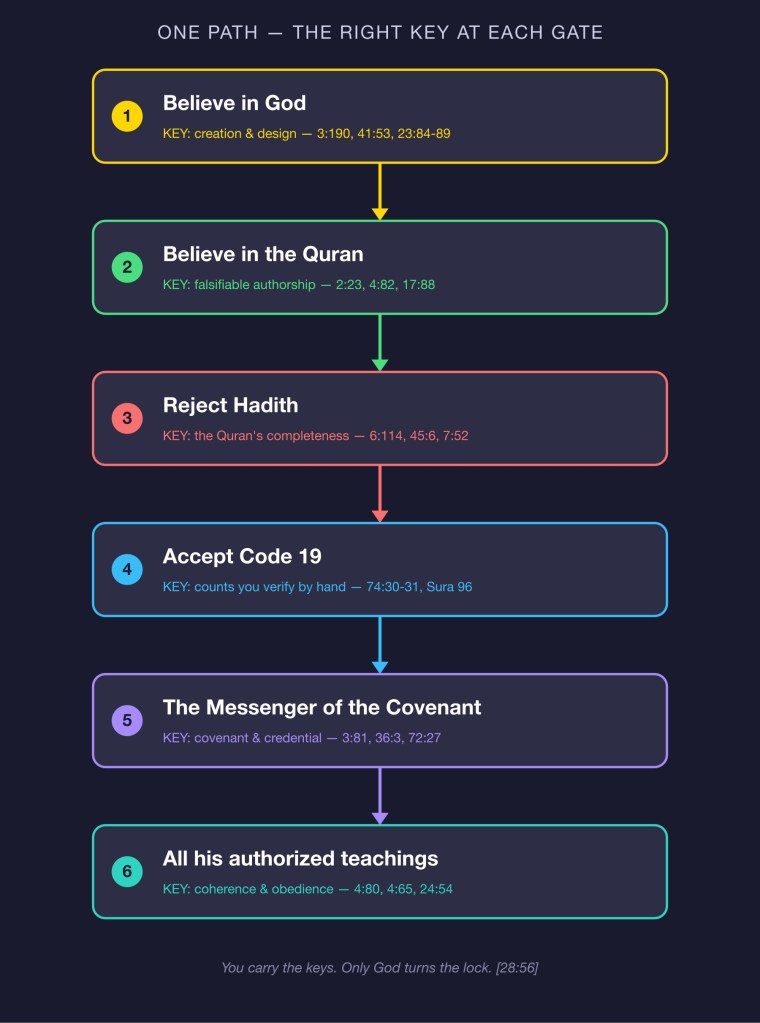
Now release yourself from the weight you were never asked to carry. You cannot guide the ones you love; God is the only One who guides [28:56]. You are not responsible for guiding anyone [2:272]. You were never asked to force anyone through a gate — “Do you want to force the people to become believers?” [10:99] — only to deliver the right key to the lock in front of you, in the best possible manner, and then to leave the door open. Abraham, threatened with stoning by his own father, modeled the exit: not a curse, but a blessing — “Peace be upon you. I will implore my Lord to forgive you” [19:47].
This is not a burden; it is the highest calling there is. The believer who learns to meet each soul at its own gate, key in hand and ego set aside, is doing the very thing the Quran exalts above all speech:
[41:33] “Who can utter better words than one who invites to God, works righteousness, and says, ‘I am one of the submitters’?”
Find the gate. Use the one key that fits. Speak nicely, even to a Pharaoh. Then step back and let God turn the lock. Continue the conversation with fellow travelers at discord.gg/submission.


 Quran Only Studies
Leave a comment