Introduction: The Seam in Plain Sight
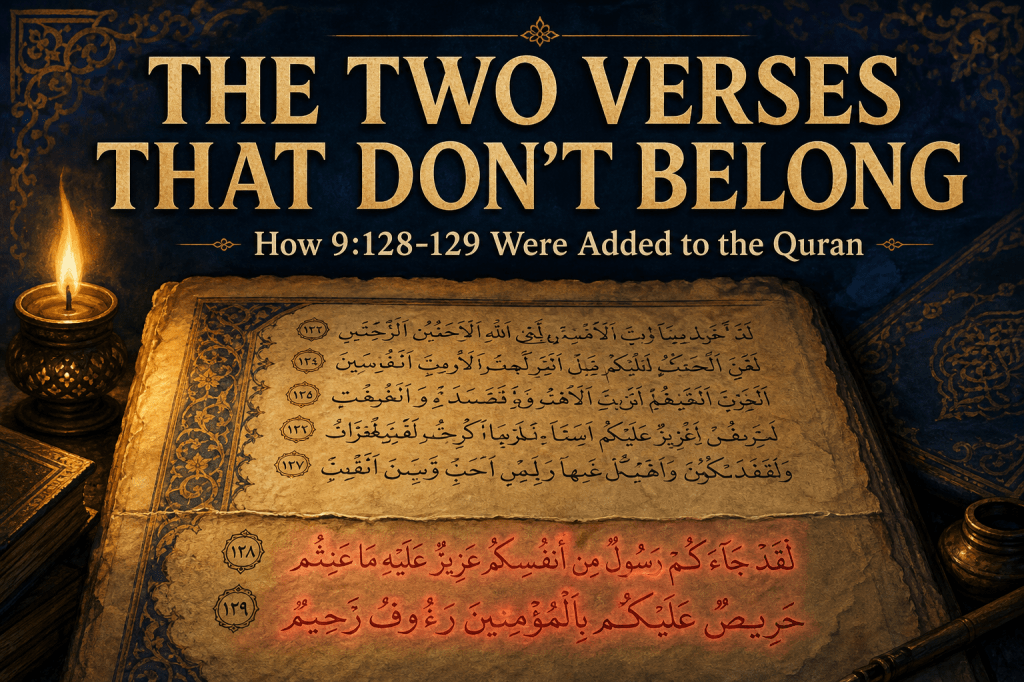
Open any printed copy of the Quran to the end of the ninth chapter — the chapter of Repentance, called Bara’ah — and count the verses. In the Final Testament, the authorized English translation that decodes the book’s mathematical structure, the chapter closes at verse 127. There is no verse 128 and no verse 129. The chapter ends, and chapter 10 begins. Yet in the traditional printed text two further verses appear after that point, verses that praise the messenger in soaring terms and end by applying two of God’s own attributes to him. These are the two verses this article is about, and the claim is direct: they were never part of the Quran that came through the prophet. They were added after his death.
This is not a reckless accusation thrown at scripture; it is the opposite. It is a defense of scripture’s perfection, and it rests on the most conservative possible reading of the historical record left by the very people who compiled the text. Three independent lines of evidence converge on the same seam: the documentary history of how the Quran was gathered, the internal content and language of the disputed material, and the mathematical structure woven through the entire book. And remarkably, the verse that sits as the true close of the chapter — verse 127 — describes the precise psychology of the people who would tamper, while another verse guarantees that God Himself would preserve His reminder. Preservation, as we will see, does not mean no one ever reached for the text. It means God built into the book the means to expose and remove whatever hands reached for it.
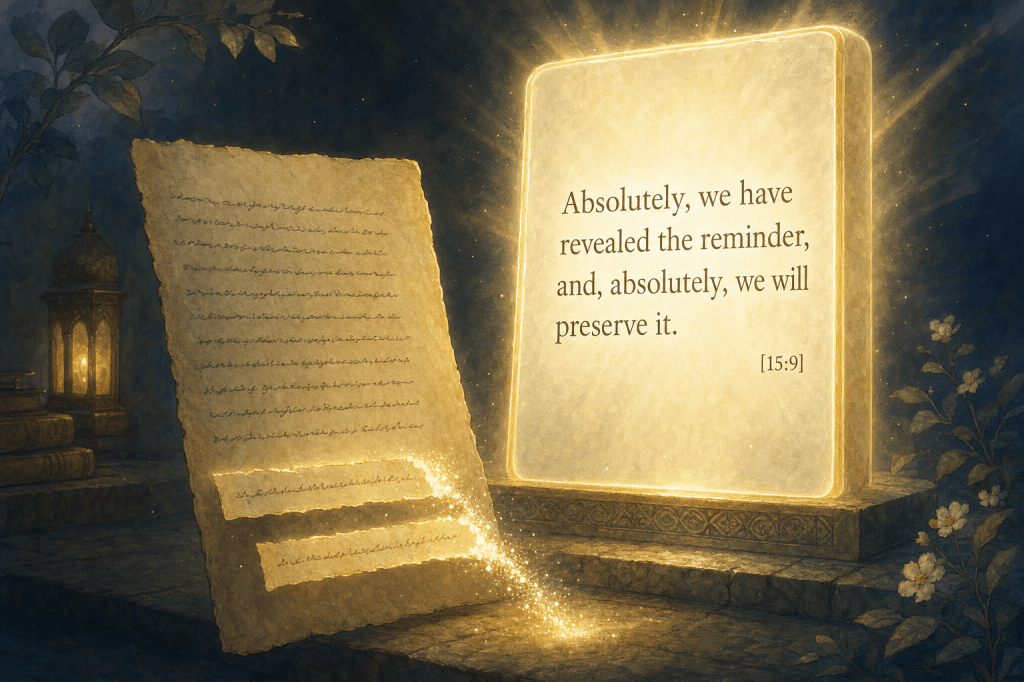
[15:9] “Absolutely, we have revealed the reminder, and, absolutely, we will preserve it.”
Hold that promise in mind. By the end of this study you will see that it was kept with mathematical precision — and that the messenger he honored was honored by God, while the two verses were the work of people who honored him too much, in a way only God deserves.
The Standard That Built the Quran: Mass-Corroboration
Why the original compilation could not be fooled
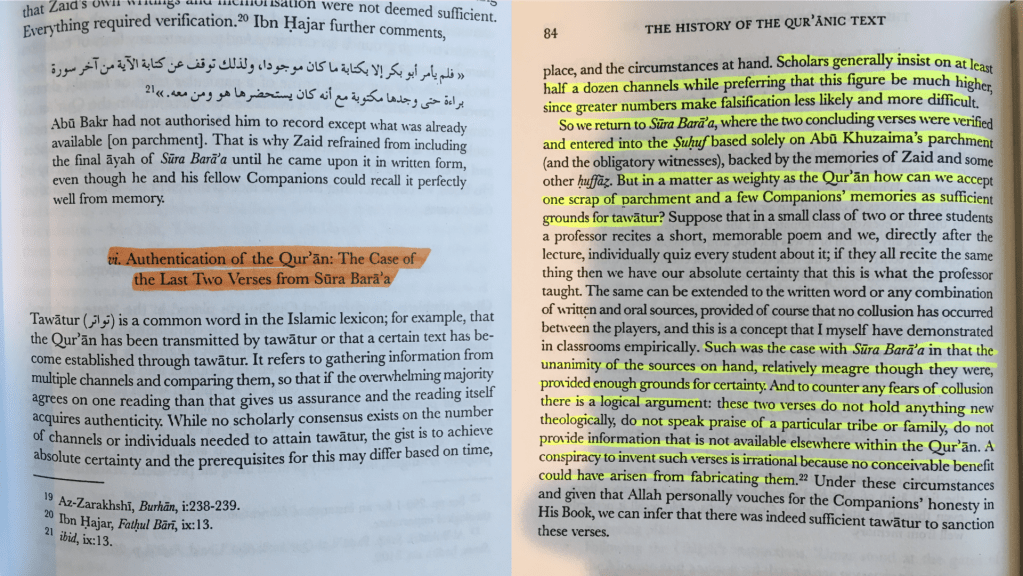
To understand why two verses stand out, you first have to understand the standard the rest of the Quran was held to. When the first compilation was undertaken under the leadership of Abu Bakr, the method was not the word of any single person. It was mass-corroboration — what the early community called tawatur — the principle that a passage is only accepted when it is independently confirmed by a multitude of witnesses whose collusion is impossible. Every verse had to be attested in two parallel streams at once: living memory, held in the hearts of a great many people who had memorized the revelation directly; and written record, preserved on the parchments, stones, and materials the scribes had inscribed during the prophet’s life. A verse confirmed by hundreds of memorizers and by the written folios was beyond doubt.
This double lock is the genius of the early effort, and it is why the Quran’s text is uniquely secure among ancient scriptures. A forger could not slip a line past it. To insert a fabricated verse, you would need to corrupt the memory of thousands of independent reciters scattered across the community and the independent written copies simultaneously — a practical impossibility. So when we are told that almost the entire Quran cleared this bar effortlessly, with abundant corroboration on every passage, we should take the claim seriously. And precisely because the standard was so high, the rare place where it broke down is the place that demands our attention. Only two verses in the whole book failed the test that every other verse passed. They are the last two of chapter 9.
The Lone Witness
“I did not find it with anybody other than him”
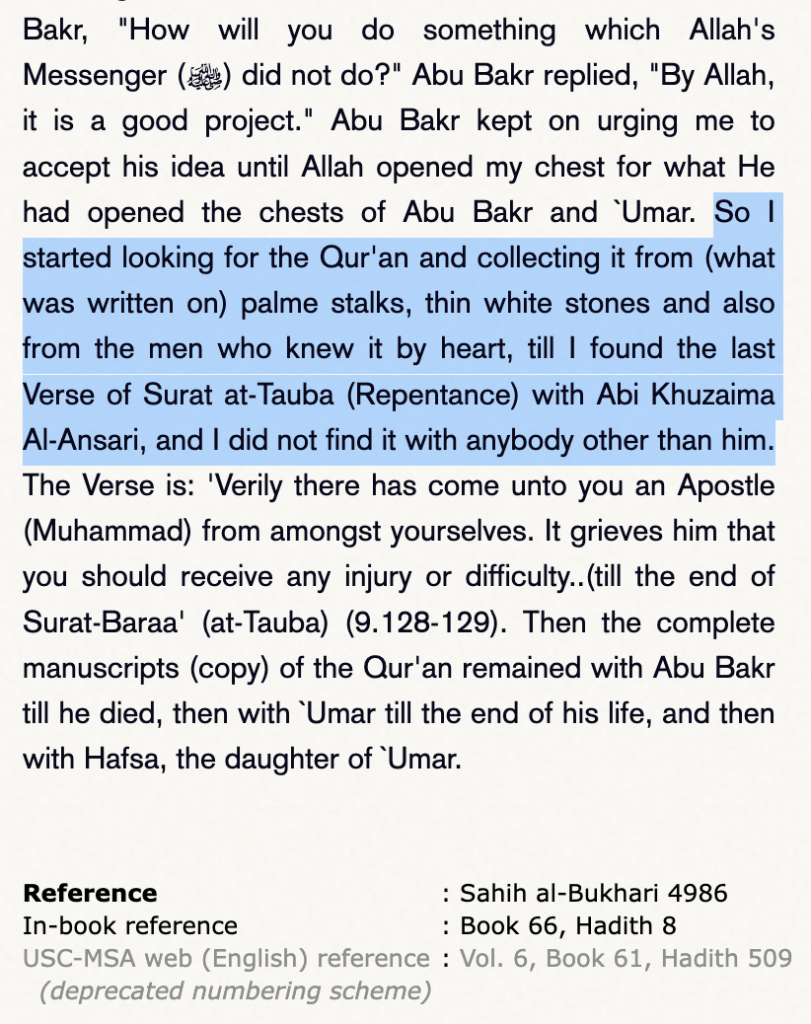
The break in the standard is recorded in the most respected of the traditional collections. Zaid ibn Thabit, the scribe entrusted with gathering the text, describes his method and then names the single exception in his own words. He collected the Quran, he says, “from palm stalks, thin white stones, and from the men who knew it by heart, till I found the last verse of Chapter Repentance with Abi Khuzayma al-Ansari, and I did not find it with anybody other than him.” That sentence is the entire case in miniature. The search swept across both channels at once — the written materials and the memorizing men — and the closing material of chapter 9 turned up in exactly one place: with one man, Abi Khuzayma, and with no one else.
Read against the standard described above, this is extraordinary. Every other verse of the Quran is mass-attested; this one is single-attested. The search was not casual or narrow — it covered the parchments and the thousands who carried the book in memory — and still, for these words alone, the corroboration was a single individual. A text that the whole community held in common should not hinge on one man’s solitary recollection. The other passages of the Quran did not; only this one did. The honest scribe did not hide the anomaly. He recorded it plainly, and it has sat in the open ever since, waiting to be read for what it is.
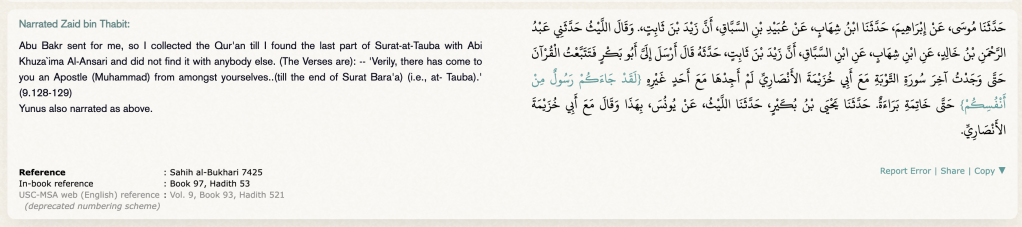
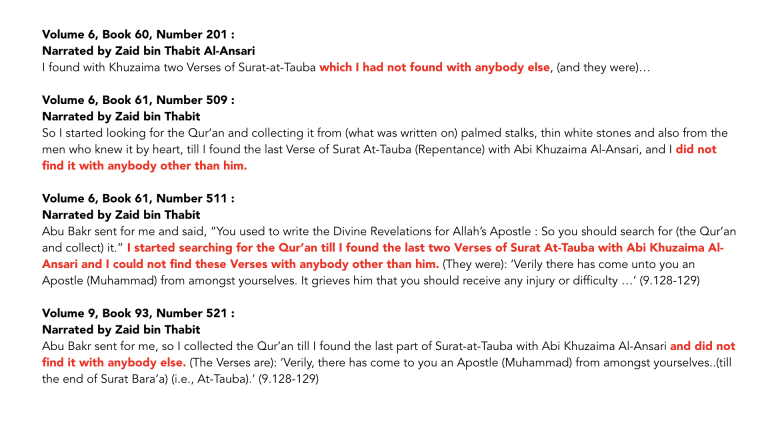
The defenders of the traditional text do not dispute that this narration exists; they cannot, since it sits in their own most authoritative source. Their response is to argue that this single witness was somehow good enough — that his lone testimony could carry the weight that every other verse required a multitude to carry. To evaluate that defense, we have to look at the very narration they use to vouch for the man.
The “Worth Two” Problem
A testimony given beyond direct knowledge
The argument for accepting one witness here goes like this: this was no ordinary witness, because the prophet had once declared Abi Khuzayma’s testimony to be “worth two.” If his word counts double, the reasoning goes, then his solitary attestation satisfies the requirement. But trace that ruling back to its source and it proves the opposite of what is claimed. The episode is recorded in Sunan Abi Dawud 3607. It concerns a dispute over a horse the prophet had purchased. A quarrel arose over whether the sale had been concluded, and witnesses were called. Khuzayma stepped forward and testified that the sale had taken place — even though he had not actually witnessed the transaction. When asked how he could testify to something he had not seen, he answered simply, “By considering you trustworthy, Messenger of God.” It was on that occasion that the prophet “made his witness equivalent to that of two.”
Look carefully at what that account actually establishes. The single qualification that supposedly makes Khuzayma a sufficient witness is an episode in which he testified to a fact he had not personally witnessed. His “worth two” status was earned precisely by going beyond his own direct knowledge on the strength of trust and good intention. That may speak to his sincerity, but it is exactly the wrong foundation for adding text to God’s preserved book. We are not questioning the man’s character; we are questioning the category of testimony. Scripture cannot be built on a witness who, by the very narration used to praise him, is celebrated for affirming what he did not directly know. The Quran itself sets the standard for witnessing, and it is the opposite standard:
[22:30] “Those who reverence the rites decreed by God have deserved a good reward at their Lord. All livestock is made lawful for your food, except for those specifically prohibited for you. You shall avoid the abomination of idol worship, and avoid bearing false witness.”
[4:135] “O you who believe, you shall be absolutely equitable, and observe God, when you serve as witnesses, even against yourselves, or your parents, or your relatives. Whether the accused is rich or poor, God takes care of both. Therefore, do not be biased by your personal wishes. If you deviate or disregard (this commandment), then God is fully Cognizant of everything you do.”
God commands testimony that is absolutely equitable and warns, in the same breath as idol worship, against bearing witness to what one has not verified. A testimony offered “by considering you trustworthy” rather than by direct knowledge is the very thing these verses guard against. So the qualification cited to justify the single witness is, on inspection, the disqualification. The foundation for the last two verses is not corroboration; it is one man’s sincere but extended testimony — and that cannot bear the weight of an addition to the book God promised to preserve.
Two Structural Anomalies
The only chapter missing its opening — and two verses from the wrong city
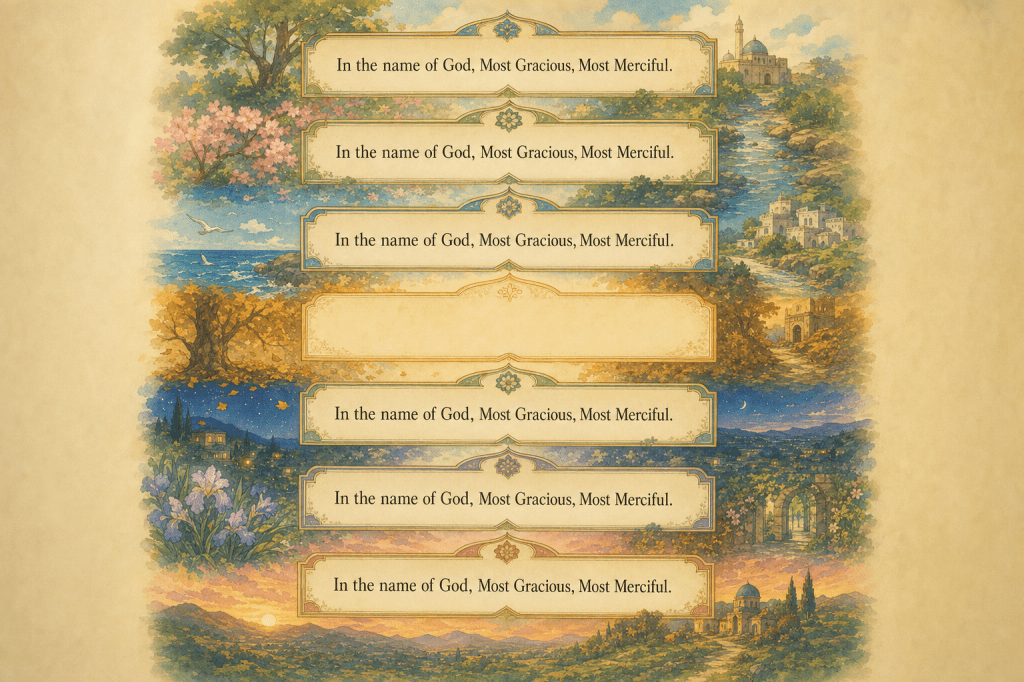
Set the testimony aside for a moment and look at chapter 9 simply as a structure, and two further oddities appear, each unique in the entire Quran. The first is its opening. Every one of the 114 chapters of the Quran begins with the same line — “In the name of God, Most Gracious, Most Merciful” — except this one. Chapter 9 is the single chapter in the whole book that does not open with that statement. A chapter already singled out as anomalous at its head is the same chapter that carries disputed material at its foot. That a book of such relentless structural regularity should have its one missing opening and its one single-witness ending in the very same chapter is not a coincidence to be waved away; it is a flag.
The second oddity concerns provenance. The chapters of the Quran were revealed either in the early period associated with one city or the later period associated with another, and each chapter is, as a rule, wholly of one or the other. Chapter 9 belongs to the later, Medinan period in its entirety — except that the two disputed closing verses are uniquely labeled as belonging to the earlier, Meccan period. A Medinan chapter with two foreign-provenance verses grafted onto its end is exactly the seam a careful reader should expect to find if something were appended from elsewhere. We have explored elsewhere how the book’s perfect structure rests on this kind of regularity, and how the opening statement is itself part of the mathematical lattice that secures the text (see our study The Quran Alone: God’s Perfect Epistemology). The point here is simpler: two independent structural features both flag the same two verses.
What the Companions Said
The internal record: it ended at 127
The strongest confirmation that something was appended comes not from later critics but from the prophet’s own closest companions, whose reactions are preserved in the early literature on the text. The first scribes treated verse 127 as the close of the chapter; the additional material was a later question, not part of the settled text. When the question of what to do with the extra lines arose, Umar is reported to have said that had the additional material amounted to three verses, he would have made it a separate chapter of its own — a remark recorded in Ibn Abi Dawud’s Kitab al-Masahif. You do not propose making a passage into its own independent chapter if it is the seamless, original ending of the chapter already before you. The very suggestion betrays that the early community regarded this material as detached, of uncertain placement, an orphan looking for a home.
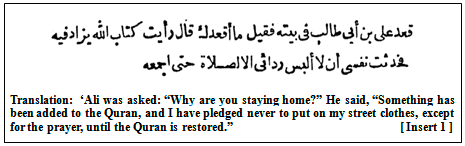
Even more striking is the protest of Ali. According to al-Suyuti’s al-Itqan fi Ulum al-Quran (volume 1, pages 57-58), Ali withdrew in objection, declaring: “I think something has been added to the Book of God; so I will not put on my street clothes except for the Friday prayer until it is resolved.” These are not the words of a modern skeptic. This is one of the most senior figures of the early community, registering in the plainest language that he believed an addition had been made to the text. When the people closest to the events — the ones doing the compiling — say in their own preserved words that the material was orphaned and that something had been added, the modern reader is not speculating by taking them at their word. The internal record itself testifies that chapter 9 ended at verse 127.
The Content Tell
God’s own attributes, handed to a man
If the documentary trail tells us how the verses entered, the language of the verses themselves tells us why. The disputed closing of 9:128 ends by describing the messenger with two attributes — in the disputed Arabic, the pairing rendered “Compassionate, Merciful.” Here we must be precise, because these words are not in the Final Testament; they are the interpolated material under examination, so we mark them clearly as such rather than presenting them as scripture.
The traditional ending attributed to 9:128 closes with the phrase بِالْمُؤْمِنِينَ رَءُوفٌ رَّحِيمٌ — “toward the believers, Compassionate, Merciful” — applying the attribute-pair رَءُوفٌ رَّحِيمٌ (ra’uf, rahim: “Compassionate, Merciful”) to the messenger himself.
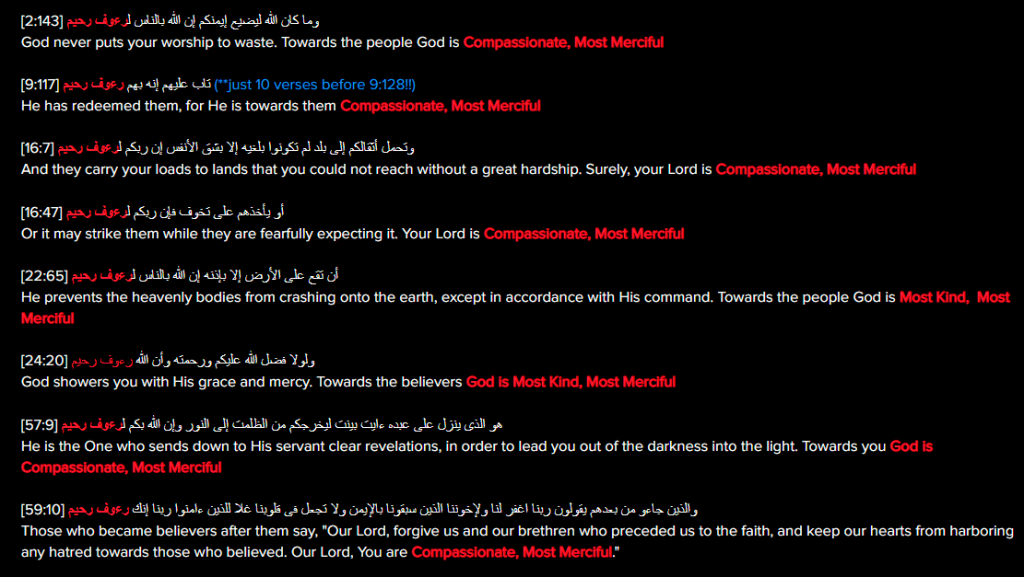
Now consider how that exact attribute-pair is used everywhere else in the text. The consecutive pairing رَءُوفٌ رَّحِيمٌ occurs exactly eight times in the Final Testament, and every single one of those eight describes God — never a created being. The eight are: [2:143], [9:117], [16:7], [16:47], [22:65], [24:20], [57:9], and [59:10]. (The English rendering sometimes reads “Compassionate” and sometimes “Most Kind,” but the underlying Arabic root is identical in all eight.) In every authentic instance the pair belongs to the Lord. The disputed ending of 9:128 would be the lone exception in the entire book — the one and only time this divine attribute-pair is applied to a creature.
The nearest authentic example sits only ten verses before the seam, and it shows the pair used exactly as it always is — for God:
[9:117] “God has redeemed the prophet, and the immigrants (Muhãjireen) and the supporters who hosted them and gave them refuge (Ansãr), who followed him during the difficult times. That is when the hearts of some of them almost wavered. But He has redeemed them, for He is Compassionate towards them, Most Merciful.”
That is the fingerprint. People who loved the messenger to excess reached for the highest words they knew to honor him — and the highest words they knew were God’s. The interpolation is not crude; it is reverent, even beautiful. That is exactly what makes it diagnostic. A fabricator inserting hatred would be easy to spot. A community elevating its prophet with language the Quran reserves for the Lord alone leaves a subtler trace — but a trace nonetheless, and one that points straight at the motive. The verses do not belong, and the reason they were made is written into their own words.
The Mathematical Seal
Nine words that break the code
The documentary and linguistic evidence would be persuasive on their own. But the Quran carries a third, independent witness that the human compilers could neither have engineered nor anticipated: the mathematical structure built on the number 19 that runs through the entire book. This structure governs counts at every level — chapters, verses, and the words within them — and it is so tightly interlocked that disturbing one element ripples through many others. It is, in effect, a built-in error-detection system, a divine checksum on the text. Add foreign material and the arithmetic refuses to close.
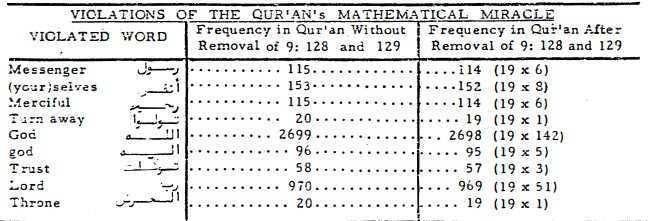
The two disputed verses contain twenty-nine words between them. When those twenty-nine words are included in the relevant tallies, they knock nine separate word-counts off their exact multiples of 19, as documented in Appendix 24 of the Final Testament. Pause on the scale of that. If these verses were genuine, random chance would predict that at most one or two counts might happen to fall on a multiple of 19 and be disturbed by their removal; instead, including them disrupts nine distinct nineteen-based counts at once. That is not the signature of authentic text being removed — it is the signature of foreign text being detected. Strip the twenty-nine words away, and the structure snaps back into place, every count resting cleanly on its multiple of 19, with the chapter closing exactly where the historical record independently says it closed: at verse 127. The mathematics does not merely permit the boundary at 127; it confirms it, and it identifies the intruding words with a precision no human committee could fake. We have set out the code’s logic and answered the technical objections to it at length in our study The Mathematical Miracle of 19, and traced the broader manuscript and preservation picture in The Manuscript Evidence: Quran vs. Hadith Sources.
God Foretold It
Verse 127 as the true close — and a preserved book
Now return to where the chapter actually ends, and read the true final verse with everything we have seen in view. Verse 127 — the genuine close — does not describe distant unbelievers. It describes people on the inside, near the revelation, who behave furtively, glancing around to see whether they are being watched, and whose hearts God has turned away because they fail to comprehend.
[9:127] “Whenever a sura was revealed, some of them would look at each other as if to say: ‘Does anyone see you?’ Then they left. Thus, God has diverted their hearts, for they are people who do not comprehend.”
Consider the placement. The authentic chapter ends on a portrait of people who operate by stealth around the revelation, checking whether anyone is looking before they slip away — and it is at precisely that verse, immediately after that portrait, that two unauthorized verses were attached. The true ending describes the very mentality of those who would tamper, and then the tampering begins. That is the seam, and the verse before it reads almost like a caption for what comes next. This is why preservation does not mean that no hand ever reached for the text. The promise of [15:9] — “we will preserve it” — was never a claim that no one would try. It is a guarantee that every attempt would be caught and undone, because God built the means of detection into the book itself: the open historical record that names the lone witness, and the mathematical structure that flags the exact words. The preserved original stands, and the addition is exposed precisely as foreign.
And there is a quiet, final confirmation that needs no argument at all. The Final Testament — the authorized English translation through which the book’s mathematical structure was deciphered — ends chapter 9 at verse 127. There is no 9:128 and no 9:129 in it. The translation that unlocked the code stops exactly where the historical record, the companions’ own protests, and the arithmetic all say the original stopped. Three independent witnesses and the restored text agree on a single boundary. The reminder was revealed, and it was preserved.
Rebutting the 33:23 Objection
Why “but another verse was also found with one man” fails
Defenders of the traditional ending raise one counter that deserves a fair answer. They point out that verse 33:23 was also reportedly located with only Abi Khuzayma, and argue that if a single witness invalidates 9:128-129, it must equally invalidate 33:23 — so the argument proves too much. The objection sounds symmetrical, but the two cases are not parallel at all, and the difference is decisive. The relevant accounts are recorded in Sahih al-Bukhari 2807 and Jami at-Tirmidhi 3104.
In the case of 33:23, Zaid ibn Thabit had already memorized the verse; he recalled hearing the prophet recite it, and the verse was independently attested in the living memory of the community. What he was doing during the later effort was locating the written folio for a verse that was already mass-corroborated in memory — verifying a manuscript page, not establishing the existence of unknown text. The memory channel was already satisfied; only the parchment needed to be found. That is an ordinary act of cataloguing, and it threatens nothing. The situation with 9:128-129 is the exact reverse: there was no independent memory of the material and no independent written attestation — the words turned up with one man and, in the scribe’s own phrase, “not with anybody other than him,” with no second channel to confirm them. One case is a single manuscript folio for a verse the whole community already carried; the other is the sole existence of words no one else had. The objection collapses the moment the two are laid side by side, because corroboration, not the name of a witness, is what the standard was ever about.
Honouring the Messenger
Who really did this — and why it changes nothing about the prophet
It is essential to be clear about who stands accused here, because the answer is the opposite of what the casual reader might assume. The prophet is not diminished by this study; he is defended by it. He delivered the Quran exactly as he received it, and it closed at verse 127. He had nothing to do with the two added verses — he was already gone when they were attached. The people who added them did so out of devotion, not malice. They loved him, and in their grief and reverence they reached for the most exalted language they possessed and draped it over his memory — language that belongs to God alone. The interpolation is an act of idolizing the messenger, the very error the Quran warns against most insistently: elevating a servant of God into a recipient of God’s own attributes.
This is precisely how the messenger of the covenant, Rashad Khalifa, explained the historical pattern in his recorded teaching documenting the history of these verses (see the lecture Heavenly Community, No Mosques For God Alone, The Arabs, 9:128-129 History). Describing why God permitted two false verses to remain in the printed text for fourteen centuries, he taught: “just a few years after the prophet’s death, they reverted to idolatry… only this time around their idol was the prophet who defeated them.” That single sentence captures the whole mechanism. The addition is not evidence against the prophet; it is evidence of how thoroughly later generations idolized him, and how easily love for a righteous man curdles into the worship that belongs to God. Honoring the messenger means refusing to give him what is God’s — and that is exactly what removing these two verses accomplishes. The mathematical code does not attack the prophet. It restores the book he delivered and clears his name of words he never spoke.
Conclusion: A Boundary Three Witnesses Agree Upon
The case for the two verses being later additions does not rest on any single thread that a skeptic could pull. It rests on three independent lines that converge on one boundary. The documentary record, in the traditional community’s own most authoritative sources, shows that the closing material of chapter 9 was found with a single man, against a standard of mass-corroboration that every other verse cleared — and that the lone witness’s “worth two” status came from testifying beyond his direct knowledge, the very thing the Quran forbids. The internal record shows the prophet’s closest companions calling the material orphaned and protesting that “something has been added to the Book of God.” The structure shows the one chapter without an opening line, two verses uniquely assigned to the wrong period, an attribute-pair reserved for God alone applied to a man, and a nineteen-based mathematical lattice that breaks in nine places when the twenty-nine words are included and snaps shut when they are removed.
Each line is independent of the others, and each lands on the same verse: 127. History, the companions, language, and mathematics are not easily made to agree by accident; here they agree completely. And presiding over all of it is the promise of [15:9], kept not by preventing every human hand from reaching for the text, but by guaranteeing that whatever was added could be found and removed — which is exactly what has happened. The Final Testament closes chapter 9 at verse 127, and the code that unlocked it confirms the same close. The reminder was revealed, and it was preserved.
So read the end of chapter 9 again, and read it with confidence. The prophet delivered a book that ended at verse 127. Those who idolized him added two more out of a love that overreached into the worship of a man. And God, who promised to preserve His reminder, left in plain sight the means to lift the addition away and hand the original back, whole and exact. The two verses do not belong — and now you can see, from every angle at once, exactly why.


 Quran Only Studies
Leave a comment