Introduction: The Obsession That Reveals the Heart
Of all the questions a person could ask about the path to God, one receives a volume of attention out of all proportion to its weight in scripture: what a woman wears on her head. Step into almost any traditional religious forum and you will find the woman’s hair treated as the frontier of faith itself — debated, policed, legislated, and enforced with a passion that the same voices rarely spend on idolatry, injustice, or the Hereafter. Yet across the 6,346 verses of the Quran, God devotes thousands of verses to His Oneness, to devotion, to the Day of Judgment, to charity and honesty and the salvation of the soul — and a mere handful to how anyone should dress. Something has gone badly wrong with our sense of proportion, and that distortion is itself the subject of this article.
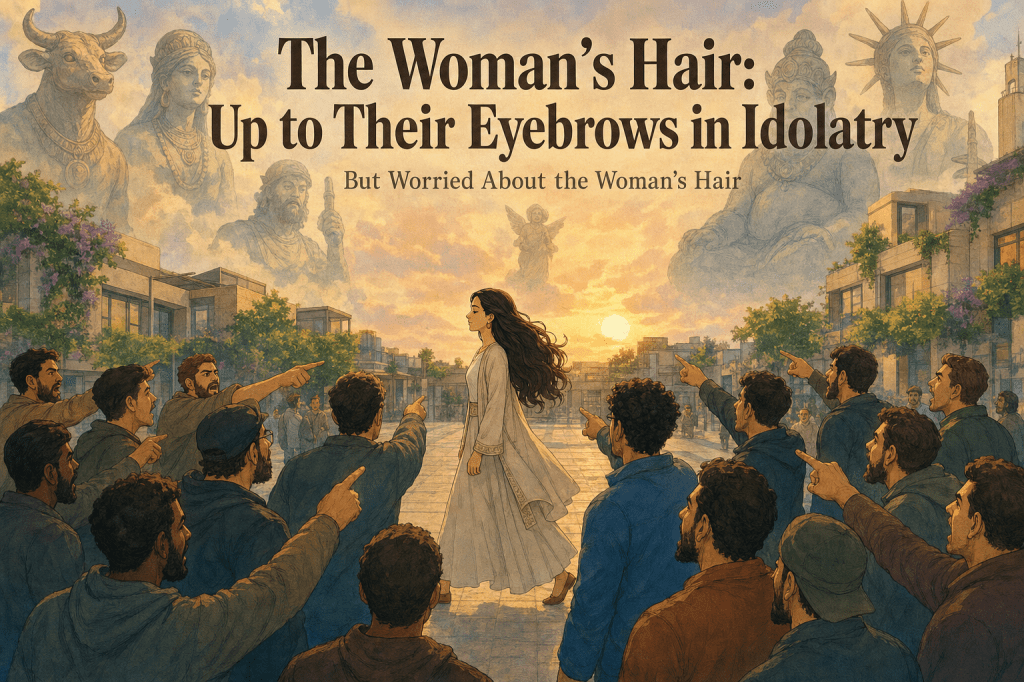
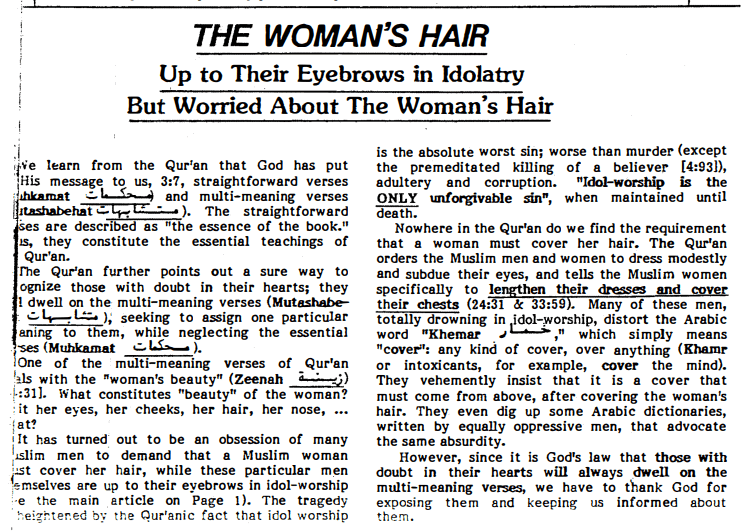
Rashad Khalifa named the disorder precisely. In a newsletter that has circulated among Submitters for decades, he titled the matter “The Woman’s Hair — Up to Their Eyebrows in Idolatry But Worried About the Woman’s Hair.” His point was not subtle and it was not meant to be: a great many men who demand that a woman cover her hair are themselves immersed in the one sin God has declared unforgivable, and they cannot see it because they are too busy measuring someone else’s hairline. This is the spiritual equivalent of straining out a gnat while swallowing a camel. In the pages that follow we will do three things: show what the Quran actually says about dress, dismantle the linguistic sleight-of-hand used to manufacture a hair-covering law, and trace that law back to its real source — not God, but seventh-century class custom and state power, policed by Umar ibn al-Khattab himself, even with a whip.
Part 1: The Law of 3:7 — Why Doubters Always Reach for the Ambiguous Verse
Two Kinds of Verses, Two Kinds of Hearts
Before we examine a single word about clothing, we have to understand the diagnostic God placed at the very start of the third chapter. The Quran tells us that its verses come in two varieties, and that how a person handles them exposes the condition of the heart. There are straightforward verses that form the backbone of the message, and there are verses that carry more than one possible meaning. People who carry doubt, God says, will always gravitate toward the ambiguous ones — not to understand, but to manufacture a reading that suits them.
[3:7] “He sent down to you this scripture, containing straightforward verses—which constitute the essence of the scripture—as well as multiple-meaning or allegorical verses. Those who harbor doubts in their hearts will pursue the multiple-meaning verses to create confusion, and to extricate a certain meaning. None knows the true meaning thereof except God and those well founded in knowledge. They say, ‘We believe in this—all of it comes from our Lord.’ Only those who possess intelligence will take heed.”
This is not a marginal observation; it is a law of human behavior that God built into the scripture as a sieve. The straightforward verses about dress are blunt and few: cover the chest, lengthen the garment, dress modestly. There is no flexibility in them and no mystery. But the word “adornment” — what a woman should not flaunt — carries a range of meanings, and it is exactly there, in the elastic word, that the hair-obsessed crowd plants its flag. They pass over the plain command and pour all their energy into the ambiguous term, twisting “adornment” until it yields the answer they wanted before they ever opened the book. Rashad observed that this is precisely what 3:7 predicts: the doubters cannot help themselves. The very fact that the hair-covering doctrine has to be extracted from an ambiguous word, rather than read off a clear command, is the first and loudest piece of evidence that it is a human invention.
Part 2: What the Quran Actually Commands — Cover the Chest, Not the Hair
The Plain Reading of 24:30-31
God’s dress guidance begins not with women but with men, and not with cloth but with the gaze. Believing men are told first to lower their eyes and guard their chastity — the discipline of modesty is placed on the one who looks before it is placed on the one who is looked at. Only then does the instruction turn to women, and when it does, the single garment-specific command is unmistakable: cover the chest.
[24:30] “Tell the believing men that they shall subdue their eyes (and not stare at the women), and to maintain their chastity. This is purer for them. God is fully Cognizant of everything they do.”
[24:31] “And tell the believing women to subdue their eyes, and maintain their chastity. They shall not reveal any parts of their bodies, except that which is necessary. They shall cover their chests, and shall not relax this code in the presence of other than their husbands, their fathers, the fathers of their husbands, their sons, the sons of their husbands, their brothers, the sons of their brothers, the sons of their sisters, other women, the male servants or employees whose sexual drive has been nullified, or the children who have not reached puberty. They shall not strike their feet when they walk in order to shake and reveal certain details of their bodies. All of you shall repent to God, O you believers, that you may succeed.”
Read it again and notice what is simply not there. The verse names the chest. It does not name the hair. Out of an entire detailed list of relatives before whom a woman may relax her dress, out of an explicit warning against striking the feet to draw attention to the body, God never once says “cover your head” or “hide your hair.” If hair-covering were the load-bearing pillar that tradition has made it, this is the verse where it would appear in plain words — and it is absent. Rashad Khalifa’s own footnote to these two verses, printed in the Final Testament, draws the conclusion without flinching: “The minimum requirements for a woman’s dress is to lengthen her garment (33:59) and to cover her chest. Tyrannical Arab traditions have given a false impression that a woman must be covered from head to toe; such is not a Quranic or Submission dress.” The phrase is worth weighing — he calls the head-to-toe doctrine a product of “tyrannical Arab traditions,” not of God.
The Whole Code: 33:59 and 24:60
Two further verses complete the picture, and neither adds a hair clause. The first explains the purpose of lengthening the garment: not concealment for its own sake, but recognition and safety, so that believing women are known as righteous and left unmolested in public.
[33:59] “O prophet, tell your wives, your daughters, and the wives of the believers that they shall lengthen their garments. Thus, they will be recognized (as righteous women) and avoid being insulted. God is Forgiver, Most Merciful.”
The second verse proves that the dress code is a guideline calibrated to circumstance rather than an inflexible uniform, because God explicitly permits older women to relax it — something He would never sanction if covering were an absolute act of worship like the prayer.
[24:60] “The elderly women who do not expect to get married commit nothing wrong by relaxing their dress code, provided they do not reveal too much of their bodies. To maintain modesty is better for them. God is Hearer, Knower.”
Put the three passages together and the entire divine dress code for a woman is this: lengthen the garment, cover the chest, dress modestly, and use judgment — with explicit room to relax in old age. That is the whole of it. Rashad summarized the same point from the most ritually strict setting imaginable, the Pilgrimage, where he described women’s dress as simply “regular modest dress, all white dress for example, so you cannot tell the rich from the poor” (at 19:50). Not a syllable about hair.

Part 3: The Linguistics of “Khimar” — A Cover Is Just a Cover
How One Word Became a Law
If the verses never mention hair, how did an entire civilization come to believe they do? The answer is a single Arabic word, “khimar,” and a centuries-long campaign to load it with a meaning it does not carry. The root of khimar means, simply, to cover. It is a generic verb for putting a cover over anything at all. The same root gives us “khamr,” the Quranic word for intoxicants — so named because they cover, or veil, the mind. A khimar is a cover; it is not, by its own meaning, a headscarf, a hood, or anything that must come from above and conceal the hair. To insist that it can only mean a head-covering is to smuggle a conclusion into the dictionary.
Now read what 24:31 actually does with that word. It does not say “cover your hair with your cover.” It says to draw the cover over the chest — over the bosom, the area the pre-Islamic style of dress left exposed. Even if we granted, for the sake of argument, that a woman of that time happened to wear a cloth on her head, the command God gives is to bring it down over the cleavage that was showing. The destination of the cloth named in the verse is the chest, not the scalp. As Rashad observed in his newsletter, the men who built the hair doctrine had to “dig up Arabic dictionaries written by equally oppressive men advocating the same absurdity” — they reverse-engineered a lexicon to license a custom they already practiced. This is the textbook behavior 3:7 warned about: seize the flexible word, ignore the fixed destination, and call the result the law of God.

Part 4: The “Hijab” Root Is Always a Barrier — Never a Headscarf
Eight Occurrences, One Meaning
The word that the modern world uses for a headscarf — “hijab” — does not mean headscarf anywhere in the Quran. Its root refers to a barrier, a partition, a screen that separates one thing from another, almost always something non-physical or spatial. Trace every single occurrence and a striking pattern emerges: not once does the root describe a garment worn on a woman’s head. It describes the barrier between Paradise and Hell, the invisible screen God places around a reciter of the Quran, the partition that separated Mary from her family, the cover of night, the barrier behind which God communicates with humanity, and the wall that shuts the wicked out from their Lord.
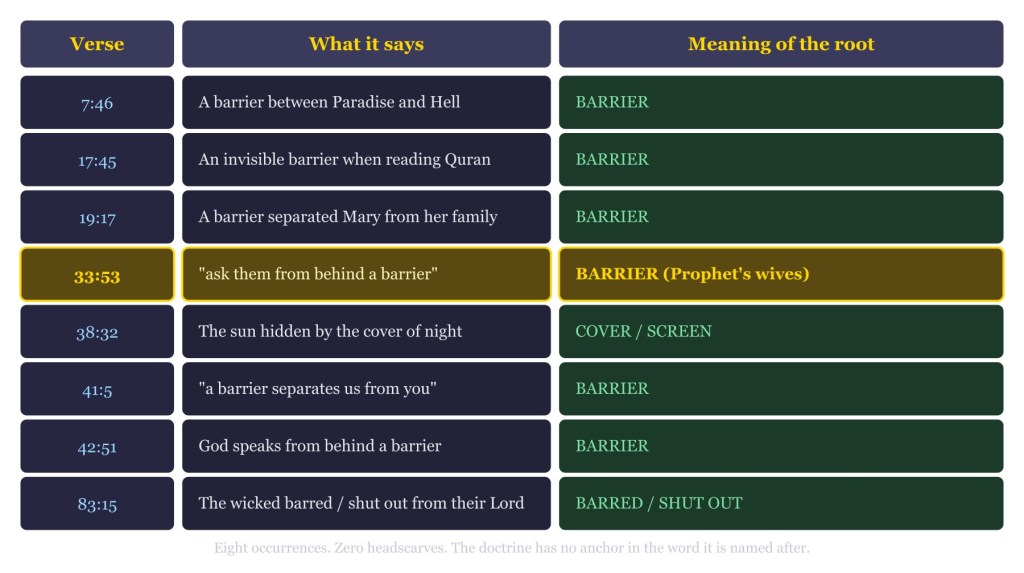
The verse traditionalists quote most often is 33:53, and it deserves a careful look because it actually proves the opposite of what they claim. The “barrier” there is a screen behind which visitors were to address the Prophet’s wives — a spatial partition in his household, not a garment, and certainly not a hair rule binding on every woman on earth.
[33:53] “…If you have to ask his wives for something, ask them from behind a barrier. This is purer for your hearts and their hearts. You are not to hurt the messenger of God. You shall not marry his wives after him, for this would be a gross offense in the sight of God.”
The context is explicit and exclusive. The wives of the prophet carried responsibilities and restrictions that applied to no other women, precisely because of who their husband was. God states plainly that they were “not the same as any other women” and that no one could marry them after him.
[33:32] “O wives of the prophet, you are not the same as any other women, if you observe righteousness. (You have a greater responsibility.) Therefore, you shall not speak too softly, lest those with disease in their hearts may get the wrong ideas; you shall speak only righteousness.”
The double recompense for their righteousness and the doubled retribution for sin (33:30-31), the prohibition on remarriage, the household screen — all of it is a special protocol for a unique household, never a universal hair law. To take a privacy partition built for the prophet’s home and convert it into a cloth that every woman must wrap around her head is to misread the verse twice over: once on its meaning, and once on its audience.
Part 5: What Does “Adornment” Actually Mean?
The Elastic Word the Doubters Seized
The whole hair doctrine ultimately hangs on the word the verse uses for a woman’s “adornment” — and this is the multiple-meaning word that 3:7 told us the doubters would exploit. Across the Quran, the word for adornment shifts meaning with context. Sometimes it means literal jewelry; sometimes worldly splendor; sometimes it is used as a verb for making something beautiful or appealing. It is never a fixed technical term for “hair,” and only a reader determined to find a hair law would force it to mean that.
[20:87] “They said, ‘We did not break our agreement with you on purpose. But we were loaded down with jewelry, and decided to throw our loads in. This is what the Samarian suggested.’”
[28:79] “One day, he came out to his people in full splendor. Those who preferred this worldly life said, ‘Oh, we wish that we possess what Qãroon has attained. Indeed, he is very fortunate.’”
Here the same root means jewelry in one place and ostentatious wealth in another. Elsewhere God uses the verb form for making faith itself beautiful in the believers’ hearts — “God made you love faith and adorned it in your hearts” [49:7] — an inner, spiritual beauty with no garment in sight. The decisive cross-reference, though, is the command to dress well for worship, which uses the very same word God supposedly wants hidden:
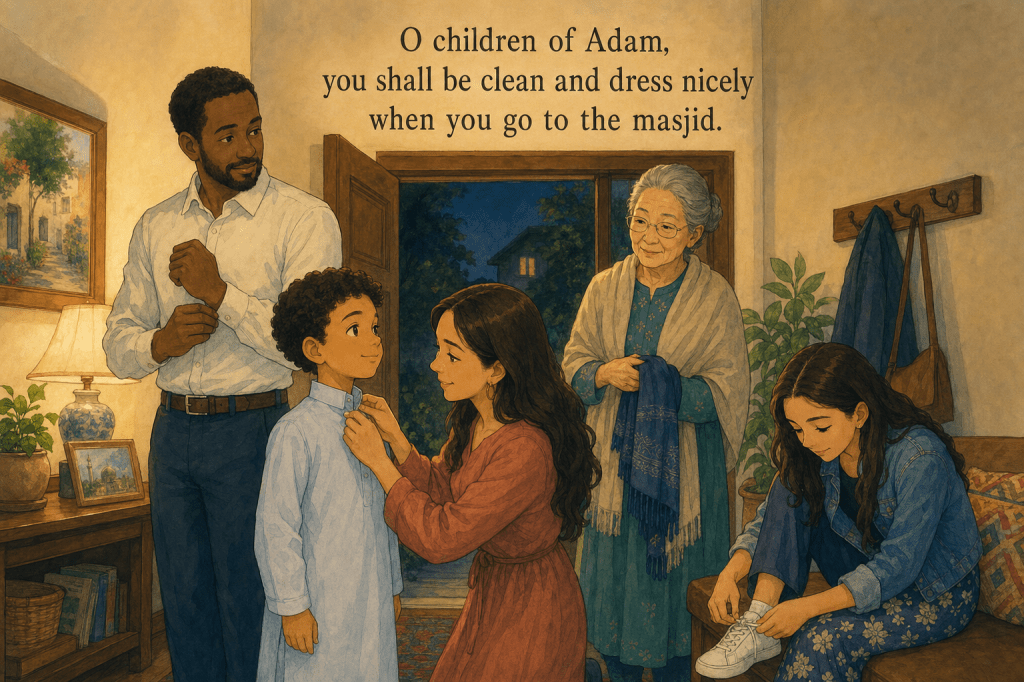
[7:31] “O children of Adam, you shall be clean and dress nicely when you go to the masjid. And eat and drink moderately. Surely, He does not love the gluttons.”
If adornment were an evil to be buried under cloth, God would not command us to bring our adornment to the mosque. The contradiction dissolves the moment we read honestly: the issue in 24:31 is not the existence of beauty but the flaunting of it in the wrong setting. Notice, too, that the verse forbids striking the feet to “reveal certain details of their bodies” — the concern is the body, not jewelry one could simply remove, and not hair. Rashad reduced the entire dress question to two clear commands he could find in the book and no more, explaining that the Quran says only “dress up for the mosque” and “dress modestly” (at 31:05). Two commands — and neither one is about hair.
Part 6: The Umar Narration — A Class Marker Policed by Violence
The Smoking Gun: Beaten for Covering
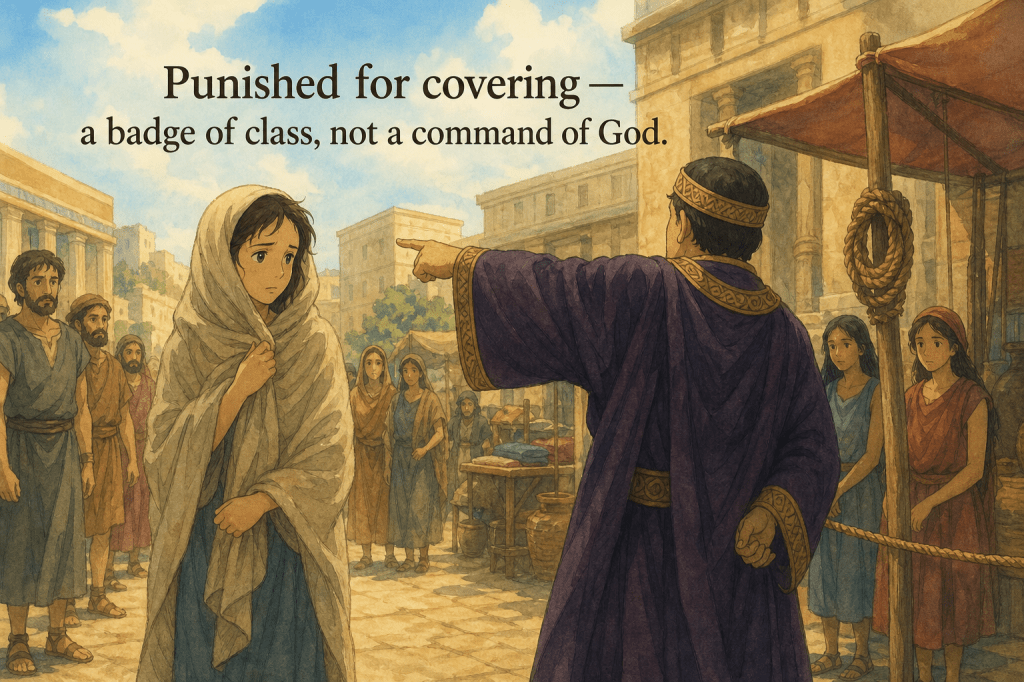
If covering the hair were a divine modesty law, then the most zealous early authority would have demanded it of every woman without exception. The historical record shows the exact opposite, and it is devastating. In the early collections preserved by tradition itself, Umar ibn al-Khattab — the second caliph — is reported to have struck a slave woman precisely because she had covered herself like a free woman. The covering was not a sign of piety to be encouraged; it was a class privilege to be denied to the enslaved, and Umar enforced the line with a whip.
The two narrations are recorded in the Musannaf of Ibn Abi Shaybah from Anas ibn Malik. In the first, Umar sees a slave-girl wearing a veil, strikes her, and says, “Do not imitate the free women.” In the second, a slave-girl comes wearing the longer outer garment; Umar asks whether she has been freed, and when she says no, he declares that such a garment “is only for the free women among the believing women,” striking her on the head until she casts it off (Musannaf Ibn Abi Shaybah, nos. 6382–6383; graded authentic by al-Albani, Irwāʾ al-Ghalīl 6:203; documented at Islam Compass). Sit with the implication. A man whom tradition reveres as a model of righteousness physically beat a woman for covering up. That is incomprehensible if covering is an act of worship owed to God — and perfectly coherent if covering was a legal badge of social status, free versus slave, policed by the state. The hair-covering regime did not descend from heaven; it was a marker of caste, and Umar was its enforcer.
The Veil as a Status Signal
The same logic surfaces in the account of the Prophet’s marriage to Safiyya, where the Companions decided his marital intent by a single visual cue — whether or not she was made to wear the veil. Tradition records their reasoning openly: “If he would make her wear the veil, then she would be a (free, married) woman; and if he would not make her wear the veil, then she would be a slave woman” (Sahih Muslim 1365e; sunnah.com). The veil here is not a modesty command at all; it is a social semaphore, read by onlookers to classify a woman’s legal standing. A covering that functions as a status marker — present for the free, forbidden to the slave, decoded by spectators — is by definition a human social institution, not a divine requirement of the soul. God does not assign acts of worship by social rank. Seventh-century Arab society did.
This is why the same body of fabricated narrations that produced the hair mandate also produced a thicket of rules designed to suppress women generally — barring them from the Friday prayer, from the mosque, from worship during menstruation. Rashad traced the whole apparatus to its true author. “Traditions from Satan,” he said. “Satan realizes that the woman is half the society… So Satan concentrated on the women. The Quran clearly guarantees the women’s rights” (at 22:57). The hair law belongs to that same machinery of suppression — and to the same author. This article stands alongside our companion piece on the manufactured restrictions placed on women’s movement, Women’s Freedom to Travel: Exposing the Mahram Hadith Fabrication, which exposes the identical pattern applied to a different freedom.
Part 7: How the “Hijab Verse” Was Born of Umar’s Lobbying
When a Man’s Opinion Became “Revelation”
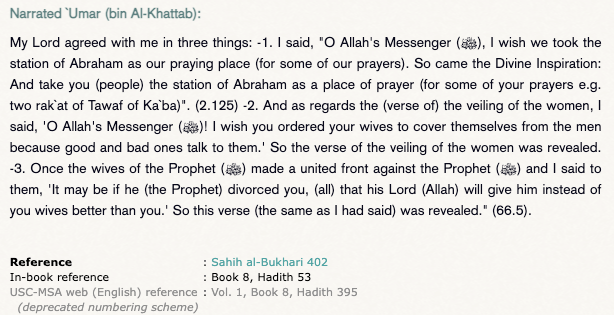
There is a deeper admission buried in the tradition, and it concerns the origin of the very verse traditionalists cite. According to several reports graded authentic in the canonical collections, Umar repeatedly pressured the Prophet to seclude his wives, and he later boasted that his own opinion was subsequently echoed in revelation. The collections call these episodes Umar’s “concordances” — the occasions when, by their own account, his suggestion came first and the verse came after.
The wording is explicit. Umar is reported to have said, “I said, ‘O Allah’s Messenger! I wish you ordered your wives to cover themselves from the men because good and bad ones talk to them.’ So the verse of the veiling of women was revealed” (Sahih al-Bukhari 402; sunnah.com). The same boast recurs: “I said, ‘O Allah’s Messenger! Good and bad persons enter upon you, so I suggest that you order the mothers of the Believers to observe veils.’ Then Allah revealed the Verses of Al-Hijab” (Sahih al-Bukhari 4790; sunnah.com; see also Bukhari 4483 and Muslim 2399). Read honestly, this is a confession, not a credential. By tradition’s own telling, the screening of the Prophet’s household originated in a man’s social anxiety about who was talking to whom — and that human suggestion was then dressed up as a command from God. The “hijab verse” they brandish is 33:53, the household barrier we examined earlier; it was prompted, on their own evidence, by Umar’s lobbying and aimed at the Prophet’s wives specifically. It was never a hair law for the believing women of every age and continent.
Recognized by Her Build, Not Her Hair
One more episode collapses the hair theory from a different direction. Tradition relates that after the household screening was prescribed, Sawda — a tall, heavyset wife of the Prophet — went out at night to attend to her needs, and Umar recognized her, calling out that she could not conceal herself from them. She complained, and revelation then permitted the women to go out for their needs (Sahih al-Bukhari 4795, sunnah.com; Sahih Muslim 2170a, sunnah.com). Notice what Umar recognized: her physical build, her unmistakable size — not her exposed hair. The entire episode is about a woman leaving the house and being identified by her stature; it says nothing whatsoever about a divine command to cover the head. Tradition’s own star witnesses, examined one after another, keep testifying to social status, household privacy, and physical recognition — and never once to a God-given law that a woman must hide her hair.
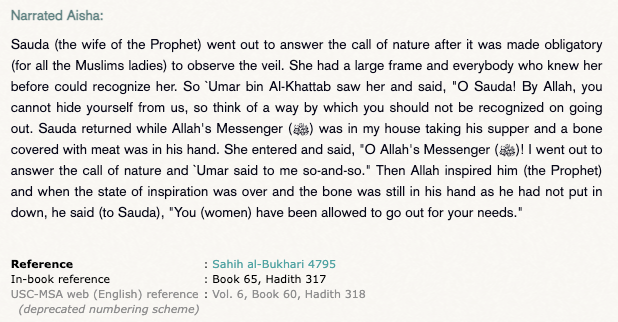
Stack the episodes together and a single coherent picture emerges, and it is not a picture of divine modesty. The screening originated in Umar’s lobbying; the covering it produced functioned as a badge of free status; and a woman of that household could still be picked out in public by her silhouette. Every thread runs back to seventh-century social rank and household arrangement, never to an act of worship owed by all women to their Creator. The harder one presses tradition’s strongest material, the more consistently it confesses that the hair mandate was a human institution wearing borrowed sacred clothing.
Part 8: Their Own “Proof” Refutes Them — They Tore Their Aprons
The Translator’s Interpolation
The traditionalist’s last line of defense is a pair of narrations attributed to Aisha, which they read as proof that the women of that era already wore headscarves and merely “extended” them when 24:31 was revealed. The English translations seem, at first glance, to support this — until you compare them with the Arabic printed beside them. The famous renderings claim the women “covered their heads and faces.” The Arabic says no such thing. The words “heads and faces” are an interpolation inserted by the translator; they do not exist in the original text.
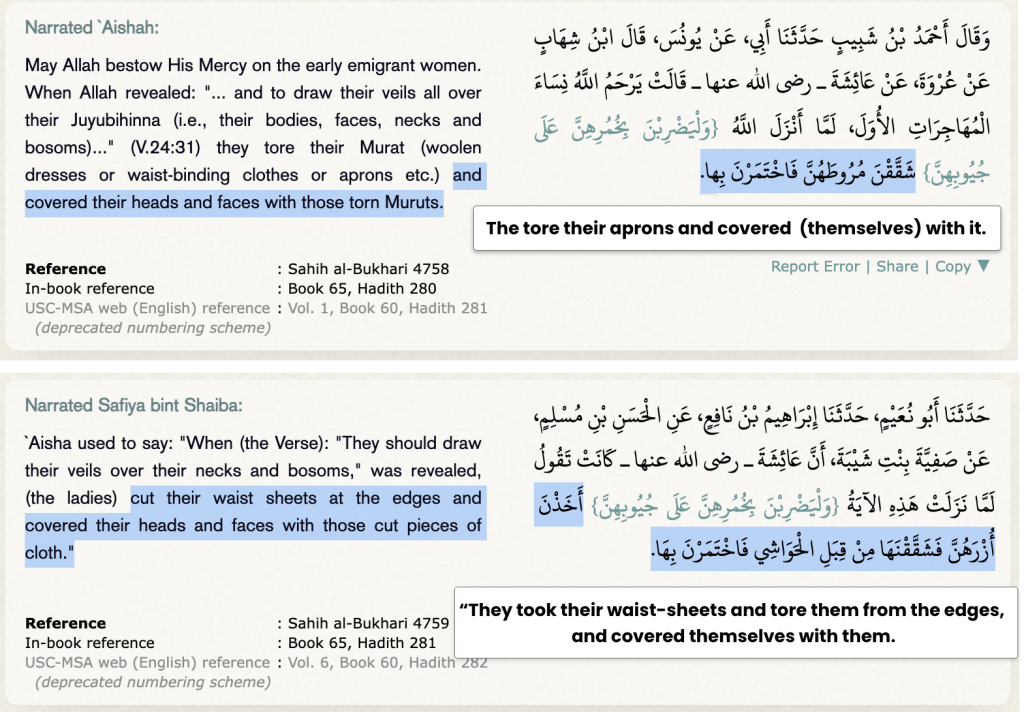
Look closely at what the Arabic actually reports. In Bukhari 4758, the phrase is “shaqaqna murūṭahunna fa-akhtamarna bihā” — “they tore their aprons (waist-binding cloths) and covered themselves with it” (Sahih al-Bukhari 4758, sunnah.com). In Bukhari 4759, the women “took their waist-sheets and tore them from the edges, and covered themselves with them” (Sahih al-Bukhari 4759, sunnah.com). The verb is from the root meaning “to cover,” with no grammatical object naming the hair, the head, or the face. And crucially, the garments being torn up are not headscarves at all — they are waist cloths, aprons, lower-body wraps. The women improvised covers for their newly-commanded chests out of the cloth they had on hand.
This destroys the traditionalist argument by their own most trusted source. Their claim requires that the women already had hair-coverings which they simply lengthened. But the authentic text says they cut up their waist garments to make covers — which means they were precisely not already covered on top. The narration that was supposed to prove pre-existing headscarves instead documents their absence. When even the strongest narration in the canon, read in its own Arabic, testifies against the doctrine it was summoned to defend, the doctrine has no foundation left. Our broader treatment of how such narrations were assembled and mistranslated is laid out in The Hadith Deception and The Divine Quran vs Human Hadith.
Part 9: Dress as State Control — The Pact of Umar
Cloth as an Instrument of Power
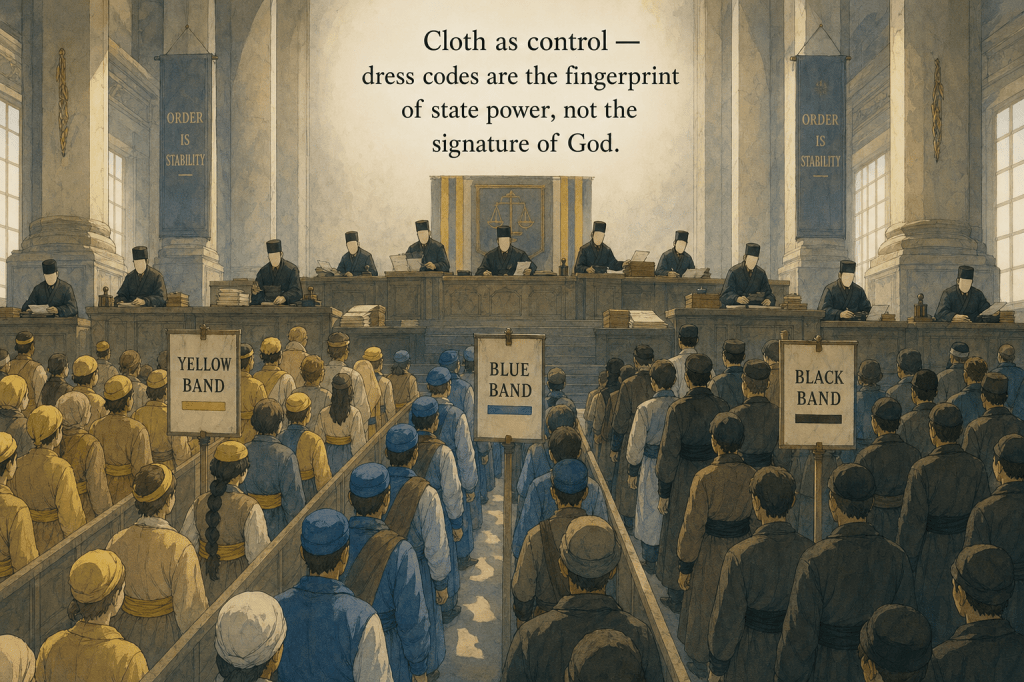
Once we see that covering was a social and legal marker rather than an act of worship, the historical trajectory falls into place. The Islamic state did not treat dress as a private matter between a soul and its Creator; it treated dress as a tool of administration, hierarchy, and humiliation. The clearest example is the so-called Pact of Umar — a set of conditions attributed to the caliphate and imposed on conquered non-Muslims — which dictated, in minute detail, what they were forbidden to wear. They pledged not to imitate the Muslims “by imitating any of their garments, the qalansuwa [cap], the turban, footwear, or the parting of the hair,” to “bind the zunnar [belt] round our waists,” and to “clip the fronts of our heads” (text in the Medieval Sourcebook, Hanover College; on the distinguishing belt see Zunnar).
Historians note that the Pact in its received form was likely formalized generations later — probably in the ninth century rather than literally drafted by Umar himself — so it is best described as attributed to him rather than authored by him. But the trajectory it represents is thoroughly documented and undeniable: belts, caps, turban colors, and badges decreed by successive Abbasid, Fatimid, Mamluk, and Ottoman authorities to mark and rank entire classes of people by their clothing. This is the true genealogy of the covering regime. It belongs to the same world of color-coded turbans and compulsory girdles — a world in which rulers used cloth to sort, subordinate, and shame. Dress codes of this kind are the fingerprints of state power, not the signature of God. When a modern government sends its morality police into the streets to measure a woman’s hairline, it is not reviving a divine law; it is reviving an imperial instrument of control.
Part 10: Even If It Were Divine, Forcing It Is the Crime
No Compulsion — Not Even in a Real Command
Suppose, for the sake of argument, that we were wrong about every linguistic and historical point above, and that God really did want women to cover their hair. Even then, the men who enforce it at the point of a baton or a prison sentence would be in flagrant violation of God’s law — because the Quran forbids compelling anyone in religion at all. The most foundational principle of the faith is freedom of conscience, and it admits no exception for popular religious laws.
[2:256] “There shall be no compulsion in religion: the right way is now distinct from the wrong way. Anyone who denounces the devil and believes in God has grasped the strongest bond; one that never breaks. God is Hearer, Omniscient.”
God goes further, condemning those who presume to outlaw the good things and the beautiful things He created for people to enjoy, and demanding hard evidence — not inherited opinion — from anyone who claims a prohibition comes from Him.
[7:32] “Say, ‘Who prohibited the nice things God has created for His creatures, and the good provisions?’ Say, ‘Such provisions are to be enjoyed in this life by those who believe…’”
[6:150] “Say, ‘Bring your witnesses who would testify that God has prohibited this or that.’ If they testify, do not testify with them. Nor shall you follow the opinions of those who reject our revelations…”
This reframes the entire conflict. The woman who walks out with her hair uncovered, in a society that tries to force her to hide it, is not the transgressor — the ones forcing her are. The Quran teaches that aggression is permitted only against aggressors, and that oppression is a graver evil than killing.
[2:193] “You may also fight them to eliminate oppression, and to worship God freely. If they refrain, you shall not aggress; aggression is permitted only against the aggressors.”
Coercion poisons even a genuine command, because God designed faith to be chosen. We develop this principle at length in The Foundation of Faith: Why Belief Must Precede Worship and in The Boundaries of Divine Law, which shows how religion becomes a prison the moment human beings start adding obligations God never imposed. The hair mandate is exactly such an added obligation — and enforcing it compounds an invented sin with a real one.
Part 11: The Real Crime — Fabricating Law and Attributing It to God
Speaking for God Without His Authorization
We can now name the actual offense at the center of this entire affair. It is not a woman’s hairstyle. It is the act of inventing a religious law and stamping God’s name on it. The Quran reserves some of its most severe language for precisely this crime — fabricating a prohibition or a command and attributing it to the Creator. There is, God says, no one more evil.
[6:93] “Who is more evil than one who fabricates lies and attributes them to God, or says, ‘I have received divine inspiration,’ when no such inspiration was given to him…”
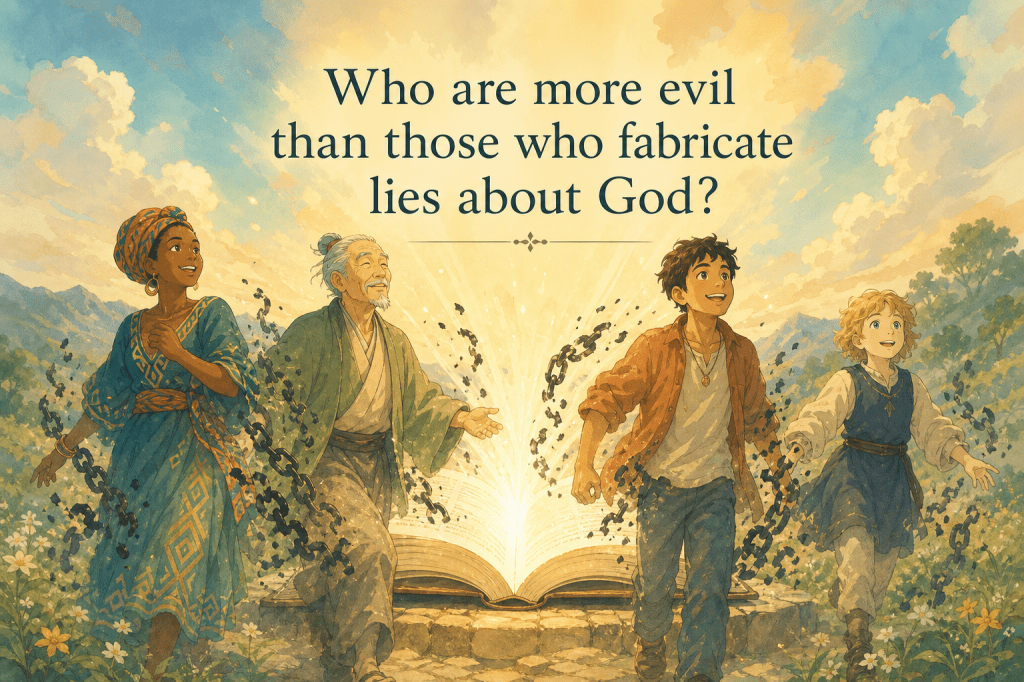
[11:18] “Who are more evil than those who fabricate lies about God? They will be presented before their Lord, and the witnesses will say, ‘These are the ones who lied about their Lord. God’s condemnation has befallen the transgressors.’”
The prohibition against legislating in God’s name is direct and personal: God forbids us to let our tongues issue verdicts of “lawful” and “unlawful” that He never authorized.
[16:116] “You shall not utter lies with your own tongues stating: ‘This is lawful, and this is unlawful,’ to fabricate lies and attribute them to God. Surely, those who fabricate lies and attribute them to God will never succeed.”
This is the heart of the matter. The book is described by God as “fully detailed” [6:114], its word “complete, in truth and justice” [6:115] — needing no human supplement to tell a woman she must cover her hair. To bolt a hair law onto the complete revelation is to declare the revelation incomplete and to set oneself up as a co-author with God. And the same scripture that heals the sincere only deepens the loss of those who twist it: “We send down in the Quran healing and mercy for the believers. At the same time, it only increases the wickedness of the transgressors” [17:82]. The men who built the hair doctrine took a book of guidance and used it to manufacture a chain.
Conclusion: Straining the Gnat, Swallowing the Camel
We have come full circle to Rashad Khalifa’s title. The tragedy he named is not merely that men invented a hair law; it is that they did so while drowning in the one sin God will not forgive. Idol-worship — setting up any partner, authority, or intercessor beside God — is graver than adultery, graver than corruption, graver even than murder; God warns that whoever deliberately kills a believer earns Hell forever [4:93], yet idolatry maintained to the grave is the single offense He has declared beyond pardon. Rashad put the practical lesson bluntly: “if this is the only unforgivable offense, I will run away from the slightest suspicion of shirk, of putting anything with God, no matter who that anything is” (at 1:24:07). Run from idolatry — and instead they ran toward a woman’s hairline.
This is straining out a gnat while swallowing a camel. The men who recoil in horror at a strand of visible hair will, in the same breath, idolize saints and scholars, elevate fabricated narrations to the rank of revelation, and treat the names of dead men as sacred — the precise behaviors the Quran calls idolatry. Rashad described seeing this pathology firsthand: a man who could not bear to hear the name of a messenger of God spoken in his neighborhood, whose wife’s entire objection to a fellow believer was that “she’s not even covering her hair” (at 14:50). He called the obsession what it is — “a cultural disaster,” the same pre-Islamic pathology that once buried baby girls alive, dressed up now as devotion (at 47:52).
So let us be clear about where the believer should stand. The Quran’s dress code is simple, humane, and freeing: lengthen the garment, cover the chest, dress modestly, use your judgment, and relax with age. No hair clause exists — not in the plain verses, not in the word “khimar,” not in the root of “hijab,” not even in the narrations summoned to prove it. The covering regime traces not to God but to seventh-century caste, to a caliph who beat a slave for covering, to state dress-codes designed to humiliate, and finally to the gravest crime of all: putting words in God’s mouth. A woman’s hair was never the test. The test was whether we would worship God alone and refuse to fabricate laws in His name — and on that test, the hair-police have failed catastrophically while congratulating themselves on their piety.
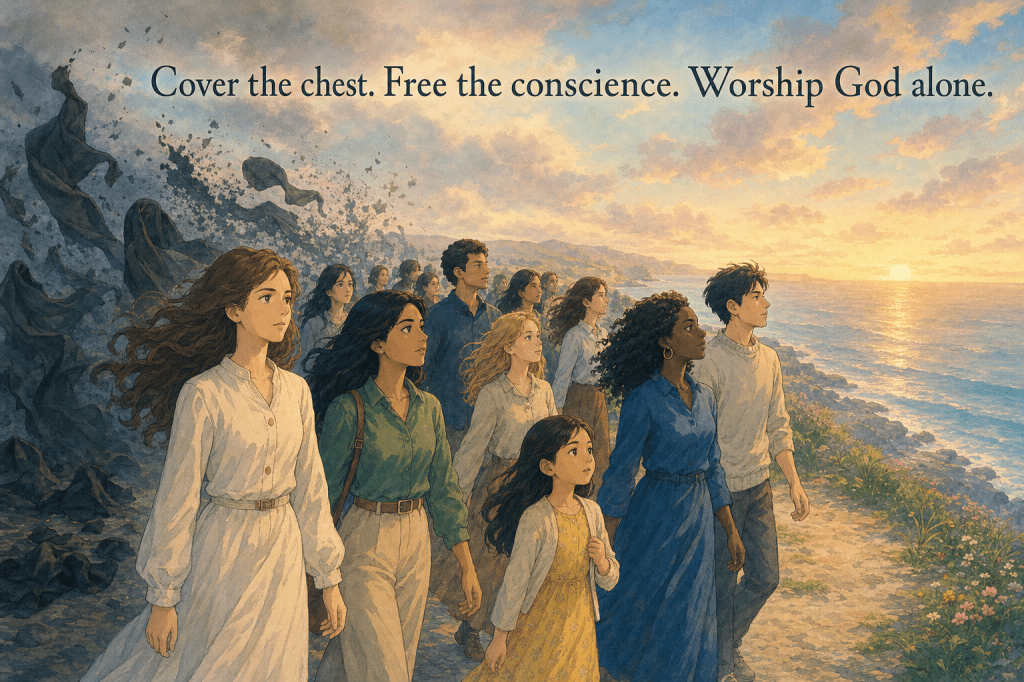
Cover the chest. Free the conscience. Worship God alone. Everything else is the gnat.

 Quran Only Studies
Leave a comment