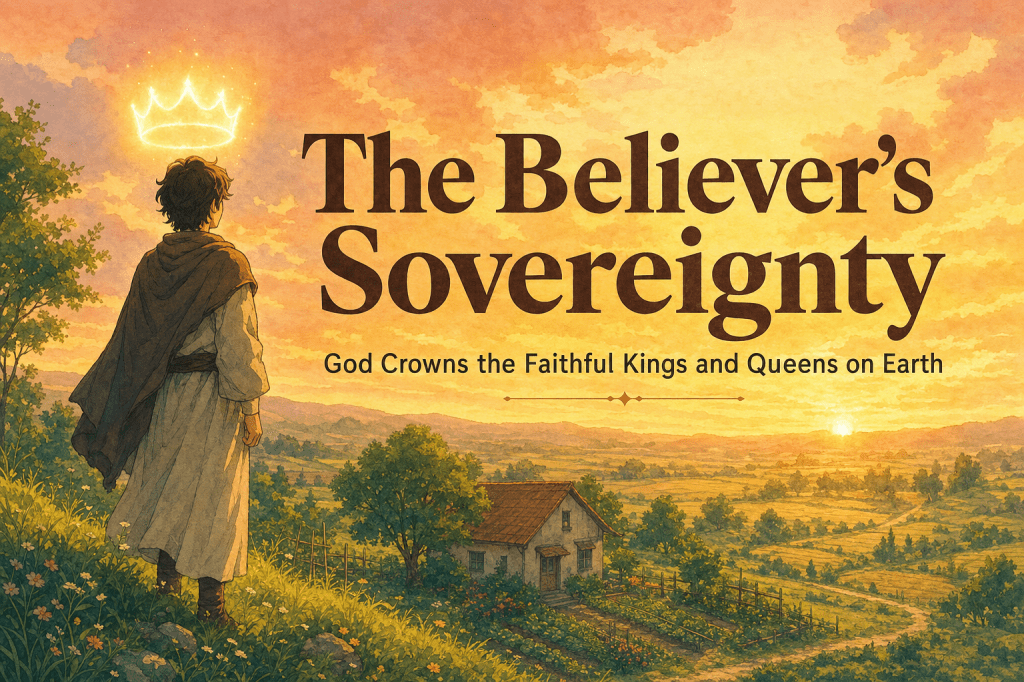
Opening: The Keys He Presses Into Your Hand
There is a promise in the Final Testament so audacious that most readers slide their eyes past it without letting it land. God does not merely offer the faithful comfort, or patience, or a good ending. He offers them a crown — real, God-backed authority on the earth, sworn to them by the One who never breaks a word.
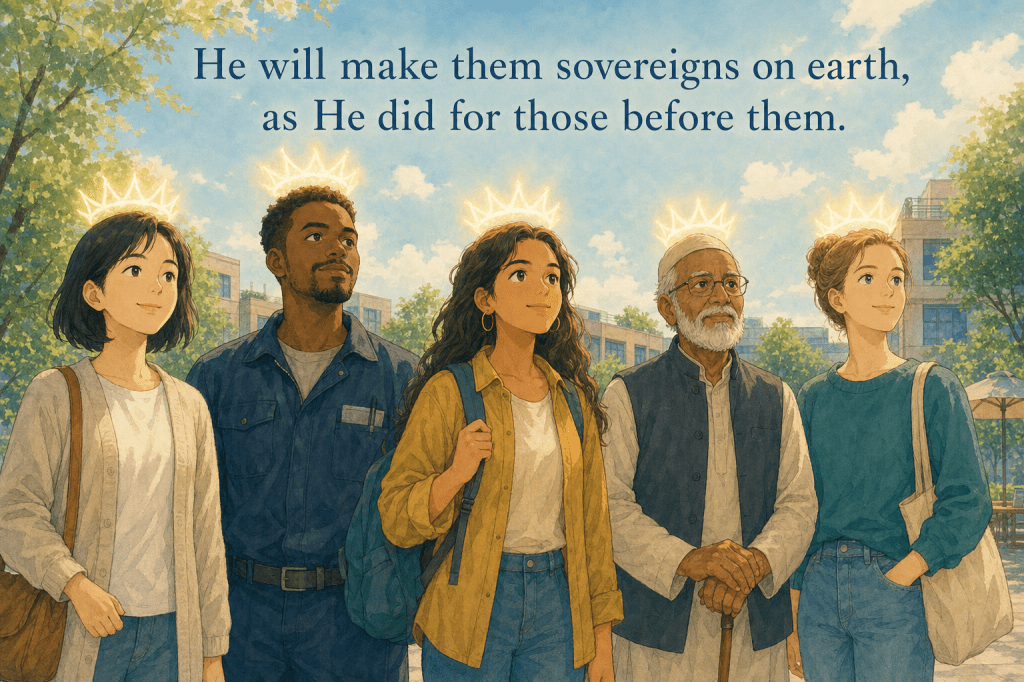
[24:55] “God promises those among you who believe and lead a righteous life, that He will make them sovereigns on earth, as He did for those before them, and will establish for them the religion He has chosen for them, and will substitute peace and security for them in place of fear. All this because they worship Me alone; they never set up any idols beside Me. Those who disbelieve after this are the truly wicked.”
Rashad Khalifa did not soften it. He read it plainly: this is a coronation, and because it is God speaking, it is already settled.
“God says He promises those among you who believe and lead a righteous life that they will be sovereigns on earth, kings and queens on earth, and when God says that He promises, it is done.”
— Rashad Khalifa, What is Life About & Who is God (at 22:00)
But we must be precise about what is being promised, because the wrong reading turns a glorious truth into a dangerous lie. This is not the throne of a politician, and it is not the bank balance of a prosperity preacher. We have a companion study, The Sovereignty of God, which establishes the foundation: that all dominion of the heavens and the earth belongs to God alone, self-existent and non-transferable — He never had a son, nor any partner in His authority.
[25:2] “The One to whom belongs all sovereignty of the heavens and the earth. He never had a son, nor does He have any partners in sovereignty. He created everything in exact measure; He precisely designed everything.”
That is the throne. This article is about the keys. God’s own sovereignty is the immovable throne; the believer’s sovereignty is the ring of keys He presses into the hand of everyone who never lets go of His. It is delegated, never owned. It is conditional, never automatic. And it is exercised entirely under Him, within your own domain — not over the world. Hold those three guardrails in your mind, and the promise opens like a door.
I. The Promise, Stated Boldly
A Coronation, Not a Wish
Read the keystone verse again and notice that it is built like an oath, not a hope. God does not say He may, or that the righteous might one day rise. He says He promises — and the verse seals itself with the exact condition on which the crown rests: “All this because they worship Me alone; they never set up any idols beside Me.” The promise and its price are welded together in a single breath. You are not petitioning a distant court for a throne; the decree has already been signed, and your only task is to be the kind of servant it names.
Rashad Khalifa treated this verse as one of the load-bearing promises of the entire scripture, and he was careful to define the word so no one could shrink it into a metaphor for mere inner calm.
“Okay, God’s promise, kings and queens on earth. One of the most important verses in the Quran, God promises, which means it’s done, those among you who believe and lead the righteous life, that he will make them…”
— Rashad Khalifa, Quran Study 12/28/89, Sura 60-61 (at 1:10:40)
“…that He will make them… Sovereigns. Means kings and queens. Just one word for it, instead of two words.”
— Rashad Khalifa, Quran Study 12/28/89, Sura 60-61 (at 1:20:13)
So the word “sovereigns” is not poetry. It means kings and queens — rulers — but always, as the rest of this study will insist, kings and queens who reign within their own domain and under God. And to anyone who feels a crown is alien to people like them, the scripture answers with a memory: God reminds an entire community that He once raised rulers from among ordinary people who had been slaves.
[5:20] “Recall that Moses said to his people, ‘O my people, remember God’s blessings upon you: He appointed prophets from among you, made you kings, and granted you what He never granted any other people.’”
Here God speaks of kingship using the language of mulk — sovereign rule — as a past favor to the Children of Israel, a thematic echo rather than the same promise of 24:55. Yet the echo carries the same astonishing logic: God lifts the lowly into rulers. If He did it for them, the promise of 24:55 says, He will do it for the believing and the righteous now.
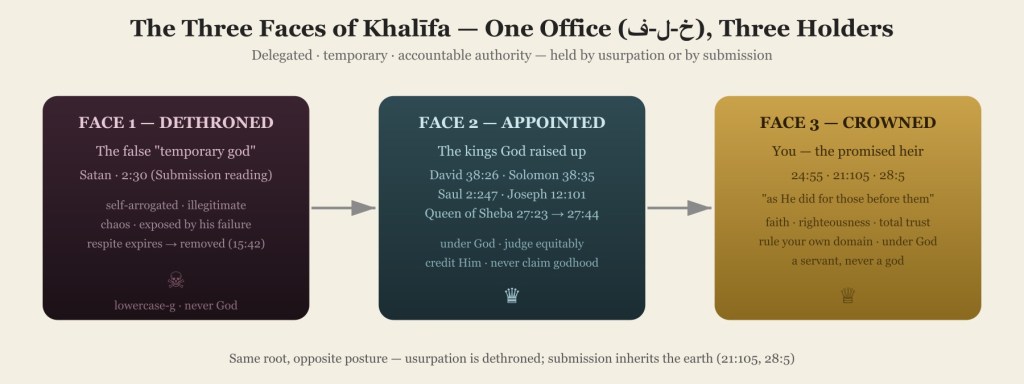
II. The Three Faces of the Office — One Root, Three Holders
Getting the Grammar Exactly Right
The promise of 24:55 belongs to a family of verses built on one Arabic root: خ-ل-ف, which means a successor, a stand-in, a representative. That root is the whole argument, so it must be handled with surgical precision rather than slogans. The singular noun khalīfa — a representative — occurs in only two verses of the entire Quran: [2:30] and [38:26]. The keystone, 24:55, does not use that noun at all; it uses the verb form (istakhlafa, “He will make them successors”). The inheritance verses (6:165, 10:14, 35:39) use the plural forms khalā’if, and 27:62 uses the related plural khulafā’. The verses about David’s kingship (5:20) use a different root entirely, mulk, and the verses about inheriting the earth (21:105, 28:5) use the root warith. The point that does the work here is the shared root and shared concept — delegated, time-bound, accountable authority — not a claim that one and the same word appears everywhere. Get that distinction wrong and a careful reader rightly stops listening; get it right, and the architecture is unshakeable.
What unites this whole family is a single idea: a successor never owns the office. You cannot be a “stand-in” for a role that is permanently and inherently your own. The authority is, by its very grammar, borrowed, temporary, and answerable. What changes from holder to holder is never the nature of the office — it is the posture of the one who holds it toward God. That gives us three faces of the same delegated authority.
Face 1 — The False Temporary God, Dethroned (2:30)
The first face is a usurper. On the Submission reading — the reading argued in detail in our prior study on the 2:30 representative, and grounded there in grammar and context — the khalīfa of 2:30, which Rashad Khalifa’s Final Testament renders as “a representative (a temporary god),” is Satan: a being who challenged God’s absolute authority, claimed he could be a god, and was granted limited, bounded dominion over this world as a test.
[2:30] “Recall that your Lord said to the angels, ‘I am placing a representative (a temporary god) on Earth.’ They said, ‘Will You place therein one who will spread evil therein and shed blood, while we sing Your praises, glorify You, and uphold Your absolute authority?’ He said, ‘I know what you do not know.’”
It is essential to flag what kind of claim this is. The rendering “(a temporary god)” is Rashad Khalifa’s translation in the Final Testament, defended by root and grammar — it is not the consensus rendering, and a reader who has not yet accepted it can still receive everything else in this article. That is deliberate: the believer’s promised sovereignty stands on its own even for someone who quarantines this first face. But for those who accept it, the contrast is the engine of the whole drama. Satan’s authority is self-arrogated, not God-granted; it is permitted only as a bounded test, and only “over the strayers who follow” him.
[15:42] “‘You have no power over My servants. You only have power over the strayers who follow you.’”
And here is the decisive point: Satan’s reign is a failure, and that failure is the entire purpose. A god — even a small, doomed, lowercase-g pretender — is supposed to keep his constituents happy. He cannot.
“When God told him that he will be a temporary God, this meant that he was supposed to take care of his constituents and make them perfectly happy. So, maybe he wanted some exit in case he cannot do it.”
— Rashad Khalifa, Quran Study 12/24/89, Sura 7:12 (at 3:49)
“We and our families become constituents in Satan’s kingdom and subject to Satan’s incompetence as a temporary god. This is why the children are suffering.”
— Rashad Khalifa, King of Chaos (at 51:39)
“An important part of this universe is exposing Satan as an incompetent God with a small g, an incompetent temporary God. So these constituents of Satan had to be there in order to prove his incompetence.”
— Rashad Khalifa, Messenger Audio 2 (at 16:57)
“Because Satan is a temporary God here. And the devils are his angels. They help him, they work for him.”
— Rashad Khalifa, Quran Study 1/21/90, Sura 37 (at 20:22)
The suffering of the world, on this reading, is evidence against Satan, not against God — it is the exposure of a counterfeit god who can never deliver. His respite has an expiry date; when it ends, he is removed. Hold this label with iron discipline: “(a temporary god)” belongs to Satan and to Satan alone. It is never, not even as a rhetorical flourish, applied to a believer. The believer made sovereign never becomes a god — and that razor is the exact idolatry this article exists to refute. (For the two-kingdoms backdrop of God’s kingdom against Satan’s, see our study A Leap of Faith, and for the pre-creation covenant that frames why the faithful inherit sovereignty as redemption, see The Pre-Genesis Chronology.)
Face 2 — The Kings God Appointed (Legitimate, Under God)
The second face holds the very same office and rules rightly. The other verse that uses the singular noun is God’s word to David — and it could not be more different in posture. The office is identical; the surrender is total.
[38:26] “O David, we have made you a ruler on earth. Therefore, you shall judge among the people equitably, and do not follow your personal opinion, lest it diverts you from the way of God. Surely, those who stray off the way of God incur severe retribution for forgetting the Day of Reckoning.”
That single instruction — “do not follow your personal opinion” — is the dividing line between Face 1 and Face 2. The usurper rules by self-will; the appointed king rules by God’s will, judging equitably under the One who placed him. The same pattern repeats across every legitimate sovereign in the scripture. David’s kingship is a gift God “gave him.”
[2:251] “They defeated them by God’s leave, and David killed Goliath. God gave him kingship and wisdom, and taught him as He willed. If it were not for God’s support of some people against others, there would be chaos on earth. But God showers His grace upon the people.”
Solomon does not seize his kingdom; he asks God for it, and God is the Grantor. Joseph, handed real worldly authority over Egypt, credits all of it to God in the same breath that he begs to die a submitter. And Saul is appointed king precisely because God wills it — over the people’s objection that he is not even rich. That last detail is decisive, because it forecloses the prosperity reading at the source: God’s chosen king lacked wealth entirely.
[38:35] “He said, ‘My Lord, forgive me, and grant me a kingship never attained by anyone else. You are the Grantor.’”
[12:101] “‘My Lord, You have given me kingship and taught me the interpretation of dreams. Initiator of the heavens and the earth; You are my Lord and Master in this life and in the Hereafter. Let me die as a submitter, and count me with the righteous.’”
[2:247] “Their prophet said to them, ‘God has appointed Taloot (Saul) to be your king.’ They said, ‘How can he have kingship over us when we are more worthy of kingship than he; he is not even rich?’ He said, ‘God has chosen him over you, and has blessed him with an abundance in knowledge and in body.’ God grants His kingship to whomever He wills. God is Bounteous, Omniscient.”
God’s promise names kings and queens, and the scripture gives us a literal queen. The ruler of Sheba is “a woman ruling them,” mistress of a tremendous palace — and the Quran is careful to show us what completes her, and what does not. Her reign begins in idolatry, and her sun-worship is never held up as a model. What the scripture honors is the moment she lays her sovereignty down before the only Sovereign.
[27:23] “‘I found a woman ruling them, who is blessed with everything, and possesses a tremendous palace.’”
[27:44] “…She said, ‘My Lord, I have wronged my soul. I now submit with Solomon to God, Lord of the universe.’”
[4:54] “Are they envious of the people because God has showered them with His blessings? We have given Abraham’s family the scripture, and wisdom; we granted them a great authority.”
One thread runs through every one of them: appointed by God, accountable to God, crediting God. Never once does a legitimate sovereign claim godhood. That is the exact inverse of Face 1.
Face 3 — You, the Promised Heir (24:55)
The third face is the one God promises to the whole righteous community — the David-mode of the office, extended to everyone who believes and lives righteously. The hinge is a single clause inside the keystone: “as He did for those before them.” That phrase deliberately fuses the promise to the believers (Face 3) back to the kings God appointed (Face 2). You are not being offered something unprecedented; you are being offered what David, Solomon, Joseph, and the submitting queen received — delegated rule, under God, within your own ground.
But the architecture must be stated precisely, because a careless version of it becomes heresy. Face 1 and Face 2 are not two beings literally sharing one numbered appointment — a fallen jinn and a human prophet-king are different kinds of creature entirely. What unites all three faces is the root and the concept (delegated, temporary, accountable authority) and the moral posture toward God (usurpation versus submission). Satan seizes the office and plays god; David and the believers receive the office and serve God. The believer made sovereign does not climb toward divinity — he descends deeper into servanthood, and is crowned precisely there.
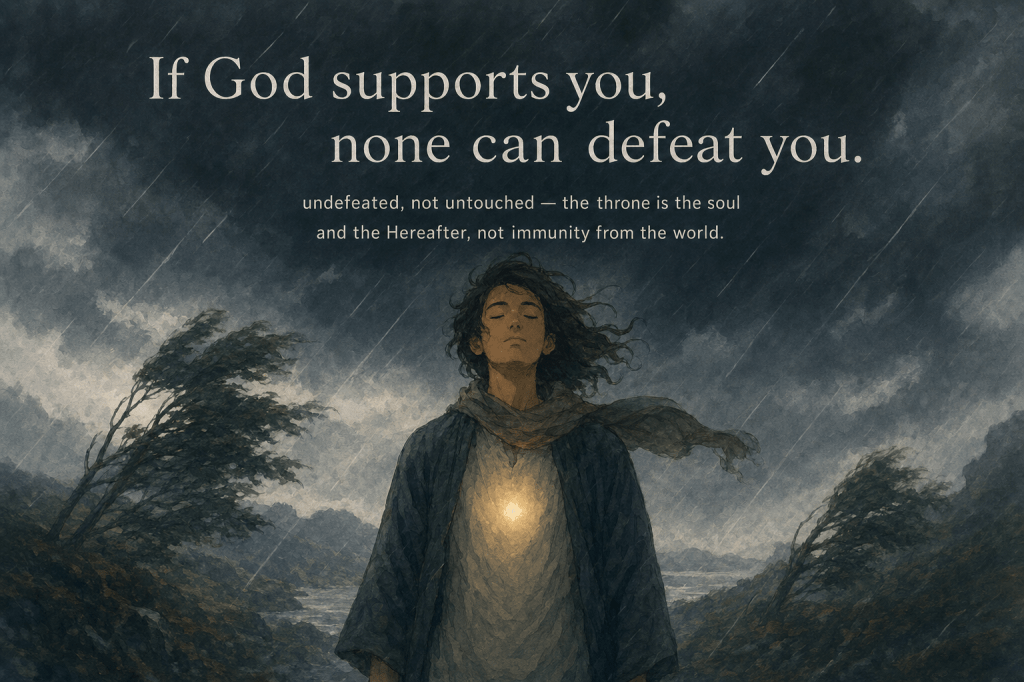
III. The Engine — If God Supports You, None Can Defeat You
The King Who Fears No Creature
What powers this crown? Not armies, not money, not status. The engine of the believer’s sovereignty is trust — absolute, undivided reliance on God. The verse that drives it is short enough to carry in the chest like a heartbeat.
[3:160] “If God supports you, none can defeat you. And if He abandons you, who else can support you? In God the believers shall trust.”
A sovereign backed by God answers to no human power. The whole apparatus of intimidation — the people who say you should be afraid — only deepens the believer’s certainty. This is the fearless posture our study Fear and Reproach explores, and it is the same security 24:55 promises when it pledges to “substitute peace and security for them in place of fear.”
[3:173] “When the people say to them, ‘People have mobilized against you; you should fear them,’ this only strengthens their faith and they say, ‘God suffices us; He is the best Protector.’”
[65:3] “And will provide for him whence he never expected. Anyone who trusts in God, He suffices him. God’s commands are done. God has decreed for everything its fate.”
The same refrain recurs like a drumbeat — in God the believers shall trust — through the moments when human strength almost failed and through the messengers’ own confession that they could show no authority except by God’s will. This is the active, daily reliance treated at length in Trust in God: An Enduring Pillar and reframed as a living discipline in The Pull System of Trust.
[3:122] “Two groups among you almost failed, but God was their Lord. In God the believers shall trust.”
[14:11] “Their messengers said to them, ‘We are no more than humans like you, but God blesses whomever He chooses from among His servants. We could not possibly show you any kind of authorization, except in accordance with God’s will. In God the believers shall trust.’”
III.b — Undefeated, Not Untouched
Here we must be brutally honest, because this is exactly where a shallow reading collapses. “None can defeat you” does not mean worldly invincibility in the here and now. It does not promise that no harm will reach you, that your body cannot be broken, that the world will hand you ease. The scripture itself records, again and again, that the wicked “killed the prophets unjustly” — God’s own messengers, the most beloved of His servants, were murdered. The early submitters were tortured. And the messenger through whom this very promise reached us, Rashad Khalifa, was martyred — stabbed to death.
[3:21] “Those who have rejected God’s revelations, and killed the prophets unjustly, and killed those who advocated justice among the people, promise them a painful retribution.”
So what does “none can defeat you” mean? It means undefeated, not untouched. A believer can be persecuted, impoverished, imprisoned, even slain — and still never be defeated, because no creature can strip him of God’s support, of mastery over his own soul, or of his inheritance in the Hereafter. The body may fall; the sovereignty does not. The crown is inner mastery, unshakeable certainty, and the ultimate estate that 39:74 will describe at the end of this study — it is emphatically not a guarantee of bodily immunity in a world that killed prophets (see also 2:61, 3:181, 4:155 on the killing of the prophets). Name this plainly, and the prosperity reading and the invincibility reading both fall away at once.
IV. The Crown’s Condition — Righteousness and Never Objecting to God
A Throne Leased on Trust
The promise of 24:55 is not unconditional, and pretending otherwise would betray the verse. Its own clause sets the gate: “those among you who believe and lead a righteous life… because they worship Me alone.” The crown is leased on faith and righteousness, and the lease is held by a trust so complete that the believer never objects to God’s guidance. Rashad Khalifa tied this directly to the promise: the sovereignty is real, but you must believe it without the slightest crack of doubt, because that certainty is itself part of believing in God.
“When we worship God alone, God fulfills His promise to us, kings and queens on earth. And you have to know that. You must believe that without the slightest doubt or hesitation. Because it is part of believing in God.”
— Rashad Khalifa, Messenger Audio 20.1 (at 16:46)
What does it mean to never object? The scripture is unambiguous: once God and His messenger have decreed a matter, the believer has no separate veto of his own; his entire utterance is to hear and obey.
[33:36] “No believing man or believing woman, if God and His messenger issue any command, has any choice regarding that command. Anyone who disobeys God and His messenger has gone far astray.”
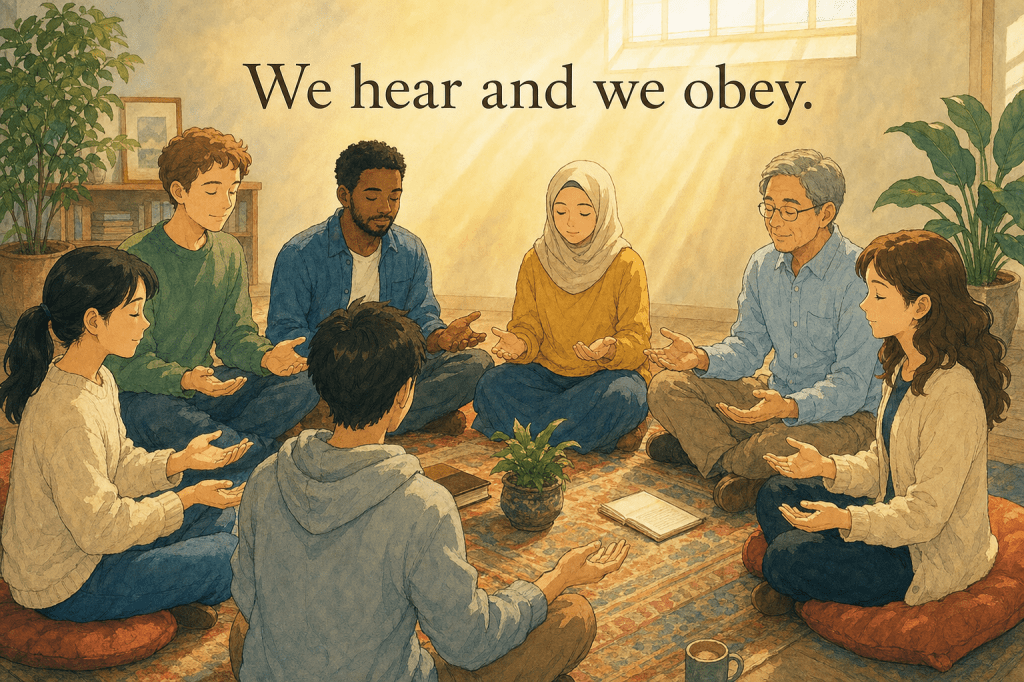
[24:51] “The only utterance of the believers, whenever invited to God and His messenger to judge in their affairs, is to say, ‘We hear and we obey.’ These are the winners.”
[4:65] “Never indeed, by your Lord; they are not believers unless they come to you to judge in their disputes, then find no hesitation in their hearts whatsoever in accepting your judgment. They must submit a total submission.”
What “Never Object” Does Not Mean
This is the precise spot where the verse is most often weaponized, so let it be stated without ambiguity. “Never object” means total trust in God’s guidance and in His messenger solely as the conveyor of God’s message — the Quran. It is not, and can never be, a license for blind obedience to any human ruler, scholar, priest, or religious authority. The messenger is obeyed because, and only insofar as, he delivers God’s words; the command in question is God’s command, not a man’s. To bend these verses into a charter for human tyranny or cult-like deference is to invert them completely. The believer surrenders his veto to God — and to God alone — which is exactly what frees him from every human master. A sovereign who answers to God answers to no tyrant.
This is why the condition is not a cage but the very source of the crown. The one who trusts God without hesitation, who refuses to set up any authority beside Him, is precisely the one who cannot be ruled by fear, by money, or by men. The condition and the sovereignty are the same act seen from two sides.
V. What Your Kingdom Actually Is — Dominion Over Your Own Domain
Not the World’s Palace — Your Own Ground
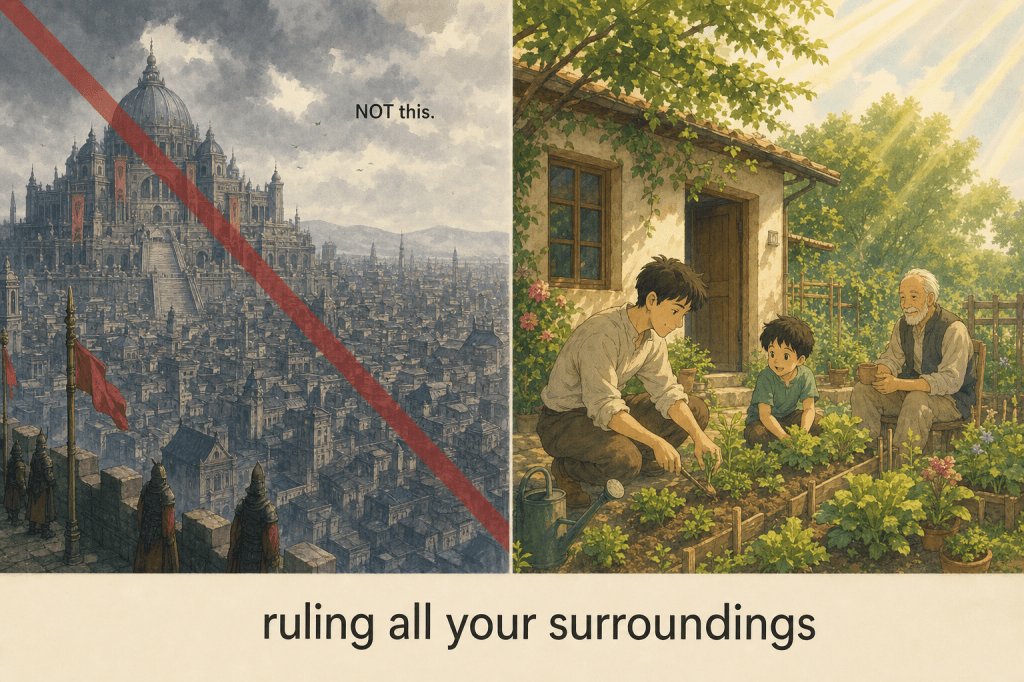
Now the most important clarification in the entire study, and the one most easily lost. The kingdom God promises is not a political empire, not a conquest, not a caliphate ruling over other people. It is dominion over your own domain — the territory of your own life: your self, your home, your circumstances, the ground you actually stand on. Rashad Khalifa named the borders of this kingdom exactly.
“Because when you make it, making it means kingship on earth. Sovereignty on earth. And ruling all your surroundings. Perfect happiness in this world and in the hereafter.”
— Rashad Khalifa, Messenger Audio 36.1 (at 13:23)
Ruling all your surroundings — your own ground, under God — not seizing the world. This is the guardrail that keeps the promise from curdling into the very thing the scripture condemns. The believer is not handed a mandate to dominate others; he is handed mastery of himself and peace in his own life, here and in the Hereafter. Anyone who reads 24:55 as a program of political world-domination has simply not read what God promised.
And It Has Nothing to Do With Money
The second guardrail is just as load-bearing, and it must stand in the foreground, not buried in a footnote: this sovereignty is not measured in wealth. It is not a prosperity gospel. Rashad Khalifa’s own prayer made the point unmistakable.
“And God willing, that will put us far ahead and make us sovereigns on earth no matter how much money or anything we have.”
— Rashad Khalifa, Quran Study, Sura 55 / Sura 56 (at 29:43)
No matter how much money — or how little. The poorest believer who trusts God completely is a sovereign; the richest doubter is a pauper. The scripture proved this at the source when God appointed Saul king while the people sneered that he was not even rich (2:247). God grants His kingship by His will, not by anyone’s bank balance. Strip away the wealth, the status, the empire — and the crown is still there, resting on the head of whoever worships God alone.
And yet the promise is not merely private. The same verse that crowns the individual also pledges a future to the believing community: God vows to “establish for them the religion He has chosen for them” and to “substitute peace and security for them in place of fear.” The crown is personal — mastery of your own domain — and it is communal — a promised refuge for the faithful together. Both are true; neither cancels the other.
VI. It Is a Test and a Trust — The Abuse of the Office
Delegated Power, Held to Account
Because the crown is delegated and not owned, it comes with a weight: it is a test you answer for. The earth handed to you as an inheritance is not a trophy to flaunt; it is an examination to pass. Rashad Khalifa stated the principle as cleanly as it can be put.
“But the granting of this khalifah to man, giving him earth as an inheritance, is really a test. Allah says in Surah 10, verse 14, Then we make you inherit the earth to see what you do… The power of a khalifah is delegated power.”
— Rashad Khalifa, Messenger Audio 33.1 (at 19:28)
The power of a representative is delegated power — that single sentence is the spine of this whole article (the same point stands alone at the 19:57 mark of the same recording). You reign as God’s representative, never in His place. And the scripture frames the inheritance of the earth explicitly as a test, in plain words.
[10:14] “Then we made you inheritors of the earth after them, to see how you will do.”
[6:165] “He is the One who made you inheritors of the earth, and He raised some of you above others in rank, in order to test you in accordance with what He has given you. Surely, your Lord is efficient in enforcing retribution, and He is Forgiver, Most Merciful.”
What happens when a holder of the office forgets that the power is borrowed? He drifts toward Face 1 — he begins to rule by self-will, the very thing David was warned against. Rashad Khalifa traced this abuse back to the original temptation, the responsibility the human being accepted and so often betrays.
“And so now we can relate the temptation of Adam to man’s so-called khalifah monarchy. In Surah 33, verse 72, shows clearly how the abuse of such power, the abuse of the khalifah, is manifested.”
— Rashad Khalifa, Messenger Audio 33.1 (at 21:44)
[33:72] “We have offered the responsibility (freedom of choice) to the heavens and the earth, and the mountains, but they refused to bear it, and were afraid of it. But the human being accepted it; he was transgressing, ignorant.”
So reign justly within your domain, under God, because the King above you is watching how His delegate rules. The crown that is held in trust is glorious; the crown that is grasped as if owned is the road back to the usurper’s failure.

VII. The Inheritance Fulfilled — The Crescendo
God Lifts the Oppressed Onto the Throne
Now the promise reaches its full height. The arc of sovereignty in the scripture is a reversal: God takes those the world ground down and raises them into rulers and heirs. Whatever holds you low now, the trajectory God swears to the faithful is upward — from the bottom to the office, by His decree and not your striving.
[28:5] “We willed to compensate those who were oppressed on earth, and to turn them into leaders, and make them the inheritors.”
And the inheritance of the earth itself is not left vague. It is decreed, written into the prior scriptures, willed to the righteous — God’s servants, the ones who worship Him alone.
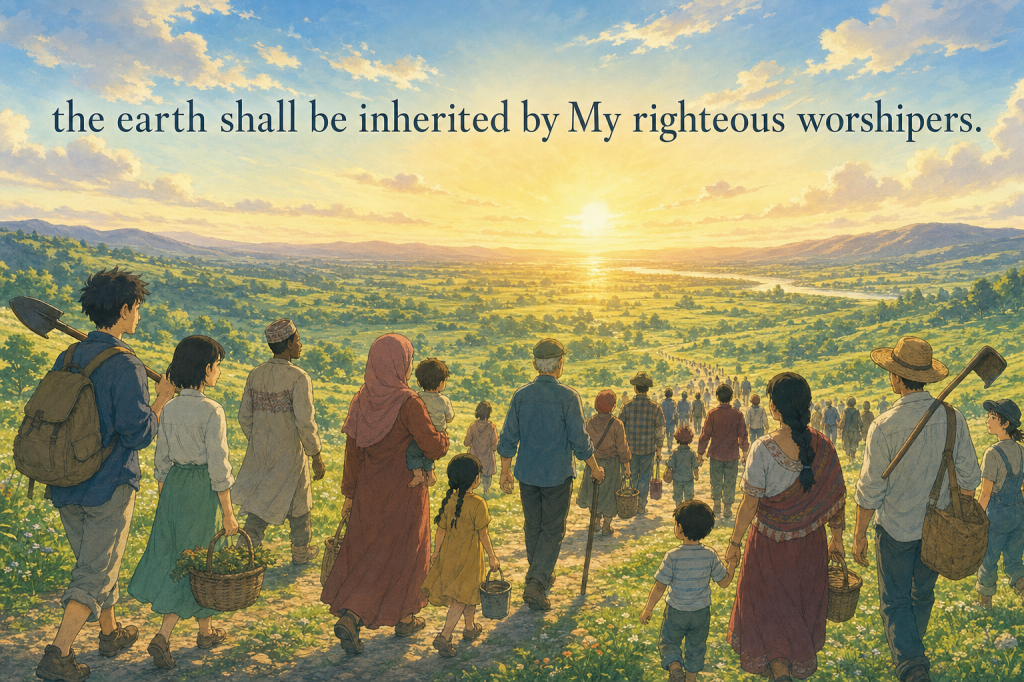
[21:105] “We have decreed in the Psalms, as well as in other scriptures, that the earth shall be inherited by My righteous worshipers.”
[35:39] “He is the One who made you inheritors of the earth. Subsequently, whoever chooses to disbelieve does so to his own detriment. The disbelief of the disbelievers only augments their Lord’s abhorrence towards them. The disbelief of the disbelievers plunges them deeper into loss.”
[27:62] “Who is the One who rescues those who become desperate and call upon Him, relieves adversity, and makes you inheritors of the earth? Is it another god with God? Rarely do you take heed.”
The Throne That Outlasts the Lease
One question remains, and it deserves an honest answer, because our prior study on the 2:30 representative used these very verses — 24:55 and 38:26 — to argue that the office is temporary: a revolving door, not a fixed throne, held only for the term of the test. Does that drain the promise of its glory? It does not. Temporary in duration is not the same as illegitimate in nature. The grant is utterly real, God-given, and total within its bounds — only the lease is term-limited. A throne held for the length of the examination is still a true throne. The line that matters is never permanent-versus-temporary; it is legitimate (David, the believers, under God) versus usurped (Satan, against God). Both poles agree the authority is delegated, conditional, and under God’s absolute power — and the prior study and this one are the two faces of one coin.
And the lease, for the faithful, is renewed forever in the place where it counts most. Reserved strictly for the Hereafter — never as proof of worldly rule — is the verse where the inheritors finally speak, having received the estate that no death can repossess.
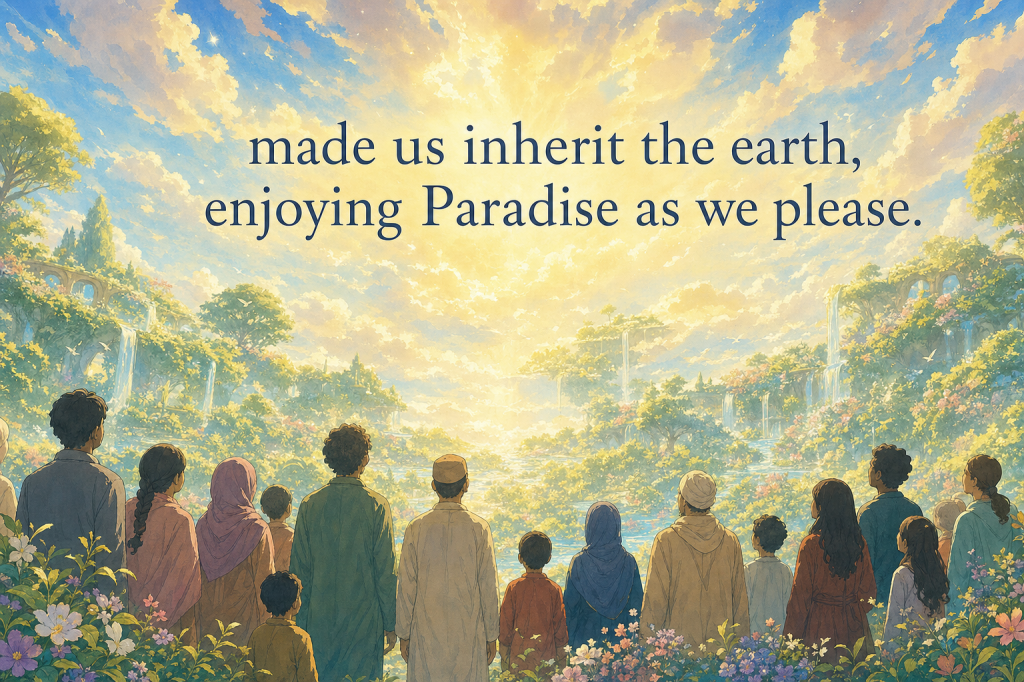
[39:74] “They will say, ‘Praise be to God, who fulfilled His promise to us, and made us inherit the earth, enjoying Paradise as we please.’ What a beautiful recompense for the workers!”
Conclusion: Never Let Go of His Hand
So here is the whole of it, gathered into one breath. God’s own sovereignty is the throne — absolute, eternal, His alone. The believer’s sovereignty is the keys He hands to those who never let go of His hand. It is one office, the same delegated and accountable authority, held in two opposite ways: Satan seized it and played god, and his failure exposed him; David, Solomon, Joseph, Saul, and a queen who finally submitted received it from God and ruled under Him; and to every believer who is faithful, righteous, and trusting, God promises that same crown — within your own domain, never over the world, never measured in money, and never, ever making you a god.
Do not read this as a guarantee that the world will not bruise you. It bruised the prophets to death. Read it as something steadier and greater: that no creature alive can defeat the soul that God supports, that your mastery of your own ground is real and God-backed, and that the final estate is already willed to you. This is the difference between a king who frets and a king who reigns in peace — not the size of the kingdom, but the certainty of the One who granted it.
So take the crown for what it is. You were not made a beggar at God’s gate; you were made a sovereign within His kingdom, fearless because He backs you, trusting His guidance without the slightest hesitation, mastering your own domain as His representative and never His rival. He has already sworn it — and when God says that He promises, it is done. Worship Him alone, trust Him completely, never let go of His hand, and the keys are yours.


Leave a Reply