Introduction: Two Questions, Never One
Every shouting match over abortion collapses two completely different questions into one. The first is a question about power: may the government, or a clergy speaking in God’s name, criminalize the decision or force it one way? The second is a question about the soul: before God, is the act neutral, good, or grave? Treat these as a single question and you will inevitably answer one of them with the other’s evidence — which is exactly how both sides talk past each other and past the Quran. The Final Testament refuses the confusion. It hands the human being two paths and a real will to walk either one, and it tells us plainly where the verdict is filed.
[76:3] “We showed him the two paths, then, he is either appreciative, or unappreciative.”
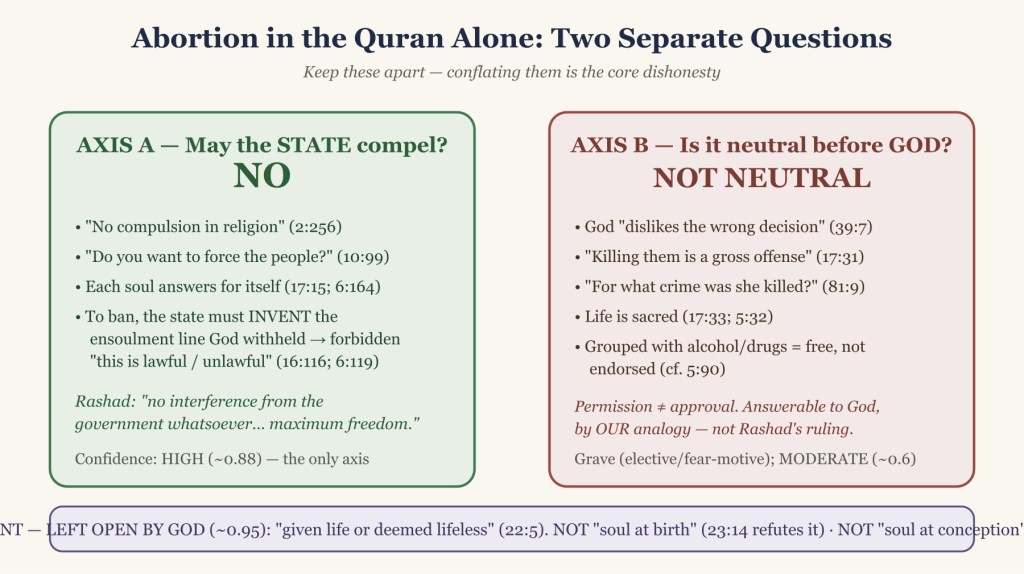
This article makes one carefully bounded argument and refuses to overreach beyond it. On the question of power, the answer is firm: the state and clergy must not criminalize or compel the abortion decision, because God Himself declined to draw the line they would need to enforce. On the question of the soul, we concede the gravity honestly and leave the verdict where God left it — in the woman’s conscience and her accounting before Him. Keeping these two axes apart is not a rhetorical trick; it is the entire integrity of the case. The diagram below fixes the distinction so nothing that follows can quietly slide from one column into the other.
Part 1: Permissible to Whom? Untangling the Real Question
The trap hidden in the word “permissible”
Ask “is abortion permissible?” as though there is one answer, and you have already smuggled in an error. Permissible to whom, and in which court? The Quran forces us to split the word into at least three separate questions that the careless debate keeps fusing: (a) may the government ban or compel it? (b) is the act morally neutral before God? and (c) when, if ever, is the fetus given a soul? These are not the same question wearing three hats. They have different evidence, different degrees of certainty, and — crucially — different judges. We answer (a) firmly in the negative for the state; we hold (b) as grave and unresolved, a matter of conscience; and we leave (c) exactly where God left it, unanswered by His own design.
The whole “permissible” claim this article defends lives in question (a) alone. It means: no human authority may forbid the decision or punish the woman for it. It does not mean the act is righteous, neutral, or consequence-free. The trap to name and avoid is the silent slide from “the state should not ban it” to “therefore God does not mind.” Those are different sentences with different truth values, and the Quran lets the first stand while flatly contradicting the second. We have made exactly this distinction before, in The Truth About Facilitating Sin: the same [2:256] that guarantees a person’s right to choose their own course does not thereby declare the chosen act lawful. Freedom to decide and the moral weight of the decision are two facts, not one.
Notice also what is honestly ours and not the Quran’s. The Quran never names abortion. It never names the embryo as the object of a command. The tension we are working through — libertarian “free to choose” set against “killing your children is a gross offense” — is a tension we are reasoning across the texts, not a verdict any verse hands down ready-made. Saying so out loud is not weakness; it is the precondition of being trusted on everything that follows.
Part 2: Free Will Is the Engine of the Test
Coercion empties an act of the very responsibility the Quran is built on
Why would God leave any moral act to the individual at all? Because the entire structure of the test depends on it. The Quran’s God does not manufacture obedience; He offers a choice and lets it be real. He set both roads before the human being — “We showed him the two paths” [76:3] — and then made the walking voluntary. A goodness that is forced earns nothing, and an abstention that is coerced proves nothing; remove the freedom and you have not produced a saint, you have produced a puppet who cannot be credited or blamed. This is why the freedom to choose wrongly is not a flaw in the design but the design itself.
[18:29] “Proclaim: ‘This is the truth from your Lord,’ then whoever wills let him believe, and whoever wills let him disbelieve. We have prepared for the transgressors a fire that will completely surround them…”
The Quran stages this as a cosmic event. The freedom of choice was a trust so heavy that the heavens, the earth, and the mountains shrank from it — and the human being alone took it up.
[33:72] “We have offered the responsibility (freedom of choice) to the heavens and the earth, and the mountains, but they refused to bear it, and were afraid of it. But the human being accepted it; he was transgressing, ignorant.”
This is the theological hinge: God explicitly grants the freedom even though He has a preference. The pivot verse refuses to let “God permits it” collapse into “God approves it.”
[39:7] “If you disbelieve, God does not need anyone. But He dislikes to see His servants make the wrong decision. If you decide to be appreciative, He is pleased for you. No soul bears the sins of any other soul. Ultimately, to your Lord is your return, then He will inform you of everything you had done. He is fully aware of the innermost thoughts.”
Read that slowly. God dislikes the wrong decision — and yet He leaves the decision to the servant anyway. That single verse dissolves the most common objection to any liberty argument: “if you say God permits it, you are saying it is fine.” No. In the Quran, God grants freedom for acts He disapproves. “Left to free will” and “may be the wrong decision” coexist without the slightest contradiction. This is the firewall verse, and it must stand guard over everything in this article: permission is not approval. Rashad Khalifa stated the same principle in writing, in Appendix 14, “Predestination”:
“We are absolutely free to believe or disbelieve in God. It is God’s will that we will freely (18:29, 25:57, 73:19, 74:37, 76:29, 78:39, 80:12).”
— Rashad Khalifa, Appendix 14 of the Authorized English Translation, “Predestination”
This is our existing position, not a new improvisation. We built the same free-will covenant out of [33:72] in Free Will and Divine Omnipotence, and stacked the freedom-to-choose verses around [18:29] in The Pre-Genesis Chronology. The point is constant across all of it: real responsibility requires real freedom, including the freedom to be wrong.
Part 3: What Rashad Khalifa Actually Said — and Did Not Say
He ruled on the law, not on the soul
Rashad Khalifa addressed abortion by name exactly once in the recorded corpus, in a Quran study of Chapter 54 whose own title carries the phrase “extreme libertarianism.” It matters enormously where he placed it. Abortion was the third item in a free-will list, right after alcohol and drugs, all marshaled to make a single point about government: that the state must not compel private conduct. He set it up by contrasting genuine obedience to God with mere compliance to the law of the land (at 51:14): “God wants the people to be free to drink if they want, take drugs if they want to.” Then he named abortion directly.
“The law has nothing to do with the people. The people will have abortions or not anyway. It depends on the individual.”
— Rashad Khalifa, Quran Study Sura 54 (at 51:50)
“The Quran is in favor of absolute freedom, no interference from the government whatsoever. It’s extreme libertarianism. Maximum freedom for the human being.”
— Rashad Khalifa, Quran Study Sura 54 (at 52:01)
And then the seal — the reason the freedom has to be maximal in the first place:
“Otherwise you cannot hold the human being responsible.”
— Rashad Khalifa, Quran Study Sura 54 (at 52:17)
Now the honesty that makes this citation bulletproof, stated in the same breath as the quote itself. Rashad’s thesis here is legal and accountability-based, not theological. He is arguing that the government must not interfere and that freedom is the precondition of responsibility — the Quran’s own logic from [76:3] and [39:7]. He is not saying the act is sinless, and he is not saying the fetus has no soul. The proof is in the company he keeps it: he files abortion beside alcohol and drugs, and intoxicants are explicitly abominations to be avoided.
[5:90] “O you who believe, intoxicants, and gambling, and the altars of idols, and the games of chance are abominations of the devil; you shall avoid them, that you may succeed.”
So the grouping itself tells us how to read him. He placed abortion in the category “free, but answerable,” not the category “approved.” Reading moral endorsement into this clip would be dishonest, and we refuse to do it. What he establishes is only this — and it is decisive on its own axis — that the matter belongs to the individual and to God, and that no parliament has a Quranic warrant to seize it. For our fullest treatment of why religious and moral coercion is foreign to God’s design, see The Slave’s Deception.
Part 4: No Soul Bears Another’s Burden
The account runs to God, not to a magistrate
If abortion is a private moral act, then who is the judge, and where is the court? The Quran answers with a principle it repeats until it cannot be missed: accountability is strictly individual and runs to God in the Hereafter. No one carries anyone else’s record, and no institution stands between the soul and its Maker on the day of reckoning.
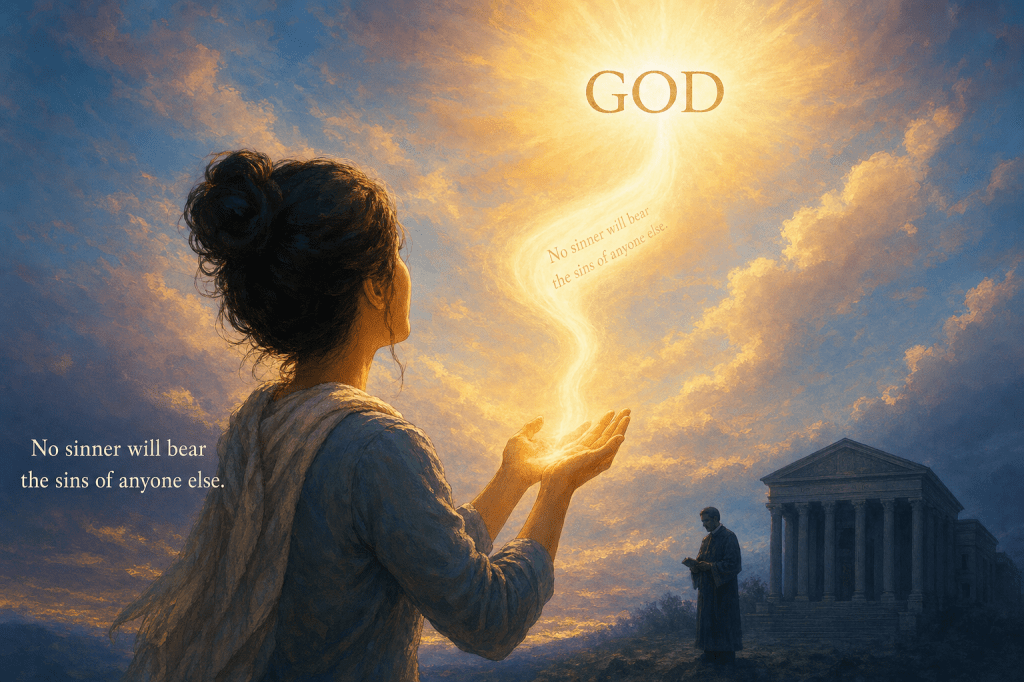
[17:15] “Whoever is guided, is guided for his own good, and whoever goes astray does so to his own detriment. No sinner will bear the sins of anyone else. We never punish without first sending a messenger.”
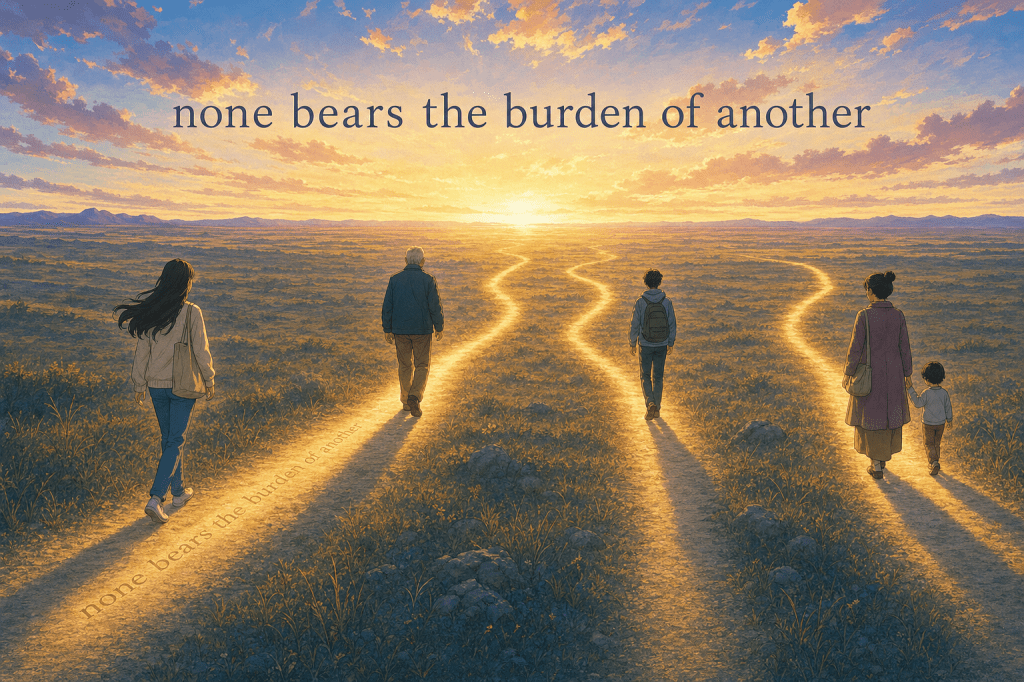
[6:164] “Say, ‘Shall I seek other than God as a lord, when He is the Lord of all things? No soul benefits except from its own works, and none bears the burden of another. Ultimately, you return to your Lord, then He informs you regarding all your disputes.’”
Here an honest qualification is required, and we give it gladly. These verses concern the non-transferability of sin in the Hereafter; they are not, by themselves, an abolition of all worldly law. A society can still run courts for theft and murder without contradicting [17:15]. So we do not stretch this verse to say “no human law may exist.” Its real and narrower work is to locate the judge: for a private matter of conscience, the one who ultimately answers is the woman, and the one she answers to is God — not a magistrate empowered to police her interior life. That is precisely why this is the wrong kind of act for the state to criminalize. The decision and its accounting were filed in a court the state cannot enter.
Part 5: Facing the Hardest Verses Honestly
The texts that cut against us — laid on the table, not hidden
A case that hides its strongest counter-evidence does not deserve to be believed. So here are the hardest verses, placed openly. The Quran condemns the killing of one’s children in the gravest terms, and it names the very motives — poverty and shame — that drive most abortions.
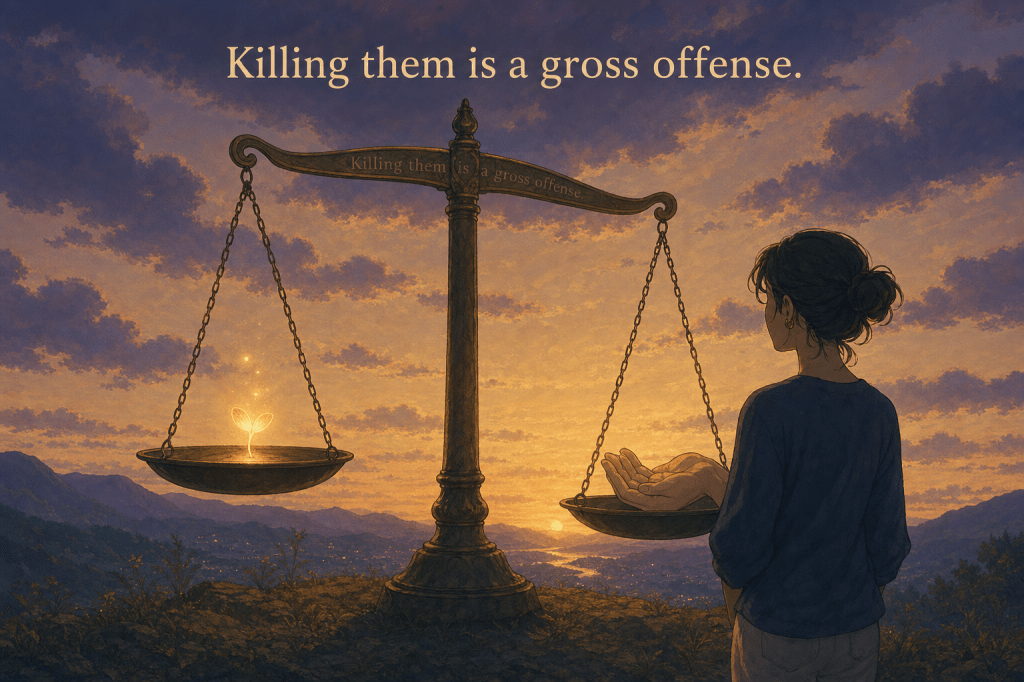
[17:31] “You shall not kill your children due to fear of poverty. We provide for them, as well as for you. Killing them is a gross offense.”
[6:151] “…You shall not kill your children from fear of poverty—we provide for you and for them. You shall not commit gross sins, obvious or hidden. You shall not kill—God has made life sacred—except in the course of justice. These are His commandments to you, that you may understand.”
[81:8-9] “The girl who was buried alive is asked: / For what crime was she killed?”
[6:140] “Losers indeed are those who killed their children foolishly, due to their lack of knowledge, and prohibited what God has provided for them, and followed innovations attributed to God. They have gone astray; they are not guided.”
We will not soften these to win the argument. Four honest moves follow, and each one concedes something real.
(a) What they actually forbid. They forbid killing one’s children, and the named motives are fear of poverty and shame. These verses are emphatic, and they create genuine moral weight that a woman contemplating an elective abortion for those very reasons must carry. We do not erase them. If anything, the motive-match is uncomfortably exact: the Quran strikes precisely at “fear of poverty,” and God pre-empts the economic argument directly — “We provide for them, as well as for you.”
(b) Their literal scope is born children. The word is “your children,” and the searing image in Chapter 81 is a buried-alive girl — an infant already born. Extending these verses to the fetus is a principled analogy on our part, and a strong one, but it is our reasoning, not an explicit Quranic ruling on abortion. The Quran never names abortion and never legislates the embryo. Honesty requires us to surface that, not bury it under confident proof-texting.
(c) 17:33 cuts both ways — so we concede it. The sanctity of life is real and it does authorize human justice for unjust killing:
[17:33] “You shall not kill any person—for God has made life sacred—except in the course of justice. If one is killed unjustly, then we give his heir authority to enforce justice. Thus, he shall not exceed the limits in avenging the murder, he will be helped.”
This verse falsifies any sloppy claim of “no government interference whatsoever” as an absolute — the Quran plainly contemplates worldly justice for the unjust killing of a person. So we drop that absolutist gloss. But notice the hinge: the verse protects “any person” (a nafs), and whether and when the fetus becomes that person is exactly what God left untimestamped. To criminalize abortion, a state must first fix the threshold at which the embryo becomes the protected “person” — and that is the line revelation deliberately withheld. Drawing it and punishing on it means legislating a ruling God did not reveal, which the Quran condemns by name:
[16:116] “You shall not utter lies with your own tongues stating: ‘This is lawful, and this is unlawful,’ to fabricate lies and attribute them to God. Surely, those who fabricate lies and attribute them to God will never succeed.”
[6:119] “…He has detailed for you what is prohibited for you, unless you are forced. Indeed, many people mislead others with their personal opinions, without knowledge…”
This is the honest replacement for Rashad’s political “no interference” slogan. Our bar to criminalization is not libertarian ideology; it is narrower and stronger: no human may legislate God’s unrevealed line. God detailed what He prohibited; the personhood timestamp is not among the details He gave.
(d) The motive carries the moral weight. Where the motive is the very “fear of poverty” or shame that [17:31] condemns, the act carries that gravity for the woman before God — even though the state still may not compel her. This is where our argument is at its most serious about Axis B, and we will not flinch from it. Note too the boundary: medical necessity, the genuine danger to the mother’s life, falls under [17:33]‘s “in the course of justice” — a separate and arguably permitted category, not the target of any moral charge here. And [5:32] reminds us how heavy the scale is when an innocent life is taken without cause: “anyone who murders any person who had not committed murder or horrendous crimes, it shall be as if he murdered all the people.” We let that weight stand. Our claim was never that the act is light; only that the line is God’s to draw, not the state’s.
We have kept this counterweight central before. In Prayer is for Believers, the “Freedom Without Excuse” principle is exactly the discipline at work here: the freedom [2:256] guarantees is never a license to call a sin a non-sin. Liberty on Axis A leaves Axis B fully intact.
Part 6: The Line God Left Open
Ensoulment is unanswered — on purpose
The entire criminalization project depends on a fact nobody has: the moment a soul enters the body. The Quran does not provide it. There is no chapter, no appendix, no footnote, and no newsletter in the Submission corpus that dates ensoulment to a trimester, to a heartbeat, to conception, or to birth. What the Quran gives instead is a portrait of the fetus as God’s unbroken, deliberate work — and a striking refusal to tell us the one thing a lawgiver would need to know.
[23:12-14] “We created the human being from a certain kind of mud. / Subsequently, we reproduced him from a tiny drop, that is placed into a well protected repository. / Then we developed the drop into a hanging (embryo), then developed the hanging (embryo) into a bite-size (fetus), then created the bite-size (fetus) into bones, then covered the bones with flesh. We thus produce a new creature. Most blessed is God, the best Creator.”
[32:7-9] “He is the One who perfected everything He created, and started the creation of the human from clay. / Then He continued his reproduction through a certain lowly liquid. / He shaped him and blew into him from His spirit. And He gave you the hearing, the eyesight, and the brains; rarely are you thankful.”
And then the decisive verse of humility — the one that tells us the verdict over which fetus lives is God’s own, made in the womb where no statute can reach:
[22:5] “…a tiny drop, which turns into a hanging (embryo), then it becomes a fetus that is given life or deemed lifeless… We settle in the wombs whatever we will for a predetermined period…”
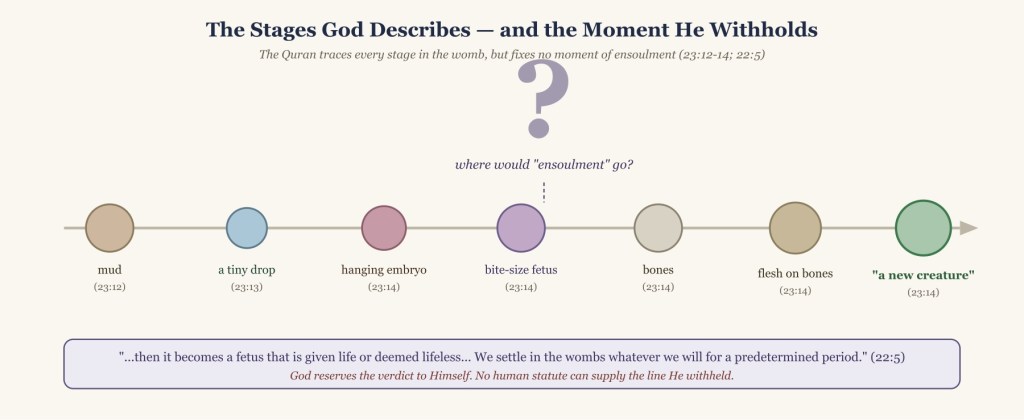
This forces us to refute both popular dogmas with the same honesty. The claim “no soul until birth” is false: the “new creature” of [23:14] is reached in the womb, after bones and flesh, before delivery — and Rashad never taught a birth-ensoulment line. The opposite claim, “soul from conception,” is unproven: the threshold in [23:14] arrives late in the sequence, and the spirit-breath verses are never gestationally dated. The Sunni tradition’s “120 days” figure is hadith-based and therefore excluded from a Quran-alone analysis. Rashad’s attested teaching on the soul establishes its sanctity without ever timestamping its arrival in the fetus — he taught that the soul is “a piece of God” (at 6:30) and that the breath blown into us is imperishable (at 9:06): “I take it that this thing breathed into us, something from Allah’s Spirit, is imperishable.” Sacred, yes — but undated.
The conclusion of this section is the quiet center of the whole article: dogmatic certainty in either direction overreaches the text. The only honest, Quran-faithful posture is reverent agnosticism about the moment of ensoulment — and that very openness is why the matter cannot be settled by criminal statute. Our prior work is consistent with this gap and never closed it: The Quran Alone: God’s Perfect Epistemology walks the same [23:12-14] embryology as description without assigning a moral line, and The Ontology of Hell develops the soul as imperishable and growing — never as something the calendar can locate.
Part 7: Freedom Is Not Endorsement — A Pastoral Word
Because you are free, you are responsible
If you have read this far hoping for a permission slip, read this section twice. Nothing here is a green light. The same revelation that bars the state from your decision calls the killing of one’s children a “gross offense” [17:31], files the act beside intoxicants [5:90], and describes the thing growing within as God’s own deliberate work, formed stage by stage toward “a new creature” [23:14]. The freedom we have defended is real precisely because the weight is real; if the decision were trivial, there would be nothing to be free about. We will not minimize the act to win the legal argument — honesty has to cut both ways or it is not honesty.
So a word to the woman actually facing this, not the debater scoring points. You are free — and because you are free, you are responsible. Weigh it before God, not before public opinion, not before a clergy that wants to seize what God left to you, and not before the fear of poverty that God Himself answered: “We provide for them, as well as for you” [17:31] — which makes economic fear the weakest of all the reasons. The decision is yours, the accounting is yours, and the One you will give it to is the most merciful judge there is, who knows “the innermost thoughts” [39:7] and who never punishes “without first sending a messenger” [17:15]. That is not a light burden. It is a dignified one — the burden of a free soul, which is the only kind of soul that can do anything that matters. The freedom-versus-still-a-sin framing we built in The Truth About Facilitating Sin is the exact posture to carry into this decision: free to choose, and answerable for the choice.
Conclusion: The State and Clergy Must Not Play God
Let us restate the surviving thesis cleanly, with nothing smuggled in. God drew no personhood line inside the womb and reserved that verdict to Himself — “a fetus that is given life or deemed lifeless” [22:5]. To criminalize abortion, a state or a clergy must forge that line and enforce it in God’s name, which is the very fabrication condemned in “this is lawful, and this is unlawful… attributed to God” [16:116]. The decision therefore belongs to the woman; the accounting belongs to God [17:15]. A religion that cannot be compelled into the heart — “There shall be no compulsion in religion” [2:256], “Do you want to force the people to become believers?” [10:99] — cannot be compelled here either. That is Axis A, and it stands at high confidence.
But we close where honesty demands, on Axis B. This is not a verdict that the act is neutral, righteous, or consequence-free. The same God who forbids the state to coerce you also dislikes the wrong decision [39:7], calls the killing of children a gross offense [17:31], and asks the buried girl “for what crime was she killed?” [81:9]. We have applied those born-child verses to the fetus by our own principled analogy, and we have said so plainly rather than disguising reasoning as revelation. The moral weight is genuine; we leave it with the woman and her Lord, where it was always filed.
So the final word is the dignity of free moral agency itself. The very freedom that lets the act be a sin is the freedom that makes any goodness real — strip it away and you have not protected anyone, you have only abolished responsibility and turned worship into coercion. The line God left open, no human authority may close. As Rashad sealed it: maximum freedom for the human being — “otherwise you cannot hold the human being responsible.” Leave the woman her path, leave the verdict to God, and let no state or clergy try to stand in His place.


Leave a Reply