
Introduction: Two Commands That Never Collide
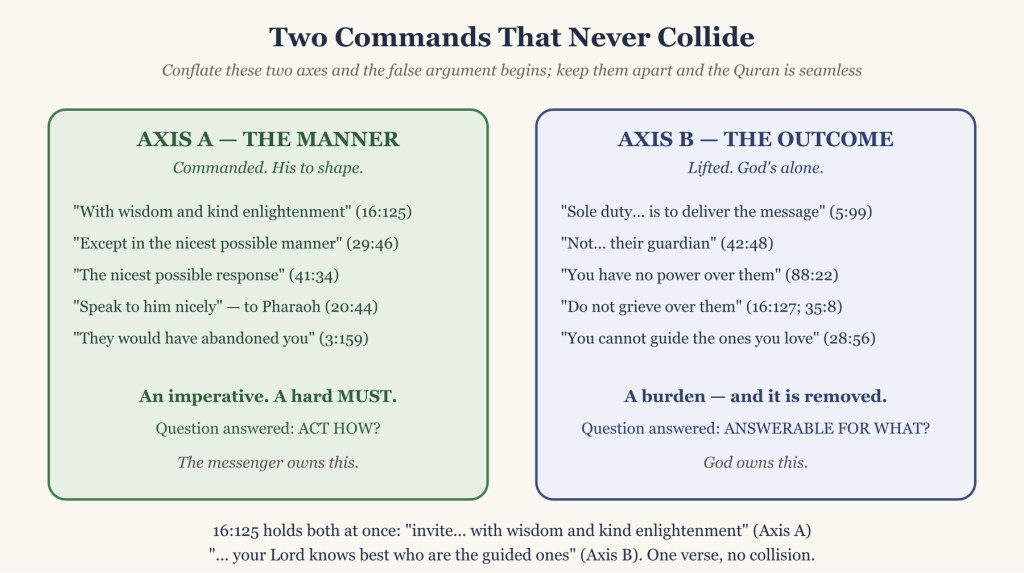
There is an argument that surfaces every time a submitter opens his mouth to share the message. One person says the messenger must labor over how he speaks — gently, wisely, patiently. Another answers that this is sentimentality: the messenger’s job is simply to deliver the truth and walk away, because results are not his department. Both quote the Quran. Both are partly right. And the only reason they fight is that they have crushed two completely separate commands into one. The Final Testament governs the one who carries God’s message along two axes that never touch each other, and keeping them apart is the entire argument of this article.
The first axis is the outcome — whether people accept, are guided, or are saved — and the Quran lifts that burden off the messenger entirely. The second axis is the manner — how he treats the human being in front of him — and the Quran commands that with the force of a direct order. So the question “must we care?” is the wrong question until it is split in two. We are not commanded to carry the result; we are commanded to carry it well. The messenger answers for how he acts, never for how they respond. Once that distinction is fixed, every verse falls into place and the false fight dissolves.
[16:125] “You shall invite to the path of your Lord with wisdom and kind enlightenment, and debate with them in the best possible manner. Your Lord knows best who has strayed from His path, and He knows best who are the guided ones.”
Read that verse slowly, because it contains the whole thesis in one breath. The first half is a command about how he acts: invite with wisdom, with kind enlightenment, debate in the best possible manner. The second half is a statement about who owns the result: your Lord — not you — knows best who has strayed and who is guided. One verse, two axes, sitting side by side without the slightest tension. The manner is the messenger’s assignment; the verdict is God’s domain. That is the frame for everything that follows.

The Frame: The Manner Is His, the Outcome Is God’s
What the messenger answers for — and what he does not
The objection has to be met head-on, because it is built from real verses. The messenger’s accountability really is capped at delivery, and the Quran says so repeatedly and plainly. He is not the guardian of anyone’s heart, he holds no power to bend a single soul toward belief, and the reckoning of those who turn away is filed with God, not with him.
[5:99] “The sole duty of the messenger is to deliver the message, and God knows everything you declare and everything you conceal.”
[42:48] “If they turn away, we did not send you as their guardian. Your sole mission is delivering the message. When we shower the human beings with mercy, they become proud, and when adversity afflicts them, as a consequence of their own deeds, the human beings turn into disbelievers.”
[88:21] “You shall remind, for your mission is to deliver this reminder.”
[88:22] “You have no power over them.”
This much is true and uncontested, and it must be conceded without flinching. A submitter who shares the message and is rejected has not failed, because acceptance was never on his ledger. He could not have forced it if he tried — “Do you want to force the people to become believers?” asks [10:99], and “You cannot guide the ones you love” settles it in [28:56]. The result belongs to God. (Our earlier study, The Foundation of Faith: Why Belief Must Precede Worship, walks this same ground: the messenger reminds, he does not compel.) So far the objector is winning the argument he thinks he is having.
But notice precisely what these verses regulate. Every one of them answers the question “answerable for what?” — and the answer is “for delivering, not for the result.” Not a single one answers the question “deliver how?” That second question is exactly what [16:125] answers, and it answers it with a command: with wisdom, with kind enlightenment, in the best possible manner. The two questions never collide because they are about different things. “Sole duty is to deliver” caps what he is accountable for; it does not license how he delivers. Delivery is never commanded in a vacuum — every verse in the Quran that specifies the manner of delivery specifies a wise and kind manner, and not one licenses harshness or carelessness. To read “sole duty to deliver” as “therefore the manner is optional” is a category error: it takes a verse about the scope of accountability and pretends it is a verse about the quality of speech.
So we pin the word that trips everyone up. When this article says the messenger must care, it means care in the manner — wisdom (ḥikmah), kind enlightenment (maw’iẓah ḥasanah), the best manner (billatī hiya aḥsan), compassion. It never means care about whether they accept. That burden is lifted, and we will see God lift it from the prophets themselves. One clarification belongs here for honesty’s sake: a submitter understands “sole duty is to deliver” as capping the messenger’s accountability for the outcome, not as a claim that he merely recites and never explains — the covenant messenger does in fact explain the message, a point we develop in The Covenant Messenger’s Divine Mandate. A traditionalist would press 16:44 (“that you may explain to the people”) against any flattening of the role; we note the distinction rather than gloss over it.
The Command: Invite With Wisdom and Kind Enlightenment
Not a suggestion — an imperative and a prohibition
If the manner were optional, the Quran would phrase it as advice. It does not. It phrases it as a standing order with a built-in prohibition. [16:125] is an imperative — “you shall invite… with wisdom and kind enlightenment.” And when the Quran turns to debate with the People of the Scripture, it does not merely recommend gentleness; it forbids everything else.
[29:46] “Do not argue with the people of the scripture (Jews, Christians, & Muslims) except in the nicest possible manner—unless they transgress— and say, ‘We believe in what was revealed to us and in what was revealed to you, and our god and your god is one and the same; to Him we are submitters.’”
That is a prohibitive imperative — a hard “must,” not a soft “should.” Do not argue except in the nicest possible manner. The submitter reading rests on the verse’s own common ground: our God and your God is one and the same. You debate from shared monotheism, not from contempt. The clause “unless they transgress” is the verse’s own limit — gentleness has a boundary when the other side moves from disagreement to aggression — and we will return to that boundary in its proper place. But the default, the rule, the commanded posture toward anyone willing to listen, is the nicest possible manner. The Quran even reframes the goal of a good response: not to crush an opponent, but to convert him into a friend.
[41:34] “Not equal is the good response and the bad response. You shall resort to the nicest possible response. Thus, the one who used to be your enemy, may become your best friend.”
The messenger Rashad Khalifa drew exactly this lesson from [16:125], distinguishing bluntness from harshness — you can be perfectly straightforward without being cruel. As he put it (at 16:36): “There’s a diplomatic way, there’s a way of doing it easy and mild. So the Quran says, invite to the way of the Lord, by wisdom and tact, and being diplomatic.” And he warned plainly against slamming the door on anyone (at 18:29): “Invite to the [path] of God with wisdom and great diplomacy. You want to do it so you don’t chase them away? Keep the door open. If they are not going to believe now, you keep the door open for them.” Keeping the door open is the entire art of the manner — and it is commanded, not optional.

Gentleness owed even to the worst tyrant
Here is where the command shows its true reach. If gentleness were merely a tactic reserved for promising audiences, God would have suspended it for history’s cruelest oppressor. He did the opposite. When God sent Moses and Aaron to Pharaoh — a man who claimed divinity and slaughtered infants — the instruction was not to thunder, but to speak gently.
[20:44] “Speak to him nicely; he may take heed, or become reverent.”
Read that and the excuse “but this person doesn’t deserve kindness” evaporates forever. If Pharaoh was owed nice speech, no one you will ever meet is beneath it. And notice the verse’s careful wording — “he may take heed,” not “he will.” Even here, the manner is commanded while the outcome stays open and unowned: speak nicely regardless of whether it works. The same principle extends even to the idol worshiper who seeks a hearing, who must be granted safe passage so “he can hear the word of God” before being returned safely [9:6]. The method of invitation is gentle toward everyone — the committed enemy, the tyrant, the idolater — because the method is the messenger’s command and the heart is God’s business.

The Prophets Felt Deeply — Temperament, Not Result-Anxiety
God does not appoint the cold-hearted
If the manner did not matter, God could have chosen messengers who recited and felt nothing. Instead the prophets He chose were men of profound tenderness — and the Quran preserves their feeling as praise, not as weakness. Abraham is the clearest case. When the angels brought news that Lot’s people would be destroyed, Abraham did not shrug and say “delivery complete.” He pleaded with God Himself on their behalf.
[11:74] “When Abraham’s fear subsided, and the good news was delivered to him, he proceeded to argue with us on behalf of Lot’s people.”
[11:75] “Indeed, Abraham was clement, extremely kind, and obedient.”
God did not rebuke the tenderness — He named it: clement, extremely kind. The compassion that motivated the plea is exactly the temperament God prizes in a caller. But honesty requires the next verse too, and it draws the line precisely. The plea did not overturn the decree.
[11:76] “‘O Abraham, refrain from this. Your Lord’s judgment has been issued; they have incurred unavoidable retribution.’”
This is the two-axis thesis written into a single story. Abraham’s compassion — the manner of his heart — is honored. But the outcome was never his to move; the judgment was God’s, and Abraham was told to refrain. The lesson is not “pushback works” or “argue with God until He relents.” The lesson is that deep care for people is the right temperament of a messenger, while the verdict remains, always, on the other axis. Feel deeply; deliver tenderly; release the result.
Weeping, forgiving, pleading
The pattern repeats across the prophets. Jacob grieved for Joseph until the grief dimmed his sight — the Quran records it without a hint of disapproval, as the natural ache of a loving heart.
[12:84] “He turned away from them, saying, ‘I am grieving over Joseph.’ His eyes turned white from grieving so much; he was truly sad.”
Joseph himself, holding total power over the brothers who had thrown him into a well to die, chose forgiveness and a prayer for their mercy rather than vengeance — [12:92]: “There is no blame upon you today. May God forgive you. Of all the merciful ones, He is the Most Merciful.” And Jesus, given the chance to condemn the people who turned his name into idolatry, pleaded for them instead — [5:118]: “If You punish them, they are Your constituents. If You forgive them, You are the Almighty, Most Wise.” This is what God’s chosen carriers of the message look like from the inside: not numb, not cold, not indifferent — tender, forgiving, deeply moved. The messenger Rashad Khalifa, describing the gentleness of God’s appointed, said it simply (at 9:06): “He is very mild, very understanding, very gentle, and very respectful. And he never, never utters the things that we would utter.” The manner of the messenger is not a performance bolted on after the fact; it flows from a heart God deliberately made tender.

But the Outcome Is God’s: Grief Is Lifted
The same tender hearts, de-burdened of the result
Here is the proof that the thesis is scoped correctly. The very prophets whom God made tender, He also explicitly relieved of the outcome. Feeling in the manner is honored; owning the result is removed. The Prophet Muhammad grieved so intensely over his people’s rejection that he blamed himself for it.
[18:6] “You may blame yourself on account of their response to this narration, and their disbelieving in it; you may be saddened.”
[26:3] “You may blame yourself that they are not believers.”
And what does God do with that self-blame? He does not feed it — He lifts it. Over and over, the instruction comes back: do not grieve over them. The grief that fixes on the result is gently but firmly redirected, because the result was never the messenger’s to carry.
[16:127] “You shall resort to patience—and your patience is attainable only with God’s help. Do not grieve over them, and do not be annoyed by their schemes.”
[35:8] “Note the one whose evil work is adorned in his eyes, until he thinks that it is righteous. God thus sends astray whoever wills (to go astray), and He guides whoever wills (to be guided). Therefore, do not grieve over them. God is fully aware of everything they do.”
Look at how surgically the Quran cuts here. “God… guides whoever wills” — that is the outcome axis, sealed shut and handed to God. “Therefore, do not grieve over them” — that is the burden being lifted off the messenger’s shoulders. He is not told to stop being kind; he is told to stop owning what was never his. This is precisely why the thesis of this article is “care in the manner,” never “care about whether they accept.” The first is commanded all the way up to Pharaoh; the second is actively discouraged as a grief that does not belong to you.
So the de-burdening and the command live together without strain. “Not their guardian… your sole mission is delivering” [42:48] and “you have no power over them” [88:22] empty the messenger’s hands of the result — and into those freed hands the Quran places the only thing that is actually his: the manner. Stop grieving over what they do with the message; pour everything into how beautifully you deliver it. That is the balance, and it is liberating. The submitter who internalizes it can preach with his whole heart and sleep soundly when rejected, because he was graded on the delivery, and the delivery is the one thing he controls.

Harshness Drives People Away; Gentleness Is Commanded
Mercy is what kept people around the Prophet
The Quran does not leave the value of gentleness to inference. It states, in the plainest cause-and-effect language, that the Prophet’s compassion is the very reason people stayed near him — and that harshness would have scattered them. This is not a poetic flourish; it is God’s own diagnosis of how human beings respond to those who carry His message.
[3:159] “It was mercy from God that you became compassionate towards them. Had you been harsh and mean-hearted, they would have abandoned you. Therefore, you shall pardon them and ask forgiveness for them, and consult them. Once you make a decision, carry out your plan, and trust in God. God loves those who trust in Him.*”
Sit with the logic. God calls the Prophet’s compassion a mercy from God — a gift, not a flaw — and then names the alternative outcome with brutal clarity: harshness would have emptied the room. This single verse demolishes the caricature of the “tough” preacher who drives people off and calls it faithfulness. The Quran calls it failure of the manner. Then it goes further still: pardon them, seek forgiveness for them, and consult them. The carrier of the message is told to lower himself toward the very people he is correcting. We explored this same verse as a wellspring of mercy in Trust in God: An Enduring Pillar of Faith and Resilience — compassion and trust in God are woven together in the same instruction.
Lower your wing
The image the Quran reaches for is tenderness made physical: a bird folding its wing down over its young. Twice God commands the Prophet to “lower your wing” for the believers — to be soft, humble, protective, approachable.
[15:88] “Do not be jealous of what we bestowed upon the other (messengers), and do not be saddened (by the disbelievers), and lower your wing for the believers.”
[26:215] “And lower your wing for the believers who follow you.”
Notice that even in [15:88], the two axes appear together once more: “do not be saddened (by the disbelievers)” — release the outcome — “and lower your wing for the believers” — perfect the manner. The carrier of God’s message is to be the gentlest presence in the room, not the harshest. Combine this with “Speak to him nicely” [20:44] for the tyrant and you have a complete picture: softness toward the believer who follows, softness toward the enemy who has not yet attacked, softness even toward the oppressor while there is any hope he might hear. Gentleness is not a mood the messenger falls into on good days. It is the standing command of his office.

Gradual, Not Dumping: God Paced His Own Revelation
The Quran models the manner of delivery
How does God Himself deliver a message? Not in an overwhelming flood, but slowly, in measured portions, so it could be absorbed. The Quran was complete and sent down all at once into the Prophet’s heart, yet released to the people over twenty-three years in a deliberate sequence. The full verse keeps both halves in view.
[17:106] “A Quran that we have released slowly, in order for you to read it to the people over a long period, although we sent it down all at once.”
[25:32] “Those who disbelieved said, ‘Why did not the Quran come through him all at once?’ We have released it to you gradually, in order to fix it in your memory. We have recited it in a specific sequence.”
We should be precise about what these verses are and are not. They describe how God revealed the Quran to the Prophet — the pacing, the memorization, the fixed order — and they are not a literal command to ration teaching to others. But the analogy is legitimate and the Quran itself invites it: the very pattern of revelation models a wise delivery. The disbelievers in [25:32] demanded everything at once and were answered that gradual release, in sequence, was the wiser way — “in order to fix it in your memory.” A wall of truth dumped on someone overwhelms; truth offered in the order they can carry it takes root.
The messenger Rashad Khalifa drew the pacing and God’s mercy together explicitly (at 3:53): “So the release was very slowly, very gradually, and it took 23 years. God created the universe and created the human race, and out of his mercy he sent messengers and books to tell us about him.” If the Author of the message chose patience and sequence over an overwhelming dump, the one who merely carries that message has no business doing otherwise. Meeting people where they are, at the pace they can bear, is not a compromise of the truth — it is the manner God modeled in the very act of revealing it.

Value the Individual Seeker; Do Not Chase Rank
The rebuke over the eager seeker
Perhaps the most striking lesson on the manner of preaching is a rebuke — and it is aimed at the Prophet himself. A blind man came to him sincerely, eagerly seeking guidance, while the Prophet was occupied courting a prominent, influential figure he hoped to win. God’s correction is unsparing, and it permanently reorders the preacher’s priorities.
[80:5] “As for the rich man.”
[80:6] “You gave him your attention.”
[80:7] “Even though you could not guarantee his salvation.”
[80:8] “The one who came to you eagerly.”
[80:9] “And is really reverent.”
[80:10] “You ignored him.”
Every word of this cuts against the instinct to chase status. The prominent man got the attention — “even though you could not guarantee his salvation” (there is the outcome axis again: not yours to guarantee). The eager, reverent seeker, the one actually reaching for God, was the one ignored. The lesson lands like a blade: do not measure a soul by its social weight. The humble seeker who comes to you on his own is worth more of your care than the influential prospect you are trying to impress. (Note that the identification of “the one who frowned” as Muhammad is the interpretive reading; the Arabic itself says only “He frowned and turned away.”)
One soul is worth all of mankind
Why does a single seeker carry such weight? Because the Quran assigns an almost unimaginable value to one human being. To save a single life is reckoned as though you saved all of humanity.
[5:32] “…anyone who murders any person who had not committed murder or horrendous crimes, it shall be as if he murdered all the people. And anyone who spares a life it shall be as if he spared the lives of all the people…”
That arithmetic transforms how a submitter sees the person in front of him. The eager seeker is not a small audience; he is, in God’s accounting, all of mankind. So the Quran forbids dismissing such people in the strongest terms — dismissing the sincere makes you the transgressor — and commands the messenger to stay rooted among the devoted rather than drifting toward worldly prestige.
[6:52] “And do not dismiss those who implore their Lord day and night, devoting themselves to Him alone. You are not responsible for their reckoning, nor are they responsible for your reckoning. If you dismiss them, you will be a transgressor.”
[18:28] “You shall force yourself to be with those who worship their Lord day and night, seeking Him alone. Do not turn your eyes away from them, seeking the vanities of this world. Nor shall you obey one whose heart we rendered oblivious to our message; one who pursues his own desires, and whose priorities are confused.”
“Do not turn your eyes away from them, seeking the vanities of this world” is the antidote to every preacher who courts the influential and overlooks the ordinary. The manner God commands is profoundly democratic: the door is open to the rich, but the cleaner’s earnest question outranks the celebrity’s polite curiosity. Value the one who is genuinely reaching. In the economy of the message, he is everything.

Firmness: Only Toward Active Aggressors, Strictly Defensive
Two different kinds of firmness
An honest article must answer the obvious objection: doesn’t the Quran also command firmness? It does — and pretending otherwise would be a lie. The flat slogan “always be gentle, the Quran is never firm” does not survive the text. God commands the Prophet to “strive against the disbelievers and the hypocrites, and be stern in dealing with them” [9:73], and describes the believers as “harsh and stern against the disbelievers, but kind and compassionate amongst themselves” [48:29]. So firmness is real. The question is what kind, and toward whom.
The resolution is to see that “firmness” names two completely different things, and neither one licenses harshness toward a sincere seeker. The first is doctrinal firmness: never dilute the truth, never validate disbelief or hypocrisy, never ally with the camp actively hostile to the faith. That is a stance, an inner refusal to compromise — and even [9:73]‘s “striving” is defined elsewhere as striving with the Quran itself: “strive against them with this, a great striving” [25:52]. The weapon is the argument, not the fist or the insult. The second is physical, defensive firmness: lawful self-defense, and only that. Crucially, the gentleness of invitation is near-absolute — owed even to Pharaoh — while firmness is never aimed at the seeker. It is aimed only at the aggressor who has already moved from disbelief to attack.
The pivot line: do they fight you?
The Quran draws the boundary with surgical precision in two consecutive verses. The dividing line is not belief, not disagreement, not even hostility of opinion — it is active aggression: do they fight you, evict you, conspire to banish you?
[60:8] “God does not enjoin you from befriending those who do not fight you because of religion, and do not evict you from your homes. You may befriend them and be equitable towards them. God loves the equitable.”
[60:9] “God enjoins you only from befriending those who fight you because of religion, evict you from your homes, and band together with others to banish you. You shall not befriend them. Those who befriend them are the transgressors.”
The word “only” in [60:9] is the whole argument. Firmness is reserved only for those who fight, evict, and conspire to banish. Everyone else — the neutral, the curious, the disagreeing, the not-yet-believing — falls under [60:8]: befriend them and be equitable. We developed this exact distinction in Love Your Enemy, But Flee From God’s Enemy: the line runs between the peaceful and the aggressor, never between the believer and the seeker. And even against true aggressors, the Quran chains firmness tightly: it must be defensive, never initiated, and it must stop the instant the aggression stops.
[2:190] “You may fight in the cause of God against those who attack you, but do not aggress. God does not love the aggressors.”
[8:61] “If they resort to peace, so shall you, and put your trust in God. He is the Hearer, the Omniscient.”
So the complete formula is clean: gentleness is the rule and the method of all invitation, owed even to a tyrant; firmness is never harshness toward seekers, only an inner refusal to compromise the truth and a lawful self-defense against those who actually fight you or drive you out — ending the instant their aggression ends. A submitter who confuses these two will either collapse into the compromiser who befriends the openly hostile camp [60:9], or harden into the bully who is rude to honest questioners. The Quran forbids both. The truth is held firm; the seeker is held gently. We traced how “false compassion” inverts this very balance in Refuting False Accusations: When Obedience to God Is Called Tyranny.

Kill the Ego, Accept Counsel; Mercy Frames It All
The ego is the enemy of the manner
What is it that turns a gentle invitation into a harsh confrontation? Almost always, ego. The moment the messenger’s pride enters — the need to win, to be proven right, to crush rather than to convince — the manner God commanded is already broken. The Quran is severe about the arrogance that flares up the instant a person is corrected.
[2:206] “When he is told, ‘Observe God,’ he becomes arrogantly indignant. Consequently, his only destiny is Hell; what a miserable abode.”
That is the portrait of the ego that cannot receive correction — and it is a warning to the preacher as much as to the audience, because the carrier of the message is not immune to it. The antidote is the posture of the genuinely guided: not defensiveness, but discernment. The intelligent ones weigh what they hear and keep the best of it.
[39:18] “They are the ones who examine all words, then follow the best. These are the ones whom God has guided; these are the ones who possess intelligence.”
A submitter who preaches with a killed ego can be told he is wrong without his world collapsing, can take good counsel from anyone, and therefore never needs to defend himself by attacking others. He examines all words and follows the best — even when the best comes from a critic. This is the inner condition that makes the gentle manner sustainable, because gentleness sourced in humility does not crack under provocation the way gentleness faked over pride always does.
Mercy is the attribute that frames everything
Beneath every command in this article lies a single governing reality: mercy is God’s own chosen attribute, and the messenger was sent as an embodiment of it. If we want to know the spirit in which the message must travel, we look at the spirit in which God describes Himself and the one He sent.
[7:156] “…My retribution befalls whomever I will. But My mercy encompasses all things…”
[21:107] “We have sent you out of mercy from us towards the whole world.”
[6:54] “…Your Lord has decreed that mercy is His attribute…”
God’s mercy encompasses all things; the Prophet was sent as a mercy to the whole world; mercy is decreed as God’s defining attribute. A message born of mercy, carried by a man who was mercy, on behalf of a God whose self-description is mercy, cannot be delivered with contempt without betraying its own source. The messenger Rashad Khalifa grounded the manner in exactly this: because God gave us the capacity for compassion, compassion is not optional (at 12:50): “If God has given us the capacity to be compassionate, it becomes a duty for us to become compassionate.” He also fixed the weight of God’s central self-description (at 15:22): “God says my mercy encompasses all things.” We connected this universal compassion to reflecting God’s attributes in Global Child Suffering: The Ignored Catastrophes. Compassion in the manner is not the soft option; it is the duty of anyone entrusted with the message of the Most Merciful.

Conclusion: Deliver as God Delivered His Own Message
The false argument we began with dissolves once the two axes are kept apart. The objector was right that the messenger’s accountability ends at delivery — the result genuinely is God’s, the guardianship is God’s, the guidance is God’s, and grieving over rejection is a weight the Quran lifts off our shoulders. But he was wrong to conclude that the manner is therefore optional. Delivery is never commanded in a vacuum. Every single verse that tells the messenger how to deliver tells him a wise, kind, patient, merciful how — and not one licenses harshness or carelessness. “Sole duty to deliver” caps what we answer for; “with wisdom and kind enlightenment” commands how we act. They never collide because they were never about the same thing.
So the submitter who carries this message walks with both hands full and both hands free. His hands are full of the manner — wisdom, kind enlightenment, the best possible response, the lowered wing, the open door, the patience that meets people where they are, the firmness that never touches a seeker and the gentleness that reaches even a tyrant. And his hands are free of the outcome — he does not own whether they accept, he cannot force a heart, and he will not grieve himself sick over a result that was always God’s to give. That is not a lesser care. It is a truer one: care poured entirely into the one thing that is actually his.
In the end the model is God Himself. He released His own perfect message not in an overwhelming flood but slowly, in sequence, over twenty-three years, so it could be carried and kept. He described Himself, before anything else, as the One whose mercy encompasses all things. And He sent His messenger as a mercy to the whole world. If that is how the Author of the message delivered it, the one who merely carries it has his instructions. Deliver as God delivered: gradually, with wisdom, with compassion, keeping the door open. The manner is commanded. The result is His. Carry it beautifully — and leave the harvest to the One who knows best who are the guided ones.



Leave a Reply