Introduction: The Fairest Possible Reading
An article titled “A Framework for Evaluating Quranic Arguments” sets itself a demanding task, and it deserves a demanding reply. The piece is a serious, disciplined attempt to sort good reasoning from bad. It proposes a four-tier hierarchy of evidence. Tier 1 holds the potentially decisive: direct contradiction, internal inconsistency, logical or grammatical impossibility, empirical falsification, a counterexample to a universal claim, and methodological failure. Tier 2 holds the strong but not decisive: formal fallacies, cumulative linguistic evidence, historical and contextual data, pragmatic consequences, and parsimony. Tier 3 holds the weak: tradition, authority, majority opinion, and the argument from silence. Tier 4 holds what is no evidence at all.
The author is careful and, notably, is not a defender of the traditions. The piece rejects reliance on the reports attributed to later generations, it links out to resources that question those reports, and it does not mention the mathematical code or the messenger Rashad Khalifa even once. It is not a polemic against Submission; it is a rulebook. And it condemns emotion, ridicule, motive-guessing, and identity-based dismissal as non-evidence, which is exactly right. So this reply will use none of those tools. It will not question anyone’s sincerity or intelligence. It will contest only two things: whether the framework is complete, and whether it is consistent with itself. The thesis is that it fails on three levels, and that the honest way to show this is to concede generously what survives, because on this subject fairness is not a courtesy, it is the argument. First, the framework refutes itself by its own Tier-1 rules. Second, it omits the Quran’s own answer to the very question it asks. Third, its worked examples reverse when they are checked against the actual Arabic. The corrective is not to burn the ladder. It is to let the Quran set the standard for evaluating the Quran.
Part One: What the Framework Gets Right
The Tier-4 List Is Correct
Begin where the framework is strongest, because a fair reply concedes before it contests. Its Tier-4 list of non-evidence is simply correct, and it is worth stating so plainly. Personal preference proves nothing about what is true. Emotional intensity proves nothing. Ridicule proves nothing. A guess about someone’s hidden motive proves nothing about the merit of what they said. And dismissing a claim because of who made it, rather than what was made, is a category error dressed as a rebuttal. A conclusion is not more true because it was asserted with confidence, nor less true because its author is disliked.
This is not a small achievement. A great deal of religious argument, on every side, lives entirely inside Tier 4, and a community that internalized only this one page would argue better tomorrow than it does today. So the point of departure is not that the framework prizes rigor. It is that the framework does not apply its rigor evenly, and that it stops short of the one standard the Quran actually sets for itself. Those two gaps, and not any lack of seriousness, are the whole of the disagreement.
Coherence Was Named, But Buried
The framework’s single best instinct appears near its end, when it finally grants real weight to explanatory scope and internal coherence, and cites the Quran to do it.
[4:82] “Why do they not study the Quran carefully? If it were from other than God, they would have found in it numerous contradictions.”
Citing this verse is the right move. But the framework introduces the coherence criterion late, treats it as one consideration among many, and calls its weight “surprisingly high.” That word “surprisingly” is the tell. There is nothing surprising about it. This verse is not a late entry in the Quran’s list of evidences; it is the Quran naming its own master test. A framework that discovers its most important principle on the last page has, by its own logic, mis-ranked the evidence. Hold this thought, because everything below returns to it.

Part Two: The Framework Fails Its Own Tier-1 Test
A Tradition Wearing a Tier-1 Costume
The framework’s most consequential decision is to seat classical Arabic grammar on the Tier-1 throne, so that a “grammatical impossibility” counts as potentially decisive. This looks objective. But it raises an immediate question the framework never answers: whose grammar? The formal sciences of Arabic grammar and morphology were codified roughly a century and a half to two centuries after the revelation, by the competing schools of Basra and Kufa, in works such as the foundational book of Sibawayh. The living language of course preceded its grammarians; native speakers spoke it correctly long before anyone wrote its rules down. But in exactly the disputed cases where a “grammatical impossibility” verdict does its heavy lifting, the deciding authority is the codified ruling, transmitted through the same scholarly apparatus a Quran-alone thinker treats with suspicion everywhere else.
This is not a quibble; it is the framework’s own listed fault turned on the framework. Its Tier 3 explicitly demotes “appeal to authority” and “appeal to tradition” to weak evidence. Yet its decisive Tier-1 grammatical verdicts rest on the authority of a transmitted grammatical tradition. A Tier-3 source has been dressed in a Tier-1 costume. Someone who distrusts transmission when it carries a report about the Prophet, but trusts it without comment when it carries a ruling about a pronoun, owes an account of the difference. Absent that account, the framework commits what it itself calls “internal inconsistency,” which it lists as potentially decisive. The point is not that grammar is worthless. Grammar is a real and useful Tier-2 tool. The point is that grammar cannot occupy the decisive throne while the very tradition that codified it sits in the basement.
One Direction, Every Example
A rubric that presents itself as neutral should, across a set of worked examples, sometimes deliver a verdict that cuts against its own author’s prior positions. That is what neutrality looks like when it is real rather than declared. A genuinely disinterested test occasionally embarrasses the tester, and that is a feature, because it shows the test is doing the deciding rather than the author. It is worth asking, then, whether the framework’s examples ever do this. In the piece, every worked example resolves in the same theological direction, against the same target.
The framework itself names this pattern as a fault. In Tier 3 it warns against selective evidence and the practice of choosing only the cases that support a foregone conclusion. That warning applies to a set of illustrations as much as to a set of proof-texts. This is not an accusation about anyone’s honesty, and it should not be read as one; a person can select unrepresentative examples in perfect good faith. It is a claim about the sample. A demonstration built only from cases that all point one way is, by the framework’s own Tier-3 standard, weaker evidence for the method than a demonstration that sometimes surprises its author.
The Parsimony Lever
The framework leans on parsimony, the principle that the explanation with the fewest assumptions is to be preferred. As a Tier-2 consideration this is legitimate. But parsimony has a hidden joint, and the framework leaves it unguarded. What counts as “an assumption” is not handed down by nature; it is decided by whoever is keeping the count. Reframe a premise as a definition and it vanishes from the tally. Reclassify a background fact as an added hypothesis and the count swells. The arbiter who sets the ledger sets the result, and calls the result simplicity.
The framework wisely warns that a method which can prove almost anything proves nothing. That warning should be turned on unconstrained parsimony itself, because a parsimony that lets the arbiter define what an assumption is can be steered to almost any conclusion. Simplicity only decides a case after some outside standard has fixed what the assumptions actually are. The Quran supplies such a standard, in the form of coherence across the whole text and the objective sign discussed below. The framework does not, and so its parsimony floats free, available to be pointed wherever the author already intended to go.
Part Three: The Great Omission
The Sign Appointed to Remove Doubt
A document that promises to evaluate Quranic arguments carries one unavoidable obligation: to address how the Quran says its own claims should be judged. The Quran answers that question directly, and the framework is silent about the answer. The answer is a number, appointed for a stated purpose.
[74:30] “Over it is nineteen.”
Footnote to [74:30]: “This ‘One of the great miracles’ provides the first physical evidence that the Quran is God’s message to the world. This 19-based miracle is detailed in Appendix 1.”
Read what the next verse says the number is for. It was assigned, in the Quran’s own words, “to strengthen the faith of the faithful,” and “to remove all traces of doubt from the hearts of Christians, Jews, as well as the believers.”
[74:31] “We appointed angels to be guardians of Hell, and we assigned their number (19) (1) to disturb the disbelievers, (2) to convince the Christians and Jews (that this is a divine scripture), (3) to strengthen the faith of the faithful, (4) to remove all traces of doubt from the hearts of Christians, Jews, as well as the believers, and (5) to expose those who harbor doubt in their hearts, and the disbelievers…”
This is an objective, arithmetic, non-interpretive criterion. It does not turn on how a pronoun is parsed or on which lexicon one prefers. A count either is or is not a multiple of nineteen. It is therefore falsifiable, and it has not been falsified. Whatever one concludes about the messenger who brought this system to public attention, the phenomenon itself is a matter of counting, and its details are set out in Appendix 1 and in our own study of the code, which examines the evidence and the standard objections at length (see The Mathematical Miracle of 19). A hierarchy for evaluating Quranic claims that never once mentions the Quran’s own stated proof cannot call itself complete. Worse, the omission has a shape. The framework confines “strong evidence” to grammar and history, the two domains where human interpretation multiplies without end, and it leaves out the single layer that is not interpretation at all.
![Verse card [74:30] 'Over it is nineteen.' over a starry night sea.](https://quranonlystudies.com/wp-content/uploads/2026/07/quran_own_standard_03_nineteen_verse_card.png?w=1024)
The Master Test Filed as a Footnote
Return now to the verse the framework cited late and ranked low. Its claim is larger than the framework allows.
[4:82] “Why do they not study the Quran carefully? If it were from other than God, they would have found in it numerous contradictions.”
Footnote to [4:82]: “Although the Quran was revealed during the dark ages, you cannot find any nonsense in it; another proof of divine authorship.”
Consider precisely what this verse asserts: that freedom from contradiction across the entire text is the fingerprint of divine authorship. That does not make coherence one weight to drop on the scale after the grammar has spoken. It makes coherence the master criterion, the thing the grammar is supposed to serve. From this it follows directly that any reading of a single verse which fractures the coherence of the whole is thereby weakened, and any reading which harmonizes the whole is thereby strengthened. This is not Tier 2. It is Tier 0. Every worked example in the framework should have been decided by it first. We have argued elsewhere that this text-adjudicated coherence is the Quran’s answer to the deepest problems in human theories of knowledge (see The Quran Alone: God’s Perfect Epistemology), and the same principle governs here.
Follow the Best-Supported Meaning
The Quran does not leave a reader to invent an interpretive method from scratch. It states the method, and it praises those who use it.
[39:18] “They are the ones who examine all words, then follow the best. These are the ones whom God has guided; these are the ones who possess intelligence.”
[25:33] “Whatever argument they come up with, we provide you with the truth, and a better understanding.”
The hermeneutic here is explicitly comparative and text-adjudicated. One examines the candidate meanings, and then follows the best-supported of them, the one the Quran itself upholds most fully. The second verse promises that this better understanding is genuinely available; it is not a counsel of despair that leaves every reading equally valid. The framework’s late arrival at “explanatory scope” is a partial rediscovery of this same principle. The trouble is only that the Quran states it as the first rule, and the framework reaches it as the last.
A Book Fully Detailed
Why should coherence and a mathematical sign carry this much authority, rather than an external grammar imported from a later century? Because the Quran describes itself as complete in a way that grounds exactly these internal tests.
[6:114] “Shall I seek other than God as a source of law, when He has revealed to you this book fully detailed? Those who received the scripture recognize that it has been revealed from your Lord, truthfully. You shall not harbor any doubt.”
[11:1] “A.L.R. This is a scripture whose verses have been perfected, then elucidated. It comes from a Most Wise, Most Cognizant.”
Footnote to [11:1]: “Our generation is fortunate to witness two awesome phenomena in the Quran: (1) an extraordinary mathematical code, and (2) a literary miracle of incredible dimensions. If humans attempt to write a mathematically structured work, the numerical manipulations will adversely affect the literary quality. The Quran sets the standard for literary excellence.”
A book that describes itself as fully detailed, perfected, then elucidated, and whose footnote points at once to a mathematical code and a literary miracle, is telling the reader where its decisive tests live. They live inside it. A framework that grounds its decisive evidence in external grammar, while ignoring the internal mathematical and coherence layers, has quietly inverted the Quran’s own order of authority. It looks outside the book for the tests the book says are inside it.

The Hidden Premise: Only Explicit Numbers Count
One worked example deserves particular care, because it quietly assumes the very thing in dispute. The framework treats the move from “we are commanded to give charity” to “therefore the rate is two and a half percent per year” as a non-sequitur. On its face this is a fair catch, and it should be granted: the Quran does not print the figure “two and a half percent” anywhere in words. To that extent there is no disagreement at all. The number is not spelled out verbally in the text.
But notice the premise buried underneath the example: that only content stated in explicit verbal numbers counts as valid Quranic religion. That premise is not neutral. It is precisely the thing under contention. The Submission position is that the mechanics of the Contact Prayer and the rate of the obligatory charity were not derived from anywhere; they were handed down intact from Abraham, practiced without interruption, and confirmed rather than invented. As Rashad Khalifa put it, many people wrongly assume the Prophet Muhammad originated these rituals, but “they came through the Prophet Abraham, and this is why we do not see the details of how many units per prayer, and these kind of details, we do not find it in the Quran, although the Quran is complete, perfect, and fully detailed” (at 9:10). We have set out this continuity of inherited practice at length (see 3 Prayers at Night vs 5 Prayers). And the same footnote that locates the five prayers adds that their unit-counts are mathematically locked, so this is not a soft appeal to custom but a claim with an objective, checkable component. One may argue against the handed-down thesis on its merits; that is a fair fight. What one may not do is assume its falsehood inside a rubric advertised as neutral, and then present the assumption as a demonstration. “Only explicit numbers count” is a contested premise, not a given.

Part Four: The Worked Examples Reverse Under Scrutiny
The sharpest test of any framework is whether its own demonstrations survive. Checked one at a time against the Arabic, the piece’s worked examples do not merely fail to reach their target. Several of them turn around and support the very reading they were built to defeat.
The Pronoun in 17:79: Right Grammar, Wrong Target
Concede the grammar plainly, with no hedging, because a fair reply pays its debts. The framework observes that the masculine pronoun in one verse cannot refer back to the feminine noun for the Contact Prayer; that would require a feminine pronoun instead. The masculine pronoun therefore refers to the recitation, the Quran, named in the preceding verse. This is correct.
[17:78] “You shall observe the Contact Prayer (Salat) when the sun declines from its highest point at noon, as it moves towards sunset. You shall also observe (the recitation of) the Quran at dawn. (Reciting) the Quran at dawn is witnessed.”
[17:79] “During the night, you shall meditate for extra credit, that your Lord may raise you to an honorable rank.”
But correct grammar aimed at the wrong target proves nothing. No careful reader in Submission claims that this verse establishes one of the five obligatory Contact Prayers. Read what it actually says. “Meditate for extra credit” renders a word meaning additional or supererogatory, and the phrase “for you” is singular, addressed to the Prophet. The verse describes an extra, Prophet-specific night vigil, not a sixth mandatory prayer for the community. So a Tier-1 grammatical impossibility has been deployed against a claim the position never made. By the framework’s own list, refuting a position the opponent does not hold is a straw man, a Tier-2 error. The grammar is right; it lands on empty ground.
The Word for Prostration: Attacking a Claim No One Holds
The framework argues that the Arabic root usually translated “prostration” does not always denote physical prostration, and it points to verses where people are told to enter a gate in a posture of humility. This is true, and it should be granted. The word is not restricted to a single sense.
[2:58] “Just enter the gate humbly, and treat the people nicely.”
Here is the elegant irony. Rashad Khalifa’s own translation, the very text used across Submission, already renders that word “humbly” in exactly these verses. Submission never claimed the root always means prostration. So what, precisely, has been refuted? A lexical universal that no careful reader asserts. The real thesis is narrower, and it stands entirely untouched: that the specific act performed within the Contact Prayer is a prostration, established by continuously inherited practice, not by any claim that one Arabic root can carry only one meaning forever (a point we develop in Salat is Physical Ritual Prayer, Not Quran Study). Demolishing “the word always means prostration” leaves “the prostration inside the Contact Prayer is a prostration” exactly where it stood. By the framework’s own list this is ignoratio elenchi, missing the point, a Tier-2 fallacy.
The Preposition “to”: A False Analogy
The framework’s most technical argument concerns the small preposition rendered “to” or “until.” It observes that the Quran says to wash the arms “to the elbows,” and to fast “until” nightfall, and it argues that reading the prayer verse, “from the sun’s decline to the darkness of night,” as a window holding several separate prayers is inconsistent special pleading.
[5:6] “…wash your arms to the elbows… wash your feet to the ankles.”
[2:187] “You may eat and drink until the white thread of light becomes distinguishable from the dark thread of night at dawn. Then, you shall fast until sunset.”
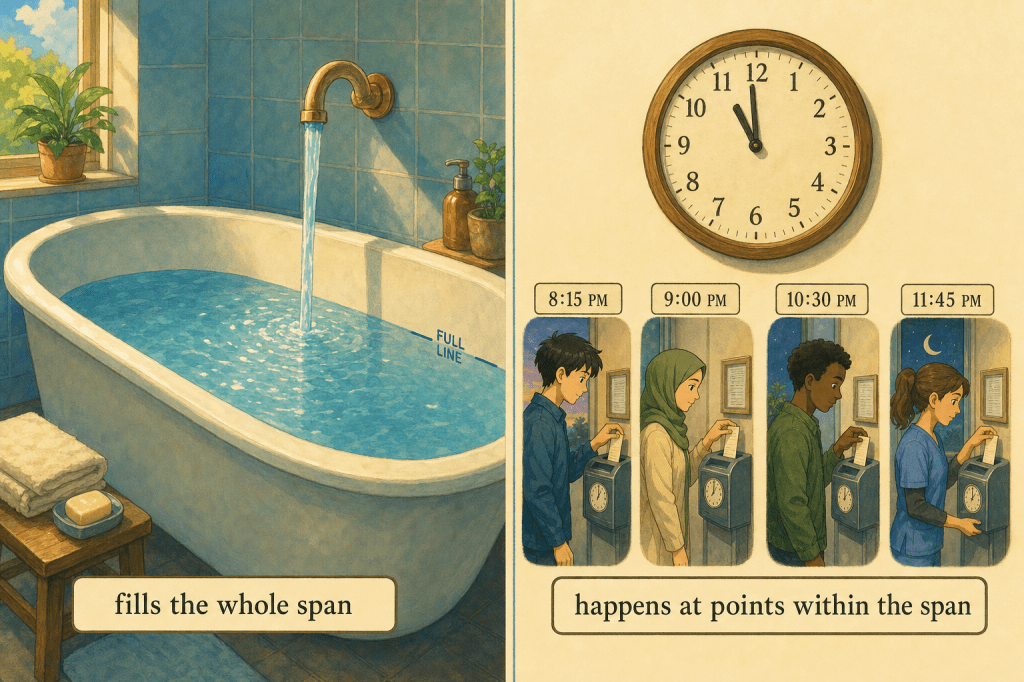
The analogy is false, and ordinary linguistics shows why. Washing and fasting are continuous acts that fill their whole interval. You wash the entire forearm all the way up to the elbow, and you fast every minute until the night arrives. The Contact Prayers are not like that. They are discrete, repeated events that occur at separate points distributed within a window. A bounding preposition takes its behavior from the nature of the act it bounds: a continuous act fills the span, while a punctual and repeated act is distributed across it. Filling a bath fills every inch of water up to the marked line; clocking in for four separate shifts before midnight happens at four points, and at no moment in between. This is the ordinary linguistic phenomenon of verbal aspect, the difference between an act that flows and an act that recurs. It is elementary, not invented for the occasion. Once it is seen, the alleged “inconsistent textual pattern” simply dissolves, and with it the objection.
Reading Silence as Refutation
The framework points to a verse that mentions noon as a time when household members change their clothes to rest indoors, and infers from it that there is therefore no noon prayer.
[24:58] “…before the Dawn Prayer, at noon when you change your clothes to rest, and after the Night Prayer. These are three private times for you.”
But look at what this verse itself does. It names the prayers. It anchors the Dawn Prayer and the Night Prayer by name, and it fixes noon as a marked time in the day’s rhythm. Whether people happen to undress for rest at noon is entirely orthogonal to whether a noon Contact Prayer exists; the two facts do not touch. To move from “noon is a time of privacy” to “there is no noon prayer” is a non-sequitur. And a non-sequitur is the framework’s own Tier-1 category of logical impossibility, here operating against the argument that deployed it rather than for it.
The Sun’s Decline: Decided by His Own Best Criterion
On the pivotal verse the framework is admirably honest, and its honesty is worth crediting. It concedes that it has no Tier-1 refutation of the noon reading, and offers only that alternative explanations exist, plus an appeal to parsimony. This concession is decisive, because the root behind “the sun’s decline” is genuinely polysemous in the classical lexicons. It can mean the sun’s decline from the meridian at noon, and it can mean its setting or reddening at day’s end. Neither reading is grammatically impossible. So the matter cannot be settled at Tier 1 at all. It must be settled by the framework’s own highest criterion: coherence across the whole text.
Apply that criterion honestly and the result is not close. The noon reading harmonizes the entire body of prayer verses into one coherent schedule of five daily prayers. One verse anchors the Dawn Prayer, noon, and the Night Prayer. The verse in question gives the window from noon toward night, which holds the Noon, Afternoon, and Sunset prayers together with the Night Prayer, plus the separate dawn recital. Two more verses confirm the same shape.
[11:114] “You shall observe the Contact Prayers (Salat) at both ends of the day, and during the night.”
[2:238] “You shall consistently observe the Contact Prayers, especially the middle prayer, and devote yourselves totally to God.”
[20:130] “…praise and glorify your Lord before sunrise and before sunset. And during the night glorify Him, as well as at both ends of the day, that you may be happy.”
Footnote to [2:238]: “All five prayers are found in 2:238, 11:114, 17:78, and 24:58. When the Quran was revealed, the Contact Prayers (Salat) had already been in existence. The details of all five prayers… are mathematically confirmed. For example, writing down the number of units for each of the five prayers, next to each other, we get 24434, 19×1286.”
The middle prayer of five is the third, the afternoon prayer, which only exists if the schedule runs Dawn, Noon, Afternoon, Sunset, Night. And the footnote adds the objective layer on top of the coherence: the five prayers are located precisely across these four verses, and their unit-counts, written side by side, form a multiple of nineteen. Now weigh the alternative. A sunset-only reading of the pivotal verse leaves the daytime prayers unaccounted for, and it collides head-on with the verses that name noon and speak of both ends of the day. It does not simplify anything; it requires extra repairs at every turn. So the framework’s own parsimony inverts under its own hand. The reading it prefers needs more patches, not fewer, and the reading it set out to weaken needs none. Its best criterion vindicates the position it opposed.
![Verse card [4:82] 'If it were from other than God, they would have found in it numerous contradictions.' over harmonized mountains.](https://quranonlystudies.com/wp-content/uploads/2026/07/quran_own_standard_07_contradictions_verse_card.png?w=1024)
Conclusion: Let the Quran Set the Standard
Set the three findings side by side. A framework for evaluating Quranic arguments that omits the Quran’s own answer to the question “how should Quranic claims be evaluated,” that seats an external grammar-authority on the decisive throne while classing tradition and authority as weak, and whose worked examples reverse when they are checked against the Arabic, has not reached the standard of rigor it rightly asks of everyone else. None of this touches the author’s seriousness or good faith, and none of it is meant to. It is a claim about the tool, not the toolmaker.
The corrective is not to throw the ladder away, because much of it is sound. Its Tier-4 list of non-evidence is correct and should be kept. Its late elevation of coherence is not merely correct, it is central; it simply belongs at the very top rather than near the bottom. Let the Quran set the standard for evaluating the Quran. That standard has three parts, and the Quran states all three itself: coherence across the whole text, so that no reading may fracture the unity of the book; the best-supported meaning, examined and then followed; and the objective mathematical sign appointed, in the Quran’s own words, to remove all traces of doubt.
End, then, where the master verse begins, on an invitation rather than a verdict. The Quran does not fear examination; it asks for it. “Why do they not study the Quran carefully?” is not a threat but an appeal, and the promise attached to it is that a better understanding is genuinely there to be found. That invitation stays open to the author of the framework, whose instinct for rigor is real, and to every reader alike. Study it carefully. Follow the best-supported meaning. And let the standard for judging the Quran be the one the book has already set for itself.



Leave a Reply