
Two Paths, One Choice
The test you were shipped into
Before you had a name, before you had a face, before there was anything about you worth reporting, you already existed as a decision waiting to be made. The Quran opens the file on the human being with a question that shrinks every pretension we carry:
[76:1] “Is it not a fact that there was a time when the human being was nothing to be mentioned?”
From that nothing, God assembled a hearer and a seer, and He states the reason in the same breath. This life is not an accident and it is not a reward. It is an examination hall, and every one of us was admitted to sit the same paper.
[76:2] “We created the human from a liquid mixture, from two parents, in order to test him. Thus, we made him a hearer and a seer.”
Notice what the test measures. It does not measure how strong you are, how clever you are, or how much you accumulate. It measures which of two responses becomes your reflex, because God tells us plainly that He set exactly two before us and then stood back to watch which one we would reach for.
[76:3] “We showed him the two paths, then, he is either appreciative, or unappreciative.”
[90:10] “Did we not show him the two paths?”
Two paths. Not seventy, not a spectrum, not a fog. Appreciative or unappreciative. Every anxiety, every complaint, every quiet resentment at your circumstances, and equally every moment of gratitude, every steadiness under loss, every instinct to thank rather than grumble, resolves at last into one of these two directions. The whole of the spiritual life is learning to take the first path so habitually that the second stops feeling like an option.

Naming the fault without slandering the Maker
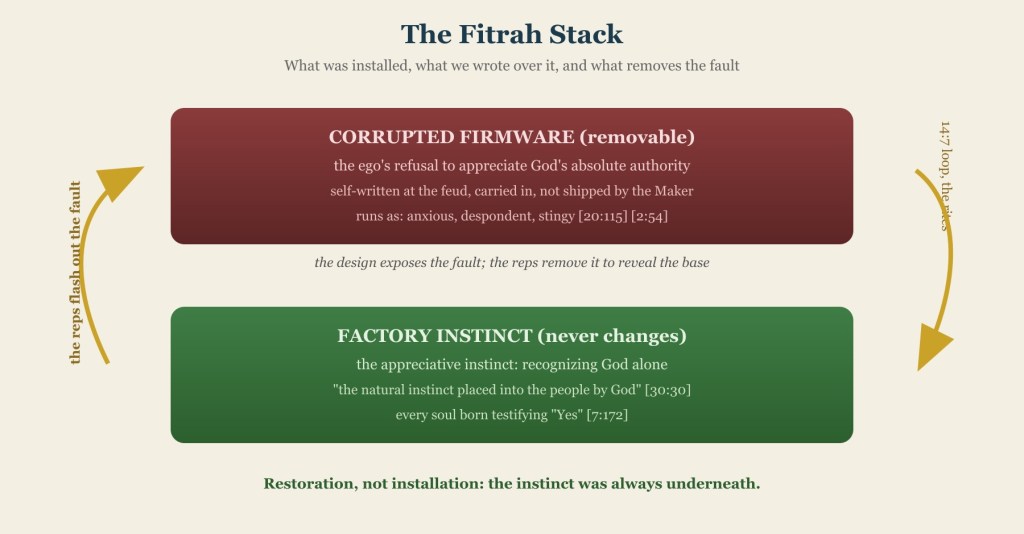
Here is where we must be precise, because a careless word here poisons everything that follows. There is, in the untrained human, a persistent pull toward the second path. The Quran does not hide it: the self, left to itself, argues for the wrong answer. We are going to call this pull “the unappreciative chip”, but the instant we use that image we must fence it, and we will keep fencing it every time it appears. This is not hardware. Nobody soldered it into you at the factory. God did not ship you defective.
The honest picture is corrupted firmware, not a silicon defect: a fault in the programming that you yourself wrote and carried in, and that can therefore be reflashed and removed. It sits over intact original equipment, and it is the removable thing in this whole article. The Quran gives it a name and, crucially, gives it an exception in the same verse, which tells you at once that it is not destiny:
[12:53] “I do not claim innocence for myself. The self is an advocate of vice, except for those who have attained mercy from my Lord. My Lord is Forgiver, Most Merciful.”
Read that exception carefully, because it governs the argument. The self advocates for vice by default, “except for those who have attained mercy”. The chip is real, but it is not sovereign. Something can be attained that overrides it. This article is about that override: what the fault is, where we got it, and the training by which God lets us delete it and switch the default back to the setting He installed.

The Default Is Decay
The verdict on the untrained human
If you want to know what the unappreciative firmware does when it runs unchecked, the Quran does not make you guess. It delivers a verdict on the untrained human character with a bluntness that is almost uncomfortable to read, and it repeats that verdict in chapter after chapter so that we cannot dismiss it as a single harsh line.
[100:6] “The human being is unappreciative of his Lord.”
[100:7] “He bears witness to this fact.”
[100:8] “He loves material things excessively.”
He bears witness to this fact. The verdict is not imposed from outside; our own conduct testifies to it. And it is not one moody chapter. The same diagnosis surfaces wherever the Quran pauses to describe us honestly, and each time the word attached is the same root that means both disbelief and thanklessness.
[14:34] “And He gives you all kinds of things that you implore Him for. If you count God’s blessings, you can never encompass them. Indeed, the human being is transgressing, unappreciative.”
[7:10] “We have established you on earth, and we have provided for you the means of support therein. Rarely are you appreciative.”
[34:13] “Only a few of My servants are appreciative.”
[2:243] “God showers His grace upon the people, but most people are unappreciative.”
Rarely appreciative. Only a few. Most unappreciative. This is not pessimism; it is a clinical baseline reading. God is telling us what the needle rests on before any training is applied, so that we stop mistaking our factory reflex for a moral achievement and start treating it as the thing to be worked against.
The swing: heedless when blessed, despondent when tested
The untrained default is not merely stingy with thanks. It is unstable. It swings violently between two failures depending on whether life is going well or badly, and the Quran maps the swing exactly. When blessed, the chip runs toward heedlessness and forgetfulness of the Source. When struck, it collapses into despair.
[16:53] “Any blessing you enjoy is from God. Yet, whenever you incur any adversity you immediately complain to Him.”
[17:83] “When we bless the human being, he becomes preoccupied and heedless. But when adversity strikes him, he turns despondent.”
[41:49] “The human being never tires of imploring for good things. And when adversity befalls him, he turns despondent, desperate.”
See the machinery. The same person who “never tires of imploring for good things” is the one who “turns despondent” the moment those good things are withheld. It is a single fault presenting two symptoms: an appetite that never says thank you, and a fragility that cannot absorb a loss. The Quran even isolates the ugliest version, where a blessing removed produces not patience but bitterness.
[11:9] “Whenever we bless the human being with mercy from us, then remove it, he turns despondent, unappreciative.”
[11:10] “Whenever we bless him, after adversity had afflicted him, he says, ‘All adversity has gone away from me;’ he becomes excited, proud.”
And then, immediately, the Quran names the exception, which is our first glimpse of the exit: this pattern is broken by a specific kind of person doing a specific kind of work.
[11:11] “As for those who steadfastly persevere, and lead a righteous life, they deserve forgiveness and a generous recompense.”
The signature run, and the idiom of hardening
Nowhere is the default character described more precisely than in one short run in chapter 70. It is the signature of the unappreciative firmware, and it deserves to be read slowly, because the very next verses name the one thing that overrides it.
[70:19] “Indeed, the human being is anxious.”
[70:20] “If touched by adversity, despondent.”
[70:21] “If blessed by wealth, stingy.”
Read what the text says and does not say. It says the untrained human “is anxious”; it does not say God created him anxious. That distinction is the whole point, and we will hold it firmly: the anxiety is the running state of corrupted firmware, not a defect stamped into the metal. The Quran describes the trajectory of a heart left untended, and its own idiom for that trajectory is not rust on a machine but hardening over time.
[57:16] “They should not be like the followers of previous scriptures whose hearts became hardened with time and, consequently, many of them turned wicked.”
[39:22] “If God renders one’s heart content with Submission, he will be following a light from his Lord. Therefore, woe to those whose hearts are hardened against God’s message; they have gone far astray.”
A muscle left unused wastes; a heart left unremembered hardens. The gym image of atrophy is a useful secondary illustration, and we will use it, but the Quran’s own primary image is a heart that either softens toward its Lord or sets like cooling stone. The decay is real and it is directional. Left alone, the needle does not hold steady; it drifts toward hardness. Which is exactly why the setting has to be actively restored, and why the Quran spends so much effort telling us how.
The Instinct God Installed
The component that never changes
Everything so far could be misread as a counsel of despair, as though the human being were simply broken. The Quran forbids that reading in the most direct way possible: it tells us that the deepest, factory level of the human being is not the fault at all. Underneath the acquired corruption sits original equipment, and God says of it that it does not change.
[30:30] “Therefore, you shall devote yourself to the religion of strict monotheism. Such is the natural instinct placed into the people by God. Such creation of God will never change. This is the perfect religion, but most people do not know.”
The footnote to this verse could not be clearer about what that instinct is:
Footnote 30:30: “Recognizing God ALONE as our Lord and Master is a natural instinct. We are born into this world with such an instinct. See 7:172-173 and Appendix 7.”
This inverts the entire picture, and it is the pivot of the whole article. The permanent, never changing, factory installed component is the appreciative instinct: the built in recognition of God alone. The unappreciative chip is not the base layer. It is corrupted firmware acquired later, sitting on top of intact original equipment. Which means the work ahead of us is not the installation of some foreign feeling that we have to manufacture from scratch. It is the restoration of equipment we were born with and then buried.
Born already testifying
How deep does this instinct go? The Quran traces it back before birth, to a moment when every soul that would ever live gave testimony with its own voice.
[7:172] “Recall that your Lord summoned all the descendants of Adam, and had them bear witness for themselves: ‘Am I not your Lord?’ They all said, ‘Yes. We bear witness.’ Thus, you cannot say on the Day of Resurrection, ‘We were not aware of this.’”
Footnote 7:172: “Thus, every human being is born with an instinctive knowledge about God.”
This is the strongest possible armor against fatalism. You are not being asked to acquire a conviction you have never held. You are being asked to remember one you were born already testifying to. Every human that has ever drawn breath said “Yes” before this life began. The appreciative response to God is therefore not an uphill invention against your nature; it is a return to it. The training we will describe reawakens an instinct that every soul already carries, which is precisely why it can succeed.
The reps restore, they do not install
If appreciation is original equipment, then the faculties God gave us were issued for exactly this purpose. The Quran says so, naming the senses and the mind and stating the reason they were granted.
[16:78] “God brought you out of your mothers’ bellies knowing nothing, and He gave you the hearing, the eyesight, and the brains, that you may be appreciative.”
That you may be appreciative. Hearing, sight, and intellect are not neutral tools; they were provisioned toward gratitude. And the direction of the restoration has its own Quranic idiom, the exact opposite of the hardening we saw earlier: skins and hearts that soften and rejoice when the remembrance runs.
[39:23] “The skins of those who reverence their Lord cringe therefrom, then their skins and their hearts soften up for God’s message.”
[13:28] “They are the ones whose hearts rejoice in remembering God. Absolutely, by remembering God, the hearts rejoice.”
So the operation is symmetrical. Neglect hardens; remembrance softens. The chip is not the base; the instinct is the base. And the reps we are about to describe do not manufacture a synthetic gratitude. They clear the corrupted firmware off a component that was always there, waiting under it, made of the same stuff as the “Yes” you said before you were born.
Where the Fault Came From: The Feud
The most important event in our history
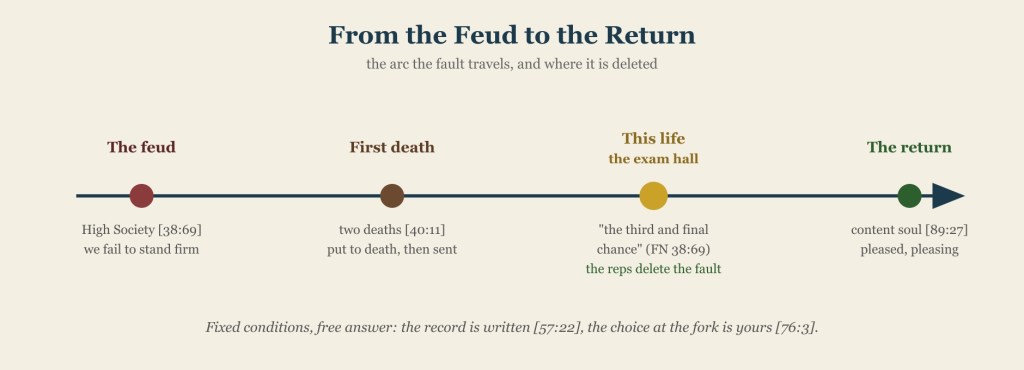
If the fault is not factory installed, then we wrote it. When? The Quran points to an event before this life, in a realm it calls the High Society, and treats it as the hinge on which our whole existence turns. The messenger is made to disclaim any prior knowledge of it, which tells us how far above ordinary human memory it sits.
[38:69] “I had no knowledge previously, about the feud in the High Society.”
Footnote 38:69: “The feud in the High Society was triggered by Satan’s challenge to God’s absolute authority. This is definitely the most important event in the history of the human race. We failed to make a firm stand regarding God’s absolute authority. This life represents the third and final chance to redeem ourselves (See the Introduction and Appendix 7).”
That footnote is the origin story of the chip, and every clause matters. The feud was “triggered by Satan’s challenge to God’s absolute authority”. We, the souls now sitting this exam, “failed to make a firm stand”. And this earthly life is, in the footnote’s exact words, “the third and final chance to redeem ourselves”. The fault we carry is not an abstraction. It is the residue of a specific failure of nerve at a specific moment, when the question was God’s absolute authority and we did not answer it cleanly. The companion verse says the same about the human being’s indecision.
[20:115] “We tested Adam in the past, but he forgot, and we found him indecisive.”
Footnote 20:115: “When Satan challenged God’s absolute authority (38:69), you and I did not make a firm stand against Satan. God is giving us a chance, on this earth, to redeem ourselves by denouncing Satan and upholding God’s absolute authority (Appendix 7).”
Rashad Khalifa taught this openly. Describing the moment the division formed, he explains that a portion of God’s creatures sided with Satan: “Some creatures agreed with satan, and this constituted the heavenly feud that we see in surah 38, 19 times 2, verse 69” (at 7:01). And he tied our arrival here directly to that pre-existence, recalling a time before the rupture: “we were all wonderful in God’s kingdom until the great feud happened” (at 50:08). The rebellion is also why the Quran speaks of two deaths for those who reject, since we were once put to death before this life even began: “when we rebelled against God, God put us all to death. The first death” (at 47:40), which is the very confession the Quran records:
[40:11] “Our Lord, you have put us to death twice, and You gave us two lives; now we have confessed our sins. Is there any way out?”
Two layers, welded once and never confused
Now we must weld two things together and then never confuse them again, because the entire argument depends on keeping them straight. There are two layers to the human predicament, and only one of them is the fault.
The first layer is what we carried in from the feud, and it is one thing only: the ego’s refusal to appreciate God’s absolute authority. That is the corrupted firmware. It is not a general badness, not a vague human frailty; it is specifically the unappreciative stance toward God’s sole authority that we failed to renounce when it counted. The second layer is entirely different, and it is not damage at all. It is a deliberate design feature. God built the human body weak and dependent on purpose, as the test bench on which the fault is exposed.
[4:28] “God wishes to lighten your burden, for the human being is created weak.”
Here is the weld, in one sentence: the design exposes the fault. God places the carried ego, which refuses to appreciate His authority, into a body He deliberately made weak and needy, “in order to test him” (76:2), and the predictable result is the untrained default we already saw, anxious, despondent, stingy. The weakness is not the sin; the weakness is the exam that reveals the sin. This is why the only stated exception to the default character is a practice rather than a personality, and why the training reps work at all: you cannot change the fact that you were built dependent, but you can change what your dependent self runs on. Notice that this puts God’s justice beyond reproach. He did not create the ego’s refusal and then punish you for it. You brought that in. He supplied only the conditions under which it becomes visible and, mercifully, removable.
This is not the inherited sin of Christianity
It is vital to say clearly what this is not, because a nearby doctrine has done enormous damage. This is not the Christian inherited sin, the notion that you are born a guilty sinner because of someone else’s act, doomed from the cradle and unable to lift the sentence yourself. The Quranic account is the opposite of that despair on every point. The sin was our own act, not Adam’s snack and not a stain passed down through blood. And it is removable; erasing it is the entire purpose of being here. Rashad drew this contrast sharply, naming the false teaching and then demolishing it: “It makes us feel that we’re doomed sinners, hopelessly sinners. But it’s not true. You don’t have to be a sinner” (at 20:40).
And where the inherited sin locates the crime in a garden and a piece of fruit, the Quranic original sin is placed billions of years earlier, at the feud, and is framed not as a hopeless verdict but as the reason we were given this chance at all. As Rashad put it: “we committed a horrendous crime back billions of years ago, and this is why we are here, to redeem ourselves. The original sin is very much a fact, a Quranic fact” (at 18:15). A fact, yes, but a fact with an exit door held open. That is the difference between a diagnosis and a death sentence. The chip is real; the doom is a lie.
Fixed conditions, free answer
One guardrail must be set here before we go further, because the feud story can be twisted into fatalism. If it was all decided before, am I not just running a script? The Quran fixes the conditions and the recording, but never the answer. Yes, the outcome is known and written; God is outside of time.
[57:22] “Anything that happens on earth, or to you, has already been recorded, even before the creation. This is easy for God to do.”
Footnote 57:22: “We are absolutely free to side with God, or with Satan. God happens to know precisely what kind of decision each of us will make. The video tape of your life, from birth to death, is already recorded. See Appendix 14.”
The footnote settles it in one line: “We are absolutely free to side with God, or with Satan.” A recording of a free choice is still a free choice; the camera does not hold the actor’s hand. The record is tied to each person, but the deed that fills it is ours.
[17:13] “We have recorded the fate of every human being; it is tied to his neck. On the Day of Resurrection we will hand him a record that is accessible.”
[4:165] “Thus, the people will have no excuse when they face God, after all these messengers have come to them.”
Hold both truths at once, and the chip loses its power to excuse anything. The conditions were fixed: you were shipped into a weak body carrying a fault you wrote at the feud. The answer at the fork was never fixed: the two paths were shown to you (76:3), the uninstaller is published (as we will see, 2:54 and 14:7), and the messengers have removed every excuse (4:165). The chip explains your default pull. It can never explain away your outcome. We have developed this same free-will covenant elsewhere, in A Leap of Faith, where the evidence removes doubt but leaves the decision squarely in your hands.
Killing the Ego Is Removing the Chip
The calf was an idol; so is the ego
The Quran does not leave the removal of the fault as a vague aspiration. It issues a literal command to destroy it, and to see that the command is about our chip and not about ancient metallurgy, we have to first establish a bridge that the Quran itself lays down. When Moses returned to a people worshiping a golden calf, the sin was idolatry: they had set up a false god beside the true one. The Quran then reveals that the most common idol is not made of gold at all. It is made of self.
[25:43] “Have you seen the one whose god is his own ego? Will you be his advocate?”
Read that and the bridge is built. The Quran explicitly classifies the ego as a god that people worship, an idol as real as the calf and far more portable. The calf-worshiper bows to a statue; the ego-worshiper bows to his own self-importance, his own verdict, his own craving to be recognized. Both are the same crime: something has been elevated into the place that belongs to God alone. That is why, when Moses commands the cure for calf-idolatry, the cure he names is the destruction of the ego, because the calf outside was only the projection of the idol inside.
The command, and the footnote that names the stakes
With the bridge in place, the command reads exactly as it should: to end the worship of a false god, you kill the self that keeps trying to be one.
[2:54] “Recall that Moses said to his people, ‘O my people, you have wronged your souls by worshiping the calf. You must repent to your Creator. You shall kill your egos. This is better for you in the sight of your Creator.’ He did redeem you. He is the Redeemer, Most Merciful.”
The footnote to this verse is the most important sentence for understanding why removing unappreciativeness and killing the ego are the same operation:
Footnote 2:54: “It is the ego that led to Satan’s fall. It is the ego that caused our exile to this world, and it is the ego that is keeping most of us from redemption to God’s Kingdom.”
Trace the chain the footnote draws. The ego led to Satan’s fall. The ego caused our exile, which is the feud we just described. The ego is what still blocks our return. And what was Satan’s fall, and our failure at the feud, and our ongoing block, all made of? A single refusal: the refusal to appreciate God’s absolute authority. Rashad named that refusal for exactly what it is: “this is a horrendous crime, not to appreciate God’s absolute authority” (at 6:42). So the unappreciative chip is not one problem and the ego another. They are the same fault under two descriptions. To kill the ego is to remove unappreciativeness; to become appreciative is to have killed the ego. We have set out the ego-as-false-god in more depth in Majority, Ego, and the Messenger, and traced the ontology of exile from God in The Ontology of Hell, where this same 2:54 command anchors the escape.
The attribution error the ego always makes
The ego betrays itself through one recurring error: it takes the credit. Watch the identical move in two places. The moment a blessing lands, the unappreciative self does not thank the Giver; it congratulates itself.
[39:49] “If the human is touched by adversity, he implores us, but as soon as we bestow a blessing upon him, he says, ‘I attained this because of my cleverness!’ Indeed, this is only a test, but most of them do not know.”
[28:78] “He said, ‘I attained all this because of my own cleverness.’”
“Because of my cleverness.” That is the voice of the chip, and Satan himself first spoke it. Rashad explained the root of it: “Satan thought he can be a god, due to his ignorance of the fact that only God possesses the power” (at 3:24). Every time we credit ourselves for what was provided, we run Satan’s original program in miniature. And this is why the removal is framed not as self-improvement but as redemption vs neglect, a choice the Quran makes brutally clear.
[91:7] “The soul and Him who created it.”
[91:8] “Then showed it what is evil and what is good.”
[91:9] “Successful is one who redeems it.”
[91:10] “Failing is one who neglects it.”
Redeem it or neglect it. The verbs are active; the soul is not a passive victim of its firmware. And the reward for the one who does the work of enjoining the self away from its cravings is stated without hedging.
[79:40] “As for the one who reverenced the majesty of his Lord, and enjoined the self from sinful lusts.”
[79:41] “Paradise will be the abode.”
Right-Sizing: Smaller Than Your Anxiety Thinks
The dissonance that feeds the anxiety
We can now look directly at the anxiety that heads the signature run, “the human being is anxious” (70:19), and understand its engine. A great deal of ordinary human anxiety, the species we will call ego-flare anxiety, is generated by a gap: the distance between the stature the ego believes it holds and the reality of what a creature actually is. The ego walks around believing itself large, autonomous, and entitled to control outcomes. Reality keeps contradicting this. Every contradiction, a slight, a setback, a loss of standing, a threat to the self-image, produces a flare of distress that is really the friction of a false self-estimate grinding against the truth. Wounded pride and status anxiety are, at root, the pain of a small thing insisting it is big.
We must scope this carefully and honestly, because to speak loosely here would be cruel. Ego-flare anxiety is one species of distress, and it is the one the spiritual training directly addresses. It is not the whole of human suffering. Clinical anxiety disorders, grief, trauma, and the fear that God Himself says He will test us with, are a different category entirely, and we will treat them with the care they deserve in a moment. For now, the point is diagnostic: much of the low-grade dread that follows us through ordinary days is the chip’s characteristic output, and it is fed by a wildly inflated estimate of our own size and control. Right-size the estimate, and you starve that particular anxiety of its fuel.
What the Quran says you actually are
So the Quran right-sizes us, deliberately and repeatedly. It begins where we began, with the reminder that we are recent arrivals from nothing.
[76:1] “Is it not a fact that there was a time when the human being was nothing to be mentioned?”
It states our constitution frankly: weakness is not a temporary condition but the design specification. And it caps our physical stature with an image no ego can argue with.
[4:28] “God wishes to lighten your burden, for the human being is created weak.”
[17:37] “You shall not walk proudly on earth… you cannot bore through the earth, nor can you be as tall as the mountains.”
You cannot drill through the ground you stand on, and you cannot rise to the height of a hill. That is the actual scale of the creature the ego dresses up as a titan. The Quran then states the dependency flatly: it is not that we happen to need God sometimes, but that need is our very definition, while God needs nothing.
[35:15] “O people, you are the ones who need God, while God is in no need for anyone, the Most Praiseworthy.”
Even the faculties the ego uses to feel clever were handed to it, on loan, for a purpose that was gratitude in the first place: “He gave you the hearing, the eyesight, and the brains, that you may be appreciative” (16:78). And when the ego banded together with every other ego to try to prove its power, the Quran set a famous limit on the whole idol-worshiping enterprise, a limit that applies to the self-god as much as to any statue.
[22:73] “the idols you set up beside God can never create a fly, even if they banded together to do so… weak is the pursuer and the pursued.”
Route this through the bridge we already built, that the ego is an idol (25:43), and it reads with full force. The idol you set up, including the idol of your own self, cannot produce a single fly. “Weak is the pursuer and the pursued”: the ego-worshiper chasing stature, and the phantom stature he chases, are both feeble. The thing your anxiety is defending is not the titan it pretends to be. It is a creature that cannot make a fly.
Grief and pride, dissolved by right attribution
Once the estimate is corrected, the two emotional failures of the untrained default collapse together, because they turn out to have a single cause. The Quran dissolves both grief-at-loss and pride-at-gain in one verse, by relocating the ownership of everything from you to God.
[57:23] “Thus, you should not grieve over anything you miss, nor be proud of anything He has bestowed upon you. God does not love those who are boastful, proud.”
Look at how surgical this is. You grieve what you miss only because you thought it was yours to keep; you take pride in what you gain only because you thought it was yours to claim. Both feelings are byproducts of a false ownership. Correct the attribution, everything is God’s, given and taken on His schedule, and the grief and the pride lose their root at the same instant. This is not the numbing of feeling; it is the removal of a specific torment that only the inflated self could generate. Our study Trust in God develops this steadiness at length: the resilience that comes from knowing the outcome was never in your custody to begin with.
Now the honest scoping we promised. Right-sizing the ego does not abolish all fear, and the Quran never pretends it does. God explicitly says He will test the believers “through some fear, hunger, and loss” (2:155), so fear itself is part of the curriculum, not a sign of failure. The prophets felt it. Jacob grieved for Joseph until “his eyes turned white from grieving so much” (12:84), and he was never rebuked for the grief; his righteousness showed in where he took it: “I simply complain to God about my dilemma and grief” (12:86). Moses “harbored some fear” (20:67) and God’s answer was not condemnation but reassurance, “Have no fear. You will prevail” (20:68). The trained soul is marked not by the absence of fear but by the address to which it sends its fear: to God, not to the void. So let this be unmistakable. The Contact Prayer is the spiritual protocol for ego-flare anxiety; it is not a replacement for medical treatment. Medication and therapy are means God provided, and using them is no more a failure of faith than setting a broken bone. Persistent symptoms in a person who prays are a test to be steadfast through, never proof that the worship is insincere. When the Quran promises God’s allies have “nothing to fear, nor will they grieve” (10:62), it is describing the settled security of their destiny, not the abolition of every symptom in a nervous body.

The Training Protocol: Reps of Appreciation
The decreed loop, read correctly
If the fault is removable and the instinct is restorable, there must be a method, and the Quran gives one as a divine decree. It is the engine of the whole training protocol, and it must be read with two companion verses clamped to it at all times, or it will be misread into a prosperity gospel it flatly is not.
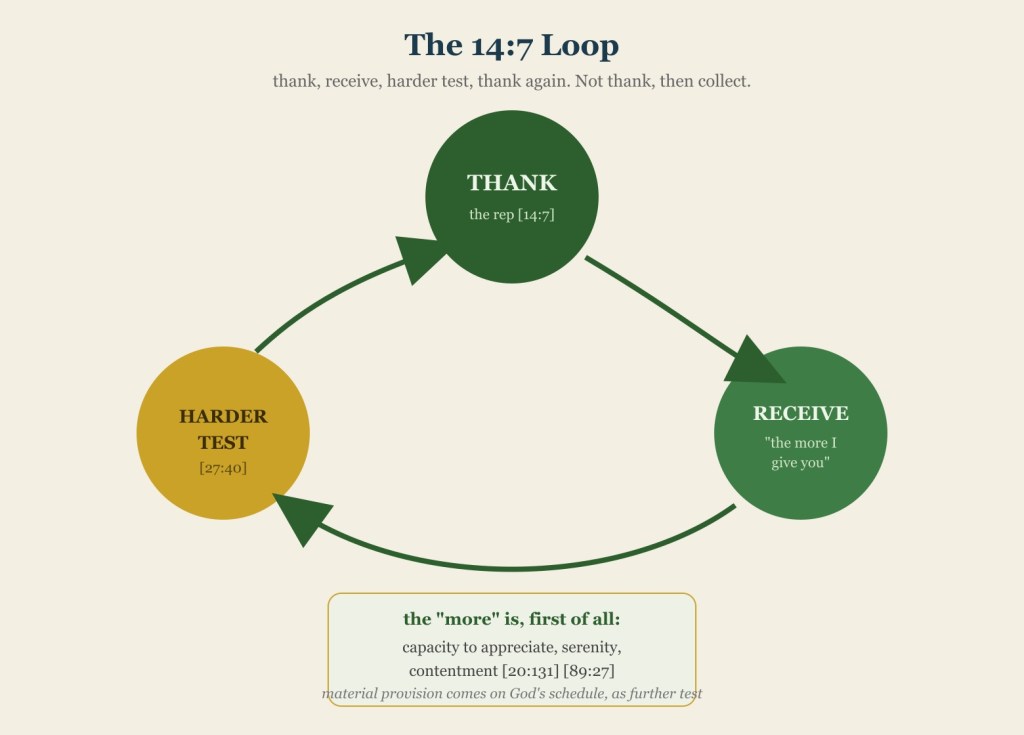
[14:7] “Your Lord has decreed: ‘The more you thank Me, the more I give you.’ But if you turn unappreciative, then My retribution is severe.”
Before anyone hears “the more I give you” and imagines a vending machine, read the very next verse and the parallel in Luqman’s wisdom, which strip the transaction of any notion that God gains or that you are buying anything.
[14:8] “If you disbelieve, along with all the people on earth, God is in no need, Praiseworthy.”
[31:12] “Whoever is appreciative is appreciative for his own good. As for those who turn unappreciative, God is in no need, Praiseworthy.”
Here is the telos, stated plainly so it cannot be mistaken: you do not thank God in order to get. You thank God because it is due, because appreciation is the truthful response of a creature to its Provider. God has then, out of grace, decreed that the one who pays this debt is the very one who receives more, and that the whole benefit flows back to the payer, “for his own good”, since God needs nothing from any of us. The thanking is the objective; the increase is God’s gift attached to it, not a fee He charges. And the “more” is not first of all money. It is first of all capacity: a widening ability to appreciate, a growing serenity, the contentment that is itself the point. The Quran even tells us not to covet the material ornaments others are given, because what God provides on His own terms is of a different order.
[20:131] “And do not covet what we bestowed upon any other people. Such are temporary ornaments of this life, whereby we put them to the test. What your Lord provides for you is far better, and everlasting.”
This loop is not narrow. It is offered to “every steadfast, appreciative person” (14:5), on open enrollment, which is why the earlier verses saying “only a few are appreciative” (34:13) describe not a locked door but how few choose to walk through an open one.
The reps themselves, and what makes them count
What is the rep? It is remembrance, performed in the practices God prescribed, done again and again until the instinct is re-grooved. The Quran pairs the command to remember directly with the promise of being remembered, and forbids the unappreciative default in the same line.
[2:152] “You shall remember Me, that I may remember you, and be thankful to Me; do not be unappreciative.”
The two great reps are the Contact Prayers and charity, and the signature run in chapter 70 names both as the exact things that lift a person out of the anxious, despondent, stingy default. The exemption is not for a personality type; it is for people doing a practice.
[70:22] “Except for the worshipers.”
[70:23] “Who always observe their contact prayers (Salat).”
[70:24] “Part of their money is set aside.”
[70:25] “For the poor and the needy.”
Prayer trains the tongue and the mind to return to the Source on schedule; charity trains the hand to open when the chip says clench. Together they are strength training against stinginess and dread. The Quran tells us why the prayer works so directly on the mechanism: it is not the postures but the remembrance that is the objective, and the remembrance is what rejoices the heart.
[29:45] “the Contact Prayers prohibit evil and vice. But the remembrance of God (through Salat) is the most important objective.”
[20:14] “I am God; there is no other god beside Me. You shall worship Me alone, and observe the Contact Prayers (Salat) to remember Me.”
[13:28] “They are the ones whose hearts rejoice in remembering God. Absolutely, by remembering God, the hearts rejoice.”
But a hard question presses in here. Does not repetition just produce hollow ritual? If I do not feel grateful, is a repeated thank you not a lie, a fake-it-till-you-make-it self-deception? The Quran answers by defining what makes a rep count, and it is not the temperature of your feelings. It is the exclusivity of the address: worship directed to God alone, whatever the heart’s current weather.
[39:2] “you shall worship God, devoting your religion to Him alone.”
Set against this the prayer the Quran actually condemns, and the contrast is decisive. The hypocrite’s prayer is not rejected for being repeated or for being performed on a cold heart. It is rejected because it is aimed at the wrong audience.
[4:142] “When they get up for the Contact Prayer (Salat), they get up lazily. That is because they only show off in front of the people, and rarely do they think of God.”
So a sincere rep, God alone as the address, even offered by a heart that feels nothing yet, is the opposite of hypocrisy, not a form of it. You are not lying to yourself; you are addressing the truth to the right recipient until your feeling catches up to the fact. That is how repetition restores the instinct rather than faking it: the fact, God alone deserves appreciation, is true whether or not you feel it today, and by rehearsing the true response you re-groove the buried instinct until the feeling becomes natural and truthful. This is a distinct angle on 14:7 from the one we took in Tolerance; there the decree grounds patience with others, here it grounds the training of the self, and the two readings reinforce rather than contradict each other. And the whole possibility rests on the keystone verse of self-change, the hinge on which the entire training turns:
[13:11] “God does not change the condition of any people unless they themselves make the decision to change.”
Increase is the next test, not the payout
Now the anti-prosperity engine, made explicit so the loop can never be mistaken for a scheme to get rich by praying. The clearest proof that the returned blessing is not a payout is that the Quran shows a blessing arriving precisely as the next examination. When Solomon saw the throne set before him, he did not read it as a reward collected; he read it as a fresh test of the very instinct we are discussing.
[27:40] “This is a blessing from my Lord, whereby He tests me, to show whether I am appreciative or unappreciative. Whoever is appreciative is appreciative for his own good, and if one turns unappreciative, then my Lord is in no need for him, Most Honorable.”
That is the loop’s true shape: thank, receive, and the receiving is itself a harder test of appreciation, which calls for thanks again. It is never thank, then collect and stop. Every increase raises the difficulty, because more blessing is more that the chip can grow heedless about or proud over. This is why the training never ends in this life and why the “more” that matters is internal capacity rather than external accumulation. And we must be equally clear about the other half of 14:7, the “severe retribution”, so that no one reads adversity as God’s rejection.
[89:15] “When the human being is tested by his Lord, through blessings and joy, he says, ‘My Lord is generous towards me.’”
[89:16] “But if He tests him through reduction in provisions, he says, ‘My Lord is humiliating me!’”
[89:17] “Wrong! It is you who brought it on yourselves by not regarding the orphan.”
“Wrong!” The Quran directly forbids reading your bank balance as a scoreboard of God’s favor. A reduction in provision is a designed test, not a verdict, sent so that we prove we worship God alone under all circumstances.
[2:155] “We will surely test you through some fear, hunger, and loss of money, lives, and crops. Give good news to the steadfast.”
Footnote 2:155: “The test is designed to prove that we worship God alone under all circumstances (29:2).”
The severe retribution of 14:7 attaches to turning unappreciative, not to being tested. The appreciative response under loss is already written for us, the exact words to run when the chip wants to run despair instead.
[2:156] “When an affliction befalls them, they say, ‘We belong to God, and to Him we are returning.’”
[21:35] “Every soul will taste death, after we put you to the test through adversity and prosperity, then to us you ultimately return.”
Adversity and prosperity are both listed as test instruments, side by side. Neither is the payout. Both are reps, and the appreciative person passes both by returning, in wealth and in loss alike, to the same truthful acknowledgment of God.

The Revived Instinct: The Content Soul
What the trained default feels like
What is the end state of all this training? It is not a grim, white-knuckled suppression of feeling. It is the buried instinct fully reawakened, so that appreciation is no longer an effort forced against the grain but the natural, truthful reflex of the soul, the setting God installed at the factory, now running clean. The Quran has a name for the soul that has reached this state, and the four verses that describe its homecoming are among the most beautiful in the scripture.
[89:27] “As for you, O content soul.”
[89:28] “Return to your Lord, pleased and pleasing.”
[89:29] “Welcome into My servants.”
[89:30] “Welcome into My Paradise.”
The content soul. Pleased, and pleasing. This is the appreciative instinct completed: a self so re-grooved to gratitude that it is at peace with its Lord, content with His decree, and welcomed home. It is the exact opposite of the anxious, despondent, stingy default we began with. The whole journey of the article is the distance between 70:19, “the human being is anxious”, and 89:27, “O content soul”, and that distance is crossed by the reps.
No fear, no grief
The trained soul is repeatedly described by a single freedom: it has been released from the two torments of the untrained default, the fear that looks forward and the grief that looks back.
[10:62] “Absolutely, God’s allies have nothing to fear, nor will they grieve.”
[41:30] “Those who proclaim: ‘Our Lord is God,’ then lead a righteous life, the angels descend upon them: ‘You shall have no fear, nor shall you grieve. Rejoice in the good news that Paradise has been reserved for you.’”
[3:139] “You shall not waver, nor shall you grieve, for you are the ultimate victors, if you are believers.”
Hold this together with the honest scoping from earlier and it becomes precise rather than naive. This is the settled security of destiny, not a promise that a believer’s body will never feel a pang. The angels do not say “you will never again experience an anxious moment”; they say your fear and your grief have lost their foundation, because the outcome that ultimately matters is secured. The chip generated fear and grief by convincing you that everything was yours to lose and yours to control. The revived instinct dissolves that foundation. What could such a soul finally lose, when it has already returned everything to the One who owns it, and been promised, “You will have in it anything you wish for” (41:31)?
Reawakening the “Yes” you were born saying
Return, at the last, to where the base layer was laid: before this life, when every soul testified. That testimony is the ultimate reason this training can succeed, and the ultimate answer to any lingering fatalism. You are not building a stranger; you are restoring yourself.
[7:172] “Recall that your Lord summoned all the descendants of Adam, and had them bear witness for themselves: ‘Am I not your Lord?’ They all said, ‘Yes. We bear witness.’”
Every rep of appreciation is an echo of that first “Yes”. Every Contact Prayer, every act of charity, every “We belong to God” spoken under loss, is the buried instinct answering the same summons it answered before time began. And because appreciation is for our own good and God needs nothing from us, the whole enterprise is pure mercy: He commands the very thing that heals us.
[31:12] “Whoever is appreciative is appreciative for his own good. As for those who turn unappreciative, God is in no need, Praiseworthy.”
Rashad Khalifa, reading the scripture that gathers all of this into a single instruction, put the whole training in one plain sentence: “Be appreciative of God’s favors upon you by His grace” (at 13:24). That is the uninstaller and the restoration in one line. The unappreciative chip was corrupted firmware we wrote at the feud, sitting over an appreciative instinct we were born with and can never truly lose. Kill the ego, and the fault is deleted. Run the reps, and the instinct comes back online. The Quran ends the matter with the same two words the whole examination was set to measure, and by now they are not a burden but a homecoming.
[39:66] “Therefore, you shall worship God alone, and be appreciative.”



Leave a Reply