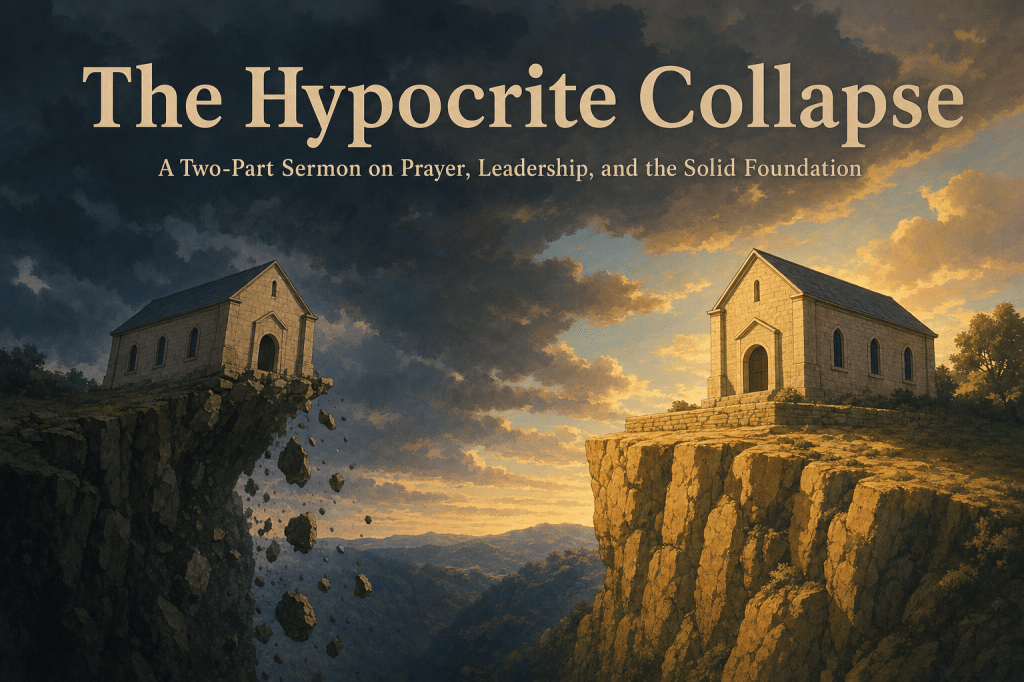
The Question at the Front of the Prayer
A question keeps returning to the community. May a believer stand in the Contact Prayer behind anyone at all, so long as the words and the motions are performed correctly? A doctrine now circulating answers yes without hesitation. It says the prayer is a matter of practice, not of the heart. It says an atheist who recites the words with no idolatry has made contact with God. It says there is no real difference between the one who stands in front and the one who stands behind. It sounds generous. It sounds like humility that refuses to police what it cannot see.
But generosity that overrules a commandment is not humility. It is a quiet substitution of our judgment for God’s. This sermon distills a cluster of studies on hypocrite leadership, anchored on the divine verdict of chapter 9, verse 107, into one plain argument delivered in two parts. Part One is the verdict: God Himself has already ruled, and the ruling is explicit. Part Two is the collapse: the permissive doctrine falls apart in its own hands, its borrowed quotations return to their rightful owner, and one honest choice is left standing. We begin where God begins, with the house.

Part One: The Verdict
The Commandment Is Explicit
God did not leave this matter to inference. He pointed to a real masjid, built by hypocrites who prayed, who swore their intentions were pure, who used the very architecture of worship to divide the believers. Then He ruled on it in His own words.
[9:107-108] “There are those who abuse the masjid by practicing idol worship, dividing the believers, and providing comfort to those who oppose God and His messenger. They solemnly swear: ‘Our intentions are honorable!’ God bears witness that they are liars. You shall never pray in such a masjid. A masjid that is established on the basis of righteousness from the first day is more worthy of your praying therein. In it, there are people who love to be purified. God loves those who purify themselves.”
Read the ruling again. You shall never pray in such a masjid. Not “prefer another.” Not “it is discouraged.” Never. And the reason is not the stone; it is what the stone is devoted to. God’s own footnote to this verse is blunt: any masjid where the practices are not devoted absolutely to God alone belongs to Satan, not God. The place takes its character from the object of its worship. So does the prayer offered inside it.
Rashad Khalifa felt the full weight of this commandment. He confessed that he had once been unsure, until the verse pressed itself upon him through sheer repetition.
“Do you go in the house of Satan to pray? No… the commandment is very strong. I used to be not sure. And then, when I read this verse over and over, I said, you shall never pray in such a mosque.”
Rashad Khalifa, Quran Study 12/28/89 (at 1:29:25)
If the messenger who delivered the mathematical proof of this scripture read the verse “over and over” and arrived at never, we are not free to arrive at “it depends.” The takeaway of this beat is one sentence: the verdict has been issued, and it was issued by God. The full Quranic proof is laid out in the case for prohibition.
The Gate and the Office
The permissive doctrine treats the prayer as a public utility, open to any competent operator. God treats it as something with a gate and an office, and He guards both. First the gate. Who may frequent His houses of worship at all?
[9:17-18] “The idol worshipers are not to frequent the masjids of God, while confessing their disbelief. These have nullified their works, and they will abide forever in Hell. The only people to frequent God’s masjids are those who believe in God and the Last Day, and observe the Contact Prayers (Salat), and give the obligatory charity (Zakat), and do not fear except God. These will surely be among the guided ones.”
The idol worshiper is turned away at the threshold, his works already nullified. The one admitted is defined by belief, by the Contact Prayer, by charity, by fearing none but God. The claim that the inner state is irrelevant has been answered before the man even reaches the door. Then comes the office. Leadership of the prayer is not a skill you qualify for; it is a covenant God bestows. When He raised Abraham, He did not cite his technique.
[2:124] “…(God) said, ‘I am appointing you an imam for the people.’ He said, ‘And also my descendants?’ He said, ‘My covenant does not include the transgressors.’”
My covenant does not include the transgressors. The office of imam is God’s appointment, and He fenced it against the wrongdoer by name. Scripture is consistent about this. The places of worship belong to God, and no one is to be called upon beside Him, in verse 72:18. The imams God raised “guided in accordance with our commandments,” in verse 21:73. They led because they “steadfastly persevered and attained certainty about our revelations,” in verse 32:24. Measure an atheist against that definition and he fails at the word certainty. Measure a hypocrite against it and he fails at the word belief. Neither man holds the office, because the office was never ours to assign in the first place. This is developed further in the analytical study of the prohibition.

What the Hypocrite’s Prayer Already Is
Here is the strongest objection the doctrine can raise. If the words are correct and the idolatry is absent, is the prayer not still a righteous deed? So look at what God says the hypocrite’s prayer already is, before anyone else renders a verdict on it.
[4:142] “The hypocrites think that they are deceiving God, but He is the One who leads them on. When they get up for the Contact Prayer (Salat), they get up lazily. That is because they only show off in front of the people, and rarely do they think of God.”
They get up lazily. They only show off. This is not a prayer awaiting our judgment; it is a performance God has already exposed. The pattern repeats across the scripture. Woe to those who observe the Contact Prayers yet are heedless of them and only show off, in verses 107:4 through 6. The disbelievers’ Contact Prayers at the Sacred Masjid were “no more than a mockery,” in verse 8:35. They observed the Contact Prayers, and still nothing was accepted, because they had disbelieved, in verses 9:53 and 54. They even say the true words, “we bear witness that you are the messenger of God,” and God answers that the hypocrites are liars, in verse 63:1. Correct words. Correct motions. Condemned worship.
Rashad stated the rank of such a person without any softening.
“The hypocrites are actually disbelievers, except they are worse, because among the believers they don’t believe.”
Rashad Khalifa, Messenger Audio 29 (at 38:33)
Worse than the disbeliever, because the hypocrite works his unbelief from inside the ranks. This is the very man the permissive doctrine would place at the front of the prayer. Scripture assigns him the lowest pit of Hell, in verse 4:145. It says he forgot God, so God forgot him, in verses 9:67 and 68. That is who God says he is. And that is the verdict of Part One. The commandment is explicit, the office is God’s covenant, and the hypocrite’s prayer already stands condemned.
Part Two: The Collapse
The Doctrine and Its Own Concessions
Let us state the doctrine at its strongest and most honest. It holds that the Contact Prayer is defined by practice, not by the belief of the one leading it. It holds that a man praying to God alone, with no idolatry in his words, performs a righteous deed whatever is in his heart. It concludes that there is therefore no meaningful distinction between the one who leads and the one who follows. Put that way it has a real force. It guards against us policing hearts we cannot see. It appeals to mercy. So it deserves a fair hearing before it is answered.
Now watch the doctrine concede its own case. Pressed on whether God accepts such a prayer, its defenders reply that whether God accepts it is another story. That single sentence surrenders the whole argument, because acceptance was the entire question. And God settled acceptance in the plainest words in scripture, spoken by the righteous son of Adam.
[5:27] “…He said, ‘God accepts only from the righteous.’”
God accepts only from the righteous. The supplications of the disbelievers are in vain, in verse 13:14. If acceptance is “another story,” it is a story God has already finished, and it does not end in the disbeliever’s favor. A prayer God will not accept is not a righteous deed with a pending result. It is a rejected act.
Then the doctrine concedes a second time, and this concession is fatal. Ask its defenders plainly: would you pray behind a man you knew worshipped someone besides God? They answer honestly. No; if I knew, the prayer would be invalid, not accepted, and I would have sinned by praying behind him. But notice what just happened. The instant that knowledge of the imam’s idolatry makes the prayer invalid and the follower sinful, the mechanics-only rule is dead. Belief now matters. The inner state now counts. The only case left is the known hypocrite, and that is the exact case God ruled on in verses 9:107 and 108. He named the men who swore their intentions were honorable, He called them liars, and He said never.
Follow the doctrine to its end and it manufactures its own refutation. There now exists a news reel of a humanoid machine placed at the front of a prayer, reciting the words, bowing on cue, announcing “I will devote myself.” On the mechanics-only rule, that machine is the perfect imam: flawless words, flawless motions, and zero belief. Zero belief is precisely what the doctrine insists does not matter. A rule that cannot tell a worshipper apart from a machine imitating one has confessed that it is measuring the wrong thing. When your doctrine ordains a machine as the ideal leader of the Contact Prayer, the doctrine has collapsed.

The Borrowed Quotes Returned
The doctrine leans on borrowed words, so let us return each one to its owner. It quotes Rashad saying it “doesn’t matter who’s doing it.” Restore the recording and the meaning inverts. Rashad was describing how submitters take turns leading the prayer among themselves, and mocking the credential hierarchy of the sects: the man who boasts “I am more worthy, I have a degree from the seminary, I am even older.” His point was equality among believers. No clergy rank stands between a submitter and the front of the prayer. To take a line about believers needing no priesthood and twist it into a mandate to accept the enemy of God as imam is not a citation. It is an inversion. The same teacher who said “it doesn’t matter” among believers is the one who said you shall never pray in the house of Satan.
The doctrine reaches for a second proof, and it turns in its hand. It cites the verse that rebukes the believers for splitting into two camps over the hypocrites. But read the reason God gives: He is “the one who condemned them because of their own behavior,” in verse 4:88. The verse does not say the hypocrites are acceptable and you are quarrelling needlessly. It says God has already condemned them, so stop being divided about a matter He has closed. Far from opening the prayer to the hypocrite, the verse commands us to stop arguing over a judgment God has finished, and the judgment was condemnation.
The doctrine’s last borrowed weapon is the image of the man who forbids prayer. It points to the one “who enjoins others from praying,” in verses 96:9 and 10, and asks whether objecting to a hypocrite-led prayer makes you into that tyrant. Restore the context. That passage describes a tyrant who stops a righteous servant of God from praying to God. But it is God Himself who commands “you shall never pray in such a masjid,” in verse 9:108, and God Himself who forbids even the funeral prayer over a hypocrite, in verse 9:84. If refusing to pray in Satan’s house made a person the villain of chapter 96, then God’s own commandment would stand condemned by God’s own scripture. The doctrine has aimed its verse at the very One who spoke it.
The Collapse and the Solid Ground
Every borrowed proof has returned to its owner, and every concession has undone the doctrine from within. Now hear the verse that gives this sermon its name. God sketches two builders and asks us to choose between them.
[9:109] “Is one who establishes his building on the basis of reverencing God and to gain His approval better, or one who establishes his building on the brink of a crumbling cliff, that falls down with him into the fire of Hell? God does not guide the transgressing people.”
A building on bedrock, raised to reverence God and seek His approval, against a building on the crumbling edge of a cliff that collapses and carries its builder into Hell. The hypocrite’s masjid is that cliff-edge building. So is the doctrine that defends it. It is erected on a concession, that acceptance is “another story.” It is cracked by a second concession, that knowledge of idolatry would make the follower sinful. It is finished off by a machine standing at the prayer niche. It “remains a source of doubt in their hearts,” as verse 9:110 says, because it was never founded on solid ground.
So where does the believer stand? Never in the ranks of those whose worship God has already exposed, for He warns that whoever sits with people mocking His revelations “will be as guilty as they are,” in verse 4:140. The believer prays instead in “a masjid that is established on the basis of righteousness from the first day,” in the company God Himself described: those who believe in God and the Last Day, observe the Contact Prayer, give charity, and fear none but God. That is the solid ground. The full argument for standing firm rather than compromising is set out in the call to stand firm against hypocrisy.
So the choice is yours, and it is the only choice this sermon asks of you. Two builders, two foundations, two destinations. One founds his worship on reverence for God and stands on rock. The other founds it on the opinions of men and the perfect mechanics of a machine, and stands on a cliff already crumbling beneath his feet. God has told you which is which. Choose your foundation.


 Quran Only Studies
Leave a comment