
A Law God Signed With Heaven and Hell
There are commands in the Final Testament, and then there are commands God underwrites personally with eternity. The law of inheritance is the second kind. When God finishes laying out who receives what from an estate, He does something He does almost nowhere else in scripture: He stamps the whole passage with a signature and attaches Heaven and Hell to obedience and defiance of it. That is not the register of a suggestion. It is the register of a constitution.
[4:13] “These are God’s laws. Those who obey God and His messenger, He will admit them into gardens with flowing streams, wherein they abide forever. This is the greatest triumph.”
[4:14] “As for the one who disobeys God and His messenger, and transgresses His laws, He will admit him into Hell, wherein he abides forever. He has incurred a shameful retribution.”
Read where those two verses sit. They do not close a chapter on prayer, or fasting, or pilgrimage. They close the chapter’s block on inheritance, [4:11] and [4:12], the shares for children, parents, spouses and siblings. God is telling us that how a family divides a dead person’s wealth is not a private, sentimental, negotiable affair. It is one of the places where obedience and transgression are measured on the scale that never miscalibrates. Getting the estate right is, in the plainest terms God offers, a matter of Heaven and Hell.
And the very first thing this law does is defend the people history has always robbed at the graveside. Before God names a single fraction, He guarantees that women inherit at all, in a world that for millennia gave them nothing.
[4:7] “The men get a share of what the parents and the relatives leave behind. The women too shall get a share of what the parents and relatives leave behind. Whether it is a small or a large inheritance, (the women must get) a definite share.”
A definite share. Not a favor, not a courtesy extended by generous male relatives, but a fixed and enforceable right that scales with the size of the estate. This is the spirit in which every fraction that follows must be read. The system is not a machine for concentrating wealth in the strongest hands. It is a mercy engineered so that, in the words God attaches to the sibling shares Himself, “no one is hurt” [4:12]. This article rebuilds that system from the ground up, line by line, and it corrects, openly and by name, the errors that crept into an earlier research diagram of it. Where the text speaks, we quote it exactly. Where we reason beyond the text, we say so, and we label how. Nothing here wears a confidence it has not earned.
The Pipeline, Not the Pie
The single most important correction to make at the outset is structural. Inheritance in the Quran is not a pie that gets sliced the moment someone dies. It is a pipeline, a fixed sequence of stages, and the famous fractions live only at the very end of it, operating on whatever survives the earlier stages. Miss the pipeline and every later calculation is built on sand, because the fractions are never fractions of the gross estate. They are fractions of a net remainder.
God states the sequence with unmistakable repetition. In the two central verses the same clause recurs, in [4:11] once and in [4:12] three separate times: “All this, after fulfilling any will the deceased has left, and after paying off all debts.” That is the pipeline in a single breath. Debts come off first. The will is executed second. Only then do the fixed shares apply, and they apply to the balance. The order is stated, not inferred: that both the debts and the will precede the shares is Explicit in the text, repeated four times so no reader can miss it.
Step 0 is debts. “And after paying off all debts” is Explicit, and it is stated four times across [4:11] and [4:12]. A creditor’s money was never the deceased’s to give; it is a prior charge on the estate, settled before anyone counts a heir’s share or honors a bequest. The earlier diagram omitted debts from its formula entirely, and that omission alone would corrupt every downstream number. It is restored here as the first stage of everything.
Step 1 is the will, the mandatory and equity-bounded bequest of [2:180], which has its own full section below. Step 1.5 is the widow’s year of support, a provision the old diagram also dropped entirely.
[2:240] “Those who die and leave wives, a will shall provide their wives with support for a year, provided they stay within the same household. If they leave, you commit no sin by letting them do whatever they wish, so long as righteousness is maintained. God is Almighty, Most Wise.”
Step 2 is the fixed Quranic shares, applied to the net remainder, always. This is the branch the earlier diagram got backwards, and the error is worth naming precisely. The old graphic treated the fixed shares as an else: shares apply “if no will exists.” That is false. The recurring clause, “All this, after fulfilling any will the deceased has left,” makes the will and the shares consecutive stages of one process, not two alternative roads. If there is a will, the shares run on what remains after it. If there is no will, the remainder simply equals the whole net estate, and the identical shares run on that. There is no configuration in which writing a will switches the fixed shares off. The shares are not a “default”; they are the destination of the pipeline. That single un-branching repairs a fault that ran through the entire original model.
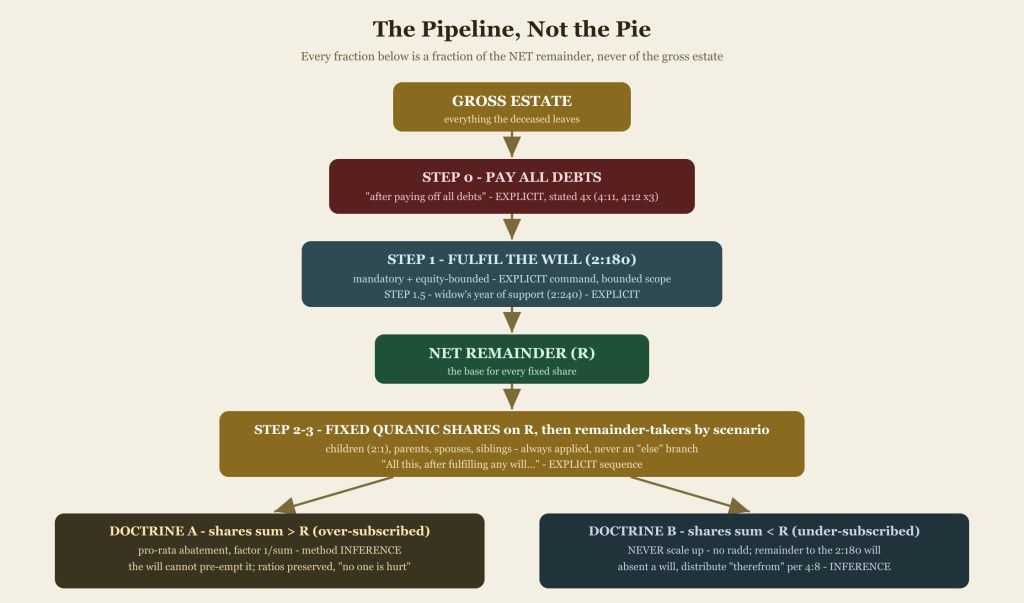
Diagram 1: The corrected pipeline. Debts and the will are welded stages before the shares, and exactly one doctrine governs each direction of imbalance.
Two doctrines, and only two, close out the pipeline, one for each direction the arithmetic can drift. When the fixed shares sum to more than the remainder, Doctrine A abates them pro-rata. When they sum to less and no verse names a taker for the rest, Doctrine B never inflates a fixed share; it sends the surplus to the will, and failing a will, to the relatives, orphans and needy of [4:8]. These are developed fully in the configurations section. For now the point is the shape: a single ordered pipeline, not a scatter of special cases, and certainly not a pie carved at the graveside before the debts are even paid.
The Mandatory, Equity-Bounded Will
Because the will sits inside the pipeline before the fixed shares, its status matters enormously, and here the Quran is far stronger than most readers assume. The will is not optional estate-planning advice. It is decreed.
[2:180] “It is decreed that when death approaches, you shall write a will for the benefit of the parents and relatives, equitably. This is a duty upon the righteous.”
The verb translated “decreed” is kutiba, the same verb, in the same passive form, that God uses three verses later to make fasting obligatory: “fasting is decreed for you” [2:183]. No submitter treats fasting as a polite recommendation. The will is decreed in exactly that grammatical class, and the verse closes by calling it “a duty upon the righteous.” Writing an equitable will is therefore an obligation of the same order as the fast, that this is the plain sense of the verse is Explicit.
An honest tension we will not hide. Rashad Khalifa’s own footnote to [4:11] describes the will more softly: “the Quran recommends in 2:180 that a will shall be left to conform with the specific circumstances of the deceased.” The verse itself says “decreed” and “a duty upon the righteous.” We hold that the verse text governs the footnote, this is the standing rule of a Quran-first reading, so we speak of the duty of the will and describe its absence as the neglect of a 2:180 duty, not as a crime. Sudden death that leaves no time to write is precisely the non-culpable case, and Khalifa’s own subtitle for the fallback shares in [4:11], “If No Will Is Left,” provides for exactly that situation. That subtitle is, incidentally, the strongest Khalifa-native evidence that the will is meant to come first and the fixed shares to catch what the will did not cover.
Now the crucial counterweight. If the will comes first and is a duty, could a person simply will the entire estate to a stranger and starve his own children? No. The will in the Quran is powerful but bounded, and the bounds are textual, not invented. [2:180] itself aims the bequest “for the benefit of the parents and relatives,” and demands it be done “equitably.” That word is a limit. A will that dispossesses the very family the verse names as its beneficiaries is not an equitable will; it is a corrupted one. And the Quran arms the community to correct it.
[2:181] “If anyone alters a will he had heard, the sin of altering befalls those responsible for such altering. God is Hearer, Knower.”
[2:182] “If one sees gross injustice or bias on the part of a testator, and takes corrective action to restore justice to the will, he commits no sin. God is Forgiver, Most Merciful.”
Read those two together and the boundary is exact. A validly made will is protected, altering it is a sin that lands on the alterer [2:181], Explicit. But a will that itself embodies “gross injustice or bias” may be corrected by an outsider “to restore justice,” and the corrector “commits no sin” [2:182], also Explicit. The Quran thus builds its own anti-abuse mechanism directly into the law: freedom to bequeath, checked by an enforceable standard of justice. The witnessing procedure of [5:106] seals it further, a will is witnessed “by two equitable people among you,” who swear after the Contact Prayer that they will not bend the testament for personal gain “even if the testator is related to us.” Equity is not decorative here. It is the entire architecture of the bequest.
Rashad Khalifa taught this bound plainly, and with a memorable example. Discussing the difficulty of inheritance law, he cautioned that a man’s freedom to write a will is real but capped by the rights of his own family.
“What I’m trying to say… is that there is a limit to what you can will. You cannot dispossess in your will members of the family who have certain rights.”
“…people go through stages where they are mad at this son… And then some people end up angry at all the children, so they leave the million dollars to the cats, you know, instead of the children… a man cannot be very arbitrary.”
– Rashad Khalifa, Messenger Audio 21 (at 22:57)
His reasoning drew on the closing line of [4:11] itself, which he paraphrased on the recording: “you don’t really know which of the children is closer to you and more beneficial to you.” That is God’s own caution against arbitrary favoritism, spoken inside the inheritance law. Yet the same verse’s footnote shows how far equity may lawfully travel in the other direction, toward a needier heir.
[4:11], footnote: “Generally, the son is responsible for a family, while the daughter is taken care of by a husband. However, the Quran recommends in 2:180 that a will shall be left to conform with the specific circumstances of the deceased. For example, if the son is rich and the daughter is poor, one may leave a will giving the daughter everything, or twice as much as the son.”
Notice what that lawful extreme is anchored to: need, not whim. A will may hand a poor daughter “everything” precisely because that is equitable, the same principle that forbids leaving the million dollars to the cats. (We take that footnote at [4:11] as evidence of the will’s lawful reach; the verse itself governs the obligation, which is why we read “decreed” as binding earlier in this section.)
The classical tradition fenced the will with two hadith-derived rules, Classical-import, and they are not equal in weight. The first is a one-third maximum on any bequest, absent the co-heirs’ consent. The second, no bequest to an heir, bars a bequest to a Quranic heir altogether, absent that same consent. Neither is void-on-its-face in their own law: both are suspended and become effective if the surviving heirs permit. Describe them at their strongest, because the objection holds there anyway. And state their alternative routes plainly: a father may instead make an outright gift in good health, unrestricted by either rule. That is the tradition’s real answer to a poor daughter, and it is precisely what a dying, weakened, or unadvised man no longer has. Both remedies leave her protection resting on the goodwill of the very people the rule exists to constrain.
Now the arithmetic, because it is the whole case. Take an estate of 100, a rich son and a poor daughter, no other heirs. With no will the fixed shares give the son 66.67 and the daughter 33.33. Bequeath her the absolute maximum a one-third ceiling allows, and she takes 33.33 from the bequest, after which the shares run on the remaining 66.67, handing her 22.22 more and the son 44.44. Her total is 55.56 against his 44.44, a ratio of 1.25 to 1. But the footnote at [4:11] names two outcomes explicitly: “twice as much as the son,” which requires bequeathing half the estate, and “everything,” which requires all of it. Both sit above the ceiling. So the cap does not merely narrow the Quran’s equity mechanism, it places the worked example of that mechanism outside the law. And the companion rule does not narrow it at all, it voids it, because the poor daughter is herself an heir. The heir prohibition is the categorical block; the cap is the quantitative one.
What then restrains an unjust testator, if not a number? The text supplies the bound. [4:12] closes by calling the shares themselves “a will decreed by God,” and a human will cannot extinguish God’s. The same verse attaches “so that no one is hurt” to the will-and-debts clause, not to the shares, making it a limit on a bequest made to injure the heirs. We own the provenance of that clause: the jurists derived their ceiling from it. We accept the clause and reject the number. Together the two yield the operative rule, Inference from two explicit clauses and never a stated fraction: a bequest may not reduce any heir holding a designated share to nothing. That is stricter than a third, which permits stripping an heir of everything above it, and it is what actually forbids the million dollars to the cats. It is given teeth before death, not only after it, by the witnessing of [5:106]: two equitable people who swear they will not bend the testament for gain must refuse to witness a will that zeroes a designated heir, and an unwitnessed will fails at the first stage of the pipeline.
One caution, so the remedy does not devour itself. [2:182] lets an observer correct “gross injustice or bias,” and a son left with less could try to invoke it. Its corrective power has a direction, and [4:12] supplies it: it corrects wills that hurt, the estate left to the cats, the child cut out in temper. A brother who receives less because his sister was destitute has not been hurt within the meaning of the clause; he has been equitably ranked, which is what “equitably” in [2:180] was there to authorise. A residual case still resists every mechanism, Gap: the testator of sound capacity, pressured in his final illness, who executes a facially fair will before compliant witnesses. For that the Quran offers the after-the-fact remedy of [2:182], and we do not pretend otherwise.
The Fixed Shares, Tagged Honestly
Here we introduce the method that is this article’s signature, because the honest handling of an ancient, high-stakes law depends on it entirely. Every rule about who gets what falls into exactly one of four confidence classes, and we tag it, every time, without exception. The reader should always know whether a number comes straight from God’s words or from a chain of reasoning laid on top of them.
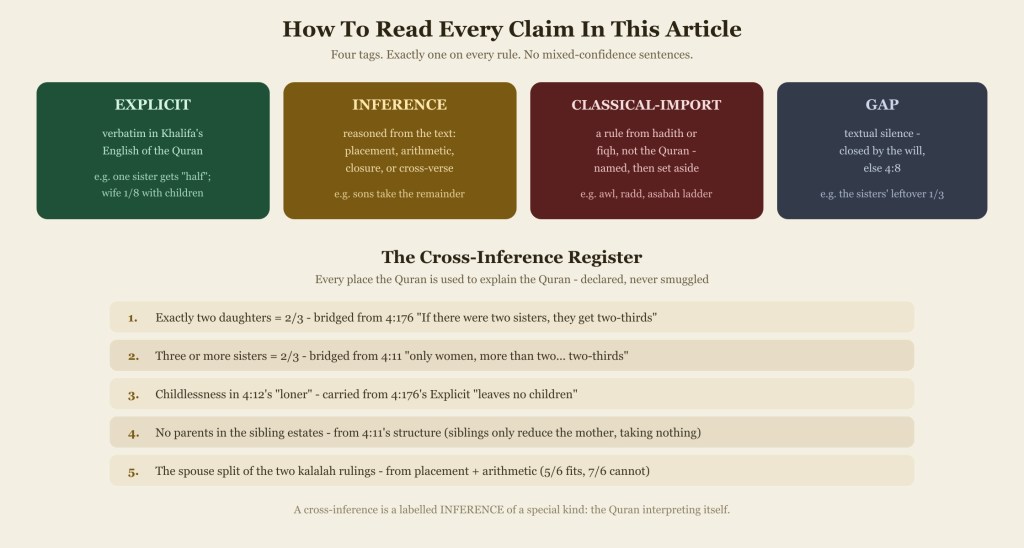
Diagram 2: The four-tag legend and the full register of every Quran-explains-itself bridge the system relies on.
With the method in place, the fixed shares themselves. Start with the children, whom God addresses first and by a stated ratio.
[4:11] “God decrees a will for the benefit of your children; the male gets twice the share of the female. If the inheritors are only women, more than two, they get two-thirds of what is bequeathed. If only one daughter is left, she gets one-half. The parents of the deceased get one-sixth of the inheritance each, if the deceased has left any children. If he left no children, and his parents are the only inheritors, the mother gets one-third. If he has siblings, then the mother gets one-sixth. All this, after fulfilling any will the deceased has left, and after paying off all debts. When it comes to your parents and your children, you do not know which of them is really the best to you and the most beneficial. This is God’s law. God is Omniscient, Most Wise.”
The male-to-female ratio of 2:1 among children is Explicit. That sons take the residue of the estate after the fixed shares, however, is nowhere stated as a number; it is an Inference, drawn by closure from the fact that daughters alone are capped (one daughter at one-half, more than two at two-thirds) while sons carry no cap, which leaves the sons as the uncapped takers of what remains. A single daughter’s one-half and a group of daughters’ two-thirds are both Explicit. But notice the seam the earlier diagram walked straight over: [4:11] assigns two-thirds to “only women, more than two,” and one-half to “only one daughter.” It says nothing at all about exactly two daughters. That number is textually unassigned in [4:11].
How, then, does the near-universal ruling of two-thirds for two daughters arise? Legitimately, and by the Quran explaining itself. [4:176] states of siblings, “If there were two sisters, they get two-thirds of the inheritance.” The two-thirds for two daughters is bridged from that verse. This is entry one in our Cross-Inference Register, and it is a labelled Inference, never presented as if [4:11] said it. The reverse bridge closes the mirror gap: [4:176] does not quantify three or more sisters, and “more than two… two-thirds” from [4:11] supplies it. An estate is often literally uncomputable without such a bridge, Configuration 1 below cannot be solved without it, and the honest thing is to show the bridge in daylight rather than fold it silently into a quotation.
The parents come next, and their shares carry conditions that must travel with them everywhere. Each parent takes one-sixth “if the deceased has left any children,” Explicit. If there are no children and “his parents are the only inheritors,” the mother takes one-third, Explicit, and the father takes the remaining two-thirds, which is a Forced inference from the “only inheritors” closure, never a stated fraction, and never to be generalized one inch beyond that exact condition. And the mother’s share is reduced to one-sixth “if he has siblings,” a datum we will return to, because it quietly encodes the rule that lets us know siblings inherit only when parents do not. The spouses, finally, appear in [4:12], and their shares hinge entirely on whether children exist.
[4:12] “You get half of what your wives leave behind, if they had no children. If they had children, you get one-fourth of what they leave. All this, after fulfilling any will they had left, and after paying off all debts. They get one-fourth of what you leave behind, if you had no children. If you had children, they get one-eighth of what you bequeath. All this, after fulfilling any will you had left, and after paying off all debts. If the deceased man or woman was a loner, and leaves two siblings, male or female, each of them gets one-sixth of the inheritance. If there are more siblings, then they equally share one-third of the inheritance. All this, after fulfilling any will, and after paying off all debts, so that no one is hurt. This is a will decreed by God. God is Omniscient, Clement.”
Husband takes one-half when the wife left no children and one-fourth when she did, Explicit. Wife takes one-fourth when the husband left no children and one-eighth when he did, Explicit. These four spousal numbers, together with the children’s caps and the parents’ sixths, are the load-bearing fixed shares of the whole system. Everything else is either an inference we will label or a gap we will name. It is worth pausing on how much of the earlier diagram’s “share list” was actually complete text and how much was quietly extrapolated; when the tags go on, the difference becomes visible, and the visible difference is the beginning of honesty about a law God calls His own.

One Kalalah, Two Rulings
Now to the hardest knot in the whole law, the word kalalah, and to the correction that most reshapes the earlier research. The old diagram framed the puzzle as “two types of kalalah,” distinguished by Arabic grammar. That framing is unearned, and we replace it with an honest one: there is one kalalah and two rulings, and the thing that forces two rulings is not grammar at all. It is the text’s own arithmetic.
First, the honest scaffolding. The word occurs exactly twice, at [4:12] and [4:176]. Rashad Khalifa footnotes neither verse. So every scrap of the apparatus below is reconstruction from his translated text, not from his commentary, and we say so at the outset. What the two verses actually contain differs sharply. [4:12] gives childless-sibling shares that are modest and gender-equal: “two siblings, male or female, each of them gets one-sixth,” and “if there are more siblings, then they equally share one-third.” [4:176] gives shares that are substantial and gender-weighted: one sister “half,” two sisters “two-thirds,” and mixed siblings at “the male gets twice the share of the female,” with a sole brother inheriting a childless sister’s whole estate.
Here is the engine of the thesis, and it is itself textual. The same word, kalalah, governs two incompatible share tables and even two incompatible gender rules, equal shares in [4:12], a 2:1 split in [4:176]. Both cannot be the law for one and the same estate; a childless person with two siblings cannot simultaneously have them take one-sixth each and two-thirds shared. So the text itself forces a distinguishing variable between the two rulings. That a distinction is necessary is Explicit, it is compelled by the plain incompatibility of the two tables. Only the identity of the distinguishing variable is inference, and we now argue it on the honest ground.
What both rulings share, and what neither states outright, has to be established carefully. That kalalah involves no children is Explicit in [4:176], which says it twice (“leaves no children,” “if she left no children”), and is carried into [4:12] by cross-inference through the word “loner” plus [4:176]’s explicit condition, a labelled Inference, register entry three. That kalalah also involves no parents is stated in neither verse. We reach it through [4:11]’s internal structure: there, when parents inherit, siblings take no share of their own at all; they appear only as a lever that drops the mother from one-third to one-sixth. So any verse that does hand siblings real shares must presuppose that the parents are absent. That is a structural Inference, register entry four, and it is a different, weaker confidence than the children condition, which is why the two must never be stated at the same level. We deliberately do not lean on the lexicon’s classical definition of kalalah as “one with neither ascendant nor descendant”; that would be Classical-import, and it is not needed.
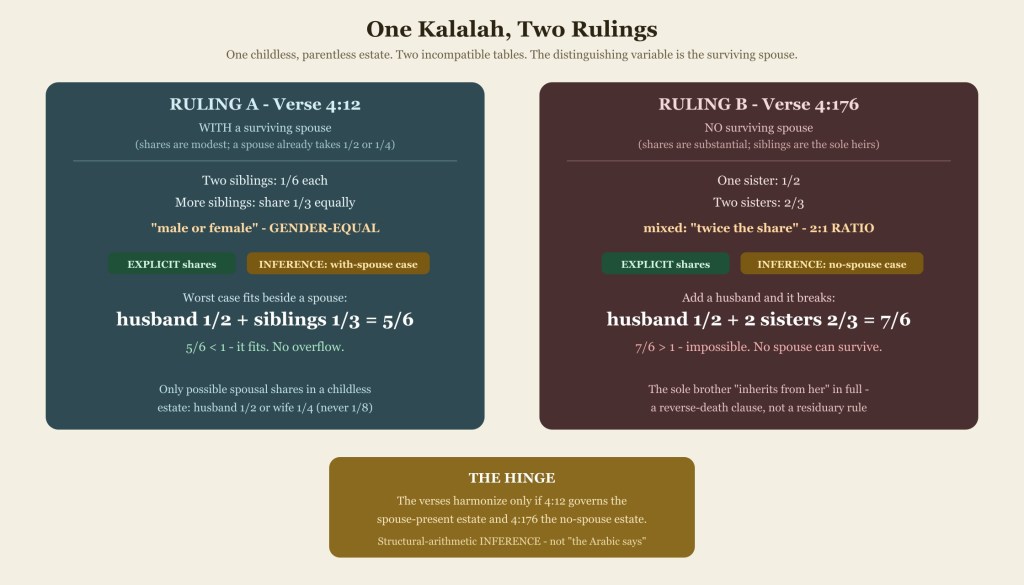
Diagram 3: The load-bearing argument. Not grammar, but arithmetic: 5/6 fits beside a spouse, 7/6 cannot. That is what forces two rulings from one word.
So what is the distinguishing variable? The honest answer is the surviving spouse, and the argument for it is structural and arithmetic, not grammatical. [4:12]’s kalalah clause sits physically inside the verse that assigns spousal shares, and its sibling table always fits beside a spouse: the worst case, a husband’s one-half plus the siblings’ one-third, sums to five-sixths, which leaves room. [4:176]’s table cannot coexist with a spouse at all: a husband’s one-half plus two sisters’ two-thirds sums to seven-sixths, which is more than the whole estate and therefore impossible, and the sole brother could not “inherit from her” in full if a husband had already taken his explicit half. The verses harmonize only if [4:12] governs the childless, parentless estate with a surviving spouse, which is exactly why its shares are modest, and [4:176] governs the estate with no spouse, which is exactly why its shares are large. This is a labelled Inference from placement and arithmetic, register entry five. The honest phrasing is always “the verses harmonize only if,” never “the Arabic says.”
We must state the candid limit of this argument rather than overstate it. One sister plus a husband sums to exactly one-half plus one-half, precisely one hundred percent, so in that single case nothing overflows and the arithmetic alone does not force the spouse’s absence. The overflow argument bites only from two sisters upward, and in the mixed-sibling cases. We flag that honestly and let the structural reading rest on the cases where it genuinely holds, rather than pretending it proves more than it does.
This is also where we retire the earlier diagram’s grammatical claims, and we retire them deliberately. It is true that the Arabic morphology differs: yurathu kalalatan in [4:12], an indefinite form, against fi al-kalalah in [4:176], a definite form after a preposition. But each form is forced by its syntactic slot, and it cannot carry the weight the old diagram put on it. Khalifa’s own English renders [4:12] with a predicate noun, “was a loner,” not with the adverbial-state reading the diagram asserted. Worse for the two-category thesis, the definite article in [4:176] most naturally points back to the kalalah already raised in [4:12], the questioners “consult you” about the topic already introduced, and ordinary Arabic usage presumes that an indefinite noun resumed later as a definite refers to the same thing. If anything, the grammar mildly favors one kalalah, not two categories. So we demote the grammar to descriptive color, explicitly non-probative, and we delete the old “definite article means a specific no-spouse category” claim outright. The load-bearing argument is, and remains, the incompatibility of the two share tables plus placement and arithmetic.
Two further corrections belong here, both flowing from reading the verses whole. First, the gender-ratio flip is real and we meet it head-on rather than by eliding words as the old graphic did. [4:12] is gender-equal (“male or female… equally”); [4:176] is 2:1. No reading explains that flip perfectly, and we will not pretend otherwise. Our functional account, that the spouse-present estate pays modest per-capita stipends while the sole-heir estate falls back on the children-template of [4:11] where “the male gets twice the share of the female,” is itself an Inference, and it is labelled as one; it is a plausible rationale, not a proof. Second, the clause “if she dies first, he inherits from her, if she left no children” is doubly conditioned and describes a reverse-death scenario, the sister is the one who has died, and her brother inherits. It is not a general “brothers are residuary” principle to be stood up beside a living sister’s one-half. The old diagram turned this reverse-death clause into a residuary doctrine; that is deleted. His heirship is Explicit; that he takes the whole is an Inference from his being the sole named heir.
The Eight Configurations, Corrected
We can now lay the configurations out as cards, each tagged, each stated as fractions of the net remainder, and each governed by the two doctrines and nothing else. The earlier diagram called its version a “Complete Family Configuration Matrix.” It was not complete, the true macro-space runs to seventy-two or more configurations, and several of its cards were wrong. We call this what it is: a set of key configurations, corrected, with the errors owned by name.
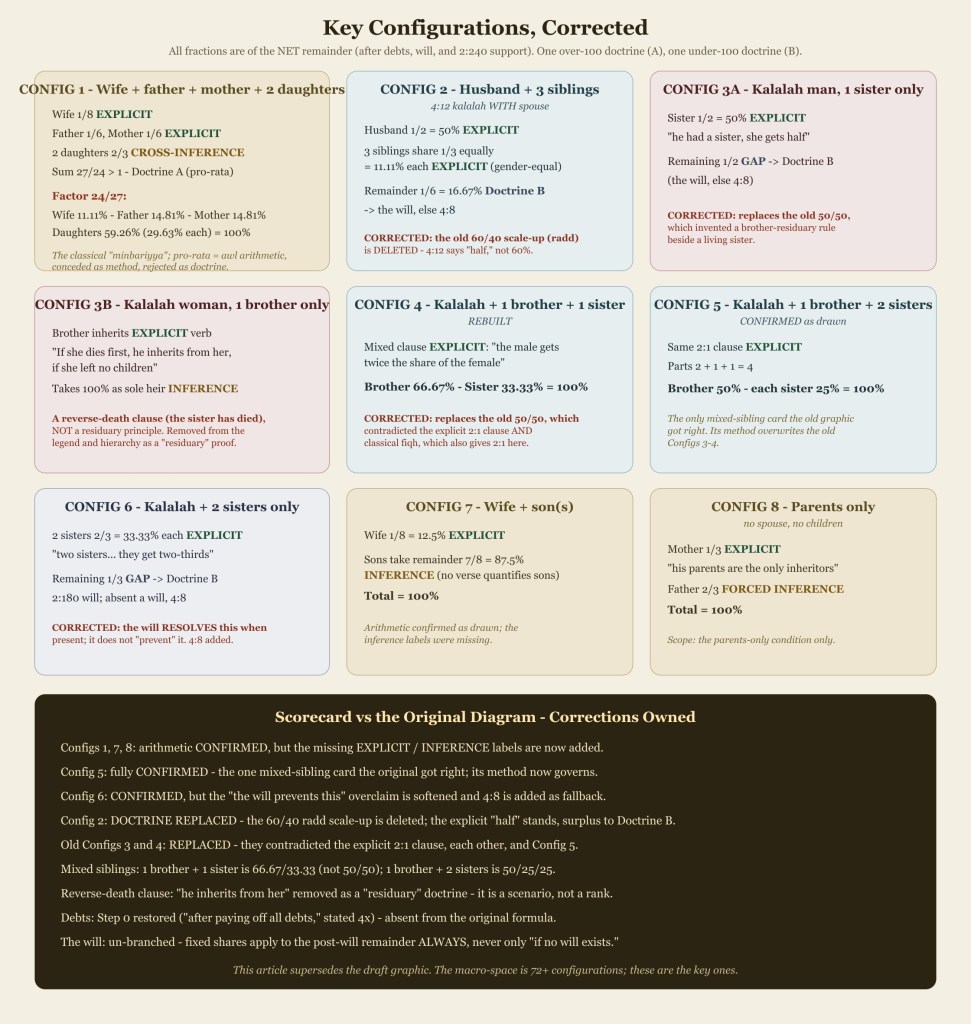
Diagram 4: The corrected configuration cards and an open scorecard against the earlier research diagram. Every fixed value is tagged; every correction is named.
Configuration 1, a wife with both parents and two daughters, is the classic case and the one the tradition calls the “minbariyya.” The wife’s one-eighth, and each parent’s one-sixth, are Explicit; the two daughters’ two-thirds is the cross-inference from [4:176] we flagged earlier. Those shares sum to twenty-seven twenty-fourths, more than the whole estate, so Doctrine A abates them pro-rata by the factor twenty-four over twenty-seven, giving the wife 11.11 percent, each parent 14.81 percent, and the daughters 59.26 percent between them. We concede openly that these are the same numbers the classical doctrine of awl produces, we accept the arithmetic as mathematically forced, while rejecting awl as a free-standing doctrine, because pro-rata abatement is simply what preserving God’s stated inter-heir ratios requires when they over-subscribe the estate.
Configuration 2 is where the old diagram broke most visibly, and the fix is clean. A husband and three siblings, under [4:12]’s kalalah-with-spouse ruling: husband one-half, the three siblings sharing one-third equally at 11.11 percent each, both Explicit. That leaves one-sixth of the estate, 16.67 percent, with no named taker. The old diagram “scaled up” the shares to fill the gap, effectively paying the husband sixty percent instead of his stated half. That is the classical override called radd, and it fails three ways at once: it contradicts the explicit “half,” it contradicts the very reasoning the old diagram used elsewhere, and even in classical law radd excludes spouses, so sixty-forty matched no system that has ever existed. We delete it. The one-sixth surplus goes where Doctrine B sends every such surplus: to the [2:180] will, and failing a will, to the relatives, orphans and needy of [4:8].
Configurations 3A, 3B, 4 and 5 are the sibling cases, and together they carry the single largest cluster of corrections. Old Config 3 paired a brother and sister at fifty-fifty; the explicit text of [4:176] says “the male gets twice the share of the female,” so one brother and one sister is 66.67 to 33.33, and that corrected case now fills the rebuilt Config 4. Old Config 4 gave a brother and two sisters at 66.7 to 33.3 (with a “33.35 percent each” typo that did not even sum correctly), while old Config 5 gave the identical heir set the correct answer of 50, 25, 25. The old diagram thus held two contradictory answers for the same family, a fatal internal contradiction; we merge them onto Config 5’s correct method and free the slot. The sole-sibling cases split cleanly: a lone sister takes her explicit one-half with the rest a Gap for Doctrine B (Config 3A), and the reverse-death sole-brother clause is Config 3B, a scenario, never a residuary rule.
Configurations 6, 7 and 8 round out the set. Two sisters alone take their explicit two-thirds, leaving a one-third Gap that the will resolves and [4:8] catches (Config 6, with the old “prevents the scenario” overclaim softened, intestate deaths do happen). A wife with sons takes her explicit one-eighth while the sons take the seven-eighths remainder by inference (Config 7). Parents alone give the mother her explicit one-third and the father the forced-inference two-thirds, scoped strictly to the “only inheritors” condition (Config 8). The arithmetic of these three was already right in the old diagram; what was missing, and is now supplied, were the tags that tell an honest reader which numbers are God’s words and which are our reasoning.
The Gaps God Left and the Instruments That Close Them
A law can be complete without enumerating every case, if it supplies the instruments to resolve the cases it does not enumerate. That is exactly the Quran’s design, and it is more honest, and more robust, than pretending the verses spell out all seventy-two-plus macro-configurations. There are gaps. We catalog them, we sort them, and we name the instrument that closes each. There are three classes.
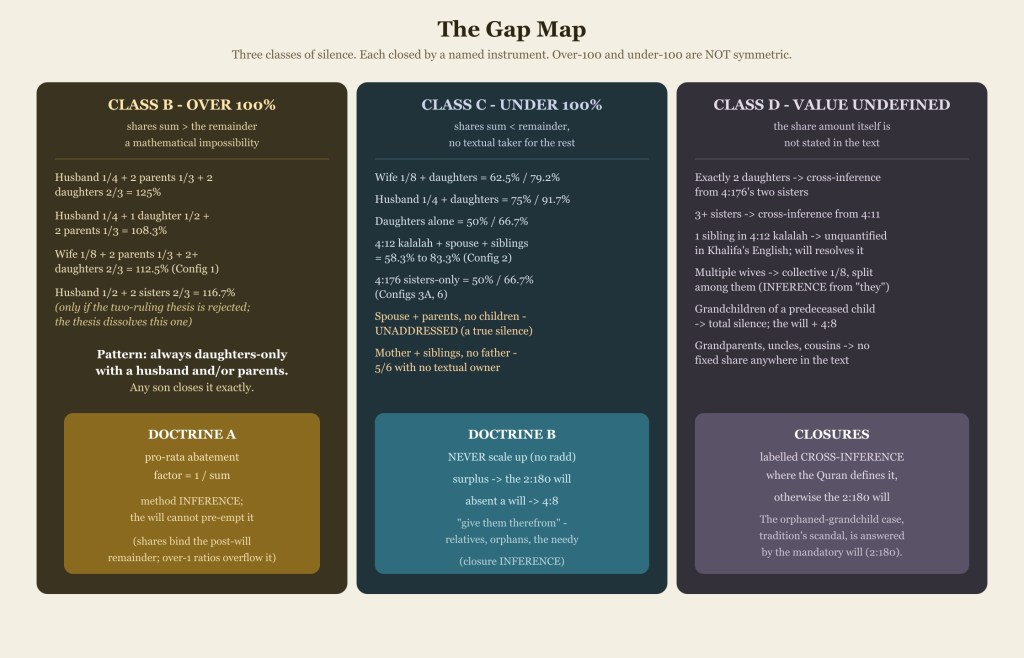
Diagram 5: The complete gap map. The asymmetry is the key insight: over-100 silence is a mathematical impossibility needing a rule; under-100 silence has explicit textual outlets.
Class B is over-subscription: the fixed shares add up to more than the estate. This is not a drafting oversight; it is a mathematical certainty in certain family shapes, and crucially, it cannot be dodged by writing a will, because the shares bind the post-will remainder, and a ratio-set summing over one over-subscribes any positive remainder whatsoever. Some abatement rule is therefore forced by mathematics itself, and pro-rata is the only one that preserves God’s stated ratios between the heirs. Every over-100 case has the same fingerprint: daughters-only, alongside a husband and/or parents, and no son. Add a single son and the arithmetic closes exactly, because the son absorbs the residue. We concede plainly that Configuration 1 is the classical “minbariyya” and that our pro-rata reproduces the numbers of awl; we grant the arithmetic and decline the doctrine.
Class C is under-subscription with no named taker for the remainder, and here the correction is a discipline: never, ever inflate a fixed share. [4:12] says “half,” not sixty percent. The surplus flows to the [2:180] will, and absent a will, to the relatives, orphans and needy of [4:8], a labelled Inference applied uniformly to every case in the class, Configurations 2, 3A and 6 alike. This is where the one-doctrine-per-direction rule earns its keep: no card is allowed to embody a doctrine another card rejects, which is precisely the incoherence that sank the old diagram, where Config 2 scaled up while Config 6 did not. Class C also surfaces two genuine silences the old diagram never even saw: a spouse together with a parent but no children (the mother’s stated one-third is conditioned on parents being the only inheritors, so it does not straightforwardly apply), and a mother with siblings but no father, where the mother’s explicit one-sixth leaves five-sixths with no textual owner. We show these holes rather than paper over them. The classical patches for them, Umar’s ijtihad on the spouse-and-parents case, are Classical-import and we do not smuggle them in.
Class D is where the share value itself is textually undefined, and most of these close by the cross-inferences already in our register, two daughters and three-plus sisters bridging across [4:11] and [4:176]. One case deserves a candid disclosure under our Khalifa-English-authority rule: in a spouse-present kalalah estate with a single sibling, Khalifa’s English quantifies siblings only “from two upward,” so that lone sibling’s share is simply not stated in the English we treat as authoritative. The Arabic dual would assign each of “a brother or a sister” one-sixth; we flag that English-Arabic divergence honestly rather than silently importing the classical one-sixth, and we let the [2:180] will resolve the case. The most humane payoff of this whole framework, though, is Class D’s grandchildren. A child who predeceases the parent, leaving orphaned grandchildren, is textually silent in the fixed shares, and classical law’s failure to provide for such orphans became a genuine historical scandal. The Quran’s answer is not a fixed fraction bolted on after the fact. It is the mandatory will of [2:180], written “for the benefit of the parents and relatives,” which is exactly the instrument by which a grandfather provides for orphaned grandchildren before he dies. The gap is not a hole in the law; it is the law pointing to its own designated instrument.
What Tradition Added
An honest reconstruction owes a direct accounting of what the Quran does not contain but tradition supplied anyway, because much of what people assume is “the inheritance law” is post-Quranic construction. We take the major additions one at a time, and refute each on its own stated ground, not by hand-waving.
First, the uterine-sibling reading of [4:12]. Classical harmonization avoids the two-ruling problem by claiming [4:12]’s siblings are maternal half-siblings and [4:176]’s are full siblings, a distinction found in neither verse. It rests on a non-canonical companion reading that inserts the words “from the mother,” the so-called “min umm” qira’ah, plus supporting hadith. That is extra-Quranic by definition, and it fails the Quran’s own standard of self-sufficiency.
[6:114] “Shall I seek other than God as a source of law, when He has revealed to you this book fully detailed? Those who received the scripture recognize that it has been revealed from your Lord, truthfully. You shall not harbor any doubt.”
The canonical text says only “two siblings, male or female.” The structural reading wins on Quran-alone parsimony, and that comparison, not grammar, is the argument.
Second, awl, the over-subscription doctrine. We have already conceded its arithmetic; what we reject is its status. That the tradition needed a caliphal improvisation to patch over-subscribed estates is itself telling: a system its own jurists call complete should not require on-the-spot invention to make the numbers add up. Pro-rata abatement is forced by mathematics and needs no doctrinal authority beyond God’s own stated ratios.
Third, radd, the doctrine of returning surplus by inflating fixed shares. It is a juristic override of explicit share values, God said “half,” and it pays out more, and revealingly, tradition’s own version of it excludes the spouse. So the old diagram’s sixty-forty in Config 2 was not even classical radd; it matched no system at all. We reject inflating any fixed share, in either direction.
Fourth, the twin hadith rules that fence the will. The no bequest to an heir prohibition comes from a Farewell Sermon report carried by Abu Dawud and al-Tirmidhi and absent from both Sahihs; the one-third maximum comes from the report of Sa’d ibn Abi Waqqas in Bukhari and Muslim. The first directly contradicts the Quran: [2:180] commands a will “for the benefit of the parents and relatives,” and parents are heirs, so a rule barring bequests to heirs bars exactly what God commands.
Their own defence is not that they overrule the Quran; no jurist claims that. The claim is abrogation, that [2:180] was cancelled either by the inheritance verses or by hadith, with al-Shafi’i holding the narrower line that it survives for relatives who do not inherit. The claim fails on three fronts. Textually, abrogation is asserted exactly where the verse is most explicit, since [2:180] names the parents who are the very heirs said to be excluded. Structurally, [4:11] and [4:12] do not repeal the will, they presuppose it, stating four separate times that the shares are computed after any will is fulfilled, which is not how a repealing text speaks of what it has repealed. And at the root it collides with God’s own guarantee about His words.
[6:115] “The word of your Lord is complete, in truth and justice. Nothing shall abrogate His words. He is the Hearer, the Omniscient.”
The one-third cap is likewise hadith-only, and as shown earlier it does not merely duplicate a protection the Quran already gives, it obstructs one: the arithmetic puts the very relief the footnote at [4:11] names, “twice as much as the son” and “everything,” beyond the ceiling’s reach. Nor was any of this the unanimous position it is often presented as. Ibn Hazm held a bequest to non-inheriting relatives to be obligatory on [2:180] rather than merely permitted; the Ja’fari school rejects the heir prohibition outright; and modern Egyptian and Syrian codes revived [2:180] as a compulsory bequest for orphaned grandchildren, conceding in statute what the abrogation claim denies in theory. Both rules are Classical-import, and both fail against a complete, unabrogated book.
It is worth naming the offence precisely, because the charge is narrower and heavier than “a mistake.” A ruling qualifies only when three things are true together: it is presented as God’s law, it is absent from the Quran, and it prohibits what God permitted or permits what He prohibited. The heir prohibition meets all three. What the Quran calls that is not a lapse of scholarship but decreeing religion God never authorised, and uttering “this is lawful, and this is unlawful” as a fabrication attributed to Him. The charge lies against the ruling and the doctrine, never against a person; God defers that judgment Himself, and so do we.
Fifth, the agnate ladder that hands surplus estates to uncles and cousins. Here precision matters, because the sloppy version of this claim hands critics an easy win. It is not true that extended kin have “zero Quranic basis” full stop, they have real Quranic standing, as the next section shows. What has zero Quranic basis is the specific classical doctrine of uncles and cousins as automatic residuary heirs in a ranked male-agnate ladder. That ladder traces to a single hadith, “give the fixed shares to those entitled, and what remains to the nearest male” (Bukhari 6732, Muslim 1615), plus agnatic analogy, Classical-import, stated nowhere in the Quran. The Quran names only children, parents, spouses and siblings as holders of designated or residuary shares.
Sixth and last, the gender-ratio flip between the two kalalah rulings, [4:12] equal, [4:176] at 2:1. We do not evade this by quietly dropping the words “male or female” from [4:12], as the old graphic did; those words are the strongest untapped datum in the whole passage. We meet it with our labelled functional Inference: the spouse-present estate pays modest, equal per-capita stipends to siblings who are secondary to a surviving spouse, while the sole-heir estate falls back to the children-template of [4:11], where the two-to-one ratio already governs. That is a reasoned account, not a proof, and we tag it as such. Honesty about the one thing no reading fully explains is worth more than a confident gloss that explains it by deletion. This is the same discipline set out in our companion study, The Quran Alone: God’s Perfect Epistemology: the book is its own sufficient source of law, and every human addition must be named and weighed against it.
The Extended Family the Quran Actually Provides For
Because the agnate-ladder correction is easy to misread as “the Quran ignores extended kin,” we state the positive doctrine in full. The Quran’s channels for uncles, cousins, grandparents and the wider family are real; they are simply different in kind from the fixed shares. They are duties of provision and care, not automatic residuary entitlements, and that difference is the whole point.
The first channel is the mandatory will itself. [2:180] commands a bequest “for the benefit of the parents and relatives,” so an uncle or a cousin can be a fully Quranic beneficiary of an estate, through the will, by name. The second is the distribution-time gift of [4:8].
[4:8] “During distribution of the inheritances, if relatives, orphans, and needy persons are present, you shall give them therefrom, and treat them kindly.”
That is a command, mandatory in kind if discretionary in amount: when the inheritance is being handed out and relatives, orphans or the needy are present, you shall give them something from it. The third channel is the standing duty of kin to support one another, stated twice and rooted in scripture itself.
[8:75] “…Those who are related to each other shall be the first to support each other, in accordance with God’s commandments. God is fully aware of all things.”
[33:6] “…The relatives ought to take care of one another in accordance with God’s scripture…”
Now the objection the old diagram never addressed, and which the article must answer to be defensible, [4:33], often read as appointing heirs for all kin.
[4:33] “For each of you, we have designated shares from the inheritance left by the parents and the relatives. Also those related to you through marriage, you shall give them their due share. God witnesses all things.”
Read carefully in Khalifa’s English, [4:33] adds no new class of heir. The relatives in its first clause are the estate-leavers, the “inheritance left by the parents and the relatives,” exactly the structure of [4:7] (“what the parents and relatives leave behind”). The verse ratifies the shares God already designated; Khalifa’s own subtitle for it reads “Do Not Object to the Inheritance Laws Proposed by God.” And its second clause, “those related to you through marriage… their due share,” points to the spousal shares already designated in [4:12], not to some new tier of heirs. Under this rendering, the classical reading of [4:33] as appointing extended-kin heirs is simply unavailable. The Quran’s care for the extended family is genuine and commanded, it just runs through the will, the distribution-gift, and the duty of mutual support, rather than through an automatic ladder of male agnates.
The Inheritance We Actually Leave
Step back from the fractions and the framework, and see what this law is for. Every stage of it bends toward the weak. The debts are paid so no creditor is cheated. The will is bounded so no child is disinherited by spite. The widow is given a year of support before anyone divides a coin. And woven through it all is a relentless concern for the most defenseless heirs of all, the children and the orphans.
[4:9] “Those who are concerned about their own children, in case they leave them behind, shall observe God and be equitable.”
That verse sits in the middle of the inheritance passage as its moral spine: whatever you would want for your own children if you died tomorrow, extend it, equitably, to the children whose fate now rests in your hands. And God guards the orphan’s property with some of the most fearsome language in the entire Final Testament, because the orphan is the heir most easily robbed.
[4:10] “Those who consume the orphans’ properties unjustly, eat fire into their bellies, and will suffer in Hell.”
[89:19] “And consuming the inheritance of helpless orphans.”
The same protective spirit shields the widow. [4:19] forbids the old tribal practice of treating a dead man’s wife as part of his estate, to be inherited or coerced: “it is not lawful for you to inherit what the women leave behind, against their will.” A woman is an heir, never a chattel. Put the whole system together and its purpose is unmistakable, stated by God Himself inside the sibling shares, the shares must be divided “so that no one is hurt” [4:12]. That is the design brief of the entire law: not the maximization of any heir’s portion, but the protection of every heir from being hurt.
So what should we take from a law God signed with Heaven and Hell? First, a discipline of honesty. The tags in this article are not academic decoration; they are a refusal to dress human reasoning in divine authority, or to hand God’s plain words the hedged tone of a guess. The Quran says what it says, “half” means half, “two-thirds” means two-thirds, and where it is silent it hands us instruments, the mandatory will and the distribution-gift, rather than licensing us to invent. Second, a duty to act. The command to write an equitable will is a duty upon the righteous [2:180], and there is no better time to fulfill it than before death approaches. To leave one’s family a clear, just, God-conforming will is to leave them the law itself, working exactly as designed.
And that is the deepest inheritance any of us actually leaves. Not the house, or the ledger, or the deed passed from an old hand to a young one, but the justice with which we pass them. The estate is divided once. The example of having divided it rightly, of having obeyed the God who attached eternity to this very law, endures in the family that receives it. That is the divine estate: a system so careful that its own author reduced its purpose to five words, “so that no one is hurt,” and so complete that it needs no addition, only obedience.
[4:13] “These are God’s laws. Those who obey God and His messenger, He will admit them into gardens with flowing streams, wherein they abide forever. This is the greatest triumph.”

We began with a diagram to be validated and end with a law to be obeyed. The related study The Quranic Proof: Marriage Requires Women, Not Children applies the same verbatim-and-labelled method to the marriage that so many of these spousal shares presuppose. The method is the message: read God’s words exactly, reason openly, name every human addition, and let the book that God calls “fully detailed” be enough. It always was.

 Quran Only Studies
Leave a comment