Introduction: A Throne Promised, a Bloodline in Question
Few doctrines carry as much weight in Christian theology as the claim that Jesus is the Messiah descended from King David. The promise of an eternal Davidic throne is the spine of Israel’s royal hope, and the New Testament opens — literally, in its very first verse — by announcing “Jesus Christ, the son of David” (Matthew 1:1). Everything about the Christian reading of Jesus depends on that genealogical link holding firm. Remove it, and the messianic case must be rebuilt on entirely different ground.
Yet the link does not hold, and the reason is hidden in plain sight. Both genealogies the New Testament offers run through Joseph — and the virgin birth doctrine, which the same New Testament insists upon, makes Joseph biologically irrelevant. Every drop of Davidic blood Jesus is claimed to carry must therefore come through his mother. That raises the question Christianity almost never asks plainly: whose line was Mary from? The Quran answers that question with remarkable consistency, and its answer is not David. It is Aaron — the priestly house of Amram, of the tribe of Levi.
This article walks through the evidence in order: what the Davidic promise actually demands, why the Gospel genealogies collapse onto Mary, what the Quran states about Mary’s line in verse after verse, how the Gospel of Luke quietly corroborates the priestly connection, and what the Dead Sea Scrolls reveal about the kind of messiah first-century Jews were actually expecting. The conclusion is not that Jesus was no messiah — the Quran calls him the Messiah without qualification [3:45] — but that he was a priestly, spiritual messiah in the Aaronic pattern, never the political warrior-king the Davidic covenant demanded.
Part 1: What the Davidic Promise Actually Demands
The Covenant of the Throne
The Davidic covenant is unambiguous about its terms. God promises David: “I will raise up your offspring to succeed you, your own flesh and blood, and I will establish his kingdom… I will establish the throne of his kingdom forever” (2 Samuel 7:12-13). The promise is biological and dynastic — an offspring, flesh and blood, an unbroken royal line. Jeremiah repeats it: “I will raise up for David a righteous Branch, a King who will reign wisely” (Jeremiah 23:5). Isaiah roots it in the family tree itself: “A shoot will come up from the stump of Jesse; from his roots a Branch will bear fruit” (Isaiah 11:1).
Notice what all three passages share: the messiah of this covenant is defined by descent. He is David’s “offspring,” David’s “Branch,” a shoot from “the stump of Jesse.” This is not a title one can simply claim; it is an inheritance one must carry in the blood. A claimant to Messiah ben David — the anointed son of David — stands or falls on documented Davidic ancestry. If the bloodline fails, the claim fails, no matter how many miracles the claimant performs.
The covenant also carries political content that is easy to overlook. The promised king “will reign,” will execute justice in the land, will restore the fortunes of Israel as a nation under its own throne (Jeremiah 23:5-6). This is the expectation that produced centuries of Jewish longing for a liberator-king — and it is precisely the expectation Jesus never fulfilled, a point we will return to. First, the bloodline itself must be examined.
Part 2: Two Genealogies, One Dead End
Matthew and Luke Cannot Both Be Right
The New Testament contains two genealogies of Jesus, and they contradict each other at nearly every step. Matthew (chapter 1) traces roughly forty generations from Abraham down through Solomon and the royal line to Joseph. Luke (chapter 3) traces a much longer list backward from Jesus through Nathan — a different son of David entirely — all the way to Adam. Between David and Joseph, the two lists share almost no names beyond Shealtiel and Zerubbabel; dozens of intervening ancestors simply do not overlap. Two genealogies of the same man cannot both be literally true; apologists have wrestled with this since the second century.
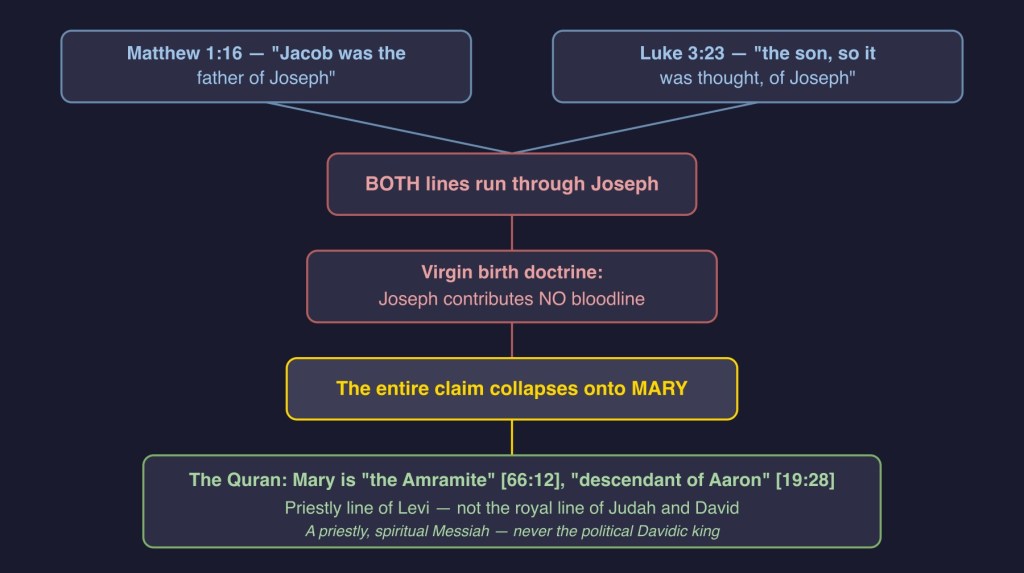
The standard harmonization is to declare one list “Joseph’s line” and the other “Mary’s line.” But read the texts: both lists explicitly terminate at Joseph. Matthew says “Jacob was the father of Joseph, the husband of Mary” (Matthew 1:16). Luke says Jesus “was the son, so it was thought, of Joseph” (Luke 3:23). Neither evangelist claims to be recording Mary’s ancestry. The harmonization invents what the text does not say to escape a contradiction the text plainly contains.
Joseph’s Line Is a Legal Fiction by the Doctrine’s Own Terms
Here the deeper problem arrives. The virgin birth doctrine — affirmed in the same two Gospels that carry the genealogies — states that Joseph had no biological role in Jesus’ conception whatsoever. If that is true, then Joseph’s ancestry, royal or otherwise, contributes nothing to Jesus’ bloodline. Legal adoption could confer a claim to a throne in some ancient frameworks, but the Davidic covenant, as we saw, speaks of “your own flesh and blood.” A promise of flesh cannot be fulfilled by paperwork.
So the entire Davidic claim collapses onto one person: Mary. If Jesus is Messiah ben David, Mary must be Davidic — and demonstrably so, since hers is now the only line that matters. Every argument for Jesus’ royal messiahship is, whether Christians realize it or not, an argument about Mary’s ancestry. And it is here that the evidence, biblical and Quranic alike, points decisively away from David.
Part 3: Two Tribes That Never Merge
The Priestly Line of Levi
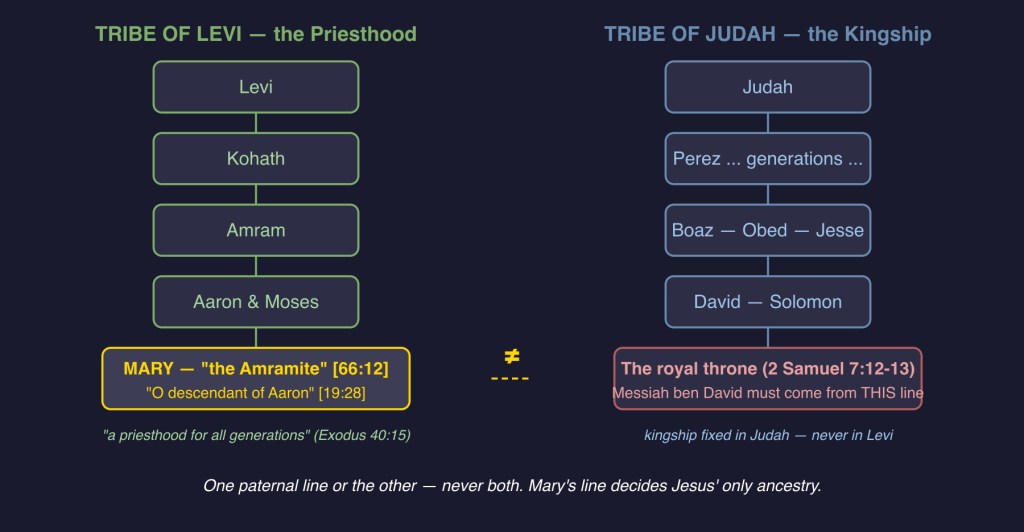
Israel’s tribal structure was not decorative; it was constitutional. The priesthood belonged to one family within one tribe and to no one else. The line runs: Levi, then his son Kohath, then Kohath’s son Amram, then Amram’s sons Aaron and Moses (Exodus 6:16-20). From Aaron onward, the high priesthood passed through his descendants by divine command: Aaron and his sons were anointed “to a priesthood that shall continue for all generations to come” (Exodus 40:15). A priest of Israel was a priest by birth — a descendant of Aaron through the male line — and no amount of personal piety could make a man of Judah into a priest.
The Royal Line of Judah
The kingship ran through an entirely different tribe. The royal line runs from Judah down through Perez, and generations later through Boaz, Obed, and Jesse, to David (Ruth 4:18-22). When David was anointed, and when Solomon after him was anointed, the throne of Israel was fixed in the tribe of Judah. Scripture is emphatic that these two offices do not mingle: when King Uzziah of Judah presumed to burn incense — a priestly act — he was struck down for trespassing on the Aaronic office (2 Chronicles 26:16-21). A person cannot be of two paternal lines. One is either a descendant of Aaron through Amram, or a descendant of David through Jesse. Not both.
This matters enormously for the question at hand. If Mary’s line is the line of Amram — as the Quran states — then Jesus’ only biological ancestry is priestly, of Levi, and the Davidic claim fails on its own terms. The two-tribe structure of ancient Israel leaves no room for a claimant to be quietly both. The Quran’s insistence on Mary’s Aaronic identity is therefore not a curious side detail; it is a direct verdict on the most consequential genealogical claim in Christianity.
Part 4: The Quran’s Verdict — The Family of Amram
Chosen Above the Worlds
The Quran does not leave Mary’s lineage to inference. It opens her story by naming her house among the elect families of all history:
[3:33] “God has chosen Adam, Noah, the family of Abraham, and the family of Amram (as messengers) to the people.”
[3:34] “They belong in the same progeny. God is Hearer, Omniscient.”
This is an astonishing placement. In the entire Quran, only four lines are singled out this way: Adam, Noah, the family of Abraham, and the family of Amram. The family of David is never given this honor — not here, and not anywhere else in connection with Jesus. When God frames the story of Mary and Jesus, the frame He chooses is Amram’s. Verse 3:34 then welds these families together as “the same progeny,” a single spiritual lineage of messengership — and notably, Amram’s house is the one named for the era of Jesus, exactly as Aaron’s house was the one named for the era of Moses.
Some readers pass over the word “Amram” without registering who he is. Amram is the father of Aaron and Moses, of the tribe of Levi, son of Kohath, son of Levi (Exodus 6:16-20). To say “the family of Amram” is to say the priestly house. There is no ambiguity available here: the Quran places Mary, before she is even born, inside the one family in Israel defined by the sanctuary rather than the throne.
A Child Dedicated to the Sanctuary
The very next verses confirm the placement with the story of Mary’s dedication:
[3:35] “The wife of Amram said, ‘My Lord, I have dedicated (the baby) in my belly to You, totally, so accept from me. You are Hearer, Omniscient.’”
[3:36] “When she gave birth to her, she said, ‘My Lord, I have given birth to a girl’—God was fully aware of what she bore—’The male is not the same as the female. I have named her Mary and I invoke Your protection for her and her descendants from the rejected devil.’”
Mary’s mother is named for us in the only way that matters genealogically: “the wife of Amram.” Her act — dedicating her unborn child entirely to God’s service — is the act of a temple family. Such dedication of a child to sanctuary service is a priestly custom, the same pattern seen with Samuel, whose mother Hannah dedicated him to the sanctuary under the priest Eli (1 Samuel 1:11, 1:24-28). Royal families dedicate heirs to thrones; priestly families dedicate children to the temple.
[3:37] “Her Lord accepted her a gracious acceptance, and brought her up a gracious upbringing, under the guardianship of Zachariah. Whenever Zachariah entered her sanctuary he found provisions with her. He would ask, ‘Mary, where did you get this from?’ She would say, ‘It is from God. God provides for whomever He chooses, without limits.’”
Mary grows up not in a palace but in a sanctuary — she has her own chamber within it — and her guardian is Zachariah, whom both scripture and the Gospel of Luke identify as a priest of the temple (Luke 1:5-9). The Quran’s picture is total: dedicated by a priestly mother, raised in the sanctuary, supervised by a serving priest, miraculously provisioned like the temple itself. Every environmental signal in the narrative says the same thing the genealogy says.
![Mary raised in the sanctuary under Zachariah; miraculous provisions [3:37]](https://quranonlystudies.com/wp-content/uploads/2026/08/mary_aaronic_not_david_02_sanctuary_zachariah.png?w=1024)
Part 5: “O Descendant of Aaron” — Three Signals, One Line
The Address on the Tongues of Her Own People
The single most direct statement comes when Mary returns to her family carrying the infant Jesus:
[19:27] “She came to her family, carrying him. They said, ‘O Mary, you have committed something that is totally unexpected.”
[19:28] “‘O descendant of Aaron, your father was not a bad man, nor was your mother unchaste.’”
Her own community, in the moment of scandal, reaches for her family identity — and the name they reach for is Aaron. Note also what they say next: “your father was not a bad man, nor was your mother unchaste.” They know her parents personally; this is a known, local, reputable family. And the family’s public identity is Aaronic. In Semitic idiom, to call someone “sister” or “descendant” of an eponymous ancestor is to state tribal and lineal affiliation — the same way the Arabs called a man of Tamim “brother of Tamim,” and the same way the Quran itself uses kinship terms for lineages. The people are not confusing her with Moses’ literal sister, separated from her by well over a thousand years; they are naming her house.
The Metaphor Dodge — and Why It Fails
Traditional commentators, uncomfortable with the verse, have long claimed “descendant of Aaron” is a mere figure of speech — that her people meant “O righteous woman, like Aaron.” This reading deserves a fair answer rather than ridicule, and the fair answer is decisive: the Quran does not make this claim once. It makes it three independent times, in three different modes. It embeds Mary in “the family of Amram” — Aaron’s literal father — before her birth [3:33-35]. It places her entire upbringing inside the sanctuary under a serving priest [3:37]. And it has her own people address her by Aaron’s name in a moment of unscripted, spontaneous speech, where metaphor is least natural and family identity most instinctive [19:28].
A metaphor does not come with a family tree. A metaphor does not dedicate a child to temple service or station her childhood in a sanctuary. Each of the three signals is a different kind of evidence — explicit genealogy, narrative setting, and social address — and all three converge on the same line. To wave away one verse as figurative, a reader must wave away the architecture of two entire chapters. That is not interpretation; it is avoidance.
The Amramite
Then, near the end of the Quran, God seals the matter with a title:
[66:12] “Also Mary, the Amramite. She maintained her chastity, then we blew into her from our spirit. She believed in the words of her Lord and His scriptures; she was obedient.”
In God’s own words, Mary’s identifier — her patronymic, the name of her line — is “the Amramite.” Not the Davidite. Not the Judahite. God had the entire vocabulary of Israel’s tribes available, and the name He chose for the mother of the Messiah is the name of Aaron’s father. If the Quran intended to endorse the Davidic genealogy of Jesus, this verse was the place to say so, in the very sentence that describes the virgin birth. Instead it does the opposite: at the exact moment of the miracle, it anchors Mary to Amram.
![Her people confront her: 'O descendant of Aaron...' [19:28]](https://quranonlystudies.com/wp-content/uploads/2026/08/mary_aaronic_not_david_03_descendant_of_aaron.png?w=1024)
Part 6: The Gospel’s Quiet Agreement
Elizabeth, Daughter of Aaron
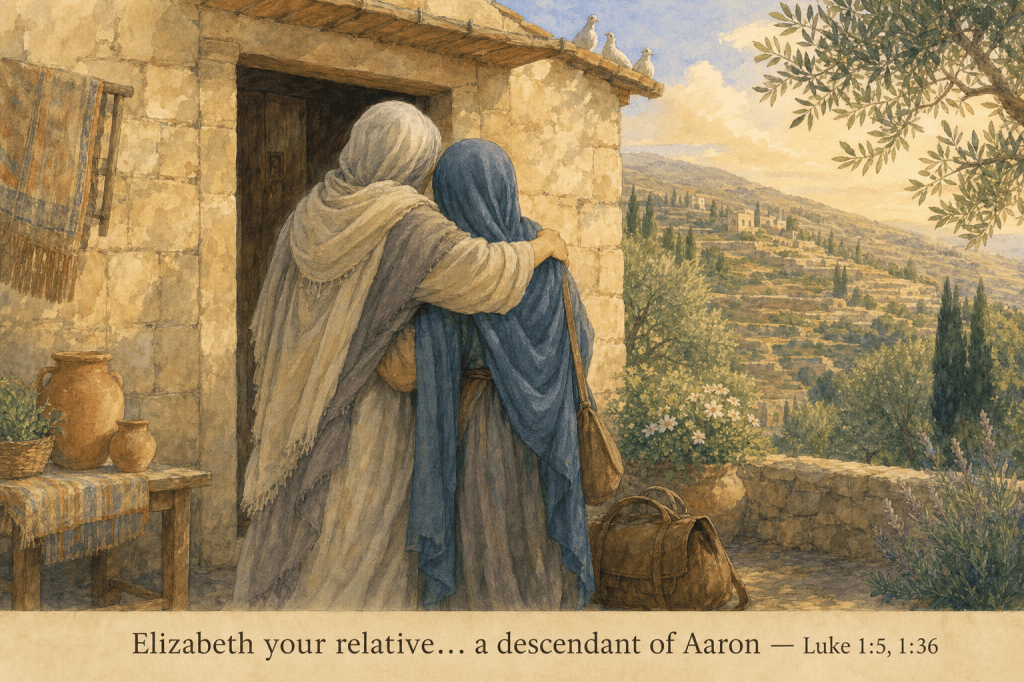
Remarkably, the New Testament itself preserves the same priestly connection — quietly, and without commentary. Luke opens his Gospel with a priest named Zechariah, “of the priestly division of Abijah,” and states plainly: “his wife Elizabeth was a descendant of Aaron” (Luke 1:5). A few verses later, the angel tells Mary: “Elizabeth your relative is also going to have a child” (Luke 1:36). The Greek word is syngenis — a kinswoman, one of the same family stock. The mother of Jesus is a kinswoman of a woman who is explicitly, textually Aaronic, married into a serving priestly family of the temple.
Now the honest caveat, and we will not hide it: kinship to Elizabeth does not, by itself, prove Mary’s paternal line. The relation could run through a marriage connection, or through a mother rather than a father. Intermarriage between tribes happened, and later Church tradition — eager to secure the Davidic claim — asserted Davidic descent for Mary without textual support. So we state the matter precisely: Luke does not prove Mary Aaronic. What Luke does is corroborate the priestly environment around her — the same environment the Quran depicts in detail — and Luke conspicuously never calls her Davidic either. The Gospel clue is a supporting witness, not the verdict. The verdict is the Quran’s.
The Protoevangelium of James
The corroboration extends into early Christian memory beyond the canon. The Protoevangelium of James, a second-century work that shaped centuries of Christian tradition about Mary, tells the story this way: her mother Anna, childless and grieved, vows to dedicate her hoped-for child to the Lord’s service; Mary is born; and at age three she is delivered to the Temple, where she is raised “like a dove” in the sanctuary, receiving food from the hand of an angel, with Zechariah serving as high priest (Protoevangelium of James 4-8).
Set that beside [3:35-37]: the wife of Amram dedicates the child in her belly entirely to God; the girl is accepted and raised in the sanctuary under Zachariah’s guardianship; provisions are found with her miraculously. The parallels are not vague — they are structural. Early Christians remembered Mary as a temple-dedicated child of a priestly world, the same memory the Quran preserves. And a child formally dedicated to the Temple, raised in its precincts under its priests, is the child of a temple family. Royal children of Judah were not handed to the sanctuary at age three.
Part 7: A Priest, Not a Warrior
The Kingdom Within
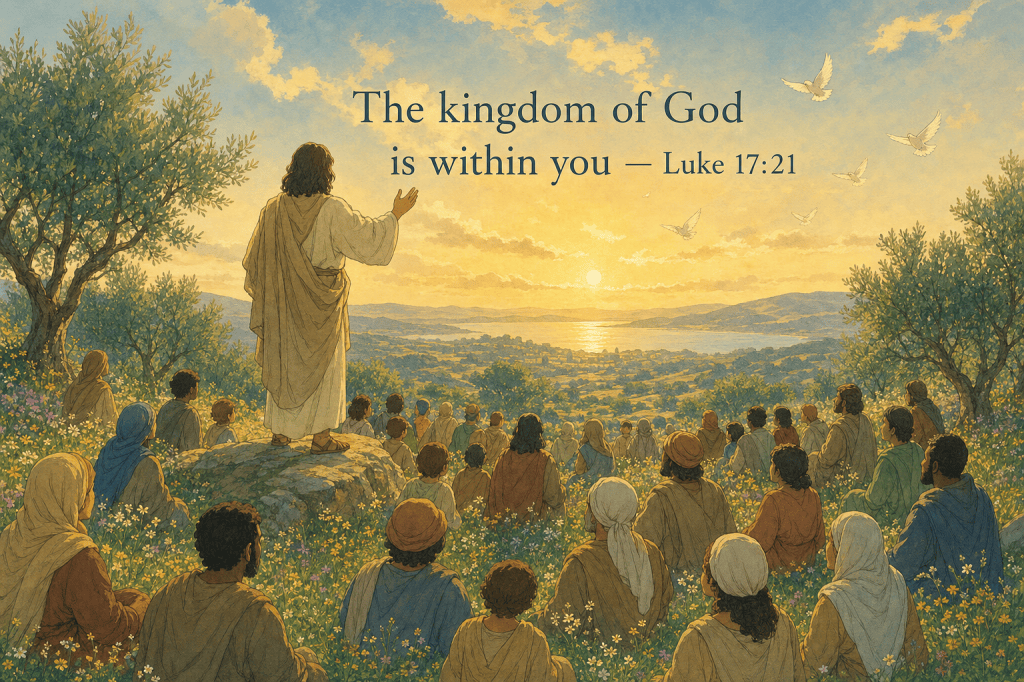
If Jesus had come as Messiah ben David, his mission would have had a defined political shape: restore the throne, gather the tribes, break the occupier’s power, reign from Jerusalem. He did none of it, and — more importantly — he refused to. Asked when the kingdom would come, he answered: “The kingdom of God does not come with observation… the kingdom of God is within you” (Luke 17:20-21). Confronted with the sharpest political question of his day — the Roman tax — he declined the revolutionary’s role entirely: “Render to Caesar the things that are Caesar’s, and to God the things that are God’s” (Matthew 22:21). These are not the words of a man building toward a throne.
What he did instead was priestly work. He cleansed the Temple, declaring “My house will be called a house of prayer” (Matthew 21:12-13) — the act of a man claiming authority over the sanctuary, not the palace. He defined his mission in the language of sacrifice: the Son of Man came “to give his life as a ransom for many” (Mark 10:45). The Epistle to the Hebrews, the most priestly book in the New Testament, makes the identification explicit, calling Jesus “a great high priest who has passed through the heavens” (Hebrews 4:14) and building its entire theology on that premise. Even on the Gospels’ own testimony, the mission of Jesus maps onto Aaron’s office — intercession, sanctification, sacrifice, the sanctuary — and not onto David’s.
The Unfulfilled Throne
The Davidic expectation, meanwhile, remained exactly where the crucifixion left it: unfulfilled. No throne was restored, no nation liberated, no reign of justice inaugurated in the land. Christian theology resolves this by relocating the kingdom to the spiritual realm and the Second Coming — which is precisely the point. A messiah whose kingdom must be spiritualized to survive the facts was never the political king Jeremiah described. The Quran agrees that Jesus is the Messiah — “The Messiah, Jesus the son of Mary” [4:171] — while never once attaching David’s name or throne to him. Where the New Testament fumbles between two messianic templates, the Quran holds one consistently: the anointed servant of the sanctuary line.
Part 8: Many Messiahs
Anointed Ones Throughout Scripture
Part of the confusion dissolves once we remember that “messiah” simply means “anointed one” — and scripture is full of them. David was anointed by Samuel, after which “the Spirit of the LORD came powerfully upon David” (1 Samuel 16:13). Solomon was anointed king by the priest Zadok (1 Kings 1:39). Most strikingly, God calls the Persian emperor Cyrus “his anointed” — messiah — because God commissioned him to liberate the exiles (Isaiah 45:1). Anointing marks a divine commission, and different commissions carried different offices.
And Aaron? “You shall anoint Aaron and his sons… their anointing will be to a priesthood that shall continue for all generations to come” (Exodus 40:13-15). Aaron is Israel’s first anointed priest — the original messiah of the sanctuary, generations before David was anointed for the throne. Israel’s scripture thus knows at least two anointings, two offices, two messianic patterns: the royal anointed of Judah and the priestly anointed of Levi. Asking which pattern Jesus fits is not a denial of his messiahship; it is the precise question his ancestry answers.
The Two Messiahs of the Dead Sea Scrolls
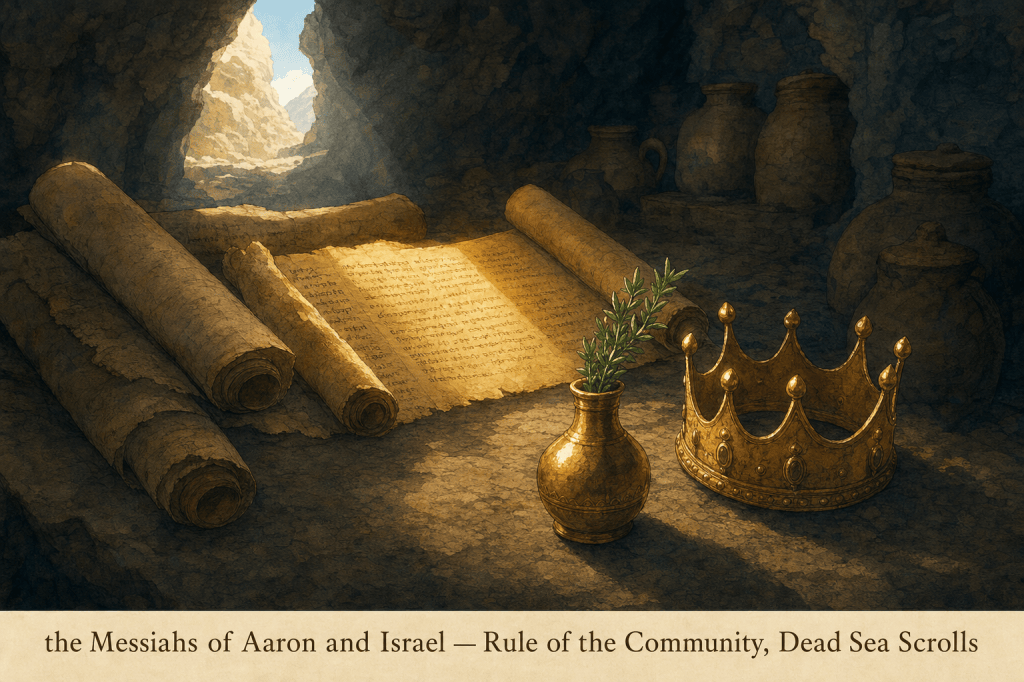
First-century Jews asked exactly that question, and their own writings prove it. The Dead Sea Scrolls — the library of the community at Qumran, hidden in caves around the time of Jesus — repeatedly anticipate not one messiah but two. The Rule of the Community speaks of the age “until the coming of the prophet and the Messiahs of Aaron and Israel” (1QS 9:11), and the Damascus Document likewise looks for the “Messiah of Aaron and Israel.” The community’s own title for these figures tells the whole story: Messiah ben Aaron, the anointed priest, and Messiah ben Israel — that is, ben David — the anointed king. The priestly messiah was even ranked first.
So the dual-messiah expectation was not invented after the fact to rescue Jesus from a failed kingship; it was the live expectation of his own era, preserved in ink that predates the Gospels. And when we lay the two patterns side by side, Jesus fits one of them with uncanny completeness: born of a temple-dedicated woman of the family of Amram, raised in the sanctuary’s orbit, preaching a kingdom within, cleansing the Temple, offering himself as ransom, called high priest by his own followers. The Quran’s Aaronic framing of Mary is exactly what we would expect the record to show if Jesus were Messiah ben Aaron — and it is exactly what we find.
Conclusion: The Criterion Settles What the Gospels Fumble
Trace the argument back along its spine. The Davidic covenant demands Davidic flesh and blood (2 Samuel 7:12-13). The only genealogies the New Testament offers run through Joseph, contradict each other, and are then nullified by the virgin birth doctrine itself — which leaves Mary’s line carrying the entire claim. And Mary’s line, by every signal available to us, is the line of Aaron: named “the family of Amram” among the four elect houses of history [3:33], dedicated to the sanctuary before birth [3:35-36], raised in the temple under a priest [3:37], hailed by her own people as “descendant of Aaron” [19:28], and sealed by God with the title “the Amramite” [66:12] — with Luke’s Gospel quietly corroborating the priestly world around her through Elizabeth (Luke 1:5, 1:36) and the Protoevangelium preserving her temple dedication.
None of this diminishes Jesus. The Quran honors him as the Messiah, God’s word sent to Mary, a messenger confirmed by miracles [3:45] [4:171] — and as we have written elsewhere, the Quran defends his mother’s honor against the very slanders her people flung at her (see our articles The Trinity Illusion and The Trinity Doctrine: A Linguistic and Historical Examination). What the evidence denies is not his messiahship but his kingship — the political throne of David he never sought, never claimed, and never received. Even his own followers’ theology made him a high priest rather than a reigning king. The priestly messiah of the Dead Sea Scrolls’ expectation walked out of the sanctuary line of Amram, and history has been trying to seat him on the wrong throne ever since.
This is what it means for the Quran to be the criterion over the scriptures that came before it. The New Testament fumbles the most consequential genealogical question in its theology — two contradictory lists, both through the wrong man, patched by harmonizations the text never states. The Quran settles it in five quiet strokes: a chosen family, a dedication, a sanctuary upbringing, a people’s address, a divine title. Mary is of the line of Aaron, not David — and her son is the Messiah of the sanctuary, not the throne.
![Final image — dawn over the sanctuary: 'Also Mary, the Amramite...' [66:12]](https://quranonlystudies.com/wp-content/uploads/2026/08/mary_aaronic_not_david_07_amramite_final.png?w=1024)


Leave a Reply