Introduction: The Only Unforgivable Sin Is Not One Sin
Ask most people what idol worship looks like and they will picture a statue — a carved figure on an altar, candles, incense, a bowed head before stone. That image is comforting precisely because it is so far away from us. It lets the modern atheist, the modern churchgoer, the modern mosque-goer, and the modern “Quran-alone” debater all nod along: yes, idol worship is terrible, and no, none of us do it. The Quran dismantles this comfort completely. In God’s scripture, idol worship — shirk, the setting up of partners or rivals to God — is not a single primitive act performed by primitive people. It is a spectrum of increasingly subtle substitutions, and the most dangerous forms of it are the ones that do not look like worship at all.
The stakes could not be stated more plainly than God states them. Idol worship is the one offense that outranks murder, adultery, theft, and every other transgression, because it attacks the very relationship for which we were created:
[4:48] “God does not forgive idolatry,* but He forgives lesser offenses for whomever He wills. Anyone who sets up idols beside God, has forged a horrendous offense.”
[4:116] “God does not forgive idol worship (if maintained until death),* and He forgives lesser offenses for whomever He wills. Anyone who idolizes any idol beside God has strayed far astray.”
Rashad Khalifa, God’s messenger of the covenant, put it with characteristic directness (at 53:47): “There is only one unforgivable sin when maintained until the time of death. This one unforgivable sin is idol worship.” One sin. Not a category of exotic sins, not a list of forbidden objects — one sin with many masks. And once you understand that the sin is setting up anything at all as a rival to God — a rival in authority, in judgment, in legislation, in loyalty — you begin to see the masks everywhere. This article walks down the levels of that descent: from the loudest denial of God, through the division of God, through the dilution of His judgment, through the enthronement of the self, and finally down to the most concealed and vicious level of all — the false god worn by the hypocrite, whose allegiance was never to God in the first place.
Each level sets up a different rival. Each level is more hidden than the one above it. And each level, left unrepented, ends in the same place.
Level One: The Godless State — Denying the God Whose Evidence Fills the Sky
The Evidence That Refuses to Go Away
The first and loudest level of shirk is the denial that God exists at all. It is the level of the person who looks at a universe balanced on mathematical razor-edges and concludes: nobody built it. Consider what physics has actually established. The cosmological constant — the energy density of empty space — is observed to be fine-tuned to roughly one part in 10^120; any significantly larger value and the universe expands too fast for galaxies, stars, or life ever to form (Source: Martin Rees, Just Six Numbers: The Deep Forces That Shape the Universe, Basic Books, 1999). Sir Fred Hoyle, the Cambridge astrophysicist who spent much of his career resisting the idea of design, looked at the carbon resonance that makes life chemistry possible and famously concluded: “A commonsense interpretation of the facts suggests that a superintellect has monkeyed with physics, as well as with chemistry and biology” (Source: Fred Hoyle, “The Universe: Past and Present Reflections,” Engineering and Science, November 1981).
Biology tells the same story from the other direction. The Cambrian explosion — the geologically sudden appearance of most major animal body plans in the fossil record, with no gradual Precambrian precursors beneath them — has been an open embarrassment to purely gradual accounts of life since the theory of evolution was first published. Darwin himself admitted that the abrupt appearance of whole groups of allied species in the lowest known fossil-bearing strata “may be justly urged as a valid argument against the views here entertained” (Source: Charles Darwin, On the Origin of Species, 1859, Chapter 9), and a century and a half of digging has not filled the gap; modern paleontology still speaks of the Cambrian “explosion” as a genuine, standing problem requiring explanation (Source: Charles R. Marshall, “Explaining the Cambrian ‘Explosion’ of Animals,” Annual Review of Earth and Planetary Sciences, Vol. 34, 2006). Rashad Khalifa, himself a Ph.D. biochemist, stated the fossil record’s verdict plainly (at 3:27): “Gradual evolution proved to be wrong, our fossil record does not support gradual evolution. You heard about the missing link… there is not just a missing link, there are thousands of missing links.”
The Quran directed humanity to exactly this evidence fourteen centuries before the telescope and the electron microscope:
[3:190-191] “In the creation of the heavens and the earth, and the alternation of night and day, there are signs for those who possess intelligence. They remember God* while standing, sitting, and on their sides, and they reflect upon the creation of the heavens and the earth: ‘Our Lord, You did not create all this in vain. Be You glorified. Save us from the retribution of Hell.”
[88:17-20] “Why do they not reflect on the camels and how they are created? And the sky and how it is raised. And the mountains and how they are constructed. And the earth and how it is built.”
[51:20-21] “The earth is full of signs for those who are certain. And within yourselves; can you see?”
A Detachment from Manifest Reality
Notice what the Quran does not say about the denier. It never says the evidence was insufficient. It never says the argument failed. It says the perceiver is sealed: “God seals their minds and their hearing, and their eyes are veiled. They have incurred severe retribution” [2:7], and “Why do they not study the Quran carefully? Do they have locks on their minds?” [47:24]. The diagnosis God gives is not intellectual but perceptual and moral — a willed blindness in the presence of overwhelming light, culminating in the state of those described in [47:23]: “It is those who incurred a curse from God, whereby He rendered them deaf and blind.”
There is a word in our own language for a fixed, unshakeable conviction held against the totality of available evidence: psychosis — a detachment from reality. We use the term here not as a clinical diagnosis but as the only honest description of the condition the Quran itself describes. When a mind can stare at a cosmos tuned to one part in 10^120, at body plans erupting into the fossil record without ancestry, at the information-bearing code inside every cell of its own body, and announce with confidence “there is no Designer” — that mind is not reasoning. It is defending itself against reality. Denial of God is the foundational shirk because it is the substitution at its most total: the denier does not merely add a rival beside God; he enthrones chance, matter, and ultimately himself in God’s place, and calls the enthronement enlightenment.

Level Two: The God of Division — Tearing the One into Three
The Claim at Which the Heavens Nearly Shatter
One step below outright denial sits a level that affirms God and still commits shirk — and the Quran treats it with a horror that should make every reader stop. This is the level of dividing God: taking the absolute, indivisible One and carving Him into a committee. Its most widespread historical form is the Christian doctrine of the Trinity, and behind it the earlier blasphemy that God begot a son. The Quran’s response is some of the most violent imagery in the entire scripture:
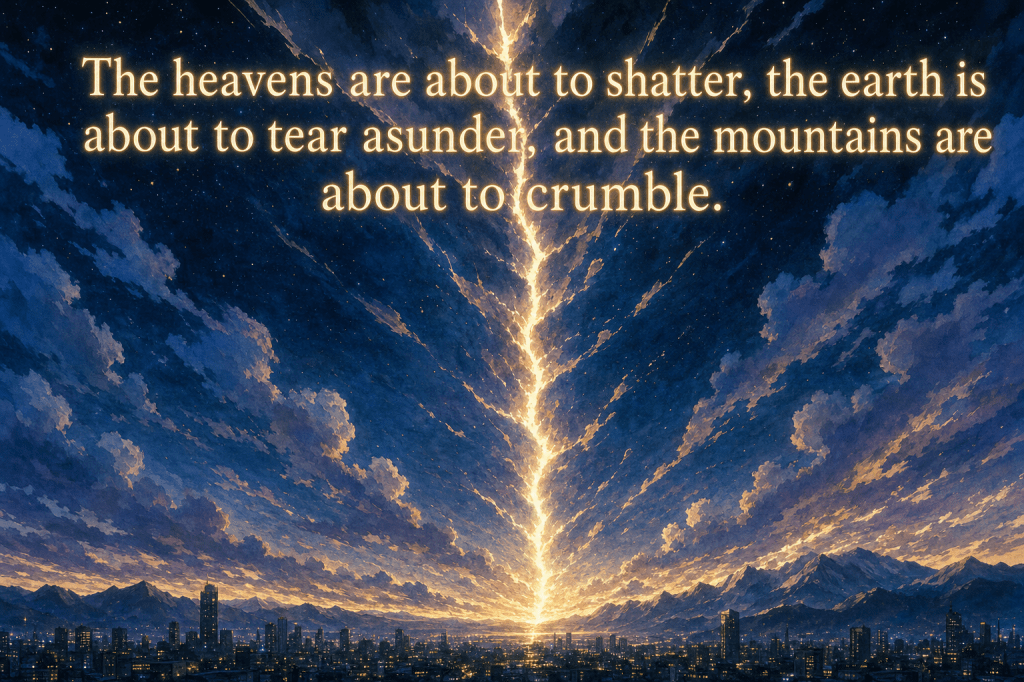
[19:88-92] “They said, ‘The Most Gracious has begotten a son!’ You have uttered a gross blasphemy. The heavens are about to shatter, the earth is about to tear asunder, and the mountains are about to crumble. Because they claim that the Most Gracious has begotten a son. It is not befitting the Most Gracious that He should beget a son.”
Creation itself nearly convulses at the words. The heavens, the earth, and the mountains — the most stable things we know — are depicted as straining at the edge of collapse, not at genocide or war, but at a theological statement. That is the measure of what dividing God means to God. And the Quran is explicit about the mechanism: it is not that Christians ceased to worship; it is that they redirected worship toward a created man. “Pagans indeed are those who say that God is a third in a trinity. There is no God except the one God” [5:73]. Jesus himself stands acquitted of the claim made in his name: “Pagans indeed are those who say that God is the Messiah, son of Mary. The Messiah himself said, ‘O Children of Israel, you shall worship God; my Lord* and your Lord’” [5:72]. He and his mother “used to eat the food” [5:75] — creatures with creaturely needs, not fragments of deity.
Rashad Khalifa, reflecting on the sheer scale of God revealed by modern astronomy, marveled at the absurdity of the claim (at 40:24): “It’s an allegorical idea to make us appreciate the greatness of God, and to make us appreciate and realize the blasphemy of saying that such great God has a human son, on the tiny tiny speck called the planet Earth. I mean how can that be?”
Even the Bible Refuses the Division
What makes this level especially tragic is that the doctrine requires ignoring the very scriptures its adherents claim to uphold. The Old Testament’s central creed — the Shema, recited daily by the people of Israel — is a monotheism so absolute it admits no parsing: “Hear, O Israel: The LORD our God is one LORD” (Deuteronomy 6:4, KJV). God declares through Isaiah, in words that tolerate no committee and no counsel of co-equals: “I am the LORD, and there is none else, there is no God beside me” (Isaiah 45:5, KJV). And when Jesus himself was asked to name the first of all the commandments, he did not announce a trinity; he recited the Shema word for word: “And Jesus answered him, The first of all the commandments is, Hear, O Israel; The Lord our God is one Lord” (Mark 12:29, KJV). The division of God was never in the mouth of the man it claims to honor.
The Quran confirms and seals the point with the purest statement of monotheism ever revealed: “Proclaim, ‘He is the One and only God. The Absolute God. Never did He beget. Nor was He begotten. None equals Him’” [112:1-4]. And it warns the people of the scripture directly: “You shall not say, ‘Trinity.’ You shall refrain from this for your own good. God is only one God. Be He glorified; He is much too glorious to have a son” [4:171]. The god of division is a god manufactured by councils centuries after the messengers — and every one of those messengers, from Moses to Jesus to Muhammad, preached the undivided One.
Level Three: The God of Intercession — Denying That God’s Judgment Is Absolute
The Myth That God’s Court Takes Bribes
Below the divider of God sits a subtler rival, and it is the one that captured the largest religious populations on earth — including the great majority of those who call themselves Muslim. This is the god of intercession: the belief that on the Day of Judgment, God’s verdict can be appealed, softened, or bought through a favorite — that Muhammad, or Jesus, or a saint, or a cleric will step into God’s courtroom and argue the guilty into Paradise. The belief sounds like piety. It is actually a denial of God’s absolute sovereignty, because it makes His judgment contingent on someone else’s lobbying. The Quran annihilates the doctrine at its root: “Say, ‘All intercession belongs to God.’ To Him belongs all sovereignty of the heavens and the earth, then to Him you will be returned” [39:44].
Intercession is not merely restricted in the Quran; as a commodity held by anyone other than God, it does not exist. “Beware of the day when no soul can avail another soul, no intercession will be accepted, no ransom can be paid, nor can anyone be helped” [2:48]. “O you who believe, you shall give to charity from the provisions we have given to you, before a day comes where there is no trade, no nepotism, and no intercession. The disbelievers are the unjust” [2:254]. God declares Himself the sole sovereign with no counselor beside His throne: “You have none beside Him as Lord, nor do you have an intercessor. Would you not take heed?” [32:4]; “He controls all matters. There is no intercessor, except in accordance with His will” [10:3]. And the Quran is to be preached precisely to those who understand they will face God without a lawyer: “they have none beside Him as a Lord and Master, nor an intercessor” [6:51]. On that day, “no soul can help another soul, and all decisions, on that day, will belong to God” [82:19].
Rashad Khalifa confronted the intercession myth directly in debate, citing the very verse the traditionalists twist (at 1:24:04): “To God belongs all intercession, so nobody possesses intercession… The Quran says that the messenger of God will not have any shafa’a, any intercession.” He explained why the myth is psychologically irresistible — it lets people outsource their own salvation: “We are more comfortable with our little idols. We don’t want to exert any effort. We like things done on our behalf” (as cited in Introduction: The Eternal Pattern of Rejection). An intercessor is the ultimate little idol: someone else to carry the weight that God commanded you to carry.
The Idols Will Disown Their Followers
The Quran does not merely refute the intercession myth; it shows us the courtroom scene in which it collapses. The very beings who were expected to plead for their followers will instead plead against them. Rashad Khalifa described the scene the traditionalists refuse to imagine (at 11:35): “They will go, will you intercede on our behalf? And he’s going to tell them, sorry, I have no power, I’m worried about my own neck.”
God Himself gives the dialogue:
[2:165-167] “Yet, some people set up idols to rival God, and love them as if they are God. Those who believe love God the most. If only the transgressors could see themselves when they see the retribution! They will realize then that all power belongs to God alone, and that God’s retribution is awesome. Those who were followed will disown those who followed them.* They will see the retribution, and all ties among them will be severed. Those who followed will say, ‘If we can get another chance, we will disown them, as they have disowned us now.’ God thus shows them the consequences of their works as nothing but remorse; they will never exit Hell.”
[46:5-6] “Who is farther astray than those who idolize beside God idols that can never respond to them until the Day of Resurrection, and are totally unaware of their worship? And when the people are summoned (on the Day of Judgment), their idols will become their enemies, and will denounce their idolatry.*”
This is the price of the third level: the follower is admitted to Hell in the company of the very idol he trusted, each disowning the other for eternity. And notice the telltale symptom God gives for diagnosing this disease in the present life: “When God ALONE is mentioned, the hearts of those who do not believe in the Hereafter shrink with aversion. But when others are mentioned beside Him, they become satisfied” [39:45]. The heart that is only content when a second name is added to God’s has already revealed which level it lives on.

Level Four: The Ego as God — Every Man His Own Lawgiver
The Most Crowded Pantheon in History
The fourth level is where shirk puts on the costume of Quran-alone religion itself. It is inhabited by people who have rejected the statues, rejected the trinity, and rejected the intercession myth — and then crowned themselves. God names the condition with terrifying precision:
[25:43] “Have you seen the one whose god is his own ego? Will you be his advocate?”
[45:23] “Have you noted the one whose god is his ego? Consequently, God sends him astray, despite his knowledge, seals his hearing and his mind, and places a veil on his eyes. Who then can guide him, after such a decision by God? Would you not take heed?”
Read the mechanism carefully: “despite his knowledge.” These are not ignorant people. They are, frequently, the most knowledge-flaunting people in the room — the ones who can quote verses, dissect Arabic grammar, and produce a chart for every claim. Knowledge is no protection at this level, because the god being served is not discovered by study; it is the studier. Whatever conclusion flatters the self becomes “what the Quran really says,” and since every ego flatters differently, the result is not one religion but an infinite permutation of private religions, each with a membership of one and a lawgiver of one.
The permutations are not hypothetical; they populate the discussion forums and comment sections of the Quran-alone world right now. There are the three-Contact-Prayer advocates, who delete two of the five daily Contact Prayers God gave us; the three-at-night-only advocates, who relocate all worship into the dark hours where it costs them nothing in front of anyone; the Quran-reading-is-a-Contact-Prayer advocates, who dissolve the command to stand, bow, and prostrate into a comfortable armchair activity; the minimum-three-Contact-Prayer advocates, always negotiating God’s command down to the lowest number their schedule permits; the six-Contact-Prayer advocates, adding to God’s law what He never authorized; the Qiblah-at-the-North-Pole advocates; the Ka’aba-is-in-Petra advocates — each theory more imaginative than the last, each one a personal religion with its founder’s name quietly stamped on it. Some of these permutations have already been dismantled verse by verse in this knowledge base (see 3 Prayers at Night vs 5 Prayers). The point here is not any single error; it is the structure of all of them together. When every individual becomes the final arbiter of God’s law, there are as many gods as there are opinions — and every one of those gods happens to agree completely with its worshipper.
God’s Law Is Not a Menu
Against infinite permutation stands a single straight path with no branches for personal taste: “This is My path—a straight one. You shall follow it, and do not follow any other paths, lest they divert you from His path. These are His commandments to you, that you may be saved” [6:153]. The religion itself is defined as God’s creation, not our negotiation: “Therefore, you shall devote yourself to the religion of strict monotheism. Such is the natural instinct placed into the people by God. Such creation of God will never change. This is the perfect religion, but most people do not know” [30:30]. The practices of submission — the Contact Prayer, the Obligatory Charity, the fasting, the pilgrimage — were not invented by Muhammad’s community and are not up for redesign by ours; they were given to Abraham, practiced by all the messengers, and delivered to us through the messenger God actually sent, whom we are commanded to follow: “Proclaim: ‘If you love God, you should follow me.’ God will then love you, and forgive your sins” [3:31]. And those who carve the one religion into personal denominations receive God’s own verdict on their project: “Those who divide themselves into sects do not belong with you. Their judgment rests with God, then He will inform them of everything they had done” [6:159].
Rashad Khalifa identified the ego as the single great obstacle between the human being and God’s kingdom, and named the command that deals with it (at 18:27): “Kill your ego is one of the first commandments in the Quran, kill your ego… in the first ten pages of the Quran, it says kill your ego.” The fourth level is what remains when that command is refused: a person who says “God alone” with his mouth while the throne of his judgment is occupied by himself. It is shirk in the first person singular.

Level Five: The God of the Hypocrites — The Most Vicious Idol of All
Wearing God’s Name as Camouflage
Now we reach the bottom of the descent, and it is the bottom for a reason. Every level above this one is at least honest about its rebellion: the atheist says plainly there is no God; the trinitarian says plainly God is three; the intercession-believer says plainly his saint will save him; the ego-worshipper says plainly he follows his own reading. The hypocrite says none of it. He says “we believe” — and God, in the second chapter of the Quran, immediately after addressing the disbelievers, opens fire on this final level with the longest sustained condemnation of any group in the scripture:
[2:8-10] “Then there are those who say, ‘We believe in God and the Last Day,’ while they are not believers. In trying to deceive God and those who believe, they only deceive themselves without perceiving. In their minds there is a disease. Consequently, God augments their disease. They have incurred a painful retribution for their lying.”
The disease is self-deception so complete that the hypocrite no longer perceives it — “In fact, they are evildoers, but they do not perceive” [2:12]; “In fact, it is they who are fools, but they do not know” [2:13]. And the double life is stated in one devastating verse: “When they meet the believers, they say, ‘We believe,’ but when alone with their devils, they say, ‘We are with you; we were only mocking’” [2:14]. There it is, in God’s own words: the hypocrite has devils he retreats to. His public god is a costume; his private allegiance has an owner. God seals the portrait: “Their example is like those who start a fire, then, as it begins to shed light around them, God takes away their light, leaving them in darkness, unable to see. Deaf, dumb, and blind; they fail to return” [2:17-18] — and they sit through the gathering storm of the Hereafter with their fingers in their ears [2:19].
The Real Allegiance: Politics, Friends, and Satan
What does the hypocrite actually worship? Everything is lip service, so look at where the loyalty goes when it costs something. God exposes the three real objects of devotion. First, political alliances with God’s enemies: “They are the ones who ally themselves with disbelievers instead of believers. Are they seeking dignity with them? All dignity belongs with God alone” [4:139]; “Have you noted those who befriended people with whom God is angry? They neither belong with you, nor with them. They deliberately swear lies!” [58:14]. Second, the crowd and the comfortable middle: “They waver in between, neither belonging to this group, nor that group” [4:143], always positioning, never standing. Third — and beneath the other two — Satan himself, whose ownership of them God states as fact: “The devil has possessed them, and has caused them to disregard God’s message. These are the party of the devil. Absolutely, the party of the devil are the losers” [58:19]. They will never abandon him — not in this life, where every test is ducked, and not in the next, where they are “committed to the lowest pit of Hell” [4:145], riding their allegiance all the way down.
God devotes an entire chapter to this level, and its opening verses capture the performance perfectly: “When the hypocrites come to you they say, ‘We bear witness that you are the messenger of God.’* God knows that you are His messenger, and God bears witness that the hypocrites are liars” [63:1]. They can be impressive — “When you see them, you may be impressed by their looks. And when they speak, you may listen to their eloquence. They are like standing logs” [63:4] — hollow timber propped upright, all appearance and no life. Their worship, when it happens at all, is theatre: “When they get up for the Contact Prayer (Salat), they get up lazily. That is because they only show off in front of the people, and rarely do they think of God” [4:142]. And God warns us explicitly that sharing their religious spaces makes us accessories: “if you hear God’s revelations being mocked and ridiculed, you shall not sit with them, unless they delve into another subject. Otherwise, you will be as guilty as they are. God will gather the hypocrites and the disbelievers together in Hell” [4:140]. This is why this knowledge base has insisted, again and again, that the believers cannot pray behind them (see The Sacred Boundary, Prayer is for Believers, and The Fatal Flaw).
Why This Level Is the Most Vicious — and Our Duty Toward It
The hypocrite outranks every other level in evil for one simple reason: he attacks the community from inside God’s own name. The atheist recruits no believers; the trinitarian’s church is outside our walls; the ego-worshipper’s private religion harms mostly himself. The hypocrite sits in the mosque, prays in the front row, learns the vocabulary, collects the trust of the believers — and spends it against them. He is, in God’s words, “the real enemies; beware of them” [63:4]. And God’s sentence on this level is the harshest in the entire Quran: “Inform the hypocrites that they have incurred painful retribution” [4:138]; “The hypocrites will be committed to the lowest pit of Hell, and you will find no one to help them” [4:145]. Lower than the atheist. Lower than the idol priest. The bottom of the bottom.
Because the threat is internal, God’s command to the believers is not politeness but sternness — stated twice, to two messengers, in language that leaves no room for the community-managing compromise so many prefer: “O you prophet, strive against the disbelievers and the hypocrites, and be stern in dealing with them. Their destiny is Hell; what a miserable abode!” [9:73]; “O prophet, struggle against the disbelievers and the hypocrites and be stern with them. Their abode is Gehenna, and a miserable destiny” [66:9]. Rashad Khalifa lived this command and explained both its hardness and its purpose. Of the believers’ posture he said (at 29:31): “With the believers you are a pussy cat. With the disbelievers you are a lion. It takes killing the ego to be humble with the believers.” And of the sifting function of sternness he was blunt (at 24:03): “It is in my best interest that people go through the test and the hypocrites are sifted away.” The mathematics of the scripture itself encodes this war — nineteen verses, one truth (see Nineteen Verses, One Truth: The Divine Mathematics Against Hypocrisy). The god of the hypocrites is the final level of shirk because it is shirk that has learned to recite the testimony of faith.

Conclusion: The Only Way Out Is Up
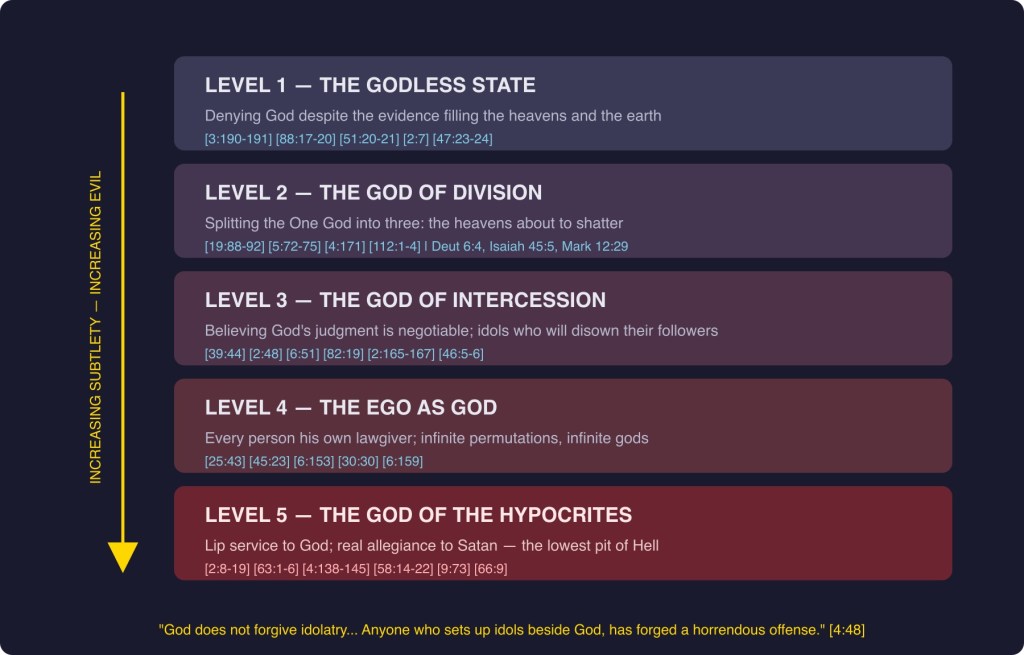
Stand back and look at the descent as a whole. Level one denies God and enthrones chance. Level two divides God and enthrones a committee. Level three dilutes God’s judgment and enthrones a lobbyist. Level four displaces God’s law and enthrones the self. Level five performs God’s religion and enthrones Satan behind the performance. At every level the move is the same move — a rival lifted onto ground that belongs to God alone — and at every level the disguise grows better. The statue was honest. The testimony of faith, in the hypocrite’s mouth, is the last and most perfect mask shirk ever devised. This is why God reserves His most violent imagery for the divider, His most detailed exposure for the hypocrite, and His single unforgivable category for the whole spectrum: “Anyone who idolizes any idol beside God has strayed far astray” [4:116].
But the descent has an ascent, and God built it into the human being before birth: “Therefore, you shall devote yourself to the religion of strict monotheism. Such is the natural instinct placed into the people by God. Such creation of God will never change” [30:30]. The way up is the unwinding of every level: affirm the God whose signs fill the heavens and the self; refuse every division of Him; accept that His judgment on the Last Day is absolute and unlobbied; kill the ego that legislates in His place; and let your inner allegiance match your outer testimony so completely that there is no hidden hand left to expose. Then the shortest chapter in the Quran stops being a creed you recite and becomes a description of your life: “Proclaim, ‘He is the One and only God. The Absolute God. Never did He beget. Nor was He begotten. None equals Him’” [112:1-4]. One God, no partners, no intercessors, no ego, no mask — this is not merely the absence of shirk. It is the whole reason we exist.



Leave a comment