Part One: Everything Has Become a Drug
Something is winning against you right now. You already know what it is. You did not need me to name it. You named it yourself in the third paragraph of your own thoughts this morning.
This is not a sermon about other people’s weakness. It is about the machinery inside you that makes the thing you hate doing feel, in the moment, like the only reasonable option in the world. That machinery has now been mapped. What the laboratory found is what the Quran already told you, and it is better news than you think.
Cheap, Strong, and Everywhere
The list of things that can capture a human being is no longer a short list of substances. Dr Anna Lembke, who runs the addiction medicine clinic at Stanford, makes the point plainly in Dopamine Nation (2021): the category now includes food engineered past the point of resistance, screens, pornography, shopping, gambling, games, work, and the daily hit of being furious at strangers.
Something changed, and it was not human nature. It was supply. What would have cost your grandfather a journey now costs you the distance from your hand to your pocket. We are not weaker than the people before us. We are drowning in a flood they never had to swim.
[5:91] “The devil wants to provoke animosity and hatred among you through intoxicants and gambling, and to distract you from remembering God, and from observing the Contact Prayers (Salat). Will you then refrain?”
Read what that verse does. It does not simply label these things bad. It names the harm mechanism: distraction from remembering God. That is not a moral flourish but a description of what capture does to attention. Whatever owns your attention owns you, and the verse identifies the theft before it identifies the thief.
And notice the honesty of [2:219], which concedes there is real benefit in these things, then delivers its verdict: the sin outweighs it. That is a judgement on the balance, not a denial that anything felt good. Scripture never insults you by pretending the hook had no bait. We traced one modern version in Day Trading: The Modern Face of Gambling — the same near-miss, the same rush, wearing a spreadsheet.

The Seesaw
Picture a balance beam inside you. Pleasure on one side, pain on the other. It has one obsession: to sit level. Tip it hard toward pleasure and your body does not simply enjoy it. It fights back, piling weight on the pain side to force the beam level again.
Here is the part that ruins everything. It does not stop at level. It overshoots into deficit — and that deficit has a name you know in your body. It is the flat, itchy, wanting feeling twenty minutes after the thing was supposed to have satisfied you.
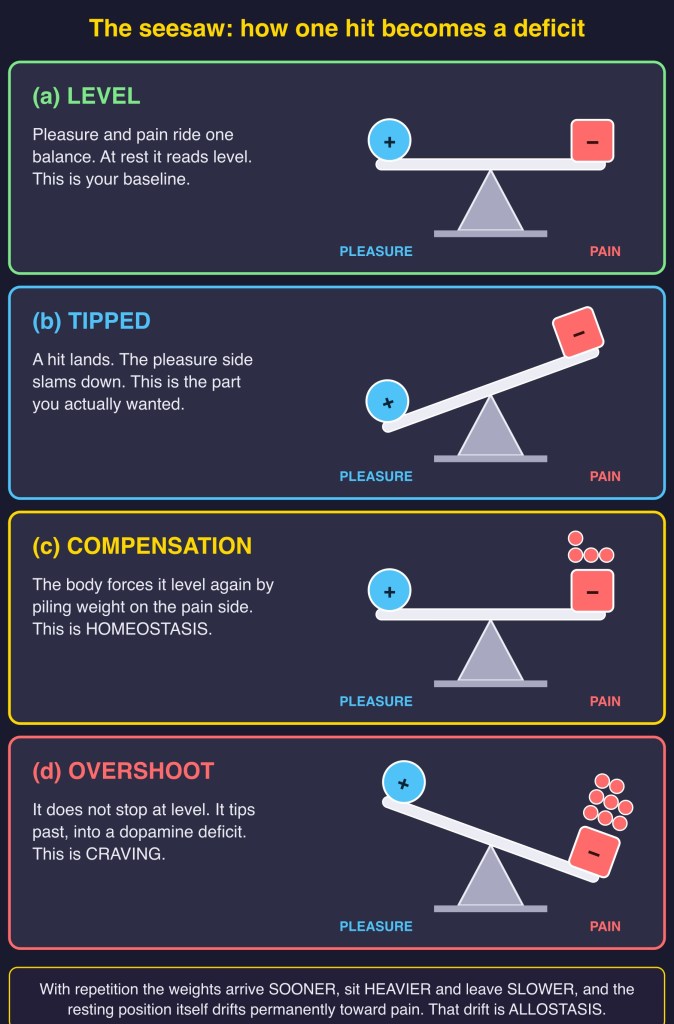
This is not a new idea, and it matters to say so. It was formalised in 1974 by Richard Solomon and John Corbit as opponent-process theory (Psychological Review 81(2), 119-145). Every pleasurable stimulus provokes an opposing after-reaction; in Solomon’s later restatement, repetition makes it stronger, quicker to start and slower to fade (American Psychologist 35(8), 691-712, 1980). The seesaw pictures a fifty-year-old finding, not a metaphor invented to sell a book.
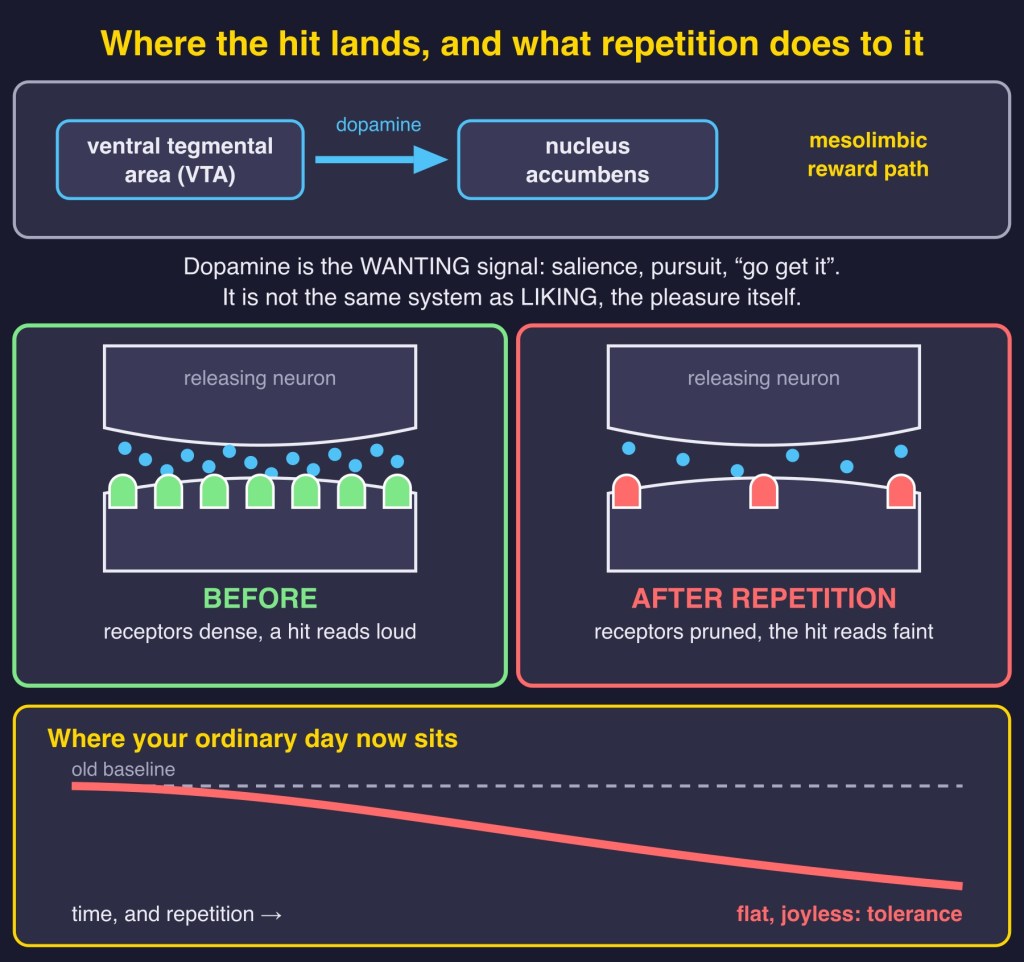
Underneath it is dopamine, released from the ventral tegmental area into the nucleus accumbens. Dopamine is not the pleasure itself. Kent Berridge and Terry Robinson separated wanting from liking: dopamine is the wanting signal, the “go get it” (American Psychologist 71(8), 670-679, 2016). Which is why you can end up desperately chasing something you no longer enjoy: the wanting can sharpen even as the liking fades. Everyone losing to a habit knows this and has never had a name for it.
Then the equipment itself changes. Nora Volkow’s brain imaging found reduced availability of dopamine D2 receptors in the striatum — a result since confirmed across thirty-one studies for stimulants and alcohol, though not for opioids, nicotine or cannabis (JAMA Psychiatry 74(5), 511-519, 2017). Be careful how far you push it: some of that reduction is a vulnerability people already carried rather than damage the drug did. But the direction holds. Turn the volume up long enough and the ear turns its own sensitivity down — and the receptors the drug shouted at are the ones your children and your food and your morning were speaking to.
George Koob and Michel Le Moal proposed the deeper problem: the set point itself moves. Not homeostasis but allostasis — stability bought at a worse resting position (Science 278, 52-58, 1997). It is a model rather than a measured quantity, but it names what people describe. The floor you stand on quietly sinks.
So understand what withdrawal actually is. Take the thing away and the opposing weight is left sitting there with nothing to cancel it. Craving, anxiety, irritability, sleeplessness, joylessness — that is not an absence. Withdrawal is not the lack of pleasure. It is the presence of pain. You are not weak for finding it unbearable. It is built to be unbearable.
Four Weeks, and the Lie of the Weekend Reset
Lembke’s clinical starting point is roughly four weeks away from the specific thing, long enough for the balance to level. Be warned: most people feel worse before they feel better, and only turn the corner somewhere after ten days. People quit at exactly that point, decide it failed, and conclude they are broken. They are not broken. They are standing in the overshoot.
And let us be honest about the internet version. The popular “dopamine detox” borrows the vocabulary of clinical abstinence without its content. You cannot detox from dopamine; you need it to move, to want, to get out of a chair. The fad itself has no direct evidence behind it (Harvard Health); what works is the older idea underneath — removing one specific thing, for long enough. The pop version promises a weekend. The real thing asks a month, about one named thing, not a vague fast from fun.
With Pain There Is Gain
Now the hinge. If tipping the beam toward pleasure lands you in pain, what happens if you press deliberately on the pain side first?
The beam swings the other way, and the compensation lands on the pleasure side. Because it is a compensation rather than a hit, it is slower to arrive and far slower to leave.
[94:5] “With pain there is gain.” [94:6] “Indeed, with pain there is gain.”
That is not a motivational slogan. Read it as what it is: a description of a mechanism. God stated the rule, and the laboratory arrived fourteen centuries later to measure it.
![Diagram: Instant pleasure hit leading to deep deficit vs pressing pain first leading to sustained gain [94:5-6]](https://quranonlystudies.com/wp-content/uploads/2026/08/with_pain_there_is_gain_04_inverted_protocol_diagram.jpg?w=1024)
Cold is the cleanest demonstration. When ten young men sat for an hour in fourteen-degree water, circulating noradrenaline rose to roughly five times baseline, dopamine rose too, and both were still up an hour after they got out (Šrámek et al., European Journal of Applied Physiology 81, 436-442, 2000). Keep it in proportion: ten men, a dose far beyond a cold shower, and catecholamines measured in blood rather than dopamine measured in the brain. But the shape is the point — no spike, no crash, a slow rise that stays. Exercise is the better-evidenced cousin, lifting mood across ninety-seven reviews with effects comparable to therapy (British Journal of Sports Medicine 57(18), 1203-1209, 2023). Fasting belongs on the same list.
And notice that the verse is said twice. Once, then again with emphasis. Why twice? Because the gain sits on the far side of the pain, which means that at the moment you most need to believe it, you will have no evidence for it yet. You are standing in the cold part. So you are told twice.

Part Two: The Guardrail Is the Mercy
Part One described a trap. Now the way out — and it begins by holding together two things people are always trying to separate.
[7:33] Say, “My Lord prohibits only evil deeds, be they obvious or hidden, and sins, and unjustifiable aggression, and to set up beside God powerless idols, and to say about God what you do not know.”
There is a line, and it is real. And God is the Most Merciful. People treat those as in tension, as if mercy were a softening of the rule. It is not. The prohibition is the mercy. The guardrail is not there to spoil the drive. It is there because of the drop.
Three Gates God Already Built
Lembke’s most useful clinical idea is self-binding: you place a literal barrier between yourself and the thing, and — this is the whole point — you place it while you are clear-headed. Because willpower is precisely the faculty that will not be available in the moment of craving. You are not building the barrier for the person you are now. You are building it for the person you become at eleven at night.
She sorts these into three kinds: physical, chronological, and categorical. All three are already legislated for you.
![Diagram: Three self-binding gates (Physical [7:201], Chronological [29:45], Categorical [7:33])](https://quranonlystudies.com/wp-content/uploads/2026/08/with_pain_there_is_gain_06_self_binding_diagram.jpg?w=1024)
Chronological. Time limits, windows, fixed stops. Look at what the Contact Prayers structurally are: five hard interruptions a day, scheduled by someone other than you, arriving whether or not the craving agrees.
[29:45] “…observe the Contact Prayers (Salat), for the Contact Prayers prohibit evil and vice. But the remembrance of God (through Salat) is the most important objective.”
The verse states the function outright. They prohibit. A day cut into five pieces is a day in which no slide runs uninterrupted for long.
Categorical. The bright line. Notice that [7:33] prohibits by class, not by dosage. It offers you no safe quantity to negotiate with. Anyone who has bargained with themselves knows why that matters: “just a little” is not a limit, it is an opening move. Bright lines hold because they take the negotiation off the table.
Physical. Distance. Get it out of the house, off the device, out of reach. And the Quran adds a gate earlier than the hand — [7:201] describes the righteous as those who, when the devil approaches with an idea, remember, and become seers. The interception happens at the idea, before the behaviour. By the time it is a behaviour you are already arguing from the weak position.
Fasting, then, is no odd survival from an older world. It is prescribed, scheduled, communal pressing on the pain side — self-binding and deliberate discomfort in one obligation, handed down before anyone had a word for either.
The Blaming Soul
There is an instrument inside you for this, and God takes an oath by it.
[75:2] “And I swear by the blaming soul.”
Sit with that. God swears by the part of you that reproaches you. Set it beside [12:53], where the self is called an advocate of vice except for those who have received mercy from the Lord. Two selves: one arguing for the thing, one filing the complaint. And it is the complaining one God swears by.
So get guilt the right way round. That sting is not a malfunction and not a character flaw. It is a working alarm, and alarms are meant to be unpleasant or nobody would move. The man who feels nothing afterwards is not healthier than you. He is the one with the broken instrument.
But an alarm can be hijacked, and Rashad Khalifa named exactly how. Satan, he said, “uses reverse psychology. He tells you, you’re bad, you’re bad” (at 21:26). The counter he gives is not to feel less, but to believe God, and to refuse to let Satan “give you a guilt complex over an old sin or a new sin.”
See the switch. The blaming soul says go back. Satan takes the same signal and rewrites it as do not bother, look at you. One is a direction. The other is a verdict, and it is a forgery. Your guilt is evidence the door is still open, because a man who had stopped caring would not be in pain about it.
Repent One Hundred Per Cent, Knowing You May Fall
[39:53] Proclaim: “O My servants who exceeded the limits, never despair of God’s mercy. For God forgives all sins. He is the Forgiver, Most Merciful.”
Every word is chosen. Not “some sins”. Not “the small ones”. And it is addressed specifically to those who went past the limit — which is to say, it is addressed to you, on purpose.
Now the hardest instruction, and the most honest. You repent one hundred per cent. Total, unqualified, no hedging. You do not say “I’ll try.” You say never again, and you mean it entirely. And then Rashad Khalifa finishes the sentence with a realism the pulpit usually refuses:
“You pledge that you’ll never do it again, but being a human, you’ll probably do it again a few times until you realize that the price is too high. The pinch is too painful. Or the price is too high.” (at 22:36)
Hold both halves. The pledge is total. The expectation is realistic. Those do not contradict each other — a hedged pledge would simply be a smaller permission slip. And the falling is priced. The price is the teacher. That is 94:5-6 again, arriving as your own biography.
This is also, precisely, the clinical picture. Relapse is the expected shape of recovery, not proof it failed. The approach that plans for a slip and gets you back the same day does better than the one treating a single lapse as collapse — because it is the despair after the slip, far more than the slip, that ends people.
Which is why the word matters. Rashad pointed out that the term in [2:222] is not those who repent once but tawwabin, those who repent continuously:
“You have to repent continuously. You have to make it a habit, to the extent that when you toss around in your bed, and you are half asleep, you must train yourself to repent.” (at 13:21)
Trained so deep you do it half-conscious, turning over in bed. And he was clear that you clean one habit at a time, because you will shed one and find yourself in another. Look at what that is: not one heroic act of will, but a small practice repeated daily until it runs unsupervised. It is the same answer the clinic reaches: recovery is a daily reflex, not a single decision.
So hold the two ends together, because that is the whole sermon. The line is real: God prohibits, and He prohibits because the drop is real. And the door back is never shut, for anyone, at any point, however many times you have already come through it. The boundary and the mercy are the same act of care. If you are losing tonight, you have not been disqualified. You have been given a working alarm, a scheduled interruption five times a day, a bright line, and an open door. Use them tonight, and not after one more.


Leave a Reply