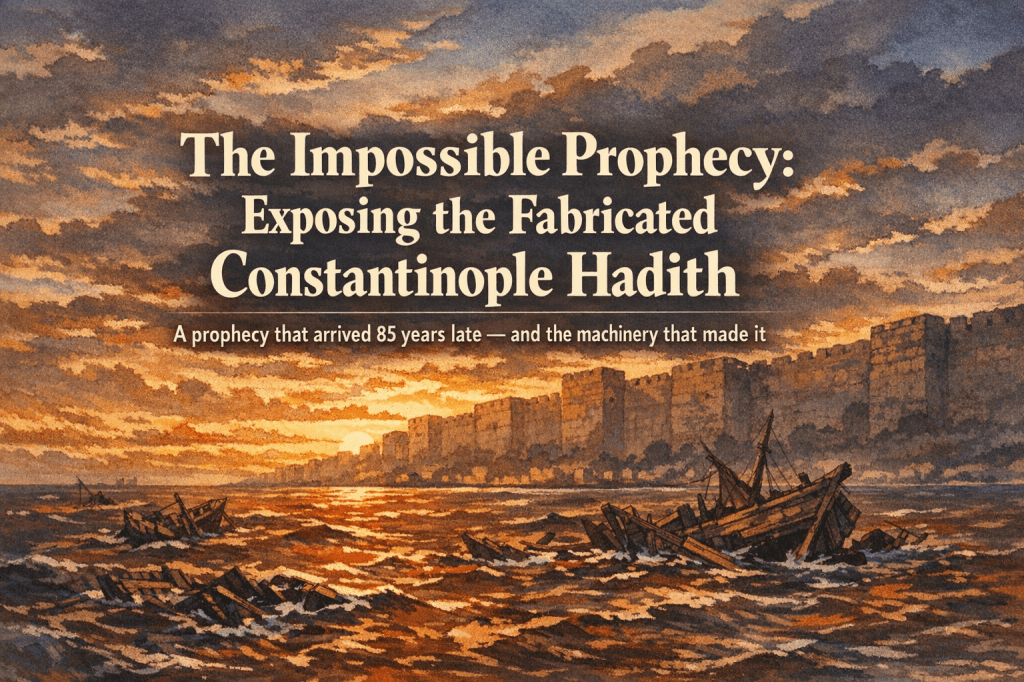
Introduction: A Prophecy That Arrived Eighty-Five Years Late
There is a saying that every schoolchild in the Muslim world learns, that preachers deploy on anniversaries, and that Ottoman court historians carved into the foundation of an empire’s self-image: that the Prophet Muhammad foretold the conquest of Constantinople, and blessed in advance the commander and the army who would take it. When Sultan Mehmet II breached the Theodosian walls on the twenty-ninth of May, 1453, it was announced not as a military victory but as the closing of a prophetic circle. The saying has done more political work over more centuries than almost any other line attributed to the Prophet.
This article asks a narrow, checkable question about it: where does the report actually come from, and who carried it? Not whether it feels true, not whether its fulfilment is emotionally satisfying, but what the chain of transmission looks like when it is laid out narrator by narrator and each name is checked against the biographical literature that the hadith tradition built for exactly this purpose. That question turns out to have a clear answer, and the answer does not require a single premise that traditional scholarship would reject. Every adverse verdict quoted below was issued by the tradition’s own critics, in their own technical vocabulary, about their own material.
The finding is this. There is not one Constantinople report but two, circulating in different words through different chains, routinely quoted as though they were a single well-attested tradition. One of them depends on a man the biographers could not identify. The other depends on a man they identified all too well, and named as a forger. Neither reaches the Prophet. And the moment the first of them steps into recorded history is not a mosque or a study circle in Medina, but a military staging ground in the year 717, where a general about to besiege Constantinople sent for a narrator and asked him, specifically, whether there was a saying about conquering Constantinople.
What follows is a forensic account of that report, an honest correction of errors this site itself published in an earlier version of this article, and then a wider survey — because Constantinople is not an isolated case. Once you know the signature of a prophecy manufactured after the fact, you begin to see it repeatedly, and always in the same place: wherever a ruler, a rebel or a preacher needed the future to have been promised to them.
Part 1: Two Reports, Quoted as One
The First Thing Nobody Mentions
Almost every popular treatment of this subject begins by quoting “the hadith,” as though there were one. There are at least two distinct traditions in circulation, and conflating them is the single most common error in the entire discussion — an error committed by defenders and critics alike, and one this site committed in the first version of this article.
The first is the famous one, the one the Ottomans used. It is recorded in the Musnad of Ahmad ibn Hanbal at number 18957, in al-Hakim’s al-Mustadrak at 8300, and — a detail we will return to, because it matters enormously — by al-Bukhari, but in his book of narrator biographies, al-Tarikh al-Kabir (2:81) and al-Tarikh al-Saghir (1:306), and not in his Sahih.
“Constantinople will surely be conquered. What a wonderful leader will its leader be, and what a wonderful army will that army be.”
The second is a different report in different words, recorded by al-Tabarani in al-Mu’jam al-Kabir at number 14157 (with variants at 14138 and 14158), by Ibn Majah at 4094, and by al-Hakim at 8448. It is addressed to Ali ibn Abi Talib and speaks of fighting “the yellow people” and of the city falling to religious proclamation rather than to arms. It is a different scene, a different addressee, and a completely different chain of narrators.
These two are constantly cited together, and the effect of citing them together is to create an impression of corroboration — as though multiple independent witnesses were converging on one fact. That impression is the whole rhetorical value of the pairing, and it is false. As we will see, each chain fails on its own, and separately. Two collapsed chains do not brace one another. They are simply two collapses.
Part 2: Version A — The Chain That Rests on a Man Nobody Can Name
Following the Famous Version Backwards
Set out in order, the chain behind the famous version runs from the collector backwards: Zayd ibn al-Hubab al-‘Ukli, who died in 203 AH; from al-Walid ibn al-Mughirah al-Ma’afiri, an Egyptian transmitter about whom the biographical literature has very little to say; from a man recorded as ‘Abdullah ibn Bishr — though the sources also write his name as ‘Ubaydullah, and give his tribal attribution sometimes as al-Khath’ami and sometimes as al-Ghanawi; from that man’s father; and from the father, the Prophet.
The whole weight of the report rests on Ibn Bishr, and the hadith tradition’s own verdict on him is a single devastating word: majhul. Unknown. It is not a term of abuse; it is a technical classification meaning that the biographers cannot establish who this person was, cannot document a body of students who transmitted from him, and therefore cannot vouch for either his memory or his honesty. A narrator who is majhul is a hole in the chain wearing a name.
Notice the instability of that name. Is he ‘Abdullah or ‘Ubaydullah? Is he of Khath’am or of Ghanawi? These are not trivial spelling variants; they are the difference between two distinct men, and the fact that the tradition cannot settle which one carried the report is itself evidence of how thin the transmission was. A saying that a community had genuinely preserved from its Prophet does not arrive attached to a narrator whose name the community cannot fix.
Nor is this a modern or a sectarian complaint. The chain has been graded weak by the most respected hadith specialists of the last century — by Muhammad Nasir al-Din al-Albani, by Shu’ayb al-Arna’ut in his critical edition of the Musnad (31:287, no. 18957), and by Ahmad Shakir. These are not Quran-alone writers. They are the men to whom traditional Islam entrusted the authentication of its own literature, and on this report they returned the same answer.
The Silence of al-Bukhari
There is a detail here that deserves far more attention than it receives. Al-Bukhari knew this report. He wrote it down. But he wrote it down in al-Tarikh al-Kabir, his encyclopaedia of narrators — a working reference in which he catalogued transmitters, including the doubtful ones — and he did not place it in the Sahih, the collection into which he sifted, by his own account, a small fraction of the material he had gathered.
Consider what that means. The most exacting collector in the tradition had in his hands a report that a Muslim army would one day take the capital of the Roman world, together with a blessing on the commander who would do it. It is difficult to imagine a more spectacular item. He left it out. So did Muslim ibn al-Hajjaj. The two collections that the Sunni tradition holds to be the most rigorous ever assembled both declined to carry the most famous prophecy in Islamic history — and the modern preacher who recites it rarely mentions that the men best placed to authenticate it chose not to.
Part 3: Version B — The Chain That Rests on a Man Everybody Named
A Forger with a Documented Method
The second report has the opposite problem. Where Version A depends on a man nobody could identify, Version B depends on a man the biographers identified in detail and then condemned without dissent.
Its chain runs: Muhammad ibn ‘Abdus ibn Kamil al-Sarraj; from Muhammad ibn Ishaq al-Musayyibi; from ‘Abdullah ibn Nafi’; from Kathir ibn ‘Abdullah ibn ‘Amr ibn ‘Awf al-Muzani; from his father; from his grandfather. It is respectable for three links and then it reaches Kathir, and there it dies.
The verdicts on Kathir are among the harshest the tradition ever recorded against anyone. Al-Shafi’i, the jurist whose name an entire school of law carries, called him “a pillar from among the pillars of lying” — not merely a liar, but load-bearing architecture in the edifice of falsehood. Abu Dawud called him “one of the liars”. Ahmad ibn Hanbal classed his material as munkar al-hadith, rejected, and discarded him. Al-Nasa’i and al-Daraqutni classified him matruk — abandoned, the technical grade reserved for narrators whose material is not to be used at all.
Ibn Hibban supplies the detail that turns a bad reputation into a matched fingerprint. He records that Kathir narrated “from his father, from his grandfather, a fabricated manuscript” — that is, Kathir’s characteristic forgery technique was to invent material and route it through precisely the father-to-grandfather line that gave him a genuine companion at the far end. His grandfather, ‘Amr ibn ‘Awf al-Muzani, really was a companion of the Prophet. That is what made the method work: an authentic name at the top of the chain, and a fabricator supplying everything that was attributed to it. And the chain of Version B runs from Kathir, from his father, from his grandfather. It is his signature move, on this very report.
Part 4: Correcting Our Own Record
Three Errors, Named Plainly
An earlier version of this article, published on this site, made three claims that further research does not support. We are correcting them here in the open, because a case built against fabrication forfeits everything if it is itself careless. If our argument cannot survive its own standard of scrutiny, it does not deserve to survive at all.
First: we said that all versions of the Constantinople report trace back to Kathir ibn ‘Abdullah al-Muzani. They do not. Kathir stands in the chain of Version B, and the verdicts against him are exactly as severe as we reported. But he is nowhere in the chain of Version A — the famous version, the one the Ottomans used, the one recorded in the Musnad of Ahmad. That chain fails for an entirely different reason: its key narrator is unknown. Collapsing the two into one accusation was a conflation, and a defender of the report could have dismantled our whole article by pointing at it. The corrected argument is stronger, not weaker: there are two chains, and each one fails independently.
Second: we named “al-Walid ibn Muslim” in the chain. That was wrong. Al-Walid ibn Muslim al-Umawi is a well-known Damascene transmitter criticised for tadlis, the concealment of sources — a genuinely suspect figure, but not this one. The narrator in this chain is al-Walid ibn al-Mughirah al-Ma’afiri, an Egyptian, and a different man entirely. Borrowing another narrator’s bad reputation to darken a chain he never stood in is precisely the sort of sloppiness we object to in others.
Third: we said the conquest came 857 years after the Prophet’s death. It did not. The figure 857 is a calendar year, not an elapsed span: 1453 CE falls within 857 AH, and the two numbers have been quietly swapped by many writers, ourselves included. The Prophet died in 632 CE; Constantinople fell in 1453 CE; the actual gap is 821 solar years. The real number is still overwhelming. There was never any need to inflate it, and inflating it by accident hands an opponent a free rebuttal.
We note these corrections not as a ritual of humility but as a matter of method. The entire case against manufactured prophecy is that people repeated an appealing claim without checking it, and that the repetition eventually felt like evidence. That failure mode has no religious affiliation. It is available to anyone, including us, and the only defence against it is to go back to the sources and be willing to publish what you find.
[17:36] “You shall not accept any information, unless you verify it for yourself. I have given you the hearing, the eyesight, and the brain, and you are responsible for using them.”
The command is unqualified. It does not exempt information that flatters us, or information that arrives inside our own argument. A verse that obliges a person to check a claim before accepting it obliges them equally to check a claim before publishing it.
Part 5: The Room Where It Was Requested
A General Sends for a Narrator, 717 CE
Ibn ‘Asakir, in his vast History of Damascus, preserves the scene in which this report first steps into daylight. Maslama ibn ‘Abd al-Malik — brother of the caliph Sulayman, and the commander appointed to take Constantinople — sends for Ibn Bishr and asks him about a saying concerning the conquest of Constantinople. The narrator supplies it. The expedition proceeds.
Read that sequence slowly, because everything turns on its order. The campaign was already decided. The commander was already appointed. What was missing was not intelligence about the walls or the Bosphorus, but a divine warrant — and the commander went looking for one, by name, on demand. The report does not arrive from the past and inspire a campaign. A campaign reaches back and produces a report.
This is the ordinary economics of religious authority under empire, and it is not unique to any one community. An army needs men to walk toward a fortified city and die there. Wages are insufficient motivation for that. A promise that God has already written the victory, and has already blessed the commander who will win it, is worth more than siege engines — and unlike siege engines, it can be manufactured overnight by one cooperative man with a reputation for knowing old sayings.
Note also what the request implies about the state of the tradition in 717. If this saying had been widely known — if it had been circulating among the companions and their students for eighty-five years as the Prophet’s own promise about the great enemy capital — Maslama would have had no need to send for a specialist to ask whether such a thing existed. You do not commission a search for a famous quotation. The very fact of the enquiry testifies that, at the moment of enquiry, the saying was not established.
Part 6: The Campaign It Was Made For Was Annihilated
Thirteen Months, and Five Ships Home
Here the story turns from suspicious to self-refuting, and it is remarkable how rarely this part is told. The siege for which the prophecy was produced was one of the worst military catastrophes of the early Islamic centuries.
Maslama crossed into Thrace in the summer of 717 with an army that al-Mas’udi numbers at 120,000 and a fleet that the Byzantine chronicler Theophanes puts at 1,800 ships, supported by a train of twelve thousand men, six thousand camels and six thousand donkeys. The Byzantines destroyed the fleet with Greek fire. A brutal winter brought famine and disease to the encamped army. Bulgar forces under Tervel fell on the besiegers and, by Theophanes’ account, killed some twenty-two thousand men. On the fifteenth of August, 718, after thirteen months, the Arabs lifted the siege and withdrew.
The retreat completed the disaster. Storms in the Sea of Marmara and a fall of volcanic ash from the eruption at Thera wrecked what remained of the fleet. Theophanes records that of that vast armada, five vessels reached Syria. Muslim sources put the total dead at 150,000; the historian John Haldon observes that the figure, “while certainly inflated, is nevertheless indicative of the enormity of the disaster in medieval eyes.”
The consequences outlived the men. Bernard Lewis judged the damage to Umayyad power “grave”; the caliph Umar II subsequently pulled Arab garrisons back from the Byzantine frontier, retaining almost nothing of what had been held, and the strategic ambition to take the city was abandoned. Later raids became ritual gestures rather than campaigns of conquest.
So the report was requested to sanctify a campaign; the campaign was destroyed; and the report survived the campaign. That is the crucial observation. A genuine prophecy that failed on first application would have been abandoned as false. This one was not tested and confirmed — it was tested and falsified, and then kept anyway, floating free of the event it had been made for, waiting seven centuries until a different army under a different dynasty finally took the city and could be retrofitted into it.
Part 7: The Chain, Laid Out
Both Versions, Narrator by Narrator
The diagram below sets out both chains side by side, with the grading attached to each narrator and the source of that grading named. It is worth studying rather than glancing at, because the shape of the thing is the argument: two lines that look respectable at the top, where the famous collectors sit, and that both terminate in a break well before they reach the Prophet.
The colour coding follows the tradition’s own categories. Green marks a collector accepted as reliable — and the point to hold on to is that the collector is never the problem. Al-Tabarani and Ahmad ibn Hanbal were scrupulous men doing exactly what they said they were doing: recording what reached them, chain and all, so that later readers could judge it. The failure is not in the recording. It is in what was handed to them, and by whom.
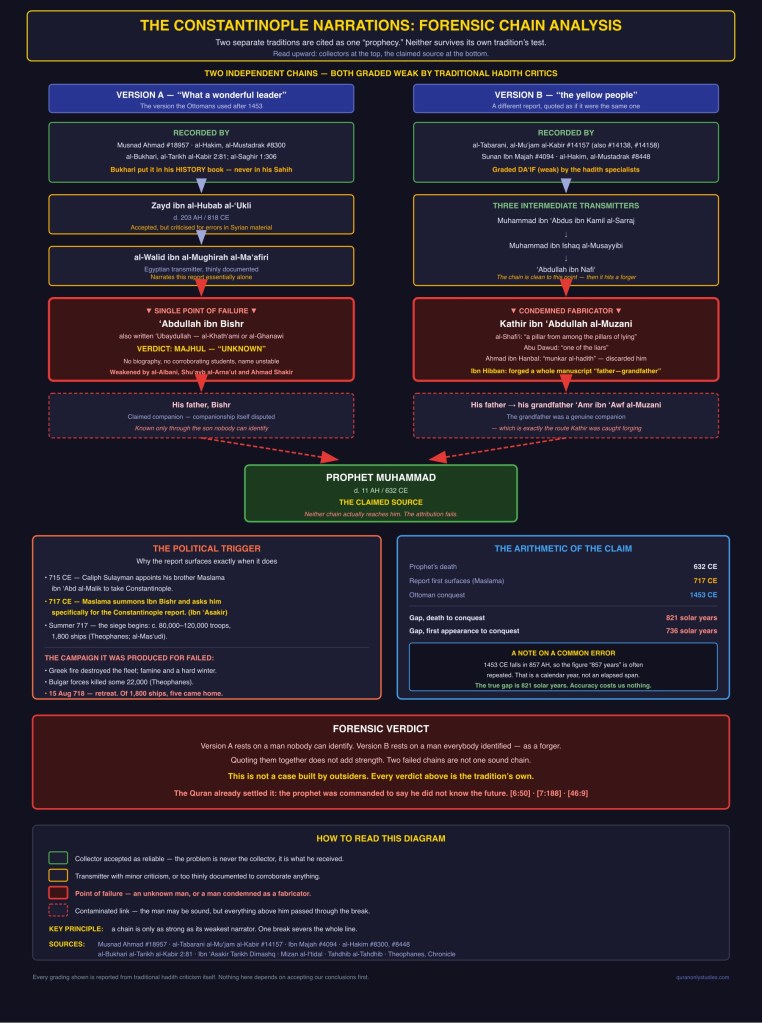
One structural principle governs the whole picture, and it is the tradition’s own: a chain is only as strong as its weakest narrator. This is not a hostile rule invented to embarrass hadith; it is the founding axiom of the science of transmission. Authenticity does not average out across a chain. A single broken link severs the line, and everything above the break is unsupported no matter how distinguished the men standing on it.
Part 8: What the Quran Says About the Prophet and the Future
A Command, Not a Suggestion
Everything above is a historical argument, and it stands on historical grounds. But for anyone who takes the Quran as the criterion, the question was settled before the chain analysis began — because God did not leave the matter of the Prophet’s knowledge of the future to inference. He issued a direct instruction about what the Prophet was to say.
[6:50] “Say, ‘I do not say to you that I possess the treasures of God. Nor do I know the future. Nor do I say to you that I am an angel. I simply follow what is revealed to me.’ Say, ‘Is the blind the same as the seer? Do you not reflect?’”
The form of this verse is important. It is not a description of the Prophet offered to third parties; it is a script, an imperative — Say. God commands His messenger to stand before people and disclaim knowledge of the future in plain words. A report that shows him volunteering the military fate of a foreign capital seven centuries ahead does not merely sit awkwardly beside this verse. It shows him doing the opposite of what he was ordered to do.
[7:188] “Say, ‘I have no power to benefit myself, or harm myself. Only what God wills happens to me. If I knew the future, I would have increased my wealth, and no harm would have afflicted me. I am no more than a warner, and a bearer of good news for those who believe.’”
This verse does not simply assert the point; it argues it, and the argument is empirical. If the Prophet had access to the future, his own life would show it — he would have avoided harm and secured advantage. His life shows the opposite: hunger, bereavement, the reverse at Uhud, exile, plots against him. The verse invites the reader to reason from the visible facts of his biography to the limits of his knowledge. Anyone who accepts that reasoning cannot then accept that he was privately briefing his companions on the eighth-century Bosphorus.
[46:9] “Say, ‘I am not different from other messengers. I have no idea what will happen to me or to you. I only follow what is revealed to me. I am no more than a profound warner.’”
“I have no idea what will happen to me or to you.” It is difficult to construct a sentence that would exclude the Constantinople report more completely. And it is worth noticing that all three of these verses are commands to speak — God is not merely limiting the Prophet’s knowledge, He is requiring him to announce that limit publicly, so that no follower could ever be in doubt about it. The hadith literature then supplies exactly the doubt the Quran was written to prevent.
[72:26-27] “He is the Knower of the future; He does not reveal the future to anyone. Only to a messenger that He chooses, does He reveal from the past and the future, specific news.”
This is the verse defenders reach for, and it repays careful reading, because it does not say what it is used to say. It establishes a strict default — God does not disclose the future to anyone — and then names a single narrow exception: revelation, given to a chosen messenger, as revelation. The channel is specified. What God discloses of the future, He discloses as scripture. The verse authorises the Quran; it does not authorise an anonymous man in 717 producing military forecasts on request. If God had meant to promise Constantinople, the promise would be in the book He protected, not in a chain He did not.
Part 9: What a Real Prophecy Looks Like
The Roman Prophecy, and Why It Is Different in Kind
The Quran does contain a prediction, and setting it beside the Constantinople report is the fastest way to see what the latter is missing.
[30:2-4] “Certainly, the Romans will be defeated. In the nearest land. After their defeat, they will rise again and win. Within several years. Such is God’s decision, both in the first prophecy, and the second. On that day, the believers shall rejoice”
Four features distinguish this from the Constantinople material, and every one of them is a feature the fabricated report lacks.
It was published in advance, to a hostile audience. These verses were recited openly in Mecca while the Muslims were a persecuted minority, to opponents who had every motive to remember the claim and mock its failure. A prediction issued to people who are waiting for you to be wrong is a prediction with a cost attached. The Constantinople report was issued to an army that wanted to hear it.
It carried a deadline. “Within several years” is a falsifiable window. It could have expired. The Constantinople report specifies no date at all, which is precisely why it could survive the catastrophe of 718 and be re-aimed at 1453 — and, had 1453 never happened, could have been re-aimed at any century thereafter. An open-ended prediction is not a prediction; it is a standing option.
It was resolved within living memory. The people who heard it saw the outcome. Verification did not depend on a chain of transmitters, because the audience and the witnesses were the same people. The Constantinople report requires you to trust a sequence of men across eight centuries, one of whom is unidentifiable and another of whom is a documented forger.
It sits inside the preserved text. This is the structural point. The Quran is a fixed, publicly recited, memorised document; nobody could insert a prophecy into it after the fact, which is exactly why no politically convenient prophecy ever appeared in it. The hadith corpus is an open oral archive into which material could be added for centuries by anyone with a reputation and a motive — which is exactly why the politically convenient prophecies are all found there. The forgeries are not distributed randomly. They accumulate wherever forgery was possible.
Part 10: The Pattern — Constantinople Is Not an Isolated Case
The Same Signature, Again and Again
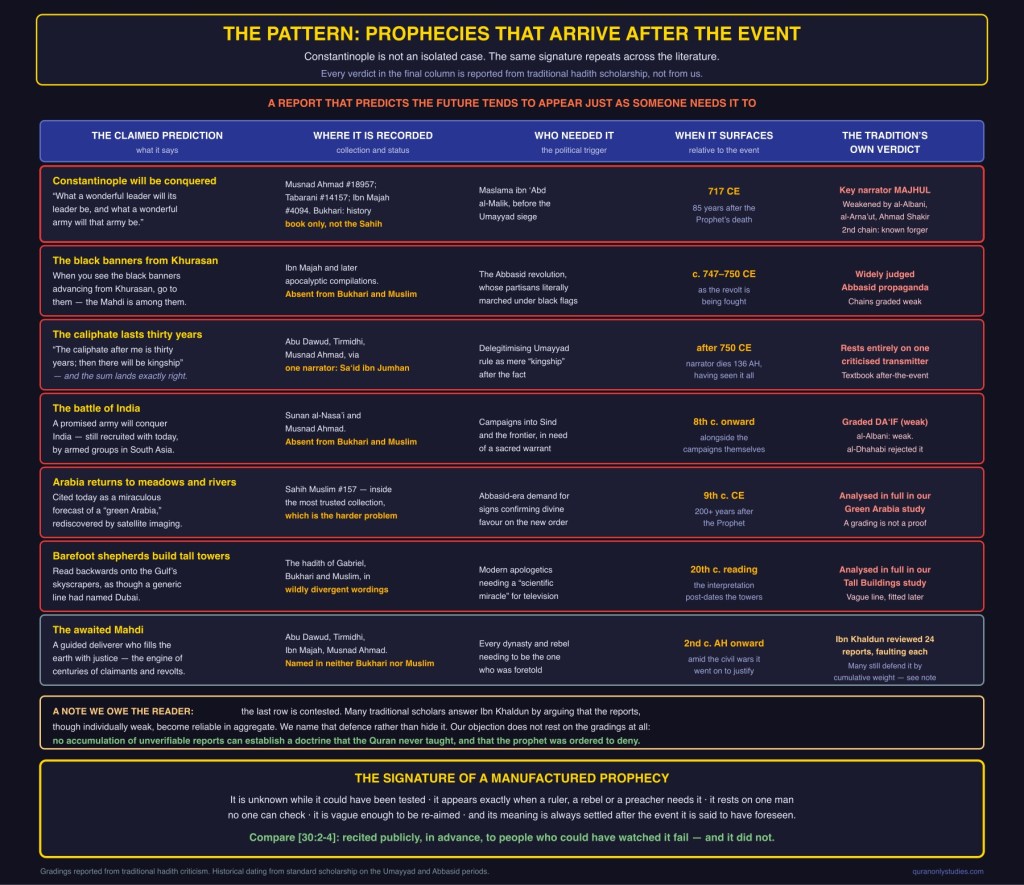
If the Constantinople report were the only one of its kind, it could be written off as an anomaly. It is not. Once the signature is visible — a prediction unknown while it could have been tested, surfacing precisely when someone needed it, resting on a narrow chain, and vague enough to be re-aimed — the same shape appears across the literature, and it appears at the political flashpoints.
The black banners from Khurasan. A saying instructs believers that when they see black banners advancing from Khurasan they should go to them, for the Mahdi is among them. The Abbasid revolutionaries who overthrew the Umayyads between roughly 747 and 750 marched under black banners, out of Khurasan; their partisans were literally known as the bearers of black. Hadith scholars have generally treated these traditions as Abbasid propaganda rather than prophecy, and the chains are graded weak. They are absent from both Sahih collections. The prediction and the movement it predicts are contemporaries.
The thirty-year caliphate. A saying holds that “the caliphate after me is thirty years; then there will be kingship” — and the arithmetic lands with suspicious neatness on the four Rightly Guided caliphs, converting everything Umayyad that followed into mere monarchy. The report rests overwhelmingly on a single transmitter, Sa’id ibn Jumhan, who died in 136 AH, having lived through the very transition the saying describes. A man who has watched a century of history and then reports a prediction that matches it exactly is the classic profile of after-the-event prophecy.
The battle of India. Reports promising a blessed conquest of India appear in Sunan al-Nasa’i and the Musnad of Ahmad, and are absent from Bukhari and Muslim. Al-Albani graded the material weak; al-Dhahabi rejected it. These reports are still used today to recruit for armed movements in South Asia, which makes the question of their authenticity considerably more than academic. A forged sentence does not stop working when the empire that commissioned it falls.
Arabia returning to meadows and rivers, cited as a miraculous forecast of a green Arabian past or future, and the barefoot shepherds competing in tall buildings, read backwards onto the skylines of the modern Gulf, are both examined at length elsewhere on this site. They belong to the same family, with one aggravating feature: they sit inside collections graded as authentic. That makes them the harder case, and it is worth stating why plainly — a grading is a judgement about a chain of men, not a demonstration that the content is true. The two questions are separate, and the first does not settle the second.
The awaited Mahdi. The deliverer who will fill the earth with justice is named in neither Bukhari nor Muslim, appearing instead in Abu Dawud, Tirmidhi, Ibn Majah and the Musnad. Ibn Khaldun examined twenty-four of these reports in his Muqaddimah and found a weakness in the transmitters of each. The doctrine has since underwritten an unbroken line of claimants and insurrections, each with a strong interest in being the man who was foretold.
A Qualification We Owe the Reader
The Mahdi case is contested, and we will not overstate it. Ibn Khaldun’s critique is frequently quoted as though he demolished the belief outright, and that is not accurate. Many traditional scholars answer him by arguing that although the individual reports vary in strength, their sheer number, arriving through independent chains from numerous companions, lifts the body of material collectively to reliability. That is a serious argument within the tradition’s own framework, and it deserves to be named rather than hidden.
Our objection does not depend on winning that argument, because our objection is not a grading dispute at all. It is this: no accumulation of unverifiable reports, however large, can establish a doctrine that the Quran never taught, about a future the Prophet was commanded to say he did not know. Multiplying uncertain testimony does not create certainty; it creates a large quantity of uncertain testimony. And a book that describes itself as fully detailed does not require a supplement smuggled in three centuries late.
[6:114] “Shall I seek other than God as a source of law, when He has revealed to you this book fully detailed? Those who received the scripture recognize that it has been revealed from your Lord, truthfully. You shall not harbor any doubt.”
Part 11: How the Defence Is Conducted
Selective Citation as a Method
Something instructive happens when you compare how different quarters of the tradition handle this report, because they do not handle it the same way, and the difference is not about evidence.
Popular devotional sites, asked whether the Constantinople hadith is authentic, tend to give a short answer: al-Hakim declared it authentic, and al-Dhahabi concurred. That is a true statement. It is also a curated one. It omits that al-Albani weakened the chain, that Shu’ayb al-Arna’ut weakened it in the standard critical edition of the very Musnad being cited, that Ahmad Shakir weakened it, that the pivotal narrator is classified unknown, and that al-Bukhari kept it out of his Sahih. The reader is handed the two favourable verdicts and none of the adverse ones, and comes away believing the matter is settled.
Meanwhile, technically serious traditionalist writers — including salafi authors with no sympathy whatever for the Quran-alone position — set out the criticisms openly, identify Ibn Bishr as majhul, list the scholars who weakened the chain, and conclude that the report’s authenticity is doubtful and at best questionable. They then generally continue to hold the report in some regard, which is their prerogative. But they do not conceal the file.
This matters more than any individual grading, because it tells you where the disagreement actually lives. It is not between Quran-alone readers and hadith scholars over whether this chain is weak; on that, we and the specialists broadly agree. It is between people who tell the public what the specialists found and people who do not. The Constantinople hadith survives in popular belief not because the evidence favours it but because the evidence is rarely presented.
[2:79] “Therefore, woe to those who distort the scripture with their own hands, then say, ‘This is what God has revealed,’ seeking a cheap material gain. Woe to them for such distortion, and woe to them for their illicit gains.”
Part 12: Why This Article Does Not Write the Honorific
A Small Symbol Carrying a Large Doctrine
Readers may notice that the Prophet’s name appears throughout this article without the honorific formula that conventionally follows it. That is deliberate, and since this is an article about accretions to the record, the omission belongs in the argument rather than in a footnote.
The practice rests on a particular reading of one verse, and the Final Testament renders that verse differently:
[33:56] “God and His angels help and support the prophet. O you who believe, you shall help and support him, and regard him as he should be regarded.”
The instruction is to support the prophet and to regard him as he should be regarded — that is, accurately, at his true measure. The word rendered “prophet” refers to Muhammad during his lifetime, when support was something a community could actually give him. Turning this into a perpetual verbal formula appended to his name converts an instruction about aid into a devotional reflex, and quietly inflates the man it names.
And that inflation is not incidental to our subject; it is the engine of it. A messenger who is remembered as a human being commanded to say “I have no idea what will happen to me or to you” cannot plausibly be credited with forecasting the fall of a city eight centuries out. A figure ritually exalted at every mention becomes exactly the kind of person to whom such forecasts can be attributed without anyone feeling the friction. The honorific and the fabricated prophecy grow from the same root: the steady elevation of the messenger past the station the Quran assigns him.
[3:79] “Never would a human being whom God blessed with the scripture and prophethood say to the people, ‘Idolize me beside God.’ Instead, (he would say), ‘Devote yourselves absolutely to your Lord alone,’ according to the scripture you preach and the teachings you learn.”
To regard the Prophet as he should be regarded is to describe him as God described him: a human messenger who delivered a scripture, who did not know the future, and who never asked to be commemorated at every mention of his name. Withholding the formula is not disrespect. It is the respect of accuracy — refusing to attribute to him either a prophecy he did not make or a status he did not claim.
![Modern readers checking sources, beneath the verse commanding verification [17:36]](https://quranonlystudies.com/wp-content/uploads/2026/08/the_impossible_prophecy_constantinople_06_verification_reading_room.png?w=1024)
Part 13: The Standard the Quran Sets
Verification as an Obligation
The Quran anticipated the problem this article describes, and it did so with a precision that is easy to miss because the verses are so familiar. It does not merely permit scrutiny of religious claims; it requires it, and it identifies the exact failure by which false material enters a community.
[49:6] “O you who believe, if a wicked person brings any news to you, you shall first investigate, lest you commit injustice towards some people, out of ignorance, then become sorry and remorseful for what you have done.”
Investigate the source of the news before acting on it. This is, in essence, the principle the science of narrator criticism was built to implement — and when that science was actually applied to the Constantinople chains, it returned the correct answer. The tradition’s own scholars did their work. What failed afterwards was transmission of the finding to the public.
[10:36] “Most of them follow nothing but conjecture, and conjecture is no substitute for the truth. God is fully aware of everything they do.”
A saying that cannot be traced to its claimed speaker is conjecture, however venerable the collection that carries it and however many centuries have repeated it. Age is not evidence. Repetition is not evidence. Emotional attachment is emphatically not evidence. And the verse’s warning about following the majority is nowhere more apt than here, where a report’s authority derives almost entirely from how many people already believe it.
[31:6] “Among the people, there are those who uphold baseless Hadith, and thus divert others from the path of God without knowledge, and take it in vain. These have incurred a shameful retribution.”
The diversion described here is not abstract. A saying produced to move an army toward a city killed men in 718; the same saying, re-aimed, sanctified an empire in 1453; and its descendants in the same genre are used to recruit fighters today. Baseless narration is not a harmless antiquarian curiosity. It has a body count, and it always did.
[45:6] “These are God’s revelations that we recite to you truthfully. In which Hadith other than God and His revelations do they believe?”
The question is put to the reader directly, and it is the question this entire article reduces to. Once you have watched a prophecy be requested by a general, produced by an unidentifiable man, falsified by the catastrophe it was made for, preserved anyway, and finally awarded to an empire seven centuries later — the verse stops being rhetorical.
Conclusion: What Is Actually Lost
Nothing That Was Ever There
Set the pieces together. Two separate reports, habitually quoted as one to manufacture an illusion of corroboration. The first turning on a narrator classified unknown, whose name the sources cannot even fix, and weakened by al-Albani, al-Arna’ut and Ahmad Shakir alike. The second turning on a man al-Shafi’i called a pillar of lying, transmitted through exactly the father-and-grandfather route Ibn Hibban documented as his forgery technique. Al-Bukhari and Muslim both declining to carry it. Its first appearance in a commander’s tent in 717, on request. The annihilation of the army it was produced for, and five ships coming home out of eighteen hundred. And then seven silent centuries before a different dynasty claimed the blessing.
Not one link in that account depends on rejecting hadith methodology. It depends on applying it. The verdicts are the tradition’s own; we have only declined to leave them in the technical literature where the public will not read them.
And this is why the argument matters beyond a single saying. If a prediction this famous — recited from pulpits, taught to children, built into the founding myth of an empire — dissolves under the tradition’s own scrutiny, the question is not whether one hadith should be discarded. It is how much else has never been examined, and what else was manufactured by men who needed the future to have been promised to them. The black banners arrived exactly when the Abbasids marched. The thirty-year caliphate resolved exactly against the Umayyads. The battle of India arrived alongside the campaigns into India. This is not a series of coincidences. It is a mechanism.
What is lost by letting the Constantinople prophecy go? Nothing that was ever there. The Prophet does not shrink when we stop crediting him with predictions he was commanded to disclaim; he comes into focus as the Quran actually presents him — a human messenger, entrusted with a scripture, who told people plainly that he did not know what would happen to him or to them. That man is more credible than the oracle the literature made of him, and considerably harder to conscript into somebody else’s war.
The Quran needs no help from manufactured prophecy. It was recited in public, in advance, to enemies who were free to see it fail, and it survives complete and unaltered while the sayings assembled around it require centuries of expert triage to sort the genuine from the invented. That contrast is the real evidence, and it has been sitting in plain view the entire time.
[39:23] “God has revealed herein the best Hadith; a book that is consistent, and points out both ways (to Heaven and Hell). The skins of those who reverence their Lord cringe therefrom, then their skins and their hearts soften up for God’s message. Such is God’s guidance; He bestows it upon whomever He wills. As for those sent astray by God, nothing can guide them.”



Leave a Reply