
1. Does respect require a formula?
Say Muhammad’s name in a religious discussion and someone may immediately add “peace be upon him.” In writing, the words often become the initials PBUH. For some speakers, this expresses affection; for others, omitting it is a religious fault. That difference brings us to the real question: has God commanded a particular phrase every time Muhammad is mentioned?
The verse most often offered in answer is [33:56]. Here it is in Rashad Khalifa’s Quran: The Final Testament, the translation used throughout this article. Its wording directs believers toward the prophet and gives them a responsibility. We should begin with that responsibility before attaching a customary formula to it.
[33:56] God and His angels help and support the prophet. O you who believe, you shall help and support him, and regard him as he should be regarded.*
Khalifa understands this as a command to help and support Muhammad in his prophetic mission, with the regard appropriate to that responsibility. Traditional interpreters generally understand the verse as calling for blessings and peace upon him. The difference deserves examination, but both discussions must face a more specific point: the verse does not spell out a fixed blessing formula, instruct its repetition after every occurrence of Muhammad’s name, or promise a numerical reward for repeating it. Those additional claims need their own justification.
This article argues from the Quran as the authority for religious obligation. On that basis, a customary honorific cannot become a duty merely because it sounds reverent or has become familiar. At the same time, a wish for someone’s peace, a prayer addressed to God, and an appeal addressed to a deceased person are different acts. A sound case must distinguish them before deciding what the evidence establishes.
In this article
- Does respect require a formula?
- Three statements, three different questions
- What the vocabulary can establish
- The prophet and his community
- Peace expressions across the Quran
- Equal faith does not mean identical ranks
- Praying to God and addressing the dead
- Who may turn a practice into religion?
- Keep the remembrance of God central
- What this means in daily practice
- Honour the messenger through the message
2. Three statements, three different questions
A discussion about “sending blessings” can move between several meanings without anyone noticing. Someone defending a prayer to God may be answered with a verse about calling upon idols. Someone questioning a compulsory suffix may be accused of rejecting all respect for Muhammad. Those exchanges miss the disputed claim because the parties are discussing different actions.
| Statement | What it expresses | Question to examine |
|---|---|---|
| “Peace be upon him.” | A third-person wish or honorific; context determines its use. | Is this voluntary courtesy, or a claimed religious requirement? |
| “God, bless Muhammad.” | A request addressed to God concerning Muhammad. | What authorizes its prescribed wording, timing or promised reward? |
| “Peace be upon you, O prophet.” | A second-person address directed grammatically to the prophet. | Is this treated as a remembered greeting, direct communication or prescribed worship? |
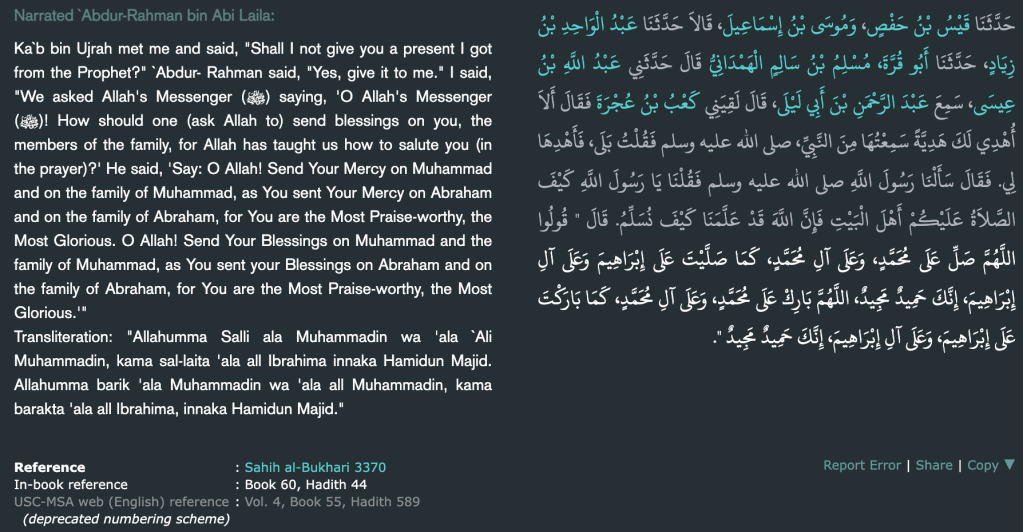
The traditional blessing prayer is explicitly addressed to God. In Bukhari’s collection, report 3370 includes Muhammad and his family, Abraham and his family, and praise of God. It is therefore inaccurate to describe that full formula as excluding every other messenger or containing no praise of God. The source establishes the tradition’s actual position; citing it here does not make the report a source of religious law. (Source: Bukhari, report 3370.)
This distinction matters for the argument about hearing. If a person asks God to bless someone, the request requires God to hear; it does not require its human beneficiary to hear. A different question arises if a person believes Muhammad receives every greeting or can answer an appeal for help. We can challenge such claims where they are made without assigning them to everybody who uses an honorific.

3. What the vocabulary can establish
The Arabic expression ṣallū ʿalayhi in [33:56] is commonly rendered as sending blessings upon him. Khalifa renders it as helping and supporting him. These are interpretations of an Arabic expression, not two different Arabic verses. Its use elsewhere in the Quran is relevant, but an English root slogan cannot settle every occurrence in advance.
Consider how the same verb family, with the relevant preposition, is rendered in four passages of the Final Testament. The subjects and situations differ: God acts toward believers, the prophet encourages contributors, believers are directed toward the prophet, and the prophet is forbidden to conduct certain funeral prayers. Those contexts are part of the evidence. Any proposed definition must be able to account for all four.
| Passage | Who acts toward whom? | Meaning in this translation |
|---|---|---|
| [33:43] | God, together with His angels, toward believers | Help that leads believers from darkness into light |
| [9:103] | The prophet toward those giving charity | Encouragement that reassures them |
| [33:56] | God and His angels toward the prophet; believers instructed likewise | Help, support and appropriate regard |
| [9:84] | The prophet toward specified people who have died | A funeral prayer, expressly forbidden for that group |
[9:84] You shall not observe the funeral prayer for any of them when he dies, nor shall you stand at his grave. They have disbelieved in God and His messenger, and died in a state of wickedness.
The funeral-prayer passage prevents the claim that this construction can never concern prayer. Its prohibition is directed at particular deceased people; its language still demonstrates the relevant religious use. The Quranic Arabic Corpus identifies the verb in both [9:84] and [33:56] as form II from the same root. That grammatical observation supports comparison, but it does not supply a single English meaning independent of context. (Sources: [9:84], verb analysis; [33:56], verb analysis.)
Traditional interpretation also distinguishes God’s action from human supplication. Ibn Kathir’s commentary reports explanations involving divine praise or mercy and angelic supplication; it does not imagine God chanting an honorific to Himself. Our objection should address that interpretation as it is actually taught. Asking why God would say PBUH defeats a position the commentary does not advance. (Source: Ibn Kathir, commentary on [33:56].)
Khalifa’s reading remains a contextual argument for active support and proper regard. Even a reader who adopts the traditional rendering must still explain the step from a general command to blessings and peace into a mandatory suffix after every mention. Neither a root analysis nor an English translation supplies that repetition rule by itself. This is where the obligation argument must be tested.
4. The prophet and his community
Chapter 33 speaks into the life of Muhammad and the community around him. Its instructions include relationships within his household and conduct toward him, including visits and meals in [33:53]. Help and respect were therefore concrete responsibilities, with consequences for the people carrying them out. Reading [33:56] in that setting gives Khalifa’s interpretation an intelligible basis.
Khalifa explains that position in The Great Debate, interpreting the command as support, assistance and staying connected with Muhammad during his lifetime. His translation’s heading above [33:56] likewise places the passage in the prophet’s life. Those are Khalifa’s explanations of the passage and should be identified as such. The heading and footnote are commentary; neither is an additional sentence in the Arabic verse. (Source: Rashad Khalifa, The Great Debate, 42:28.)
However, the word “prophet” does not, by itself, prove that every reference is restricted to earthly life. In [66:8], the Quran describes a future day on which God will not disappoint the prophet and those who believed with him. That is a judgment-day scene. It rules out treating the noun as an exceptionless vocabulary test for whether someone is presently alive.
[66:8] (excerpt) On that day, God will not disappoint the prophet and those who believed with him.
The sounder argument concerns the situation being addressed. The instruction not to raise one’s voice above the prophet’s voice in [49:2] has an immediate setting among people who could speak with him; its lesson in respect can still be understood afterward. Likewise, [33:56] should be read for the responsibility it gives its original hearers and any continuing principle that follows. Historical context deserves consideration, but it cannot substitute for showing why a particular later verbal ritual is commanded.

5. Peace expressions across the Quran
The Quran contains peace declarations about particular people, greetings within human conversations, and collective expressions of peace. God declares peace upon Noah, Abraham, Moses and Aaron, and Elias in chapter 37. These passages make it impossible to argue that peace upon an individual is inherently an objectionable idea. Their presence also means that the important distinction cannot be simply individual versus collective wording.
Nor are all individual peace expressions spoken directly by God as the speaker within the account. Abraham addresses his father in [19:47]. In [20:47], Moses and Aaron are instructed to speak to Pharaoh, including an expression of peace for those who follow guidance. The Quran therefore supplies human examples as well as divine declarations.
[19:47] He said, “Peace be upon you. I will implore my Lord to forgive you; He has been Most Kind to me.
At the same time, these examples do not prescribe a universal rule for appending a phrase whenever Muhammad’s name appears. A reported greeting to a living father is one kind of speech; an instruction to repeat an honorific after every mention is another. The former cannot establish the latter without further reasoning. We should neither erase the examples nor ask them to prove more than they say.
[27:59] Say, “Praise be to God and peace be upon His servants whom He chose. Is God better, or the idols some people set up?”
[37:181] Peace be upon the messengers.
The collective language is especially valuable for its breadth. [27:59] explicitly tells its hearer to speak, while [37:181] is a declaration within a passage praising God. The latter does not contain a separate “Say,” so we cannot use the presence or absence of that word inconsistently to approve one declaration and dismiss another. These passages give us Quranic expressions of peace without producing a closed list of the only courteous sentences people may ever use.
Someone may reasonably point to these passages when explaining a voluntary wish for peace. That is different from proving that God requires a particular suffix, at a particular trigger, with a particular reward. The same evidence must be kept within the same limits whichever conclusion we prefer. Quranic peace language should inform our speech without being converted into additional legislation.
6. Equal faith does not mean identical ranks
The Quran repeatedly commands belief in God’s messengers without selective acceptance. [2:136] includes numerous messengers in a common profession of faith, and [2:285] presents the believers as accepting God’s messengers together. This guards against a religion that accepts one divine message while rejecting another. It does not mean every messenger has an identical history, mission or God-given rank.
[4:150] Those who disbelieve in God and His messengers, and seek to make distinction among God and His messengers, and say, “We believe in some and reject some,” and wish to follow a path in between;
The wording of [4:150] makes its target explicit: believing in some and rejecting others. Failing to append the same honorific to every name is not, by itself, proof of that rejection. Nor may we claim that God places no messenger above another. [2:253] describes differing blessings and ranks, and [17:55] states the distinction directly.
[17:55] Your Lord is the best knower of everyone in the heavens and the earth. In accordance with this knowledge, we preferred some prophets over others. For example, we gave David the Psalms.
There is nevertheless a useful question of religious perspective. Does our way of speaking keep all God’s messengers within one coherent faith, or do we use one messenger’s name to justify rejecting the revelation God sent? Khalifa draws attention to the collective language of [37:181] when teaching the principle of making no distinction. We can retain that inclusive lesson without turning it into a mechanical test based on counting suffixes. (Source: Rashad Khalifa, Quran study, 4:50.)
The principle also applies to Muhammad himself: accepting him as God’s messenger does not require granting him divine powers. Loving a messenger and accepting his message can coexist with refusing a religious rule that has not been established. Conversely, someone’s familiar expression of affection does not disclose everything that person believes. Arguments about faith require evidence about faith, not assumptions about an omitted or repeated phrase.

7. Praying to God and addressing the dead
The Quran warns against calling upon beings beside God who cannot answer. [35:14] describes their inability to hear or respond, and [46:5] condemns worship directed toward those unaware of it. In [35:22], the contrast between the living and the dead also occurs within imagery about hearing and receptiveness. These passages support a serious challenge to claims that deceased beings are available as supernatural recipients of our appeals.
[35:14] If you call on them, they cannot hear you. Even if they hear you, they cannot respond to you. On the Day of Resurrection, they will disown you. None can inform you like the Most Cognizant.
That challenge has a defined scope. A third-person wish for someone’s peace does not necessarily assert that the person hears it. A prayer addressed to God concerning that person likewise requires no such assertion. The Quran itself discusses funeral prayer in [9:84], so prayer concerning a deceased person and prayer addressed to one cannot be collapsed into the same category.
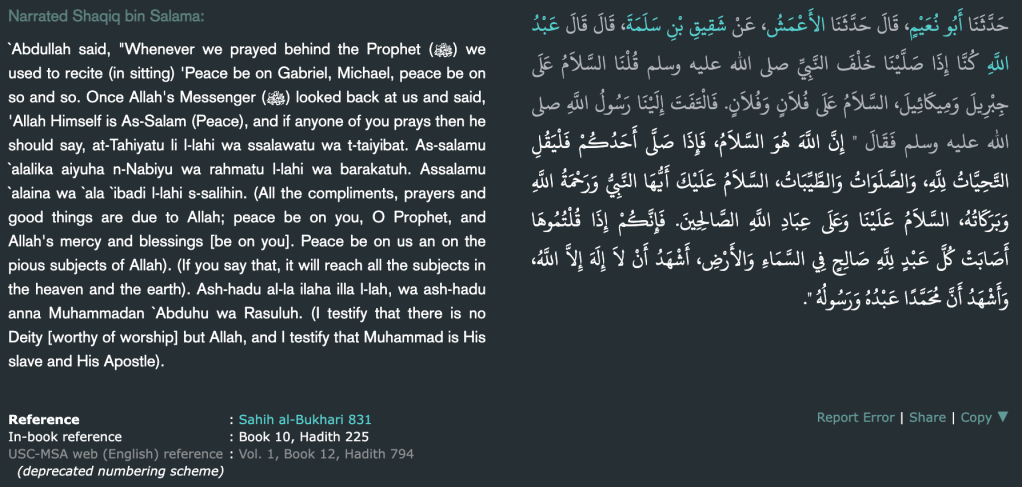
Traditional ritual speech presents a separate issue because it includes second-person address to the prophet. Bukhari’s report 831 records that form within the seated prayer recital. A person may understand this as an inherited liturgical greeting; a claim of actual reception introduces a further belief requiring evidence. Grammar identifies the addressee; it does not, on its own, establish each speaker’s theory of hearing or intention. (Source: Bukhari, report 831.)
[72:18] The places of worship belong to God; do not call on anyone else beside God.
For submission to God alone, worship must remain directed to God. That is the governing concern when evaluating a ritual address or an appeal for supernatural help. It should not be diluted into the implausible assertion that any sentence mentioning a human being is worship of that human being. Keeping the distinction clear allows the actual religious claim to be examined on its merits.
8. Who may turn a practice into religion?
A practice can be widespread, sincerely meant and emotionally meaningful without becoming a commandment. Religious obligation is a claim about what God requires, and therefore about what people owe Him. A promise of a fixed divine reward is also a claim about God. Neither claim can rest on our preference for the practice.
[6:114] Shall I seek other than God as a source of law, when He has revealed to you this book fully detailed?* Those who received the scripture recognize that it has been revealed from your Lord, truthfully. You shall not harbor any doubt.
This is the Quran-alone foundation of the argument. We accept the messenger through the revelation he delivered, and we do not give a later collection independent authority to add religious duties. Traditional believers dispute that framework because they accept transmitted reports as guidance from the messenger. The disagreement should be stated openly: it concerns the authority of those reports, not whether their authors can supply a formula.
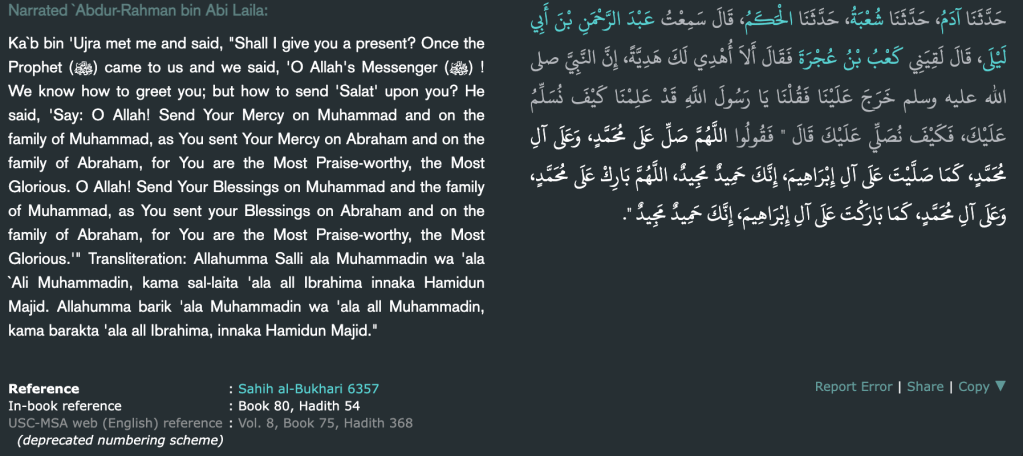
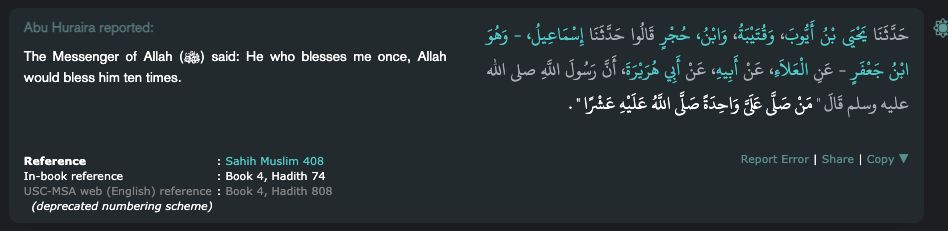
The reports do supply formulas and rewards. Bukhari’s report 6357 presents wording for seeking blessings upon Muhammad and his family, alongside Abraham’s family. Muslim’s report 408 promises a tenfold blessing in return for one blessing upon Muhammad. Those details show where part of the traditional case is located; the numerical exchange is not stated in [33:56]. (Sources: Bukhari, report 6357; Muslim, report 408.)
A traditional reader may therefore answer that the Quran gives a broad command and the reports explain how to carry it out. The Quran-alone reply must meet that argument directly: a report attributed to Muhammad is not automatically verified revelation from him. The authority to make its details binding is precisely what remains disputed. Simply calling the details an explanation does not resolve their source or establish that God prescribed them.
[42:21] They follow idols who decree for them religious laws never authorized by God. If it were not for the predetermined decision, they would have been judged immediately. Indeed, the transgressors have incurred a painful retribution.*
The question becomes concrete whenever someone condemns omission of an honorific. What wording is compulsory, how often must it be repeated, and which revelation makes omission a sin? If the evidence establishes only respect or a general wish for blessing, it cannot silently become proof of all those additional conditions. Within the Quran-alone framework, the fixed suffix has not been established as a duty.

9. Keep the remembrance of God central
Before [33:56], the chapter gives a direct and expansive instruction about remembrance. The object of that remembrance is God. The frequency is stated plainly, followed by glorification across the day. This is a positive responsibility that should shape the discussion, rather than leaving it entirely about which phrase to stop saying.
[33:41] O you who believe, you shall remember God frequently.*
[33:42] You shall glorify Him day and night.
Khalifa’s footnote to [33:56] warns that constant commemoration of Muhammad can displace this command. That is his interpretive warning, and it raises an examination of devotion worth taking seriously. If attention to a formula leaves us inattentive to God’s commands, something has gone wrong. We do not need to claim that every person using PBUH has made that displacement.
Remembering God is not measured by a contest over whose name appears most often in a paragraph. A study of Muhammad’s life may properly mention him many times; this article necessarily does so. The issue is the direction of worship and the authority governing our conduct. Repeating God’s name also does not excuse someone from justice, honesty or obedience.
[39:45] warns about aversion when God alone is mentioned and satisfaction when others are mentioned beside Him. Its moral force should lead us to honest self-examination, not a claim that we can diagnose a stranger’s heart from one typing habit. We can ask whether devotion to God alone satisfies us and whether His revelation governs us. Those questions reach deeper than the appearance of an honorific.
10. What this means in daily practice
You can discuss Muhammad respectfully by naming him, accurately describing his mission and taking the revelation he delivered seriously. There is no need to make every reference carry a compulsory verbal addition. The same care should extend to all God’s messengers. Respect is visible in truthful representation and faithful response, not merely in a suffix.
For everyday greetings, the Quran gives a clear direction in [4:86]. Respond generously when someone greets you. This belongs to actual human interaction, where a greeting can be received and answered. The verse directs our conduct without establishing a required honorific after every mention of an absent person.
[4:86] When greeted with a greeting, you shall respond with a better greeting or at least an equal one. God reckons all things.
When you pray, address God. If you wish to use Quranic language expressing peace upon His chosen servants or messengers, [27:59] and [37:181] provide that language. Use it with an understanding of its setting and meaning. Do not manufacture a new compulsory replacement formula, repetition count or promise of reward.
If someone says an honorific is “only respect,” the immediate task is to establish whether it is actually being treated as optional. If omission is condemned as disobedience, a religious obligation is being claimed and needs evidence. If someone is merely expressing goodwill, that narrower act should be considered as such. We need neither force a formula onto people nor turn every courteous expression into a verdict about their faith.

11. Honour the messenger through the message
The Quran gives us much more to work with than a dispute over initials. It calls for belief in God’s messengers, appropriate regard for the prophet, generous greetings, frequent remembrance of God and worship directed to Him alone. Its peace expressions include individuals and groups. Its vocabulary must be read with attention to context, including passages that challenge our preferred argument.
The conclusion is therefore precise: the Quran does not prescribe a fixed honorific after every mention of Muhammad’s name. [33:56] cannot, without additional argument, be made to specify its words, frequency or numerical reward. A voluntary wish for peace, a God-directed supplication and a ritual address are distinct questions; proving or disproving one does not automatically settle the others. That precision makes the challenge to an imposed formula stronger.
Our allegiance is to God, and our acceptance of His messenger is expressed through the message he delivered. We can refuse an unsupported obligation while remaining truthful about those who disagree with us. We can honour all God’s messengers without claiming powers or duties that revelation has not established. The work before us is to read carefully, worship sincerely and let God’s guidance govern what we call religion.
Translation and source notes
All Quranic quotations reproduce the English text of Rashad Khalifa’s Quran: The Final Testament; a quotation labelled “excerpt” reproduces only the specified words. Asterisks are retained as editorial reference markers from the source translation; they are not part of the Arabic verse text. Relevant commentary is discussed separately in the article. Headings, footnotes and recorded explanations are identified as Khalifa’s interpretation, separately from the verse text. The Arabic grammar references support the stated word comparison, while the linked traditional reports and commentary establish the position being examined rather than serving as religious authority here.
This study builds on our examination of religious practices and their sources and our discussion of the Quran and traditional narrations. This article refines the broader wording of those earlier discussions: a prayer to God about Muhammad must be distinguished from an address to Muhammad. The focus here is the authority claimed for a repeated honorific, with goodwill, prayer to God and address to Muhammad considered separately. The conclusion concerns a claimed obligation; it does not pronounce on an individual’s ultimate standing before God.



Leave a Reply