Introduction: The Generation That Says Its Life Is Fake
A Harvard-trained social scientist sits down in front of a camera for Big Think and opens with a number that should stop a room. Depression among adults under thirty has roughly tripled in fifteen years, and anxiety has doubled (Source: Big Think, “Young people say their lives feel fake. Here’s why”, interview with Arthur Brooks, August 2026). Arthur Brooks, who has spent his career measuring human happiness, runs through the usual explanations and dismisses them one by one. It is not that one generation ruined things for another, he says, because “people have been complaining about different generations for thousands of years.” The variable that actually tracks the collapse is a single question: does your life have meaning?
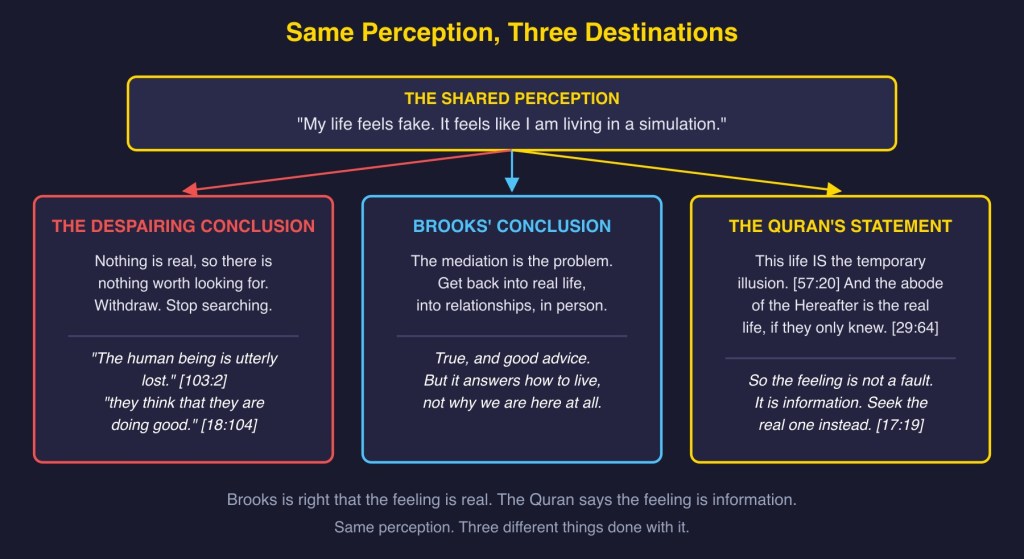
Then he reports what young people tell him when he interviews them, and the phrasing is what made the interview travel. He says they will tell him “my life feels fake, it feels like something’s missing, it feels like I’m living in a simulation.” He reaches for the obvious reference, the film in which machines farm sleeping people for energy while feeding them a convincing counterfeit, and he says plainly: “we’re living in the matrix in no small part, or at least many people are.” The ones deepest inside the simulation are the ones suffering most.
Something in that sentence should be familiar to anyone who reads the Quran. A whole generation has arrived, without any scripture in hand, at the perception that this life is not the real thing. They are not wrong about the perception. They are wrong about what to do with it. This article takes Brooks’ diagnosis seriously, follows it as far as his instruments can carry it, and then says what a happiness questionnaire is not built to say: why things happen the way they do, why you do what you do, and why your particular life matters. Those are the three questions Brooks names. The Quran answers all three, in plain statements, and it named the mechanism behind the fake feeling and behind the phone habit long before either existed.
Who Is Arthur Brooks, and What Is He Actually Claiming?
A man who had to learn happiness on purpose
Arthur C. Brooks was born in Spokane in 1964 and did not take the ordinary route into academia. He left college at nineteen to play the French horn professionally, ended up in the city orchestra in Barcelona, finished his bachelor’s degree by distance learning, and only later took a doctorate in public policy at the RAND Graduate School. He taught at Syracuse, ran the American Enterprise Institute from 2009 to 2019, and then moved to Harvard, where he taught at the Kennedy School and the Business School. He is now a professor at Vanderbilt University and a senior fellow at Harvard Business School. For years he wrote The Atlantic’s “How to Build a Life” column, he now writes “The Pursuit of Happiness” at The Free Press, and he hosts a podcast on the same subject.
The biographical detail that matters most is one he volunteers about himself: happiness does not come naturally to him, so he studies and tracks it deliberately. That is not a small admission from a man who has written sixteen books on the subject, including the number one bestsellers “From Strength to Strength” and “Build the Life You Want,” the latter written with Oprah Winfrey. He is also a practising Catholic, and he does not hide it. The interview discussed here accompanies his newest book, The Meaning of Your Life: Finding Purpose in an Age of Emptiness (Portfolio, 2026), and its argument follows the book’s; the full-length conversation it was cut from is also published by Big Think.
The argument the interview actually makes
Brooks builds the case in a straight line, and it deserves to be stated fairly before anything is added to it. The number one predictor of a meaningful life, he says, is “living your life in real life,” which he glosses as relationships and “living kind of in the old way.” Put a screen between you and the people you love and life stops being lived and starts being mediated. Then comes the finding that puzzles him most: when he asks the people who say life is meaningless whether they are looking for meaning, the answer is no. “The problem isn’t that meaning is impossible to find. It’s that looking for meaning has gotten harder.” Not an absence of meaning, but an absence of the search.
From there he lays out the machinery. Meaning has three components. The brain has a side that handles them and a side that does not. About twenty years ago the culture decided every problem had a technological fix, and we began trying to solve the first kind of problem with the second kind of tool. The result is a population that checks a phone roughly two hundred times a day, has abolished its own capacity for boredom, and has thereby switched off the very mental state in which the meaning questions get asked at all. He closes on a note of balance: he is not against technology, he owns every device made, and the answer is “using technology appropriately,” attending to the parts of life that need attention “by actually being in relation, in love.”
The line at the end that nobody quotes
The closing seconds of the interview are its most interesting part, and almost nobody cites them. Brooks says that most of what he knows about all this comes from neuroscience, which he loves, and then draws a hard boundary around it: “But I don’t let it turn into a religion per se. I have a real religion. I don’t turn it into love per se because I have real love in my life.” He is telling you, on the record, that the science he has just spent half an hour explaining is not the thing he lives by. It is instrumentation. Something else is load-bearing.
Nothing in what follows claims Brooks agrees with a word of it, and nothing here is an attack on him. He is a careful man describing a real catastrophe honestly, and he ends by admitting the limits of his own tools. This article simply takes him at his word about those limits and then goes where he does not go. His framework can locate the hole with real precision. It cannot tell you what the hole is shaped like, because the shape of it is a matter of fact about the universe, and facts about the universe before the universe are not obtainable by questionnaire.
The Three Whys: Coherence, Purpose, Significance
Three questions, one word
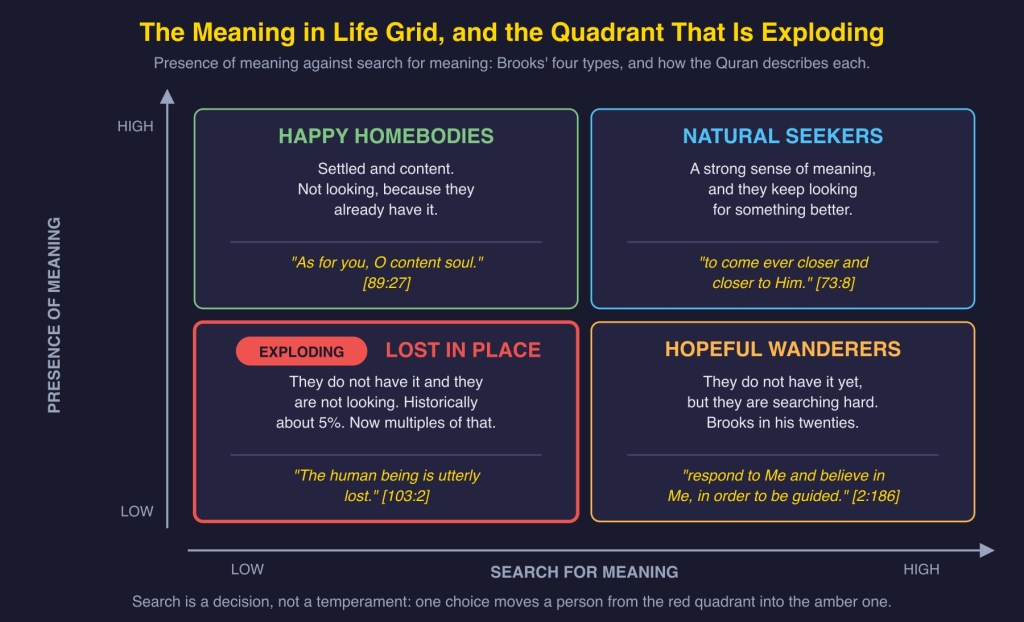
In The Meaning of Your Life, and again in the interview, Brooks credits two psychologists with the cleanest available definition of what people are actually asking for when they say they want meaning. It is not one thing but three: “Coherence, which is why things happen the way they do. Purpose, which is why I do the things that I do. And significance, which is why does my life matter? Those are the three big whys.” The framework comes from Frank Martela and Michael Steger (Source: The Journal of Positive Psychology, 2016), and its value is that it takes a vague complaint and splits it into three answerable questions.
Notice what has quietly happened here. Each of the three is a request for a fact, not for a feeling. Coherence asks for an account of how reality is arranged. Purpose asks what a human being is for. Significance asks whether anyone is on the other end of your existence. A person can have warm feelings and still have no answers, and a person can have hard answers and still have bad days. Brooks’ three whys are, whether he frames them this way or not, three theological questions wearing lab coats.
Presence and search: the four kinds of people
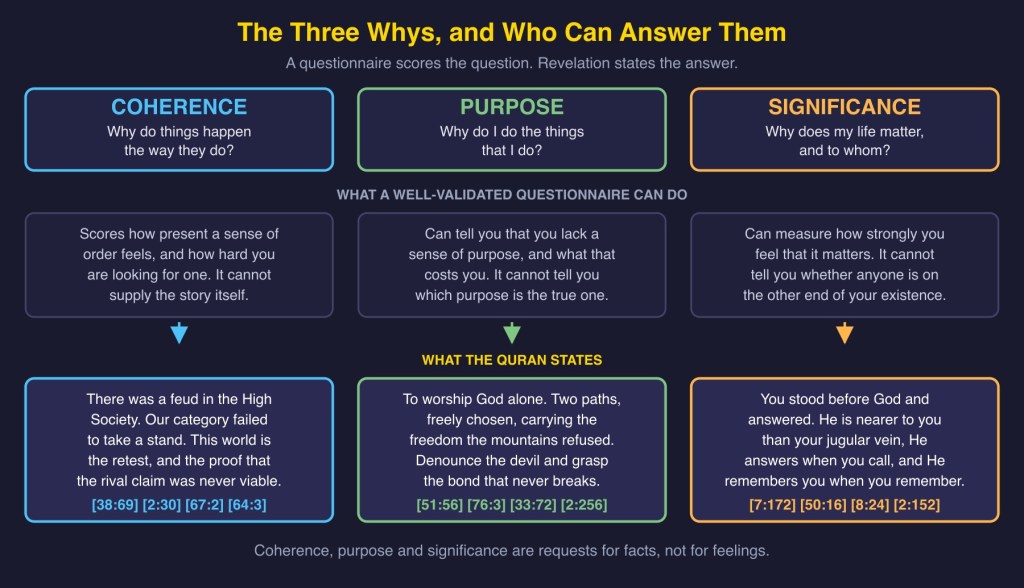
Steger also built the instrument that measures this, the Meaning in Life Questionnaire (Source: Journal of Counseling Psychology, 2006). Brooks explains that it scores two separate things: presence, meaning how much meaning you feel you already have, and search, meaning how hard you are looking. Cross the two and you get four kinds of people. High presence and low search are the happy homebodies, settled and content. Low presence and high search are the hopeful wanderers, and Brooks says that was him in his twenties. High presence and high search are the natural seekers, which is where he places himself today.
The fourth quadrant is the one he is worried about. Low presence and low search: they do not have it and they are not looking. “And these people are stuck,” he says. “They’re just stuck. They’re not looking. They don’t have it. They don’t know what to do.” The technical name he uses for the quadrant is lost in place. Historically it runs at about five per cent of the population. He reports that it is now “multiples of that and it’s going up every single year,” concentrated almost entirely among young adults coming of age.
Lost in place has an older name
There is a chapter of the Quran, four lines long, that names this quadrant and then names the exit in the same breath. It opens with an oath on the time of day and delivers a verdict on the species without qualification.
[103:1] “By the afternoon.”
[103:2] “The human being is utterly lost.”
[103:3] “Except those who believe and lead a righteous life, and exhort one another to uphold the truth, and exhort one another to be steadfast.”
Read that as a survey result and it is startling. The default state of the human being is not neutral, not searching, not mildly unfulfilled. It is lost. Brooks discovered a quadrant that used to hold five per cent of people and is now swelling; the Quran says the quadrant is the natural condition of everyone who has not been pulled out of it, and then specifies the only four things that pull a person out: belief, righteous conduct, telling one another the truth, and steadfastness. Not one of the four is a feeling. All four are actions.
There is a harder verse still, and it explains why the stuck are not looking. It is not laziness. It is that a life which is going nowhere can feel, from inside, like a life that is going well.
[18:103] “Say, “Shall I tell you who the worst losers are?”
[18:104] “”They are the ones whose works in this life are totally astray, but they think that they are doing good.””
That is the mechanism of low search stated in one sentence. You do not search when you believe you have already arrived. Brooks can see the behaviour in his data and can tell you it is spreading; the verse tells you what it feels like on the inside, which is the reason it is so difficult to interrupt from the outside.
A Questionnaire Can Measure the Hole. It Cannot Fill It.
What an instrument is for
A questionnaire is a measuring device and it is very good at its job. It can tell you that a population’s sense of coherence has collapsed, it can tell you which demographic is collapsing fastest, and it can tell you whether the collapse tracks screen hours. None of that is trivial, and Brooks deserves the credit he gets for reading the instrument correctly when others were blaming generations. But there is a category of question that no instrument of this kind can answer, and it is precisely the category Brooks’ three whys fall into.
Ask a thermometer why there is weather and it will keep returning a temperature. Ask a well-validated psychometric scale why things happen the way they do and it will return a score for how strongly you feel that things happen for a reason. That is not the same information. The score is about you. The question was about reality. Every honest happiness scientist eventually hits this wall, which is why the prescriptions at the end of the genre are always behavioural: connect more, look up more, put the phone down. Good advice, all of it, and none of it an answer to the question that was asked.
The Quran does not offer a search. It offers a statement.
Here is the structural difference, and it is the whole argument of this article in one move. The Quran does not invite you to go looking for the meaning of your life as though it were mislaid. It states, as fact, that the universe was not built idly, and it dares you to have thought otherwise.
[23:115] “”Did you think that we created you in vain; that you were not to be returned to us?””
[44:38] “We did not create the heavens and the earth, and everything between them, just to play.”
[44:39] “We created them for a specific purpose, but most of them do not know.”
[21:16] “We did not create the heavens and the earth, and everything between them just for amusement.”
Three separate passages, one insistence: there is a specific purpose, it exists whether or not you know it, and most people do not know it. That last clause of [44:39] is the bridge to Brooks. He has quantified “most of them do not know” and published the trend line. The Quran is not surprised by his data. It predicted the ratio.
And the posture the Quran commends is not blank searching but attention to what is already in front of you. The people it praises are the ones who look at the sheer construction of the world and draw the obvious inference from it.
[3:190] “In the creation of the heavens and the earth, and the alternation of night and day, there are signs for those who possess intelligence.”
Sharpening a reviewer’s objection
When Christianity Today reviewed Brooks’ new book in March 2026, its reviewer made a criticism that is worth borrowing and pressing harder. The book, the review argued, is aimed at strivers whose lives are busy but not meaningful, it deliberately keeps its pathways ecumenical and non-doctrinal so as to exclude nobody, and the result is a project that is individualistic right down to its title: the meaning of your life, as though the quantity were yours to define. The reviewer’s complaint was that this leaves the whole enterprise unanchored in any objective truth.
That criticism is correct and it does not go far enough. The problem is not merely that a non-doctrinal answer is unsatisfying. It is that “coherence” is either a fact about how the universe is actually arranged or it is nothing at all. If the account of why things happen the way they do is something each reader assembles privately from whatever materials feel right, then it is not coherence, it is decoration. A submitter can say the thing a Christian reviewer had to say gently: the meaning of your life is not yours. It was set before you existed, it is on the record, and your only freedom in the matter is whether to accept it.
Coherence: Why Things Happen the Way They Do
The most important event you were never told about
Brooks’ first why asks for an account of the arrangement of reality. The Quran gives one, and it is not a gentle one. It begins before the earth, before the human body, in a dispute among creatures made of light. A prophet is instructed to announce it as news, and to say that his audience is entirely unaware of it.
[38:67] “Say, “Here is awesome news.”
[38:68] “”That you are totally oblivious to.”
[38:69] “”I had no knowledge previously, about the feud in the High Society.*”
[38:70] “”I am inspired that my sole mission is to deliver the warnings to you.””
The footnote to that verse in the Final Testament does not treat this as a curiosity. It treats it as the hinge of everything: “The feud in the High Society was triggered by Satan’s challenge to God’s absolute authority. This is definitely the most important event in the history of the human race. We failed to make a firm stand regarding God’s absolute authority. This life represents the third and final chance to redeem ourselves (See the Introduction and Appendix 7).”
Read that again with Brooks’ three whys in hand. Coherence, purpose and significance all descend from a single historical claim: there was a challenge to God’s absolute authority, and we, the human category, did not take a firm stand. Everything since is consequence. Rashad Khalifa put the method plainly before he told the story (at 20:01): “In order to answer the question why are we here, and what is the purpose of our lives, we have to go back in time to where there was God and nothing else.”
How a creature came to want a throne
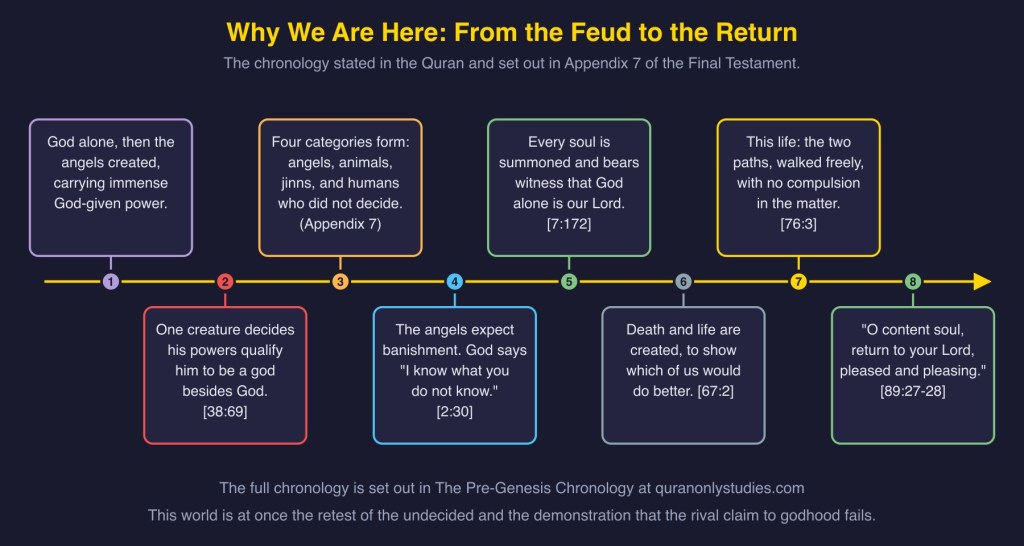
Appendix 7 of the Final Testament, titled “Why Were We Created?”, tells it in a few sentences. It opens with the verdict: “We are in this world because we committed a horrendous crime, and this life is our chance to redeem ourselves, denounce our crime, and rejoin God’s kingdom.” Then the origin: “One of the high-ranking creatures, Satan, entertained supercilious thoughts that his God-given powers qualified him to be a god besides God. He thus challenged God’s absolute authority.”
Rashad described the psychology of it in ordinary language (at 21:30): “One of the angels became infatuated with his God-given powers, he had so much power that he thought he can be a God in his own right.” The vanity is recognisable. It is the vanity of competence, of a creature so good at something that it forgets who supplied the faculty. The Quran preserves the exact reasoning Satan used when ordered to honour the new human creature, and it is an argument from material superiority.
[38:74] “except Satan; he refused, and was too arrogant, unappreciative.”
[38:76] “He said, “I am better than he; You created me from fire, and created him from clay.””
Appendix 7 records that the dispute sorted every creature in God’s kingdom into four categories: angels, who upheld God’s absolute authority; animals, who rebelled and then accepted the invitation to repent; jinns, who agreed with Satan that he was capable of being a god; and humans, described in the appendix as “Creatures who did not make up their minds; they failed to make a firm stand with God’s absolute authority.” That is our category. Not the rebels. The undecided.
“I know what you do not know”
The angels expected the undecided to be banished with the rebels. What happened instead is the single most merciful sentence in the record.
[2:30] “Recall that your Lord said to the angels, “I am placing a representative (a temporary god) on Earth.” They said, “Will You place therein one who will spread evil therein and shed blood, while we sing Your praises, glorify You, and uphold Your absolute authority?” He said, “I know what you do not know.””
The footnote is brief and total. It reads: These verses answer such crucial questions as: “Why are we here?” (See Appendix 7). The angels’ objection is reasonable and God does not dispute the prediction; He disputes their conclusion. Rashad narrated the moment of exposure (at 23:41): “And thus Satan was exposed as a rebel. Now the angels see for themselves that Satan is a rebel who deserves to be banished from God’s kingdom. That was the first reason for creating the human race.”
And the second reason is the one that explains the state of the world. Appendix 7 uses an analogy anyone can check: “If you claim the ability to fly a plane, the best way to test your claim is to give you a plane and ask you to fly it. This is precisely what God decided to do in response to Satan’s claim.” Rashad rendered the same decision as speech (at 25:11): “alright you want to be a god? I will make you a god and see how good you are. There is much more to godhood than you think.”
This is the answer to the question every sufferer eventually asks, and it is the reason Brooks’ coherence question is answerable at all. Appendix 7 states the finding of the experiment: “Satan’s incompetence as a ‘god’ has already been proven by the prevalence of chaos, disease, accidents, misery, and war throughout his dominion (36:66).” The chaos is not evidence against a purpose. The chaos is the result being recorded.
[36:66] “If we will, we can veil their eyes and, consequently, when they seek the path, they will not see.”
Three verses that state the purpose outright
If the story were only a story it would still be an account of coherence. But the Quran attaches the design statement to it directly, and the footnotes point straight back to the same appendix.
[67:2] “The One who created death and life for the purpose of distinguishing those among you who would do better.* He is the Almighty, the Forgiving.”
The footnote reads: “See the Introduction and Appendix 7 for details of the purpose behind this world.” Death is not a flaw in the arrangement. It is the instrument that makes the arrangement a test. And the scope of the design is stated to be the whole cosmos, not a corner of it.
[64:3] “He created the heavens and the earth for a specific purpose,* designed you and perfected your design, then to Him is the final destiny.”
Its footnote supplies the tone that so much religious writing about human fault leaves out: “We are in this world due to God’s immense mercy. The Most Gracious has given us a chance to redeem ourselves. See the Introduction & Appendix 7.” We are not here as convicts. We are here on a mercy. And the selection criterion is stated in an unexpected place, in a footnote about Abraham, which turns the whole question of who deserves guidance on its head.
[21:51] “Before that, we granted Abraham his guidance and understanding, for we were fully aware of him.*”
The footnote asks the question directly and answers it: “Was Abraham so smart as to discover God, or, did God grant him the intelligence because He knew that he deserved to be saved? As it turns out, this whole world was created to redeem those among us who deserve redemption. When the angels suggested that all the rebels, humans and jinns, must be banished out of God’s kingdom, ‘I know what you do not know’ (2:30). At the same time, this world proves Satan’s incompetence as a god (App. 7).” That is coherence in the full sense Brooks asks for. Not “things happen for a reason” as a comfort, but a stated reason, a stated method, a stated criterion, and a stated end. The full chronology, from the kingdom before time through to the assignment of souls, is set out in our earlier study, The Pre-Genesis Chronology, and the reading of [2:30] that treats the human being as a stand-in placed on earth is examined at length in The Temporary God.

Purpose: Why I Do What I Do
One sentence, and it is not about achievement
Brooks’ second why asks what a human being is for. The Quran answers it in eleven words, and then immediately forecloses the obvious misreading.
[51:56] “I did not create the jinns and the humans except to worship Me alone.”
[51:57] “I need no provisions from them, nor do I need them to feed Me.”
The second verse is doing important work. Worship here is not a service God requires, because God requires nothing. The arrangement exists entirely for the benefit of the creature being arranged. That distinction matters enormously in a culture trained to hear any command as an imposition. Nobody gains from your recognition of reality except you, which is why the Quran can be as direct as it is elsewhere about who needs whom.
[35:15] “O people, you are the ones who need God, while God is in no need for anyone, the Most Praiseworthy.”
The two paths, and the freedom that makes them real
A purpose that could not be refused would not be a purpose, it would be a mechanism. So the Quran states the offer as an offer, with both outcomes named.
[76:3] “We showed him the two paths, then, he is either appreciative, or unappreciative.”
And the capacity to choose is described as something the rest of creation declined to accept. The mountains would not take it. We did.
[33:72] “We have offered the responsibility (freedom of choice) to the heavens and the earth, and the mountains, but they refused to bear it, and were afraid of it. But the human being accepted it; he was transgressing, ignorant.*”
This is the deepest possible answer to “why do I do the things that I do,” because it locates your daily conduct inside a decision that predates you and that you are now free to reverse. The commitment is described as a covenant already made, which is why the language of the reminder is the language of recall rather than instruction.
[36:60] “Did I not covenant with you, O Children of Adam, that you shall not worship the devil? That he is your most ardent enemy?”
[36:61] “And that you shall worship Me alone? This is the right path.”
[36:62] “He has misled multitudes of you. Did you not possess any understanding?”
Rashad compressed the whole of purpose into a single clause (at 58:27): “our purpose in life to be successful is to side with God’s point of view that he alone is enough.” Side with. Not discover, not construct, not curate. The proposition is already on the table and has been since before the earth cooled; the only act required of you is to take a position on it, which is exactly the act our category failed to perform the first time.
What taking the position actually looks like
And because it is a position rather than a feeling, it can be taken deliberately, in a moment, without a religious biography and without anyone’s permission. The Quran describes the act with a physical image, of taking hold of something that will not break.
[2:256] “There shall be no compulsion in religion: the right way is now distinct from the wrong way. Anyone who denounces the devil and believes in God has grasped the strongest bond; one that never breaks. God is Hearer, Omniscient.”
Note the order in that verse. Denouncing the devil comes first, belief in God second. That is not a stylistic accident; it retraces the original failure in reverse. The crime was the refusal to take a firm stand against a rival claim to authority, so the remedy begins by taking that stand. Brooks tells the stuck to start searching. The verse tells them something more actionable: there is a specific thing to let go of and a specific thing to grasp, and the grasping is available now, with no compulsion attached to it either way.
Significance: Why My Life Matters, and to Whom
You have already met the one who is asking
The third why is the one that isolates people. Coherence and purpose can be held at arm’s length as philosophy; significance is personal, and the honest form of the question is not “does life matter” but “does mine, and to whom.” The Quran’s answer is that the relationship is not new, that you were present at its formation, and that you agreed to it.
[7:172] “Recall that your Lord summoned all the descendants of Adam, and had them bear witness for themselves: “Am I not your Lord?” They all said, “Yes. We bear witness.” Thus, you cannot say on the Day of Resurrection, “We were not aware of this.””
The footnote draws out the consequence: “Thus, every human being is born with an instinctive knowledge about God.” Appendix 7 states the same thing in the language of design: “To give us a headstart, the Most Merciful gathered all the human beings before Him, prior to sending us to this world, and we bore witness that He alone is our Lord and Master (7:172). Thus, upholding God’s absolute authority is a natural instinct that is an integral part of every human being.”
This is a claim with a testable edge to it, and it is stated again as a general fact about human nature rather than as a doctrine for insiders.
[30:30] “Therefore, you shall devote yourself to the religion of strict monotheism. Such is the natural instinct placed into the people by God. Such creation of God will never change. This is the perfect religion, but most people do not know.”
Its footnote: “Recognizing God ALONE as our Lord and Master is a natural instinct. We are born into this world with such an instinct. See 7:172-173 and Appendix 7.” If that is true, then the ache Brooks measures is not a deficiency that arrived with smartphones. It is an instinct with nothing to attach to, reporting its condition. The instrument is not broken. It is unplugged.
Nearer than you have words for
Significance also asks about distance. Even people who accept that God exists tend to place Him at an administrative remove, which makes any individual life statistically negligible. The Quran refuses the framing twice, and both refusals are spatial.
[50:16] “We created the human, and we know what he whispers to himself. We are closer to him than his jugular vein.”
[8:24] “O you who believe, you shall respond to God and to the messenger when he invites you to what gives you life.* You should know that God is closer to you than your heart, and that before Him you will be summoned.”
Closer than the jugular vein, closer than your heart, and already listening to what you say only to yourself. Set that beside the honours the same scripture says were conferred on the species and the arithmetic of insignificance stops working.
[17:70] “We have honored the children of Adam, and provided them with rides on land and in the sea. We provided for them good provisions, and we gave them greater advantages than many of our creatures.”
[32:9] “He shaped him and blew into him from His spirit. And He gave you the hearing, the eyesight, and the brains; rarely are you thankful.”
And the relation is reciprocal, which is the part that tends to stop people when they first read it. The remembrance is not one-directional homage. It is answered.
[2:152] “You shall remember Me, that I may remember you, and be thankful to Me; do not be unappreciative.”
Why you, and why here
There is one more layer to significance, and it is the one that addresses the specific accidents of your particular life: this century, this family, this city. Rashad taught that these are not accidents at all, and that the fact of your encountering the message is itself the evidence. He put it as a piece of absurd good fortune (at 5:26): “Now when you decide, when you denounce our ancient crime, and decide to worship God alone, you have won a lottery with a million numbers.”
He was explicit that this is not a compliment to anyone’s intelligence (at 9:21): “So we are not here because we are intelligent, or because we are smarter than anyone out there in the street. We are here because we are really fortunate, because obviously we were swept in the crowd when those billions of creatures deviated, and God knows that.” And he promised that the circumstances themselves become legible in hindsight (at 6:32): “you will understand why you were born at this time, in that house, at that place, and what brought you here.”
That is a complete answer to Brooks’ third why, and it is not available from any instrument. Your life matters because it is one of the cases the entire world was built to adjudicate, and the destination has a form of address reserved for you personally.
[89:27] “As for you, O content soul.”
[89:28] “Return to your Lord, pleased and pleasing.”
[89:29] “Welcome into My servants.”
[89:30] “Welcome into My Paradise.”
“My Life Feels Fake”: The Quran Agrees, and Then Disagrees
The perception is accurate
Return to the sentence that made the interview travel. Young people tell Brooks their lives feel fake, like a simulation. His explanation is mediation: screens have inserted themselves between people and the real thing, so life has taken on the texture of a copy. That explanation is true and it is not the deepest available one, because the Quran says the same thing about every human life in every century, including the ones with no screens in them at all.
[57:20] “Know that this worldly life is no more than play and games, and boasting among you, and hoarding of money and children. It is like abundant rain that produces plants and pleases the disbelievers. But then the plants turn into useless hay, and are blown away by the wind. In the Hereafter there is either severe retribution, or forgiveness from God and approval. This worldly life is no more than a temporary illusion.”
The verse does not say that a badly lived life is an illusion. It says this worldly life is one, full stop, and the image it uses is agricultural and merciless: rain, growth, delight, then dry hay blown off a field. The same judgement is repeated across the scripture with no softening.
[3:185] “Every person tastes death, then you receive your recompense on the Day of Resurrection. Whoever misses Hell, barely, and makes it to Paradise, has attained a great triumph. The life of this world is no more than an illusion.”
[6:32] “The life of this world is no more than illusion and vanity, while the abode of the Hereafter is far better for the righteous. Do you not understand?!”
[40:39] “”O my people, this first life is a temporary illusion, while the Hereafter is the eternal abode.””
So the generation reporting that something is not real is not deluded. They have perceived, without the vocabulary for it, a fact that revelation states outright. What they lack is the second half of the sentence.
The half nobody told them
[29:64] “This worldly life is no more than vanity and play, while the abode of the Hereafter is the real life, if they only knew.”
There it is. Not “this is fake, therefore nothing is real,” but “this is the provisional one, and there is a real one.” The despair of the lost-in-place quadrant depends entirely on the missing clause. Take the perception on its own and the only available conclusions are nihilism or distraction, which is precisely the pair of options the stuck are choosing between. Add the clause and the same perception becomes a reason to move, because now there is somewhere to move toward.
The Quran even anticipates the sense of foreshortening that people describe when they say a decade went past and they cannot account for it. At the end, the estimate given by those being questioned is a day or less.
[23:112] “He said, “How long have you lasted on earth? How many years?””
[23:113] “They said, “We lasted a day or part of a day. Ask those who counted.””
[23:114] “He said, “In fact, you stayed but a brief interim, if you only knew.”
And the warning against mistaking the provisional for the permanent is issued as a direct address to everyone, not as advice for the pious.
[35:5] “O people, God’s promise is the truth; therefore, do not be distracted by this lowly life. Do not be diverted from God by mere illusions.”
The word that keeps returning in these passages is diverted. Not defeated, not condemned: diverted, as a vehicle is diverted, by something that was interesting enough at the time. That is the charge laid at the end against those who lost, and it is worth noticing how ordinary the failure sounds.
[57:14] “They will call upon them, “Were we not with you?” They will answer, “Yes, but you cheated your souls, hesitated, doubted, and became misled by wishful thinking, until God’s judgment came. You were diverted from God by illusions.”
Two Hundred and Five Times a Day: Whatever Occupies Your Mind Is Your God
The number
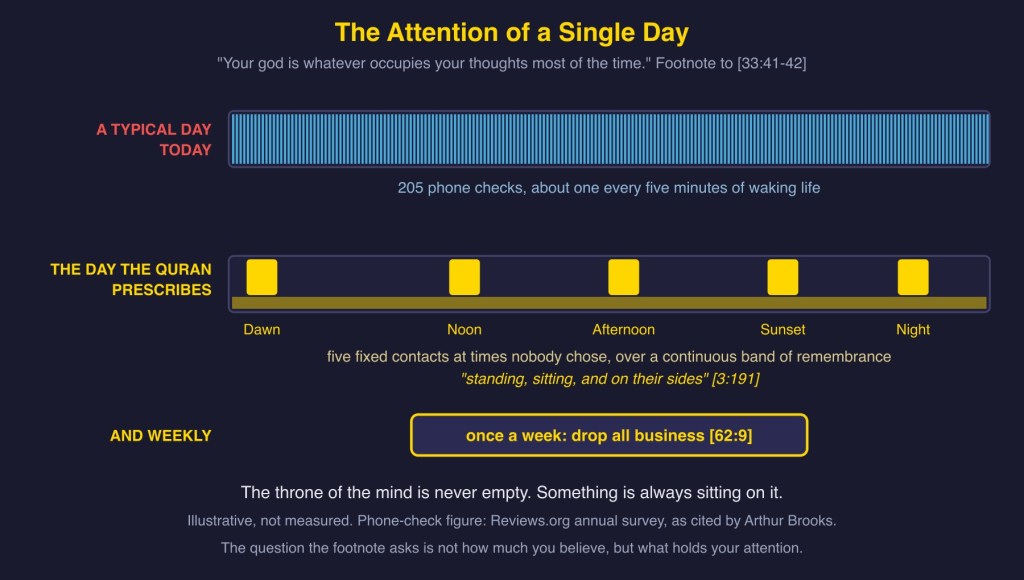
Brooks then produces the figure that anchors the second half of the interview. “If you’re like the average American, you’re looking at your phone 205 times a day. That’s 13 times per hour. That’s every five minutes or so.” The number comes from an annual consumer survey rather than a peer-reviewed study (Source: Reviews.org cell phone usage survey), and Brooks is careful about what he does with it. His point is not that phones are wicked. It is about which moments get consumed. He lists them: the supermarket checkout line, the long red light, “any opportunity for the right hemisphere of your brain to turn on, to give you mind-wandering and flights of fancy and thoughts of meaning, you’re going to turn it off.”
Hold that thought and read a two-verse commandment with its footnote. The commandment is unremarkable on its own. The footnote is the reason this section exists.
[33:41] “O you who believe, you shall remember God frequently.*”
[33:42] “You shall glorify Him day and night.”
The footnote reads: “Your god is whatever occupies your thoughts most of the time. Hence the commandment to commemorate God and glorify Him day and night. See Appendix 27.” Read that as a definition rather than a rebuke, because that is how it is written. It is not saying that distraction is naughty. It is saying that the word god denotes whatever holds the throne of your attention, and that the throne is never vacant. Something is always on it. The commandment to remember God frequently follows as an engineering consequence, not as a piety.
Rashad on the same definition
Rashad devoted an entire sermon to this and opened by predicting that his audience would find the question offensive, because everyone assumes they already know the answer. He gave the answer before the argument (at 2:59): “Whatever you are thinking of in your mind, this is your God.”
He then ran the diagnostic across ordinary life, and the examples are pointedly mundane. On self-absorption (at 3:21): “If you are preoccupied with yourself, what the people think of you, he is a nice guy, she’s a nice lady. If this is your concern the majority of the day, then you are your God, you are worshipping your ego.” On work (at 4:12): “If you are preoccupied with your job most of the day, that is your God, not God who created you.” He cited the verse behind the ego case directly.
[25:43] “Have you seen the one whose god is his own ego? Will you be his advocate?”
[45:23] “Have you noted the one whose god is his ego? Consequently, God sends him astray, despite his knowledge, seals his hearing and his mind, and places a veil on his eyes. Who then can guide him, after such a decision by God? Would you not take heed?”
Be careful with the conclusion here, because it is easy to overshoot. Nothing in this says that a person who checks a phone is an idolater, and no one reading this is in a position to pronounce on anyone’s standing. What the footnote and the sermon establish is the mechanism, and the mechanism is neutral about the object. Whatever wins the majority of your attention occupies the position the word god names. A device engineered by very capable people to win exactly that competition is therefore not a neutral object in a spiritual life, whatever its owner intends. The Quran names the competitors it expects, and they are not temples of rival religions but the ordinary contents of a life.
[63:9] “O you who believe, do not be distracted by your money and your children from remembering God. Those who do this are the losers.”
And the people it praises are defined by what fails to distract them.
[24:37] “People who are not distracted by business or trade from commemorating God; they observe the Contact Prayers (Salat), and give the obligatory charity (Zakat), and they are conscious of the day when the minds and the eyes will be horrified.”

Boredom, the Default Mode Network, and the Commandment to Remember
The state in which the questions get asked
This is the most valuable stretch of the interview, and it is where Brooks the scientist is at his best. He makes a claim that sounds strange until you sit with it: “we are designed biologically to be bored a lot.” He then names the machinery. “There’s a set of structures in our brains called the default mode network. It turns on when you’re undistracted, when you’re bored.” It is the state in which the mind wanders, in which questions surface from inside rather than arriving from outside. And then the line that matters most: “This is what gives us the capacity to ask the meaning questions in the first place.”
So boredom is not a defect in the design. It is the doorway. And we have bricked it up. Brooks generalises the failure: “we fix little problems and create major crises,” and he gives the parallel case, painkillers made ever more powerful until overdose deaths run to roughly a hundred thousand a year in the United States (Source: CDC provisional drug overdose death counts). We solved boredom the way we solved pain, and with a comparable side effect.
The experiment where people chose the shock
Then comes the study everybody remembers. Undergraduates were left alone in a bare room for fifteen minutes with nothing to look at, nothing to listen to, and one available action: a button that delivered a painful electric shock to themselves. A quarter of the women pressed it. Two thirds of the men pressed it. One man pressed it a hundred and ninety times in fifteen minutes and was removed from the study (Source: Wilson et al., Science, 2014). Brooks draws the conclusion: “The point is we would prefer pain, and we figured out how to get that pain. It’s the supercomputer in your pocket. That’s your shocking device.”
That is a remarkable sentence and it should be allowed to land before anything is added to it. A person alone with their own mind for a quarter of an hour will, more often than not, choose to hurt themselves rather than continue. Now put that next to a verse that describes an aversion of the same shape, triggered by a very specific stimulus.
[39:45] “When God ALONE is mentioned, the hearts of those who do not believe in the Hereafter shrink with aversion. But when others are mentioned beside Him, they become satisfied.*”
Hearts that shrink with aversion, and relax again the moment something else is put in the frame. The Quran is describing a reflex, not an argument. It is not that the message was heard and rejected on the merits; it is that the undiluted subject is unbearable and something, anything, is reached for instead. The button in the laboratory and the phone in the checkout line are, on this reading, the same gesture.

The doom loop, and the loop that runs the other way
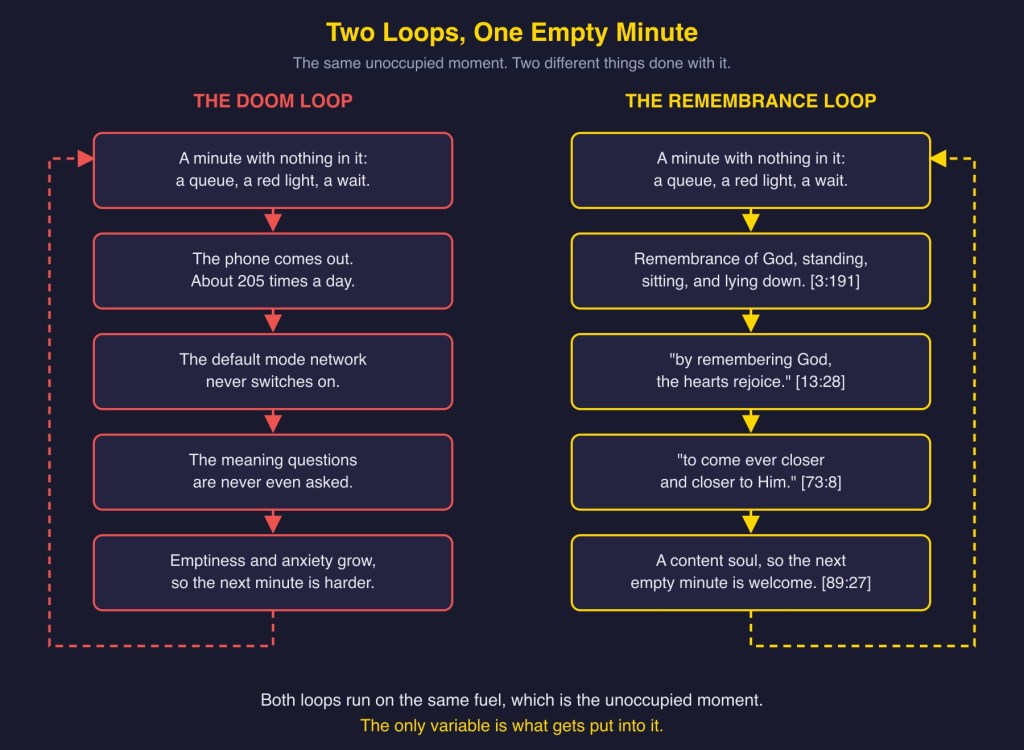
Brooks names the spiral. A little boredom, so the device comes out; the device makes boredom harder to tolerate, so the device comes out sooner; the tolerance keeps falling. “And pretty soon before we know it, that’s all we’re doing. We’re not alive in real life. We’re not seeing the things around us. We don’t notice anything else. We’re simply trying to distract ourselves almost 24 hours a day.” He also notes that boredom and anxiety are among the best predictors of addiction to drink, drugs and gambling, because people “don’t want to be alone in their heads.”
Here is the point where the Quran stops being a commentary on Brooks and starts being an answer to him. He has identified an empty minute and shown what happens when it is filled with a feed. The Quran issues a standing instruction about what to fill it with instead, and it specifies the postures precisely because the instruction is meant to cover all the leftover moments of an ordinary day.
[3:191] “They remember God* while standing, sitting, and on their sides, and they reflect upon the creation of the heavens and the earth: “Our Lord, You did not create all this in vain. Be You glorified. Save us from the retribution of Hell.”
Its footnote repeats the definition we met earlier: “your god is whoever or whatever occupies your mind most of the time. The true believers are those who remember God most of the time. See 23:84-89 and Appendix 27.” Standing, sitting, and lying down is not a list of ritual positions. It is a list of the times you are not doing anything else, which is exactly the inventory Brooks made: the queue, the traffic light, the minute before sleep. And the effect claimed for the practice is not endurance or discipline. It is stated as pleasure.
[13:28] “They are the ones whose hearts rejoice in remembering God. Absolutely, by remembering God, the hearts rejoice.”
[73:8] “You shall commemorate the name of your Lord, to come ever closer and closer to Him.”
Read those two together and you have a loop with the opposite sign. The empty minute is filled with remembrance; remembrance produces gladness rather than depletion; gladness closes the distance; the closed distance makes the next empty minute something to look forward to rather than something to escape. Both loops run on the same fuel, which is the unoccupied moment. The only variable is what gets put into it.

Right Brain, Real Person: What Is Actually Starving
The half that handles why
Brooks’ organising metaphor is anatomical. In the book, and again in the interview, he names the theory, hemispheric lateralization, and describes the division of labour: the right side handles “the why, to the mystery, the meaning, the love and the happiness,” and he includes in that list “Why do I worship the divine? What is my purpose in life?” The left side is “the engineering side,” the how and the what: get to work, write the code, operate the toaster. Both are necessary. Lose the how and you are helpless. Lose the why, he says, and “you’ll be rootless and won’t have any idea why you’re doing what you’re doing. And you’ll be depressed and lonely and anxious.”
The interview does not name the source of this framing, but the “why side versus how side” reading of the hemispheres in contemporary popular writing traces largely to the psychiatrist Iain McGilchrist and his study of divided attention (Source: The Master and His Emissary, 2009). It is a contested reading among neuroscientists, and it is worth being honest that no scan has ever located meaning in a hemisphere. Brooks is using it as a working model of two modes of attention, and as that it is useful.
What the Quran says is starving, and why it is not the same claim
Now a necessary distinction, because the temptation to collapse these two accounts is strong and it should be resisted. The right hemisphere is a piece of tissue. The soul, in the Quran’s account, is not tissue at all; it is the person, and the body is what the person is wearing. Nobody should say that Brooks’ neuroscience has discovered the soul, and this article does not say it. What can be said is narrower and still striking: an entirely secular scientist, measuring attention, has arrived at the conclusion that a whole faculty of the human being is being systematically deprived of its nourishment, and that the deprivation produces exactly the symptoms scripture attributes to a neglected soul.
Rashad Khalifa opened a sermon on New Year’s Day 1988 by announcing that the search was over, and the announcement is unusually confident (at 1:16): “finally, we have discovered the secret of happiness. The most elusive of all human searches.” Then the content of the secret: “Happiness is a quality of the soul, the real person, not the body. Therefore, a body that achieves all the material successes it longs for, money, fame, power, good looks, carnal satisfactions, often belongs to an unhappy person.”
He drove it home with a diagnosis rather than a consolation (at 3:19): “material success does not bring happiness. If the soul is shrunk, and not fed, and not nourished, there is no happiness. This is the secret of happiness. Nobody can be happy unless the soul is nourished, develops, and grows.” He pointed out that we feel the body’s hunger within hours and never feel the other hunger at all, which is why it can run for decades unnoticed.
The Quran describes the composite creature in a single verse, and the order of the clauses is instructive: the spirit first, then the equipment.
[32:9] “He shaped him and blew into him from His spirit. And He gave you the hearing, the eyesight, and the brains; rarely are you thankful.”
And it describes the possible trajectories of that creature with a bluntness that maps uncomfortably well onto a graph of youth depression.
[95:4] “We created man in the best design.”
[95:5] “Then turned him into the lowliest of the lowly.”
[95:6] “Except those who believe and lead a righteous life; they receive a reward that is well deserved.”
Brooks says a person without the why becomes rootless. The Quran uses the identical image, and it makes the root a function of what the person is holding to.
[14:24] “Do you not see that God has cited the example of the good word as a good tree whose root is firmly fixed, and its branches are high in the sky?”
[14:26] “And the example of the bad word is that of a bad tree chopped at the soil level; it has no roots to keep it standing.”

Little by Little, and Then All of a Sudden
Why it exploded when it did
Brooks asks the right follow-up question: the culture of hustle and efficiency is a century old at least, so why did the collapse arrive after 2008? His answer is borrowed from a character in a Hemingway novel who is asked how he went bankrupt and replies that it happened little by little, and then all of a sudden. Brooks calls it the Campbell effect and applies it broadly: nobody’s marriage ends overnight, and neither did this. “It brewed and it bubbled and it cooked and it rose little by little. And then we had a few outsized innovations and boom.”
The gradient he is describing is stated in the Quran as a deliberate method, and the wording is chilling precisely because it is calm.
[7:182] “As for those who reject our revelations, we lead them on without them ever realizing it.”
[7:183] “I will even encourage them; My scheming is formidable.”
[68:44] “Therefore, let Me deal with those who reject this Hadith; we will lead them on whence they never perceive.”
[68:45] “I will give them enough rope; My scheming is formidable.”
Without them ever realising it. Whence they never perceive. Enough rope. The imperceptibility is the whole design, and it is the same imperceptibility Brooks names when he says people always claim the crisis came out of nowhere. It did not come out of nowhere. It came one unremarkable evening at a time, and none of those evenings felt like a decision.
The billionaire’s first sentence
Then Brooks turns to the fallacy that keeps the slide going, which is the belief that the cure for too much of something is more of it. He reports what he has found interviewing the very rich: “The first thing that a billionaire says after earning her or his first billion is, it didn’t feel the way I thought it was going to. I guess I need another billion. This is also known as the hedonic treadmill.” His verdict is a sentence anyone can use: “if you’re in a hole, stop digging.”
The treadmill has a three-line chapter of its own, and it is the shortest and most efficient account of the phenomenon ever written.
[102:1] “You remain preoccupied with hoarding.”
[102:2] “Until you go to the graves.”
[102:3] “Indeed, you will find out.”
Preoccupied, until the graves. Not condemned for being wealthy, not blamed for working: preoccupied, which is the same word the footnotes used when defining what a god is. The rest of the scripture fills in the mechanism, and it is always a mismatch of priority rather than a prohibition on enjoyment.
[87:16] “Indeed, you are preoccupied with this first life.”
[87:17] “Even though the Hereafter is far better and everlasting.”
[75:20] “Indeed, you love this fleeting life.”
[75:21] “While disregarding the Hereafter.”
[30:7] “They care only about things of this world that are visible to them, while being totally oblivious to the Hereafter.”
And the outcome of each priority is stated as a pair, so that the choice is legible rather than mysterious.
[17:18] “Anyone who chooses this fleeting life as his priority, we will rush to him what we decide to give him, then we commit him to Gehenna, where he suffers forever, despised and defeated.”
[17:19] “As for those who choose the Hereafter as their priority, and work righteousness, while believing, their efforts will be appreciated.”
Notice the cruelty of the first outcome. The one who prioritises this life is not refused; he is given, and rapidly. Getting what you were chasing is the punishment. That is the hedonic treadmill described fourteen centuries before anyone put a name to it, and we examined the same dynamic at length in The Infinite Game of Life. The inventory of what people chase is even itemised, and the list has aged remarkably well.
[3:14] “Adorned for the people are the worldly pleasures, such as the women, having children, piles upon piles of gold and silver, trained horses, livestock, and crops. These are the materials of this world. A far better abode is reserved at God.”

If You Are in a Hole, Stop Digging: Repentance Is the Exit
The instruction Brooks gives, and the one he cannot give
Stop digging is excellent advice and it has a gap in the middle of it. It tells you to cease an action. It does not tell you what to do with the hole you are already standing in, and for the person in the lost-in-place quadrant that gap is the whole problem. They are not held there by ignorance of the fact that their life is going badly. They are held there by the belief that the accumulated weight of how it has gone so far cannot be set down.
The Quran addresses exactly that person, by name, and it does so in the most generous verse in the book. The address is not to the mildly lapsed. It is to those who exceeded the limits.
[39:53] “Proclaim: “O My servants who exceeded the limits, never despair of God’s mercy. For God forgives all sins. He is the Forgiver, Most Merciful.””
[39:54] “You shall obey your Lord, and submit to Him totally, before the retribution overtakes you, then you cannot be helped.”
Read the two verses in order, because together they are a complete instruction. The first removes the obstacle: no quantity of past conduct is disqualifying, and despair itself is named as the error. The second supplies the action and the deadline: submit, and do it before the window closes. That is what stop digging becomes when someone is authorised to say more than stop.
One decision, and the quadrant changes
Rashad opened his New Year sermon on precisely this point (at 0:26): “The first day of a new year, 1988, is also the first day of the rest of your life. And the Quran provides the ways and means of starting all over again, anytime you want to.” He named the mechanism a moment later: “The concept of repentance. Repentance, returning to God.”
Look at what this does to Brooks’ grid. The four quadrants are formed by two axes, presence and search, and the person in the worst quadrant scores low on both. But search is not a talent or a temperament. It is a decision, and it can be taken in an afternoon. The moment a stuck person begins to look, they have moved out of lost in place and into hopeful wanderer, which is the quadrant Brooks himself occupied in his twenties and got out of. And the Quran attaches a promise to precisely that movement, which is that the search is met halfway.
[2:186] “When My servants ask you about Me, I am always near. I answer their prayers when they pray to Me. The people shall respond to Me and believe in Me, in order to be guided.”
Respond to Me, in order to be guided. The order in that clause is deliberate and it inverts the sequence most people assume. Guidance is not the prerequisite for responding; responding is the prerequisite for guidance. You are not asked to be certain first. You are asked to answer, and the certainty is what arrives afterwards.
[39:22] “If God renders one’s heart content with Submission, he will be following a light from his Lord. Therefore, woe to those whose hearts are hardened against God’s message; they have gone far astray.”
Not Throwing the Phone in the Ocean: A Protocol for a Technological Life
Brooks refuses the ascetic answer, and so does the Quran
Brooks deals with the suggestion he clearly hears most often. “One solution to this problem that I hear all the time is, throw your phone in the ocean. Get rid of it all, man. I mean, go live in the woods.” He rejects it twice over: it will not happen, and it is wrong anyway, because “human ingenuity is improving human life all the time. We live longer. We live better.” The answer, he says, is “using technology appropriately. It’s not over-engineering the parts of our lives that don’t need to be over-engineered.”
A great deal of religious commentary would have taken the ascetic route he refused. The Quran does not, and it is unusually pointed about it, framing prohibition itself as the presumption.
[7:32] “Say, “Who prohibited the nice things God has created for His creatures, and the good provisions?” Say, “Such provisions are to be enjoyed in this life by those who believe. Moreover, the good provisions will be exclusively theirs on the Day of Resurrection.” We thus explain the revelations for people who know.”
[28:77] “”Use the provisions bestowed upon you by God to seek the abode of the Hereafter, without neglecting your share in this world. Be charitable, as God has been charitable towards you. Do not keep on corrupting the earth. God does not love the corruptors.””
Without neglecting your share in this world. That is not a grudging concession, it is a command inside a command, and the model prayer the scripture puts in the mouth of the balanced believer asks for both halves of life at once rather than trading one away for the other.
[2:201] “Others would say, “Our Lord, grant us righteousness in this world, and righteousness in the Hereafter, and spare us the retribution of Hell.””
Fixed times, dropped business, and a day that stops
So what does using technology appropriately look like when it is a divine protocol rather than a personal resolution? In his book, and in the longer interview, Brooks recommends technology-free times, zones and fasts: a protected first hour of the morning, meals, a protected last hour before sleep, a bedroom with no screen in it, and an annual stretch of days entirely offline. Those recommendations are his, offered ecumenically, and they are good ones. What is striking is how precisely the Quran’s own structure already implements them, with two differences: the times are fixed rather than negotiated, and they are addressed to someone.
The five daily Contact Prayers are the backbone, and they land at astronomical times that nobody chose and nobody can slide to a more convenient hour. Rashad described their function in exactly the vocabulary of nourishment this article has been using (at 8:27): “The best nourishment of all is the contact prayer, making contact with God.” He came back to it a minute later (at 9:19): “But the best nourishment is the five daily contact prayers. These are specifically prescribed by God at specific times, with specific utterances and specific movements.”
Then there is the weekly instruction, which is the most aggressive digital-detox rule ever written and predates the problem by fourteen centuries.
[62:9] “O you who believe, when the Congregational Prayer (Salat Al-Jumu’ah) is announced on Friday, you shall hasten to the commemoration of God, and drop all business. This is better for you, if you only knew.”
[62:10] “Once the prayer is completed, you may spread through the land to seek God’s bounties, and continue to remember God frequently, that you may succeed.”
Drop all business. Then, when it is finished, go back out and earn, and keep remembering while you do. That is the entire balance in two verses: a hard stop that is not negotiable, followed by a full return to ordinary economic life with the remembrance carried into it rather than left behind at the door. Fasting adds an annual month in which the body is told, daily and on a schedule, that it is not in charge. None of this is a retreat from the world. It is a set of fixed points that the world is not permitted to move.

Heaven and Hell Begin Right Here
The claim that sounds too large
Everything so far has concerned this life, and that is deliberate, because the Quran’s most surprising claim is not about the next one. Rashad stated it in the middle of a study session, almost in passing, while discussing people who follow their parents’ religion without examining it (at 31:16): “You can’t follow the parents blindly. There is too much at stake. And this means perfect happiness here in this world. But terrible misery here in this world. Heaven and hell begin right here. And all we need to do is step into God’s kingdom. Then you are guaranteed perfect happiness.”
He then gave the counterexample, a woman who had every material thing available to a human being (at 31:54). Christina Onassis inherited billions. “She tried to commit suicide six times… She died at the age of 38… But she was a very unhappy person.” It is the same data point Brooks reports from his billionaires, arrived at from the other direction: the treadmill does not stop at the top, because the top was never where the mechanism was.
The guarantee, and the condition attached to it
This has to be stated carefully, because it is the point at which religious writing most often slides into something the Quran never says. The promise is real and it is explicit, and so is its condition.
[10:62] “Absolutely, God’s allies have nothing to fear, nor will they grieve.”
[10:63] “They are those who believe and lead a righteous life.”
[10:64] “For them, joy and happiness in this world, as well as in the Hereafter. This is God’s unchangeable law. Such is the greatest triumph.”
The footnote states the timing without ambiguity: “Most people think that they have to wait until the Day of Resurrection before they receive their rewards for righteousness, or the retribution for wickedness. But the Quran repeatedly assures the believers that they are guaranteed perfect happiness here in this world, now and forever. At the end of their interim here, they go directly to Paradise (see Appendix 17).” And the condition is in [10:63], sitting between the promise and its delivery: they are those who believe and lead a righteous life. Not those who believe and hope. The same pairing appears wherever the promise appears.
[16:97] “Anyone who works righteousness, male or female, while believing, we will surely grant them a happy life in this world, and we will surely pay them their full recompense (on the Day of Judgment) for their righteous works.”
[41:30] “Those who proclaim: “Our Lord is God,” then lead a righteous life, the angels descend upon them: “You shall have no fear, nor shall you grieve. Rejoice in the good news that Paradise has been reserved for you.”
[41:31] “”We are your allies in this life, and in the Hereafter. You will have in it anything you wish for; you will have anything you want.”
Now the guardrail, and it matters. None of this is a promise of money, and nobody should read it that way. Rashad’s example was a woman with billions who was miserable, which is the opposite of a prosperity claim. What is guaranteed is described as freedom from fear and grief, joy in this world and the next; and it is guaranteed alongside a scripture that promises testing as a matter of course, not as a failure of the arrangement.
[2:155] “We will surely test you through some fear, hunger, and loss of money, lives, and crops. Give good news to the steadfast.*”
[2:156] “When an affliction befalls them, they say, “We belong to God, and to Him we are returning.””
[2:157] “These have deserved blessings from their Lord and mercy. These are the guided ones.”
Hardship is inside the guarantee, not outside it, which is why the response prescribed for affliction is a sentence of belonging rather than a complaint. We have written on that response and on what it means for the believer’s relationship to death in Embracing Transition, and on the nature of the opposite condition in The Ontology of Hell.
The other side of the same law
If heaven begins here then so does its opposite, and the Quran describes it not as a punishment scheduled for later but as a quality of life beginning immediately.
[20:124] “”As for the one who disregards My message, he will have a miserable life, and we resurrect him, on the Day of Resurrection, blind.””
[20:125] “He will say, “My Lord, why did you summon me blind, when I used to be a seer?””
[20:126] “He will say, “Because you forgot our revelations when they came to you, you are now forgotten.””
A miserable life, now, for the one who disregards the message. That is a falsifiable-sounding claim about the present tense, and it is precisely the claim Brooks’ data keeps confirming from the outside without ever being able to name the variable. The retrospective verdict is stated in the same terms: not that pleasure was taken, but that a chance was spent.
[46:20] “The day will come when those who disbelieved will be introduced to the hellfire: “You have wasted the good chances given to you during your worldly life, and you rejoiced in them. Consequently, today you incur a shameful retribution as a requital for the arrogance you committed on earth without any basis, and for your evil works.””
[26:88] “That is the day when neither money, nor children, can help.”
[26:89] “Only those who come to God with their whole heart (will be saved).”
What No Happiness Scientist Can Offer: Proof
Honouring the last line of the interview
Brooks ends by saying he keeps a boundary between his instruments and the things that are load-bearing in his life: “I don’t let it turn into a religion per se. I have a real religion.” That is an honest and admirable place to stop, and it deserves to be answered rather than exploited. The answer is not that his religion is the wrong one and ours is the right one, asserted louder. The answer is that the Quran makes a claim no happiness science can make and no religion had previously made either: that its account of coherence does not have to be taken on trust, because it comes with a physical proof attached.
[74:30] “Over it is nineteen.*”
[74:35] “This is one of the great miracles.*”
The footnote on that passage is direct about what the number is for. It reads: This “One of the great miracles” provides the first physical evidence that the Quran is God’s message to the world. This 19-based miracle is detailed in Appendix 1. The detail belongs to Appendix 1 of the Final Testament and not to this article, but the structural point belongs here exactly. Every one of the three whys in this article rests on a chain of claims about events before the world existed, and the reasonable objection to all of it is: how would anyone know? The Quran’s answer is that the book carrying those claims is stamped with a verifiable mathematical structure, which anyone can check, in any language, without trusting a scholar or a tradition or a feeling.
Which is why the religion has to be God alone
That proof does not attach to a personality, an institution or a lineage. It attaches to a text, and the text is insistent that the object of worship has no partners in it. Two verses in particular describe a diagnostic reaction that occurs when the subject is presented undiluted.
[17:46] “We place shields around their minds, to prevent them from understanding it, and deafness in their ears. And when you preach your Lord, using the Quran alone,* they run away in aversion.”
And the criterion stated a few chapters later is the sharpest instrument in the book, because it does not test what a person says they believe but what makes them comfortable.
[39:45] “When God ALONE is mentioned, the hearts of those who do not believe in the Hereafter shrink with aversion. But when others are mentioned beside Him, they become satisfied.*”
This is the point at which the article parts company with Brooks, and it does so respectfully and without pretending the gap is smaller than it is. He has a real religion and he says so. The Quran’s position is that a religion is complete only when it is strict monotheism, that this is the natural instinct we were all born with according to [30:30], and that no created being, however revered, may be placed alongside God. That is not a claim any social scientist can adjudicate. It is a claim the reader has to test personally, which is what the mathematical structure is there for, and which is why the invitation is issued without any compulsion behind it.
[2:257] “God is Lord of those who believe; He leads them out of darkness into the light. As for those who disbelieve, their lords are their idols; they lead them out of the light into darkness …”
Conclusion: The Answer Was Given Before You Were Born
Arthur Brooks has done the field a service. He identified the variable behind the youth mental-health collapse when others were arguing about generations, he split the vague word meaning into three answerable questions, he found the quadrant that is exploding, and he had the honesty to end by admitting that the science he loves is not the thing he lives on. Everything in this article that concerns diagnosis is his, and it holds up. The disagreement is not about what is wrong. It is about whether the three whys have answers or only scores.
The Quran says they have answers, and it states them rather than inviting a search. Why do things happen the way they do? Because there was a challenge to God’s absolute authority, our category failed to take a stand, and this world is both the retest and the demonstration that the rival claim was never viable. Why do I do what I do? To worship God alone, on one of two paths that are genuinely open, having grasped the bond that does not break. Why does my life matter? Because you were summoned before God and you answered, because He is nearer to you than your jugular vein, and because the whole apparatus of creation was assembled to redeem the ones who deserve it, which is why you are reading this at all.
So why seek purpose? The honest answer is that you do not have to seek it in the way the word usually implies, as though it were hidden and yours to invent if the search fails. It was given, it is on the record, and you have already agreed to it once. The only thing left undone is the thing our category has always left undone: taking a firm position. Brooks tells the stuck to start looking. The scripture tells them something more immediately useful, that the search is answered as soon as it begins, that no amount of past conduct disqualifies anyone, and that the two paths are still both open this afternoon.
Put the device down for the length of one traffic light and find out what your mind does with an unoccupied minute. That minute is not empty. It is the only room in a modern life where the three whys can still be heard asking themselves, and there is a specific thing to put into it.
[13:28] “They are the ones whose hearts rejoice in remembering God. Absolutely, by remembering God, the hearts rejoice.”



Leave a Reply