Different wording, different meaning, different obligations
As Submitters, we believe God preserved the Quran, and we take the question of its exact wording seriously. The differences between transmitted readings reach into the meaning of sentences and the obligations people derive from them. Do the feet belong with what is washed or what is wiped? Does a passage give a command, or report what people previously did? Is the fear relevant to a marital separation expressed as the couple’s fear, or as fear concerning them? These are questions of grammar, meaning and religious practice, and the reading literature explicitly discusses them.
The evidence overturns the claim that all the readings amount to the same words with different accents. Some variations concern pronunciation; others change words, grammatical relationships, the stated recipients of an obligation or the agency in a condition. The sources connect these differences with competing rules about purification, menstruation, prayer and divorce. When a transmitted form supplies a different textual basis for what a believer must do, the difference is serious. Reconciling the alternatives does not restore identical wording, and agreement on a later ruling cannot establish which expression was originally revealed.
This study examines publicly available reading manuals, historical collections and academic collations, then tests chapter 36 against Code 19. The historical record extends beyond seven readers and fourteen familiar transmissions: the defined Brill inventory examined here contains 1,448 discussion groups and 3,486 displayed form cells, with each counting unit explained below. The chapter 36 recount reproduces 237 Y-shaped bases plus 48 S letters, or 285 = 19 × 15, in the canonical text, the specified Hafs file and al-Duri from Abu Amr; the specified Warsh and Qalun files give 283. We seek the text confirmed by God’s evidence, and we distinguish what this particular test establishes from the broader case for that confirmation.
[17:36] You shall not accept any information, unless you verify it for yourself. I have given you the hearing, the eyesight, and the brain, and you are responsible for using them.
What exactly are we counting?
A reading tradition is a structured way of transmitting and reciting the Quran. A transmitter passes on a reader’s tradition, while further transmission paths may preserve choices within that transmission. A variant is a particular alternative at a particular location. These categories relate to each other, but they are not interchangeable units.
This distinction resolves several common confusions immediately. Hafs transmits from Asim; “Hafs and Asim” does not name two competing readings. Al-Duri occurs in the transmission of both Abu Amr and al-Kisai, so a book or spreadsheet headed only “Duri” needs further identification. A printed edition also has its own spelling, marking and numbering conventions, which must be examined separately from its transmission label.
| Term | What the number would count | What it would not count |
|---|---|---|
| Seven ahruf | A category in the traditional reports about the revelation’s permitted modes; the term’s interpretation is disputed. | A verified list identical to Ibn Mujahid’s seven named readers. |
| Reading, qira’a | A named reader’s transmitted reading tradition. | One individual altered word or one physical book. |
| Transmission, riwaya | A specified transmitter’s relation to a reading. | The complete number of that reading’s internal alternatives. |
| Transmission path, tariq | A further route through which a transmission is conveyed. | Necessarily a wholly distinct text from beginning to end. |
| Variant location | One defined textual location at which alternatives are registered. | The number of alternative forms or the number of witnesses attesting them. |
| Alternative form | A distinct wording or pronunciation at a defined location. | A new complete Quran for every form. |
| Manuscript witness | A physical manuscript or fragment with particular readings and features. | A complete text when only a fragment survives, or proof that all reported variants belonged to it. |
| Printed edition or translation | An editorial product or rendering into another language. | Automatically a separate Arabic reading tradition. |
Imagine one word with three recorded forms, each attested by ten transmitters. That is one location, three forms, and thirty form-to-transmitter attestations; it is not thirty different wordings. Now imagine a pronunciation rule repeated at a hundred places: counting the rule once and counting its occurrences a hundred times answer different questions. An honest total declares its unit before displaying the number.
The same discipline applies to verse numbers. If one edition divides a continuous passage into three numbered verses and another divides it into two, the different totals do not establish an extra sentence or a missing letter. First align the actual words, then examine the boundaries. A count over the same joined Arabic text remains unchanged when the verse markers move.
Beyond seven and fourteen: the historical literature
Ibn Mujahid’s Book of the Seven is central to the history of the reading canon, but its title is not a census of every alternative known in the literature. Its seven are selected readers, not seven isolated variant words. Nor does the work mean that every selected reader had only two immediate transmitters. The later familiar pairing of transmitters compresses a more extensive literary record.
Marijn van Putten’s Quranic Arabic makes the scale of that compression concrete: Ibn Mujahid reports forty-nine immediate transmitters for his seven readers. Forty-nine is a count of transmitters in that literary account, not forty-nine individual variant words or forty-nine surviving complete Qurans. It nevertheless directly answers the assumption that the history stops at two transmitters per reader. This is the scholar’s reported count, verified in the publisher’s indexed text. (Source: Marijn van Putten, Quranic Arabic, Brill, 2022, chapter 3.)
That distinction is precisely why “seven readings, two transmissions each” cannot answer the expanded numerical question. We need to inspect what Ibn Mujahid records, how later handbooks select and arrange it, and what collections outside the selected canon preserve. The term “irregular” or “extra-canonical” identifies a reading’s position relative to a canon; it does not make the report disappear from history. Equally, a report attributed to an early companion is evidence of a reported attribution, not automatic proof that an original manuscript survives in our hands.

Ibn Mujahid, Kitab al-Sabʿa, edited by Shawqi Dayf (Dar al-Maʿarif, Egypt), introduction, p. 19. The final Arabic sentence explains that the unselected reports were not discarded; they were placed behind the seven in chain and transmission. This is an editorial English explanation of Dayf’s introduction, not a translation printed in the scan.
A useful modern guide is Waleed Edrees Al-Meneese’s The Fourteen Qur’anic Readings: Impact on Theology and Law, in the 2021 English translation and critical annotation by Dr. Abu Zayd. It distinguishes fourteen readings from twenty-eight transmissions, and reports still larger counts associated with earlier collections. These figures show why the bare number fourteen is ambiguous: it can mean two transmissions for each of seven readers, or a different arrangement comprising fourteen readers. A total detached from its author’s categories is easy to misuse.

Al-Meneese, The Fourteen Qur’anic Readings, p. 31. Fourteen readers and twenty-eight transmissions describe a different unit from the fourteen transmissions of the selected seven.

Al-Meneese, pp. 27–28. The larger medieval collection totals are the modern author’s reports, not new counts of their original contents.
| Source or arrangement | Number and actual unit | Coverage and overlap | Verification status |
|---|---|---|---|
| Ibn Mujahid, Book of the Seven | 7 selected readers | A selection of reading traditions, with many transmitted alternatives; not seven variant word-forms. | Source examined; its title’s seven describes readers. |
| Van Putten, Quranic Arabic, 2022, chapter 3 | 49 immediate transmitters | Ibn Mujahid’s reported transmitter field for the seven readers; wider than the later fourteen-transmission selection. | Source-reported count verified in the official publisher’s indexed text. |
| Later two-transmitter presentation of the seven | 14 transmission positions | A narrower teaching arrangement associated with al-Dani and subsequent tradition; not a complete census of Ibn Mujahid’s transmitters. | Documented by the Corpus Coranicum historical overview. |
| Common later ten-reading canon | 10 readers; 20 principal transmission positions | Includes the earlier seven and three further readers. Does not enumerate every later path or local variant. | Academic taxonomy; reader/transmitter map shown below. |
| Al-Meneese, English edition, 2021, p. 31 | 14 readings; 28 transmissions | Ten canonical readings plus four outside that canon. This fourteen counts readers, unlike the fourteen-transmission row above. | Author’s stated classification verified in the English edition. |
| Abu Hatim’s collection, as reported by Al-Meneese, p. 27 | 24 readers/readings | Historical collection count, not twenty-four additional independent Qurans. | Modern author’s report; original collection not recounted here. |
| Al-Tabari’s collection, as reported by Al-Meneese, p. 27 | 22 teacher-readings on p. 27 | The same modern source uses twenty on p. 28; these statements are not merged into an independently established exact corpus count. | Modern author’s report; original collection not recounted here. |
| Al-Hudhali’s collection, as reported by Al-Meneese, p. 28 | 50 readings | Broader collection scope than the selected seven or ten. | Modern author’s report; fifty distinct full texts not reconstructed here. |
| Abu Ma’shar al-Tabari, Suq al-‘Arus, as reported by Al-Meneese, p. 28 | 350 transmissions | Transmissions, not three hundred and fifty readers or individual variant words. | Modern author’s report; original chains and contents not recounted here. |
| Ibn Khalawayh and Ibn Jinni’s extra-canonical collections, listed by Corpus Coranicum | No exhaustive total established in this audit | Reported readings outside the selected canon, including earlier attributions; overlaps require source-by-source alignment. | Collections and scope documented; contents not completely enumerated here. |
| Arthur Jeffery, Materials for the History of the Text of the Quran, 1937, p. 14 | 15 primary and 13 secondary named codex groups | Literary classifications of reported codices, with bracketed and dependent groups; not twenty-eight extant manuscripts or complete reconstructed texts. | Original classification page and the preface’s reconstruction limitation checked in the institutional scan. |
| Nasser, Brill supplement to The Second Canonization of the Qur’an, 2020 | 1,448 source groups; 3,486 displayed form cells; 1,498 distinct verse references | An accessible, defined collation of Ibn Mujahid’s material, including disputed or subsidiary transmissions. | Independently extracted from the frozen publisher table; counting units explained next. |
The particularly useful step here is moving from named collections to an inspectable inventory. Shady Nasser’s publisher-hosted supplement records variant forms, attributions, notes and classifications connected with Ibn Mujahid’s work. We extracted that complete table rather than selecting only the examples useful to our thesis. Its preserved snapshot contains 1,448 source location groups, 3,486 displayed variant-form cells and 12,273 attribution cells.
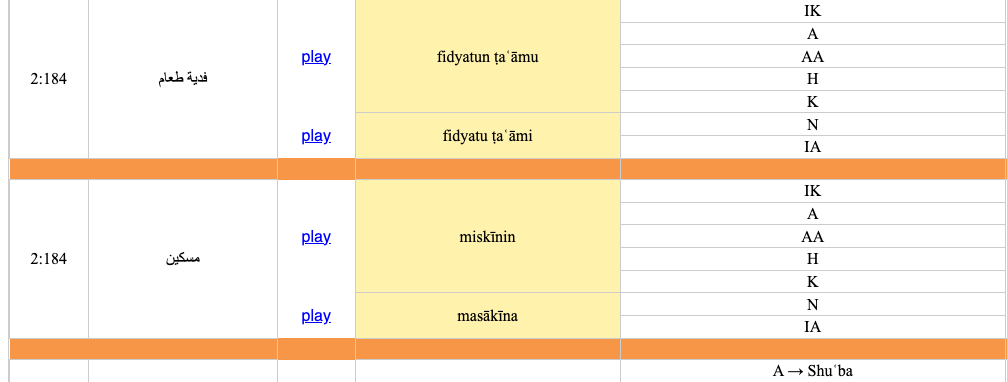
Nasser’s publisher-hosted variant table. These original rows show the form cells and attribution structure counted in the preserved inventory. The displayed excerpt is 2:184. Yellow highlighting is added; the publisher’s text is unchanged.
Those are substantial, reproducible counts, but each describes the table’s own structure. One location group can include multiple words or verses, and one displayed form cell can bundle several alternatives. The reference column covers 1,498 distinct verse references after expanding ranges; that is not 1,498 word-level locations, and it excludes further references appearing only in notes. An attribution cell can contain a chain, alternatives or editorial qualification, so 12,273 is not a count of independent transmitters.
The inventory preserves the source’s transliterations and Arabic, expands the table’s merged cells, and standardizes Unicode composition and whitespace without replacing letters or deleting diacritics. Two malformed reference labels were repaired solely for the verse index, with their original labels retained. Each counted cell remains connected to its source: a cell containing several alternatives has not been silently relabelled as one unique textual variant.
Corpus Coranicum places this material in a wider research setting, documenting both canonical and extra-canonical reading collections. Its overview distinguishes Ibn Mujahid’s work from al-Dani’s later two-transmitter selection and identifies Ibn Khalawayh and Ibn Jinni among the broader sources. Reported companion readings belong in that historical field, but must retain their individual attributions and evidential status. This article does not claim to have exhaustively counted those collections, all manuscript variants, or every reading ever transmitted.
Corpus Coranicum, “Variant Readings,” source overview. The archive’s historical scope is broader than the familiar two-transmitter summaries.
Arthur Jeffery’s Materials for the History of the Text of the Quran supplies another important historical category. His classification lists fifteen primary and thirteen secondary named codex groups, including bracketed entries for Aisha and Umm Salama. These are groups of reports associated with named codices, not twenty-eight surviving physical manuscripts; secondary groups can depend on earlier ones, and unnamed material exists outside the list. Jeffery’s own preface warns that the surviving material cannot reconstruct a complete picture of any one codex and that the reports need critical testing.
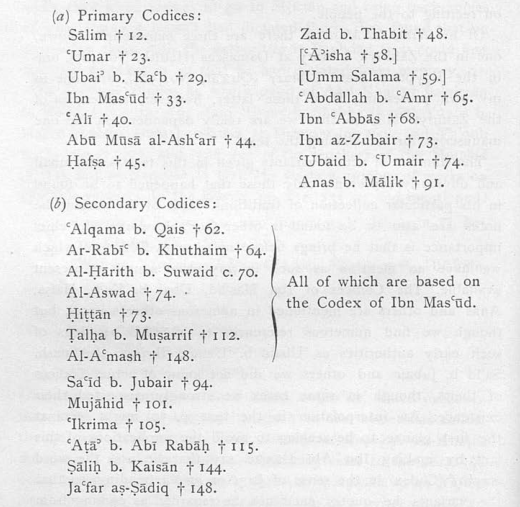
Jeffery, Materials for the History of the Text of the Quran, p. 14; reconstruction qualification in the preface, p. x. The named literary groups are a different unit from twenty-eight recitation transmissions.
A concrete example shows what the wider literature adds. For [5:89], Corpus Coranicum records the additional qualifier متتابعات, editorially glossed “consecutive,” in a reading report attributed to Ibn Masud. It qualifies the three days of fasting in the oath-atonement passage, whose canonical Arabic expression is فَصِيَامُ ثَلَٰثَةِ أَيَّامٍ. The record lists attestations in Muqatil, al-Farra, Abd al-Razzaq, Abu Ubayd and al-Tabari; those attestations do not become five different added word-forms, and they are not a photograph of a surviving companion autograph.
[5:89] Excerpt: If you cannot afford this, then you shall fast three days.
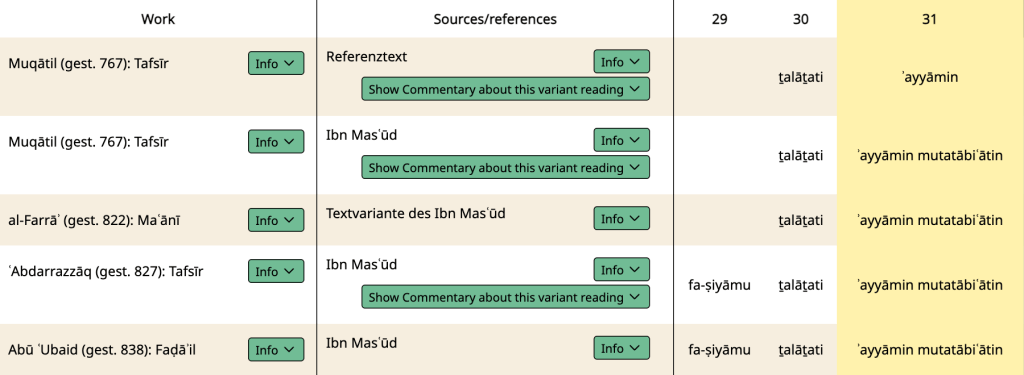
Corpus Coranicum, [5:89], companion-attributed reading and its literary attestations. The additional qualifier is historical comparison evidence; no legal ruling is derived here from the report alone. The image selects the reference row and four early-source reports; the full online table also includes al-Tabari.
The table’s totals must therefore be read across, with their units, rather than added down. A form occurring in Ibn Mujahid, a later handbook and a modern database can be the same form attested three times. Later selections can overlap earlier collections extensively. No honest historian can turn those repeated attestations into new independent variants merely because they occupy different books.
The traditional ten-reading system itself is useful to display accurately. It includes the seven readers associated with Ibn Mujahid’s selection and three further readers, with two principal transmission positions commonly taught for each. That yields twenty positions, but not twenty unrelated books and not twenty different historical people: al-Duri appears twice. The map below prevents a transmission name from drifting between lineages during the numerical test.
| Reader | Two principal transmissions |
|---|---|
| Nafi | Warsh; Qalun |
| Ibn Kathir | al-Bazzi; Qunbul |
| Abu Amr | al-Duri; al-Susi |
| Ibn Amir | Hisham; Ibn Dhakwan |
| Asim | Hafs; Shu’ba |
| Hamza | Khalaf; Khallad |
| al-Kisai | al-Duri; Abu al-Harith |
| Abu Ja’far | Ibn Wardan; Ibn Jammaz |
| Ya’qub | Ruways; Rawh |
| Khalaf, as an independent reader | Ishaq; Idris |
Marijn van Putten, “When the Readers Break the Rules,” Table 1, p. 439. This map describes the later canonical arrangement.
From a changed word to a changed ruling
The reading literature itself connects changes in the Arabic with changes in religious rules. In The Fourteen Qur’anic Readings, Al-Meneese explains that a reading can affect interpretation, qualification and legal application. His chapter on jurisprudence supplies concrete cases in which the alternatives entered disputes over obligation and permission. We use this public source for its documented readings and legal discussions; our argument for Code 19 is developed separately below.
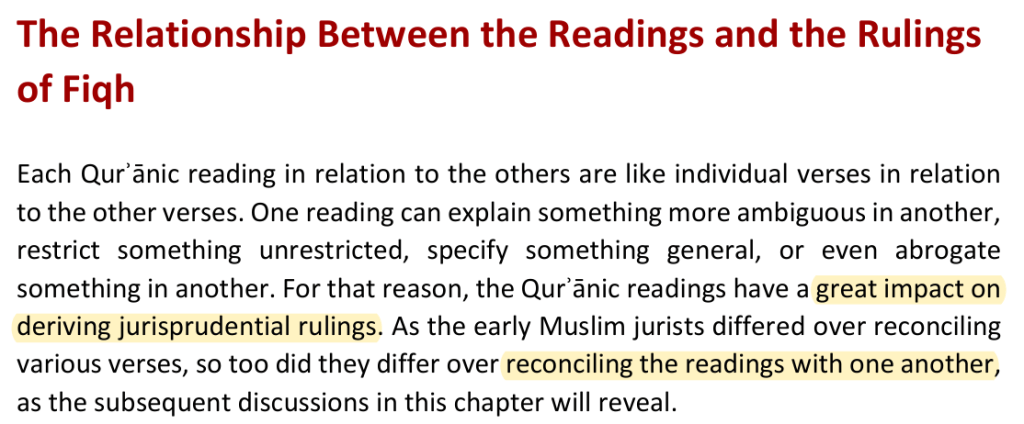
Al-Meneese, The Fourteen Qur’anic Readings, English edition, 2021, p. 234. The author connects the readings with legal interpretation.
The following examples trace the change from Arabic form to grammatical meaning to a documented legal question. A vowel or doubled consonant can carry grammatical information just as decisively as a separate word. The examples at [5:6] and [2:125] distinguish transmissions included in our four-edition count; [2:222] and [2:229] show further differences within the wider ten-reading canon. Legal reasoning uses additional evidence as well, but the variant wording is an identifiable premise in the disputes examined here.
| Passage | Verified difference | Material question discussed in the literature | Status of the comparison |
|---|---|---|---|
| [5:6] | وَأَرْجُلَكُمْ / وَأَرْجُلِكُمْ arjulakum / arjulikum | Washing or wiping the feet in preparation for prayer. | Both forms occur within the ten-reading canon. |
| [2:125] | وَاتَّخِذُوا / وَاتَّخَذُوا wattakhidhū / wattakhadhū | A command versus a report, used in debate over obligatory or recommended prayer at Abraham’s station. | Both forms occur within the ten-reading canon. |
| [2:222] | يَطْهُرْنَ / يَطَّهَّرْنَ yaṭhurna / yaṭṭahharna | Cessation of menstruation and the cleansing required before intercourse resumes. | Both forms occur within the ten-reading canon. |
| [2:229] | يَخَافَا / يُخَافَا yakhāfā / yukhāfā | Who assesses the fear relevant to separation, including arguments about judicial involvement. | Both forms occur within the ten-reading canon. |
The Arabic in these comparisons is presented in normalized spelling so the grammatical changes remain readable. The adjacent source images preserve the original published evidence. Editorial glosses explain the variants; the separately marked English Quran quotations are taken verbatim from the canonical Final Testament translation. We can therefore examine the alternatives without quietly turning a comparison gloss into scripture.
Further changes in words and grammatical person
| Location | Arabic alternatives | Reading evidence | Meaning and significance |
|---|---|---|---|
| [1:4] | مَالِكِ يَوْمِ الدِّينِ مَلِكِ يَوْمِ الدِّينِ | Asim and al-Kisai: māliki; the other five readers in Nasser’s seven-reader collation: maliki. | Editorial gloss: “Master/Owner” and “King.” The words name different attributes; the wording and lexical meaning change. |
| [2:184] | فِدْيَةٌ طَعَامُ مِسْكِينٍ فِدْيَةُ طَعَامِ مَسَاكِينَ | Hafs from Asim compared with Warsh and Qalun from Nafi. | Singular “a poor person” versus plural “poor people,” together with a change in the grammatical construction expressing the compensation. |
| [36:35] | وَمَا عَمِلَتْهُ أَيْدِيهِمْ وَمَا عَمِلَتْ أَيْدِيهِمْ | Hafs retains the object pronoun; Shu’ba, Hamza and al-Kisai lack it in Nasser’s collation. | The pronoun ه is present or absent. This difference changes neither Y nor S. |
| [36:70] | لِيُنْذِرَ مَنْ كَانَ حَيًّا لِتُنْذِرَ مَنْ كَانَ حَيًّا | Asim and Abu Amr have the third-person form; Nafi and Ibn Amir the second-person form in the seven-reader collation. | Editorial gloss: “so that he/it may warn” versus “so that you may warn.” One Y becomes T. |
The opening chapter already supplies a clear lexical difference. مَالِكِ names a master or owner; مَلِكِ names a king. The words express different attributes. Their use for the same God does not make them the same Arabic word or give them identical lexical meaning. These are alternatives in the recited text, and an account of its preservation must explain which wording is confirmed.
[1:4] Master of the Day of Judgment.

Shady Nasser, The Second Canonization of the Qur’an, supplementary variant table, [1:4]. The transliterated variants supply the reading distinctions.
[5:6]: washing the feet or wiping them
The difference in [5:6] concerns an act performed in preparation for prayer. Hafs from Asim has وَأَرْجُلَكُمْ, arjulakum, with an accusative ending; Abu Amr, including al-Duri’s transmission, has وَأَرْجُلِكُمْ, arjulikum, with a genitive ending. Both are canonical readings in the traditional classification. The changed vowel affects how “your feet” is grammatically connected to the surrounding commands.
[5:6] Excerpt: O you who believe, when you observe the Contact Prayers (Salat), you shall: (1) wash your faces, (2) wash your arms to the elbows, (3) wipe your heads, and (4) wash your feet to the ankles.
The earlier command is فَاغْسِلُوا وُجُوهَكُمْ وَأَيْدِيَكُمْ إِلَى الْمَرَافِقِ, editorially glossed “wash your faces and your hands/arms to the elbows.” The later construction contains وَامْسَحُوا بِرُءُوسِكُمْ وَأَرْجُلَكُمْ إِلَى الْكَعْبَيْنِ, or, in the genitive reading, وَامْسَحُوا بِرُءُوسِكُمْ وَأَرْجُلِكُمْ إِلَى الْكَعْبَيْنِ. The accusative form is used to connect the feet with the earlier washing command, while the genitive form supports linking them with the heads in the wiping construction. That is the textual basis of a practical disagreement, not a change confined to accent.
![Al-Meneese, p. 240: the accusative and genitive readings of [5:6]. The source's English comparison is distinguished from the canonical quotation above.](https://quranonlystudies.com/wp-content/uploads/2026/09/how_many_qurans_code_19_09_ablution_variants.png?w=1024)
Al-Meneese, p. 240: the accusative and genitive readings of [5:6]. The source’s English comparison is distinguished from the canonical quotation above.
Al-Meneese reproduces Ibn Rushd’s explanation that the competing readings underlie competing arguments for washing and wiping. This is explicit evidence that the grammatical difference entered the determination of a religious duty. The question concerns what a worshipper does with the feet before prayer: washing them and wiping them are distinguishable actions.
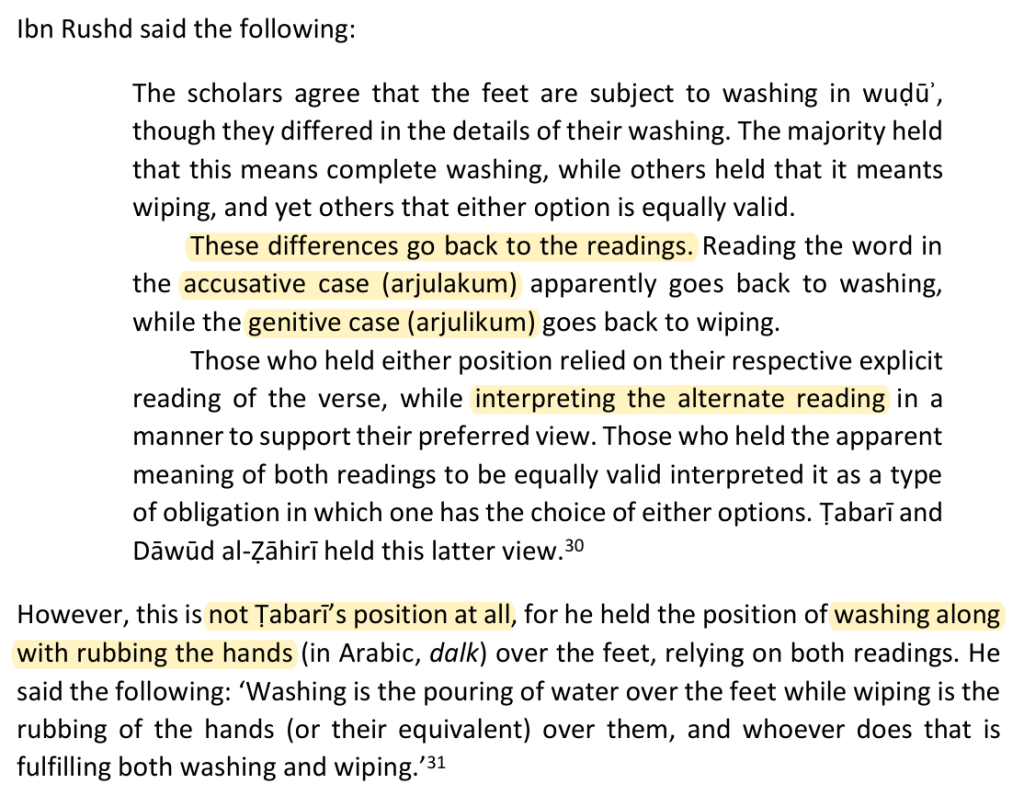
Al-Meneese, p. 241: Ibn Rushd’s account of the readings in the washing-or-wiping dispute. The excerpt also includes the author’s correction concerning an attribution to al-Tabari.
The case ending is one part of the grammatical and legal argument, rather than an automatic ruling detached from the rest of the sentence. Its material role is nevertheless plain: the two accepted forms supplied different grammatical grounds for deciding how the feet should be treated. Calling the difference “only pronunciation” obscures the information carried by that pronounced ending.
[2:125]: a command becomes a report about the past
The Arabic distinction in [2:125] is particularly clear. Hafs and the other readers of the imperative form have وَاتَّخِذُوا مِنْ مَقَامِ إِبْرَاهِيمَ مُصَلًّى: editorially, “take Abraham’s station as a place of prayer.” Nafi and Ibn Amir have وَاتَّخَذُوا مِنْ مَقَامِ إِبْرَاهِيمَ مُصَلًّى: “they took Abraham’s station as a place of prayer.” A direct address instructing people and a past-tense statement describing people are different grammatical acts.
[2:125] Excerpt: You may use Abraham’s shrine as a prayer house.
Al-Meneese explicitly connects this distinction with the debate over prayer at Abraham’s station following the circuit of the shrine. His discussion describes jurists using the past-tense reading in an argument for a recommended practice, while others appeal to the imperative in arguing that the prayer is obligatory. The page also identifies other evidence used in the legal reasoning. The variation therefore supplied a different kind of textual premise: an instruction to act, or a report that an action had occurred.
![Al-Meneese, p. 283: command and past-tense readings of [2:125], with the resulting obligation debate.](https://quranonlystudies.com/wp-content/uploads/2026/09/how_many_qurans_code_19_11_abraham_station_variants.png?w=1024)
An instruction and a report of an earlier action give the reader different textual grounds. The canonical translation above says “may”; the historical comparison shows how jurists used the alternative Arabic forms when debating the force of the passage. The command-versus-report distinction remains a substantive difference in the kind of statement the text makes.
[2:222]: becoming clean and cleansing oneself
In [2:222], the disputed form occurs in the condition that ends a prohibition on intercourse. Hafs has حَتَّىٰ يَطْهُرْنَ, editorially glossed “until they become clean”; Shu’ba from the same reader, Asim, has حَتَّىٰ يَطَّهَّرْنَ, “until they cleanse themselves.” Hamza, al-Kisai and Khalaf also have the doubled form in the traditional ten-reading classification. This example demonstrates material variation even between the two principal transmissions from a single named reader.
[2:222] They ask you about menstruation: say, “It is harmful; you shall avoid sexual intercourse with the women during menstruation; do not approach them until they are rid of it. Once they are rid of it, you may have intercourse with them in the manner designed by God. God loves the repenters, and He loves those who are clean.”
The difference is between a change of state and an act of purification. It belongs inside the complete expression وَلَا تَقْرَبُوهُنَّ حَتَّىٰ يَطْهُرْنَ or وَلَا تَقْرَبُوهُنَّ حَتَّىٰ يَطَّهَّرْنَ, followed in both forms by فَإِذَا تَطَهَّرْنَ فَأْتُوهُنَّ. The shared continuation about purification remains part of the sentence and must be interpreted with the first condition. The reading difference changes how explicitly that first condition requires an act of cleansing.
![Al-Meneese, p. 238: the two forms in [2:222] and their grammatical contrast.](https://quranonlystudies.com/wp-content/uploads/2026/09/how_many_qurans_code_19_12_menstruation_variants.png?w=1024)
Al-Meneese, p. 238: the two forms in [2:222] and their grammatical contrast.
The following page describes the practical dispute: whether cessation of bleeding is sufficient in particular circumstances, or whether further cleansing must occur before intercourse resumes. It records a widespread requirement to use water, a qualified Hanafi treatment tied to the duration of menstruation, and disagreement about what kind of cleansing the verse requires. These are differences about permission and its conditions, not simply alternative descriptions of an unchanged ritual. The author introduces the readings as one influence on the dispute.
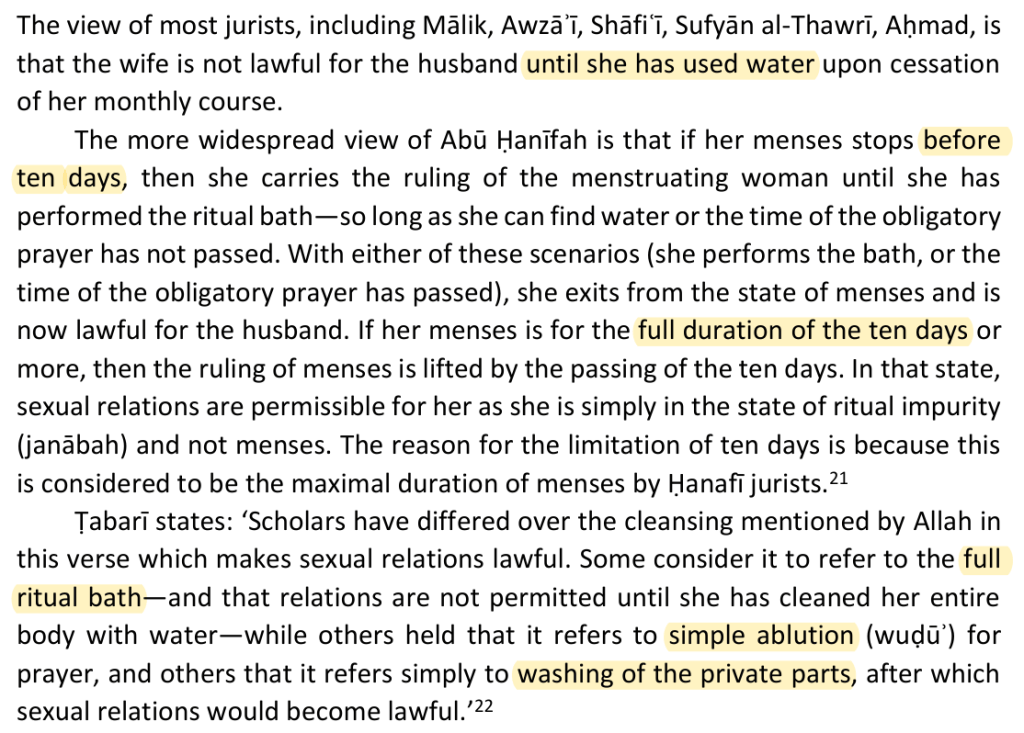
Al-Meneese, p. 239: differing conditions for resuming intercourse after menstruation.
The issue is when a restriction ends and what must happen before it ends. The difference between becoming clean and cleansing oneself bears directly on that question. Hafs and Shu’ba transmit these different forms from the same named reader, Asim: even agreement on the reader’s name does not guarantee agreement on the expression governing a practical condition.
[2:229]: whose fear, and whose decision?
The agency changes in [2:229], in the exception concerning what the wife gives back upon separation. The active wording is إِلَّا أَنْ يَخَافَا أَلَّا يُقِيمَا حُدُودَ اللَّهِ, editorially “unless the two fear that they will not maintain God’s limits.” The passive reading is إِلَّا أَنْ يُخَافَا أَلَّا يُقِيمَا حُدُودَ اللَّهِ, “unless it is feared concerning the two that they will not maintain God’s limits.” Hafs has the active form; Hamza, Abu Ja’far and Ya’qub have the passive form in the ten-reading classification.
[2:229] Excerpt: It is not lawful for the husband to take back anything he had given her. However, the couple may fear that they may transgress God’s law. If there is fear that they may transgress God’s law, they commit no error if the wife willingly gives back whatever she chooses.
The active expression assigns the fear to the couple. The passive does not name the person who fears for them, opening the question of an outside assessor such as a judge or mediator. Both continue with فَإِنْ خِفْتُمْ أَلَّا يُقِيمَا حُدُودَ اللَّهِ, addressing a plural “you,” so the full passage already contains an external address. The variant changes the agency in the preceding condition, and that difference became part of the legal argument.
![Al-Meneese, p. 290: active and passive readings of [2:229].](https://quranonlystudies.com/wp-content/uploads/2026/09/how_many_qurans_code_19_14_divorce_variants.png?w=1024)
Al-Meneese, p. 290: active and passive readings of [2:229].
The next page records Abu Ubayd’s appeal to the passive reading as support for placing this kind of separation under the authorities. It also describes the majority position allowing the couple or their representatives to effect it by agreement, with recourse to a judge when agreement is absent. The disagreement concerns who can effect the separation and when an authority must become involved. The reading difference is thus connected with a substantive question of decision-making power.

Al-Meneese, p. 291: the readings in arguments about consent and judicial authority.
The word “judge” is an inference drawn in the legal argument, not an additional word in the passive Arabic. The grammatical change itself is direct: the couple are expressly the ones fearing in one form, while the other leaves the fearing agent unexpressed. Jurists used that change when discussing consent and authority over separation. Those are substantial differences in what the text was understood to permit and who could act upon it.
The fasting example: one poor person and poor people
The compensation for missed fasting in [2:184] shows a change in both the recipient noun and the construction expressing the obligation. Hafs from Asim has a singular poor person; Warsh and Qalun from Nafi have poor people in the plural. The contrast is part of the Arabic wording itself.
[2:184] Specific days (are designated for fasting); if one is ill or traveling, an equal number of other days may be substituted. Those who can fast, but with great difficulty, may substitute feeding one poor person for each day of breaking the fast. If one volunteers (more righteous works), it is better. But fasting is the best for you, if you only knew.
The shared lead-in is وَعَلَى الَّذِينَ يُطِيقُونَهُ, introducing those to whom the obligation applies. The following forms state the compensation differently:
| Transmission | Arabic wording | Editorial explanation |
|---|---|---|
| Hafs from Asim | فِدْيَةٌ طَعَامُ مِسْكِينٍ | The compensation is explained as food for a poor person: the recipient noun is singular. |
| Warsh and Qalun from Nafi | فِدْيَةُ طَعَامِ مَسَاكِينَ | A linked noun construction: “a compensation of food for poor people.” The recipient noun is plural. |
| Hisham from Ibn Amir | فِدْيَةٌ طَعَامُ مَسَاكِينَ | The plural recipient noun with the first construction retained. |
In the Nafi transmissions, فِدْيَةُ loses the final nunation present in Hafs, and طَعَامِ has a genitive ending, producing a connected noun construction. The recipient noun changes from مِسْكِينٍ to the broken plural مَسَاكِينَ. Hisham’s form combines the plural with the other construction. We therefore have three attested combinations, not a single phrase written in different regional styles.
The singular explicitly identifies a poor person; the plural names poor people. This changes the expression of the recipients within a religious obligation. The plural alone does not specify a fixed number for each day, but that does not erase the difference in what the text says. The complete phrases must be compared, including their case endings, instead of replacing them with a claim that all editions have identical words and meaning.
The three-form attribution is recorded in Abd al-Fattah al-Qadi’s al-Budur al-Zahirah, p. 45. Nasser’s public collation, reproduced in the historical inventory above, also records the singular/plural variation. The table’s English explanations are editorial glosses; the canonical English verse is quoted separately.
These examples establish why identifying the text matters. A case ending affects the relation to a command, a verbal form changes the expression of a condition, a command becomes a report, and a singular recipient becomes plural. The historical reading canon preserves these alternatives. As Submitters, we seek God’s confirmation of the text through the Quran’s evidence and the Messenger’s teaching. Code 19 supplies testable relationships for that investigation, beginning here with the initials of chapter 36.
Chapter 36: where the letters become the test
Chapter 36 is especially suitable for a transparent numerical investigation because it opens with the very letters being counted. We are not choosing an arbitrary pair simply because it produces an attractive total. The initials point to Y and S, and the published Code 19 claim specifies their frequencies. That gives us a definite proposition to reproduce rather than an impression to admire.
[36:1] Y. S.*
Rashad Khalifa’s Appendix 1 states the separate totals: 237 Y and 48 S. Their combined total is 285, or nineteen times fifteen. The same chapter-level claim appears in the indexed recording Witness a Miracle, at 21:57, and is repeated in Mathematical Miracle of the Quran, at 33:37. The printed Appendix anchors the exact published figures; the recording links were checked against corpus metadata, without claiming a new audio verification.

Rashad Khalifa, Appendix 1, printed p. 381. This excerpt shows the S count of 48 and the combined total of 285; the full discussion also states the Y count and addresses subtle Y forms.
Appendix 1 also distinguishes obvious and subtle Y forms and says this chapter contains no subtle Y. That qualification makes method important: a computer’s character inventory is not automatically a linguist’s account of pronounced letters. Our audit therefore declares the graphic shapes it groups and preserves the original strings so that the choice can be examined. It reproduces the published numerical pair under that explicit rule; it does not pretend that the rule alone reconstructs every detail of Rashad’s original procedure.
Before counting the whole chapter, look at one local difference. In [36:70], the relevant alternatives begin لِيُنْذِرَ and لِتُنْذِرَ. They change the grammatical person from “he/it” to “you,” replacing a Y with a T. The meaning and the counted letter both change at the same location.
[36:70] To preach to those who are alive, and to expose the disbelievers.

Nasser’s collation, [36:70]. The source independently records the third-person and second-person forms.
The second relevant change occurs in [36:68]. Hafs has أَفَلَا يَعْقِلُونَ, while the compared Warsh and Qalun wording has أَفَلَا تَعْقِلُونَ. In normalized comparison, these ask whether “they” or “you” understand; once again, Y becomes T. The canonical English verse gives the third-person wording.
[36:68] Whomever we permit to live for a long time, we revert him to weakness. Do they not understand?
A complete per-verse alignment confirms that these two locations account for the entire counted difference between the main Hafs file and the Warsh/Qalun files. Each loses one Y-shaped base at [36:68] and one at [36:70], with no S-count differences elsewhere. Al-Duri from Abu Amr shares Hafs’s Y/S distribution at every aligned verse. These are statements about the counted letters; they do not assert that all other wording and pronunciation is identical.
Returning to the original spreadsheet
My earlier Code 19 workbook preserves the same four totals. In Code 19.xlsx, the “Yasin Count” worksheet records 285, 285, 283 and 283 in cells E27:H27 beneath the labels Hafs, Douri, Qaloon and Warsh. Those recorded values agree with the two-pair outcome independently obtained in this investigation. The earlier arithmetic was not contradicted by the new result.
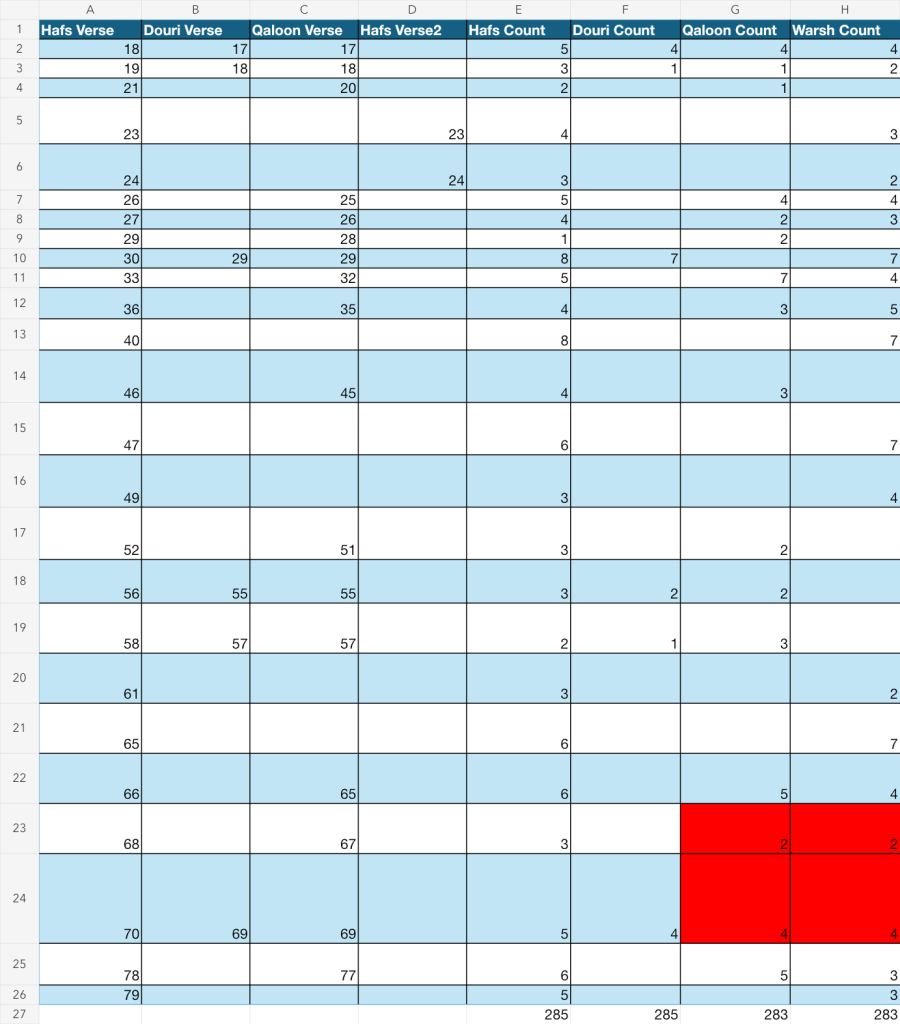
The original Code 19.xlsx, “Yasin Count,” cells E27:H27. This read-only worksheet rendering shows the recorded totals; the original file was preserved unchanged.
The worksheet still needs to be described accurately. These total cells contain entered values rather than formulas that reconstruct a complete count from an attached chapter text; the working sheet is a selective 25-row discrepancy and OCR correction log, with no formulas and no complete chapter text. It is valuable evidence of the earlier investigation, but it is not by itself an independently reproducible printed-edition collation. In particular, the word “Douri” alone does not prove which of al-Duri’s reader lineages supplied that old comparison.
The new audit supplies what a bare total cannot. It identifies the fresh transmission metadata, preserves raw chapter inputs, records their file hashes, and lists the count at every verse. The independently identified al-Duri file is explicitly from Abu Amr. Agreement with the old worksheet strengthens the continuity of the result, while the original source-label limitation remains visible. The workbook also identifies the two Y-to-T changes at the aligned locations above; its annotation calling one a “scribe error” is an earlier judgment, not an independently established origin for the reading.
The count, with its rules visible
The comparison uses the Quranpedia data release identified as 17 September 2026 and the canonical Final Testament Arabic. The selected inputs are Hafs from Asim in the Uthmanic representation, al-Duri from Abu Amr, Warsh from Nafi and Qalun from Nafi. The source copies used for this calculation were frozen and identified individually, so a later update cannot silently change the result. These specified digital representations establish exactly what was counted; a transmission label alone does not identify every printed or encoded form.
The rule counts each encoded Y-shaped base once in the group ي ى ئ ے, and counts ordinary S, س. It does not expand doubled pronunciation from the shadda mark, add miniature Y signs, or apply automatic Unicode normalization. It includes the opening formula and the chapter’s initial letters. Calling this a written-shape rule is essential: a Y-shaped long-A spelling or the seat under a hamza is not thereby declared to be the consonant /y/ in pronunciation.
| Specified input | Y-shaped bases | S | Total, opening included | Exact 285 target |
|---|---|---|---|---|
| Canonical Final Testament Arabic | 237 | 48 | 285 | Matches |
| Hafs from Asim, Quranpedia ID 2, Uthmanic representation | 237 | 48 | 285 | Matches |
| Al-Duri from Abu Amr, Quranpedia ID 6 | 237 | 48 | 285 | Matches |
| Warsh from Nafi, Quranpedia ID 4 | 235 | 48 | 283 | Does not match |
| Qalun from Nafi, Quranpedia ID 7 | 235 | 48 | 283 | Does not match |
237 + 48 = 285 = 19 × 15
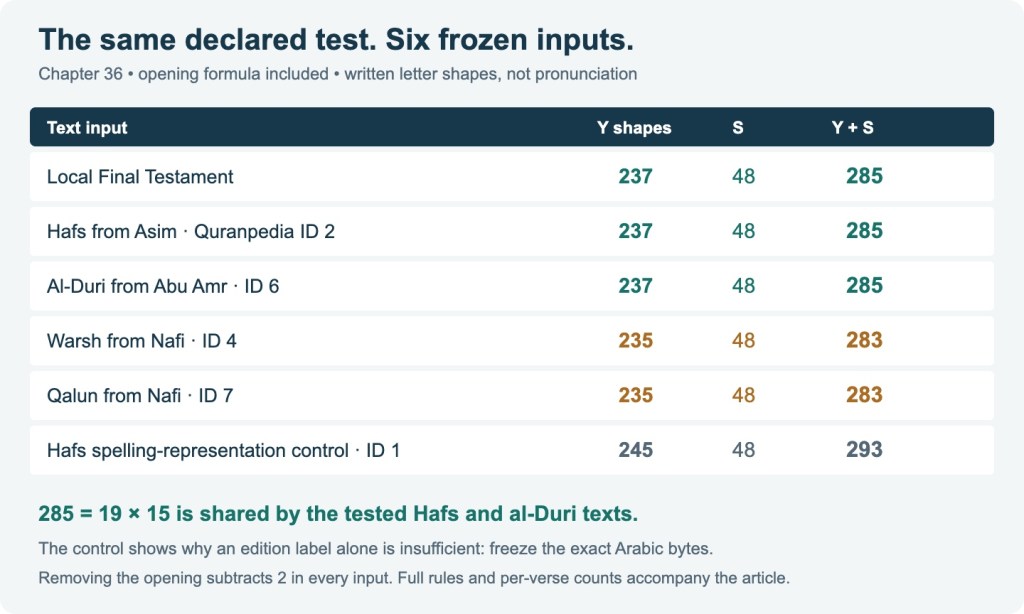
Chapter 36 totals for the specified inputs, using the written-shape rule stated above and including the opening formula.
Both Hafs and al-Duri from Abu Amr pass this demonstrated test. They share the exact separate 237/48 frequencies, not merely the combined sum. Warsh and Qalun fall two below 285 in the specified representations. No other untested transmission is classified as passing or failing in this article.
The opening formula contributes one counted Y-shaped base and one S. Remove it and the main totals become 283 for the canonical, Hafs and al-Duri inputs, and 281 for Warsh and Qalun. That is why “I counted chapter 36” is not an adequate method statement: the boundary convention must be stated. Renumbering verses does not create this difference; including or excluding actual letters does.
Why spelling and encoding controls matter
A second Quranpedia file labelled Hafs, ID 1, gives 245 Y-shaped bases plus 48 S, or 293, under the same rule with the opening included. Its text field uses a different, more fully spelled representation. This is a control on the representation being counted, not a verdict that Hafs as a transmission has failed. A familiar reading label cannot substitute for inspection of the actual Arabic input. The eight additional counted bases are traced to [36:12], [36:20], [36:23], [36:30], [36:54], [36:56], [36:78] and [36:82].
At [36:12] and [36:78], for example, the fuller spelling adds a written Y to the corresponding forms نحي and يحي, producing نحيي and يحيي. At four other locations a hamza is encoded on a Y-shaped seat where the Uthmanic string does not contain that counted base. These are graphic representation comparisons, not new English verse translations or independent claims of changed meaning. The eight affected verse locations are listed above.
Warsh and Qalun supply another useful control. Their files contain thirty-one instances of ے in the relevant chapter, a shape represented by a different character code from the more familiar Y forms. Ignoring that code point produces an artificial total of 252 instead of 283. The uniform grouping prevents a computer’s encoding choice from being presented as thirty-one missing letters.
These controls are part of the argument’s strength. If counting conventions are left implicit, an opponent can reproduce another number without either party understanding why. With raw text, individual characters and inclusion decisions available, the disagreement becomes inspectable. A serious numerical claim should make it easy to find a transcription error, challenge a shape classification or repeat the calculation.
The previous study on the mathematical miracle and letter-counting criticism called for a frozen reference text, explicit rules and independent replication. This chapter-level audit puts that requirement into practice. Its scope also makes a necessary precision explicit: a particular numerical relationship can detect only the changes that affect that relationship. Claims about the full preservation system must be supported by the full system, not transferred automatically to one sum.
A matching total is a constraint, not a complete text
The new legal examples make this limitation concrete. Hafs and al-Duri from Abu Amr both reach 285 in the chapter 36 audit, yet they differ at [5:6]: Hafs has the accusative feet-form and al-Duri the genitive. This chapter-specific Y/S count cannot decide between those forms in another chapter. Nor does it inspect every vowel or doubled consonant. A full identification of the text therefore requires further independent constraints; a successful total cannot be stretched into confirmation of every reading attached to an edition label.
A count discards information. Even the separate totals 237 and 48 do not record where those letters occur, how the remaining letters are arranged, or what other characters the text contains. Two passages can preserve those frequencies while differing in wording or order. The actual Hafs/al-Duri match makes that limitation concrete within our tested candidates.
Chapter 36 itself contains an instructive example. In [36:35], Nasser records عَمِلَتْهُ and عَمِلَتْ, differing in the object pronoun H. The surrounding interpretation involves the construction with مَا and how an expressed or unexpressed object is understood. Whatever interpretation is adopted, the presence or absence of H does not directly change either of the two letters counted here.
[36:35] This is to provide them with fruits, and to let them manufacture with their own hands whatever they need. Would they be thankful?
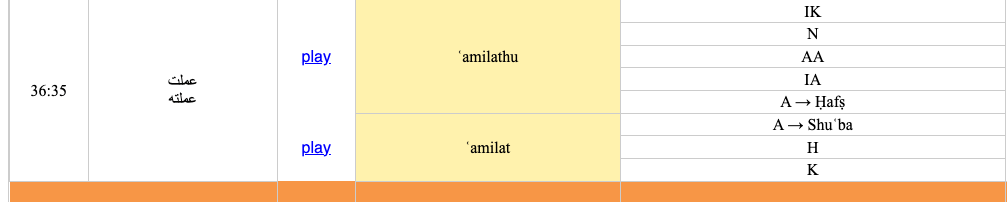
Nasser’s collation, [36:35]. The object-pronoun difference illustrates information the Y/S total does not record.
It follows that this one calculation cannot authenticate every word in the chapter. It also cannot choose the singular or plural recipient in [2:184], which lies outside the counted chapter altogether. That example shows why exact wording matters; the Ya-Sin calculation shows how one numerical criterion can compare specified texts. A further argument is needed to connect a whole-Quran textual decision to a whole-Quran set of tests.
The affirmative case for Code 19
God’s promise of preservation is our foundation. The existence of transmitted alternatives makes the means of identifying the preserved text a pressing question. Reader names, widespread adoption and inherited authority cannot take the place of God’s confirmation. We turn to the Quran’s evidence and the Messenger who explained its mathematical sign, with a method that allows the numerical claims to be examined.
[15:9] Absolutely, we have revealed the reminder, and, absolutely, we will preserve it.*
[74:30] Over it is nineteen.*
[74:35] This is one of the great miracles.*
The immediate context is important. In [74:31], the Quran identifies the guardians of Hell as angels and assigns their number purposes involving trial, conviction, strengthened faith and the removal of doubt. Code 19 connects that stated sign with the mathematical relationships investigated in the Quran; the verse itself does not spell out the equation Y + S = 285. The connection is explained through the Messenger’s teaching and tested in the text.
The number nineteen is present in the Quran before our investigation, and chapter 36 supplies its own initial letters. Those features give a reason to examine this numerical relationship. They do not, on their own, predetermine every spelling and counting decision; those still need to be shown. Once the method is fixed, however, a reproduced result becomes available for inspection by believers and critics alike.
Our confidence in Code 19 belongs to a cumulative case: the Quran’s message, the specified mathematical relationships and God’s Messenger of the Covenant who identified and explained the sign. We accept Rashad Khalifa’s confirmation as part of that case. His documented chapter 36 claim is 237 Y and 48 S; the comparison of the four identified digital inputs is the investigation presented here. Keeping those attributions distinct allows the Messenger’s actual teaching and the comparative result to stand clearly.
This matters for the question “which text?” Inherited popularity alone cannot establish authorization, and neither can a table’s longest list of transmitters. We seek the text confirmed by the Quran’s evidence and the Messenger’s confirmation. The chapter 36 result contributes one concrete comparison to that larger task.
The result gives a definite distinction among the tested inputs: the specified Hafs and al-Duri texts satisfy the exact initial-frequency target, while the specified Warsh and Qalun texts do not. It also identifies the two locations responsible for that outcome. Further justified tests must distinguish any texts left together by this count. That is how a cumulative confirmation becomes precise: each demonstrated relationship contributes what it actually measures.
The wording matters
The historical record is broader, and the differences more consequential, than the slogan “the same Quran with different accents” allows. We have seen words and grammatical forms change the recipients of an obligation, the connection to a washing or wiping command, the force of an instruction, the condition ending a restriction and the agency in a separation. The reading literature itself connects these differences with arguments about what people must or may do. Their seriousness follows from the evidence.
The census gives this investigation a defined historical scale: seven selected readers within a wider transmitter field, later arrangements of ten and fourteen readers, larger reported collections, companion-attributed variants, and a reproducible inventory of 1,448 source groups and 3,486 displayed form cells. These are different units, with overlap, rather than a single number to add together. They establish that the problem extends far beyond a few accents or two familiar editions.
As Submitters, we seek the text confirmed by the Quran’s evidence and the Messenger’s confirmation. The chapter 36 calculation reproduces 237 + 48 = 285 = 19 × 15 and agrees with the earlier workbook’s four totals, 285, 285, 283 and 283. The specified Hafs and al-Duri from Abu Amr texts meet that target; Warsh and Qalun fall two short because of the identified Y-to-T changes. The test distinguishes the two pairs, while the full confirmation requires the additional relationships that distinguish beyond this shared result.
We accept God’s promise of preservation, and we take the evidence needed to identify His text seriously. Material variation calls for a criterion that can be demonstrated. Read the sources, compare the Arabic and repeat the count. The transmitted differences are real, their effects on meaning deserve to be stated plainly, and the numerical confirmation must be accountable to the actual text. That is the case we put before the reader.


Leave a Reply