Zakat is defined by careful calculation and actual, regular giving whenever income arrives. Its timing belongs to the duty itself. The messenger’s practical accommodations help us fulfil that duty; they do not turn general generosity into unrestricted credit against future income.
Zakat Is Defined by Calculation and Recurring Giving
Zakat, the obligatory charity, is a defined act of worship. We calculate the due on our net income and give it to the specified recipients whenever that income arrives. Calculation, giving and the occasion of receipt belong together. A donation does not become a substitute for future zakat simply because its amount equals an estimate of future dues.
Rashad Khalifa, God’s Messenger of the Covenant, states the rule directly: “You must give the zakat on the day of harvest.” He continues with the day we receive our money, taking out two and a half percent “no matter how small”, and giving it to the designated person (Quran Study 11/29, 15:50–16:11). This is the prescribed practice, not merely the safest option among interchangeable payment systems. The accommodations must be understood within that practice.
This article argues for that contextual reading: apply the demonstrated accommodations to the situations they address, while preserving the continuing duty as income arrives. The recordings expressly permit advance payment in the small-dues exchange, including its closing lump-sum approval; they do not expressly say “only small amounts”, set a universal advance deadline, or restrict month-end calculation to irregular earners. The distinction between those actual words and the scope argued here matters. Recognising a concession does not establish a general right to stop giving while new income keeps arriving.
Paying on the Day of Harvest
[6:141] He is the One who established gardens, trellised and untrellised, and palm trees, and crops with different tastes, and olives, and pomegranate —fruits that are similar, yet dissimilar. Eat from their fruits, and give the due alms on the day of harvest,* and do not waste anything. He does not love the wasters.
Footnote: *6:141 Zakat charity is so important, the Most Merciful has restricted His mercy to those who give it (7:156). Yet, the corrupted Muslims have lost this most important commandment; they give Zakat only once a year. We see here that Zakat must be given away “On the day we receive income.” The proportion that came to us through Abraham is 2.5% of our net income.
The verse gives the day of harvest as the occasion for payment. Its footnote applies that command to the day we receive income and identifies the inherited proportion as 2.5% of net income. Appendix 15 brings the parts of the duty together:
Appendix 15, The Obligatory Charity: “Zakat must be carefully calculated and given away on a regular basis whenever we receive any income.”
This is a definition of the practice: carefully calculated AND given away, regularly, WHENEVER we receive income. “Regular” cannot be detached from “whenever” and reduced to any convenient recurring date. Giving once a year may be regular in ordinary speech, but it does not follow weekly or monthly receipts. One annual harvest with no other income is a different case because the actual receipt pattern is different. The footnote to [7:156] likewise requires giving upon receipt; retaining already purified savings does not itself create another due.
Rashad applies harvest directly to paychecks in New Messenger After 1400 Years, 26:18: when the paycheck comes, take out the proportion and give it to those in need. People who are hungry now cannot wait a year (26:47). In Essentials of Submission, 15:06, he describes a “continuous flow of money”. Regular giving is therefore part of the restored duty, not an optional benefit of doing it a particular way.
Our earlier discussion of the annual system opposed replacing this recurring duty with annual assessment. A proposal to pay ahead avoids one problem—holding back help—but it still has to preserve the defined practice. A balance showing enough money previously donated does not answer when and how the current income’s zakat is being fulfilled. Both how much is paid and how it is paid need support from the teaching.
The Messenger Clarifies the Duty; He Does Not Invent a Rival Law
[2:151] (Blessings) such as the sending of a messenger from among you to recite our revelations to you, purify you, teach you the scripture and wisdom, and to teach you what you never knew.
Teaching the scripture and wisdom is part of the messenger’s work. Explaining the scope and application of zakat is not the same as legislating against the Quran. Rashad restores a practice whose obligation the Quran commands and whose details came through Abraham. The Quran itself instructs Muhammad to follow Abraham’s religion ([16:123]).
[4:64] We did not send any messenger except to be obeyed in accordance with God’s will. Had they, when they wronged their souls, come to you and prayed to God for forgiveness, and the messenger prayed for their forgiveness, they would have found God Redeemer, Most Merciful.
Obedience to a messenger operates in accordance with God’s will. It cannot be separated from the messenger’s own obligation to follow revelation. The Quran states that boundary just as clearly:
[10:15] When our revelations are recited to them, those who do not expect to meet us say, “Bring a Quran* other than this, or change it!” Say, “I cannot possibly change it on my own. I simply follow what is revealed to me. I fear, if I disobey my Lord, the retribution of an awesome day.”
These verses belong together: the messenger teaches and is obeyed, while having no authority to replace God’s revelation with his own law. That is why the objection “an allowance outside the literal words of [6:141] would make Rashad a lawgiver” fails. Clarifying an inherited duty, its calculation and its practical application is not permission to abolish it. Nor may we enlarge an explanation until it displaces the command it explains.
Apply the same standard consistently. The number 2.5% is not written into [6:141], yet Rashad identifies “one quarter of one tenth” as what came through Abraham and tells us to take it from net income when received (22:42–22:55). He identifies 2.5% as the minimum and allows greater giving, including 50% (17:46–18:26). Appendix 15 says to deduct government taxes, and he confirms the net-income basis in the study (16:16–16:29). These are clarifications of the duty, not rival commandments.
The same reasoning applies to the permission to hold impractically tiny dues briefly and to the advice to advance a small group. Accepting those explanations does not require treating every imagined extension as another approved method. The consistent position is to accept both the messenger’s repeated rule and the accommodations in their stated settings. His explanation determines the scope; our preference for a different payment schedule does not.

Practical Accommodations Preserve the Duty
After the example of 25 cents due from a $10 receipt, Rashad allows an impractically small amount to accumulate for a couple of weeks or a month. He then says, “don’t go beyond a month” (27:09–27:19). The permission addresses an identified practical difficulty: handing over a tiny due. The money has already arrived, and the allowance briefly groups what must be given; it does not authorise routinely keeping a year’s zakat.
The limit here is a month, not a year, and it concerns holding dues after receipt. An advance is a different arrangement because the recipient receives the money sooner. The stated delay limit cannot simply be transplanted into the advance discussion as a universal prepayment deadline. Both accommodations still have to be read within the recurring duty they serve.
A separate recording addresses knowing the month’s net income: “it makes sense that we wait like a month, to know what our monthly income is”, followed by the paycheck or monthly income and calculation at month end (23:06–23:19). This directly concerns calculating income and then giving its proportion. It is useful where income needs to be totalled, including variable receipts, but the recording also mentions common paychecks; it does not say “irregular income only”. Monthly calculation is not a licence to replace recurring giving with years of advance credit.
For an employee whose monthly paycheck arrives as a known net amount, the ordinary application is straightforward: calculate its due and give it on receipt. There is no need to manufacture an unresolved-income problem when the figure is already available, or a tiny-payment problem when the due is readily distributable. Where an accommodation’s actual circumstances arise, apply it to those circumstances. A practical concession serves the rule; it does not become the default method for every payer.
The Advance Advice, in Its Actual Sequence
The advance exchange starts with the rule, not with an open invitation to choose any payment horizon. Rashad tells us to plan recipients ahead of payday, then give on receipt “no matter how small” (Quran Study 11/29, 15:26–16:11). The questioner raises grouping $1.50 or $2.50 amounts over two or three weeks into about $10. The concern is making small payments more useful to a family in need, and the answer addresses that concern.
| Passage | What happens in the exchange |
|---|---|
| 16:32–16:46 | The questioner recalls grouping small dues into a more useful amount. |
| 16:48–17:16 | Rashad recommends giving ahead to comply carefully and avoid leaving received income’s due unpaid; four amounts of $2.50 make $10. |
| 17:19–17:49 | The questioner returns to the small-sum grouping problem. The reply mentions $20, affordability and giving ahead. Some intervening speech overlaps. |
| 17:51–18:28 | A quiet timing objection is followed by discussion of the minimum, greater giving, 50% and the giver’s means. The objection’s exact words remain uncertain. |
| 18:32–18:38 | Rashad says the questioner created the problem by wanting a larger amount instead of a small gift. |
| 18:43–18:50 | He repeats the advance permission and the minimum percentage. |
“I would do it in advance then” answers the situation just raised: if the concern is grouping those small dues, give the group ahead (16:51). That way the wish to send a larger amount does not leave received income’s zakat unpaid. The warning about taking income into one’s pocket without its zakat out comes in this same answer (16:58–17:02). It explains his concern about owing the due; it does not cancel the advance advice that surrounds it.
“If you want to give in advance, if you want to give a big lump sum, that’s fine. The two and a half percent is a minimum.” (18:43–18:50)
The closing lump-sum approval remains within that exchange. Just before it, Rashad says the questioner wants a big amount instead of a small one and has therefore “created the problem” (18:35–18:45). He offers a way to accommodate that preference without leaving the received income’s due unpaid. The phrase is not a withdrawal of permission, and the intervening discussion of 50% does not turn the approved arrangement into forbidden conduct.
The scope follows the circumstances, not the questioner’s identity: another person facing the same small-dues grouping problem can apply the same advice. But an employee choosing arbitrary future credit has not shown the same situation merely by saying early money is helpful. The exchange approves an arrangement serving an immediate giving problem. It does not institute an annual credit account or a right to replace years of later giving.
The sermon and the later study address different practical questions: briefly holding small dues and advancing a grouped payment. Their uploader dates are not proof that one instruction revoked another; an alternate upload identifies the study as 29 November 1989. Neither passage announces that the receipt-based duty has ended. The relevant task is to read the explanations together.

A Contextual Allowance Is Not an Unlimited Exemption
Rashad’s example is four amounts of $2.50 making $10 (17:08–17:16). Four amounts are not automatically four weeks, and “for example” does not set a universal numerical ceiling. The example demonstrates the scale and purpose of the arrangement being discussed. It cannot be expanded into any number of future payments merely because the speaker did not list every excluded duration.
The controlling question is whether the proposed method still fulfils the duty clarified in Appendix 15. Giving a large amount on a large receipt, giving extra voluntarily, and claiming that one payment covers years of future zakat are different acts. Affordability may address extravagance, but it does not establish the last claim. An affluent person’s ability to fund years of projected dues does not remove “whenever we receive any income” from the definition.
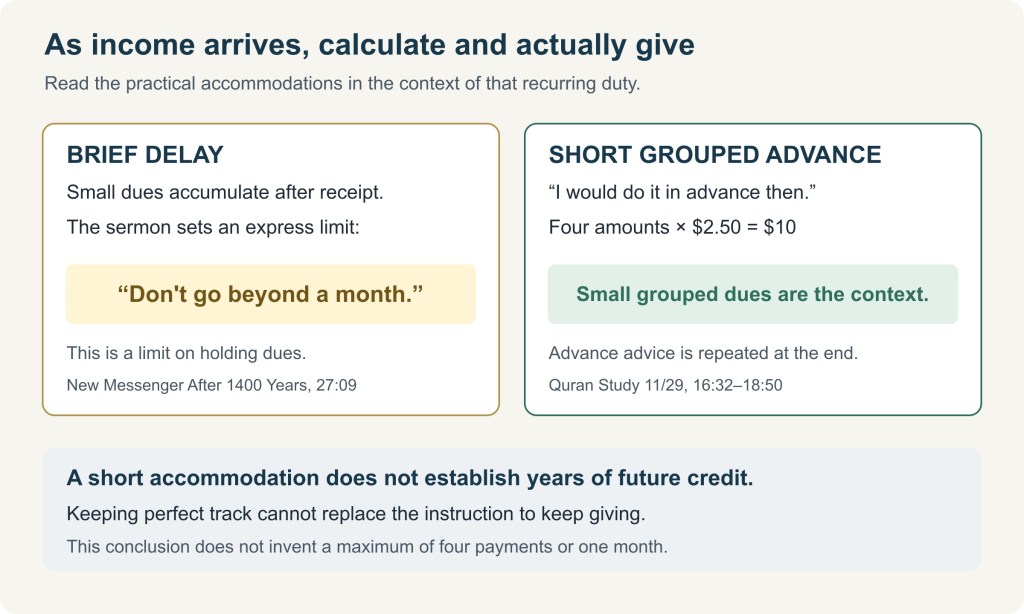
The rule governs the accommodation. The month limit concerns postponed small dues. The short grouped advance is affirmed, but it does not establish years of credit in place of recurring giving. No exact advance ceiling is supplied.
Practical Help and Fulfilment Are Different Questions
A grouped payment may be more useful to the recipient. That practical reason explains the advice; it does not authorise every scheme with a useful result. Fewer transfers, earlier help and convenient accounting can all be advantages without determining whether the arrangement fulfils the prescribed duty. The scope of a concession comes from the teaching, not from how broadly we can restate its possible benefits.
A gift can help someone without counting as the zakat due on a particular income. Appendix 15 itself distinguishes general institutional donations from zakat given through an institution specifically to help poor people. Good intent and a worthy institution do not erase the defined conditions. Timing and allocation likewise cannot be settled by the observation that the recipient benefited.
This is why a debate about practicality must not replace the question of permissibility. A large advance might be easy to afford and perfectly tracked; those facts still do not show that it substitutes for the required later giving. We should ask what in the teaching authorises that substitution. The absence of an announced maximum is not such an authorisation.
Does Giving One Day Early Automatically Count?
Suppose a monthly employee knows that a paycheck will arrive tomorrow and gives money to a needy relative today. The gift is charitable, but being one day early does not by itself mean that tomorrow’s zakat has already been paid. The ordinary rule is to calculate the zakat when the income arrives and pay it then. A departure from that rule needs the support of an applicable accommodation, not merely a short interval.
Under the contextual reading argued here, a general gift before payday remains additional charity unless it belongs to a supported zakat arrangement. Calling it “advance zakat” does not create that support. The small-dues exchange supplies a genuine example of an accepted advance; an unrelated early gift cannot simply assume the same status. The issue is the kind of arrangement being justified, not whether the date is one day, one month or one year earlier.
An approved grouped advance necessarily covers some dues before their later receipt days; otherwise it would not be an advance. It is therefore inaccurate to insist that every portion in that arrangement was physically handed over on its own harvest day. What it preserves is the income-linked duty through the demonstrated accommodation. Outside that application, tomorrow’s new income still calls for its calculated giving; yesterday’s extra generosity is not automatically deducted from it.
Why Treating an Early Gift as Zakat Is a Serious Sin
Picture someone who gives a gift the day before payday, or a large sum months ahead, and believes zakat has now been paid. Payday comes and they give nothing from it. This is much more than a mistake about dates. It does three wrong things at once.
First, it turns charity into zakat. God defined zakat and the messenger explained it: a set share of our net income, calculated carefully and given away when the income arrives. A gift outside that rule is good charity, but it is still charity. Calling it zakat gives a duty a new meaning that God never gave it. This is exactly what [9:31] and [42:21] condemn: “They have set up their religious leaders and scholars as lords, instead of God,” and “They follow idols who decree for them religious laws never authorized by God.” Writing our own version of zakat, and then calling it God’s, is writing a religious law that He never authorized.
Second, the real zakat is still unpaid. The zakat on that income is already owed, and God says to pay it on the day of harvest, the day the income arrives. The early gift was a different act, so that amount has not been paid. It stays unpaid, and because the giver believes it is settled, nobody notices and nobody fixes it. The next income then adds another unpaid due on top. Rashad warned about taking income into our pocket without taking out its zakat, saying that “apparently it is a gross crime” (Quran Study 11/29, 16:58–17:08).
Third, it teaches against the Quran. In [6:141] God says to “give the due alms on the day of harvest.” Telling people that a gift the day before, or the year before, can stand in for that day is teaching the opposite of what God said. Whoever teaches it also leads others to leave their dues unpaid. That is why this is bigger than one person’s mistake: a wrong practice becomes a wrong teaching.
None of this touches the grouped advance that Rashad approved. That warning comes inside his answer about giving small dues ahead, so it does not condemn the arrangement he recommended, and it does not name an annual prepayment. The seriousness described here follows from the three reasons above, not from that one sentence alone. It is also a judgment about the practice, not about anyone’s heart. It does not decide what a person knew or meant, and it does not say that everyone who gave early must pay twice. It says that when income arrives, the zakat on it is paid that day.
Actual Income, Calculation and Conscious Intention
In the college-support example, Rashad explains that helping a sister can count, but the giver must calculate the proportion: “So I receive this income, 2.5% is this much”, then give it and add more if desired (Quran Study 1-11-89, 50:32–50:44). He also rejects the idea that the classification happens automatically: “you have to have the intention”, and be aware that a proportion of income is being given as the obligatory charity (50:49–51:14).
So both the calculation and the intention matter. Helping someone does not automatically count as paying zakat, and deciding in our heads that a gift will cover future zakat does not make it so. The passage does not require us to tell the recipient that the money is zakat, and the Quran praises giving charity privately in [2:271].
Conscious intention identifies the act we mean to perform; it does not rewrite its conditions. Intending a gift as six years of zakat cannot by itself convert the recurring duty into a single event. Rashad’s instruction begins with receiving the income and calculating its proportion. Our intention should carry out that instruction, including an accommodation where it applies.
Keeping records helps in the same way. Notes help us work out our net income and avoid mistakes, especially when money comes from more than one source. They can also check an approved advance against the income that actually arrives. But writing a payment down only records it; it cannot make a payment count as zakat when the teaching does not allow it.
The approved grouped advance shows that an accommodated payment can cover a later due without a fresh transfer on that particular receipt day. The article’s objection is therefore to generalising that arrangement into a substitute for recurring giving. The existence of one supported accommodation is not proof that every duration and every circumstance falls within it. The governing instruction remains calculation and giving as income arrives.
Giving More and Paying Sooner Are Different Choices
The minimum is not a ceiling on generosity. But a larger percentage given for the present receipt and a larger transfer allocated against future receipts are not the same arithmetic. Suppose net income is $4,000 each month and the minimum due is $100. In month one the giver transfers $400.
If $100 fulfils that month’s due and the other $300 is additional giving, the giver still pays $100 on each of the next three receipts. Total giving over those four months is $700. If the $400 is instead treated as the current $100 plus three future $100 credits, with no further payment while the credit lasts, total giving is $400—assuming the allocation is valid. The latter delivers the same four-month minimum earlier; it does not add $300 to that minimum.
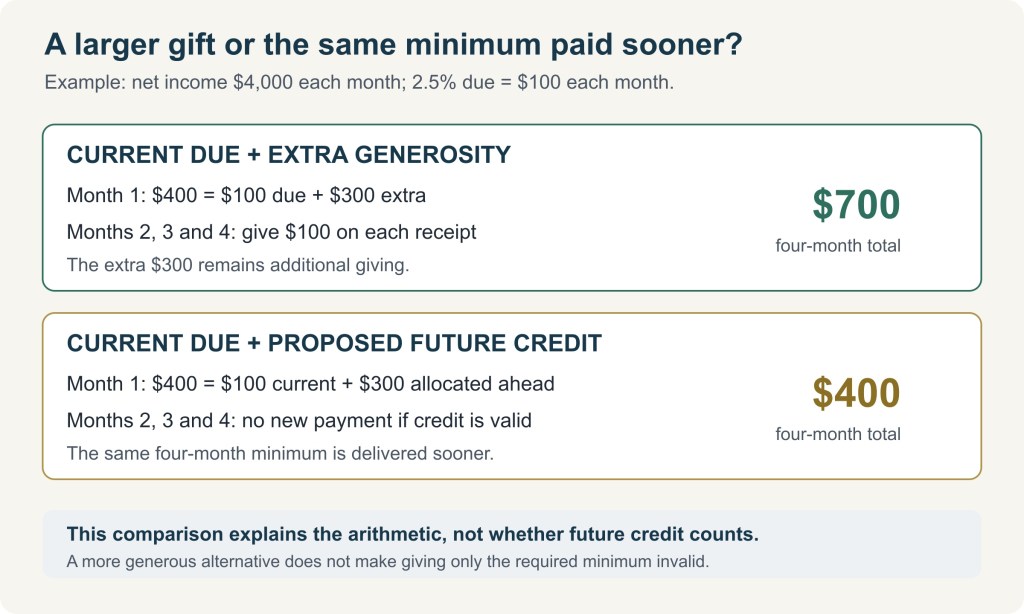
Illustrative accounting, not a ruling on credit. Under the stated equal-income assumptions, $400 now plus three later $100 payments totals $700. $400 now with three claimed future credits totals $400 if those credits count.
The same distinction applies to 50%. Half of one $4,000 receipt is $2,000, equal to twenty $100 dues. If the present month’s due is included, that is the present one plus nineteen future ones, not twenty future ones as well. The percentage alone cannot tell us whether the donor intended a much larger current gift or an advance allocation. The intention passage explains why this distinction matters.
Extra giving stays extra because it is not taken off later dues. Give more when you can afford it and people need it, and keep giving at least the minimum on each new income. The 50% example shows that 2.5% is the least we give, not a way to pay a lifetime of zakat at once. Giving more than today’s minimum does not excuse us from giving when the next income arrives.
What the Harvest Wording Establishes
The relevant Arabic in [6:141] ties the payment to the harvest:
كُلُوا مِن ثَمَرِهِۦٓ إِذَآ أَثْمَرَ وَءَاتُوا حَقَّهُۥ يَوْمَ حَصَادِهِۦ
The canonical English above says: “Eat from their fruits, and give the due alms on the day of harvest”. In the Arabic, حَقَّهُۥ and حَصَادِهِۦ mean, in a close editorial gloss, “its due” and “its harvest”. What is owed from the produce is its due, and the command is to pay that due on the day the produce is harvested. That is why Rashad applies it to the day we receive income.
Rashad’s spoken explanation makes the connection to the particular harvest explicit. He refers to the zakat charity for “that crop” and says to give it “on the day of harvest” (22:08–22:15). He then applies harvest to paychecks and instructs us to take 2.5% of net income when we receive it (22:34–23:02). The zakat comes from the crop being harvested, or the income being received, and it is paid on that day. A past donation cannot simply be assumed to cover it. This identifies which income the payment must fulfil; it does not require handing over the very same banknotes or erase the grouped-advance concession explained above.
So the rule stays the same: zakat must be carefully calculated and given on the day the income arrives, again each time new income comes. Rashad’s advance advice does not change that rule. It answers one particular situation: the questioner’s dues were tiny, and the questioner wanted to give the family a bigger, more useful amount instead. Rashad says the questioner “created the problem” by wanting the bigger amount, and rather than hold back zakat already owed, the questioner can give the grouped amount ahead of time (18:32–18:50). His example is four small dues of $2.50 making $10. He gives it “for example”, and no other example of paying ahead has been found in his recordings. This is a concession for that situation, where the giver wants to hand over a larger sum. It is not a second way of paying zakat, and having the money ready or knowing when payday will come does not turn it into a general permission to stop giving on payday.
[9:103] Take from their money a charity to purify them and sanctify them. And encourage them, for your encouragement reassures them. God is Hearer, Omniscient.
The Quran here speaks of charity purifying the people. Rashad also describes purifying income, including the example of being paid despite sleeping on the job (sermon, 27:32–28:08). His separate example of money purified once concerns a loan from funds on which the charity has already been given (Quran Study 7/27/89, 29:03–29:20). It prevents repeatedly assessing the same returned principal merely because it comes back; it does not require donating the physical banknotes from the newly received sum. The concern is identifying and fulfilling the due on that income. Purification does not make even one day early impossible, because Rashad himself advised the grouped advance; but that advance is the concession described above, not the normal rule.
What matters is the link between the income, the amount calculated on it and the giving that follows. We do not need a theory about which particular coins are handed over. And the word “purification” does not turn a past donation into payment for future zakat. The messenger’s actual instructions tell us how to apply it: give on the day the income arrives, and pay ahead only in the situation he addressed.

Annual Savings and Annual Advance Are Not the Same Arrangement
Rashad criticises paying once a year on savings in The Great Debate, 1:00:14, and contrasts the annual savings calculation with payment on receipt in Quran Study 1-11-89, 15:30–18:44. A rule assessing accumulated savings after a holding period is different from a proposal to estimate the dues on next year’s income. The two can both involve an annual date without having the same assessment base or the same defects.
A traditional report illustrates why the expression “in advance” needs context. In Tirmidhi 678, the English source presents al-Abbas asking to pay before the due time, with a parenthetical explanation referring to a whole year of possession. The cited page marks this route weak. We show the report to identify the argument being made in that literature, not to adopt it as authority for our duty.
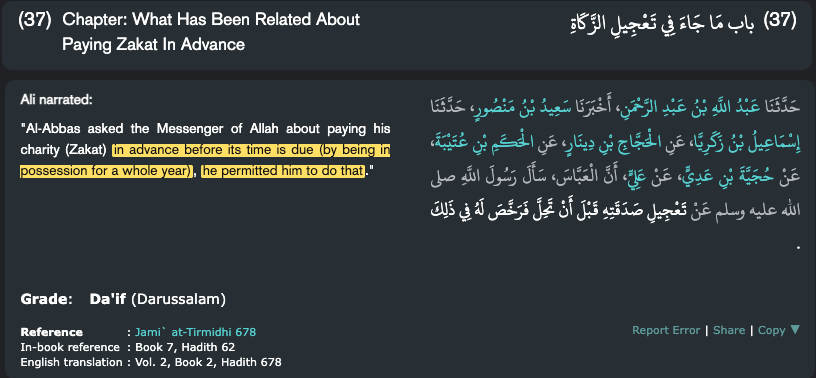
Jami` at-Tirmidhi 678, narrated from Ali. The page’s English translation includes the possession-period explanation and displays the grade Da’if (Darussalam). Yellow highlighting is added.
IslamQA’s answer 160574 gives a concrete salary-savings method: choose an annual date after reaching the threshold and assess all current savings, including recently saved salary. The later savings are treated as paid ahead of their own holding-period dates. The answer quotes Ibn ‘Uthaymeen approving “one or two years in advance”. This example concerns money already saved, rather than next year’s earnings.
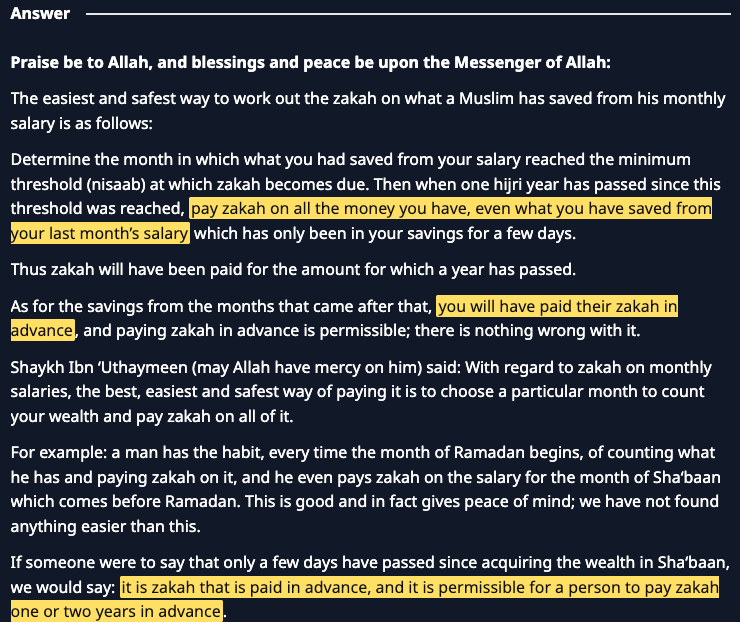
IslamQA, “How should he pay zakah on his savings from his monthly salary?” (7 July 2020). The excerpt shows the annual savings calculation and the advance language in its context. Yellow highlighting is added.
Nor is it accurate to say every Sunni pays every receipt one year late. Jordan’s General Iftaa Department, ruling 3092 (14 July 2015), treats a lunar holding year as a condition for the saved monetary wealth discussed, then requires payment when that period ends. Payment at that due date is not overdue under that rule. Egypt’s Dar al-Ifta, “Paying zakat on my salary” (23 February 2015), permits intended advance instalments as salary arrives, reconciled against annual liability. Jordan’s official Zakat Fund separately gives harvest-time payment for qualifying crops. These are descriptions of institutional rules, not a claim about every person’s conduct.
“In arrears” may mean payment after a period rather than payment already overdue. Neither meaning accurately captures every Sunni arrangement. Rashad’s criticism is broader: his January study also objects to assessing the same already-purified savings again the following year (18:13). The dispute concerns the assessment base, holding period, threshold, repeated assessment and frequency—not merely missing a date that both systems accept. Traditional advance rulings therefore cannot be imported as authority for the restored receipt-based duty.
The question about keeping track of a year follows the explanation of immediate giving and purification (sermon, 28:08–28:11). That context does not identify annual tax settlement as the problem being discussed. It reinforces his criticism of the annual arrangement; it is not an express answer about a monitored payment made a year early.
A monitored annual advance may avoid the errors of assessing savings repeatedly and may provide real help sooner. Those benefits still leave the central substitution unproved: one transfer is being used to replace recurring giving on later receipts. The teaching calls for both careful calculation and actual distribution. Correcting the accounting base does not authorise dropping the continuing act of giving.

Keeping Perfect Track Does Not Change the Rule
Give the proposed system every practical advantage: the money reaches eligible recipients, the giver intends zakat, every later receipt is measured correctly, and the balance never falls short. The objection need not depend on forgetfulness or bad arithmetic. A record of sufficient past donations is still being offered in place of later giving. That substitution is the religious claim that requires support.
The issue starts before the most dramatic examples. A two-month, six-month or annual balance does not become an established zakat method merely because it can be maintained. The proposed arrangement must fit the accommodation being invoked and the duty it serves. We should not teach a general credit system where the evidence supplies a contextual solution to grouping small dues.
Extend the same premise to six years, or 975 months—81 years and three months—with new income arriving throughout. The account may remain solvent while the giver makes no fresh transfer. Calculation continues, but regular giving whenever income arrives has been replaced. The extreme example reveals what the unlimited-credit premise permits; its failure is not that someone forgot to update the spreadsheet.
I reject that replacement of the recurring duty. The same governing principle answers the article’s annual question: a projected annual balance has not been established as a substitute for giving with actual receipts. A narrow accommodation cannot acquire unlimited scope through the absence of an exhaustive list of prohibited intervals. The definition supplies the rule against which the proposed exception must be tested.
The same discipline applies to comparisons with other worship. Rashad himself compares planning the payment to planning the afternoon Contact Prayer (15:37–15:45). Timing can be part of a duty; a larger quantity performed earlier does not by arithmetic alone fulfil later occasions. Each duty’s stated rules still govern: charity has this short advance accommodation, while Appendix 15 describes Pilgrimage as once in a lifetime. That separate lifetime rule supplies no lifetime-payment rule for the obligatory charity.
This conclusion is about how the duty is carried out, not about where any giver stands with God. It does not make help already given worthless, and it does not automatically settle every person’s past payments. We can respect generosity and still reject an unsupported way of paying future zakat ahead. Judging a practice is not judging the soul of everyone who followed it.
Read the Teachings Together
The available source search located one explicit advance-payment conversation: the small-dues grouping exchange, including its repeated and closing approvals. The month-end calculation passage addresses a separate practical arrangement. Neither presents a several-month, annual or lifetime credit procedure. This is a bounded finding from the available recordings and written material, not a claim to have recovered every statement ever made.
The argument does not depend on a search failing to find a sentence. Its positive foundation is [6:141], Appendix 15 and Rashad’s repeated instruction to calculate and give when income arrives. The practical explanations are read within that foundation. They are not a reason to reduce a defined, continuing act of worship to an eventual total.
The linked passages let the reader examine the complete exchange, including the closing allowance. Selected source-audio windows were also checked with automatic transcription; quiet and overlapping speech remains uncertain, and offsets are approximate. No disputed, inaudible objection is needed for the argument. The clearly stated rule and clearly stated permissions are sufficient.
Receipt-based giving already accommodates different livelihoods. A farmer’s harvest, an employee’s paycheck and income from trading or sales do not arrive on identical schedules; Rashad names trading, investments and sales in the January study (15:54–16:09). “Whenever” follows those actual receipts. It does not impose a fixed monthly charge when there has been no new income, and it does not let a regular wage earner disregard the receipt that has occurred.
For Regular Paychecks, Make Giving Part of Payday
[2:215] They ask you about giving: say, “The charity you give shall go to the parents, the relatives, the orphans, the poor, and the traveling alien.” Any good you do, God is fully aware thereof.
For a monthly employee paid a known net salary, the ordinary practice is clear: prepare the recipients, calculate 2.5% and give it when the paycheck arrives. Do the same with additional income when it arrives. Appendix 15 deducts government taxes, but not debts, mortgages or living expenses. This defines net income for the calculation; it does not require waiting for the government’s final annual tax settlement before giving.
- Known ordinary income: calculate its due and give on receipt. Planning ahead prepares that act; it does not replace it.
- Impractically tiny dues: apply the stated brief accumulation allowance, with its express instruction not to go beyond a month.
- Monthly calculation: calculate the month’s net income and give its proportion as described. The passage mentions common paychecks as well as monthly income; it is not expressly restricted to irregular earners.
- Grouping small payments in advance: apply the advice to the practical circumstances it addresses. Four amounts illustrate the arrangement; they are not a declared four-week maximum.
- Extra generosity: give more when you can afford it and people need it. A larger current gift does not automatically cancel what must be given from the next receipt.
- Arbitrary future credit: do not turn an affordable, carefully tracked balance into authority to replace regular giving. The method itself must fulfil the defined duty.
If an advance has already been made in good faith, its actual circumstances and allocation need examination; this article does not invent an automatic requirement to pay every amount twice. For practice going forward, keep the receipt-based duty in view and use the accommodations for the situations they address. A normal, calculable paycheck supplies the occasion to give. It is not a reason to redesign zakat as a prepaid account.

An illustration of regular giving alongside weekly receipts. The four marked dates are a household example, not an advance-payment ceiling.
Be Generous, and Be Accurate About God’s Requirement
[25:67] When they give, they are neither extravagant, nor stingy; they give in moderation.
The Quran’s praise of charity is not permission to ignore moderation or manner. [17:29] warns against both stinginess and foolish expenditure; [2:263] and [2:264] warn against insult, reproach and display. A larger or earlier payment is not automatically a universal measure of greater righteousness. Needs, means, intention and conduct still matter.
[9:79] Those who criticize the generous believers for giving too much, and ridicule the poor believers for giving too little, God despises them. They have incurred a painful retribution.
This warning rules out contempt for generous believers and ridicule of those who can give little. It does not stop us from examining a claim that one donation pays off years of future zakat. We can value the help while rejecting an interpretation that replaces the commanded giving. That is a judgment about the method, not a declaration of another person’s final standing before God.
Zakat is carefully calculated and given away on a regular basis whenever we receive income. The messenger clarified that duty, including its proportion, net-income basis, recipients and practical accommodations. Honour those explanations together. As God continues to provide, continue the prescribed giving; a concession that helps fulfil the rule is not a licence to replace it.
![Bread and an envelope delivered to a neighbour, with the exact harvest clause from [6:141].](https://quranonlystudies.com/wp-content/uploads/2026/09/zakat_day_of_harvest_advance_10_final_harvest_gift-2.jpg?w=1024)


Leave a Reply