

Zakat is worked out and given on the day income arrives, no matter how small the share. There is one concession, and it never reaches more than a month: behind, for income that cannot be totalled until the month ends, or ahead, for pay that is already known. Either way the payment is made on a payday.
The Question
Can a donation given before payday count as the zakat on the next paycheck? No. A gift on a day with no income is charity. The zakat on that paycheck is still due when the paycheck arrives, unless it falls inside the one-month concession explained below.
Rashad describes one concession to this rule. Every payment is still made on the day you get paid. What the concession changes is which month the payment is for. Take someone paid on 30 November. They can give that day for the month just finished, November, settling the dues on everything they received that month (behind). Or they can give that day for the month coming, December, paying its dues early (ahead). Either way the money changes hands on a payday, and the reach is never more than a month. The six points below explain this and show how it works for ordinary paychecks.
1. The Rule: Give on the Day You Are Paid
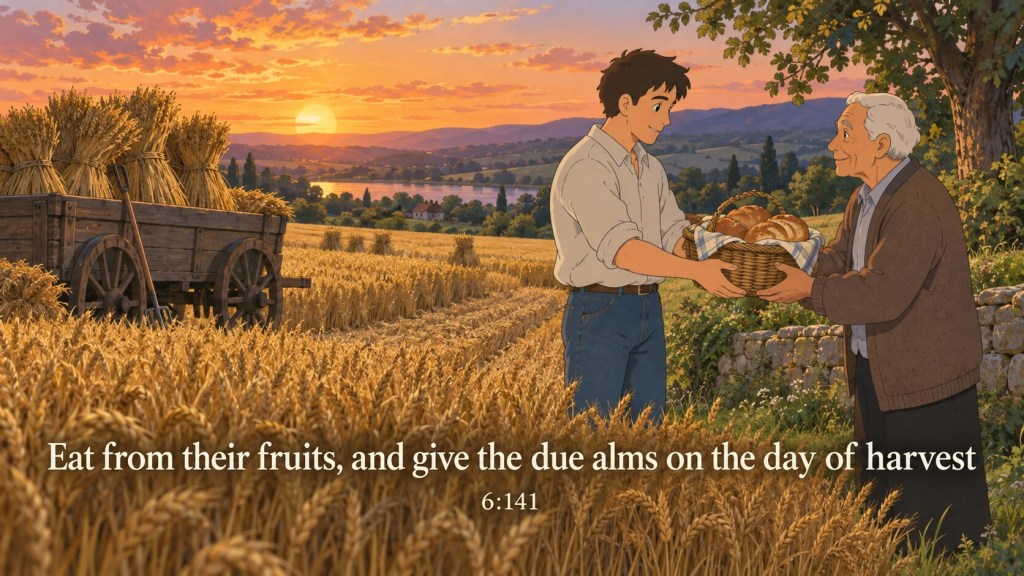
[6:141] He is the One who established gardens, trellised and untrellised, and palm trees, and crops with different tastes, and olives, and pomegranate —fruits that are similar, yet dissimilar. Eat from their fruits, and give the due alms on the day of harvest,* and do not waste anything. He does not love the wasters.
The verse tells us to give the due on harvest day. Its footnote applies that instruction to receiving income and identifies 2.5% of net income as the proportion. Appendix 15 says:
“Zakat must be carefully calculated and given away on a regular basis whenever we receive any income.”
This is the definition of zakat, and a payment must have all three qualities to be zakat: it is carefully calculated, given away whenever income arrives, and it is given regularly. Each time income arrives we calculate the share and we give it. Writing the share down against an old balance keeps the calculation but skips the giving. A farmer with one harvest a year gives once a year because that is when the income comes. A wage earner is paid every month, so the giving is monthly too.
Rashad applies the harvest to paychecks: give when the paycheck arrives (sermon, 26:18–26:26). He says the same for the smallest share, “no matter how small” (Quran Study 11/29, 15:26–16:11). It is a duty, not a bookkeeping preference. The concession below helps two kinds of earner keep that duty; it is not a way around it.

2. Behind: Settle the Month on Its Last Payday
The rule does not bend for small amounts: the share is given on the day, no matter how small. The concession behind is for a different problem, income that arrives in irregular amounts. A contractor or a delivery driver is paid several times a month in sums they cannot predict, and even the tax on that income is only an estimate until the month closes. They cannot know the month’s net figure, so they cannot calculate its share, until the month ends. Rashad’s advice fits them: wait a month to know what the monthly income is, then calculate and give (I Thought I Was Doomed, 23:02–23:19).
The sermon sets the limit on that waiting. Dues may accumulate for a couple of weeks or a month, and then: “Don’t go beyond a month” (sermon, 27:09–27:20). So the irregular earner holds the month’s receipts and, on the last payday of the month, when the figure is finally known, gives 2.5% of the month’s net that same day. Paid on 30 November, they give November’s share on 30 November. The payment is still made on a day income arrives, and it never reaches back more than a month. If your pay is a known fixed amount, there is nothing to wait for: give its share on the day.
3. Ahead: Rashad Says “Do It in Advance”
In Quran Study 11/29, 16:32–16:46, a questioner mentions $1.50 or $2.50 dues, two or three weeks, and a more useful sum of about $10. Rashad answers:
“I would do it in advance then.” (16:48–17:15)
His example is “four times for example two and a half would be ten dollars”. He later mentions $20 given ahead as a lump sum (17:35–17:49). The aim is to send a sum that is actually useful, without holding back dues that have already arrived.
For weekly pay it works like this: on today’s payday, give today’s $2.50 together with the next three weeks’ $2.50, so $10 goes out today. This only works because the pay is a fixed, known amount: the next three dues can be calculated today. It is paid on a day of harvest and reaches no more than a month ahead, the same month the sermon allows behind. It does not turn a donation on some other day into payment of a later paycheck’s zakat.
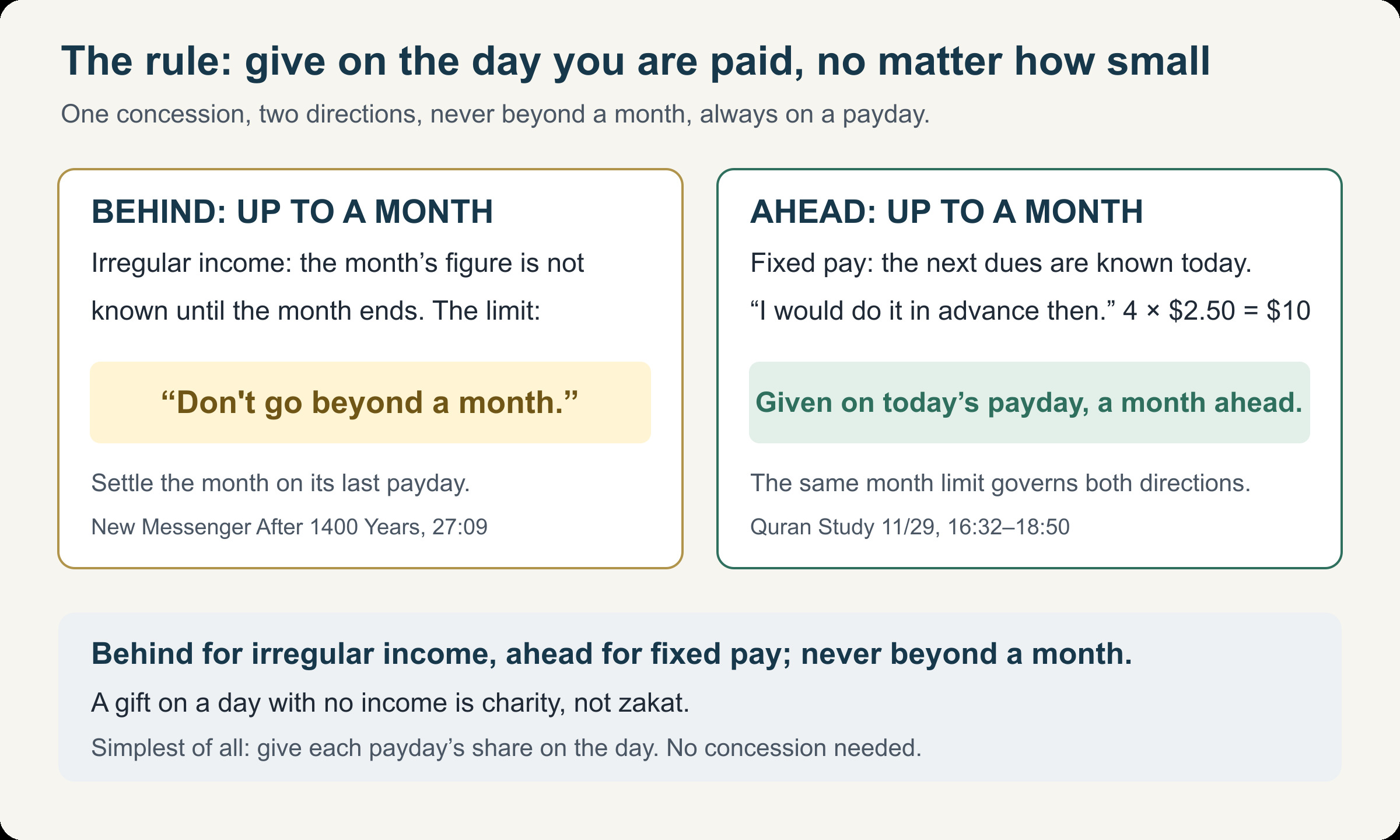
One rule, one concession. Every payment is made on a payday. Behind, for irregular income, the month is settled on its last payday. Ahead, for fixed pay, up to a month of coming dues may be given today. Neither reaches beyond a month, and a gift on a day with no income is charity, not zakat.
4. “A Big Lump Sum Is Fine” Means the Same Month, Not a Year
The talk then moves to the minimum, to giving as much as 50%, and to what the giver can afford (18:02–18:28). Rashad says the questioner created the problem by wanting to give a larger amount (18:32), and then says:
“If you want to give in advance, if you want to give a big lump sum, that’s fine. The two and a half percent is a minimum.” (18:43–18:50)
This is still the same conversation about tiny dues. The “big lump sum” is the four small dues grouped together and given on today’s payday, inside the month. It is not permission to prepay a year. Rashad is answering the question in front of him, not opening a running balance against income that has not arrived.
Rashad had just said the questioner created the problem by wanting to give a larger amount. The advance is a sound way through that problem, and it keeps the rule exactly. But the simplest course has no problem to solve at all: give each week’s $2.50 on the day it is paid.
Grouping is allowed because it is useful. But usefulness is not what makes a gift zakat. A gift can meet a real need and still be extra charity. What matters is whether it was given on a payday, within the month.
Giving more today is one thing. Counting today’s gift against next year’s income is another. A 50% gift today does not pay a due that has not arisen. The 2.5% tells us how much; the day of harvest tells us when.
5. Good Records Do Not Make an Early Gift Zakat
Rashad asks for calculation and clear intention in the example of helping a sister through college (Quran Study 1-11-89, 50:32–51:14). Helping her is not automatically zakat; the giver must intend the 2.5% as zakat. The intention need not be announced to her. But intention alone cannot turn any gift, on any day, into zakat for income that has not yet come.
The grouped advance covers the next few small dues, so those weeks need no second payment. That is what the concession does. It does not make every earlier donation zakat. A gift the day before a known salary lands is given on a day with no income; it is charity, and that salary’s zakat is still given on the day it arrives.
So a yearly balance, or unrelated gifts on earlier days, do not replace the zakat due as each paycheck arrives. Good records show what you gave. They cannot make a different timetable satisfy the day-of-harvest rule.

6. Once a Year Is Wrong for More Than One Reason
The sermon says people need help now and cannot wait a year (26:47–26:53). Prepaying a year avoids the delay, but lateness is only part of the objection. The footnote to [6:141] rejects giving only once a year. The January study also objects to counting the same purified savings a second time (18:13). What is wrong is the yearly base, the long hold and the once-a-year rhythm, not just the amount on savings.
The question about keeping track over a year (28:08–28:11) comes right after purification and giving at once; it is not about tax returns or paying a year ahead. Appendix 15 deducts government tax to reach net income. It does not say to wait for the tax to be settled before giving.
It would be unfair to say every Sunni pays a year late. Jordan’s General Iftaa Department treats a full year of holding as the condition before money becomes liable. Egypt’s Dar al-Ifta allows salary-time advances, made with that intention, with a yearly reconciliation. Jordan’s Zakat Fund sets harvest-day payment for qualifying crops. “In arrears” can simply mean “after the period”, not “overdue”. Neither sense fits every Sunni practice.
The restored duty is a “continuous flow of money” (Essentials of Submission, 15:06). Early help is good, but it does not pay the zakat on each new paycheck. The instruction is to keep giving as God keeps providing.
Keep Giving as God Provides
[2:215] They ask you about giving: say, “The charity you give shall go to the parents, the relatives, the orphans, the poor, and the traveling alien.” Any good you do, God is fully aware thereof.
- Paid today: work out 2.5% of the net amount and give it today, no matter how small. This is the rule.
- Behind: irregular income. Hold the month’s receipts and give the month’s share on its last payday, when the figure is known. Never beyond a month.
- Ahead: fixed, known pay. On today’s payday you may add up to a month of coming dues: today’s $2.50 plus the next three weeks’ $2.50.
- Boundary: a gift on a day with no income is charity, not zakat. Do not deduct earlier donations from later zakat just because they were early.
Rashad’s purification example even covers being paid despite sleeping on the job (sermon, 27:32–28:08). The point is that the due is on the income, not on particular banknotes. Purification does not cancel the timing rule or its one concession.
A past advance does not buy a lifetime exemption. Rejecting that exemption does not mean every earlier gift must now be paid twice either. Keep assessing each paycheck and make good any shortfall you find. Each person’s past giving needs its own honest look; a fresh voluntary gift is not the same as a proven Zakat debt.
Give more when you can, with moderation and without insult or display ([25:67]; [2:263]; [2:264]). The size of a gift does not decide what it is. A donation on a day with no income, outside the one-month concession, is charity, not the zakat on the next paycheck.
[9:79] Those who criticize the generous believers for giving too much, and ridicule the poor believers for giving too little, God despises them. They have incurred a painful retribution.
We can admire generosity and still tell it apart from zakat. This is about the practice, not about anyone’s sincerity or standing before God. When income arrives, work out its share and give it that day. If your income cannot be totalled until the month ends, settle it on the month’s last payday. If your pay is fixed, you may give the coming month early. Neither reaches beyond a month, and the plain rule, giving on each payday, needs no concession at all.
Source note: The four grouped amounts are the only advance period Rashad names, and the sermon’s “don’t go beyond a month” is the only number he gives as a limit. Read together: every payment is on a payday, and no payment reaches more than a month ahead or behind. Neither recording says “four weeks”; the shared one-month limit is our reading of the two passages together. The monthly-calculation passage (“wait like a month, to know what our monthly income is”) gives the reason for holding; it mentions ordinary paychecks, so we say the concession behind is typically, not only, for irregular income. The sermon’s month limit is spoken about small amounts; we read it as the limit on any holding. Quotations were checked against a high-quality automatic transcript as well as the older corpus; this is not complete independent listening, and quiet or overlapping speech remains uncertain.


Leave a Reply