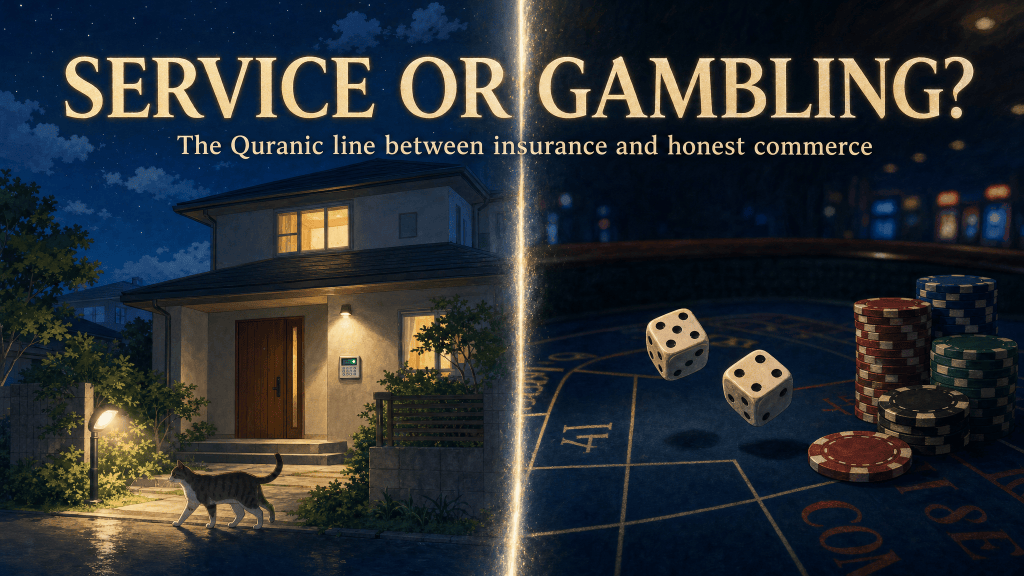
Correction — 17 September 2026: The earlier version of this article treated roadside labour as automatically different from insurance and therefore exempted ordinary AA breakdown membership. That was too broad. Insurance can discharge its promise through repairs, towing or replacement rather than cash. This revision withdraws that blanket AA exemption and distinguishes an actual service purchase from a contract covering the consequences of an uncertain adverse event. The prohibition concerns the substance of insurance; subscription billing and services are not prohibited in themselves.
The Question at the Gate
A brother in our community described a monitored alarm service: sensors at home, a control room watching the signal, and responders dispatched when assistance is needed. He pays a subscription even in quiet months, when the alarm may be triggered only by the cats. His concern was understandable: if nothing happens, what has he bought? The discussion widened to AA breakdown cover and Tesla’s Windshield Protection Plan.
Three products can all be advertised as protection and all be paid monthly, while promising different things. One supplies monitoring throughout the month. Another pays for a repair already ordered. A third undertakes to bear a covered repair or recovery cost if a future breakdown or impact occurs. We must examine that promise, rather than let the words membership, service or protection answer the religious question for us.
God prohibits gambling and permits honest commerce. Rashad Khalifa expressly included insurance in the prohibition, while recognising compulsion. Applying that teaching to modern products requires both fidelity to his words and an accurate account of the contract. The AA conclusion below corrects our earlier application; it does not invent a newly discovered statement by Rashad about the AA or Tesla.
Part 1: What God Actually Prohibited
Benefits Do Not Cancel a Prohibition
[5:90] O you who believe, intoxicants, and gambling, and the altars of idols, and the games of chance are abominations of the devil; you shall avoid them, that you may succeed.
[5:91] The devil wants to provoke animosity and hatred among you through intoxicants and gambling, and to distract you from remembering God, and from observing the Contact Prayers (Salat). Will you then refrain?
[2:219] They ask you about intoxicants and gambling: say, “In them there is a gross sin, and some benefits for the people. But their sinfulness far outweighs their benefit.” They also ask you what to give to charity: say, “The excess.” God thus clarifies the revelations for you, that you may reflect,
The Quran acknowledges benefits while maintaining the prohibition. It would therefore be a mistake to argue that a product must be lawful because it helps someone after a loss. Equally, these verses do not say that every payment connected with an uncertain future is gambling. A farmer, a shopkeeper and a person hiring a guard all face uncertainty without that fact alone settling the character of their transactions.
What the Messenger Said About Insurance
In Messenger Audio 32, Rashad illustrates his objection by describing a person paying a $200 insurance instalment and receiving $100,000 the next month. He calls it a game of chance. The example makes his insurance objection clear, but it does not establish that cash settlement, a particular payment ratio or profit after a loss is a necessary condition of the prohibition. (Messenger Audio 32, 14:13)
In the Ray Catton interview, he identifies insurance with gambling and also criticises reliance on it as inconsistent with confidence in God. He then expressly makes allowance for a person compelled by circumstances, without deliberate or malicious intent. Both the objection and the qualification must remain in our account. (Interview with Ray Catton, 44:49)
When discussing compulsory motor insurance, he says, “We will not buy insurance unless we have to.” His subsequent explanation applies the compulsion allowance. This article does not direct anyone to cancel cover required by law or ignore an actual compulsory obligation; the distinction between an optional purchase and genuine compulsion remains material. (Messenger Audio 28.1, 9:16–10:02)

Part 2: The Contract, Not the Form of Payment
Cash, Repairs and Replacement Can Fulfil the Same Promise
Suppose two companies sell protection against accidental windscreen damage. After a covered impact, one reimburses the glass bill; the other sends its own technician and fits the replacement. Both can undertake to meet the same uncertain repair expense in return for an advance charge. Making the customer whole through labour and materials does not automatically turn the second agreement into an ordinary purchase of scheduled work.
The practical question is: what obligation is the customer buying? Is it an identifiable service delivered throughout the agreed period, a specified job bought in advance, or an undertaking to absorb a covered expense when a specified adverse event occurs? A loss-covering obligation may have limits, exclusions, deductibles or a requirement to use the provider’s own staff. None of those features, by itself, removes its contingent character.
Why the Earlier Tests Failed
The earlier version overstated Rashad’s illustration by turning it into a complete definition: money staked for a disproportionate cash prize. It then suggested that an insured person profits from, or must hope for, misfortune. That is unsound. Insurance often merely offsets part of a real loss, and a person can sincerely hope never to claim. A car repaired after a crash is not evidence that its owner wanted the crash.
Nor is it accurate to say insurers perform no productive work. Claims staff, engineers and repairers do real work. The question is what the purchaser has contracted for, not whether anyone in the delivery chain works hard. Mutual consent, useful labour, a standing fleet and a modest claim amount cannot each serve as an automatic exemption from a prohibited contractual arrangement.

Part 3: What God Permits — The Dignity of Commerce
Payment for Work Remains Lawful
[4:29] O you who believe, do not consume each others’ properties illicitly— only mutually acceptable transactions are permitted. You shall not kill yourselves. God is Merciful towards you.
[28:26] One of the two women said, “O my father, hire him. He is the best one to hire, for he is strong and honest.”
Paying for honest work is not made unlawful by paying monthly, annually or in advance. A mechanic may charge for a booked service; a guard may be paid to watch a building; a monitoring company may charge for continuously receiving and investigating alarm signals. Quiet periods do not make their work fictitious. The customer has received the agreed work or availability under the actual service obligation.
However, general permission for commerce is not a device for overriding a specific prohibition. Two consenting parties can enter a prohibited agreement, and a seller can combine lawful services with a separate loss-covering promise. We must identify each material obligation rather than infer that every benefit in a subscription has the same status.
A Genuine Prepayment Is Different from Cover
The distinction becomes clearer with concrete alternatives. Paying £200 now for a particular scheduled inspection is a purchase of work. Keeping £200 in a repair account, with the customer bearing any additional bill, is not the same promise as a provider agreeing to meet an uncertain covered bill beyond that balance. Paying a retainer for access while paying separately for the actual repair can also differ from buying cover against its cost.
The Financial Conduct Authority’s guidance distinguishes prepaid services, scheduled maintenance and some retainer arrangements from contracts of insurance; the details and substance control the result. Its legal analysis helps us describe the transaction accurately. It does not itself issue the religious ruling. (Source: FCA Handbook, PERG 6.6.3–6.6.5)
![Verse card over an accountant's desk with balance scale and ledger: 'God permits commerce, and prohibits usury.' [2:275]](https://quranonlystudies.com/wp-content/uploads/2026/09/service_or_gambling_03_commerce_verse.png?w=1024)
Part 4: The Guard Who Never Fights
Monitoring Is Something Received in a Quiet Month
A staffed alarm-monitoring service can supply an ongoing preventive service whether or not a burglary occurs. Receiving sensor signals, checking alerts and maintaining communications are actual activities. Likewise, hiring a guard for a shift buys that guard’s attendance and duties, even if nobody attempts an entry. Uncertainty about whether a threat will arise does not by itself turn these purchases into insurance.
On the facts originally described, the brother’s continuous monitoring service is therefore permissible in principle. That conclusion rests on the continuing service being bought, not on the absence of a cash payment. We have not inspected his actual agreement, so we cannot certify every response obligation, guarantee or bundled benefit it may contain.
Readiness Alone Is Not an Exemption
An insurance provider also maintains readiness: it employs staff, operates a telephone line and arranges assistance. Calling that infrastructure a service does not settle what the customer is buying. A response-only agreement that promises to absorb an uncertain emergency expense requires scrutiny, even if the provider sends its own people. A monitoring subscription with a burglary-loss guarantee similarly contains a separate promise that must be assessed.
The correct comparison is between an actual ongoing or specified service and cover for the consequences of a future adverse event. It is not between a company with workers and a company with money. Prevention, detection, response and indemnity can be combined in one brochure; the contract must show which of them the fee purchases and on what terms.

Part 5: Pricing Risk Does Not Settle the Question
A security company may charge more where guards need more time or face greater danger. A mechanic may charge more for difficult work, and a courier more for a demanding route. A price reflecting risk is therefore not sufficient to establish insurance. Conversely, an identical price for every subscriber does not prove the absence of it.
Frequency of billing is equally inconclusive. A subscription is a payment arrangement: it can pay for software, monitoring, maintenance or loss cover. The provider’s label and its use of subcontractors rather than employees are also secondary. The operative promise, the covered trigger, the benefits and the allocation of the resulting expense carry the analysis.
Part 6: Does AA Breakdown Cover Qualify?
Yes — Ordinary Breakdown Cover Is Not Exempt Just Because a Patrol Comes
HM Revenue & Customs addresses precisely this misconception. Its insurance-premium-tax guidance identifies AA and RAC roadside assistance as insurance, including where assistance is provided in kind through roadside repairs. That directly defeats our earlier assumption that a van and a mechanic necessarily place the arrangement outside insurance. (Source: HMRC, IPT03730: roadside assistance)
The AA’s own current breakdown terms, dated April 2025, identify insurers for Roadside Assistance, At Home and National Recovery. These are not merely garage-bill add-ons sitting beside a universally exempt core membership. The operative roadside and recovery benefits themselves form part of the insurance arrangement described by the document. A customer’s actual certificate and terms remain necessary to identify their particular product. (Source: The AA, UK Breakdown Cover Terms and Conditions, April 2025)
The corrected answer is yes: ordinary optional AA breakdown cover falls on the prohibited side of this article’s insurance reasoning. Its assistance is contingent on a covered breakdown, and delivering that benefit through a patrol or recovery vehicle does not provide an exemption. This is our application of Rashad’s insurance teaching to the documented product, not a quotation of him naming the AA.
This does not condemn everything the AA sells. Purchasing an inspection, paying for a repair after it is needed, or buying a genuinely specified maintenance service presents a different contract. Nor does the conclusion automatically decide every employer-provided, bundled or compulsory arrangement. The brand is not the unit of judgment; the actual agreement and the person’s circumstances are.
Tesla’s Windshield Protection Plan
Tesla’s US terms, revision R5 dated July 2026, promise repair or replacement for specified road-hazard windscreen damage. Its operative benefit is repair or replacement after covered road-hazard damage, rather than scheduled upkeep. The same terms include a Missouri provision saying the agreement is not an insurance contract. That legal designation must be reported honestly rather than erased to force a uniform statutory label. (Source: Tesla, Windshield Protection Plan Terms and Conditions, R5, July 2026)
The religious comparison concerns the substance: an optional advance payment for a provider to meet a covered future damage expense through repair or replacement. On the reasoning developed here, that belongs with prohibited loss cover rather than ordinary maintenance. This is an inference about the documented US plan, not a claim that every jurisdiction legally classes it as insurance or that Rashad spoke about Tesla. A different country’s plan must be checked against its own wording.
An ordinary warranty remedy for a seller’s defective product is a different starting point: the seller is answering for the quality it was already obliged to supply. It must not be casually equated with a separately purchased plan covering future accidental damage. Equally, attaching the word warranty to an optional extension does not decide the issue; its actual promise still needs examination.
Part 7: Fear, Trust and Taking Precautions
[4:71] O you who believe, you shall remain alert, and mobilize as individuals, or mobilize all together.
[12:67] And he said, “O my sons, do not enter from one door; enter through separate doors. However, I cannot save you from anything that is predetermined by God. To God belongs all judgments. I trust in Him, and in Him shall all the trusters put their trust.”
Jacob’s precaution and his trust appear together. Taking practical steps does not give those steps independent control over the outcome. We can maintain a car, fit an alarm, hire someone to monitor it and save toward repairs without imagining that we govern God’s decree. The fact that something is prudent or reassuring, however, does not on its own make every contract used to obtain it lawful.
We should also avoid judging another person’s heart from a product name. A person may have accepted cover through ignorance, compulsion or a different understanding of the terms. The task here is to clarify the agreement and apply the teaching consistently. It is not to claim that everyone who buys insurance desires a loss, or that anyone who suffers an accident has thereby been shown faithless.
Part 8: Where the Line Runs
Read the agreement in this order: identify what is owed during an uneventful period; identify what additional obligation is triggered by damage or breakdown; establish who bears the resulting cost; and separate any maintenance, monitoring or ordinary defect remedy from the loss-covering promise. Look beyond the payment schedule. A cash benefit and an in-kind benefit can discharge the same obligation.
The comparison below is a guide to that examination, not a substitute for reading exclusions, limits and any compulsory conditions. It deliberately removes the earlier cash-versus-labour and “profit from calamity” tests. The decisive question is the nature of the contractual undertaking.
| Arrangement | What is purchased | Conclusion in this article |
|---|---|---|
| Scheduled maintenance or a specified prepaid repair | Defined work; payment may precede delivery. | Permissible service in principle. |
| Continuous monitoring or a hired guard | Ongoing preventive work, including quiet periods. | Permissible in principle; inspect separate cover or response-only promises. |
| Retainer plus separately paid actual repairs | Access or availability, with the customer retaining the repair expense. | Can be an ordinary service; verify the full terms. |
| Optional AA breakdown cover | Covered assistance after breakdown; performance in kind. | Insurance; not exempt because a patrol performs work. |
| Tesla US windscreen road-hazard plan | Repair or replacement following covered damage. | Prohibited loss cover by application of the teaching; statutory labels vary. |
| Ordinary seller defect warranty | Remedy for the quality the seller owes. | Distinguish from separately purchased accidental-damage cover. |
| Compulsory insurance | Insurance obtained under genuine compulsion. | The compulsion allowance remains; do not disregard legal obligations. |
Insurance regulation and religious judgment answer different questions. Official terms and guidance establish what a product does and how it is treated in their jurisdiction; they do not pronounce God’s ruling. Our conclusion follows by applying Rashad’s stated objection to optional insurance to those established facts. We have no verified product-specific ruling from him on the AA or Tesla, and present none.
This correction belongs beside our related work on day trading and speculation, games of chance in the digital age, and the pull system of trust. It replaces this article’s earlier blanket permission for AA membership. The aim is consistency in applying the prohibition, including the willingness to correct a distinction that the actual contracts do not support.
Conclusion: Buy the Service, Examine the Promise
The brother’s quiet-month concern still has a sound answer: continuous monitoring can be a real service even when no intruder appears. But that answer cannot automatically be carried over to every emergency assistance plan. Standard AA breakdown cover is insurance, despite its patrols; the examined Tesla plan similarly covers a contingent damage expense, despite supplying glass and labour rather than cash. Neither subscription billing nor useful work supplies a blanket exemption.
Take precautions, pay fairly for actual services and examine what a protection contract undertakes to bear. Preserve the allowance for compulsion, and distinguish a legal label from a religious application. Our confidence belongs in God, and our explanation of a contract must be honest enough to survive reading its terms.



Leave a comment