Scripture · Manuscripts · Confirmation

Early manuscripts give us a history we can examine. The Quran gives us God’s promise. Its mathematical sign and the Messenger of the Covenant confirm the revelation we are called to follow.
1. Start with the question in the video
In the discussion that prompted this article, one speaker defends the Quran’s preservation by pointing to agreement among mosques today. The other repeatedly asks for manuscript evidence: which early copies survive, where they are kept, and who wrote them. The defender acknowledges that his knowledge of manuscripts is limited and returns to present agreement. The exchange raises a fair historical question, even though it never supplies the evidence needed to answer it. (Source: the original Digital Social Hour debate on YouTube, starting at 1:40:46.)
A visit to present-day mosques can demonstrate something about present practice. Establishing earlier transmission requires earlier evidence, so we should welcome the request for manuscripts and answer it concretely. At the same time, failing to name an ancient copyist does not establish that his text was corrupted. A manuscript’s date, wording and relationship to other copies can be investigated even when its writer left no name. The strength of an argument is determined by the evidence available, rather than by one participant’s ability to recall a catalogue entry during a debate.
Our answer therefore begins with actual surviving pages, then asks what their agreement and differences mean. We will examine Birmingham, an early Quran fragment at Chester Beatty, and the substantial Topkapi codex; we will also face the difficult Sana’a evidence. Finally, we will explain why God’s mathematical sign and His confirming messenger settle the question of the authorized revelation for us. Each part contributes to the same conclusion, while answering a distinct question.
[17:36] You shall not accept any information, unless you verify it for yourself. I have given you the hearing, the eyesight, and the brain, and you are responsible for using them.
2. God promises to preserve His revelation
Preservation begins with God’s commitment to His own message. The Quran does not ask us to rest our confidence on the supposed perfection of every printer, collector or copyist. It locates the guarantee in the Author of the revelation, who knows what He revealed and can expose what people introduce. The promise is direct:
[15:9] Absolutely, we have revealed the reminder, and, absolutely, we will preserve it.*
[41:42] No falsehood could enter it, in the past or in the future;* a revelation from a Most Wise, Praiseworthy.
The practical question is what this promise protects. A person can mistype a verse, misprint a page or insert words into a document labelled “Quran”; that physical act cannot make the addition God’s revelation. Preservation means the divine text remains identifiable and available, and that attempts to confuse it with human material can be recognized and removed. The footnotes to [15:9] and [41:42] explain the mathematical code’s role in that protection. This is why the distinction between the revelation and a particular physical copy matters from the beginning.
God also assigns the collection of the Quran to Himself in [75:17]. Human beings participate in writing, learning and circulating the text, but the final authority over it remains divine. Historical research asks how those human activities appear in the surviving record; the Quran tells us whose message they were carrying and who guarantees its preservation. A convincing explanation joins these questions without making a museum catalogue pronounce on divine authorship, or making a promise stand in for examining a photographed page.
[75:17] It is we who will collect it into Quran.
3. How manuscripts carry a history
A manuscript is a physical witness: parchment or paper carrying ink, often with signs of use, repair and correction. Its present location tells us where to inspect it, while a shelfmark distinguishes it from other objects in the same collection. A folio is a leaf with two sides, conventionally labelled recto and verso, abbreviated “r” and “v.” Identifying those details lets another reader check whether a claimed passage really appears on the page being shown.
Dating also needs a stated method. Radiocarbon testing estimates when the animal that supplied parchment died; the writing was added afterwards. The study of handwriting, page design and material construction can help assess when a copy was produced, but a range is not an exact year. Likewise, an attribution to a famous early owner requires evidence of its own. We can recognize a manuscript’s considerable historical value while remaining precise about which of these questions has been answered.
The Arabic comparisons below use modern normalized text and the verified English translation in The Final Testament. Normalization supplies the familiar modern spelling and reading signs for comparison; it is not a claim to reproduce every ancient stroke. The photographs show the artifacts, while the adjacent text helps an English reader recognize the passages. Where a witness has corrections or a different form, that must remain part of the discussion.
| Witness | What is being examined | What it contributes |
|---|---|---|
| Birmingham, Mingana Islamic Arabic 1572a | Two early parchment leaves; folio 2r shown below | An early material witness to familiar passages |
| Chester Beatty, Is 1615 II | A four-folio fragment; folio 3r shown below | A separately preserved early witness, with a published transcription |
| Topkapi, H.S.44/32 | An almost complete eighth-century codex; folio 253v shown below | Continuity across a much larger surviving text |

4. Birmingham: a very early material witness
The Birmingham Quran manuscript is held by the University of Birmingham’s Cadbury Research Library under the shelfmark Mingana Islamic Arabic 1572a. Its two leaves preserve portions of chapters 18, 19 and 20. The parchment returned a calibrated radiocarbon range of 568–645 CE at 95.4% confidence. This is important material evidence, but it dates the parchment rather than directly testing the age of the ink. The university also says that the scribe and place of production cannot be identified with certainty. (Source: University of Birmingham, manuscript FAQs.)
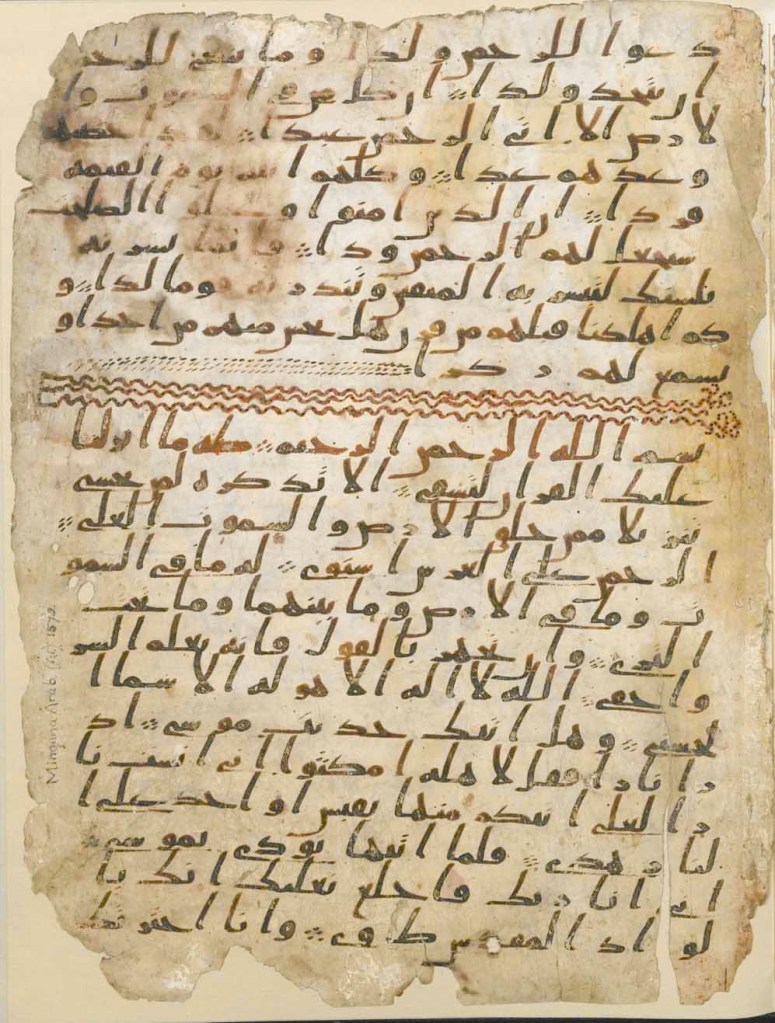
Birmingham Quran, Mingana Islamic Arabic 1572a, folio 2r. Photograph: Cadbury Research Library, University of Birmingham. The decorated separation marks the transition from chapter 19 to chapter 20.
On this page, the transition is a useful point of recognition. The opening of chapter 20 follows the separation, beginning with its two initials and continuing with the explanation that the Quran was not revealed to impose hardship. The comparison gives the opening five verses, rather than asking the reader to accept a claim of similarity from the photograph’s age or appearance. A familiar chapter beginning survives in a very early physical witness.
| Verse | Modern normalized Arabic | The Final Testament |
|---|---|---|
| [20:1] | طه | T. H.* |
| [20:2] | مَآ أَنزَلْنَا عَلَيْكَ ٱلْقُرْءَانَ لِتَشْقَىٰٓ | We did not reveal the Quran to you, to cause you any hardship. |
| [20:3] | إِلَّا تَذْكِرَةً لِّمَن يَخْشَىٰ | Only to remind the reverent. |
| [20:4] | تَنزِيلًا مِّمَّنْ خَلَقَ ٱلْأَرْضَ وَٱلسَّمَٰوَٰتِ ٱلْعُلَى | A revelation from the Creator of the earth and the high heavens. |
| [20:5] | ٱلرَّحْمَٰنُ عَلَى ٱلْعَرْشِ ٱسْتَوَىٰ | The Most Gracious; He has assumed all authority. |
This establishes more than the observation that contemporary communities possess similar books. We have an inspectable ancient page carrying the recognizable sequence of the passage itself. Its historical force does not depend on inventing the copyist’s identity, treating the earliest possible radiocarbon date as the date of writing, or extrapolating from two leaves to an entire lost codex. The correct conclusion is specific and substantial: the surviving material anchors this passage in the early manuscript record.
5. Chester Beatty: a readable early fragment
“The Chester Beatty manuscript” can refer to very different objects, so a shelfmark is essential. The early Quran witness used here is Is 1615 II, represented in the Corpus Coranicum catalogue as manuscript 418. Its current record estimates 640–700 CE and identifies a four-folio fragment. The photographed side, folio 3r, contains material from [94:1] through [97:4], including the opening of chapter 96. That scope makes it a valuable witness to these passages, without turning a small surviving fragment into a complete Quran.
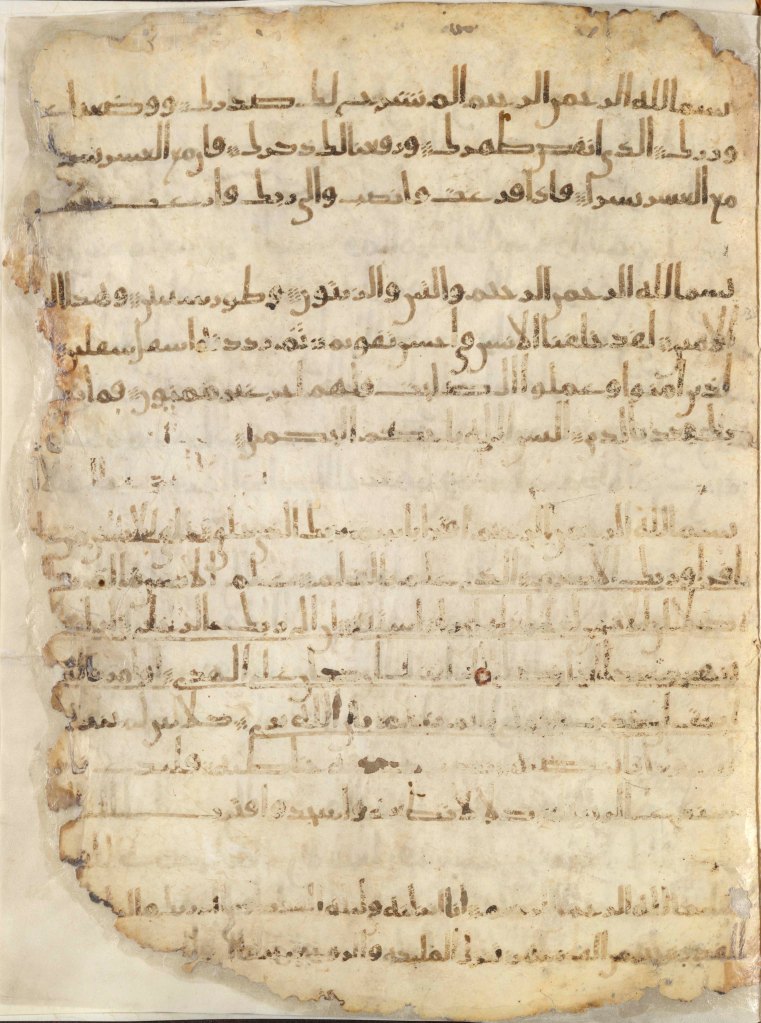
Chester Beatty Is 1615 II, folio 3r, Corpus Coranicum. Photograph © Trustees of Chester Beatty Library, Dublin. The page includes [96:1–5]; its published transcription locates that passage across lines 10–11 and records editorial and variant information.
Three short verses make the connection particularly accessible. They move from the instruction to read, to teaching by the pen, to the knowledge imparted to the human being. The Arabic below is the modern normalized reading, not a substitute for the catalogue’s detailed transcription. That transcription includes corrections and variant forms, including around [96:2]; those details should remain visible when an exact spelling claim is tested.
| Verse | Modern normalized Arabic | The Final Testament |
|---|---|---|
| [96:3] | ٱقْرَأْ وَرَبُّكَ ٱلْأَكْرَمُ | Read, and your Lord, Most Exalted. |
| [96:4] | ٱلَّذِى عَلَّمَ بِٱلْقَلَمِ | Teaches by means of the pen. |
| [96:5] | عَلَّمَ ٱلْإِنسَٰنَ مَا لَمْ يَعْلَمْ | He teaches man what he never knew. |
The comparison supports continuity of an identifiable passage in a separately preserved early witness. It also shows why careful research works at the level of an actual object and a specified line, rather than treating every item in a famous library as interchangeable. Our earlier NuN study discussed Chester Beatty Ar.3051, a tenth-century work on Quranic readings. That is a different kind of source, with a different question to answer; it must not be presented as this early Quran fragment. (Source: van Putten and Sidky, “Pronominal variation,” 2024, note 32.)
6. Topkapi: continuity on a much larger scale
The Topkapi codex H.S.44/32, in Istanbul, contributes a different scale of evidence. François Déroche describes an almost complete text on 408 folios and assigns it to the eighth century, while noting uncertainty within that period and the presence of some probable later replacement leaves. Its importance does not require identifying it as Uthman’s personal copy. A substantial early codex is already strong evidence, and its repairs and missing material should be recorded as features of the surviving object. (Source: Déroche, Qur’ans of the Umayyads, pp. 130–131.)
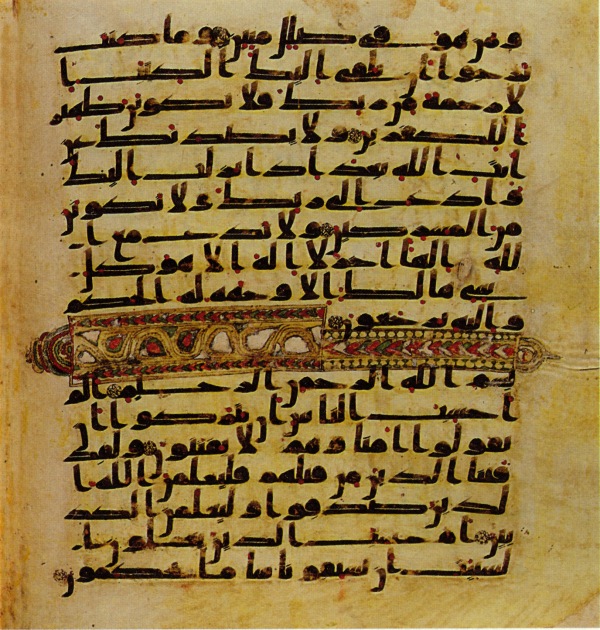
Topkapi H.S.44/32, folio 253b/253v. Photograph reproduced from Tayyar Altıkulaç’s 2007 facsimile. The chapter separation leads into [29:1–3].
The page shown preserves the end of chapter 28 and the opening of chapter 29. Below the separator, the initials are followed by the question of whether a profession of belief will be left untested, then the statement about testing earlier people. Here again, the comparison is anchored to an identified passage. We can see a recognizable chapter transition within a codex that preserves far more of the Quran than an isolated leaf.
| Verse | Modern normalized Arabic | The Final Testament |
|---|---|---|
| [29:1] | الٓمٓ | A. L. M.* |
| [29:2] | أَحَسِبَ ٱلنَّاسُ أَن يُتْرَكُوٓا أَن يَقُولُوٓا ءَامَنَّا وَهُمْ لَا يُفْتَنُونَ | Do the people think that they will be left to say, “We believe,” without being put to the test? |
| [29:3] | وَلَقَدْ فَتَنَّا ٱلَّذِينَ مِن قَبْلِهِمْ فَلَيَعْلَمَنَّ ٱللَّهُ ٱلَّذِينَ صَدَقُوا وَلَيَعْلَمَنَّ ٱلْكَٰذِبِينَ | We have tested those before them, for God must distinguish those who are truthful, and He must expose the liars. |
Large witnesses matter because they allow the examination of sequence and continuity across many chapters. Yet “almost complete” remains the accurate description: IRCICA’s account of the 2007 facsimile discusses missing and damaged material. We therefore do not attach an unverified percentage of completeness or a radiocarbon result borrowed from another manuscript. The conclusion is already clear without either: Topkapi brings extensive early written evidence into the same investigation as the smaller Birmingham and Chester Beatty witnesses.

7. Why shared spellings carry weight
The argument becomes stronger when comparison moves beyond recognizable passages. Marijn van Putten’s study examines the spelling of the expression for God’s favor across fourteen early manuscripts. At particular locations, these witnesses repeatedly share the same choice between alternative written forms. Such recurring positional agreement supports descent from a common written exemplar: it is evidence about copying, not simply people remembering a similar message.
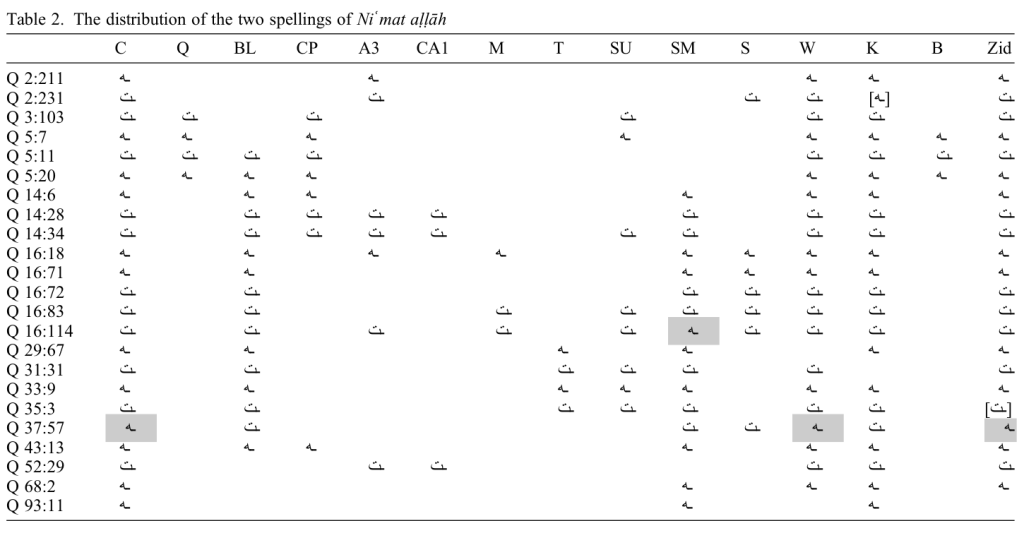
Marijn van Putten, “The Grace of God,” Table 2, p. 278 (2019), CC BY 4.0. “C” represents the Cairo 1924 edition; other columns identify manuscript witnesses. Blank cells are unavailable evidence; shaded cells mark divergences.
The table’s exceptions belong to the evidence. Van Putten does not claim that every cell matches, and his wider discussion distinguishes variable internal alifs from the particular pattern being investigated. His analysis supports an early common written ancestry for the dominant Quranic text type, with standardization near Uthman’s period. That is a more informative result than judging two pages identical because their scripts look alike. It tells us why specific agreements are historically significant.
Hythem Sidky’s separate study of regional codices reconstructs ancestral witnesses associated with Syria, Medina, Basra and Kufa. The small differences help identify relationships among copies and support an early history of distribution. A textual family tree can contain branches while preserving a strongly shared trunk. These findings make the affirmative case more concrete: the surviving agreement has a discernible written history, and the variants help us investigate it. (Source: Sidky, “On the Regionality of Qur’anic Codices,” 2020.)
8. Facing the variants honestly
The Sana’a palimpsest is the clearest reason to avoid saying that every ancient copy agrees in every respect. A palimpsest is a reused writing surface: an earlier text was erased and another written over it. Behnam Sadeghi and Mohsen Goudarzi identify the lower writing of Sana’a 1 as a distinct text type, with differences in wording and chapter order. It cannot responsibly be reduced to a difference resembling modern regional spelling. Their analysis also finds strong fidelity in the standard tradition and places the formation of chapters before standardization. (Source: Sadeghi and Goudarzi, “Sana’a 1 and the Origins of the Qur’an,” 2012.)
The setting in which those leaves were used is debated. Asma Hilali proposes a teaching and transmission context and describes the material as work in progress; her account is an interpretation of the artifact, not permission to announce that every difference has been explained away as a student’s mistake. The upper and lower texts must also be distinguished. A claim about the lower layer cannot automatically be transferred to the writing above it, or to every manuscript discovered in Sana’a. (Source: Hilali, The Sanaa Palimpsest, 2017.)
Spelling, consonantal wording, verse division and recitation are related but distinct subjects. Some variations concern written signs; others affect the reading or wording, and modern recitation differences are not all merely accents. The historical conclusion should therefore be stated at the level the evidence supports: a very early, recognizable and strongly transmitted dominant text, alongside documented variants. That conclusion is substantial. It gives preservation an actual history to examine and leaves the final identification of the authorized revelation to the further evidence God has provided.
9. Code 19: counts we can check
The Quran’s mathematical sign addresses authentication from within the scripture. Chapter 74 identifies nineteen and explains functions assigned to the number, including strengthening faith and removing doubt. We should read that explanation with the number, rather than presenting a detached numeral as the whole argument. The relevant passage says:
[74:30] Over it is nineteen.*
[74:31] We appointed angels to be guardians of Hell, and we assigned their number (19) (1) to disturb the disbelievers, (2) to convince the Christians and Jews (that this is a divine scripture), (3) to strengthen the faith of the faithful, (4) to remove all traces of doubt from the hearts of Christians, Jews, as well as the believers, and (5) to expose those who harbor doubt in their hearts, and the disbelievers; they will say, “What did God mean by this allegory?” God thus sends astray whomever He wills, and guides whomever He wills. None knows the soldiers of your Lord except He. This is a reminder for the people.
[74:35] This is one of the great miracles.*
Ya-Sin: 285, with the counting rule stated
Chapter 36 gives us a concrete example. Appendix 1, printed page 381, reports 237 Y’s and 48 S’s: 285, or 19 × 15. Our direct recount of the Arabic Final Testament text reproduces that result when it includes the unnumbered opening invocation before verse 1. Here “Y” counts the written forms ي، ى، ئ; “S” counts س. This groups ya, the dotless ya-shaped form and the ya-shaped seat bearing hamza; it is an explicit written-shape convention. Vowel marks and the doubling sign do not add written letters. This states our reproducible method; it does not attribute our digital counting procedure to the appendix.
Including the opening: 237 + 48 = 285 = 19 × 15
Numbered verses 1–83 alone: 236 + 47 = 283
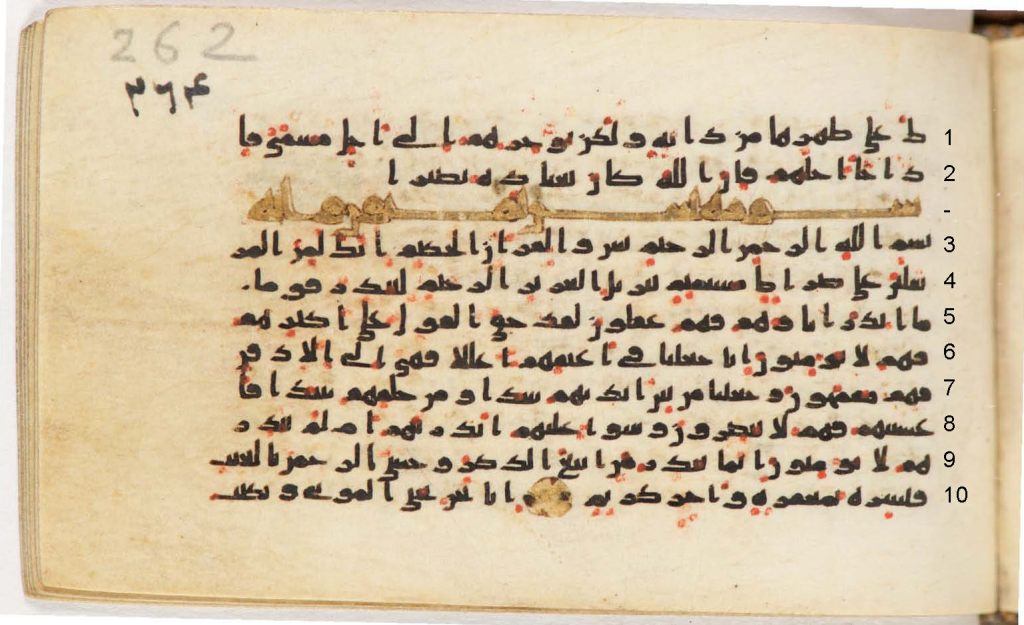
Arabe 399, Elktb viewer image 520, page bearing the pencilled number 262. The opening invocation and initials appear on line 3 below the divider. Line numbers are annotations supplied with the source image. This page locates the opening; the whole-chapter totals below come from the transcriptions.
The initials in the current Arabic text are يسٓ; the canonical English at [36:1] is “Y. S.*”
The opening visible in the photograph is present in the manuscript, even though the local worksheet stores only numbered verses. In our current edition, the opening contributes one Y and one S. Its inclusion therefore matters. Two totals of 285 can arise from different spellings and different boundaries. To compare a manuscript with this edition, we must state both what text we counted and which written forms we grouped together.
What the manuscript transcriptions record
Our manuscript workbook contains 17 historical witness labels. Six have all 83 numbered verse records without asterisk gap markers. Counting their recorded Arabic under the same character rule, excluding the opening, gives the following results. These are counts of transcriptions; the manuscript photographs remain the evidence against which individual entries must be checked. The linked comparison at 36:12 and Arabe 399 manuscript viewer provide a concrete route back to the source.
| Witness label in the workbook | Y forms | S | Total |
|---|---|---|---|
| Arabe 399 | 238 | 47 | 285 |
| Cairo Husayni | 237 | 47 | 284 |
| Rampur | 238 | 47 | 285 |
| Topkapi 50385 | 227 | 47 | 274 |
| Topkapi 50386 Karatay | 237 | 47 | 284 |
| Tübingen Ma VI 148 | 238 | 47 | 285 |
The differences are traceable. At [36:12], the phrase rendered “revive the dead” contains نحيي in the Arabe 399 transcription, compared with نحى in our current text, shown without vowel marks. At [36:78], “resurrect the bones” similarly has يحيي compared with يحى. Each difference adds one written Y form in the transcription. These two differences explain 285 versus 283 over the same numbered verses.
In Topkapi 50385, ten instances of علا for علي (word gloss: “upon”) and one حتا for حتي (“until,” at [36:39]) account for its eleven-count reduction. Cairo Husayni has the latter difference alone, giving 284. Topkapi 50386 records لتنذر at [36:70], the reading difference illustrated below. These observations prevent a claim that every manuscript gives 285 under one unchanged rule. Incomplete witnesses cannot establish a whole-chapter total.
Two reading variants that change the count
The separate Code 19 workbook reports 285, 285, 283 and 283 for Hafs, Douri, Qaloon and Warsh. These are stored totals in Yasin Count, cells E27:H27, rather than formulas that independently recount every verse. The labels name reading editions, not four ancient codices. Its notes identify two substitutions: يَعْقِلُونَ / تَعْقِلُونَ at 36:68 and لِيُنذِرَ / لِتُنذِرَ at 36:70. Each replacement of ya by ta removes one counted Y while leaving S unchanged. The grammatical shifts are from “they” to “you” in the first case and from “he/it” to “you” in the second; these are explanatory glosses.
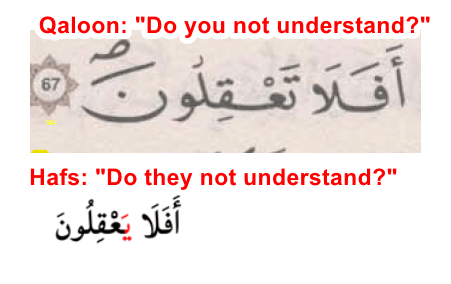
Original annotated image embedded at row 23 of Code 19.xlsx → Yasin Count. These are reading-edition excerpts, not ancient manuscript photographs. The red English text is the compiler’s explanatory gloss; the source edition labels this verse 67.
[36:68] Whomever we permit to live for a long time, we revert him to weakness. Do they not understand?
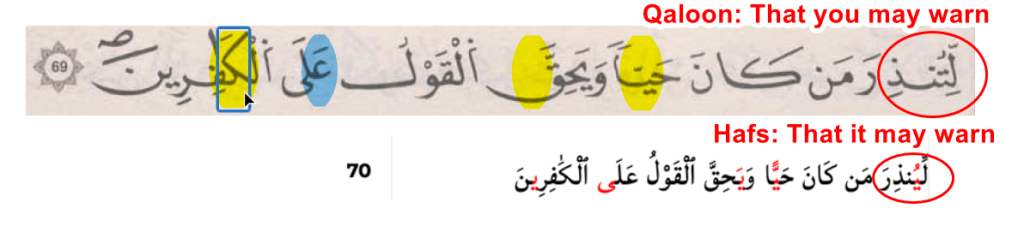
Original annotated image embedded at row 24 of the same worksheet. The circled opening words display the second ta/ya difference. The source edition labels this verse 69. Existing highlights and English glosses are retained from the workbook.
[36:70] To preach to those who are alive, and to expose the disbelievers.
These are recognized reading variants. The nQuran reading register for [36:70] explicitly lists Qaloon and Warsh with the second-person reading. We accept the messenger-confirmed text and assess alternatives against its evidence. Calling the illustrated ta/ya differences scanning mistakes would obscure the question the mathematical criterion is supposed to help resolve.
How the Hamming analogy helps
Richard Hamming’s original paper, pp. 150–151, explains how overlapping checks can identify the position of a single transmission error. This offers a useful analogy: preservation can include the means to recognize and correct a faulty copy. It does not require every transmitted copy to be flawless.
A strict check for exactly 285 detects any change in that total. A weaker check for divisibility by 19 would miss changes of 19, 38, and other multiples of 19. Both checks miss changes that leave the total unchanged. Our own workbook records an instructive example at [36:78]: an OCR program, which converts pictures into text, missed one ya and wrongly counted another mark as ya. The two mistakes cancelled in its total. Checking the image exposed what the sum alone missed.
The capabilities must therefore be demonstrated. A Y-plus-S total alone cannot locate an error or detect changes that preserve that sum, such as reordering letters. A mismatch identifies a departure under a specified rule; it does not uniquely identify the original reading. The Quran’s full mathematical structure and the Messenger’s confirmation form our affirmative case. The manuscript comparison makes that case stronger when we show its actual readings, explain each counting choice, and keep the observed evidence visible.
A second example: NuN
Appendix 1 develops this sign through the Quran’s literary composition and its chapter-and-verse structure. A simple example also makes the counting discipline clear: the opening of [68:1] is written نُونْ, the name of the letter spelled with nun, waw, nun. There are three letters in that name, including two nuns. Confusing “three letters” with “three nuns” changes the explanation and must be corrected.
[68:1] NuN,* the pen, and what they (the people) write.

Appendix 1, “NuN,” p. 380. The spelled-out initial contributes two nuns; the middle letter is waw.
In the Arabic edition of The Final Testament at UnitedSubmittersInternational.com, counting the written character ن throughout chapter 68 gives 133 when the unnumbered opening invocation before verse 1 is included. Its numbered verses contain 132, and that opening contributes one more. This counts written nuns, including the two in the initial, without treating vowel marks or a doubling sign as extra written letters. Stating those choices makes the observation reproducible.
132 + 1 = 133 = 19 × 7
A count has a defined scope: this one responds to a change in the number of written nuns. It cannot, by itself, detect every possible alteration involving other letters, nor justify multiplying probabilities as though every proposed pattern were independent. The mathematical case is assessed through its full structure and specified conventions. This example shows why accurate spelling, honest arithmetic and the complete evidence matter to the sign we accept as God’s authentication.

10. Why the two rejected additions do not defeat preservation
The clearest objection deserves a direct answer. We accept God’s promise to preserve the Quran, while rejecting the two statements conventionally numbered [9:128] and [9:129]. Appendix 24 explains that rejection through the mathematical code and the Messenger of the Covenant’s purification of the text. We cannot simultaneously claim that every physical copy in circulation has always contained only the authorized revelation. Preservation protects the divine message and provides the means to distinguish it from what people attach to it.
The manuscript photographs in this article are not offered as evidence that those two statements were absent from every early codex. None of the three comparative photographs shows an intact end of chapter 9. Nor could missing leaves establish what the missing text originally contained. Our identification of these statements as additions rests on the evidence set out in Appendix 24, which should be examined openly, with its own reasoning and evidence clearly identified.
Rashad addressed this distinction directly in The Great Debate. He explained that people can alter ink and paper, while the preserved Quran remains identifiable; recognizing and correcting the intrusion is an expression of the protection. The passage is especially useful because he answers the preservation objection itself, rather than discussing the subject only in general terms (at 31:33). His July 1987 article, Perfect Preservation of Qur’an, gives the same explanation through examples of incorrectly printed copies.
[22:52] We did not send before you any messenger, nor a prophet, without having the devil interfere in his wishes. God then nullifies what the devil has done. God perfects His revelations. God is Omniscient, Most Wise.*
This verse places attempted interference and God’s nullification of it within the same account. It does not identify a particular manuscript or date a historical insertion, but it explains why protection need not mean that human interference is physically impossible. God’s revelation remains the standard by which the interference is exposed. The conclusion is that the authentic text has been preserved and authenticated, even where a received physical presentation required purification.
11. The Messenger’s confirmation is decisive
Historical evidence establishes transmission; God’s confirming messenger identifies the authorized message with the evidence God gives him. We accept Rashad Khalifa as God’s Messenger of the Covenant on the Quranic and mathematical evidence presented in Appendix 2. His confirmation is therefore decisive for us, including where inherited custom insists that every printed addition must be retained. The source of that authority is God, and the mission is described in the Quran itself:
[3:81] God took a covenant from the prophets, saying, “I will give you the scripture and wisdom. Afterwards, a messenger will come to confirm all existing scriptures. You shall believe in him and support him.” He said, “Do you agree with this, and pledge to fulfill this covenant?” They said, “We agree.” He said, “You have thus borne witness, and I bear witness along with you.”
Chapter 33 names Muhammad among the prophets from whom the covenant was taken and identifies him as the final prophet. Read together, these passages explain the distinction between delivering scripture and subsequently confirming what has been delivered. The Messenger of the Covenant does not introduce a new scripture to replace the Quran. He confirms and purifies God’s message, so that people can return to worshiping God alone with confidence in the revelation before them.
[33:7] Recall that we took from the prophets their covenant, including you (O Muhammad), Noah, Abraham, Moses, and Jesus the son of Mary. We took from them a solemn pledge.*
[33:40] Muhammad was not the father of any man among you. He was a messenger of God and the final prophet. God is fully aware of all things.
Confirmation also comes with a demand for proof. Appendix 2 makes that requirement explicit, and Rashad states in his sermon on messengership that a messenger must be supported by signs (at 14:52). Earlier in the same recording, he says that anyone’s information must conform to the Quran (at 7:49). These requirements belong together: neither a title nor a personal assertion exempts a claim from the evidence.
This is the proper sense in which the messenger’s confirmation overrides an inherited religious convention. It establishes which message we are authorized to follow; it does not change the ink visible on a folio or erase a documented variant from history. The Quran itself says in [10:15] that its messenger cannot change it on his own. An authenticated messenger directs us back to God’s revelation, and his decisive confirmation completes the case without turning an unanswered historical question into an invented historical fact.
The verse texts, footnotes and Appendix 2 are available at UnitedSubmittersInternational.com. Verse quotations in this article use the exact text of The Final Testament; asterisks indicate its footnotes.
12. A clearer case, and a responsibility to follow it
This article builds on our earlier manuscript study and NuN study, while refining several claims. Birmingham’s result is a confidence range for parchment, Topkapi is almost complete and should not be presented as an authenticated personal copy of Uthman, and the Sana’a lower text has substantive variants. Claims of universal identity in every letter went beyond those sources. Correcting them strengthens the affirmative case by making the evidence and the conclusion correspond.
The NuN discussion also needs a clear correction: نون contains two nuns and one waw. Chester Beatty Ar.3051 is a later treatise on readings, so spelling a letter’s name there does not by itself establish the original written form of [68:1]. A list of earlier authorities reported in such a work is also not a collection of surviving early Quran codices. The arithmetic and the character of each source must be stated accurately before either is used to support the broader argument.
The answer to the video is now concrete. We have named surviving objects, shown their pages, located recognizable passages, and explained why systematic agreements point to an early common written history. We have allowed the differences to tell us about copying and readings, instead of declaring them nonexistent. Alongside that public record stands God’s promise, His mathematical authentication and the confirming messenger whom He sent. The historical evidence supports continuity; the divine evidence gives us the authority to identify and follow the preserved revelation.
God’s preservation is a reason to read carefully and respond faithfully. We do not honor His book by exaggerating the age of parchment, miscounting a letter, or making a photograph say more than it shows. We honor it by verifying what is before us and accepting the truth that the evidence establishes. The Quran has been preserved, its message remains available, and the responsibility to follow it belongs to us.


 Quran Only Studies
Leave a comment