Introduction: Turn the Headline into a Test
A number is only as sound as its counting rule
The claim is short: the proper name Allah, meaning God, occurs 2,698 times in the authentic Quran, and 2,698 equals 19 × 142. The audit behind that sentence is not short, because Arabic case endings, attached prepositions, attached conjunctions, unnumbered chapter-openers, and the textual boundary of chapter 9 all have to be handled consistently. A reader should never be asked to accept a result merely because a finished spreadsheet contains 2,698 rows. The rule must be declared first, the source list must be open to inspection, and a competing count must be able to falsify the result.
This article therefore does one focused job. It defines the counted object as the proper-name lemma Allah in the numbered verse text of the Final Testament, reconciles that text against an independent public morphology corpus, and shows every surface-form subtotal that produces the result. It does not treat an English search for the word “God” as an Arabic audit, and it does not inflate a single divisibility result into an unsupported probability claim. The conclusion is deliberately compact: under a stated, linguistically reproducible scope, the result is 2,698, exactly 19 × 142.
[74:30] “Over it is nineteen.*”
[74:35] “This is one of the great miracles.*”
The Quran itself places nineteen before the reader, so nineteen is not a modulus selected only after the count was seen. Even so, naming the target number does not excuse vague counting; it makes methodological discipline more important. A valid audit should be simple enough for a skeptic to repeat and strict enough to fail if even one retained token is wrongly classified. That is the standard applied below.
Part 1: Define Exactly What Is Being Counted
Root, lemma, surface form, and token are not interchangeable
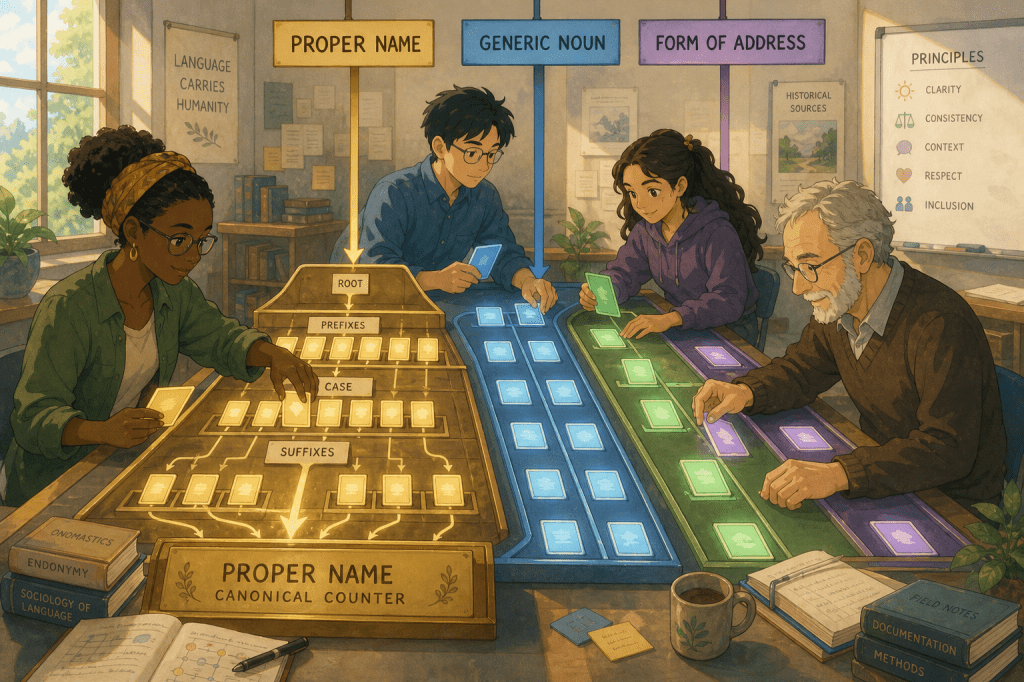
The Arabic root a–l–h is a family, not a single word. The independent Quranic Arabic Corpus root concordance divides that family into three grammatical groups: 147 occurrences of the generic noun ilah (“deity” or “god”), 2,699 occurrences of the proper name Allah, and five occurrences of the form of address Allahumma (“O God”). Those categories are morphological facts supplied before any Code 19 calculation. Adding all three together would answer a different question and would not be a count of the proper-name lemma.
A lemma is the dictionary headword that gathers inflected and prefixed forms into one lexical identity. A surface form is the spelling that actually appears in a verse, such as the name in nominative, accusative, or genitive case, sometimes with “and,” “by,” “for,” or an oath particle attached. A token is one occurrence at one exact chapter, verse, and word position. The audit counts every token whose lemma is the proper name, whatever its valid case or attached particle, while excluding the generic noun and the separately classified form of address.
This distinction prevents two opposite errors. A raw text search can undercount because the prefixed spelling لِلَّهِ does not look identical to the unprefixed spelling ٱللَّهُ; a root search can overcount because it sweeps the generic noun and the vocative into the same basket. Lemma-level counting is the middle path: broad enough to include every grammatical realization of the proper name, narrow enough to exclude different lexemes. The rule is linguistic before it is numerical.
Part 2: The Public Corpus Gives 2,699
Begin with the conventional list, not the desired answer
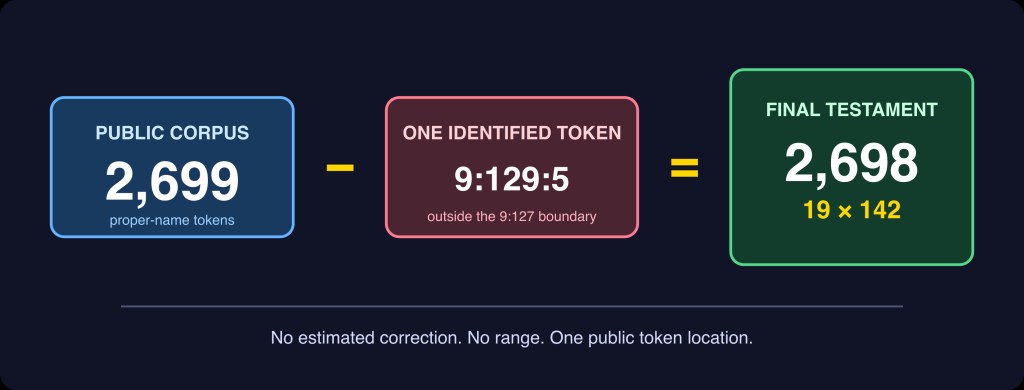
The public morphology corpus lists 2,699 tokens under the proper-name lemma. Its sequence begins at word 2 of verse 1:1, continues through every case and attached particle in the conventional text, and ends at verse 112:2. The count is independently visible on the corpus dictionary page; it is not inferred from the target total of 2,698. Starting here matters, because an honest reconciliation shows the surplus token rather than quietly filtering it away.
The same corpus lists the five Allahumma tokens separately at 3:26:2, 5:114:5, 8:32:3, 10:10:4, and 39:46:2. They are not removed because they are inconvenient; they were never inside the corpus’s 2,699 proper-name count. Likewise, the 147 generic-noun forms are never candidates for this audit. Anyone who wishes to count the whole root family may do so, but that result must be labelled as a root-family count rather than silently substituted for a proper-name count.
The 112 unnumbered opening formulas that precede chapters other than chapters 1 and 9 are also outside this lexical count of numbered verse text. In the Final Testament data they are represented as chapter-zero display rows, while verse 1:1 is numbered and the full formula inside 27:30 is ordinary verse text; both 1:1 and 27:30 are included in the proper-name count. This scope is not equivalent to “every visible instance on every printed page,” and it should never be advertised that way. It is the classical numbered-text count described in Appendix 1, where the cumulative proper-name total is reported as 2,698.
Part 3: One Token Separates 2,699 from 2,698
The reconciliation is a location, not a hidden adjustment
There is exactly one proper-name token in the public 2,699-entry concordance beyond the Final Testament’s chapter 9 boundary: 9:129:5. The corpus identifies it as a nominative proper noun, l-lahu. The Final Testament ends that chapter at verse 127, so that token is not present in its authentic numbered text. Remove that one precisely identified entry and no other proper-name token, and the count becomes 2,698.
[9:127] “Whenever a sura was revealed, some of them would look at each other as if to say: “Does anyone see you?” Then they left. Thus, God has diverted their hearts, for they are people who do not comprehend.”
This article does not repeat the historical and textual case concerning the traditional 9:128–129 ending. That evidence is treated separately in The Two Verses That Don’t Belong. Here the methodological point is narrower and fully exposed: a reader using the conventional corpus will obtain 2,699; a reader using the Final Testament boundary will omit the lone proper-name token at 9:129:5 and obtain 2,698. The textual premise is disputable in public, but the arithmetic consequence is not concealed.
Rashad Khalifa stated the same reconciliation in direct numerical terms during The Great Debate (at 1:10:20): “The word Allah, there is one extra in these two verses.” He then gave the two totals plainly: 2,698 without the disputed ending and 2,699 with it. In his recorded presentation of the opening formula, he also gave the positive count (at 8:45): “The second word Allah is mentioned in the whole book 2,698 times, or 19 times 142.” Both statements are now independently testable against the public token list.
Part 4: The Fifteen Written Forms Sum to 2,698
Every retained token belongs to an inspectable subtotal
After the 9:129:5 token is removed, the retained concordance contains fifteen fully vocalized surface forms. The three largest rows are simply the unprefixed proper name in genitive, nominative, and accusative case; the remaining rows carry ordinary conjunctions, prepositions, interrogatives, or oath particles. None creates a new lemma. Their counts below sum without remainder to 2,698.
| # | Surface form | Morphological reading | Tokens |
|---|---|---|---|
| 1 | ٱللَّهِ | unprefixed, genitive | 828 |
| 2 | ٱللَّهُ | unprefixed, nominative | 732 |
| 3 | ٱللَّهَ | unprefixed, accusative | 592 |
| 4 | وَٱللَّهُ | and + nominative | 239 |
| 5 | بِٱللَّهِ | by/in + genitive | 139 |
| 6 | لِلَّهِ | to/for + genitive | 102 |
| 7 | وَلِلَّهِ | and + to/for + genitive | 27 |
| 8 | لِّلَّهِ | to/for + genitive, orthographic form | 14 |
| 9 | تَٱللَّهِ | oath particle + genitive | 8 |
| 10 | فَٱللَّهُ | then/so + nominative | 6 |
| 11 | فَلِلَّهِ | then/so + to/for + genitive | 6 |
| 12 | ءَآللَّهُ | interrogative + nominative | 2 |
| 13 | وَٱللَّهِ | and + genitive | 1 |
| 14 | أَبِٱللَّهِ | interrogative + by/in + genitive | 1 |
| 15 | وَتَٱللَّهِ | and + oath particle + genitive | 1 |
| Total retained proper-name tokens | 2,698 | ||
The table also exposes a small but useful quality-control lesson. In the scraped source list, the Arabic at 22:40:29 is correctly nominative, but its transliteration is mistakenly written as the accusative l-laha. The independent morphology record for 22:40:29 identifies it correctly as nominative l-lahu. The typo does not change the lemma, location, Arabic form, or total, but catching it demonstrates why a rebuild should derive and cross-check instead of copying a table blindly.
Part 5: Independent Checks That Can Make the Claim Fail
Agreement must occur at more than the final cell
A second audit read the canonical Final Testament data independently and kept only numbered rows, excluding all 112 chapter-zero opening rows. It applied Unicode NFKD normalization, stripped combining marks, unified the relevant alif variants, and matched exact whitespace-delimited tokens against the permitted proper-name spellings; it did not use a loose substring search. The fifteen vocalized surface forms reduce to eleven exact base-and-clitic spellings after normalization, and that independent route again produced 2,698 tokens. More importantly, its complete per-verse frequency counter matched the scraped concordance exactly: 1,820 distinct numbered verses across 85 chapters contain the retained tokens.
A verse containing the name twice was counted twice in the token total, and once in the descriptive distinct-verse total. This agreement is stronger than merely typing 2,698 into a finished spreadsheet, because two different extraction paths have to place the same number of tokens in every verse. It also protects against a misleading success in which one missed token and one false positive cancel each other at the grand total. The audit agrees on the whole distribution, not only on the last line.
The word-position column is not used as a hidden source of authority. Tokenizers can number words differently when pause marks, attached particles, or display-only opening formulas are handled differently, while still agreeing on the Arabic token and its verse. The public morphology corpus is therefore the authority for its own word-position links; the independent text is a check on verse-level content and multiplicity. If the two sources disagreed on which verse contains how many proper-name tokens, the audit would fail and the factorization would not rescue it.
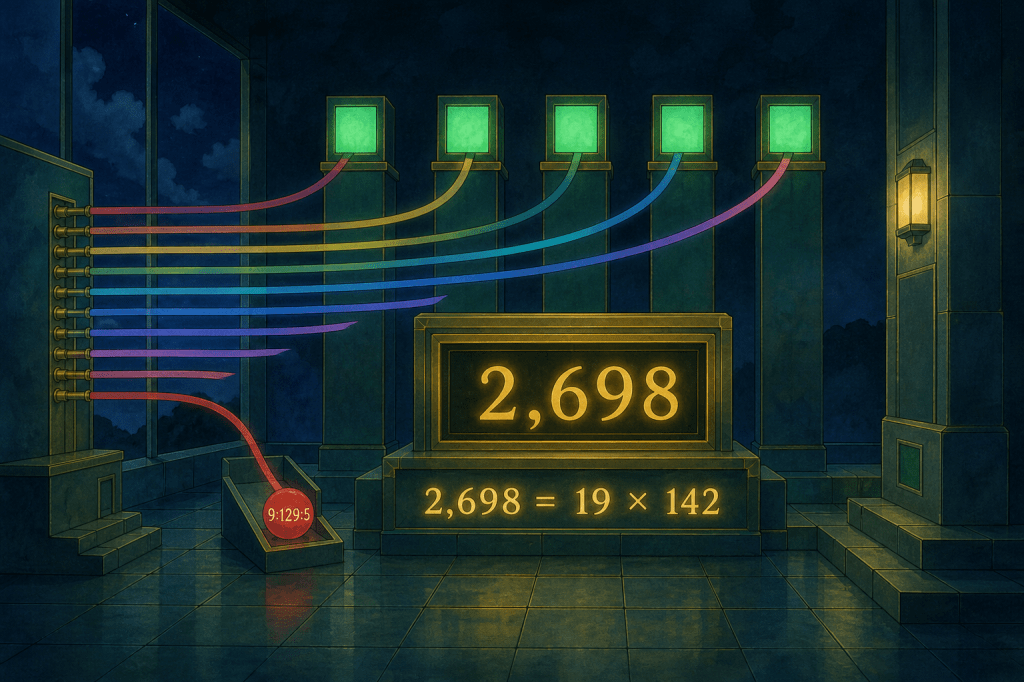
Five explicit falsification gates now exist. The public lemma list must contain 2,699 proper-name tokens; exactly one of them must be 9:129:5 beyond the Final Testament boundary; the fifteen retained surface-form subtotals must sum to 2,698; an independent canonical text must match the retained verse-level multiplicities; and 2,698 must divide evenly by 19. Any failed gate invalidates this presentation. The fact that every gate passes is the result.
Part 6: The Strongest Skeptical Objection
One multiple of nineteen is not an astronomical probability
A fair critic can say that, among whole numbers with reasonably distributed remainders, roughly one in nineteen is divisible by nineteen. That is the correct baseline for a single predeclared divisibility check, not “one in millions” and not an automatic proof of divine authorship. It would be statistically careless to select many words, many grammatical scopes, and many arithmetic transformations after inspecting the data, report only the successful one, and then multiply convenient one-in-nineteen fractions as though every choice were independent. This article makes no such probability claim.
The stronger logical objection is circularity. If an investigator begins by adopting a canon that already ends at 9:127, then 2,698 functions as an internal-consistency checksum for that canon; this count alone is not independent proof that the boundary must be 9:127. The statistic also says nothing directly about 9:128, because that disputed verse contains no proper-name token; the one-token difference comes from 9:129:5. The historical evidence and the broader set of independent textual and mathematical checks must carry the larger conclusion about 9:128–129.
The proper response is not to exaggerate the number but to protect the audit from flexibility. The target number nineteen is declared by the Quran; the grammatical categories come from an independent morphology project; the disputed token is public and has an exact address; the Final Testament boundary is stated rather than smuggled in; and the retained surface forms are all disclosed. These facts do not turn 2,698 into a standalone statistical demonstration. They turn it into a clean, falsifiable datum that can be evaluated as one part of the Quran’s larger mathematical structure.
The broader opening-formula argument, including the other constituent-word counts and their verse distribution, is already developed in The 1919 Signature. The spiritual distinction between believing a claim and knowing a physical fact is treated in Belief Is Not Enough. Keeping those arguments separate prevents this focused audit from pretending to establish more than it has actually counted. Precision strengthens the case; overstatement weakens it.
Part 7: A Reproduction Protocol Anyone Can Challenge
Six steps, all declared before the final division
The audit can be repeated without trusting this article’s arithmetic. It requires a public concordance, the declared Final Testament boundary, and ordinary addition. A programmer may automate the same steps, but code is not what makes the result valid; transparent classification does. The protocol is:
- Select the lemma, not the root string. Open the public a–l–h root concordance and select only its proper-name Allah category.
- Record the conventional total. Confirm that the category contains 2,699 tokens.
- Keep every grammatical realization. Retain nominative, accusative, genitive, and all valid attached-particle forms belonging to that lemma.
- Do not import neighboring categories. Exclude the 147 generic-noun tokens and five separately classified forms of address.
- Apply the stated text boundary. Since the Final Testament ends chapter 9 at 9:127, remove the lone proper-name token at 9:129:5; do not add the 112 unnumbered chapter-opening display rows to this numbered-text count.
- Re-total and test. Confirm that the fifteen retained surface-form subtotals equal 2,698 and that 2,698 ÷ 19 = 142 with no remainder.
A different investigator may reject the Final Testament’s chapter 9 boundary. If so, that investigator should report 2,699 for the conventional text, not accuse the arithmetic of hiding the difference. Another investigator may choose to count the whole root family or every printed opening formula. Those are legitimate alternative questions, but they must carry different labels and will produce different totals. Reproducibility does not mean every scope gives 2,698; it means the declared scope always does.
Steps one through six have now been implemented so that a reader need not perform them by hand. The live counter applies exactly the scope declared above — every case and attached-particle form of the proper name, the generic noun and the form of address excluded, the 112 unnumbered chapter openers excluded, 1:1 and 27:30 retained — and recomputes the total in the browser each time the page is opened. It stores no answer. Its independently produced subtotals reproduce all fifteen surface-form rows of Part 4 without adjustment, and the token at 9:129:5 is absent from its corpus for the reason given in Part 3, not by subtraction. Code still does not make the result valid; transparent classification does. What the tool removes is the reader’s need to take the addition on trust.

Part 8: Why the Quran Directs Attention to Nineteen
The text names both the number and its human effect
The relevance of nineteen does not begin with the word-frequency result. Chapter 74 names the number, then explains that it will disturb disbelievers, strengthen the faithful, remove doubt, and expose the response of diseased hearts. That sequence matters. The number is presented as a test as well as evidence, which is why opposite readers can look at the same disclosed arithmetic and react differently.
[74:30] “Over it is nineteen.*”
[74:31] “We appointed angels to be guardians of Hell, and we assigned their number (19) (1) to disturb the disbelievers, (2) to convince the Christians and Jews (that this is a divine scripture), (3) to strengthen the faith of the faithful, (4) to remove all traces of doubt from the hearts of Christians, Jews, as well as the believers, and (5) to expose those who harbor doubt in their hearts, and the disbelievers; they will say, “What did God mean by this allegory?” God thus sends astray whomever He wills, and guides whomever He wills. None knows the soldiers of your Lord except He. This is a reminder for the people.”
[74:32] “Absolutely, (I swear) by the moon.”
[74:33] “And the night as it passes.”
[74:34] “And the morning as it shines.”
[74:35] “This is one of the great miracles.*”
[74:36] “A warning to the human race.”
[74:37] “For those among you who wish to advance, or regress.”
An audit serves this passage better than rhetoric does. The reader can see the public corpus total, inspect the exact surplus token, verify the grammatical exclusions, add the fifteen rows, and decide whether the result strengthens faith or provokes another objection. No private revelation and no inaccessible calculation stands between the claim and the test. The evidence is placed on the table, including its scope and its limit.
Part 9: Preservation Means Detectable Boundaries
The count does not merely decorate the text
The difference between 2,698 and 2,699 is one word at one disputed location. That sensitivity is precisely why a count can function as an audit trail: a textual addition need not be large to become detectable. The Final Testament’s preservation claim is not that every later printed copy would be free from every human intervention; it is that the reminder itself would remain recoverable and guarded. A reproducible mathematical boundary is meaningful only when the underlying textual premise is stated openly.
[15:9] “Absolutely, we have revealed the reminder, and, absolutely, we will preserve it.*”
[41:42] “No falsehood could enter it, in the past or in the future;* a revelation from a Most Wise, Praiseworthy.”
This is also why the 22:40:29 transliteration typo deserves mention. A human data table can contain an error without changing the underlying Quranic token; independent morphology exposes and corrects it. Preservation should not be confused with pretending that every derivative dataset is perfect. The stronger position is that errors are discoverable because the source text, grammatical category, and public location can be checked against one another.
Conclusion: The Result, Without Inflation
One clean count, fully exposed
The audit begins at 2,699, not at the desired answer. It keeps every case and attached-particle form of the proper name, excludes the generic noun and the separately classified form of address, applies the Final Testament’s end of chapter 9, and removes exactly one publicly identified token at 9:129:5. The fifteen retained surface forms then total 2,698. The arithmetic closes exactly: 2,698 = 19 × 142.
That result should be neither minimized nor exaggerated. By itself, divisibility by nineteen is a one-in-nineteen property under a simple remainder model; it is not an honest licence for astronomical probability claims. What makes this count valuable is its disciplined scope, independent morphological source, exact textual difference, complete subtotal disclosure, and capacity to fail. It is not a number to chant. It is a count to audit.
The Quran challenges humanity to examine its claim rather than inherit it passively. Here the examination can be done token by token, location by location, and rule by rule. The name at the heart of the scripture appears 2,698 times in its authentic numbered text, and the final division leaves no remainder. The reader is free to advance or regress, but the ledger is open.
Verify the count yourself
Do not take this article’s arithmetic on trust. The complete count runs live, in your own browser, against the Quran text itself:
quranonlystudies.app → Initial Counts → Allah 2698
No total is stored on that page. Every figure — the 2,698, each of the surface-form subtotals, and the per-chapter table — is recomputed from the verse text on each load, so altering the text would alter the number. The counting rules of Part 1 are listed on screen for audit, each chapter expands to its verses, and every occurrence is highlighted inside the Arabic. If the count is wrong, the page is where it will fail.
![Final audit ledger joining fifteen token streams into 2,698 = 19 × 142 beneath [74:30].](https://quranonlystudies.com/wp-content/uploads/2026/08/allah_count_2698_05_final_ledger-1.png?w=819)


Leave a Reply